Monohydrate Is Still King in 2026: Why It Beats HCL Despite the Marketing
By The Creatine Canada Research Team — Evidence-based supplement analysts
Yes — creatine monohydrate is still the best form of creatine in 2026 for most people because it has the strongest human evidence, the best safety record, and the lowest cost per effective dose. Creatine HCL is more soluble and sometimes easier on the stomach, but current evidence does not show it beats monohydrate for strength, power, or lean-mass results.
Evidence-based · Cites 4 sources · Editorial standards
Key Takeaways
- Creatine monohydrate remains the best form for most lifters, athletes, and beginners in 2026.
- The standard evidence-based dose is 3-5 g daily, with an optional loading phase of about 20 g/day split into 4 doses for 5-7 days.
- Creatine HCL is marketed as needing a smaller dose and causing less bloating, but high-quality evidence does not show better performance outcomes than monohydrate.
- Monohydrate is still the most studied creatine by a very wide margin and the cheapest effective creatine for long-term daily use.
- If monohydrate upsets your stomach, trying smaller doses, taking it with food, or using micronized monohydrate usually makes more sense before paying more for HCL.
- In Canada, look for a Health Canada Natural Product Number (NPN) and preferably third-party testing when buying creatine.
The direct answer: monohydrate is still best, and HCL still has not dethroned it
Creatine monohydrate is still the best form of creatine in 2026 for most people. That answer is straightforward because the main question is not which form sounds more advanced, but which form has the best proof of real-world results at a sensible price. On that standard, monohydrate still wins.
Monohydrate is better than HCL for most buyers because it has by far the largest body of human research, reliably raises muscle creatine stores, improves high-intensity performance, and usually costs much less per effective dose. The 2017 ISSN position stand concluded that creatine monohydrate is the most effective ergogenic nutritional supplement currently available for increasing high-intensity exercise capacity and lean body mass during training. That is still the anchor point for evidence-based practice in 2026. See the original position stand here: Kreider et al. (2017), ISSN Position Stand.
Creatine HCL is not useless; it is simply under-evidenced relative to its marketing. HCL, short for creatine hydrochloride, is creatine bound to hydrochloride to improve water solubility. That makes it mix more easily and helps marketers position it as a premium, low-dose, no-bloat alternative. The problem is that better solubility does not automatically mean better muscle saturation or better training outcomes.
If your goal is strength, power, sprint performance, training volume, or gradual lean-mass gain, monohydrate remains the default first choice. If your goal is convenience, a smaller scoop, or trying a form that may feel gentler on your stomach, HCL can be reasonable as a niche option. That is why the most honest answer to "is monohydrate better than HCL?" is yes for results-per-dollar, yes for evidence, and usually yes overall.
That conclusion also fits the market. Market-research estimates put the global creatine supplement market near USD $1.85 billion in 2026, and roughly 71.9% creatine sales growth in the performance category in 2025 was driven overwhelmingly by monohydrate, not by boutique forms. In other words, despite heavy marketing for "advanced" creatines, the market still behaves the way the science would predict.
If you want help choosing a product rather than a form, start with our best creatine rankings, browse the creatine product catalog, or compare form-specific guidance in Creatine Monohydrate vs. HCL: Which Form Is Actually Better?.
Why monohydrate is best: it saturates muscle predictably and powers repeat efforts
Creatine monohydrate works so well because it increases muscle phosphocreatine stores, and phosphocreatine helps rapidly regenerate ATP, the cell's immediate energy currency, during short, hard efforts. That mechanism is simple, well established, and exactly why creatine consistently helps in lifting, sprinting, jumping, repeated intervals, and other high-intensity work.
Here is the practical version. Your muscles store a limited amount of phosphocreatine, which is a high-energy compound used to quickly remake adenosine triphosphate, or ATP. ATP is what muscle fibres spend when they contract forcefully. During a heavy set of squats, a 10-second sprint, or repeated explosive efforts, ATP gets used fast. More intramuscular creatine means a bigger reserve for regenerating ATP between contractions, so output drops off more slowly.
Monohydrate is best not because it is flashy, but because it reliably creates the exact muscle saturation effect that drives performance benefits. Once muscle creatine stores are elevated, many users notice they can squeeze out an extra rep, hold bar speed a little better across sets, or recover slightly faster between repeated bursts. Those small improvements compound over weeks of training into more total work, and more total quality work is one reason creatine supports lean-mass gains over time.
The 2021 JISSN review on common questions and misconceptions about creatine reaffirmed that creatine monohydrate remains the reference form because it is the most studied and the evidence for alternative forms being superior is lacking. Read it here: Antonio et al. (2021), Common questions and misconceptions about creatine.
Better water solubility is not the same thing as better performance. HCL does dissolve more easily in water, but the key performance question is whether it increases muscle creatine stores better than monohydrate or produces better outcomes in strength, power, or lean mass. At this point, there is little high-quality evidence showing that it does.
Monohydrate may also pull some extra water into muscle cells as stores rise. That intracellular water shift is one reason muscles can feel fuller early on, and it is not the same thing as gaining body fat. If you are new to the topic, our guides on what creatine is, whether creatine builds muscle, and how creatine gives you energy go deeper on the underlying physiology.
Monohydrate vs HCL in 2026: what the evidence actually supports
In 2026, the evidence supports monohydrate as the best-studied and most reliable form, while HCL remains a plausible but under-proven alternative. That is the central scientific answer to searches like "monohydrate vs HCL 2026" and "is monohydrate better than HCL".
The strongest evidence in creatine research is attached to monohydrate, not HCL. Monohydrate has been examined across strength training, repeated sprint work, body composition, recovery, older adults, some clinical contexts, and long-term safety questions. HCL, by contrast, is discussed far more often in marketing copy than in large, durable bodies of human outcome research.
This matters because supplement decisions should be made on outcomes, not just ingredient chemistry. A form can be more soluble, more acidic, or easier to flavour and still fail to produce better results in the gym. Right now, there is little high-quality evidence that creatine HCL outperforms monohydrate for strength, power, or lean-mass outcomes.
The International Olympic Committee consensus on dietary supplements notes creatine as one of the few supplements with strong evidence for specific performance uses, but that practical consensus has always been built largely on monohydrate data rather than premium variants. See the IOC consensus here: International Olympic Committee consensus on dietary supplements (2018).
What about claims that HCL needs a much smaller dose? That claim is common, but evidence-based dosing still centres on delivering enough creatine to saturate muscle stores over time. Monohydrate does this very well at 3-5 g/day, or faster with a loading phase of about 20 g/day split into four doses for 5-7 days. If an alternative form is sold at a lower dose, the burden of proof is on that form to show equal saturation and equal outcomes. That proof remains limited.
What about bloating? Many people use the word bloating to describe any early scale increase. In reality, monohydrate commonly increases intracellular water in muscle, especially during loading, and that is part of how saturation looks in the first week or two. Some people do get stomach upset from large single doses, but that is often a dosing problem rather than a monohydrate problem.
If you want a broader evidence summary, Examine.com’s creatine evidence summary is useful for seeing where evidence is strong and where it is thinner.
How to take creatine monohydrate properly: the simple step-by-step that works
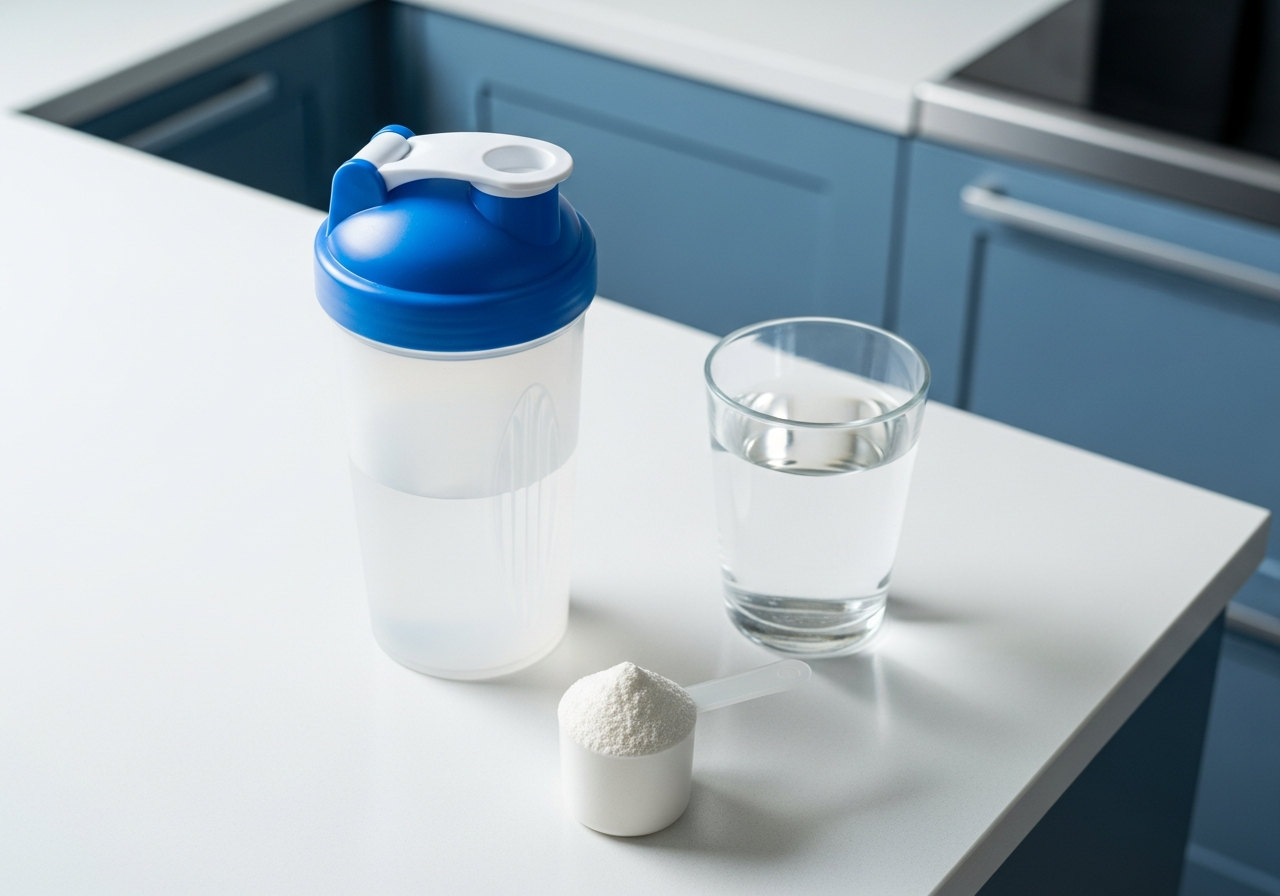
The best way to take creatine monohydrate is to use 3-5 g every day, keep the dose consistent, and optionally load if you want faster saturation. Most people do not need a complicated protocol.
- Pick plain creatine monohydrate. An unflavoured powder is usually the cheapest effective creatine and the easiest to dose accurately. If you want smoother mixing, micronized monohydrate is a fine convenience upgrade.
- Decide whether to load. If you want faster results, take about 20 g/day split into four 5 g doses for 5-7 days. If you do not care about speed, skip loading and take 3-5 g/day from day one.
- Take it daily, including rest days. Creatine works by keeping muscle stores saturated, not by acting like a stimulant. Consistency matters more than workout timing.
- Mix it in water or a meal-sized drink. Shake it well, stir, or mix it into a protein shake. If grit bothers you, use warm water or let it sit briefly after stirring.
- Take it with food if your stomach is sensitive. Splitting the dose into smaller servings often helps more than switching forms immediately.
- Stay patient and track performance. Look for better repeat reps, slightly higher training volume, better sprint repeatability, or a modest early increase in body mass from water stored in muscle.
If you do a loading phase, you will usually notice bodyweight and training effects sooner; if you use a maintenance dose only, expect a slower ramp. For a deeper timeline, see how long creatine takes to work and for practical mixing advice visit how to take creatine.
Here is a simple week-by-week expectation guide:
- Week 1 with loading: muscle stores rise quickly; some people notice fuller muscles, a small bodyweight increase, and easier repeated efforts.
- Weeks 2-3 with 3-5 g/day only: gradual saturation; subtle training improvements become easier to notice.
- Weeks 3-6: more obvious benefits in training quality, especially if you are lifting or doing repeated sprint-style work.
- Beyond 6 weeks: the benefit shows up mainly as more productive training over time, not as a dramatic day-to-day feeling.
If you want a precise intake based on your situation, use our creatine dosage calculator or read how much creatine per day.
Exact creatine doses by body weight and goal, including loading, maintenance, and cutting
For most adults, 3-5 g/day of creatine monohydrate is the right maintenance dose, while larger or more muscular people often sit more comfortably at the upper end of that range. The goal is not to chase a magical scoop size; it is to keep muscle creatine stores saturated.
The standard loading option is about 20 g/day split into four 5 g doses for 5-7 days, followed by 3-5 g/day. Loading is optional, not required. It speeds saturation but does not create a special long-term advantage over simply taking a maintenance dose consistently.
| Body weight / goal | Simple monohydrate dose | Practical note |
|---|---|---|
| Under 60 kg | 3 g/day | Usually enough for maintenance if taken consistently |
| 60-90 kg | 3-5 g/day | The standard range for most lifters and active adults |
| Over 90 kg | 5 g/day | Often the most practical default for larger athletes |
| Want faster saturation | ~20 g/day for 5-7 days, split into 4 doses, then 3-5 g/day | Useful before a training block or competition period |
| Cutting / fat loss phase | 3-5 g/day | Keep it in; performance retention matters when calories are lower |
| Rest days | Same 3-5 g/day | Do not skip just because you are not training |
Creatine monohydrate is still the best form during a bulk, cut, strength phase, or general fitness plan because the mechanism does not change with the season. What changes is how you interpret the scale. During a cut, early water retention in muscle can mask small scale drops, but that does not mean fat loss has stopped. For more on that, see creatine during a cut and does creatine make you gain weight.
If monohydrate causes stomach upset, the first troubleshooting step is to reduce single-dose size, not to assume you need HCL. Try 2-3 g taken twice daily, or take your full daily amount with a meal. Many users who think they "need" HCL simply do better when they stop dry scooping, stop taking oversized doses, and stop slamming 10 g at once.
For more personalised guidance, our maintenance dose guide and loading phase guide walk through the most common use cases.
When to take creatine: timing matters less than saturation, consistency, and adherence
The best time to take creatine monohydrate is the time you will remember to take it every day. Creatine is not a stimulant and does not need to be taken immediately pre-workout to work.
Muscle saturation matters far more than exact timing. Once your muscles are saturated with creatine, the body draws on that larger phosphocreatine pool whenever you train. That is why daily adherence beats micro-optimising the clock. If after lunch is easiest, do that. If adding it to your post-workout protein shake is easiest, do that instead.
There are a few practical timing approaches that work well:
- With breakfast: great for routine and low risk of forgetting.
- Post-workout in a shake: convenient if you already use protein after training.
- Split doses during loading: useful for reducing stomach discomfort when taking about 20 g/day for 5-7 days.
- With meals: often easiest on the stomach.
If you train in the evening, taking creatine at night is fine. There is no good evidence that normal creatine dosing harms sleep in healthy users. Likewise, taking it on rest days is still important because rest days help maintain saturation rather than letting stores drift.
You also do not need to cycle creatine. Cycling is a bodybuilding-era habit, not an evidence-based requirement. Long-term daily use of monohydrate at standard doses has the strongest safety data of any creatine form. The question is not whether to cycle, but whether you are taking enough often enough to stay saturated.
If you miss one day, do not panic and do not double up dramatically the next day. Just resume your normal dose. Muscle creatine levels do not vanish overnight. If you want a full timing breakdown, visit when to take creatine, creatine on rest days, and do you need to cycle creatine.
The big takeaway is simple: the best creatine schedule is the one you can follow for months. For most people, that means one plain daily serving of monohydrate and very little drama.
Who creatine monohydrate is best for: beginners, women, older adults, and competitive athletes
Creatine monohydrate is the best starting form for nearly every population that uses creatine, including beginners, women, older adults, vegetarians, and many competitive athletes. The reason is not that every group responds identically, but that monohydrate has the broadest evidence base across different ages, goals, and training styles.
Beginners should usually start with monohydrate because it is simple, proven, and inexpensive. A new lifter does not need a premium form to benefit from better phosphocreatine availability. Beginners often notice improved repeat reps and a modest increase in bodyweight from water stored in muscle within the first few weeks.
Women can use the same evidence-based monohydrate doses as men because creatine is dosed for muscle saturation, not for marketing categories. The common fear that creatine will make women "bulky" is a myth. What it is more likely to do is support strength, training quality, and lean-mass retention. See creatine for women for specifics.
Older adults may benefit from monohydrate when it is paired with resistance training because preserving strength and lean tissue matters more with age, not less. Monohydrate is the form most often used in research relevant to healthy ageing. If that is your main interest, read creatine for older adults.
Vegetarians and vegans often respond especially well because baseline dietary creatine intake is usually lower. Since creatine is naturally found in animal foods, plant-based athletes may see a more noticeable response to supplementation. For that audience, monohydrate is still the best-supported choice. More on that here: creatine for vegetarians and is creatine vegan.
Competitive athletes should default to monohydrate because it is the form with the best sport-performance evidence and the easiest case to justify to coaches, dietitians, and medical staff. In Canada, athletes should also pay close attention to product quality, lot transparency, and third-party testing to reduce contamination risk.
The main people who should speak with a clinician first are those with relevant medical conditions, those under active kidney evaluation, or anyone told to restrict supplements. For that nuance, see who should not take creatine and is creatine safe.
Safety, bloating, kidneys, and buying in Canada: what matters and what is mostly myth
Creatine monohydrate is widely considered safe for healthy people at standard doses, and most side effects blamed on creatine are either dose-related, misunderstood, or exaggerated. The biggest practical issues are usually stomach upset from too much at once and confusion about water weight.
Monohydrate does not have credible evidence showing it damages healthy kidneys when used at recommended doses, but it can raise creatinine on lab work because creatinine is a breakdown product related to creatine metabolism. That lab distinction matters. A clinician who knows you use creatine can interpret results more accurately. If kidney concerns are your sticking point, read the creatinine confusion explained.
Bloating is real for some users, but it is often either temporary or mislabelled. Water retained inside muscle is not the same as puffy subcutaneous water or digestive distension. Loading phases make early water shifts more likely, which is one reason some people prefer straight to 3-5 g/day. If you do get GI discomfort, the best fixes are usually:
- reduce your single dose size
- take it with food
- split the dose across the day
- use micronized monohydrate
- avoid dry scooping
If those steps fail, HCL can be a reasonable convenience experiment, but that still does not make it superior for results. It simply means your personal tolerance may be better with a different format.
For Canadian buyers, look for a Natural Product Number, or NPN, on the label. An NPN means the supplement has been authorised for sale by Health Canada as a natural health product. It is not a guarantee of athletic purity, but it is an important legitimacy signal. Also look for clear ingredient lists, dose transparency, and ideally third-party testing or a strong brand quality reputation. Our creatine brand reviews and best creatine rankings can help narrow options.
The best buying move in Canada is usually plain monohydrate from a reputable brand, not an expensive proprietary blend. Fancy claims about absorption, pH buffering, no loading, or zero water retention are often attempts to justify a higher price rather than proof of better outcomes. For more myth-busting, visit creatine myths debunked.
Why the market still chooses monohydrate in 2026: better value beats better marketing
Monohydrate is still winning in 2026 because the market eventually rewards evidence, trust, and value more than fancy chemistry claims. That is the real answer behind searches like "cheapest effective creatine," "creatine HCL worth it," and "creatine HCL vs monohydrate cost."
Market-research estimates put the overall creatine supplement market near USD $1.85 billion in 2026. At the same time, editor-verified market data indicates roughly 71.9% creatine sales growth in the performance category in 2025, with growth overwhelmingly led by monohydrate rather than premium derivatives. The market has grown fast, but monohydrate has kept its throne because consumers, coaches, and formulators keep coming back to what works.
HCL is a niche-but-steady premium play. It survives not because it has convincingly beaten monohydrate in head-to-head outcome evidence, but because it sells convenience: smaller scoops, easy mixing, premium branding, and a "no bloat" story that appeals to first-time buyers. For some people, those features are worth paying for. For most people, they are not necessary.
Cost per effective dose is where monohydrate usually crushes HCL. If one product gives you a standard evidence-based dose cheaply for months and another charges a premium for a less proven mechanism story, the cheaper proven option is usually the smarter buy. That is why monohydrate remains the best-value form in practical sports nutrition, not just in lab theory.
| Question | Monohydrate | HCL |
|---|---|---|
| Human evidence depth | Very strong | Limited compared with monohydrate |
| Standard effective dosing | 3-5 g/day; optional ~20 g/day loading for 5-7 days | Varies by product marketing; superiority not established |
| Mixability | Good; better if micronized | Typically very good |
| Price per effective use | Usually lowest | Usually higher |
| Best reason to buy | Evidence, results, value | Convenience, tolerance, smaller scoop |
In short, monohydrate dominates because it is the most studied creatine, the most trusted creatine, and still the cheapest effective creatine. That combination is hard for any premium niche form to dislodge.
The biggest mistakes people make with creatine, and the myths HCL marketing keeps alive
The biggest creatine mistakes are inconsistent dosing, taking too much at once, confusing water in muscle with fat gain, and assuming a premium form must work better. Most bad creatine experiences come from those mistakes, not from monohydrate itself.
- Mistake 1: Taking it only on workout days. Creatine works through saturation, so skipping rest days makes less sense than many users realise.
- Mistake 2: Expecting a stimulant feeling. Creatine is not pre-workout. If you are waiting to "feel" it like caffeine, you may miss the real signs that it is working: better repeat performance, more reps, and better training quality over time.
- Mistake 3: Using a loading dose as a forever dose. About 20 g/day is for a short loading phase, not permanent maintenance.
- Mistake 4: Blaming monohydrate for poor mixing. A gritty drink is mostly a texture issue, not a sign that it is ineffective.
- Mistake 5: Buying the story instead of the evidence. New forms often sell innovation first and proof second.
Now for the common myths.
Myth: HCL is better absorbed, so it must build more muscle. Better solubility does not automatically mean better muscle creatine saturation or better hypertrophy outcomes. That leap is exactly where the evidence is weak.
Myth: Monohydrate causes harmful bloating, HCL does not. Monohydrate can increase intracellular water, especially during loading, but that is not inherently harmful and is often part of normal saturation.
Myth: You need an expensive designer creatine in 2026 because old monohydrate is outdated. The opposite is closer to the truth. Monohydrate remains the benchmark precisely because decades of research have not been replaced by better human outcome data from trendier forms.
Myth: If creatine upsets your stomach once, monohydrate is not for you. In many cases, smaller servings, taking it with food, or switching to micronized monohydrate solves the problem.
For a deeper breakdown, explore creatine myths vs. facts, creatine digestive side effects, and does creatine cause bloating.
The practical lesson is this: get the basics right before spending more money on a form that has not earned better evidence.
Bottom line: the best form of creatine is still plain monohydrate for almost everyone
If you want the short final verdict, creatine monohydrate is still the best form of creatine in 2026. It remains the best answer to "why monohydrate is best," "is monohydrate better than HCL," and "what is the cheapest effective creatine" because it continues to win on the three things that matter most: evidence, reliability, and value.
Use monohydrate first unless you have a specific reason not to. Take 3-5 g/day consistently. If you want faster saturation, use an optional loading phase of about 20 g/day split into four 5 g servings for 5-7 days, then return to 3-5 g/day. Expect the biggest real-world benefit to appear as slightly better training capacity and, over time, better strength and lean-mass outcomes.
HCL is worth considering only if convenience, mixability, or personal stomach tolerance matters enough to justify a premium price. That can be a valid reason to buy it, but it is not the same as evidence that it produces superior results.
For most buyers, the smartest path looks like this:
- Choose a reputable plain creatine monohydrate product.
- Check for sensible Canadian labelling, including an NPN where applicable.
- Take 3-5 g every day.
- Judge it by performance trends over weeks, not by one workout.
- Only consider HCL if monohydrate remains inconvenient after proper troubleshooting.
That is why monohydrate is still king in 2026: not because the marketing war ended, but because the evidence never really moved. If you want help picking the right product next, visit our best creatine rankings, compare options in the product catalog, or use the dosage calculator to set your plan today.
Creatine Monohydrate vs HCL in 2026: The Numbers That Matter
- 3-5 g/day Standard monohydrate maintenance dose — Evidence-based daily range for most adults
- ~20 g/day Optional loading dose — Split into 4 doses for 5-7 days to saturate faster
- USD $1.85B Estimated 2026 creatine market size — Market-research estimate, not a clinical figure
- 71.9% Estimated 2025 performance-category creatine sales growth — Growth was overwhelmingly led by monohydrate
Frequently Asked Questions
Is creatine monohydrate still the best in 2026?
Yes, creatine monohydrate is still the best form for most people in 2026 because it has the strongest human research, the best-established safety profile, and the lowest cost per effective dose. HCL may be easier to mix and may suit some sensitive stomachs, but evidence still does not show it beats monohydrate for strength, power, or lean-mass outcomes.
Is monohydrate better than HCL?
Yes, monohydrate is better than HCL for most users because it is far better studied and usually much cheaper while delivering the same core goal of raising muscle creatine stores. HCL mainly competes on convenience and mixability, not on clearly superior results.
Why is creatine monohydrate considered the most studied creatine?
Creatine monohydrate is considered the most studied creatine because the vast majority of meaningful human creatine research has used monohydrate rather than newer premium forms. That matters because dosing, safety, and performance recommendations are strongest when they come from repeated human outcome data, not from theory or marketing claims.
Is creatine HCL worth it?
Creatine HCL can be worth it if you personally value a smaller scoop, easier mixing, or better stomach tolerance enough to pay more. It is usually not worth it if your main goal is maximum evidence-based results per dollar, because monohydrate remains the cheaper and better-proven option.
Does creatine HCL cause less bloating than monohydrate?
Creatine HCL may feel better for some people, but there is not strong evidence that it universally causes less bloating than monohydrate. Many complaints blamed on monohydrate are actually from loading too aggressively, taking too much at once, or confusing normal water retention in muscle with digestive bloating.
What is the cheapest effective creatine?
Plain creatine monohydrate powder is usually the cheapest effective creatine by a wide margin. It gives you the standard evidence-based dose of 3-5 g/day at the lowest typical cost, which is why it still dominates among value-focused buyers and experienced coaches.
How much creatine monohydrate should I take per day?
Most adults should take 3-5 g of creatine monohydrate per day. If you want to saturate faster, you can use an optional loading phase of about 20 g/day split into four 5 g doses for 5-7 days, then return to 3-5 g/day.
Do I need to load creatine monohydrate?
No, you do not need to load creatine monohydrate to benefit from it. Loading simply helps you saturate muscle stores faster, while a standard 3-5 g/day approach gets you to the same place more gradually with less chance of stomach discomfort.
When should I take creatine monohydrate?
You should take creatine monohydrate whenever you are most likely to take it consistently every day. Timing is far less important than daily adherence because creatine works by maintaining muscle saturation over time rather than giving an immediate stimulant effect.
How do I choose creatine in Canada?
In Canada, choose a plain creatine monohydrate product from a reputable brand and look for a Natural Product Number, or NPN, on the label when applicable. It is also smart to favour brands with transparent dosing, minimal extra ingredients, and preferably third-party testing.