Creatine Maintenance Dose: The Right Daily Amount to Stay Saturated
By The Creatine Canada Research Team — Evidence-based supplement analysts
The right creatine maintenance dose for most adults is 3 to 5 grams per day after your muscles are saturated. If you completed a loading phase, that daily amount keeps muscle creatine stores elevated; if you skipped loading, the same dose still works, but saturation takes a few weeks longer.
Evidence-based · Cites 4 sources · Editorial standards
Key Takeaways
- For most people, a creatine maintenance dose of 3-5 g/day is enough to stay saturated.
- After loading at 20 g/day for 5-7 days, drop to 3-5 g/day to maintain elevated muscle stores.
- If you skip loading, take 3-5 g/day consistently for about 3-4 weeks to reach full saturation.
- Larger athletes and people with more lean mass often do better at the upper end of the maintenance range.
- Timing matters far less than daily consistency; take creatine every day, including rest days.
- Creatine monohydrate is the most studied, most reliable, and usually the best-value form.
- Mild water-weight gain and occasional stomach upset are the most common early side effects, and both are usually manageable.
What is the right creatine maintenance dose after loading?
The right creatine maintenance dose for most adults is 3 to 5 grams per day, and that is the standard answer to both “how much creatine to maintain?” and “what is the daily creatine dose after loading?”. The purpose of the maintenance phase is simple: once your muscles are saturated with creatine, a small daily dose replaces what your body naturally breaks down to creatinine and excretes each day.
The most practical rule is this: take 3 g/day if you are smaller, lighter, or mainly using creatine for general fitness, and take 5 g/day if you are larger, more muscular, or training hard most days of the week. This aligns with mainstream sports-nutrition guidance and with the broad dosing framework summarized by the 2017 ISSN position stand, which concluded that creatine monohydrate is effective and well supported by research.
If you did a loading phase, the typical protocol is 20 grams per day split into 4 doses for 5 to 7 days, followed by the maintenance phase at 3 to 5 grams per day. If you did not load, you can still use the same maintenance dose from day one; it simply takes longer to fully saturate muscle stores.
For most readers, the simplest answer is also the best one:
- Under roughly 70 kg: 3 g/day is often enough
- About 70-90 kg: 3-5 g/day works well
- Over 90 kg or very lean/muscular: 5 g/day is usually the safer bet
That does not mean more is better. Once muscle creatine stores are topped up, taking much more than you need is unlikely to improve results and is more likely to cause digestive discomfort. If you want a more tailored estimate, use our creatine dosage calculator or read the full guide on how much creatine per day.
The short version is this: the creatine maintenance phase is just daily consistency at 3 to 5 grams, not a complicated cycling strategy. For nearly everyone, that is enough to stay saturated and keep the performance and training benefits coming.
Why a small daily dose works once your muscles are saturated
A creatine maintenance dose works because your muscles can only store a limited amount of creatine, and once that pool is filled, you only need to replace normal daily losses. Creatine is stored in muscle mostly as phosphocreatine, a high-energy compound that helps rapidly regenerate ATP, the cell’s immediate energy currency, during short, intense efforts like lifting, sprinting, jumping, and repeated hard intervals.
When you supplement with creatine, muscle creatine and phosphocreatine stores rise toward saturation. That matters because higher phosphocreatine availability can improve the speed of ATP resynthesis between hard efforts, which helps you maintain force output, perform extra reps, and recover a bit better between sets. Over time, that small training edge can add up to larger improvements in strength and lean mass than training alone.
Once saturated, however, your muscles do not keep storing creatine indefinitely. A portion is continuously converted into creatinine, a breakdown product that is excreted in urine. The maintenance dose exists to replace that ongoing loss. That is why 3 to 5 grams per day is usually sufficient after loading: you are no longer trying to fill the tank, only keep it topped up.
The 2021 JISSN review on common questions and misconceptions about creatine reinforces a key point: creatine’s benefits are driven by saturation over time, not by an acute stimulant-like hit from a single scoop. In other words, creatine is not a pre-workout rush; it is a tissue-saturation supplement.
That also explains why missing one dose is not a disaster. Muscle creatine levels do not crash overnight. But repeated missed doses over days and weeks can gradually lower stores and blunt the effect.
If you are new to the topic, think of creatine maintenance like this:
- Loading fills the reservoir quickly
- Maintenance keeps the reservoir full
- Stopping completely lets stores slowly drift back toward baseline over time
That is the entire logic behind the creatine dose after loading. It is not arbitrary; it matches how muscle creatine turnover actually works in the body.
How to do the creatine maintenance phase step by step
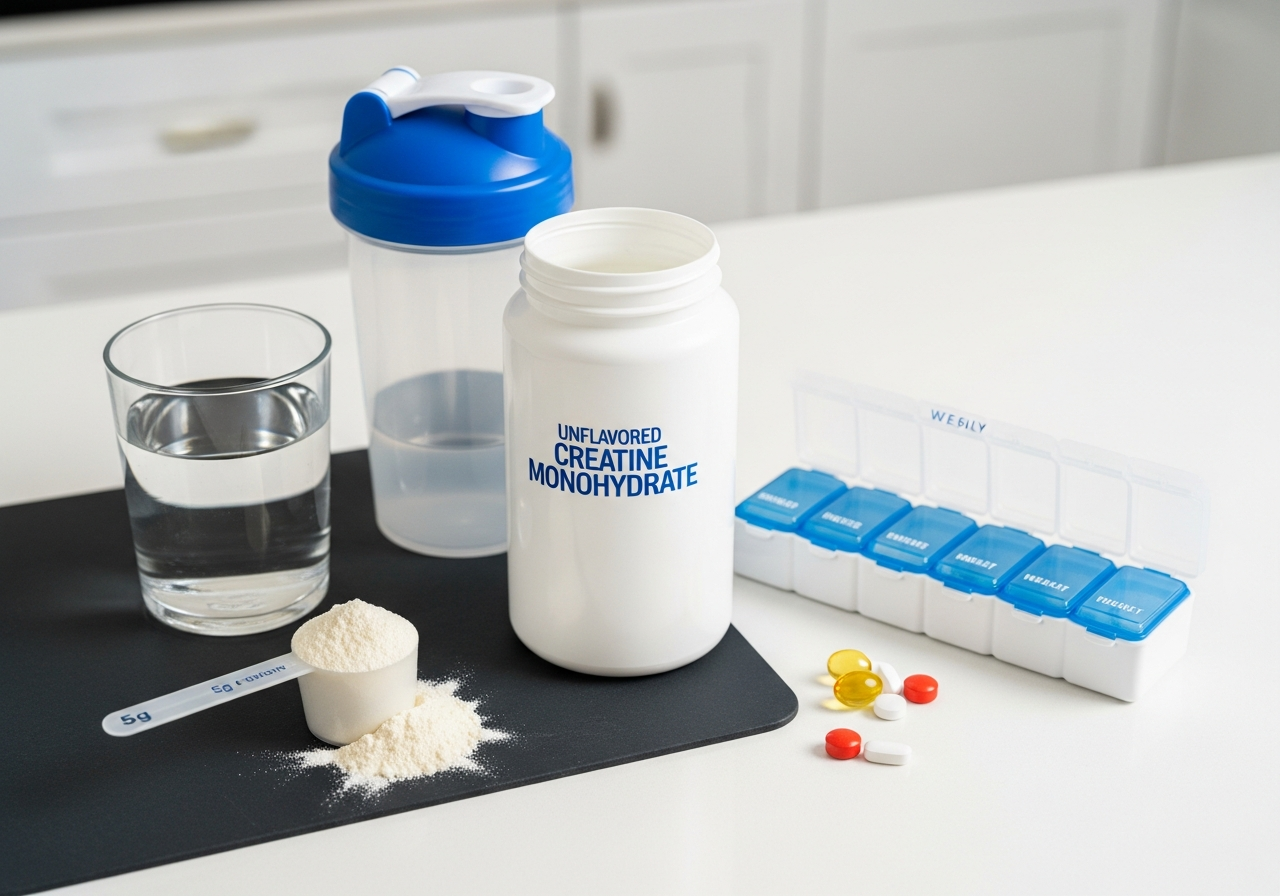
The creatine maintenance phase is straightforward: take 3 to 5 grams every day, keep doing it on training and rest days, and do not overthink the timing. The hardest part for most beginners is not the science; it is remembering to be consistent for long enough.
- Choose creatine monohydrate. Creatine monohydrate is the most studied, most cost-effective, and most evidence-backed form. If you are comparing options, start with our best creatine rankings or browse the creatine product catalog.
- Decide whether you loaded. If you finished a loading phase, move directly to 3-5 g/day. If you skipped loading, begin with 3-5 g/day anyway and stay patient while saturation builds over 3-4 weeks.
- Pick your daily amount. Use 3 g/day if you are smaller or cautious about stomach comfort; use 5 g/day if you are bigger, training hard, or want a simple one-scoop routine.
- Take it every day. Daily consistency matters more than exact timing. Pair it with a habit you already do, such as breakfast, a post-workout shake, or brushing your teeth at night.
- Mix it properly. Stir it into water, a protein shake, or another non-acidic drink you already tolerate well. For mixing help, see how to mix creatine.
- Stay normally hydrated. You do not need to force excessive water intake, but regular fluid intake is sensible, especially if you train hard or sweat heavily. Our guide on how much water should you drink with creatine covers the practical details.
- Assess after 4 to 8 weeks. Look for better repeat performance, slightly better gym volume, or gradual strength progress rather than expecting a dramatic immediate feeling.
A few practical notes make the maintenance phase easier:
- If 5 g at once upsets your stomach, split it into 2.5 g twice daily.
- If you forget a dose, just take the next scheduled dose; do not “double up” aggressively.
- If you travel, pre-portion a few daily servings into a small container or sealed bag.
The best maintenance protocol is the one you will actually follow for months. A plain, unflavoured monohydrate powder taken once per day is usually the simplest and cheapest long-term solution.
How much creatine to maintain by body weight, lean mass, and training goal
The best creatine maintenance dose depends mainly on body size, lean mass, and how much high-intensity training you do, but 3 to 5 grams per day covers most people well. Bigger athletes generally have more muscle mass and often benefit from the upper end of the range because they have a larger storage pool to maintain.
Use this table as a practical starting point, not a rigid medical prescription:
| Body size / goal | Typical maintenance dose | Best use case |
|---|---|---|
| Smaller adult, general fitness, lighter body mass | 3 g/day | Beginner, casual lifter, smaller-framed woman or man |
| Average adult doing regular resistance training | 4-5 g/day | Most gym-goers seeking strength and muscle support |
| Larger or more muscular athlete | 5 g/day | Bodybuilding, powerlifting, team-sport training, repeated sprints |
| Vegetarian or vegan athlete | 3-5 g/day | Useful after saturation, as baseline stores may start lower |
| Older adult using creatine with resistance training | 3-5 g/day | Muscle function, training quality, and healthy ageing support |
Examples help:
- 60 kg beginner woman lifting 3 times weekly: 3 g/day is a sensible maintenance dose.
- 78 kg recreational lifter: 5 g/day is simple, standard, and well supported.
- 98 kg rugby player or powerlifter: 5 g/day is a practical floor after loading.
Goal also matters. If your priority is maximal support for strength, power, sprint performance, or muscle gain, 5 g/day is usually the easiest default. If your priority is a minimal effective dose with excellent tolerance and lower cost, 3 g/day can be enough once saturated.
Body-weight formulas are sometimes used in research, especially during loading, but for everyday maintenance they are often more precise than necessary. For real-world use, a flat 3 to 5 gram daily creatine dose is accurate enough for most healthy adults.
If you want more nuance by sex, age, or training style, see our guides on creatine for women, creatine for older adults, and creatine for competitive athletes. The key point remains the same: maintenance is not one-size-fits-all, but it is usually close enough to one-range-fits-most.
Creatine dose after loading vs. starting straight at maintenance
You do not need to load creatine to make it work, but if you want results faster, loading gets you there sooner and maintenance keeps you there. The classic loading protocol is 20 grams per day for 5 to 7 days, usually split into four 5-gram doses, followed by a creatine maintenance dose of 3 to 5 grams per day.
If you skip loading and simply take 3 to 5 grams daily from the start, you can still achieve muscle saturation; it just typically takes about 3 to 4 weeks instead of roughly one week. That is why the answer to “daily creatine dose after loading” differs from “daily creatine dose from day one” only in the timeline, not in the eventual maintenance routine.
Loading makes sense if:
- You want to saturate quickly before a training block, meet, tournament, or season
- You like seeing effects sooner
- You tolerate split doses well
Skipping loading makes sense if:
- You are prone to stomach upset
- You do not mind a slower ramp-up
- You prefer a simpler routine
Neither method is inherently more “correct”. The Examine creatine evidence summary and mainstream sports-nutrition guidance agree on the practical takeaway: loading changes how fast you saturate, not whether you can saturate.
A common beginner mistake is to finish loading and then stop completely, as if the loading phase itself were the entire strategy. That wastes the point of saturating in the first place. Once loaded, you still need the maintenance phase to hold those elevated stores.
Another mistake is to keep loading for too long. More is not better once saturation is reached. Prolonged high doses can raise the odds of bloating or digestive discomfort without giving extra performance benefit.
If you are deciding between approaches, the simplest answer is this:
- Need speed? Load, then maintain
- Prefer simplicity? Start with maintenance and wait a few weeks
For a full breakdown, see creatine loading phase and how long creatine takes to work.
When to take your daily creatine dose, including rest days
The best time to take your daily creatine dose is the time you will consistently remember, because timing has far less impact than daily adherence. Creatine works by gradually saturating muscle tissue, so a dose taken at breakfast, after training, or before bed can all be effective if you repeat it daily.
For many people, the easiest options are:
- Post-workout: easy to pair with a shake or meal
- With breakfast: simple for rest days and early trainers
- Any fixed daily routine: lunch, dinner, or evening are fine if that improves consistency
The important thing is that you take creatine on rest days too. Your maintenance phase is about keeping muscle stores elevated every day, not only on the days you lift. If you only use creatine on workout days, you make consistency harder and can slowly reduce the stability of your muscle creatine pool over time.
Should you take it with food? For most people, taking creatine with a meal or shake is convenient and often gentler on the stomach, but it is not mandatory. Should you take it before or after workouts? The evidence does not show a decisive practical difference large enough to matter more than consistency for most lifters.
If you use caffeine, coffee, or pre-workout, that usually does not require a different maintenance strategy. You can learn more in when to take creatine, creatine on rest days, and creatine and caffeine.
A good “forget-proof” system looks like this:
- Choose one standard dose: 3 g or 5 g
- Attach it to one anchor habit: breakfast or post-workout shake
- Keep the tub visible
- Use the same routine on weekends and rest days
If you miss a day, do not panic. One missed dose will not undo saturation. Just resume your normal schedule the next day. Creatine rewards long-term consistency, not perfection.
Beginners, women, older adults, and athletes: who should use which maintenance dose?
Most healthy adults can use the same basic creatine maintenance range of 3 to 5 grams per day, but the most practical dose can vary slightly by body size, diet, and training demands. The mechanism is the same across groups: maintain elevated muscle creatine stores so you can support high-intensity performance and, in many cases, training adaptations over time.
Beginners usually do best with simplicity. If you are new to supplements, start with 3 to 5 g/day of creatine monohydrate, taken once daily. A smaller beginner who wants maximal stomach comfort can start at 3 g/day; most average-size beginners can simply use 5 g/day and move on.
Women generally do not need a special “pink” creatine formula or a different fundamental maintenance strategy. Women can use the same 3 to 5 g/day range, adjusted mainly by body size and comfort. Creatine does not cause automatic “bulking”; any early scale increase is usually water pulled into muscle, not fat gain. See creatine for women for the full breakdown.
Older adults often benefit from creatine when it is paired with resistance training, and 3 to 5 g/day is the usual practical range here too. In this group, consistency and pairing with strength training matter more than chasing aggressive doses.
Athletes in sports that rely on repeated high-power efforts, sprint ability, explosive strength, or hard training density often use 5 g/day as a clean default once saturated. Team-sport athletes, powerlifters, bodybuilders, sprinters, and many CrossFit athletes fit this category.
Vegetarians and vegans may respond especially well because dietary creatine intake is lower when meat and fish are absent. That does not mean they need megadoses; it means a normal maintenance dose may feel more impactful once saturation is achieved.
The main exceptions are not based on sex or age alone but on health context. If you have kidney disease, are pregnant or breastfeeding, or have a medical condition requiring diet or fluid restrictions, speak with a qualified clinician before supplementing. For a deeper safety review, visit is creatine safe and who should not take creatine.
Safety, side effects, and what to check on a creatine label in Canada
Creatine monohydrate is generally considered safe for healthy adults at recommended doses, and the best-supported long-term maintenance intake remains 3 to 5 grams per day. The ISSN position stand and the International Olympic Committee consensus on dietary supplements both recognise creatine as one of the most evidence-backed sports supplements available.
The most common side effects are practical, not dramatic:
- Temporary water-weight gain: often noticed early as muscle water content rises
- Stomach upset or loose stools: more likely with large single doses or poor mixing
- Bloating sensation: often improved by using monohydrate properly and avoiding oversized doses
These issues are usually manageable. If you are uncomfortable on 5 g at once, split the dose into 2.5 g twice daily, take it with food, or choose a micronized monohydrate powder. For digestion-specific troubleshooting, see creatine digestive side effects and does creatine cause bloating.
A critical nuance is that creatine can raise serum creatinine, which is a lab marker related to creatine metabolism, without meaning your kidneys are being damaged. This is one reason creatine is often misunderstood on bloodwork. If you are having labs done, it helps to tell your clinician that you use creatine. Our guide on creatine vs creatinine explains the distinction.
In Canada, it is smart to check the label for a few basics:
- Creatine monohydrate as the primary ingredient
- NPN, which stands for Natural Product Number, on products sold as licensed natural health products
- Third-party testing or reputable manufacturing standards where available
- Minimal extras if you want the best value and lowest chance of GI issues
If you are comparing brands, use our creatine brand reviews. In most cases, a plain monohydrate powder with clear dosing and trustworthy quality control is the best long-term maintenance choice.
Common creatine maintenance mistakes and myths that waste results
The biggest creatine maintenance mistakes are taking too much, taking it inconsistently, or believing myths that make people quit too early. The good news is that all three are easy to fix once you understand what creatine actually does.
Mistake 1: treating creatine like a stimulant. Creatine does not need to “kick in” before a workout like caffeine. Its benefits come from muscle saturation, so the daily creatine dose matters more than the exact minute you take it.
Mistake 2: stopping after loading. Loading without maintenance is like filling a battery and then unplugging the charger forever. If you want to keep elevated stores, you need 3 to 5 g/day afterwards.
Mistake 3: thinking more is always better. Once saturated, taking 10 or 15 grams every day is unlikely to improve performance further, but it may increase stomach upset or waste money.
Mistake 4: skipping rest days. Creatine maintenance is a daily strategy. Your muscles do not only need support on training days.
Now the myths:
- “Creatine is a steroid.” False. Creatine is not an anabolic steroid and works through cellular energy support, not hormone mimicry.
- “Creatine harms healthy kidneys.” The evidence does not support this in healthy adults using recommended doses, though people with kidney disease need medical guidance.
- “Creatine causes dehydration or cramps.” This is a persistent myth, but mainstream reviews do not support the idea that recommended creatine use causes dehydration in healthy users.
- “You need to cycle creatine.” False for most users. A standard maintenance phase can be continued long term if tolerated and appropriate.
- “Creatine makes you fat.” False. Early scale weight changes are usually from water in muscle, not fat gain.
If creatine seems not to be working, the usual causes are: underdosing, inconsistent use, not training hard enough to notice the edge, or expecting an acute sensation rather than gradual performance benefits. Some people also respond less noticeably than others, especially if their baseline muscle creatine stores are already relatively high.
For a deeper myth-by-myth breakdown, see creatine myths debunked, do you need to cycle creatine, and creatine non-responders.
Best creatine for the maintenance phase: monohydrate vs other forms
The best creatine for a maintenance phase is still creatine monohydrate, because it has the strongest evidence, the best value, and the simplest dosing. Many alternative forms are marketed as better absorbed or easier on the stomach, but they do not consistently outperform monohydrate in the evidence base.
| Form | Evidence quality | Typical maintenance use | Practical verdict |
|---|---|---|---|
| Creatine monohydrate | Strongest | 3-5 g/day | Best default for nearly everyone |
| Micronized monohydrate | Strong, same active form | 3-5 g/day | Helpful if you want better mixability |
| Creatine HCl | Limited compared with monohydrate | Brand-dependent | May be convenient, but not proven superior |
| Buffered / Kre-Alkalyn / ester forms | Weaker support | Brand-dependent | Usually more marketing than meaningful advantage |
| Gummies / capsules | Depends on form and dose delivered | Must still reach 3-5 g/day | Convenient, but often worse value per gram |
What should you look for when buying in Canada?
- Plain creatine monohydrate if you want the most evidence-backed option
- Clear grams per serving so you can actually hit a maintenance dose
- NPN and reputable manufacturing where applicable
- Third-party testing if purity and quality assurance matter to you
- Reasonable cost per 5-gram serving, since maintenance is a long-term habit
Fancy formats are not automatically bad, but they often make maintenance more expensive or less precise. For example, gummies can require multiple pieces to reach a full 5-gram dose, and capsules can mean swallowing several capsules daily.
If you want curated options, see best creatine rankings, creatine brand reviews, and the related guide on best creatine monohydrate in Canada. If you want the short answer: buy a trustworthy monohydrate powder, measure 3 to 5 grams, and repeat daily.
Bottom line: the simplest maintenance dose that works
The bottom line is simple: the right creatine maintenance dose for most people is 3 to 5 grams per day, taken every day to keep muscle creatine stores elevated. If you loaded first, that dose maintains saturation. If you skipped loading, the same dose still works, but you will usually need a few weeks of consistency before the full effect is reached.
If you want the most practical recommendation possible, use this:
- 3 g/day if you are smaller-bodied, cautious about GI comfort, or just want the minimum effective maintenance approach
- 5 g/day if you are average to large, train hard, or want the simplest one-scoop default
Take it on training days and rest days. Mix it with water, a shake, or a meal you already have. Do not worry too much about the clock. Do not cycle it unnecessarily. Do not pay extra for flashy forms unless they solve a specific convenience problem for you.
What should you expect? Over the first month, most people notice better repeat performance, slightly improved training volume, or a gradual strength uptick rather than a dramatic stimulant-like feeling. Some also notice modest water-weight gain early on, which is usually water inside muscle, not fat gain.
If you are still deciding where to start, this is the safest practical path:
- Buy a plain creatine monohydrate product
- Take 5 grams daily unless you have a reason to choose 3 grams
- Stay consistent for at least 4 weeks
- Adjust only if stomach comfort or body size suggests you should
That is the real answer to how much creatine to maintain. Simple, evidence-based, and sustainable beats complicated every time.
Creatine Maintenance Dose at a Glance
- 3-5 g/day Standard maintenance dose — Enough for most healthy adults once saturated
- 20 g/day Typical loading dose — Usually split into 4 doses for 5-7 days
- 5-7 days Approximate loading timeline — Gets muscle stores up faster than maintenance alone
- 3-4 weeks Time to saturate without loading — Using 3-5 g/day consistently from the start
Frequently Asked Questions
What is the best creatine maintenance dose?
The best creatine maintenance dose for most adults is 3 to 5 grams per day. That range is enough to maintain elevated muscle creatine stores after loading, and it is also the standard daily dose if you choose to skip loading and build saturation more gradually.
How much creatine should I take after a loading phase?
After a loading phase, most people should take 3 to 5 grams of creatine per day. That amount replaces normal daily losses and keeps your muscles saturated without the extra digestive burden that can come with staying on high loading doses.
Do I need a creatine maintenance phase?
Yes, if you want to keep the benefits of elevated muscle creatine stores, you need a maintenance phase or at least continued daily use. Without ongoing intake, muscle creatine levels gradually fall back toward baseline over time after supplementation stops.
Can I just take 5 grams of creatine every day without loading?
Yes, you can take 5 grams of creatine every day without loading, and this is a common, effective approach. The tradeoff is that full saturation usually takes about 3 to 4 weeks instead of roughly a week with a classic loading protocol.
Is 2 grams of creatine enough for maintenance?
For many active adults, 2 grams is likely on the low side for reliable maintenance, especially if you are larger or train hard. Most evidence-based guidance centres on 3 to 5 grams per day because that range more consistently maintains elevated muscle creatine stores.
Should I take creatine on rest days during maintenance?
Yes, you should take creatine on rest days during maintenance because creatine works by keeping muscle stores elevated over time. Daily use is more effective and simpler than trying to match intake only to training days.
Does body weight change the right daily creatine dose?
Yes, body weight and lean mass can influence the most practical daily creatine dose, especially at the edges. Smaller people often do well on 3 grams per day, while larger or more muscular athletes usually benefit from using 5 grams per day.
How long can you stay on a creatine maintenance dose?
Most healthy adults can stay on a creatine maintenance dose long term if they tolerate it well and use recommended amounts. Research reviews and sports-nutrition position stands support ongoing use of creatine monohydrate in healthy populations at standard doses.
What happens if I miss a day of creatine maintenance?
If you miss a day of creatine maintenance, very little happens in the short term because muscle creatine stores do not disappear overnight. The best move is simply to resume your normal dose the next day rather than trying to compensate with an oversized catch-up dose.
What form of creatine is best for maintenance?
Creatine monohydrate is the best form for maintenance because it has the strongest research support, the clearest dosing, and usually the best price per effective serving. Most alternative forms are more expensive and have not shown consistent superiority.