Best Type of Creatine: Which Form Actually Works (and Is Worth It)
By The Creatine Canada Research Team — Evidence-based supplement analysts
The best type of creatine for almost everyone is creatine monohydrate. It is the most effective creatine form because it is the most studied, consistently improves strength and high-intensity performance, reaches full muscle saturation reliably, and usually costs less per effective dose than HCl, gummies, capsules, buffered creatine, or fancy blends.
Evidence-based · Cites 4 sources · Editorial standards
Key Takeaways
- Creatine monohydrate is the best creatine to take for most people because it has the strongest evidence, best value, and most reliable results.
- A standard maintenance dose is 3-5 g per day; a loading phase is optional at 20 g per day split into 4 doses for 5-7 days.
- Micronized creatine monohydrate can be easier to mix, but it is not a superior form in terms of results.
- Creatine HCl, buffered creatine, ethyl ester, and liquid creatine have not outperformed monohydrate in the evidence.
- Beginners, women, older adults, vegetarians, and power athletes can all use the same basic monohydrate strategy.
- The most common side effects are mild stomach upset or temporary water-weight gain, which are usually solved by smaller doses and better mixing.
- In Canada, look for a clear ingredient list, a Natural Product Number when applicable, and preferably third-party testing or strong quality controls.
The direct answer: creatine monohydrate is the best type of creatine for most people
Creatine monohydrate is the best type of creatine for most people because it is the most effective, most studied, safest long-term option in healthy populations, and usually the cheapest per gram that actually matters. If you are asking what kind of creatine should I take, the practical answer is plain creatine monohydrate powder.
The reason this answer is so consistent is simple: the goal of supplementation is to raise muscle creatine and phosphocreatine stores, where phosphocreatine is the stored form that helps your muscles rapidly regenerate ATP, the cell's immediate energy currency, during short, hard efforts. Monohydrate does that job extremely well. The 2017 ISSN position stand concluded that creatine monohydrate is the most effective nutritional supplement available for increasing high-intensity exercise capacity and lean mass during training.
That matters because many alternative forms are marketed around side claims like better absorption, no bloating, smaller doses, or superior mixing, yet they rarely show better real-world outcomes in strength, sprint performance, muscle gain, or recovery. In other words, a form can sound more advanced without producing better results.
If you want the shortest possible buying rule, use this checklist:
- Choose: creatine monohydrate.
- Format: powder is usually the best value; capsules are fine if convenience matters more.
- Dose: 3-5 g daily, every day.
- Loading: optional, not required.
- Ignore: inflated claims about exotic forms unless there is strong head-to-head evidence.
For most readers, the best creatine type for beginners is the same as the best type for experienced lifters: monohydrate. If you want help picking a specific product after you understand the form, see our best creatine rankings, compare options in the creatine product catalog, or run your daily amount through the creatine dosage calculator.
The exception is not usually effectiveness; it is tolerance or convenience. If monohydrate upsets your stomach, a smaller split dose, a meal, more water, or a micronized version often fixes the issue before you need to consider a different form.
How creatine works in your muscles, and why the form usually matters less than the marketing
Creatine works by increasing your muscles' phosphocreatine stores, and that mechanism is why most forms end up chasing the same finish line. Once creatine is absorbed and stored in muscle, the key benefit is faster regeneration of ATP during repeated high-intensity efforts like heavy sets, sprint intervals, jumps, and explosive sport actions.
Here is the mechanism in plain English:
- You ingest creatine. Most of it is absorbed through the gut.
- Your muscles store more creatine and phosphocreatine. This is often called saturation.
- During hard efforts, phosphocreatine donates a phosphate to help rebuild ATP quickly.
- You can sustain power output a little better, recover between bouts a little faster, and usually accumulate more quality training over time.
- Over weeks and months, that often translates into greater strength and lean mass gains.
This is why the most effective creatine form is the one that reliably gets enough creatine into muscle at a practical dose. Monohydrate does that very well. Claims that a newer form is "more bioavailable" only matter if that translates into better outcomes at equal or realistic dosing. In most cases, it does not.
Another important point is that creatine is not a stimulant. You do not feel a jolt like caffeine. You are more likely to notice that your training quality improves subtly: an extra rep on later sets, slightly better repeat sprint ability, or better maintenance of output across a hard session. That is the real signature of creatine working.
The 2021 JISSN review on common questions and misconceptions about creatine also emphasised that many fears and claims around creatine are overstated or misunderstood. For mechanism, performance, and safety, the evidence base remains centred on monohydrate.
If you are brand new to this supplement, read Creatine for Beginners after this guide. If you want a more foundational explainer on the molecule itself, see What Is Creatine and What Does It Do?.
The short version is this: form matters some for convenience, texture, and cost, but far less than consistent daily intake, an evidence-based dose, and giving supplementation enough time to saturate muscle stores.
Creatine monohydrate vs HCl, buffered, ethyl ester, gummies, capsules, and liquid: what actually differs
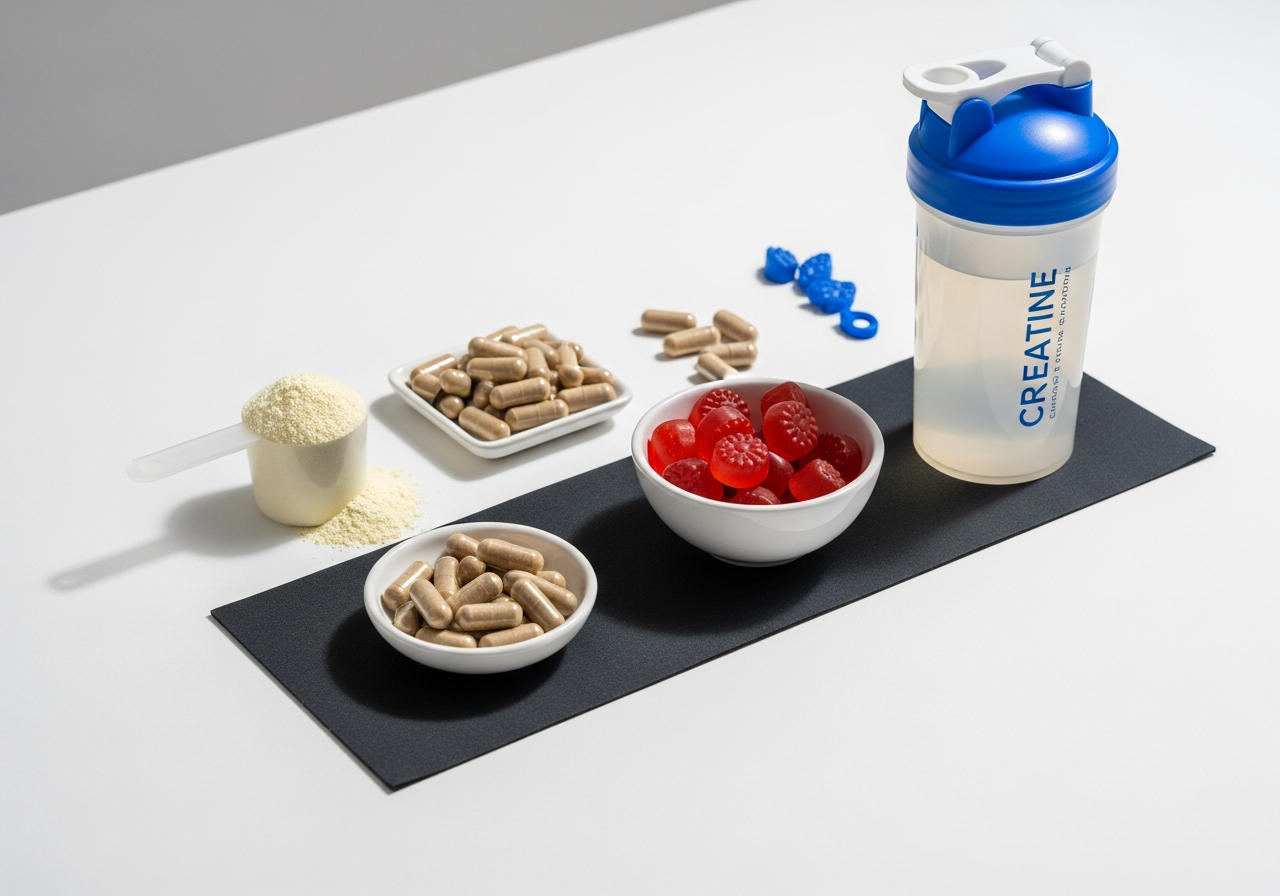
Creatine monohydrate is still the benchmark because other forms have not consistently beaten it on outcomes that matter. The best type of creatine is not the one with the flashiest label; it is the one with the strongest evidence, reliable dosing, and sensible cost.
The table below compares the main options you will see in Canada.
| Form | What it is | Evidence for performance | Typical pros | Main cons | Best verdict |
|---|---|---|---|---|---|
| Creatine monohydrate | Standard creatine bound with water | Strongest by far | Best studied, effective, low cost | Can clump or feel gritty in some powders | Best overall choice |
| Micronized monohydrate | Monohydrate with finer particles | Same active form as monohydrate | Mixes better, may feel easier on stomach | Sometimes costs more | Good if you dislike texture |
| Creatine HCl | Creatine bound to hydrochloride | Limited, not clearly superior | Often smaller scoop, may dissolve well | Higher cost, weak superiority evidence | Fine, but not better |
| Buffered creatine / Kre-Alkalyn | Higher-pH creatine product | No clear advantage over monohydrate | Marketing around reduced breakdown | Usually pricier, evidence underwhelming | Skip unless preferred personally |
| Creatine ethyl ester | Esterified creatine form | Poor compared with monohydrate | Past marketing appeal | Not a top evidence-based choice | Generally not recommended |
| Capsules | Usually monohydrate in pills | Depends on ingredient inside | Convenient for travel | Many capsules needed for 3-5 g | Use for convenience |
| Gummies | Chewable format | Depends on dose delivered | Easy to take | Often expensive, more pieces needed | Convenience product, check dose carefully |
| Liquid creatine | Pre-mixed liquid format | Less convincing and stability can be an issue | Portable | Often poor value and not ideal for long storage | Usually not the best buy |
The most important lesson is that capsules and gummies are formats, not necessarily different biochemical forms. If the ingredient is still creatine monohydrate, the core effectiveness comes from monohydrate. You are simply paying for convenience, flavour, portability, or texture.
If you want a deeper comparison of specific alternatives, see our guides on creatine monohydrate vs HCl, micronized creatine, and creatine gummies vs powder.
For most buyers, the best creatine to take is unflavoured monohydrate powder unless there is a strong reason to prioritise taste or convenience.
What type of creatine is best for beginners, women, older adults, and athletes?
The best creatine type for beginners, women, older adults, and most athletes is still creatine monohydrate. The differences between these groups are usually about dose size, expectations, and convenience, not about needing a special form.
Beginners: Start with 3 g daily if you want the lowest-friction approach, or 5 g daily if you are larger-bodied or simply want the standard maintenance habit from day one. Beginners often overcomplicate creatine, but consistency matters more than timing or flavour. Our full beginner guide walks through the first month.
Women: Women do not need a separate female-only form. Monohydrate works for women for strength, training capacity, lean mass support, and potentially broader applications that are still being studied. Many women prefer smaller daily doses only because of body size or because they want to ease into it. More detail: creatine for women.
Older adults: Monohydrate is also the evidence-based default for older adults, especially when paired with resistance training. The practical goal is often preserving muscle function, strength, and training quality rather than chasing a pump or scale change. A simple 3-5 g daily approach works well for most healthy older adults, with medical guidance if there are existing health conditions.
Vegetarians and vegans: Creatine can matter even more here because dietary intake of creatine is typically lower when you do not eat meat or fish. Some vegetarians appear to respond very well because baseline muscle creatine stores may start lower. The form is still monohydrate. See creatine for vegetarians.
Strength, sprint, team-sport, and CrossFit athletes: These groups typically benefit most clearly because their performance depends heavily on repeated high-intensity output. Monohydrate remains the go-to form used in most of the literature and in real-world practice.
Endurance athletes: Creatine can still help with sprint finishes, interval work, gym sessions, or maintaining lean mass, but some endurance athletes are cautious about body-mass increases from water retention. That is a dosing and goal conversation, not a reason to choose a weakly supported form.
If you are still asking what kind of creatine should I take for my situation, the answer is usually monohydrate first, then adjust the dose, format, or loading strategy to fit your goal.
How to take creatine properly: a simple step-by-step plan that actually works
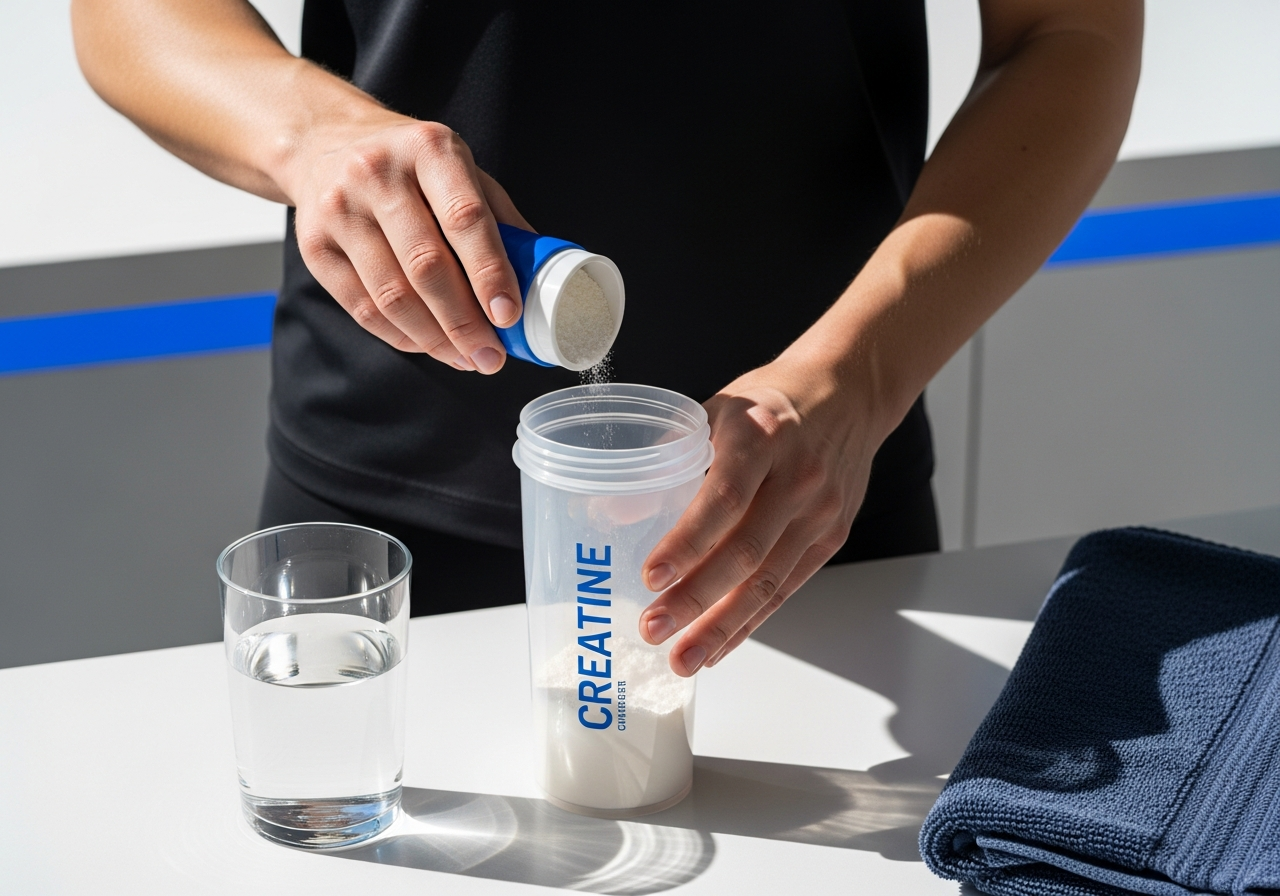
The best way to take creatine is to use creatine monohydrate every day at a dose you can stick to consistently. If you want the simplest answer, take 3-5 g of monohydrate once daily, with any meal or shake you regularly remember.
- Pick the form. Buy plain creatine monohydrate powder. If you hate gritty texture, choose micronized monohydrate instead.
- Pick the dose. Use 3 g daily if you are smaller-bodied or cautious about stomach comfort; use 5 g daily if you are average-to-larger, highly active, or simply want the standard evidence-based maintenance dose.
- Decide on loading or no loading. For faster saturation, take 20 g per day split into 4 doses for 5-7 days, then switch to 3-5 g daily. If you do not care about speed, skip loading and just take 3-5 g daily.
- Mix it well. Stir into water, juice, or a protein shake. Warm liquid can improve dissolving. If you want help with texture, see how to mix creatine.
- Take it daily, including rest days. Muscle saturation is built by consistency, not by workout-day heroics. See creatine on rest days.
- Stay patient. With loading, many people notice effects within about a week. Without loading, it often takes roughly 3-4 weeks to feel and perform differently.
- Troubleshoot before switching forms. If you get stomach upset, split the dose, take it with food, use more water, or change to micronized monohydrate.
Here is a practical first-month example for a beginner:
- Week 1 with loading: 5 g four times daily for 5-7 days, then 3-5 g daily.
- Week 1 without loading: 3-5 g once daily.
- Weeks 2-4: continue 3-5 g daily, train normally, and track performance in key lifts or intervals.
If you want exact numbers personalised to your body size and goal, use the creatine dosage calculator or read how much creatine per day. The best creatine type in the world still will not help much if you take it sporadically.
Exact creatine dosing by body weight and goal: maintenance, loading, cutting, and performance
The right creatine dose depends more on body size and your goal than on the brand name on the tub. For most adults, 3-5 g per day of creatine monohydrate is the standard maintenance range, while a loading phase uses about 20 g per day split into 4 doses for 5-7 days.
The evidence-based body-weight method often used for loading is about 0.3 g per kg per day for 5-7 days, followed by a maintenance intake around 0.03 g per kg per day. In practice, most people do fine with simpler rounded numbers.
| Body weight | Simple daily maintenance | Optional loading approach | Best use case |
|---|---|---|---|
| Under 60 kg | 3 g/day | 15-18 g/day split doses | Smaller beginners, lighter athletes |
| 60-90 kg | 3-5 g/day | 18-25 g/day split doses | Most adults |
| Over 90 kg | 5 g/day | 25-30 g/day split doses | Larger strength athletes |
For muscle and strength: 5 g daily is the easiest default if you train hard and want a one-size routine.
For cutting or fat loss phases: keep creatine in. Creatine does not stop fat loss, and it may help preserve training quality and lean mass while calories are lower. See creatine during a cut.
For athletes needing fast saturation before a block or event: loading can make sense. It does not create a bigger ultimate effect; it just gets you there sooner.
For sensitive stomachs: split 3-5 g into two smaller servings, or take 1.5-2.5 g twice daily.
For people who miss doses: do not panic. Take your normal daily amount the next day. Do not double up unless you are deliberately following a loading protocol.
If you want precision, especially for larger bodies or sport-specific plans, use our creatine dosage calculator. If you want the deeper dosing logic, including weight-based formulas and examples, read creatine maintenance dose and creatine loading phase.
The most effective creatine form is still monohydrate here; the dosing logic does not suddenly change because the label says HCl or buffered.
When to take creatine, how fast it works, and what results to expect week by week
The best time to take creatine is the time you will remember every day, because total daily intake matters far more than precise timing. If you are wondering whether pre-workout or post-workout is best, the practical answer is that consistency beats timing for the vast majority of users.
Creatine is not like caffeine, so do not expect an immediate buzz. It works by gradually saturating muscle stores. The timeline usually looks like this:
- Days 1-7 with loading: muscle stores rise quickly; some people notice slightly better gym endurance, fuller muscles, or a small scale increase from intracellular water.
- Weeks 2-4 without loading, or week 2 after loading: performance effects become more noticeable, especially on repeated hard sets or short explosive efforts.
- Weeks 4-8: the main benefit often becomes clearer as you accumulate more quality training and recover better between intense bouts.
- Months 2-6: the meaningful payoff is usually better training volume, strength progression, and lean mass support over time.
How do you tell it is working? Look for these signs:
- you maintain reps better on later sets
- your sprint or interval output drops off less
- your body weight rises modestly at first, often from water stored in muscle rather than fat
- your strength progression becomes a bit steadier over a training block
There is no need to cycle creatine on and off for effectiveness. Daily use is the standard evidence-based approach. If you miss a day, just resume your normal dose the next day.
If you want a dedicated deep dive, read when to take creatine, how long creatine takes to work, and whether you need to cycle creatine.
One final practical note: taking creatine with a meal or protein shake is often a good adherence strategy because it links the habit to something you already do. That is not magic absorption; it is smart routine design.
Is creatine safe, what side effects are real, and who should be more cautious?
Creatine monohydrate is generally considered safe for healthy people when used at evidence-based doses, and the best-supported safety data are specifically on monohydrate. According to the ISSN position stand, creatine monohydrate is not only effective but well supported for safety in healthy individuals when taken appropriately.
The most common real side effects are mild and manageable:
- Water-weight gain: often an early increase from more water stored inside muscle cells, not fat gain.
- Stomach upset or loose stools: more likely with large single doses, poor mixing, or aggressive loading.
- Bloating: some people report it, but dose size and product format often matter more than the existence of creatine itself.
What creatine does not reliably do in healthy users at normal doses is damage kidneys, cause dehydration, or trigger muscle cramps as a general rule. The 2021 JISSN misconceptions review and mainstream summaries such as Mayo Clinic's creatine page both reflect that much of the scare language around creatine is based on confusion, poor assumptions, or special-case medical contexts.
That said, there are sensible cautions. You should speak with a qualified health professional before using creatine if you have known kidney disease, significant renal concerns, are taking medications that affect kidney function, are pregnant or breastfeeding, or have a complex medical history. That is a caution about individual medical context, not evidence that creatine is broadly unsafe.
To reduce side effects:
- use monohydrate from a reputable brand
- take smaller doses instead of one large scoop
- mix fully in enough liquid
- take it with food if your stomach is sensitive
- avoid "more is better" thinking
If you want myth-by-myth answers, visit creatine myths debunked, is creatine safe, creatine digestive side effects, and creatine and kidney concerns.
The best type of creatine from a safety standpoint is also monohydrate, simply because it has by far the deepest safety record.
Common myths about the best creatine form, debunked without the marketing spin
Most claims that a newer creatine form is automatically better than monohydrate do not hold up well under scrutiny. The best type of creatine is the one supported by outcome data, not the one paired with the most aggressive ad copy.
Myth 1: HCl is proven more effective because it dissolves better.
Better dissolving does not automatically mean better muscle saturation or better performance outcomes. Solubility and effectiveness are not the same thing.
Myth 2: Monohydrate causes "bad" water retention.
Creatine often increases intracellular water, meaning water stored within muscle cells. That is not the same as getting fatter, and for many users it is part of why muscles look and feel fuller.
Myth 3: You need a proprietary blend for absorption.
You do not. Plain monohydrate is absorbed well enough to saturate muscle stores effectively when taken consistently.
Myth 4: Capsules or gummies are weaker than powder.
If they contain the same amount of creatine monohydrate, they are not inherently weaker. The issues are usually cost, dose transparency, and how many capsules or gummies it takes to reach 3-5 g.
Myth 5: Creatine must be cycled.
There is no established requirement to cycle creatine for healthy users. Daily use is standard.
Myth 6: Non-responders prove creatine does not work.
Some people feel fewer effects, often because their baseline muscle creatine is already relatively high, their training does not strongly depend on repeated high-intensity output, or they have not dosed consistently long enough.
Myth 7: More expensive means purer or stronger.
Sometimes higher price reflects branding, flavour systems, or convenience, not better results. Quality matters, but price alone proves very little.
If you enjoy fact-checking supplement claims, read our deeper pages on creatine myths vs facts, creatine HCl, buffered creatine, and creatine ethyl ester.
A useful buying mindset is this: ask what evidence shows the product improves strength, lean mass, sprint performance, or saturation better than monohydrate at a realistic cost. If that answer is vague, monohydrate remains the smarter bet.
How to buy the best creatine in Canada: labels, NPNs, quality control, and value
In Canada, the best creatine to buy is usually a straightforward monohydrate product with transparent labelling, sensible pricing per effective dose, and clear quality controls. Fancy packaging matters less than ingredient clarity.
Here is what to check before you buy:
- Ingredient list: ideally just creatine monohydrate, unless you specifically want a flavoured product.
- Dose per serving: look for a clear gram amount, not a vague proprietary blend.
- Format honesty: if it is gummies or capsules, calculate how many pieces you need to reach 3-5 g.
- Natural Product Number: in Canada, many supplement products carry an NPN, which is a Natural Product Number showing the product has been licensed under Health Canada's natural health product framework.
- Quality indicators: reputable manufacturing standards, third-party testing where available, and established brand credibility.
- Cost per effective dose: compare cost per 5 g, not just container price.
There is also a practical difference between buying a product and buying a marketing story. A premium tub only deserves a premium price if it offers something tangible, such as better testing transparency, better scoop accuracy, better texture, or better flavour adherence for someone who otherwise would not take it consistently.
Canadian buyers should also be wary of imported marketplace listings with unclear ingredient sourcing, vague serving sizes, or labels that seem designed for a different regulatory system. If a listing makes dramatic medical or performance promises, that is usually a red flag rather than a selling point.
To compare products more concretely, browse our creatine brand reviews, product catalog, and best creatine rankings. If you specifically want the standard form, our guide to best creatine monohydrate in Canada goes deeper on selection criteria.
The International Olympic Committee supplement consensus also reinforces a key point relevant beyond elite sport: product quality and contamination risk matter, so buying from reputable companies is part of smart supplementation.
For most Canadians, the winning formula is boring in the best way: plain monohydrate, reputable seller, clear grams, good value, and a routine you will actually follow.
Bottom line: the most effective creatine form is the one you will take daily, but monohydrate still wins
The best type of creatine is creatine monohydrate, and for most people that answer is not close. It has the strongest evidence for increasing high-intensity exercise capacity and supporting lean mass gains with training, it is the most studied for safety, and it is usually the most cost-effective option in Canada.
If you want the simplest decision tree, use this:
- Want the best all-around form? Choose creatine monohydrate.
- Want better mixability? Choose micronized creatine monohydrate.
- Want convenience for travel? Capsules are fine if the ingredient is monohydrate and the dose adds up.
- Thinking about HCl or buffered creatine? Only do so for personal preference, not because the evidence shows they outperform monohydrate.
- Beginner and overwhelmed? Buy plain monohydrate and take 3-5 g daily.
That means the answers to the common search questions are straightforward:
- What kind of creatine should I take? Creatine monohydrate.
- What type of creatine is best? Creatine monohydrate.
- What is the most effective creatine form? Creatine monohydrate.
- What is the best creatine type for beginners? Creatine monohydrate.
Do not let form-shopping distract you from the real levers of results: daily consistency, a sensible dose, enough training effort, and enough time for muscle saturation. If you do those things, creatine becomes one of the rare supplements that usually earns its place.
For your next step, calculate your intake with the creatine dosage calculator, compare specific picks in our best creatine rankings, or start with the practical walkthrough in how to take creatine.
Best Type of Creatine: the numbers that matter
- 3-5 g/day Standard maintenance dose — Works for most adults using creatine monohydrate
- 20 g/day Optional loading dose — Usually split into 4 doses for 5-7 days
- 5-7 days Typical loading timeline — Faster route to saturation than maintenance alone
- 3-4 weeks Typical no-loading timeline — Approximate time to reach full effect with daily maintenance only
Frequently Asked Questions
What is the best type of creatine to take?
The best type of creatine to take is creatine monohydrate. It has the strongest research support for strength, repeated high-intensity performance, and lean mass gains with training, and it is usually the most affordable effective option.
What kind of creatine should I take as a beginner?
As a beginner, you should usually take plain creatine monohydrate. A simple 3-5 g daily routine is easy to follow, well studied, and much more important than chasing advanced forms or complicated timing strategies.
Is creatine HCl better than creatine monohydrate?
Creatine HCl is not clearly better than creatine monohydrate in the evidence. It may dissolve well and some people prefer the smaller scoop, but it has not consistently outperformed monohydrate on the outcomes that matter most.
Is micronized creatine better than regular monohydrate?
Micronized creatine is not more effective than regular creatine monohydrate, but it can be more convenient. Its finer particle size often helps it mix more smoothly and may feel easier on the stomach for some users.
Do women need a different type of creatine?
Women do not need a different type of creatine. Creatine monohydrate is still the evidence-based default, and any adjustments are usually about total dose, product format, or personal preference rather than a special female-only form.
What is the most effective creatine form for muscle growth?
The most effective creatine form for muscle growth is creatine monohydrate. Its main benefit is improving training capacity and helping muscles regenerate ATP faster during hard efforts, which can support greater strength and lean mass gains over time.
Should I load creatine or just take 5 grams a day?
You can do either, and both approaches work. Loading at 20 g per day split into 4 doses for 5-7 days gets you saturated faster, while taking 3-5 g per day reaches the same place more gradually over roughly 3-4 weeks.
Are creatine capsules or gummies as good as powder?
Creatine capsules or gummies can work as well as powder if they provide the same total dose of creatine monohydrate. The main trade-offs are usually cost, how many pieces you need per day, and how easy they make long-term consistency.
Can I take creatine every day long term?
Yes, healthy adults can generally take creatine every day long term at standard doses, and monohydrate has the best long-term safety record. If you have kidney disease, major medical conditions, or relevant medications, speak with a health professional first.
How do I know if creatine is working?
You know creatine is working when your training quality improves over time rather than from a sudden buzz. Common signs are better repeat performance on hard sets, slightly steadier strength progression, and sometimes a modest early increase in body weight from water stored in muscle.