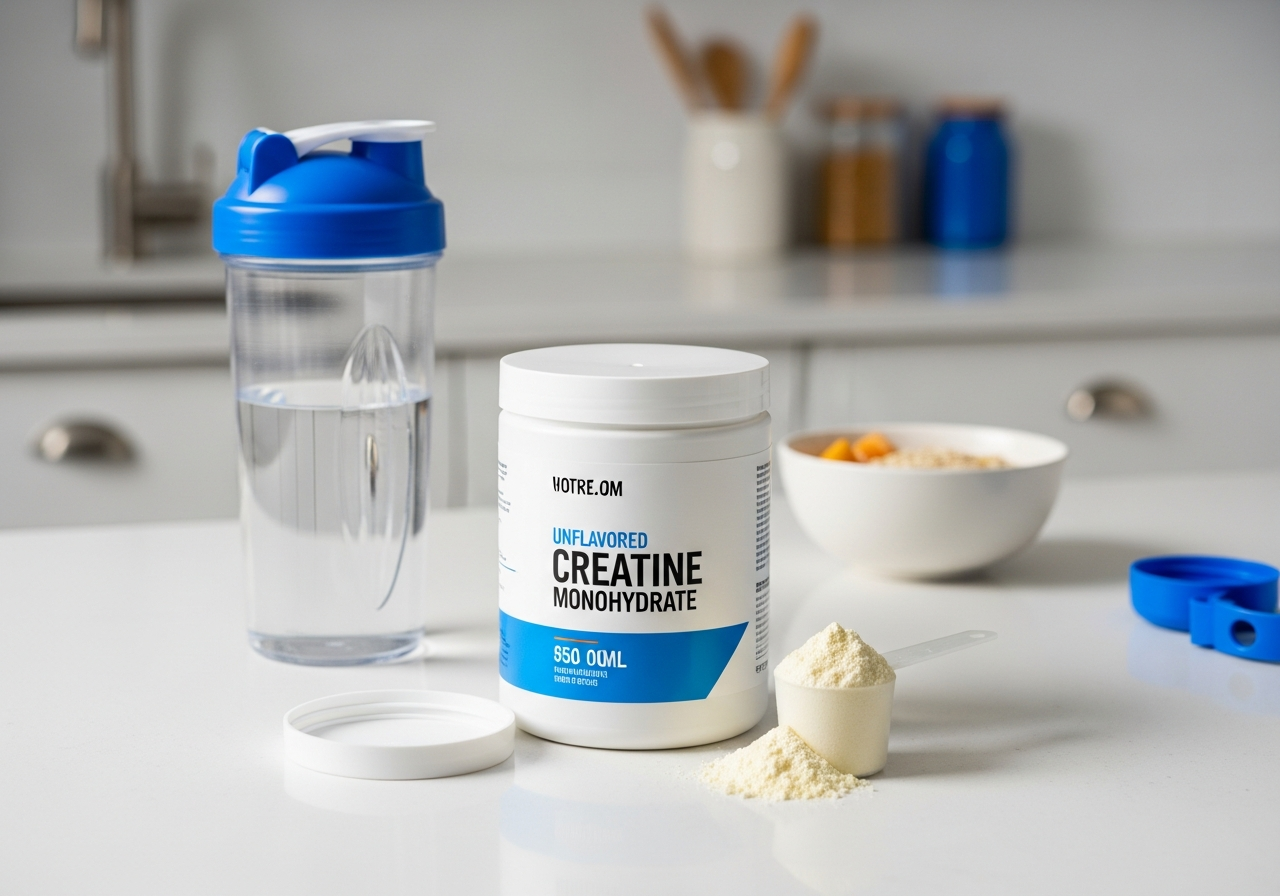
How to Take Creatine: A Step-by-Step Guide for Maximum Results
By The Creatine Canada Research Team — Evidence-based supplement analysts
How to take creatine properly is simple: take 3 to 5 grams of creatine monohydrate every day, mixed in water or another drink, and keep taking it consistently. You can load with 20 grams per day split into 4 doses for 5 to 7 days if you want faster saturation, but the most important factor for results is daily adherence, not perfect timing.
Evidence-based · Cites 4 sources · Editorial standards
Key Takeaways
- Take 3 to 5 g of creatine monohydrate once daily for a simple, proven maintenance approach.
- If you want faster results, load with 20 g/day split into 4 doses for 5 to 7 days, then continue with 3 to 5 g/day.
- Mix creatine powder in water, juice, or a protein shake; taking it with food is fine and often easier on the stomach.
- Use creatine every day, including rest days, because muscle saturation depends on consistency over time.
- Creatine works by increasing muscle phosphocreatine stores, which helps regenerate ATP during short, hard efforts.
- Mild water-weight gain and occasional stomach upset are the most common side effects; both are usually manageable.
- For most people in Canada, plain creatine monohydrate powder is the best-tested, best-value option to buy.
How to take creatine properly in one minute
How to take creatine properly is to use 3 to 5 grams of creatine monohydrate daily, mixed into water or another beverage, and continue taking it every day. If you prefer faster saturation, you can use a loading phase of 20 grams per day split into 4 doses for 5 to 7 days, then switch to 3 to 5 grams daily.
If you are asking “how do I use creatine”, “how to consume creatine powder”, or “how to drink creatine”, the practical answer is straightforward: measure your dose, mix it in 250 to 500 mL of liquid, drink it, and repeat daily. Creatine is not a stimulant, so you do not need to “feel” it immediately the way you might feel caffeine. Instead, it works by gradually increasing intramuscular creatine and phosphocreatine stores until your muscles are more fully saturated.
The strongest evidence supports creatine monohydrate, not newer premium forms marketed as more advanced. The 2017 International Society of Sports Nutrition position stand concluded that creatine monohydrate is the most effective ergogenic nutritional supplement currently available for increasing high-intensity exercise capacity and lean mass during training when used appropriately. For a deeper primer, see what creatine is and our creatine for beginners guide.
Here is the simplest beginner plan:
- Buy plain creatine monohydrate powder.
- Take 5 g once daily, ideally at a time you can remember.
- Mix it with water, juice, or a shake and drink it fully.
- Take it on training days and rest days alike.
- Keep going for at least 2 to 4 weeks before judging results if you did not load.
If your question is “should I use creatine”, the answer is yes for many healthy adults who want better strength, power, training volume, or lean-mass support. It is especially useful for resistance training, sprinting, repeated high-intensity efforts, and active older adults. If you want dose precision beyond the generic 3 to 5 g rule, our creatine dosage calculator can help.
Why use creatine: the mechanism that makes daily dosing work
Creatine works because it helps your muscles regenerate ATP faster during short, hard efforts. ATP, or adenosine triphosphate, is the immediate energy currency your cells use for explosive work, and phosphocreatine is a stored high-energy compound in muscle that helps rebuild ATP rapidly when demand spikes.
When you supplement with creatine, your muscles store more total creatine and phosphocreatine. That extra reserve matters most in activities such as heavy sets of squats, repeated sprints, jumps, rowing intervals, and other efforts lasting only a few seconds at a time. In practice, more phosphocreatine can help you squeeze out an extra rep, maintain power slightly longer, or repeat hard efforts with less drop-off. Over weeks and months, those small training advantages can add up to better gains in strength and lean mass.
This is why “how to use creatine correctly” is mainly a question of saturation, not a question of chasing a special pre-workout buzz. Saturation means your muscle creatine stores have been raised and maintained at a higher level. Loading reaches saturation faster; maintenance-only dosing reaches it more gradually. The endpoint is similar if intake is consistent.
Creatine also draws more water into muscle cells, which partly explains the early increase on the scale many users notice. That is not body fat gain. It is primarily an increase in intracellular water, meaning water stored inside muscle cells rather than under the skin. For many lifters, that can make muscles look and feel fuller while also supporting training. If this worries you, read does creatine make you gain weight.
The broader evidence base is strong. The ISSN position stand and the 2021 JISSN review on common questions and misconceptions both support creatine monohydrate as effective, well-studied, and appropriate for a wide range of healthy active people. If you want the complete physiology and use cases, see creatine benefits.
Exactly how to use creatine powder, step by step
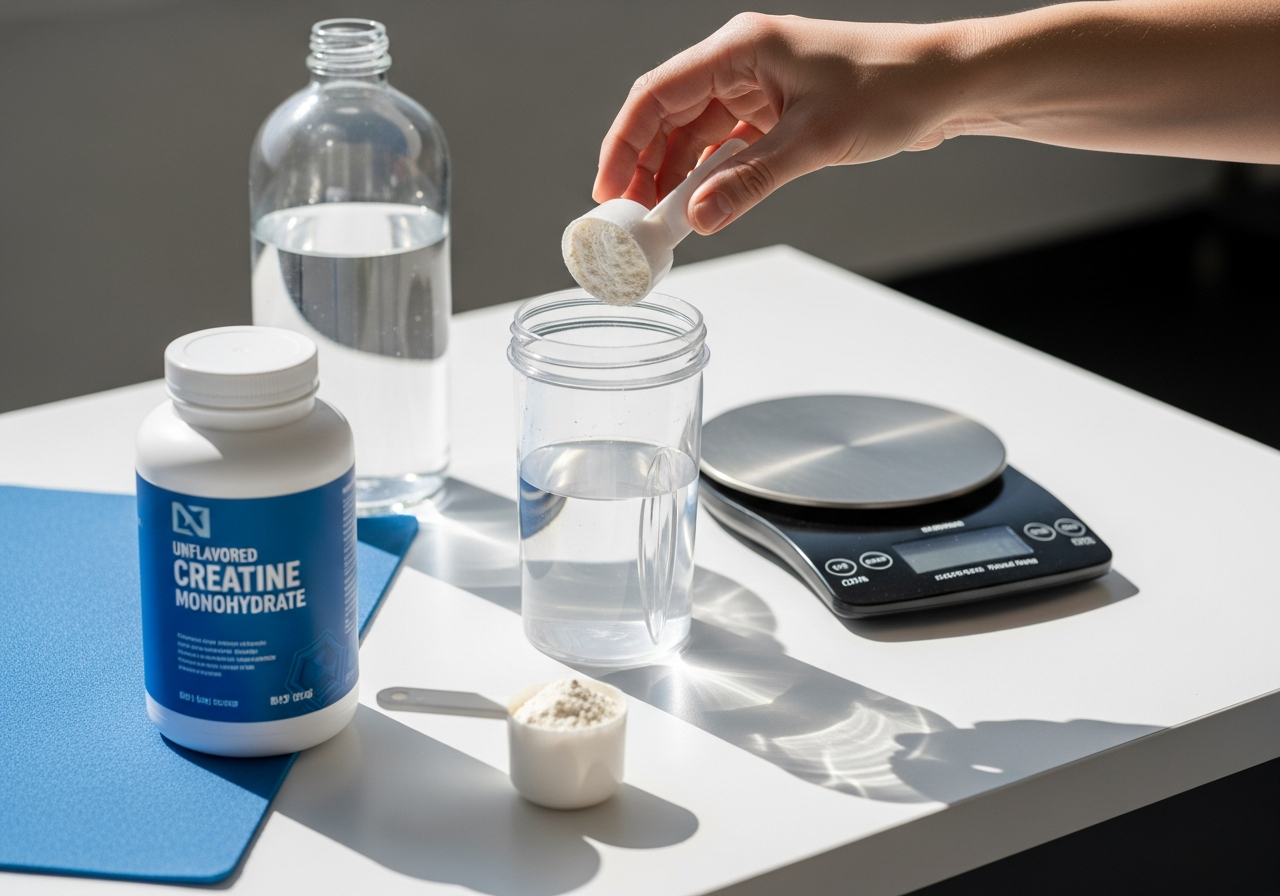
How to use creatine powder is simple: measure the dose, mix it in liquid, drink it, and repeat daily. If you are overcomplicating it, you are probably making creatine harder than it needs to be.
- Choose creatine monohydrate. Plain monohydrate powder is the most studied and usually the best value per gram.
- Measure 3 to 5 g. Use the scoop provided only if it states the gram weight clearly; scoop sizes vary by brand. A kitchen scale is more accurate.
- Add it to 250 to 500 mL of liquid. Water is perfectly fine. Juice, milk, or a protein shake also work.
- Stir or shake well. Some creatine settles at the bottom, especially non-micronized powder, so give it a final swirl before finishing.
- Take it with or without food. Food is not required, but many people find creatine gentler on the stomach when taken with a meal or post-workout shake.
- Use it every day. Rest days count because your goal is to keep muscle creatine stores elevated.
If you are asking “how to take creatine with water”, the answer is simply to dissolve or suspend your dose in a glass or shaker and drink it. It does not need to be fully clear to work. Creatine monohydrate is not highly soluble in cold water, so a little settling is normal and not a sign of poor quality.
Good mixing options include:
- Water
- Protein shakes
- Smoothies
- Juice
- Yoghurt or oats if you prefer to stir it into food
Dry scooping is unnecessary and less comfortable for most people. Creatine is not absorbed better by taking it dry, and inhaling powder is an avoidable risk. For practical mixing help, see how to mix creatine and how much water to drink with creatine.
If you forget a day, do not panic and do not double up aggressively the next day. Just resume your usual dose. Missing one day does not erase saturation overnight, which is why long-term consistency matters more than daily perfection.
Creatine dose by body weight, training goal, and whether you want to load
The right creatine dose for most adults is still 3 to 5 grams per day, but body size and goal can help you choose the most sensible end of that range. Heavier athletes and people with more lean mass often do well at 5 g daily, while smaller individuals often do fine at 3 g daily.
A common evidence-based loading strategy is 0.3 g per kg of body weight per day for 5 to 7 days, usually rounded to about 20 g/day for average-sized adults and split into 4 smaller doses. A common maintenance strategy is 3 to 5 g/day, or roughly 0.03 g/kg/day.
| Body weight | Maintenance dose | Optional loading dose | Best for |
|---|---|---|---|
| Under 60 kg | 3 g/day | 15 to 18 g/day split into 3 to 4 doses | Smaller adults, lighter beginners |
| 60 to 90 kg | 3 to 5 g/day | 18 to 25 g/day split into 4 doses | Most gym-goers and field/court athletes |
| Over 90 kg | 5 g/day | 25 to 30 g/day split into 4 to 5 doses | Larger athletes, higher lean mass |
Goal also matters:
- General fitness: 3 to 5 g/day is enough.
- Maximizing strength quickly: load first, then maintain.
- Bulking: 5 g/day is a common practical dose.
- Cutting: 3 to 5 g/day still makes sense to help preserve training quality.
- Older adults: 3 to 5 g/day paired with resistance training is a sensible starting point.
If you are wondering “how much creatine supplements should I take” or “how do you use creatine monohydrate”, do not get distracted by complicated proprietary formulas. Plain monohydrate at the right dose is usually enough. More is not automatically better, and very high doses mainly increase the chance of stomach upset.
For goal-specific help, see how much creatine per day, creatine loading phase, and creatine maintenance dosing.
When to use creatine: timing matters far less than consistency
The best time to take creatine is the time you will actually remember to take it every day. Timing is a secondary detail because creatine works through saturation over days and weeks, not through an acute stimulant effect in the hour before training.
If you are asking “when do I use creatine” or “when to use creatine”, you have several perfectly reasonable options:
- Post-workout: convenient if you already make a shake after training.
- Pre-workout: also fine if that fits your routine better.
- With a meal: useful for habit formation and stomach comfort.
- On rest days: take it whenever is easiest, such as breakfast or lunch.
There is some interest in whether post-workout intake may be slightly better in certain contexts, but the evidence is not strong enough to matter for most people. The bigger difference comes from simply taking enough creatine for long enough. If pre-workout works for your routine, great. If post-workout or with breakfast is easier, that is also great.
For people who train early, late, fasted, or on shifting schedules, the rule stays the same: daily intake beats perfect timing. A person who takes 5 g every day at random times will usually do better than a person who only remembers on workout days but chases the “optimal” minute.
You can also mix creatine with protein powder, and most people tolerate that well. You can learn more in mixing creatine with protein powder. Coffee is usually workable too, though practical tolerance varies; for that nuance see creatine with coffee.
If you want the full timing debate unpacked, including pre vs post workout and whether rest days matter, read when to take creatine and creatine on rest days.
What to expect after you start taking creatine
Creatine usually does not feel dramatic on day one, but it often becomes noticeable over 1 to 4 weeks depending on whether you load. The earliest signs are often better training performance, fuller muscles, and a small increase in body weight from intracellular water.
If you load with 20 g/day split across the day for 5 to 7 days, many people notice changes within the first week. If you skip loading and take 3 to 5 g/day, it commonly takes around 2 to 4 weeks to approach saturation.
A realistic timeline:
- Days 1 to 7 with loading: scale weight may rise modestly; muscles may feel fuller; repeated hard efforts may feel slightly better.
- Weeks 2 to 4 without loading: strength and training-volume benefits become easier to notice if you train consistently.
- Weeks 4 to 8: the compound effect shows up more clearly in performance logs, rep quality, and lean-mass progress.
- Months 2 and beyond: creatine helps you keep training quality higher over time, which is where many of the best results accumulate.
How do you know it is working? The most useful indicators are objective:
- More reps at a fixed weight
- Less drop-off across repeated sprint or interval efforts
- Improved bar speed or power on hard sets
- Slight body-weight increase without obvious fat gain
- Better recovery between short, intense efforts
Not everyone notices the same effect size. People with lower baseline creatine stores, including many vegetarians and vegans, may respond more noticeably because they often start with less muscle creatine from diet. Others still benefit, but the difference can feel subtler. If you think you may be a weak responder, see why creatine may not seem to work and how long creatine takes to work.
Who should use creatine, and who may benefit the most
Creatine is appropriate for many healthy adults, especially people doing resistance training, sprint work, team sports, or repeated high-intensity exercise. It is one of the most evidence-based supplements for improving strength, power, and lean-mass support when combined with training.
Beginners can absolutely use creatine. In fact, creatine is often more useful for beginners than complex pre-workouts because the instructions are simpler, the evidence is stronger, and the benefit is tied to better training output over time. If you are new, a plain 3 to 5 g daily routine is usually all you need.
Women can use creatine the same way men do. Creatine does not “bulk” women in a magical or hormonal sense; it helps support training quality and lean tissue the same fundamental way it does in men. Many women prefer 3 to 5 g/day without loading simply because it is easy to tolerate and maintain. For more, see creatine for women.
Older adults may benefit from creatine alongside resistance training because muscle mass, strength, and functional capacity often decline with age. While creatine is not a substitute for training or adequate protein, it is a reasonable evidence-based adjunct for healthy adults over 50 who want to support muscle function. See creatine for older adults.
Vegetarians and vegans may respond especially well because their baseline dietary creatine intake is typically lower. Since most dietary creatine comes from animal foods, supplemental creatine can make a bigger difference in tissue stores for plant-based athletes. If that is relevant to you, see is creatine vegan and creatine for vegetarians.
Competitive athletes can generally use creatine legally, and the International Olympic Committee consensus on dietary supplements includes creatine among supplements with strong evidence for specific performance uses. As always, tested athletes should choose products carefully to reduce contamination risk.
Safety, side effects, and what to look for when buying creatine in Canada
Creatine is widely considered safe for healthy individuals when taken at recommended doses, and the best-supported side effects are usually mild and manageable. The most common issues are temporary water-weight gain, occasional stomach upset, and sometimes bloating if the dose is too large at once.
The major safety misconceptions are worth clearing up. Creatine is not an anabolic steroid. Creatine does not inherently dehydrate you. Creatine does not automatically damage healthy kidneys in healthy people at standard doses. The 2021 JISSN review addressed many of these myths directly, and the broader literature continues to support creatine’s safety profile in healthy users. For more detail, see creatine myths debunked, is creatine safe, and creatine and kidney concerns.
That said, some people should speak with a healthcare professional first, especially if they have known kidney disease, are under medical evaluation for kidney function, are pregnant or breastfeeding, or take medications that warrant professional review. Caution is not the same thing as evidence of harm; it simply means individual context matters.
In Canada, practical buying quality matters. Look for:
- Creatine monohydrate as the primary ingredient
- Simple label without unnecessary “proprietary matrix” blends
- NPN, which is a Natural Product Number indicating the product has been licensed under Health Canada’s natural health product framework where applicable
- Third-party testing or transparent quality assurance
- Clear serving size in grams
| What to compare | Best choice for most Canadians | Why it matters |
|---|---|---|
| Form | Monohydrate powder | Most studied, most cost-effective, easiest to dose |
| Flavour | Unflavoured or simple flavoured option | Fewer extras, easier stacking |
| Testing | Third-party verified when possible | Reduces contamination risk |
| Label clarity | Grams per scoop listed clearly | Prevents underdosing or overdosing |
| Regulatory context | NPN on Canadian products where applicable | Helpful quality and compliance signal |
To compare options, browse our best creatine rankings, creatine brand reviews, and creatine product catalog.
The most common creatine mistakes, plus myths that still confuse people
The biggest creatine mistake is inconsistency. Most “creatine didn’t work for me” stories come down to underdosing, skipping rest days, quitting too early, or expecting a stimulant-like feeling instead of gradual performance support.
Here are the mistakes that matter most:
- Only taking it on workout days. This slows or disrupts saturation.
- Using too little. Tiny pre-workout sprinkle doses are often not enough.
- Stopping after a week. Maintenance-only dosing takes time to build up.
- Taking huge single doses. This raises the chance of stomach upset without improving maintenance results.
- Buying fancy forms for marketing reasons. Most people do not need HCl, buffered creatine, or overpriced blends.
- Dry scooping. It is unnecessary and can be unpleasant or risky.
Now the myths:
Myth 1: You must cycle creatine. False for most healthy users. There is no established requirement to cycle on and off creatine when using standard doses. Daily use is the norm. See do you need to cycle creatine.
Myth 2: Creatine is bad for your kidneys. In healthy people using recommended doses, current evidence does not support routine kidney damage from creatine. Confusion often comes from creatinine blood tests, which are related but not the same thing as creatine itself.
Myth 3: Creatine makes you bloated everywhere. Early water gain is usually inside muscle, not a puffy whole-body effect, though some people do get mild GI bloating if they load too aggressively.
Myth 4: Creatine is only for bodybuilders. False. It can also help sprinters, field sport athletes, recreational lifters, and many older adults doing resistance training.
Myth 5: If I do not feel it instantly, it is not working. False. Creatine is more like filling a fuel reserve than flipping a switch.
For a deeper myth-by-myth review, see creatine myths vs facts.
Bottom line: the simplest way to take creatine for maximum results
The best way to take creatine is still the simplest one: use 3 to 5 grams of creatine monohydrate every day, mix it in water or another drink you tolerate well, and keep taking it consistently. If you want faster results, use a loading phase of 20 grams per day split into 4 doses for 5 to 7 days, then continue with 3 to 5 grams daily.
If you want the short version to remember, use this:
- Buy creatine monohydrate.
- Take 5 g daily.
- Use it on workout days and rest days.
- Mix it with water, juice, or a shake.
- Give it at least 2 to 4 weeks if you are not loading.
This answer covers nearly every common variation of the question, whether you searched “how to take creatine properly”, “how to consume creatine”, “how to use creatine powder”, or “when do you use creatine”. The details matter less than people think. Brand matters less than quality and correct dosing. Timing matters less than consistency. Fancy forms matter less than using enough monohydrate for long enough.
For most healthy adults, creatine is worth considering because it is one of the few supplements with a strong evidence base, a clear mechanism, a simple dosing protocol, and realistic performance benefits. If you want to tailor your intake, compare forms, or solve a specific issue, the next best reads are how much creatine per day, when to take creatine, best type of creatine, and creatine digestive side effects.
How to Take Creatine at a Glance
- 3-5 g/day Standard daily maintenance dose — Suitable for most healthy adults using creatine monohydrate.
- 20 g/day Common loading dose — Usually split into 4 doses for 5 to 7 days.
- 5-7 days Typical loading timeline — Helps raise muscle creatine stores faster than maintenance alone.
- 2-4 weeks Typical time to notice effects without loading — Consistency matters more than exact timing.
Frequently Asked Questions
How do I take creatine for the first time?
Take 3 to 5 grams of creatine monohydrate once daily, mixed in water or another drink, and keep doing that every day. Beginners do not need anything more complicated than a consistent maintenance dose, though a 5 to 7 day loading phase can help you reach saturation faster if you want quicker results.
How do you use creatine powder with water?
Use creatine powder by mixing your measured dose into roughly 250 to 500 mL of water and drinking it fully. It does not need to dissolve perfectly clear to work, because some settling is normal with monohydrate, especially in cold water.
Should I take creatine before or after a workout?
You can take creatine before or after a workout, because timing is much less important than taking it consistently every day. If one option fits your routine better, choose that one, since adherence has a bigger impact on results than the exact timing window.
Do I need to load creatine, or can I just take 5 grams a day?
You do not need to load creatine to get benefits, because 3 to 5 grams per day will still raise muscle creatine stores over time. Loading is simply a faster way to reach saturation, while daily maintenance alone is slower but easier for many people.
Can I take creatine on rest days?
Yes, you should take creatine on rest days because muscle saturation depends on regular daily intake, not just workout-day use. On rest days, take your normal dose whenever it is easiest to remember, such as with breakfast or lunch.
What should I mix creatine with?
You can mix creatine with water, juice, a protein shake, or a smoothie, and all are fine for most people. The best choice is the one you tolerate well and will use consistently, though taking it with food can be easier on the stomach for some users.
How long does creatine take to work?
Creatine often starts working within about a week if you load, or within roughly 2 to 4 weeks if you only use a maintenance dose. The timeline depends on how quickly your muscles become saturated and how consistently you take it.
Should I use creatine if I am a beginner?
Yes, beginners can use creatine, and it is often one of the most sensible first supplements because the evidence is strong and the instructions are simple. A plain daily dose of creatine monohydrate is usually more useful than chasing complicated supplement stacks.
Can women take creatine the same way men do?
Yes, women can generally take creatine the same way men do, using about 3 to 5 grams of creatine monohydrate daily. The supplement works through the same muscle energy system, and the common myth that it automatically causes unwanted bulking is not supported.
Is it better to take creatine with food or without food?
Creatine can be taken with or without food, and both approaches work. Many people prefer taking it with a meal or shake because it is easier to remember and may reduce the chance of mild stomach upset.