Does Creatine Make You Gain Weight? Water vs. Fat vs. Muscle
By The Creatine Canada Research Team — Evidence-based supplement analysts
Yes—creatine can make you gain weight, but in most people that early gain is mainly water stored inside muscle cells, not body fat. Over time, creatine can also support slightly greater lean mass gains from training, while it does not directly cause fat gain unless your overall calorie intake is high enough to add fat.
Evidence-based · Cites 4 sources · Editorial standards
Key Takeaways
- Creatine often increases body weight in the first 1-2 weeks because it pulls more water into muscle, not because it adds fat.
- A loading phase of 20 g/day for 5-7 days usually causes faster scale changes than taking 3-5 g/day with no loading.
- Most people maintain creatine stores with 3-5 g/day, taken consistently every day, including rest days.
- Creatine does not contain meaningful calories and does not directly make you gain belly fat.
- If you want the benefits with less sudden scale movement, skip loading and take a steady daily dose instead.
- The best-supported form is creatine monohydrate because it is the most studied, most effective, and usually the best value.
- If the scale matters for your sport or cut, track waist, photos, strength, and training performance—not body weight alone.
Does creatine make you gain weight? Yes—but usually from water first, not fat
Yes, creatine can make you gain weight, but the type of weight matters. In most users, especially during the first week or two, creatine causes a small increase in body mass because it raises creatine and phosphocreatine stores inside muscle, which draws more water into the muscle cell. That is why people asking does creatine cause weight gain, will creatine make me gain weight, or will I gain weight on creatine often notice the scale move before they see visible muscle gain.
Creatine does not directly make you fat. Creatine monohydrate has no meaningful calories, so it does not create a calorie surplus by itself. Fat gain still requires sustained excess energy intake. If you were wondering does creatine make you fat, can creatine make you fat, or will creatine make you fat, the evidence-based answer is no: creatine is not a fat-gain supplement.
What creatine can do is help you train harder and recover better over time, which may support greater increases in lean body mass when combined with resistance training. The 2017 ISSN position stand concluded that creatine monohydrate is the most effective nutritional supplement available for increasing high-intensity exercise capacity and lean body mass. That means some later scale gain can reflect actual muscle, especially over weeks to months of productive training, rather than only water. See what creatine is and what it does if you want the full background.
A simple way to think about it:
- Days 1-14: any weight gain is usually mostly water inside muscle.
- Weeks 3-12+: some additional gain may come from better training output and slightly greater muscle gain.
- At no point: creatine itself is not a direct cause of fat gain.
This distinction matters because water in muscle is not the same as bloating under the skin, and it is not the same as belly fat. If scale weight is emotionally or competitively important to you, use creatine with a plan: measure body weight, waist, gym performance, and progress photos together instead of letting one number tell the whole story.
For a broader evidence review, see Antonio et al. (2021) on creatine misconceptions and our guide to creatine myths debunked.
Why the scale goes up: creatine increases muscle water and can later support more muscle
Creatine increases body weight mainly by increasing intracellular water, meaning water stored inside muscle cells, and later by helping you build more lean tissue if you train properly. That is the central mechanism behind questions like how much weight gain from creatine and can I gain weight with creatine.
Here is the physiology in plain English. Your muscles store creatine partly as phosphocreatine, a high-energy compound that helps rapidly regenerate ATP, the immediate fuel your muscles use for short, hard efforts. When you supplement with creatine, muscle creatine stores rise toward saturation. As those stores rise, water follows into the muscle cell due to osmotic forces. That is why the first noticeable change is often fuller muscles and a heavier body weight, not a sudden increase in body fat.
That water shift is not useless fluff. Cell hydration appears to be one of the signals associated with an anabolic, or tissue-building, environment. More importantly, higher phosphocreatine availability can improve repeated high-intensity performance: extra reps, slightly better sprint output, or more training volume over time. Small improvements repeated over months can translate into more muscle gain than training without creatine.
The practical takeaway is that creatine-related weight gain has at least two phases:
- Acute phase: water weight rises as muscles store more creatine.
- Chronic phase: better training quality may contribute to more lean mass gain over time.
This is also why creatine affects people differently. Someone with relatively low starting muscle creatine stores, such as a vegetarian or vegan or a new supplement user, may notice a clearer response. Someone who already eats a lot of meat or naturally stores higher creatine may see a smaller change on the scale. Our guides on is creatine vegan and creatine for vegetarians explain why plant-based athletes often respond well.
Importantly, creatine does not selectively send water to your stomach or waist. If you are wondering does creatine make you gain belly fat, the honest answer is no. It can make muscles hold more water, and some people may feel temporarily puffy if they load aggressively, but that is not the same thing as abdominal fat accumulation.
The strongest summary remains the ISSN position stand: creatine monohydrate is safe, effective, and best supported for increasing high-intensity performance and lean mass when paired with training.
How much weight gain from creatine is normal, and how fast does it happen?
Most people who gain weight from creatine notice it early, especially if they use a loading phase, and the usual change is modest rather than dramatic. If you are asking how much weight gain with creatine or will creatine cause weight gain, expect anything from no visible change to a small increase over the first 1-2 weeks, with larger and faster shifts more likely during loading.
Mainstream creatine protocols look like this:
- Loading: about 20 g/day split into 4 doses for 5-7 days, then 3-5 g/day.
- No loading: 3-5 g/day from the start, every day.
With loading, scale weight often rises within several days because muscle creatine stores saturate quickly. Without loading, the same total saturation happens more gradually, often over roughly 3-4 weeks, so any body-weight increase is usually slower and less noticeable day to day. If you want a realistic timeline, read how long creatine takes to work.
What should you expect in practice?
- Week 1 with loading: many people notice fuller muscles and a small bump on the scale.
- Weeks 2-4 without loading: any weight change tends to be slower and subtler.
- Weeks 4-12+ with training: improvements in reps, power, or training volume may start contributing to lean mass gains.
It is also normal to see no major scale change. Not gaining scale weight does not automatically mean creatine is not working. Some users improve performance with only minimal body-mass changes. That is especially true if you are leaner, already well hydrated, or not doing a loading phase.
To judge whether creatine is helping, track more than weight:
- Morning body weight, 3-4 times per week.
- Waist measurement once weekly.
- Gym performance on repeat lifts or sprints.
- Photos every 2 weeks under similar lighting.
If body weight rises but waist stays stable and your training improves, that pattern points far more toward muscle water and potentially lean mass support than toward fat gain. If both body weight and waist rise steadily while performance does not improve, calories are the more likely explanation.
For custom dosing, use our creatine dosage calculator or see how much creatine per day.
Water vs. fat vs. muscle: how to tell what kind of weight you are gaining
You can usually tell whether creatine-related weight gain is water, fat, or muscle by looking at timing, waist changes, gym performance, and how your muscles feel. The short answer is that early gain is usually water in muscle, fat gain requires a calorie surplus, and muscle gain shows up more slowly alongside better training results.
Use this quick diagnostic:
- Water in muscle: happens quickly, often within days to 2 weeks; muscles may look fuller; body weight rises faster than body measurements.
- Body fat: rises gradually; waist, skinfolds, or how clothes fit around the stomach tend to increase; performance may or may not improve.
- Muscle gain: happens over weeks to months; strength or training volume improves; body measurements may rise in trained areas more than at the waist.
Many people confuse water retention with being “soft” or “fat”. With creatine, the better-supported effect is intracellular fluid retention, not general subcutaneous puffiness. That is a major reason the question does creatine make you gain belly fat is misleading. Creatine does not target the abdomen for fat storage.
Here is a practical comparison:
| Change | Usually appears | Most likely cause | What to monitor |
|---|---|---|---|
| Scale up quickly | 3-10 days | Muscle water from higher creatine stores | Waist, muscle fullness, hydration |
| Scale up slowly with stronger workouts | 4-12+ weeks | Lean mass support from better training | Strength, reps, photos, measurements |
| Scale and waist both up | Weeks to months | Likely calorie surplus and fat gain | Food intake, waist, trend lines |
If your goal is a lean look during a cut, do not panic at a modest early increase. Creatine may still help preserve training quality when calories are lower. In that setting, the right question is not “can creatine cause weight gain?” but “what kind of weight is it, and does it help performance enough to be worth it?” For many lifters, the answer is yes.
If bloating is your concern, our guide on does creatine cause bloating explains the difference between transient stomach fullness and true muscle water storage. And if fat loss is your goal, see does creatine help you lose fat.
How to take creatine if you want the benefits with less sudden weight gain
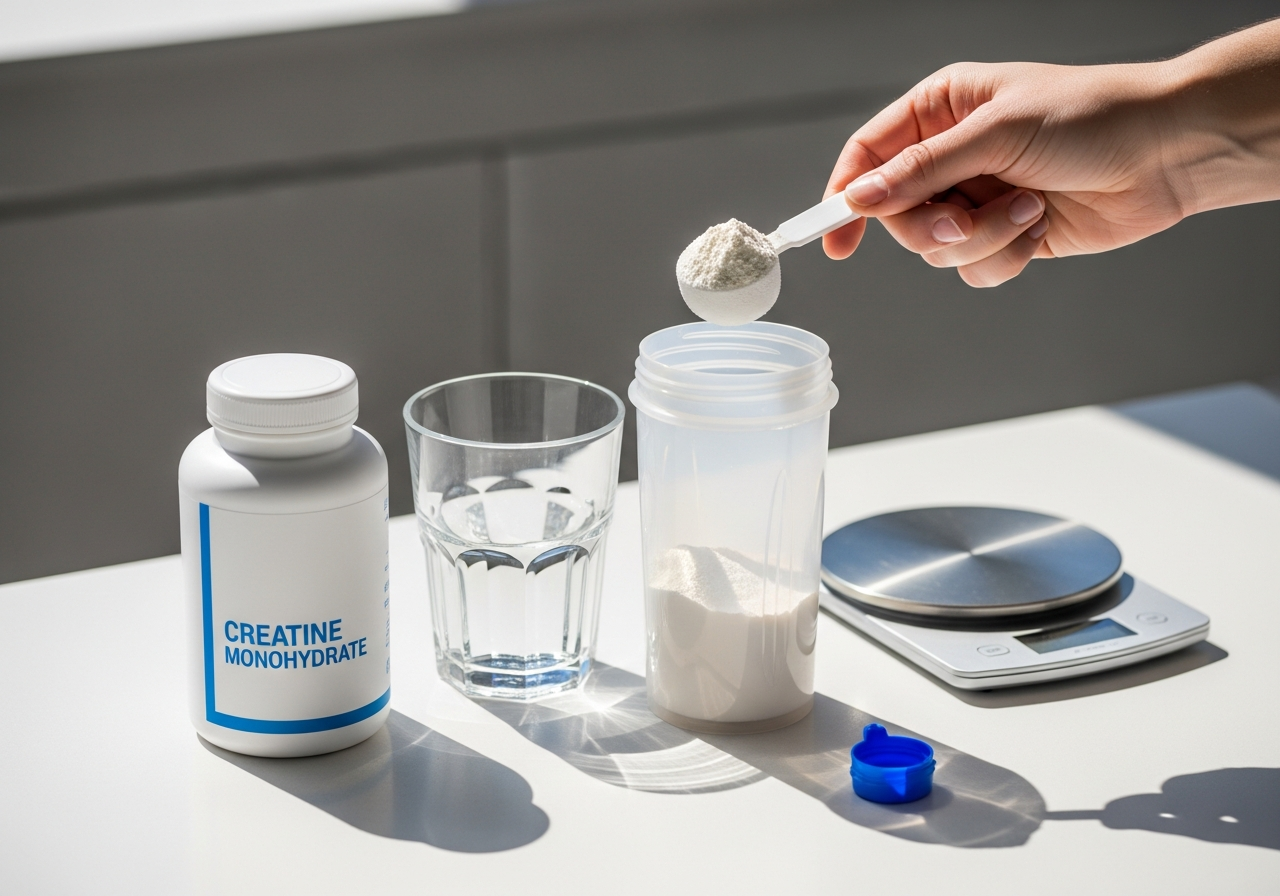
If you want creatine’s performance and muscle benefits while minimizing sudden scale changes, the simplest strategy is to skip the loading phase and take 3-5 g of creatine monohydrate daily. That slower approach still saturates muscle stores; it just does so more gradually.
Here is the step-by-step plan most people can start today:
- Choose creatine monohydrate. It is the most studied, most cost-effective form, and the form supported by the strongest evidence. Our best creatine rankings and creatine brand reviews can help you compare options.
- Take 3-5 g every day. Do not overcomplicate it. Daily consistency matters more than exact timing.
- Mix it in water, a shake, or a meal. Warm liquid can help it dissolve, but room temperature works fine too. See how to mix creatine.
- Take it on rest days too. Muscle saturation depends on repeated intake over time, not only workout-day use.
- Hydrate normally. You do not need extreme water intake, but underhydration can worsen stomach upset or make you feel off. See how much water to drink with creatine.
- Track the right markers for 4 weeks. Use body weight, waist, strength, and training notes together.
If you want faster saturation and do not care about a quicker scale increase, a loading phase is still valid: 20 g/day split into 4 doses for 5-7 days, then 3-5 g/day. Splitting the dose reduces the chance of digestive discomfort compared with taking a large single serving.
What about timing? Timing matters much less than consistency. You can take creatine before or after training, with breakfast, or any other time you will reliably remember it. For the full timing breakdown, see when to take creatine.
If you are nervous because you compete in a weight-class sport, have an important weigh-in, or simply dislike seeing the scale jump, start with 3 g/day for the first 2-3 weeks. That approach often gives you a smoother ramp-up while still moving you toward saturation.
The big mistake is stopping creatine too early because of a normal water shift. If your waist is stable, your muscles feel fuller, and your workouts are improving, the supplement is probably doing exactly what it should.
Creatine dose by body weight and goal: cutting, bulking, maintenance, and sport
Most adults do well with 3-5 g of creatine monohydrate per day, but your goal can determine whether you should load, stay conservative, or be especially careful about scale timing. If you are asking can I gain weight from creatine, the answer partly depends on how aggressively you dose it.
| Body weight / goal | Conservative daily plan | Faster saturation plan | Best for |
|---|---|---|---|
| Under 60 kg | 3 g/day | ~20 g/day split for 5-7 days, then 3 g/day | Smaller athletes, beginners, scale-sensitive users |
| 60-90 kg | 3-5 g/day | ~20 g/day split for 5-7 days, then 3-5 g/day | Most gym-goers |
| Over 90 kg | 5 g/day | ~20 g/day split for 5-7 days, then 5 g/day | Larger lifters, team-sport athletes |
| Cutting / making weight | 3 g/day, no load | Usually avoid loading near weigh-ins | Physique cuts, combat sports, rowing |
| Bulking / muscle gain | 5 g/day | Loading optional | Lifters prioritizing size and strength |
These are practical starting points, not magic thresholds. The commonly cited scientific approach is approximately 0.3 g/kg/day for 5-7 days to load, followed by about 0.03 g/kg/day to maintain, which works out close to the standard 3-5 g/day maintenance range for most adults. For most readers, that level of precision is optional; consistency beats micromanagement.
Goal-based advice:
- If you are cutting: use 3 g/day and skip loading if scale volatility stresses you out.
- If you are bulking: 5 g/day is simple and effective; loading is optional if you want faster saturation.
- If you are in a weight-class sport: avoid loading close to competition and monitor scale response in advance.
- If you are purely performance-focused: loading can make sense if you want stores topped up quickly.
If you are unsure, use our creatine dosage calculator and then read creatine maintenance dose or creatine loading phase for a deeper breakdown.
Remember that higher doses do not create extra benefits once muscle stores are saturated. They are more likely to create stomach upset or make the scale jump faster. More is not better here; better is better.
Who tends to gain more weight on creatine: beginners, women, older adults, and athletes
Different people can respond differently to creatine, but the same basic rule still applies: if body weight goes up, the earliest change is usually water in muscle, not fat. The amount you notice can vary with training status, muscle mass, diet, and whether you load.
Beginners often notice creatine clearly because they are improving rapidly in training anyway, and creatine can support that process. If you are new, start simple with 3-5 g/day and keep lifting. Our creatine for beginners guide covers the basics.
Women often ask whether creatine will make them look bulky. The evidence does not support the idea that standard creatine use suddenly makes women fat or overly muscular. Women may see the same early intracellular water effect as men, but that is not the same as unwanted fat gain. For a dedicated breakdown, see creatine for women.
Older adults may benefit from creatine paired with resistance training for strength and lean mass support, and weight changes may be modest. In this group, the performance and healthy-aging benefits can matter more than the scale alone. See creatine for older adults.
Vegetarians and vegans may respond more noticeably because baseline muscle creatine stores can be lower when dietary creatine intake is lower. That can mean a clearer improvement in performance or a slightly more obvious increase in muscle fullness after supplementation.
Athletes in weight-sensitive sports need context. A sprinter, hockey player, football player, or power athlete may happily accept a small weight increase if repeated-effort performance improves. A boxer, wrestler, lightweight rower, climber, or distance runner may be more cautious, especially near weigh-ins or races. If the scale matters, test creatine in training, not during a critical competition week.
Possible lower responders include people who already consume more creatine-rich foods, have higher baseline stores, or simply experience less visible water change. If that is you, do not assume creatine is useless. Judge response by workouts, not only by the mirror or scale.
The best question is not “will creatine make you gain weight?” but “does the likely performance tradeoff make sense for your goal?” For many people, yes. For weight-class athletes in-season, maybe not right now.
Safety, side effects, and smart buying in Canada
Creatine monohydrate is widely considered safe for healthy people when used at standard doses, and the most common side effects are minor digestive issues or temporary water-related scale changes, not fat gain. The 2017 ISSN position stand and the 2021 JISSN review both support creatine’s strong safety profile in healthy populations.
Common, realistic side effects include:
- Initial weight gain: usually water in muscle, especially with loading.
- Stomach upset or loose stools: more likely if you take too much at once.
- Temporary bloated feeling: often related to dosing method or mixing, not a sign of fat gain.
To reduce side effects:
- Use creatine monohydrate.
- Take 3-5 g/day or split loading doses into smaller servings.
- Mix it well and take it with food if your stomach is sensitive.
- Stay normally hydrated.
People with known kidney disease, those advised to restrict certain supplements by a physician, or anyone managing a medical condition should check with a qualified healthcare professional before starting. Creatine can increase blood creatinine, a breakdown marker often used in kidney tests, without necessarily indicating kidney damage. That is one reason lab interpretation can be confusing; our guide on creatine and kidneys explains the distinction.
In Canada, look for products with clear ingredient lists and, where applicable, a Natural Product Number (NPN), which is the Health Canada identifier for licensed natural health products. An NPN does not guarantee superiority, but it does show the product falls within Health Canada’s regulatory framework. Third-party testing is also useful, especially if you are a competitive athlete concerned about contamination risk. The International Olympic Committee consensus on dietary supplements highlights contamination as a real issue in sport, which is why buying from reputable brands matters.
When comparing options, plain monohydrate powder is usually the best value and the easiest way to get an evidence-based dose. Start with our creatine product catalog or best creatine rankings if you are shopping in Canada.
Myths debunked: creatine does not make you fat, ruin your abs, or force you to bulk
Creatine does not make you fat, and it does not automatically make you look bulky or gain belly fat. Those are among the most common myths in sports nutrition, and they persist because people confuse water in muscle, temporary digestive fullness, and actual body-fat gain.
Myth 1: “Creatine makes you gain fat.”
False. Creatine has no meaningful calories and does not create fat gain on its own. Fat gain comes from a sustained calorie surplus, not from the creatine molecule.
Myth 2: “If the scale goes up, it must be bad weight.”
False. Early creatine-related weight gain is usually intracellular water, which is part of how the supplement works. In the right context, that can coincide with fuller-looking muscles and better training output.
Myth 3: “Creatine causes belly fat.”
False. Creatine does not selectively increase abdominal fat storage. If your waistline is expanding over time, look first at calorie intake, food quality, sodium swings, menstrual cycle changes, stress, and overall training, not just the creatine tub.
Myth 4: “You should avoid creatine while cutting.”
Not necessarily. Many people use creatine successfully during a cut to help preserve strength and training quality. If scale sensitivity bothers you, use 3 g/day and skip loading.
Myth 5: “More expensive forms avoid weight gain.”
Usually unsupported. Claims that HCl, buffered creatine, or other premium forms prevent water retention better than monohydrate are not backed by stronger evidence. Water-related weight change is largely a function of increasing muscle creatine stores, not of paying more for fancy branding.
The cleanest evidence-based view is this: creatine may increase body weight, but that does not mean it makes you fat. If anything, creatine is one of the few supplements where a small scale increase can be completely compatible with better body composition and better performance.
If you want more myth-busting, see creatine myths vs. facts, is creatine a steroid, and does creatine build muscle.
Which form of creatine is best if you are worried about weight gain?
If you are worried about weight gain, the best form is still creatine monohydrate, because the evidence does not show that newer forms meaningfully avoid the normal water-related response while matching monohydrate’s value and research depth. The right strategy is usually changing the dose protocol, not chasing a different form.
| Form | Evidence quality | Typical dose | Best point | Reality on weight gain |
|---|---|---|---|---|
| Creatine monohydrate | Strongest | 3-5 g/day | Most studied, best value | May increase muscle water; expected and normal |
| Micronized monohydrate | Strong | 3-5 g/day | Mixes a bit easier | Not meaningfully different in body-weight effect |
| Creatine HCl | Weaker than monohydrate | Brand-dependent | Marketed for solubility | No strong proof it prevents weight gain better |
| Buffered / Kre-Alkalyn / other variants | Limited | Brand-dependent | Heavy marketing | No convincing evidence they avoid normal water shifts |
| Gummies / capsules | Delivery format only | Varies widely | Convenience | Same active ingredient still behaves like creatine |
If your true concern is the scale, do this instead of switching forms:
- Skip loading.
- Use 3 g/day to start.
- Track weekly averages, not single weigh-ins.
- Judge by waist and performance, not body weight alone.
Monohydrate remains the default recommendation from evidence-based reviews and practitioner consensus because it simply has the best support. Examine’s evidence summary and the ISSN position stand both reinforce that monohydrate is the benchmark form.
In Canada, plain unflavoured monohydrate also tends to be the easiest product to compare cleanly on ingredient simplicity, cost per gram, and regulatory labelling. If you want a dedicated comparison, read best type of creatine, monohydrate vs HCl, and why monohydrate still wins.
The honest bottom line: if you “gain weight” on monohydrate, changing to a pricier form is unlikely to solve a problem that is really just normal creatine physiology.
Bottom line: should you take creatine if you are worried about gaining weight?
Yes, you can still take creatine if you are worried about gaining weight, as long as you understand that any early increase is usually water in muscle, not fat. For most healthy adults, the most sensible approach is creatine monohydrate at 3-5 g/day, taken consistently, with expectations set correctly.
If your goal is strength, power, muscle gain, or preserving training quality while cutting, creatine is often worth it. If your goal depends on making a strict weight class or minimizing any short-term scale fluctuation, creatine can still be useful, but the dosing strategy matters more. In that case, avoid loading near competition and trial it well before an important event.
Here is the simplest decision guide:
- Take creatine now if you want better gym performance, more complete muscle saturation, and you are fine with a possible modest scale increase.
- Take creatine cautiously if you are cutting or weight-sensitive; use 3 g/day and skip loading.
- Delay or discuss with a professional if you have a medical condition or a physician has told you to avoid it.
The final answer to does creatine make you gain weight is this: yes, it can increase body weight, but that early gain is usually water stored in muscle, not body fat, and over time it may help you gain a bit more lean mass by improving training performance. That is very different from “creatine makes you fat.”
If you want to act on this today, buy a basic monohydrate, take 3-5 g daily, keep training, and judge results over 4-8 weeks using more than just the scale. For next steps, read how to take creatine, is creatine safe, and best creatine monohydrate in Canada.
Creatine can raise body weight, but in most users the first change is water inside muscle cells, not fat tissue, and that distinction is the key to using creatine intelligently.
Creatine and weight gain at a glance
- 3-5 g/day Standard maintenance dose — The evidence-based daily amount most adults use to maintain saturated muscle creatine stores.
- 20 g/day Typical loading dose — Usually split into 4 servings for 5-7 days to saturate stores faster.
- 5-7 days Typical loading timeline — Scale changes are most noticeable during this faster saturation phase.
- 3-4 weeks Time to saturate without loading — Taking 3-5 g/day without loading works too, but weight changes usually appear more gradually.
Frequently Asked Questions
Does creatine make you gain weight right away?
It can, especially if you use a loading phase. The earliest weight gain from creatine usually happens within several days to 2 weeks and is mostly water stored inside muscle cells, not fat.
Will I gain weight on creatine if I only take 5 grams a day?
You might, but it is often slower and less noticeable than with loading. Taking 3-5 g/day without loading still raises muscle creatine stores; it just usually takes about 3-4 weeks instead of 5-7 days.
Does creatine make you fat?
No, creatine does not directly make you fat. Creatine does not meaningfully add calories, so body-fat gain still depends on being in a calorie surplus over time.
Can creatine make you gain belly fat?
No, creatine does not specifically cause belly fat gain. If your waistline is increasing, overall calorie intake, food choices, stress, and normal body-weight fluctuations are much more likely explanations than creatine itself.
How much weight gain from creatine is normal?
A small increase is normal, but the exact amount varies a lot by person. Some people notice no major change, while others see a modest bump on the scale during the first 1-2 weeks, especially if they load.
Can I take creatine while cutting without getting bigger?
Yes, many people take creatine during a cut. Using 3 g/day without loading can help minimize sudden scale changes while still supporting training performance and strength retention.
Does creatine make women gain weight?
Creatine can make women gain a small amount of scale weight for the same reason it does in men: more water stored in muscle. That does not mean it causes fat gain or makes women automatically look bulky.
If creatine makes me heavier, should I stop taking it?
Not necessarily. If the gain happened quickly, your waist is stable, and your training feels better, it is probably normal muscle water rather than fat, so stopping may not be necessary.
Is creatine weight gain just water weight?
At first, it is mostly water weight inside muscle cells. Over longer periods, creatine can also support slightly greater lean mass gains by helping you perform more quality work in training.
What is the best way to avoid weight gain on creatine?
The best way to reduce sudden scale changes is to skip loading and take 3-5 g/day consistently. That slower approach still works, but it usually causes less abrupt water-related weight gain.