When to Take Creatine: Before or After Workout, and Does Timing Matter?
By The Creatine Canada Research Team — Evidence-based supplement analysts
The best time to take creatine is the time you will reliably take it every day, because total daily intake matters far more than exact timing. If you want a practical default, take 3 to 5 g of creatine monohydrate daily and place it after training or with a meal, but do not stress if before your workout, at night, or on rest days fits your routine better.
Evidence-based · Cites 4 sources · Editorial standards
Key Takeaways
- Take creatine every day; consistency beats perfect timing.
- A standard maintenance dose is 3 to 5 g of creatine monohydrate daily.
- Post-workout is a reasonable default, but the performance difference versus pre-workout appears small.
- On rest days, still take your usual daily dose to keep muscle creatine stores saturated.
- A loading phase of 20 g/day split into 4 doses for 5 to 7 days speeds up results but is optional.
- You can take creatine with water, a meal, or protein shake; absorption is not fragile.
- Creatine before bed is fine if it does not bother your stomach or your routine.
When to take creatine: the direct answer most people actually need
The best time to take creatine is whenever you can take it consistently every day, because muscle saturation matters more than clock timing. If you want a simple answer to when should you take creatine, take 3 to 5 g of creatine monohydrate daily and attach it to a habit you rarely miss, such as your post-workout shake, breakfast, or dinner.
This is the key point many people miss when searching when to take creatine, when should creatine be taken, or even the typo variation when to creatine: creatine is not like a stimulant pre-workout that you feel within 20 minutes. Creatine works by gradually increasing the amount of creatine stored inside muscle, especially as phosphocreatine, which is the rapidly available form your body uses to help regenerate ATP, the cell's immediate energy currency, during short bursts of hard effort.
Because the mechanism depends on building up stores, the biggest driver of results is whether you take enough creatine often enough for long enough. The 2017 ISSN position stand concluded that creatine monohydrate is the most effective ergogenic nutritional supplement currently available for increasing high-intensity exercise capacity and lean mass during training. That conclusion is about daily use, not a magical minute on the clock.
If you still want a ranking of timing options, this is a fair practical order for most lifters:
- Best for convenience: with the meal or shake you already have every day.
- Best simple workout-day habit: after your workout with protein and carbs if that helps you remember.
- Also completely acceptable: before your workout, between meals, or before bed.
- Least ideal: taking it randomly and often forgetting.
For beginners, the easiest approach is to use plain monohydrate, take it once daily, and stop overthinking timing. If you need a primer on what creatine is and why it works, start with what creatine is, then come back here for the day-to-day timing details.
Why timing matters less than saturation: the mechanism behind creatine
Timing matters less than saturation because creatine works by filling your muscle creatine pool over days and weeks, not by producing an acute same-session boost like caffeine. When people ask when is the best time to take creatine, the physiologically accurate answer is that the supplement only works well once your muscles are sufficiently stocked with creatine and phosphocreatine.
Your body stores most of its creatine in skeletal muscle. There, phosphocreatine helps donate a phosphate group to ADP to regenerate ATP during very short, intense efforts such as heavy sets, sprint intervals, jumps, and repeated high-power bouts. More stored phosphocreatine can improve your ability to maintain output across repeated efforts and, over time, train a little harder or recover a little better between sets. That is why creatine's benefits are usually seen in strength, power, lean mass, and repeated-sprint work rather than endurance pace itself.
Muscle creatine stores can be increased either with a loading phase or with steady daily intake. A typical loading phase is 20 g per day, usually split into four 5 g doses, for 5 to 7 days. A typical non-loading approach is 3 to 5 g per day for several weeks. Both can get you to a saturated state; loading just gets you there faster.
Once saturated, the exact timing of your daily dose is unlikely to change much. Some small studies have compared pre-workout with post-workout creatine, and post-workout sometimes looks slightly favourable, but the body of evidence does not show a large, consistent real-world advantage. The 2021 JISSN review on common creatine questions and misconceptions reinforces a broader point: monohydrate is the reference form, it is well supported, and many fine-grained marketing claims go beyond what the evidence can firmly prove.
In plain English, creatine timing is a small detail sitting on top of a much bigger foundation:
- Choose creatine monohydrate.
- Take enough each day.
- Keep taking it for weeks and months.
- Train hard enough to benefit from improved high-intensity capacity.
That is also why you should still use it on days you do not train. Rest days help maintain the muscle saturation you built in the first place. For more context on timelines, see how long creatine takes to work.
Before or after a workout: should you take creatine pre-workout or post-workout?
If you are choosing between before or after a workout, post-workout is a sensible default, but the difference is probably small enough that convenience should decide. That directly answers the common searches should I take creatine before or after workout, do you take creatine before or after workout, and should you take creatine before or after workouts.
Why does post-workout get recommended so often? Mostly because it is easy to pair creatine with an existing shake or meal, and because training increases blood flow to working muscle and often leads people to eat protein and carbohydrate shortly afterward. In theory, that could support creatine uptake, although the practical effect size appears modest. There is not strong evidence that taking creatine 30 minutes before lifting creates a meaningful acute performance benefit in the same session if your muscles are already saturated.
Pre-workout can still make sense if that is the habit you stick to. For example, some people mix 3 to 5 g into a pre-training drink because it simplifies their routine. That is perfectly acceptable as long as the dose is accurate and the product agrees with your stomach. The only issue is that some pre-workouts underdose creatine or hide it in proprietary blends, which is one reason plain monohydrate remains the smarter buy for most Canadians. If you are comparing options, our best creatine rankings and creatine brand reviews can help.
Here is the practical reality:
- Take it before training if that is the easiest way for you to remember.
- Take it after training if you already use a post-workout shake or meal.
- Do not double dose just because you trained that day.
- Do not skip it on non-training days if your goal is to stay saturated.
If you train early and cannot stomach a shake before lifting, take creatine afterward. If you train late and often forget post-workout supplements, take it earlier in the day with lunch. In other words, the best workout timing is the one that keeps your weekly adherence near 100%.
If you want to combine it with whey, that is fine and common; see mixing creatine with protein powder for practical examples.
Rest days, bedtime, and meals: the timing questions people ask after the gym debate
Yes, you should take creatine on rest days, and yes, you can take creatine before bed if that timing helps you stay consistent. Those are the clean answers to should I take creatine on rest days, should you take creatine on rest days, can you take creatine before bed, and when should you drink creatine.
Rest-day dosing matters because muscle creatine stores are maintained by regular intake, not by only taking it around training. If you only use creatine on workout days, especially if you train three or four times per week, your average intake may be too low to maximise or maintain saturation. A simple rule is to take the same daily dose every day regardless of whether you lift, run, play hockey, or stay home.
Before bed is also fine for most people. Creatine is not a stimulant, so it does not inherently keep you awake. If someone feels discomfort at night, the issue is usually fluid volume, mixing it into a very large shake, or mild stomach sensitivity rather than a sleep-specific effect. In that case, move it to dinner or earlier in the day.
Taking creatine with food can be a good idea if it reduces stomach upset or improves routine adherence. It does not need a special “anabolic window” to work, but pairing it with a meal is often practical. Good options include:
- Breakfast smoothie with 3 to 5 g creatine monohydrate
- Lunch with water or juice
- Post-workout whey shake
- Dinner if you always sit down for that meal
If you practise intermittent fasting, many people still take creatine during the fasting window because plain creatine monohydrate does not meaningfully contribute calories. Whether that fits your fasting rules is a separate personal choice.
For people searching in French, quand prendre la creatine or quand prendre creatine, the answer remains the same: prenez-la chaque jour, à un moment facile à répéter. The best time is the time you do not forget.
If bedtime is your preferred routine, see our guide to creatine before bed. If rest days are your main concern, see creatine on rest days.
Exactly how to take creatine starting today: a no-nonsense step-by-step plan
The simplest way to start creatine is to buy creatine monohydrate, measure 3 to 5 g, take it once daily, and keep doing that for at least a month. If you want a practical answer to when should I take creatine or when do I take creatine, this is the routine that works for almost everyone.
- Choose the right form. Buy plain creatine monohydrate powder unless you have a specific reason to use capsules. Monohydrate is the most studied and usually the most cost-effective form.
- Pick your daily dose. Most adults do well on 3 to 5 g daily. Heavier or more muscular athletes often choose the upper end of that range.
- Decide whether to load. If you want faster saturation, use 20 g per day for 5 to 7 days, split into four 5 g doses. If not, skip loading and take 3 to 5 g daily.
- Attach it to a fixed habit. Example: after training, with breakfast, or at dinner. The habit matters more than the exact clock time.
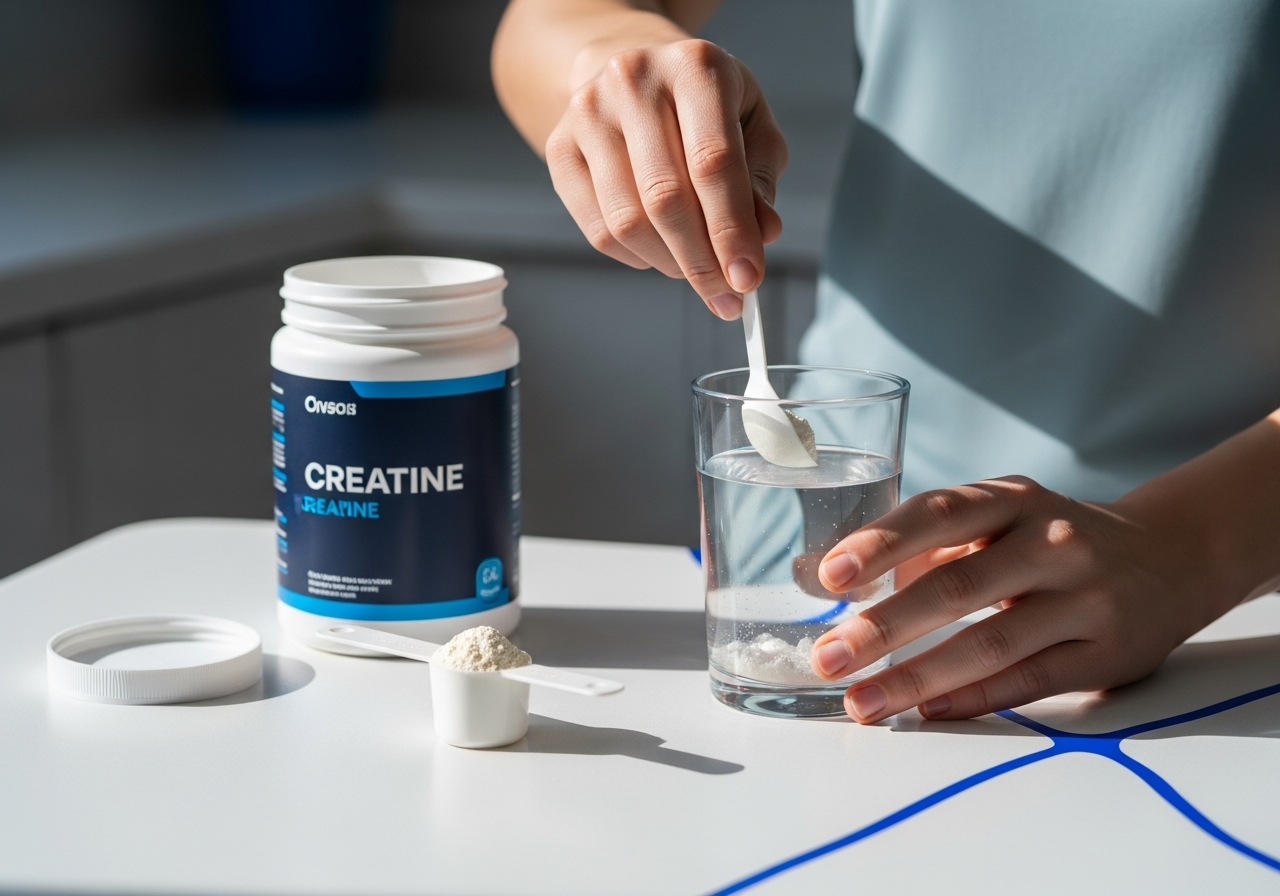
- Mix it simply. Stir it into water, juice, or a protein shake. If it settles, swirl and finish the glass.
- Take it on rest days too. Use the same daily dose seven days per week.
- Give it enough time. Expect faster effects with loading and slower but still effective results without loading.
What might you notice?
- Week 1 with loading: slight body-mass increase from intracellular water and possibly better gym endurance in repeated hard sets.
- Weeks 2 to 4 without loading: performance benefits become more noticeable as stores rise.
- Weeks 4 to 12: the biggest visible payoff is often better training quality translating into strength and lean mass gains over time.
If you want help choosing your dose, use our creatine dosage calculator. If you want a broader tutorial on scooping, mixing, and habit-building, read how to take creatine.
One final beginner tip: do not judge creatine by whether you “feel” it on day one. Creatine is a saturation supplement, not a buzz supplement. The sign it is working is usually better performance over repeated hard efforts and improved long-term training progress, not a dramatic immediate sensation.
The right dose by body weight, training goal, and how quickly you want results
The right creatine dose for most people is 3 to 5 g daily, while a loading phase of 20 g daily split into four doses for 5 to 7 days is the fastest way to saturate muscle stores. This is the part people often mean when they ask when to take creatine monohydrate, because timing and dosing work together.
Body weight can help you choose the low or high end of the standard range, but you usually do not need a complicated formula. A practical approach is:
| Body weight | Maintenance dose | Best for | Notes |
|---|---|---|---|
| Under 60 kg | 3 g/day | Smaller adults, cautious starters | Adequate for many when taken consistently |
| 60-90 kg | 3-5 g/day | Most gym-goers | 5 g/day is the common default |
| Over 90 kg | 5 g/day | Larger or more muscular athletes | Useful when total muscle mass is higher |
| Any body weight, rapid start | 20 g/day for 5-7 days, then 3-5 g/day | People who want quicker saturation | Split into 4 x 5 g doses to improve tolerance |
Goal also matters:
- Strength and hypertrophy: 3 to 5 g daily is the standard evidence-based range.
- Team sport or sprint power: the same daily range works well; loading may help if you want benefits sooner.
- Older adults training for muscle function: 3 to 5 g daily is common, especially when combined with resistance training.
- Vegetarians or vegans: response can be especially noticeable because baseline muscle creatine may be lower.
Do not assume more is better. Taking 10 g daily long-term is not automatically more effective than 5 g if 5 g already keeps you saturated. Higher doses mainly increase the chance of stomach upset and waste your money.
If your scoop is unmarked or you are unsure whether you are actually getting 5 g, check how to measure creatine. For a deeper dose breakdown, read how much creatine per day and creatine maintenance dose.
Who should take creatine, and does timing change for women, older adults, or athletes?
Creatine can benefit beginners, women, older adults, vegetarians, and competitive athletes, and the timing advice is broadly the same across those groups: take it daily, not just around workouts. The difference between groups is usually in expected response, practical routine, and training goal rather than in a special time of day.
Beginners often do best with the least complicated plan: 3 to 5 g monohydrate once daily with a meal or shake. They do not need fancy stacks, cycling, or proprietary pre-workout blends. If that sounds like you, start with creatine for beginners.
Women can use the same basic dosing framework as men. Creatine does not automatically make women “bulky”; it supports training performance and lean mass gains in the context of resistance exercise. Many women prefer taking it with breakfast or a post-workout shake simply because those routines are easier to maintain. See creatine for women for the fuller evidence picture.
Older adults may benefit from creatine alongside resistance training for muscle function and lean mass support. In practice, taking it with a daily meal is often easier than tying it to exercise, especially if training times vary. Consistency is again the priority.
Athletes in power, sprint, and team sports often care most about getting saturated before a competition block, which makes loading more useful. If a meet, tournament, or testing week is coming up, loading 5 to 7 days in advance can be reasonable if body-mass gain is not a downside.
Endurance athletes need more nuance. Creatine can help with sprints, hills, finishing kicks, repeated attacks, and gym work, but the small gain in body mass from water retention may not suit every event. Timing still does not become crucial; the decision is more about whether creatine fits the demands of the sport.
In all groups, the core principle holds: there is no special female timing, no over-50 timing, and no elite-athlete timing that overrides daily adherence. The International Olympic Committee's 2018 supplement consensus includes creatine among the supplements with strong evidence for specific performance uses, but it is still the basic monohydrate-and-consistency strategy that wins in real life. For sport-specific nuance, see creatine for athletes.
Safety, side effects, and how to troubleshoot creatine if timing seems to bother you
Creatine monohydrate is well studied and generally safe for healthy people when used at standard doses, and most timing-related problems are really dosing or digestion problems. That matters because many people think they chose the wrong time of day when the real issue is taking too much at once, not mixing it well, or using a product that does not agree with them.
According to the ISSN position stand, creatine monohydrate is not only effective but also well supported for safety in healthy populations. The Mayo Clinic overview similarly notes that creatine appears to be safe when used appropriately, though people with pre-existing kidney disease or other medical conditions should speak with a healthcare professional first.
Common issues and fixes:
- Stomach upset or loose stools: lower the single dose, split it up, or take it with food.
- Feeling bloated: this is more common during loading; switch to 3 to 5 g daily without loading if needed.
- Powder settling at the bottom: use more water, warmer liquid if preferred, or a shaker bottle.
- Concern about kidney markers: creatine can raise creatinine, a breakdown product used in blood tests, without meaning your kidneys are harmed. That is a testing interpretation issue, not proof of injury.
When should you change timing? Only if your current routine causes a practical problem. For example:
- If pre-workout creatine makes you feel too full, move it post-workout.
- If bedtime creatine means you drink too much water right before sleep, move it to dinner.
- If morning coffee is your only stable habit, mixing creatine then may be easiest.
Creatine does not need to be cycled, dry-scooped, or chased with huge amounts of sugar. It also is not a steroid and does not work through hormones the way anabolic drugs do. For deeper myth-busting, visit creatine myths debunked or our guide to whether creatine is safe.
Common timing mistakes and myths: what people get wrong about when to drink creatine
The biggest creatine timing mistake is treating it like a pre-workout stimulant instead of a daily saturation supplement. That misunderstanding leads to most of the confusion behind searches like when to drink creatine, when should you drink creatine, and when to eat creatine.
Here are the most common myths and the reality behind them:
- Myth: You must take creatine immediately before training.
Reality: There is no strong evidence that pre-workout timing is required for creatine to work once muscle stores are saturated. - Myth: If you miss the post-workout window, you wasted your dose.
Reality: Creatine does not depend on a tiny anabolic window the way supplement marketing often suggests. - Myth: Creatine only works on training days.
Reality: Daily use, including rest days, is how you maintain saturation. - Myth: Taking more creatine at one time works better.
Reality: Bigger single doses mostly raise the chance of GI discomfort; they do not create magical extra uptake. - Myth: Timing can compensate for the wrong form.
Reality: Choosing monohydrate consistently matters more than chasing exotic forms at exotic times. - Myth: You need sugar to absorb creatine.
Reality: Creatine can be taken with or without carbs; food may be helpful, but it is not mandatory.
Another subtle mistake is buying flashy blends that include tiny amounts of creatine and then obsessing over timing instead of checking the label. In Canada, supplements may carry an NPN, which stands for Natural Product Number, showing the product has been authorised for sale by Health Canada within the natural health products framework. That does not replace quality control, so third-party testing and transparent labelling still matter.
If you are shopping in Canada, favour brands that clearly state the creatine form, dose per serving, ingredient list, and ideally independent testing. Our creatine product catalog and best creatine rankings are built to help with exactly that.
The short version is simple: get the right product, use the right dose, and take it every day. Timing is the last 5% question, not the first 95% question.
The best creatine to take at any time: what to buy in Canada and what to skip
The best creatine to take, regardless of time of day, is plain creatine monohydrate from a reputable brand with clear dosing and good quality control. If you are asking when to take creatine monohydrate, it is worth emphasising that monohydrate is still the evidence-based benchmark, not HCl, gummies, liquid creatine, or fancy buffered forms.
Why monohydrate still wins:
- It is the most studied form by a wide margin.
- It reliably raises muscle creatine stores.
- It is usually the lowest-cost option per effective dose.
- Micronized monohydrate may mix a bit better, but it is still monohydrate.
Here is a practical comparison:
| Form | Evidence base | Best use case | Main drawback |
|---|---|---|---|
| Creatine monohydrate powder | Strongest | Most people, best value | Can settle in liquid |
| Micronized monohydrate | Strong | People who want easier mixing | Often slightly pricier |
| Capsules | Strong if monohydrate inside | Travel or convenience | Many capsules needed for 3-5 g |
| Gummies | Depends on product | People who hate powders | Often costly and lower-dose per piece |
| HCl / buffered / ethyl ester | Weaker or less convincing | Niche preference only | Usually more marketing than advantage |
For Canadians, check for a legitimate label, serving size in grams, and if available, an NPN and third-party testing information. A product being sold in Canada does not automatically mean it is the best value or best-dosed product. Compare cost per 5 g effective serving, not just sticker price.
If you want help narrowing down products, see the best creatine monohydrate in Canada, browse our brand reviews, or compare products in the product catalog.
The buying conclusion is straightforward: choose monohydrate first, then make timing work around your life, not the other way around.
Bottom line: the best creatine timing plan for almost everyone
The best creatine timing plan for almost everyone is 3 to 5 g of creatine monohydrate every day, taken at the time you are least likely to miss. If you want the shortest possible answer to when is best time to take creatine, it is this: daily consistency beats pre- versus post-workout timing.
A simple evidence-based plan looks like this:
- Use plain creatine monohydrate.
- Take 3 to 5 g daily.
- Use a loading phase of 20 g/day split into 4 doses for 5 to 7 days only if you want faster saturation.
- Take it after training or with a meal if you want an easy default.
- Keep taking it on rest days.
- Adjust the timing only if your stomach or schedule prefers another slot.
If you are the kind of person who likes precise rules, here is the honest one: post-workout is a good recommendation because it is convenient and plausible, not because the evidence proves it is dramatically superior. If pre-workout, lunch, or before bed is the only routine you can maintain for months, that is the better timing for you.
That is also why creatine remains one of the rare supplements worth taking seriously. Its benefits are well established, the mechanism is clear, and the practical strategy is refreshingly simple. You do not need to cycle it, spike it with sugar, or chase exotic forms. You just need the right product, the right dose, and enough consistency to let saturation do its job.
If you want your next step, use the dosage calculator, read how much creatine per day, or compare options in our best creatine guide. Once those basics are covered, you can stop worrying about the clock and focus on training hard enough to benefit.
Creatine Timing in Numbers
- 3-5 g/day Standard maintenance dose — The typical evidence-based daily range for most adults.
- 20 g/day Common loading dose — Usually split into 4 x 5 g doses for 5 to 7 days.
- 5-7 days Typical loading timeline — A loading phase can raise muscle stores faster than maintenance dosing alone.
- 4+ weeks No-loading patience window — Daily 3 to 5 g without loading still works, but saturation takes longer.
Frequently Asked Questions
When should you take creatine for the best results?
You should take creatine at the time of day you can stick to consistently, because daily intake matters more than exact timing. For most people, 3 to 5 g of creatine monohydrate after a workout or with a meal is an easy default, but morning, pre-workout, or bedtime can work just as well if adherence is better.
Should I take creatine before or after my workout?
You can take creatine either before or after your workout, but post-workout is a practical default. The evidence does not show a large, consistent advantage for one over the other, so the smarter choice is the timing you are least likely to forget.
Should you take creatine on rest days?
Yes, you should take creatine on rest days to maintain muscle creatine saturation. Creatine works by keeping your muscle stores elevated over time, so skipping non-training days can reduce the consistency that makes supplementation effective.
Can you take creatine before bed?
Yes, you can take creatine before bed if that is your most reliable routine. Creatine is not a stimulant, so it does not inherently interfere with sleep, though some people prefer taking it earlier if a large drink before bed feels uncomfortable.
When should I drink creatine if I work out in the morning?
If you work out in the morning, take creatine either right after training or with breakfast. There is no need to force it pre-workout unless that habit is easier for you, because your long-term daily intake matters more than the exact minute you drink it.
Do I need to take creatine with food?
No, you do not need to take creatine with food for it to work. That said, taking creatine with a meal or shake can make it easier to remember and may reduce stomach upset for people who do not tolerate supplements well on an empty stomach.
How long does creatine take to work?
Creatine can start working within about a week if you use a loading phase, while a no-loading approach usually takes several weeks to fully build muscle stores. The practical difference is speed, not effectiveness, because both methods can raise muscle creatine when used consistently.
What happens if I miss a day of creatine?
Missing one day of creatine is not a big deal, because muscle saturation does not disappear overnight. Just resume your normal daily dose the next day and do not try to overcompensate with a large catch-up dose.
Is there a best time to take creatine monohydrate specifically?
No special clock time is unique to creatine monohydrate; the best time is still the time you can repeat every day. Post-workout or with a meal are common choices simply because they fit naturally into established routines.
Can I mix creatine with protein powder or coffee?
Yes, you can mix creatine with protein powder, and many people do so after training for convenience. Coffee is also generally fine if that is how you remember to take it, though some people prefer separate timing if hot drinks or caffeine upset their stomach.