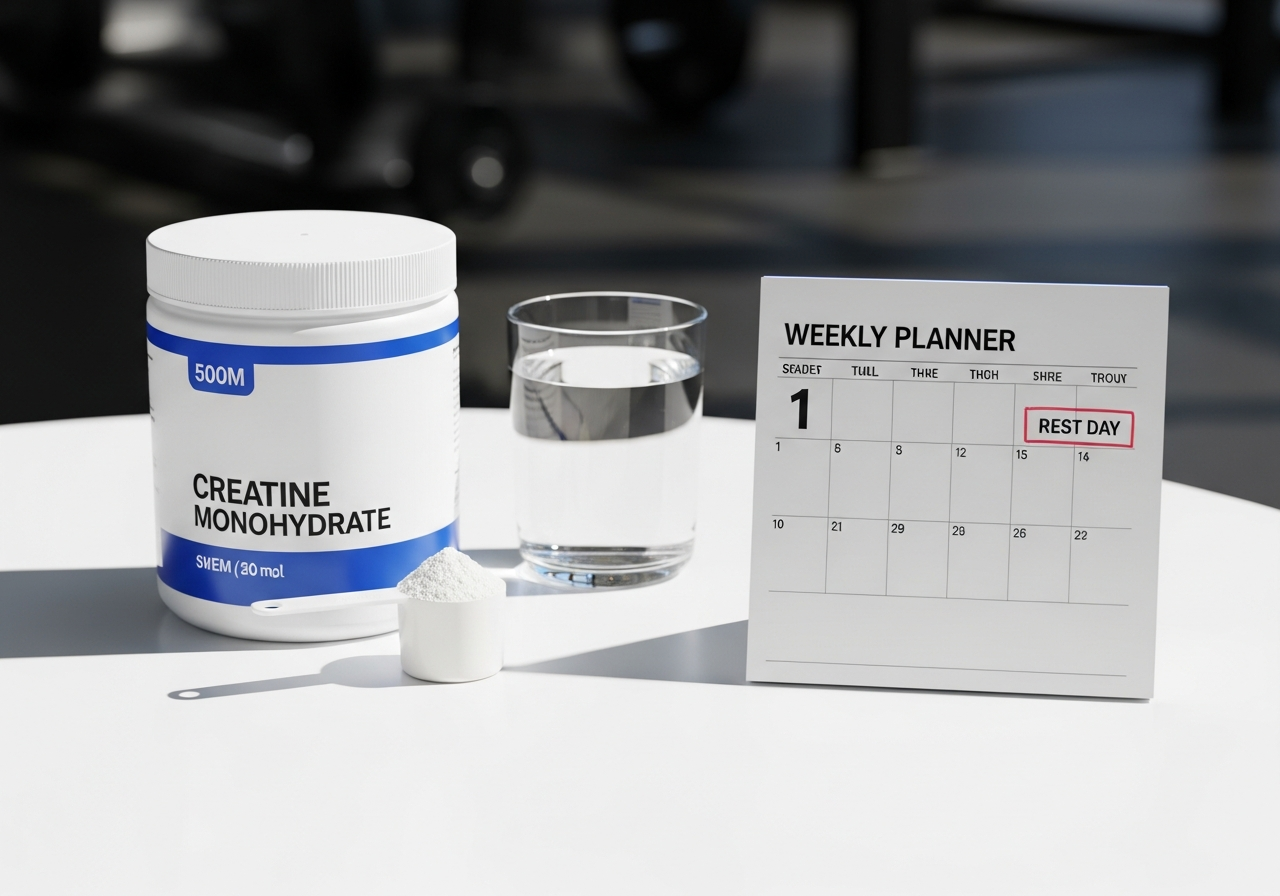
Creatine on Rest Days: Should You Still Take It?
By The Creatine Canada Research Team — Evidence-based supplement analysts
Yes — you should still take creatine on rest days if your goal is to keep your muscle creatine stores saturated. Creatine works by building up in muscle over days and weeks, not by giving a one-day boost only on workout days, so consistency matters more than whether you train that day.
Evidence-based · Cites 4 sources · Editorial standards
Key Takeaways
- Take creatine on rest days the same way you take it on training days: consistently, every day.
- A standard maintenance dose is 3-5 g of creatine monohydrate daily for most adults.
- Rest-day timing matters far less than total daily intake; take it whenever you will remember it.
- If you skip rest days often, your muscle creatine stores can gradually drift down over time.
- Loading is optional, but if you do it, keep taking creatine on off days during and after the loading phase.
- Creatine monohydrate is the most studied, most effective, and usually the best-value form.
- Mild water-weight gain or stomach upset is usually manageable by using the right dose and splitting it if needed.
Yes, take creatine on rest days — because saturation, not workout timing, drives results
Yes, you should take creatine on rest days if you want the supplement to work as intended. Creatine is not a stimulant or pre-workout that only matters in the hour before training; it works by increasing the amount of creatine and phosphocreatine stored inside muscle, and those fuller stores support repeated high-intensity efforts over time.
If you are asking, should I take creatine on rest days? the practical answer is simple: take it daily, whether you train or not. This is also the best answer to related searches like creatine non training days, when to take creatine on off days, and do you need creatine on rest days. Daily intake helps maintain muscle saturation, which is the point of supplementation in the first place.
The 2017 International Society of Sports Nutrition position stand concluded that creatine monohydrate is the most effective nutritional supplement currently available for increasing high-intensity exercise capacity and lean mass during training when used appropriately. That conclusion is based on regular supplementation, not only workout-day use. See Kreider et al. (2017), ISSN Position Stand.
Think of creatine like topping up a rechargeable battery in your muscles. Training is when you spend that battery. Daily creatine is how you keep it topped up. If you only take it on workout days, you can still get some benefit if your weekly intake is high enough, but it is a less reliable strategy than simply taking 3-5 g every day.
For most people, the best routine is boring on purpose:
- Training day: take your usual daily dose.
- Rest day: take the same usual daily dose.
- Missed dose: do not double up aggressively; just resume your normal schedule.
If you want help choosing a dose, start with our creatine dosage calculator or read more on how much creatine per day. If you are brand new to the supplement, the best beginner framework is daily creatine, adequate hydration, and patience for a few weeks rather than obsessing over minute-by-minute timing.
What creatine is doing on off days inside your muscles
Creatine on rest days helps preserve elevated intramuscular creatine and phosphocreatine, which are the energy stores your body uses to rapidly regenerate ATP, the cell’s immediate energy currency, during short, hard efforts. In plain English: your muscles do not stop storing creatine just because you skipped the gym that day.
About 95% of the body’s creatine is stored in skeletal muscle. Once supplemented, creatine increases the available pool of phosphocreatine, which helps you resynthesize ATP faster during repeated bouts of heavy lifting, sprinting, jumping, or other high-intensity work. That is why creatine is especially useful for strength, power, and repeated-effort performance rather than long, steady endurance alone.
Rest days matter because muscle creatine stores are not a switch that flips on only during a workout. They are more like a reservoir. Supplementation fills the reservoir. Training draws from the performance system that reservoir supports. Maintenance intake helps keep the level high enough that you show up to the next session with stores still elevated.
This is also why when to take creatine on off days is a smaller issue than many people think. There is no special anabolic window unique to rest days. Your main job is simply to keep the muscle pool topped up by taking a consistent dose.
The 2021 JISSN review on common questions and misconceptions about creatine notes that many myths around timing, water retention, and safety are overstated or poorly understood. What has held up well across decades of research is the core mechanism: regular creatine monohydrate supplementation raises muscle creatine content, and that supports performance and training adaptations over time. See Antonio et al. (2021).
If you want the simplest mental model, use this one:
- Workout days: creatine helps support high-intensity performance.
- Rest days: creatine helps maintain the stored supply that makes that support possible.
- Over weeks: the benefit comes from consistency, not from a one-time dose before a single session.
For a broader foundation, see what creatine is and what it does and the evidence-based benefits of creatine.
Exactly how to take creatine on rest days without overthinking it
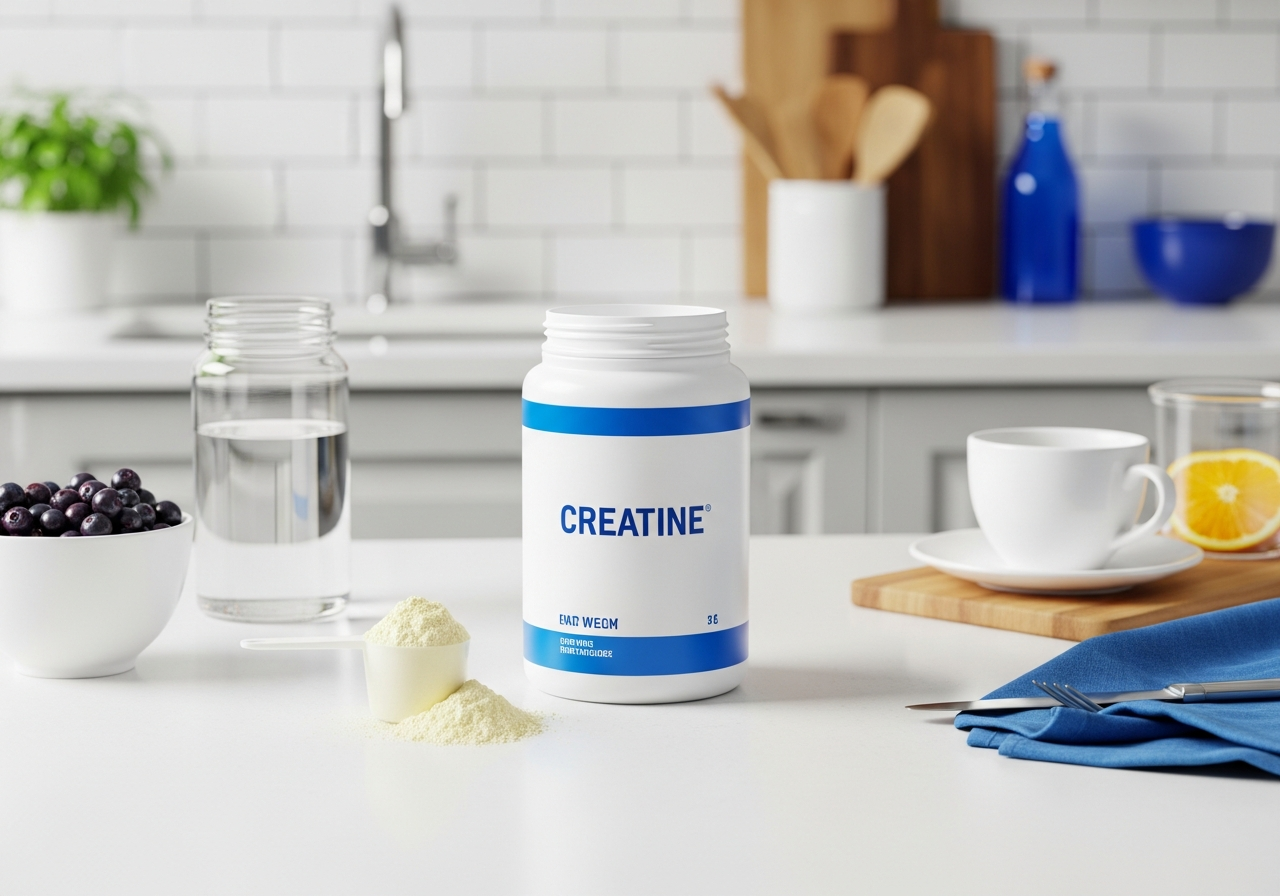
The best way to take creatine on rest days is to use the same simple maintenance routine you use on training days. For most adults, that means 3-5 g of creatine monohydrate once daily, taken with water or mixed into a shake, at whatever time you can repeat consistently.
- Choose creatine monohydrate. Monohydrate is the most studied form and the benchmark against which newer forms are compared. If you are not sure where to start, review the best creatine rankings or browse the creatine product catalog.
- Pick a daily dose. Most people do well with 3-5 g per day. Larger athletes and people with more lean mass often sit toward the upper end of that range.
- Attach it to a routine. Take it with breakfast, lunch, dinner, or your usual protein shake. The best rest-day timing is the time you will actually remember.
- Mix and drink it normally. Stir it into water, juice, or a shake. It does not need fancy transport ingredients to work.
- Stay consistent. Use it every day for weeks, not only when motivation is high.
- Adjust if your stomach is sensitive. Split 5 g into two smaller doses, or take it with a meal.
Many people ask if they should take creatine in the morning, at night, or with a meal on non training days. The evidence-based answer is that timing is secondary to adherence. If a bedtime dose means you never miss it, that is better than chasing an ideal time and forgetting half the week. For a deeper timing breakdown, see when to take creatine.
Here is a rest-day routine that works well in real life:
- Morning person: 3-5 g in water with breakfast.
- Shake person: 3-5 g in a protein shake with lunch.
- Habit stacker: keep the tub beside your coffee maker or vitamin organiser.
- Traveller: pre-portion doses in small containers so off days do not become missed days.
If you want even more step-by-step detail, read how to take creatine and how to mix creatine.
Rest-day dose by body weight, goal, and whether you loaded first
The right creatine dose on rest days is usually the same as your regular daily dose, and for most adults that means 3-5 g of creatine monohydrate. The exact number does not need to change just because it is an off day.
There are two mainstream ways to start creatine:
- Loading approach: about 20 g per day, split into 4 doses of 5 g, for 5-7 days; then 3-5 g per day for maintenance.
- No-loading approach: 3-5 g per day from the start; saturation takes longer, but you still get there.
Loading is optional, not required. Its main benefit is speed. If you load, you should still take creatine on rest days during the loading week and after it. If you skip loading, take your daily maintenance dose on all days and let time do the work.
| Body weight / situation | Typical rest-day dose | Practical note |
|---|---|---|
| Under 60 kg | 3 g/day | Often enough for maintenance if taken consistently |
| 60-90 kg | 3-5 g/day | Most people in this range use 5 g for simplicity |
| Over 90 kg or very muscular | 5 g/day | Larger lean mass tends to justify the top end |
| After a loading phase | 3-5 g/day | Do not keep taking 20 g/day long term unless specifically advised |
| Sensitive stomach | 2 x 2.5 g/day | Split dosing can reduce GI discomfort |
Your goal can also influence how you think about the dose, though not usually by much:
- General fitness: 3-5 g/day.
- Strength and hypertrophy: usually 5 g/day for simplicity and consistency.
- Older adults: 3-5 g/day, especially useful when paired with resistance training.
- Vegetarians or vegans: 3-5 g/day, and some may notice a stronger response because baseline stores can be lower.
If you want a more customised number, use the creatine dosage calculator or read creatine maintenance dose and creatine loading phase. The key rest-day rule stays the same: keep the daily habit intact.
When to take creatine on off days: the best time is the time you will not miss
The best time to take creatine on off days is whenever you can take it consistently, because daily saturation matters more than clock time. If you are not training that day, there is no strong evidence that morning, afternoon, or evening is meaningfully superior for most people.
This answer disappoints people who want an exact minute-by-minute protocol, but it is useful because it makes adherence easier. Rest days are where many routines break down. If your training-day habit is tied to your workout shake, you need a new cue for non training days so you do not forget it.
Good rest-day timing options include:
- With breakfast: ideal for people who like a fixed morning routine.
- With lunch: useful if you already take other supplements midday.
- With dinner: often easiest for busy professionals.
- With a protein shake: convenient if you already use whey on off days.
You do not need to take creatine with carbohydrates for it to work, and you do not need a special insulin spike to benefit. Eating it with a meal can be helpful if that improves tolerance or makes the habit stick, but it is not mandatory. Likewise, there is no compelling reason to avoid taking it later in the day unless you personally find that any fluid intake close to bed disrupts sleep because you wake to use the bathroom.
If your real question is whether timing matters at all, the honest answer is: a little, maybe, in some contexts, but much less than consistency and adequate daily dose. Workout timing might have small practical advantages for habit formation, but rest-day timing is mostly a compliance question. For a full breakdown, see when to take creatine and whether to take creatine with or without food.
A useful rule of thumb is this: if you regularly wonder what time to take creatine on off days, choose the earliest convenient moment in your day and make it automatic. The best schedule is the one that survives weekends, travel, and missed gym sessions.
What to expect if you keep taking creatine on non-training days
If you take creatine on rest days consistently, what you should expect is steadier saturation and a better chance of noticing performance benefits over the next several weeks. Creatine does not usually feel dramatic overnight unless you loaded, and even then, the clearest effects often show up in the gym rather than in how you feel at rest.
Here is a realistic timeline for most people using creatine monohydrate:
- Days 1-7 with loading: muscle stores rise quickly; some people notice a small body-weight increase from intracellular water.
- Weeks 1-2 without loading: not much to “feel,” but stores are gradually building.
- Weeks 2-4: you may notice slightly better repeat performance, an extra rep, stronger sprint repeatability, or better training volume.
- Weeks 4-8: the effect becomes more obvious through training outcomes, such as improved strength progression, better session quality, or a fuller muscle look.
How do you tell it is working? Look for useful markers, not magic sensations:
- One or two more reps at the same load
- Better maintenance of power across sets
- Less drop-off in repeated sprints or explosive efforts
- Gradual improvements in training volume
- A small increase in scale weight from water stored in muscle, not fat gain
If you skip creatine every weekend or only take it on workout days, the effect may still build if your average intake remains decent, but it becomes less consistent and less idiot-proof. Daily use on off days keeps the process smoother.
The IOC consensus on dietary supplements recognises creatine as one of the few supplements with strong evidence for certain performance uses, particularly short-duration, high-intensity exercise. See the International Olympic Committee consensus (2018). That is important because it reminds people to judge creatine by performance and training adaptation, not by whether they “feel” a buzz.
If you want a more detailed results timeline, read how long creatine takes to work and whether creatine builds muscle.
Who should keep taking creatine on rest days: beginners, women, older adults, and athletes
Nearly everyone who is a good candidate for creatine should take it on rest days, because the basic physiology does not change by sex, age, or training level. If creatine is appropriate for you at all, daily use is usually the most effective and simplest plan.
Beginners: new lifters often assume supplements only matter around workouts, but beginners may benefit most from a simple daily routine because consistency is easier than complicated timing. If you are just starting, daily 3-5 g monohydrate is the easiest evidence-based setup. See creatine for beginners.
Women: women do not need a separate “female creatine” protocol. The same rest-day principle applies: take it every day. Women often avoid creatine because they fear bulk or fat gain, but creatine does not directly cause fat gain. Any early weight increase is usually water stored inside muscle. See creatine for women and does creatine make you gain weight.
Older adults: older adults can benefit from daily creatine, especially alongside resistance training, because maintaining muscle function and lean mass becomes more important with age. Rest-day dosing matters here too because the goal is maintaining elevated stores over time, not chasing a workout-only effect. See creatine for older adults.
Athletes: power athletes, team-sport athletes, sprinters, CrossFit athletes, and many lifters are especially likely to benefit from consistent daily supplementation. Athletes with frequent training blocks, travel, and mixed schedules should be even more strict about rest-day use because off days and transit days are where doses get missed. See creatine for athletes.
Vegetarians and vegans: because dietary creatine intake from meat and fish is absent or lower, some plant-based people may experience a stronger effect from supplementation. Daily use on off days is part of that advantage. See is creatine vegan.
The main exception is not a special group that should skip rest days; it is people who should discuss creatine with a qualified clinician first because of a medical condition, medication use, or renal evaluation in progress. For that conversation, see who should not take creatine.
Safety on rest days: side effects, kidney confusion, hydration, and Canadian buying tips
Taking creatine on rest days is generally considered safe for healthy people at standard doses, and there is no evidence that the dose becomes riskier simply because you did not train that day. The safety questions around creatine are mostly about the supplement overall, not about rest-day use specifically.
The most common issues are practical rather than dangerous:
- Water-weight gain: often a small early increase from more water stored inside muscle cells.
- Stomach upset: more likely with large single doses, poor mixing, or aggressive loading.
- Bloating complaints: often dose- or product-related, and frequently manageable.
A persistent myth is that creatine damages healthy kidneys. Current evidence does not support that claim in healthy individuals using recommended amounts, though creatine can increase blood creatinine, which is a breakdown marker that can confuse kidney lab interpretation. That is not the same thing as kidney damage. If you have known kidney disease, are under renal investigation, or have been advised to limit certain supplements, speak with your clinician before use. For the big-picture review, see Mayo Clinic — Creatine and the creatinine confusion explained.
Hydration matters, but the popular claim that creatine dehydrates you is not supported by the weight of evidence. You do not need to chug absurd amounts of water; you just need normal good hydration habits. If you are prone to headaches, cramps, or GI issues, ensure your fluid and electrolyte intake is sensible and your dose is appropriate. See how much water to drink with creatine and does creatine dehydrate you.
For Canadians, buy products with clear ingredient labelling and, ideally, third-party testing. On Canadian shelves, you may see an NPN, or Natural Product Number, which indicates a licensed natural health product under Health Canada’s framework. An NPN is useful for regulatory legitimacy, but it does not replace good manufacturing quality or independent testing. Compare labels, serving sizes, and grams per scoop carefully in our creatine brand reviews and best creatine rankings.
The biggest mistakes people make with creatine on rest days
The biggest mistake with creatine on rest days is treating it like a pre-workout instead of a daily saturation supplement. That single misunderstanding causes most dosing errors, missed doses, and disappointment.
Here are the most common mistakes, with the fix for each:
- Mistake 1: Only taking creatine before workouts.
Fix: Take it every day. Creatine works through tissue saturation, not an acute stimulant effect. - Mistake 2: Skipping weekends.
Fix: Build a non-gym cue, such as breakfast or brushing your teeth, so your routine survives off days. - Mistake 3: Using too much because more seems better.
Fix: Stick to 3-5 g/day for maintenance unless you are intentionally doing a short loading phase. - Mistake 4: Quitting after one week because you do not feel anything.
Fix: Judge creatine by performance and training progress over weeks, not by an immediate sensation. - Mistake 5: Assuming weight gain means fat gain.
Fix: Early scale changes are usually water inside muscle, not body fat. - Mistake 6: Buying fancy forms expecting superior results.
Fix: Use monohydrate first. It remains the reference standard for efficacy, safety, and value.
Now the quick myth round:
- Myth: You do not need creatine on rest days.
Fact: Rest days are part of the daily maintenance strategy that keeps muscle stores elevated. - Myth: Rest-day creatine turns into fat if you do not exercise that day.
Fact: Creatine is not a fat-building nutrient and has no calories in the way carbohydrate or fat does. - Myth: Missing one rest day ruins your progress.
Fact: One missed day is not a disaster; repeated inconsistency is the real problem. - Myth: You must cycle on and off creatine.
Fact: Routine cycling is not required for most healthy users.
If you enjoy seeing supplement myths dismantled point by point, read creatine myths debunked, creatine myths vs. facts, and do you need to cycle creatine.
Which creatine should you take on rest days? Monohydrate still wins
The best creatine to take on rest days is almost always plain creatine monohydrate, because it is the most studied, most reliable, and usually the most cost-effective option. Rest-day use does not require a special form, delivery system, or “recovery blend.”
| Form | Best use case | Evidence strength | Rest-day verdict |
|---|---|---|---|
| Creatine monohydrate | Almost everyone | Strongest | Best default choice |
| Micronized monohydrate | People who want easier mixing | Strong, same core ingredient | Good if texture matters |
| Capsules | Convenience and travel | Good if total dose is adequate | Fine, but often pricier per gram |
| Gummies | People who hate powders | Varies by product and dose | Works if the label delivers enough grams |
| HCl / buffered / ester forms | Niche preference | Weaker than monohydrate overall | Usually not worth extra cost |
Why does monohydrate still dominate? Because newer forms are often marketed on claims of better absorption, less bloating, or smaller doses, but they have not consistently outperformed monohydrate in the research. Monohydrate already absorbs well and reliably raises muscle creatine stores when taken at evidence-based doses.
On rest days, simplicity matters even more than usual. The easier and cheaper your product is to use daily, the more likely you are to stay consistent for months rather than days. That is one reason powders remain popular: they deliver the full effective dose without requiring you to swallow a handful of capsules or spend extra on trendier formats.
When buying in Canada, check:
- Creatine monohydrate as the primary ingredient
- Transparent grams per serving
- Minimal unnecessary fillers if you want pure powder
- NPN where applicable and sensible quality controls
- Third-party testing or strong brand transparency
To compare options, see best type of creatine, best creatine monohydrate in Canada, powder vs capsules, and why monohydrate still wins.
Bottom line: what to do on your next rest day
On your next rest day, take your normal daily creatine dose. That is the short answer, the practical answer, and the evidence-based answer.
If you want the simplest possible protocol, use this:
- Buy creatine monohydrate.
- Take 3-5 g every day.
- Do not skip off days.
- Take it at a time you will remember.
- Give it several weeks to show up in your training.
If you loaded with about 20 g/day split into four doses for 5-7 days, move to 3-5 g/day and continue taking it on rest days. If you did not load, keep taking 3-5 g/day and be patient while your stores build more gradually.
The reason this works is straightforward: creatine supports performance by increasing muscle creatine and phosphocreatine stores over time. Rest days are part of that process, not an exception to it. Missing one day is not catastrophic, but making a habit of skipping all non training days is a common and unnecessary way to undermine results.
If you want the full system dialled in, pair this article with how much creatine per day, when to take creatine, how long creatine takes to work, and what happens if you miss a day.
One-sentence takeaway: You do need creatine on rest days if you want to keep muscle stores saturated, and for most people the right move is 3-5 g of creatine monohydrate every day, regardless of whether you train.
That daily consistency is what turns creatine from a tub in your cupboard into a supplement that actually improves your training.
Creatine on Rest Days: The Numbers That Matter
- 3-5 g/day Standard maintenance dose — Typical daily amount for most adults, including rest days
- 20 g/day Optional loading dose — Usually split into 4 doses for 5-7 days
- 5-7 days Typical loading phase length — Speeds muscle saturation compared with maintenance-only dosing
- 95% Of body creatine stored in muscle — Supports high-intensity energy production through phosphocreatine
Frequently Asked Questions
Should I take creatine on rest days?
Yes, you should take creatine on rest days if your goal is to keep muscle creatine stores elevated. Creatine works through saturation over time, so daily consistency matters more than whether you train that day. For most people, 3-5 g of creatine monohydrate on both training and non-training days is the simplest effective plan.
Do you need creatine on rest days if you already took it all week?
Yes, you still need creatine on rest days if you want the most consistent results. One skipped day is not a disaster, but regularly skipping all off days makes your routine less reliable and can gradually reduce the benefit of staying fully saturated. Daily use is the evidence-based default.
When should I take creatine on off days?
Take creatine on off days whenever you are most likely to remember it. Morning, lunch, dinner, or with a shake are all fine because rest-day timing is much less important than total daily intake. The best time is the one that turns into a repeatable habit.
How much creatine should I take on non-training days?
Most adults should take the same amount on non-training days as on training days: 3-5 g of creatine monohydrate. If you completed a loading phase, switch to 3-5 g daily for maintenance. Larger or very muscular people often choose 5 g for simplicity.
Can I skip creatine on weekends?
You can skip creatine on weekends, but it is not the best approach if you want consistent saturation and easy long-term results. Missing an occasional day will not erase progress, yet turning every weekend into two missed doses is an avoidable mistake. A daily schedule works better.
Is creatine useless if I take it on rest days?
No, creatine is not useless on rest days; rest-day intake is part of how creatine works. The supplement raises muscle creatine stores over days and weeks, and those stores are what support future training performance. Off-day dosing helps maintain the reservoir rather than wasting the supplement.
Do I need to take creatine with food on rest days?
No, you do not need to take creatine with food on rest days for it to work. Taking it with a meal can improve convenience or stomach comfort for some people, but creatine monohydrate does not require food to be effective. Choose the approach you can stick with consistently.
What happens if I miss a day of creatine?
If you miss one day of creatine, usually not much happens and you should simply resume your normal dose the next day. Creatine stores do not vanish overnight, so there is no need to panic or double up aggressively. The real issue is repeated inconsistency, not a single missed dose.
Should beginners take creatine every day or only on workout days?
Beginners should usually take creatine every day rather than only on workout days. Daily use is easier to remember, aligns with how creatine actually works, and removes unnecessary complexity. A simple 3-5 g monohydrate routine is usually the best beginner setup.
Can women take creatine on rest days too?
Yes, women should take creatine on rest days by the same daily logic as men. The mechanism is the same: maintaining elevated muscle creatine stores over time. Women do not need a separate off-day protocol, and typical daily maintenance remains 3-5 g of creatine monohydrate.