Creatine Loading Phase: Is It Necessary, and How to Do It Right
By The Creatine Canada Research Team — Evidence-based supplement analysts
A creatine loading phase is not necessary, but it is the fastest way to fully saturate your muscles with creatine. If you want results sooner, take 20 grams per day split into 4 doses for 5-7 days, then drop to 3-5 grams daily; if you do not mind waiting a few extra weeks, skip loading and just take 3-5 grams per day.
Evidence-based · Cites 4 sources · Editorial standards
Key Takeaways
- A creatine loading phase means taking about 20 g/day for 5-7 days to saturate muscle faster.
- Loading works, but it is optional; 3-5 g/day without loading still gets you there in roughly 3-4 weeks.
- The best-supported form for loading is creatine monohydrate because it is the most studied and most cost-effective.
- Splitting loading into 4 smaller doses of 5 g reduces the chance of stomach upset better than taking 20 g at once.
- Most people should switch to a maintenance dose of 3-5 g/day after loading, with larger athletes sometimes using 5-7 g/day.
- Short-term weight gain during loading is usually water pulled into muscle, not body fat.
- Healthy adults can usually load safely, but people with kidney disease, relevant medical conditions, or physician-directed restrictions should ask a clinician first.
What a creatine loading phase actually is, and whether you really need one
A creatine loading phase is a short period of taking a higher dose of creatine, usually 20 grams per day for 5-7 days, to raise muscle creatine stores quickly. The direct answer to what is the loading phase for creatine and is creatine loading necessary is simple: loading is effective, but it is optional.
Your muscles store creatine as free creatine and phosphocreatine, which is the high-energy form used to rapidly regenerate ATP, the cell’s immediate fuel for hard efforts like sprinting, jumping, and heavy sets. Supplementation gradually increases those stores, but a loading phase fills them faster than a standard daily dose. The 2017 ISSN position stand concluded that creatine monohydrate is the most effective ergogenic nutritional supplement currently available for increasing high-intensity exercise capacity and lean mass during training.
So, does a loading phase of creatine work? Yes. Loading does not create a different end result than daily low-dose use; it simply gets you to full saturation faster. If you take 3-5 grams daily without loading, you will usually reach near-maximal muscle saturation in roughly 3-4 weeks. If you load, many people get there within about a week.
This is why a loading phase can be useful when:
- You want faster performance benefits for a training block or competition prep.
- You are starting creatine and want to feel the effects sooner.
- You are fine with a slightly higher chance of temporary water-weight gain or mild digestive discomfort.
And it is why skipping the loading phase is perfectly reasonable when:
- You prefer the simplest routine possible.
- You have a sensitive stomach.
- You are not in a rush and are happy to let stores rise gradually.
If you are new to creatine, read this page as your complete answer, then use our creatine dosage calculator for a quick body-weight-based estimate and our beginner guide at /creatine-for-beginners if you want a broader overview.
How creatine loading works inside the muscle
Creatine loading works by rapidly increasing intramuscular creatine and phosphocreatine stores, which helps your muscles regenerate ATP faster during repeated hard efforts. That is the key mechanism behind why loading can improve gym performance sooner than a low daily dose alone.
When you perform a short, intense effort, ATP is broken down for energy in seconds. Phosphocreatine then donates a phosphate group to help rebuild ATP quickly. More stored phosphocreatine means a better ability to maintain force output across repeated bouts of near-maximal work, such as heavy compound lifts, sprint intervals, repeated jumps, and high-power team sport actions.
A loading phase takes advantage of the fact that skeletal muscle can absorb more creatine over a short window when doses are high and spread through the day. This is why the classic protocol is 20 grams daily divided into four 5-gram servings. By contrast, a straight 3-5 gram maintenance dose increases stores more gradually because the daily input is lower.
Loading does not mean your body suddenly starts using creatine in a new way. It means your muscles reach the same destination faster. In practical terms, the likely benefits you may notice after full saturation include:
- One or two extra reps on some sets at a given weight.
- Better repeat sprint or repeat effort performance.
- A slightly higher training volume over the week.
- Faster increases in lean mass over time because you can train harder and recover better between hard bouts.
The mechanism also explains one of the most common early changes: scale weight often rises during loading because creatine draws water into muscle cells. This is intracellular water, meaning water held inside muscle tissue, not fat gain. For many lifters, that can create a fuller look and a small but real increase in body mass within days.
The evidence base is strongest for strength, power, lean mass, and repeated high-intensity performance. Evidence for endurance performance, cognition, and other non-gym outcomes exists but is more context-dependent. For a broader research summary, see Antonio et al. (2021) and the Examine creatine evidence summary.
How to load creatine properly: the simplest step-by-step plan
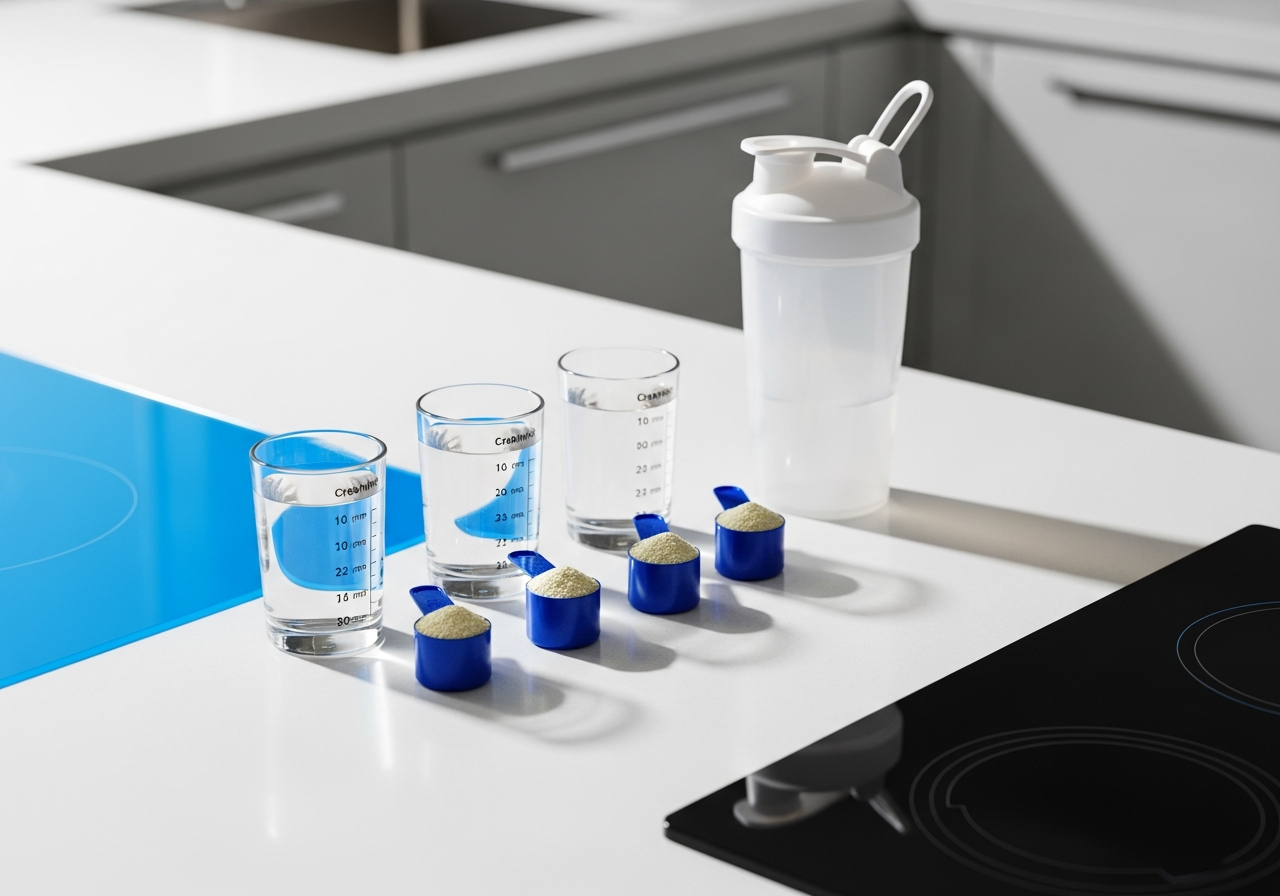
If you want to know how to load creatine or how do you load creatine, the simplest evidence-based plan is 20 grams per day of creatine monohydrate, split into 4 doses of 5 grams, for 5-7 days, followed by 3-5 grams daily. This is the standard protocol used in research and the one most people should start with.
- Choose creatine monohydrate. Monohydrate is the most studied form and remains the best default for effectiveness, value, and evidence. If you are comparing products, start with our best creatine rankings and creatine brand reviews.
- Measure accurately. Use a scale if possible. Many scoops are approximate, not exact. If you need help, see /how-to-measure-creatine.
- Split the daily dose. Take 5 grams four times per day rather than 20 grams all at once. A practical schedule is breakfast, lunch, post-workout or mid-afternoon, and dinner.
- Mix with enough liquid. Stir each 5-gram dose into water, a shake, or another beverage you tolerate well. Warm water usually dissolves plain monohydrate better than cold water.
- Take it every day for 5-7 days. Training day or rest day does not matter during loading; consistency matters more than timing.
- Switch to maintenance. After the loading week, move to 3-5 grams per day. Larger athletes, very muscular individuals, or those with high lean body mass often do well with 5 grams daily.
A practical 7-day example for an average gym-goer looks like this:
- 7:30 a.m. — 5 g with breakfast
- 12:30 p.m. — 5 g with lunch
- 4:30 p.m. — 5 g post-workout or as an afternoon dose
- 8:30 p.m. — 5 g with dinner
If you miss one dose in the loading week, do not double up aggressively later if that causes stomach issues. Just take the next planned dose and continue. If four doses feel annoying, you can use two 10-gram doses, but that increases the chance of digestive upset for some people.
For full daily-use instructions beyond the loading week, see /how-to-take-creatine and /creatine-maintenance-dose.
Best creatine loading dose by body weight, size, and training goal
The classic creatine loading dose is 20 grams per day, but a body-weight-based method of 0.3 g/kg/day for 5-7 days is also well established. The direct answer to can you load creatine if you are larger or smaller than average is yes: either use the standard 20-gram approach or calculate from body weight for more precision.
For most adults, these two methods land in a similar range. The body-weight method is especially helpful for very light or very heavy athletes.
| Body weight | Loading dose (0.3 g/kg/day) | Practical daily split | Maintenance dose |
|---|---|---|---|
| 50 kg | 15 g/day | 3 x 5 g | 3 g/day |
| 60 kg | 18 g/day | 3-4 doses | 3-5 g/day |
| 70 kg | 21 g/day | 4 x 5 g | 5 g/day |
| 80 kg | 24 g/day | 4-5 doses | 5 g/day |
| 90 kg | 27 g/day | 5 smaller doses | 5 g/day |
| 100 kg | 30 g/day | 5-6 smaller doses | 5-7 g/day |
In real life, you do not need to be obsessively exact. A 75 kg person does not need 22.5 grams instead of 20 grams for loading to work. Precision matters less than consistency and tolerance.
Goal-specific adjustments are mostly about whether faster saturation matters:
- Beginners building general strength or muscle: 20 g/day for 5-7 days if you want faster results, or skip loading for simplicity.
- Powerlifters, sprinters, CrossFit athletes, team-sport athletes: loading is often worthwhile because repeat high-intensity output matters.
- People in a weight-class sport or those closely monitoring scale weight: loading may be less attractive because water weight can rise quickly.
- Older adults using creatine with resistance training: loading can be used, but many prefer a simple 3-5 g/day approach for adherence.
If you are wondering can I load creatine with 10 g, the answer is yes, but 10 g/day is more like a moderate ramp than a true classic loading protocol. It will raise stores faster than 3-5 g/day, but slower than 20 g/day. It can be a good compromise if 20 g/day upsets your stomach.
For personalised estimates, use our creatine dosage calculator and detailed guide at /how-much-creatine-per-day.
Loading vs skipping it: how much difference does it really make?
Skipping the loading phase is completely fine because daily creatine still works; the main difference is speed, not the final destination. If you are asking can I skip creatine loading phase, can I take creatine without loading phase, or is a creatine loading phase worth it, the answer depends on how quickly you want saturated muscle stores.
Here is the practical comparison:
- With loading: muscle creatine rises quickly, often reaching near-saturation in about 5-7 days.
- Without loading: muscle creatine rises gradually, usually reaching a similar place in around 3-4 weeks at 3-5 g/day.
That means loading is not magic. It simply compresses the timeline. If you are starting a new strength phase next week, going on a sport-specific performance block, or want the fuller-muscle effect quickly, loading is useful. If you are starting creatine for long-term use and will still be taking it a month from now, skipping the loading phase is often the easier choice.
Some people also prefer to skip loading because:
- They want to minimise the chance of stomach upset.
- They dislike taking multiple doses per day.
- They are concerned about quick scale-weight changes, especially during a cut or in weight-class sports.
Others prefer loading because:
- They want to know sooner whether creatine agrees with them and helps performance.
- They like immediate structure and a clear start point.
- They want to hit saturation before a meet, camp, or tournament.
A useful middle ground is a moderate ramp such as 10 grams per day split into two 5-gram doses for 10-14 days, then 3-5 grams daily. This is not the classic research protocol, but it can balance convenience and tolerance. Just understand that the evidence base is strongest for the classic loading approach or the simple no-loading maintenance approach.
If you want a realistic expectation for what you will feel and when, see /how-long-does-creatine-take-to-work. If you train through cuts or body-composition phases, also see /does-creatine-make-you-gain-weight.
Best timing, mixing, hydration, and week-by-week expectations
The best time to take creatine during a loading phase is the time you will reliably take all your doses, because total daily intake matters more than exact timing. If you are asking whether loading creatine must happen pre-workout, post-workout, or with carbs, the evidence says consistency is the bigger lever than clock time.
During loading, spread your doses across the day. That helps tolerance and may support better total uptake than one giant single serving. Many people find taking doses with meals easier on the stomach, especially if plain creatine powder bothers them when taken alone.
Helpful practical rules:
- Mix each 5-gram dose in a generous amount of water or a shake.
- Take it with food if you are prone to nausea or loose stools.
- Stay normally well hydrated; do not force excessive water, but do not under-drink either.
- Micronized monohydrate often mixes more easily, though standard monohydrate works just as well.
Week-by-week, here is what many people notice:
- Days 1-3: no dramatic performance change yet, though some people notice fuller muscles or slight scale changes.
- Days 4-7: muscle creatine stores are climbing rapidly, and some notice better repeat efforts, a stronger pump, or an extra rep on certain lifts.
- Week 2 onward with maintenance: the benefits become more obvious through training quality, work capacity, and gradual strength progress.
- Weeks 4-8: the main payoff often shows up as better training output accumulating into better muscle and strength gains.
How do you tell it is working? The best signs are not mystical. Look for:
- Small improvements in reps at a fixed load.
- Better quality on later sets.
- Less drop-off across sprints or intervals.
- A modest early increase in body weight from water inside the muscle.
If you want a deeper timing breakdown, read /when-to-take-creatine. For fluid intake, see /how-much-water-with-creatine. For mixing tips and clumping fixes, see /how-to-mix-creatine.
Who should use a loading phase, and who is better off skipping it
A creatine loading phase is most useful for people who want faster saturation and faster potential performance benefits, while long-term recreational users can often skip it without losing meaningful long-run results. The direct answer to who is creatine loading for is that it is a convenience and speed strategy, not a requirement.
Beginners can absolutely load creatine, but they do not need to. If you are just learning to train consistently, daily 3-5 grams may be easier to stick with. Adherence beats a perfect protocol you quit after three days.
Women can use the same loading logic and broadly the same dosing principles as men, adjusted for body weight if preferred. Creatine does not work only for men, and loading does not have a sex-specific mechanism. If this is your focus, read /creatine-for-women.
Older adults can also use creatine, especially alongside resistance training, but many do best with the simplest sustainable plan. Loading is reasonable if tolerated, yet a straight maintenance dose is often enough because ease and consistency matter greatly.
Vegetarians and vegans sometimes respond especially well to creatine because dietary intake is often lower to begin with. For them, loading may produce a noticeable response sooner. See /creatine-for-vegetarians and /is-creatine-vegan.
Athletes in explosive or repeated high-intensity sports often benefit most clearly from loading because they may want full stores before an event or block. This includes sprinters, football and hockey players, CrossFit athletes, powerlifters, and many swimmers.
People who may prefer skipping loading include:
- Anyone with a history of digestive sensitivity to supplements.
- People in weight-class sports managing scale weight tightly.
- Users who struggle with multi-dose routines.
- Anyone who simply does not care whether saturation takes one week or four.
Creatine is not just for bodybuilders. The International Olympic Committee consensus on dietary supplements recognises creatine among the better-supported performance supplements in sport. The key is matching the protocol to your goal, sport, and tolerance rather than assuming everyone needs a loading phase.
Is a loading phase safe? Side effects, kidney concerns, and what Canadians should buy
A creatine loading phase is generally considered safe for healthy adults when used at standard evidence-based doses, but mild digestive side effects and temporary water-weight gain are more common during loading than during simple maintenance use. The direct answer to is a loading phase for creatine safe is yes for most healthy people, with sensible caveats.
The most common side effects during loading are:
- Stomach upset or loose stools: usually caused by taking too much in one serving.
- Bloating or heaviness: often really water retention in or around muscle, especially early on.
- Temporary scale-weight increase: typically water, not fat.
You can reduce side effects by splitting doses, taking creatine with meals, and avoiding very large single servings. If you are sensitive, dropping to 10 grams per day for a slower ramp or skipping loading entirely is reasonable.
Kidney concerns are a major source of confusion. In healthy people, mainstream reviews do not show that recommended creatine supplementation damages kidneys. However, creatine can raise blood creatinine, a lab marker that can be misread as kidney trouble because creatinine is a breakdown product related to creatine metabolism. That is why context matters. If you have diagnosed kidney disease, significant renal concerns, or have been told to restrict such supplements, speak with your clinician first. For a deeper explanation, see /is-creatine-bad-for-your-kidneys and /is-creatine-safe.
For Canadians, the best buying advice is boring but important: choose plain creatine monohydrate from a reputable brand, ideally with clear lot information and third-party testing. In Canada, many supplements carry an NPN, or Natural Product Number, which means the product has been licensed by Health Canada as a natural health product. An NPN is not a guarantee of superiority, but it is a useful compliance signal. You can browse our creatine product catalog or compare options in best creatine rankings.
If you are deciding between monohydrate and heavily marketed alternatives, monohydrate still wins on evidence, price, and reliability.
Common creatine loading mistakes and myths that need to die
Most creatine loading mistakes are not dangerous; they are just unnecessary, uncomfortable, or based on bad supplement marketing. The direct answer to is the loading phase for creatine a myth is no: loading is real and effective, but many claims around it are exaggerated.
Myth 1: You must load creatine or it will not work.
False. Loading is optional. Daily 3-5 grams still works; it simply works more slowly.
Myth 2: More than 20 grams per day will work much better.
Usually false. Taking far more than the classic loading dose mainly increases the chance of GI distress and waste, not better results.
Myth 3: You should take all 20 grams at once.
False for most people. Splitting into multiple smaller doses improves tolerance and is the standard approach.
Myth 4: Loading causes fat gain.
False. The early weight gain is mostly water drawn into muscle tissue, not body fat. If you want the full explanation, see /does-creatine-make-you-gain-weight.
Myth 5: You need a fancy creatine form to load properly.
False. Monohydrate remains the gold standard. HCL, buffered creatine, and other forms may be marketed as superior, but they do not have stronger evidence for loading outcomes than monohydrate.
Myth 6: You need to cycle off after loading.
False for most users. After loading, you generally just move to maintenance. Cycling is not required for effectiveness. See /do-you-need-to-cycle-creatine.
Myth 7: Creatine loading dehydrates you or causes cramps.
The best evidence does not support creatine as a dehydration or cramp culprit in healthy users following normal hydration habits. Related myth-busting is covered at creatine myths debunked.
The most common real-world mistakes are straightforward:
- Eyeballing doses instead of measuring them.
- Using one giant dose and blaming creatine when your stomach rebels.
- Stopping after the loading week and forgetting maintenance.
- Expecting steroid-like changes instead of subtle but real performance benefits.
- Buying flashy blends that underdose actual creatine.
Creatine works best when you respect the boring fundamentals: correct dose, daily consistency, decent hydration, and enough hard training to benefit from higher phosphocreatine availability.
Best creatine for a loading phase: monohydrate vs other forms
The best creatine for a loading phase is creatine monohydrate because it is the most studied, the most consistently effective, and usually the best value per gram. If your goal is simply to load creatine properly, you do not need a premium-sounding alternative form.
| Form | Best use case | Evidence for loading | Key takeaway |
|---|---|---|---|
| Creatine monohydrate | Almost everyone | Strongest | Gold standard for loading and maintenance |
| Micronized monohydrate | People who want easier mixing | Strong, because it is still monohydrate | Same active ingredient, sometimes nicer texture |
| Creatine HCl | People who strongly prefer capsules or niche formats | Weaker than monohydrate | Not proven superior for loading |
| Buffered creatine | Marketing-driven niche choice | Weaker than monohydrate | No convincing advantage for most users |
| Gummies/capsules/liquids | Convenience-first users | Depends on actual delivered grams | Check how many servings are needed to reach a real loading dose |
What matters most is not a trendy delivery system but whether you can actually take the required grams consistently. Loading with gummies or capsules can become expensive or tedious because you may need many units per day to hit 20 grams. Powder is usually easiest for true loading protocols.
When shopping in Canada, look for:
- Plain creatine monohydrate with no proprietary blend hiding the dose.
- A brand with transparent testing or quality-control statements.
- A practical serving format for the amount you plan to take.
- An NPN where applicable and clear labelling in line with Canadian supplement norms.
If you want product help, compare our creatine brand reviews, browse the creatine product catalog, or read /best-creatine-monohydrate-canada. If you are considering alternatives, our comparisons on /creatine-monohydrate-vs-hcl and /why-monohydrate-still-wins explain why monohydrate still leads in 2026.
Bottom line: the smartest way to use a creatine loading phase
A creatine loading phase is worth doing if you want your muscles saturated quickly, but it is not necessary for creatine to work. That is the clearest answer to every variation of what is loading phase creatine, does loading creatine do anything, and can I skip the loading phase of creatine.
If you want the fastest path, use this simple protocol:
- Take creatine monohydrate.
- Load with 20 grams per day split into 4 doses of 5 grams for 5-7 days.
- Then continue with 3-5 grams per day for maintenance.
If you prefer the easiest path, use this instead:
- Take creatine monohydrate.
- Skip loading entirely.
- Take 3-5 grams per day, every day, and expect similar saturation after roughly 3-4 weeks.
The decision comes down to one question: Do you want the benefits faster, or do you want the simplest routine? Both approaches are valid. Neither is a trick. Neither requires cycling. And neither turns creatine into something it is not.
For most healthy adults, the best strategy is the one you will actually follow for months, not the one that looks most aggressive on day one. If you want help choosing a product or confirming your dose, start with our creatine dosage calculator, then compare reputable options in the creatine product catalog.
One complete sentence to remember: a creatine loading phase is the fastest way to saturate muscle creatine stores, but taking 3-5 grams daily without loading still works and reaches a similar place within a few weeks.
Creatine Loading Phase at a Glance
- 20 g/day Classic loading dose — Usually split into 4 doses of 5 g each.
- 5-7 days Typical loading duration — Often enough to approach muscle saturation quickly.
- 3-5 g/day Standard maintenance dose — Used after loading, or from day one if you skip loading.
- 3-4 weeks Time to similar saturation without loading — Typical timeline when taking 3-5 g daily.
Frequently Asked Questions
What is a creatine loading phase?
A creatine loading phase is a short period of taking a higher daily dose, usually 20 grams split into several servings for 5-7 days, to saturate muscle creatine stores quickly. After that, most people switch to a maintenance dose of 3-5 grams per day.
Is creatine loading necessary?
No, creatine loading is not necessary for creatine to work. It simply speeds up saturation, while taking 3-5 grams per day without loading usually gets you to a similar place in about 3-4 weeks.
How do you load creatine properly?
The standard way to load creatine is to take 20 grams per day of creatine monohydrate for 5-7 days, ideally split into 4 doses of 5 grams. Splitting the dose through the day tends to reduce stomach upset compared with taking it all at once.
Can I skip the creatine loading phase?
Yes, you can skip the creatine loading phase and just take 3-5 grams daily. This is a perfectly valid approach if you prefer simplicity, want to reduce the chance of digestive discomfort, or do not mind waiting a few extra weeks for full saturation.
Does loading creatine do anything?
Yes, loading creatine increases muscle creatine stores faster than a standard daily dose alone. The main benefit is earlier access to potential improvements in repeated high-intensity performance, training volume, and the fuller-muscle water-retention effect.
Can I load creatine with 10 grams per day?
Yes, 10 grams per day can work as a slower ramp, but it is not the classic loading protocol. It will likely saturate muscles faster than 3-5 grams per day, but slower than 20 grams per day, and it may be easier on the stomach for some people.
Is a creatine loading phase safe?
For most healthy adults, a standard creatine loading phase is generally considered safe when used as directed. The most common issues are mild digestive upset and temporary water-weight gain, while anyone with kidney disease or relevant medical concerns should speak with a clinician first.
Do you need a loading dose of creatine monohydrate specifically?
If you choose to load, creatine monohydrate is the best-supported form to use because it has the strongest evidence base. You do not need a loading dose for monohydrate to work, but if you want faster saturation, monohydrate is the form to load with.
How long should a creatine loading phase last?
A typical creatine loading phase lasts 5-7 days. That duration is usually enough to raise muscle creatine stores rapidly before you drop to a maintenance intake of 3-5 grams per day.
Will creatine loading make me gain weight?
Creatine loading often causes a small early increase in body weight, but this is usually water pulled into muscle rather than fat gain. For many users, that change appears within the first week and may make muscles feel or look a bit fuller.