Does Creatine Cause Bloating? Why It Happens and How to Stop It
By The Creatine Canada Research Team — Evidence-based supplement analysts
Creatine can make some people feel bloated, but it usually does not cause true stomach bloating when taken properly. In most cases, the "bloat" people notice is temporary water being pulled into muscle cells during a loading phase, not fat gain or harmful fluid retention under the skin.
Evidence-based · Cites 4 sources · Editorial standards
Key Takeaways
- Creatine monohydrate can increase body water, but most of that water is stored inside muscle, not under the skin.
- The biggest bloating complaints happen during a loading phase of about 20 g/day; 3-5 g/day causes fewer issues.
- If creatine upsets your stomach, split the dose, take it with food, and avoid dry scooping.
- Face puffiness from creatine is not a well-supported effect in research and is more often due to sodium, carbs, alcohol, poor sleep, or normal weight fluctuation.
- Any water-weight increase is usually modest and often appears within the first 1-2 weeks, then stabilizes.
- Micronized creatine monohydrate is often the simplest way to reduce grittiness and digestive discomfort without paying for overhyped forms.
- If bloating persists, lower the dose, review your total diet, and consider whether the issue is digestive irritation rather than creatine itself.
Does creatine cause bloating? Yes, sometimes — but usually not in the way people mean
Yes, creatine can make some people feel bloated, but the most common reason is intramuscular water retention rather than true abdominal bloating or a soft, puffy look. Intramuscular water retention means water is drawn into muscle cells as creatine stores rise, which is one reason muscles can look fuller soon after starting supplementation.
This distinction matters because many people ask "does creatine make you bloated", "does creatine cause water retention", or "will creatine make you bloat" as if all water gain is the same. It is not. Water stored inside muscle is very different from fluid sitting under the skin or gas and digestive distension in the gut. According to the 2017 ISSN position stand, creatine monohydrate is the most studied form of creatine and is both effective and generally well tolerated when used at standard doses.
What people usually notice falls into one of three buckets:
- Muscle fullness: a firmer, slightly heavier feeling from more water inside muscle.
- Scale weight increase: often a small rise in the first week or two, especially with loading.
- Digestive bloating: stomach discomfort, gas, or a sloshy feeling from taking too much at once.
Those are not the same problem, and each has a different fix. If your goal is to avoid bloating entirely, the best strategy is simple: skip the loading phase and take 3-5 g daily instead. That slower approach saturates muscles over a few weeks and usually causes fewer complaints than taking 20 g/day.
Beginners often also confuse normal early water gain with fat gain. Creatine does not directly increase body fat. If the scale moves up quickly after you start, especially within the first several days, that change is far more likely to be water than fat. For a fuller primer, see does creatine make you gain weight and what creatine is and what it does.
The short version is this: creatine can cause temporary bloating sensations in some users, but properly dosed creatine monohydrate is much more likely to make muscles feel fuller than to make your whole body look bloated.
Why creatine can make you feel puffy: the actual mechanism behind water retention
Creatine can cause water retention because creatine stored in muscle increases the cell's osmotic pull, meaning it draws water into the muscle along with it. That is the core mechanism behind the common question "can creatine cause water retention".
About 95% of the body's creatine is stored in skeletal muscle, where it helps regenerate ATP, the cell's immediate energy currency for short, intense efforts. As muscle creatine and phosphocreatine stores rise, water tends to follow. This is why creatine is useful for performance and why some people notice a fuller look before they notice a strength increase.
Importantly, this is not the same as the kind of water retention people mean when they say they look "watery". The best-supported effect is a shift toward more intracellular water, which means water inside the muscle cell. That is one reason creatine can support training capacity and muscle growth over time. The 2021 JISSN review on common questions and misconceptions about creatine notes that many popular fears about creatine, including exaggerated claims about bloating and dehydration, are not supported by the broader evidence.
So why do some people still swear that creatine makes them look smooth or swollen?
- Large loading doses can create a fast jump in total body water.
- Taking too much in one serving can cause stomach upset that feels like bloating.
- Diet changes that often happen during a bulk, such as more carbs and sodium, can increase visible puffiness.
- Expectations can cause people to blame creatine for every small scale or mirror change.
In practice, the mechanism is helpful, not harmful. Creatine's water effect is part of how it works. If you want the performance benefits with less chance of feeling puffy, the key is controlling the speed of saturation rather than avoiding creatine altogether. Our creatine dosage calculator and daily dosing guide can help you match intake to your size and goal.
The direct answer is this: creatine can increase water retention, but the best evidence suggests that the water is mainly stored in muscle tissue, not as the kind of general puffiness most people worry about.
Loading phase vs daily dose: the biggest reason some users bloat and others do not
The loading phase is the biggest reason creatine sometimes causes noticeable bloating. Taking about 20 g/day for 5-7 days, usually split into four 5 g doses, saturates muscle faster but also raises the chance of stomach discomfort and a quick increase in water weight.
By contrast, taking 3-5 g/day without loading reaches near-full muscle saturation more slowly, typically over about 3-4 weeks, with fewer reports of digestive upset or sudden heaviness. This is why many beginners asking "can creatine make you bloated" do better on a steady daily dose.
Here is the practical tradeoff:
| Approach | Typical dose | Time to saturation | Bloating risk | Best for |
|---|---|---|---|---|
| Loading phase | 20 g/day split into 4 doses for 5-7 days, then 3-5 g/day | About 1 week | Higher | People who want faster performance effects |
| Standard daily use | 3-5 g/day | About 3-4 weeks | Lower | Most beginners and anyone sensitive to stomach issues |
| Body-weight method | About 0.3 g/kg/day loading, then about 0.03 g/kg/day | Same pattern as above | Depends on total dose and splitting | Larger athletes who want precision |
Examples by body weight:
- 60 kg person: loading about 18 g/day, maintenance about 2-3 g/day, though 3 g/day is practical.
- 75 kg person: loading about 22.5 g/day, maintenance about 2-3 g/day, though 3-5 g/day is standard.
- 90 kg person: loading about 27 g/day, maintenance about 3 g/day, though 5 g/day is commonly used.
For most recreational lifters, exact precision is less important than consistency. If you are worried about bloating, skip loading entirely. The gain you give up is speed, not eventual effectiveness. The ISSN position stand supports both methods, but the lower-dose route is often easier to tolerate in real life.
If you are debating protocols, read whether a loading phase is necessary and how to maintain saturation. If you do load, never take the whole 20 g in one shot; that is one of the fastest ways to create avoidable digestive bloating.
How to take creatine without getting bloated: the step-by-step playbook
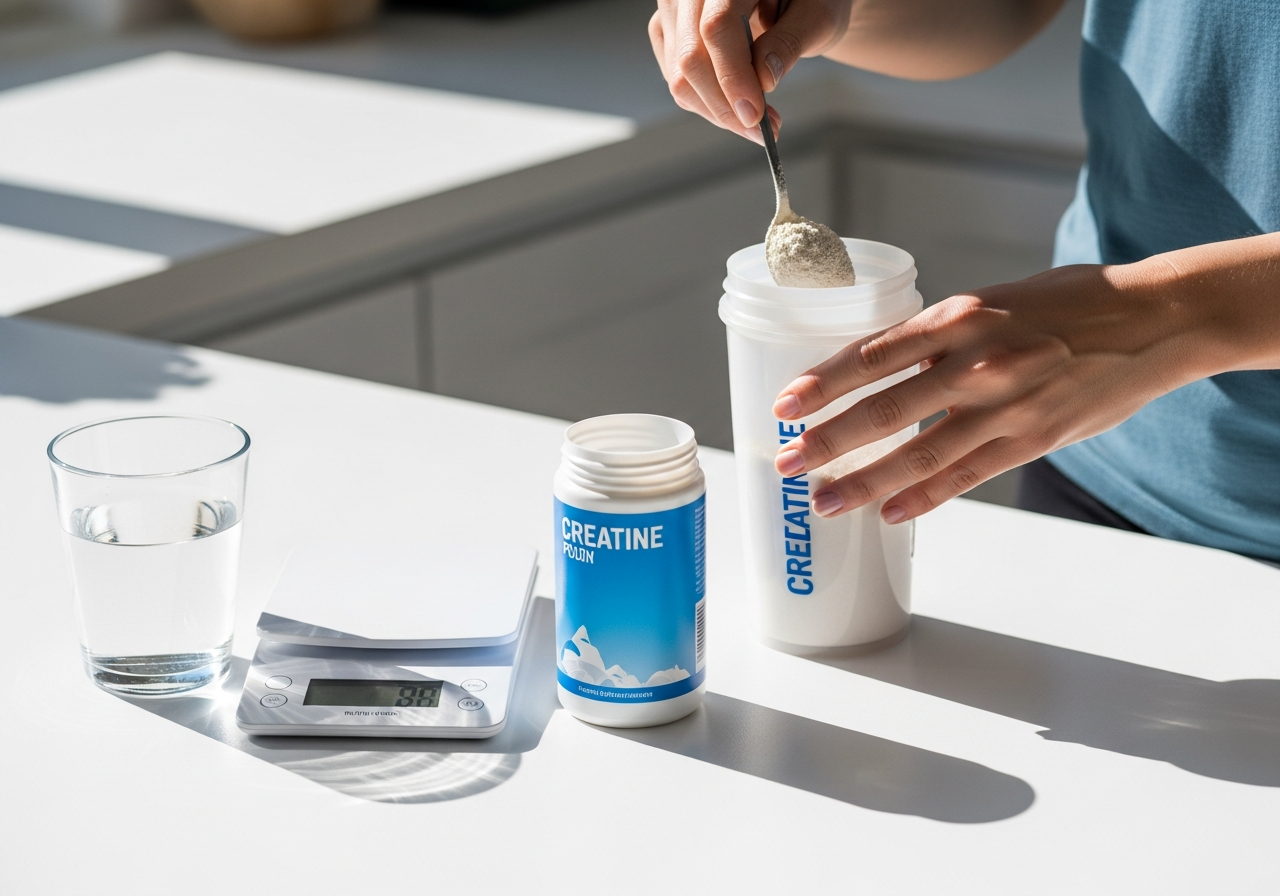
You can reduce the odds of creatine bloating by using a smaller daily dose, splitting large doses, mixing it well, and taking it consistently rather than aggressively. For most people, that means 3-5 g of creatine monohydrate once daily.
- Choose creatine monohydrate. Monohydrate remains the most studied and cost-effective form, and there is no strong evidence that expensive forms reliably prevent bloating better. If texture bothers you, consider micronized monohydrate.
- Start with 3 g/day for one week. If you are cautious or have had digestive issues before, this is a smart entry point.
- Move to 3-5 g/day. Most adults can stay there indefinitely. Larger athletes often choose 5 g/day; smaller adults may do well on 3 g/day.
- Take it with a meal or shake. Food can reduce stomach irritation, especially if you are sensitive. See with or without food for details.
- Mix it fully in water or another drink. Poorly dissolved powder can leave grit and may worsen stomach comfort. Our mixing guide shows easy ways to dissolve it better.
- Do not dry scoop. Dry scooping increases the chance of coughing, throat irritation, and stomach upset without improving effectiveness.
- Stay normally hydrated. You do not need absurd amounts of water, but under-drinking can make you feel worse overall. A practical hydration guide is at how much water to drink with creatine.
If you still feel bloated, troubleshoot in this order:
- Cut your dose from 5 g to 3 g for 1-2 weeks.
- Split 5 g into 2.5 g twice daily.
- Take it after food instead of on an empty stomach.
- Check whether the real trigger is a mass gainer, sugar alcohols, fibre, dairy, or pre-workout ingredients.
- Stop loading if you started with 20 g/day.
Many people blame creatine when the actual culprit is the supplement stack around it. Flavoured products, gums, fillers, magnesium blends, or giant post-workout shakes are much more likely to cause digestive bloating than plain creatine monohydrate itself. If that sounds familiar, review creatine digestive side effects before abandoning creatine entirely.
The simplest anti-bloat formula is also the best-supported one: plain monohydrate, 3-5 g daily, well mixed, taken consistently.
Does creatine bloat your face or make you look puffy? Probably less than social media suggests
Creatine is not well supported as a common cause of face bloat, and research does not show facial puffiness as a signature creatine side effect. When people ask "does creatine bloat your face", "does creatine make your face puffy", or "can creatine cause bloating in face", the honest answer is that it can happen anecdotally, but it is not a hallmark effect of standard creatine use.
Why the disconnect between research and real-world complaints? Because face puffiness is influenced by many variables that often change at the same time someone starts creatine:
- Higher carbohydrate intake during a bulk, which increases glycogen and associated water storage.
- Higher sodium intake, especially from restaurant meals or processed foods.
- Alcohol, poor sleep, stress, allergies, and menstrual-cycle-related fluid shifts.
- Rapid loading, which can increase total body water quickly enough that some people feel puffier overall.
Women often ask whether creatine makes women bloated more than men. Standard dosing guidance is broadly similar, and there is no strong evidence that women are uniquely prone to creatine face bloat. What is true is that women may notice water fluctuations more closely because hormone-related changes can already affect how "puffy" they look across the month. If that is your concern, the best approach is still the same: use 3-5 g/day and skip loading. Our creatine for women guide covers this in more detail.
How to tell whether creatine is really the cause:
- Did the puffiness start only after a loading phase?
- Did your sodium, carb intake, alcohol intake, or sleep change at the same time?
- Does your face look normal in the morning some days and puffier on others? That pattern often points away from creatine itself.
- Does lowering the dose to 3 g/day for two weeks help?
If facial puffiness is your only complaint and performance is improving, a slower dosing strategy usually solves the issue. If swelling is pronounced, persistent, or accompanied by other symptoms, it is worth speaking with a healthcare professional instead of assuming it is just creatine.
The bottom line is straightforward: creatine can increase body water, but facial bloating is not a reliably established effect and is often blamed for changes driven by diet, sleep, or overall calorie intake.
How long does creatine water retention last, and does the bloating go away?
Creatine-related water retention usually appears early, often within the first few days to two weeks, and then stabilizes once muscle creatine stores are saturated. In other words, yes, creatine bloating often goes away or becomes much less noticeable after the initial adjustment period.
If you use a loading phase, the timeline is faster and more obvious. You may notice fuller muscles, a slightly tighter feeling, or a quick bump on the scale during the first week. If you use 3-5 g/day without loading, any water-related change tends to be slower, smaller, and easier to tolerate.
What to expect by timeline:
- Days 1-7 with loading: greatest chance of stomach discomfort or sudden scale changes.
- Week 1-2 without loading: some people notice nothing yet; others notice mild fullness.
- Weeks 3-4 without loading: muscles are approaching saturation, and benefits may be more noticeable than any water effect.
- After saturation: water changes usually level off rather than keep climbing.
If you stop taking creatine, the extra stored creatine and associated water gradually decline over time. That means any creatine-related water retention is not permanent. It does not keep accumulating endlessly while you stay on a normal maintenance dose.
People often ask, "does creatine increase bloating over time?" Usually, no. Ongoing worsening bloating suggests another issue, such as:
- too-large single doses
- a poorly tolerated flavoured formula
- dietary changes unrelated to creatine
- constipation, gas, or another digestive issue
If your bloating has not improved after 2-4 weeks on a modest daily dose, that is a sign to troubleshoot rather than push through blindly. Consider switching to plain monohydrate, reducing the dose, or reading creatine for beginners and how long creatine takes to work so your expectations match the typical timeline.
The direct answer is this: creatine water retention is usually front-loaded, modest, and temporary, and it typically settles once your muscles adapt to the new storage level.
The best creatine dose by body weight and goal if you want benefits without bloat
The best dose to minimize bloating while still getting results is usually 3-5 g/day of creatine monohydrate. For people who prefer precision, a maintenance dose of about 0.03 g/kg/day is the standard body-weight formula after saturation.
Here is the practical version most people can use:
- Small adults under about 65 kg: start with 3 g/day.
- Average adults about 65-90 kg: 3-5 g/day works well.
- Larger athletes over about 90 kg: 5 g/day is a common maintenance dose.
Goal matters too:
- General fitness or beginners: 3 g/day is a very sensible starting point.
- Muscle gain or strength focus: 5 g/day is simple and effective for most.
- Fastest possible saturation: loading at about 0.3 g/kg/day for 5-7 days works, but bloating risk is higher.
- Cutting or weight-class sports: skip loading and use a conservative maintenance dose to limit abrupt water changes.
For example, a 55 kg beginner worried about puffiness has little reason to load. A steady 3 g/day is likely enough. A 95 kg rugby player trying to maximize training output quickly may choose a loading phase, but should split doses carefully and accept that early water gain is part of the tradeoff.
Older adults can generally use standard dosing as well. The benefits may extend beyond gym performance into support for muscle mass and function during resistance training, and there is no evidence-based reason to use a "senior" bloating-avoidance formula. Women can also follow the same core range, usually 3-5 g/day, unless body size or personal tolerance suggests starting lower.
If you want exact numbers, our creatine dosage calculator and dose-by-body-weight guide make this easier. If you are a competitive athlete, the IOC consensus on dietary supplements includes creatine among the more evidence-based performance supplements when used appropriately.
The main anti-bloat lesson is simple: the lowest effective dose for your goal is usually the most comfortable dose for your stomach.
What creatine does not make you bloat? Usually the answer is not a different form
No form of creatine is guaranteed to prevent bloating, and the best-supported option is still plain creatine monohydrate. When people ask "what creatine does not make you bloat", they are often being sold on expensive alternatives with weak evidence.
The main reason a different product may feel better is not necessarily superior absorption. It is often one of these simpler factors:
- smaller serving size instructions
- better mixing
- fewer flavouring agents or fillers
- micronized texture that is easier to dissolve
| Form | Evidence for performance | Evidence it reduces bloating | Practical verdict |
|---|---|---|---|
| Creatine monohydrate | Strongest | No guarantee, but standard dosing is usually well tolerated | Best first choice |
| Micronized monohydrate | Essentially same active ingredient | May feel easier on the stomach because it mixes better | Good option if texture bothers you |
| Creatine HCl | Less evidence overall | Claims exceed proof | May work, but not clearly superior |
| Buffered or branded specialty forms | Usually weaker evidence than monohydrate | Not reliably proven to prevent bloating | Often more marketing than advantage |
If your goal is to buy wisely in Canada, look for:
- a Natural Product Number (NPN) on the label, which shows the product is licensed as a natural health product in Canada
- third-party testing or transparent quality statements
- minimal ingredient lists if you are sensitive to digestive upset
You can compare options in our best creatine rankings, browse the creatine product catalog, or review specific creatine brand reviews. For a deeper form comparison, see monohydrate vs HCl and why monohydrate still wins.
The direct answer is this: if creatine makes you feel bloated, your first move should be changing the dose and how you take it, not assuming you need an exotic form.
Safety, side effects, and who should be more careful with creatine-related bloating
Creatine is generally considered safe for healthy people at recommended doses, but some users are more likely to notice digestive side effects or to misread normal water shifts as a problem. The best evidence-backed guidance remains that creatine monohydrate is safe and effective when used appropriately, as summarized by the ISSN position stand and mainstream clinical references such as the Mayo Clinic overview.
The most common side effects in real-world use are not dangerous ones. They are practical ones:
- stomach upset from taking too much at once
- temporary water-weight increase
- grittiness or nausea if poorly mixed
Who should be more cautious?
- People with sensitive digestion: start low, use micronized monohydrate, and take it with food.
- People in weight-class or aesthetic peak-week situations: avoid loading close to an event because sudden water shifts may matter even if they are not harmful.
- People with pre-existing medical conditions: especially kidney disease or other conditions requiring medical supervision, should speak with a healthcare professional before use.
Who does well with creatine despite bloating fears?
- Beginners: often very well, provided they avoid loading.
- Women: same core dosing as men, with no strong evidence of unique bloating risk.
- Older adults: often benefit when creatine is paired with resistance training.
- Athletes in sprint, strength, and repeated high-intensity sports: among the most likely to benefit from muscle creatine saturation.
A common mistake is treating every gram of scale gain as a side effect. In reality, a modest early increase can simply mean the supplement is doing what it is supposed to do. Another mistake is using multiple supplements at once and then blaming creatine for the consequences. If you stack creatine with a sugary post-workout, pre-workout stimulants, fibre-heavy bars, sugar alcohols, and a sodium-heavy bulk diet, the diagnosis gets murky fast.
If you want the full safety picture, including kidneys, hydration, and long-term use, read is creatine safe and the creatinine confusion explained. For healthy users at sensible doses, bloating is usually a manageable comfort issue, not a sign that creatine is unsafe.
Common mistakes and myths: what people get wrong about creatine bloating
Most creatine bloating myths come from mixing up water, fat, and digestive discomfort. If you understand that difference, most of the confusion disappears.
Myth 1: Creatine makes everyone look soft.
False. The best-supported effect is more water inside muscle cells, which often makes muscles look fuller, not softer.
Myth 2: If the scale goes up, it must be fat.
False. Rapid weight gain over days is far more likely to be water than body fat, especially right after starting creatine.
Myth 3: The only way to make creatine work is to load.
False. Loading works faster, but daily 3-5 g dosing reaches the same destination with fewer bloating complaints.
Myth 4: Fancy forms like HCl do not cause bloating.
Unproven. Some people prefer them, but the evidence does not clearly show they outperform monohydrate for bloating prevention.
Myth 5: Creatine face bloat is inevitable.
False. Facial puffiness is not a classic creatine side effect and is often driven by diet, sleep, alcohol, or normal fluid fluctuations.
Myth 6: Creatine dehydrates you, so you hold water and dry out at the same time.
This is a misunderstanding. Creatine changes water distribution in useful ways and is not supported as a cause of dehydration when used properly.
Here are the most common real-world mistakes:
- Taking 10-20 g in a single serving
- Dry scooping
- Starting creatine during a high-sodium cheat weekend and blaming the supplement
- Switching to a flavoured formula with extra ingredients and misidentifying the trigger
- Quitting after three days because of a mild scale increase
If you are unsure whether your concern is real or a myth you picked up online, review creatine myths debunked and the biggest misconceptions. The Examine.com creatine evidence summary is also useful for checking what is strongly supported versus merely repeated.
The practical truth is boring but helpful: most creatine bloating problems come from how people take creatine, not from creatine being inherently bloating for everyone.
Bottom line: should you stop creatine if it makes you feel bloated?
No, you usually do not need to stop creatine just because you feel a bit bloated at first. In most cases, creatine-related bloating is either a temporary water shift during saturation or a dosing problem that can be fixed.
If you want the simplest evidence-based plan, do this:
- Use plain creatine monohydrate.
- Take 3-5 g daily, not 20 g all at once.
- Skip loading if you are worried about puffiness.
- Take it with food and enough fluid.
- Give it 2-4 weeks before judging whether it suits you.
Stop and reassess if you have persistent digestive distress, obvious intolerance to a specific product, or a medical reason that warrants professional guidance. But for the average healthy person, mild early water retention is not a red flag. It is often part of the normal adaptation that comes with increasing muscle creatine stores.
If your main worry is appearance, remember this: creatine does not directly add fat, and it does not reliably cause facial bloating. If your main worry is comfort, there is a good chance you can solve the issue by lowering the dose, splitting it, or simplifying the product.
For next steps, the most useful follow-up reads are how to take creatine properly, how much creatine per day, water vs fat vs muscle gain, and how to choose creatine monohydrate in Canada.
The final answer to "does creatine make you bloated" is this: sometimes a little, especially with loading, but usually in a manageable, temporary way that does not outweigh creatine's benefits for performance, training quality, and muscle gain.
Creatine bloating: the numbers that matter
- 3-5 g/day Standard daily creatine dose — The simplest maintenance range for most adults and usually the best place to start.
- 20 g/day Typical loading dose — Usually split into 4 doses for 5-7 days; this is the protocol most linked to early bloating complaints.
- 5-7 days Time to saturate with loading — Faster results, but also a higher chance of stomach discomfort or noticeable water gain.
- 3-4 weeks Time to saturate without loading — Slower, steadier, and often better tolerated by beginners.
Frequently Asked Questions
Does creatine make you bloated?
Creatine can make some people feel bloated, but it usually does not cause severe or lasting bloating when taken properly. Most of the effect is temporary water being pulled into muscle cells, especially during a loading phase, rather than fat gain or harmful fluid retention.
Can creatine cause water retention?
Yes, creatine can cause water retention, but the water is mainly stored inside muscle tissue. That is different from the under-the-skin puffiness people usually worry about, and it is part of how creatine supports muscle performance and fullness.
Does creatine cause face bloat?
Creatine is not well supported as a common cause of face bloat. If you notice a puffy face after starting creatine, it is often more likely to be related to sodium, carbs, alcohol, sleep, or a rapid loading phase than to standard daily creatine itself.
How long does creatine water retention last?
Creatine water retention usually shows up early and then stabilizes once muscle stores are saturated. With loading, that can happen in about a week; without loading, it is usually a slower change over roughly 3-4 weeks and often becomes less noticeable over time.
Does creatine bloating go away?
Yes, creatine bloating often goes away or becomes much milder after the first couple of weeks. If it does not, the issue may be your dose, your product formula, or another part of your diet rather than creatine itself.
What creatine does not make you bloat?
No creatine form is guaranteed not to make you bloat, but plain creatine monohydrate taken at 3-5 g/day is usually the best-supported and best-tolerated option. Micronized monohydrate may feel easier on the stomach because it mixes better, but it is not a fundamentally different ingredient.
Can creatine make women bloated?
Creatine can make women feel bloated for the same reasons it can affect men, mainly early water retention or taking too much at once. There is no strong evidence that women are uniquely prone to creatine bloating, though normal hormonal water fluctuations may make changes more noticeable.
Will creatine make you gain belly fat or just water weight?
Creatine does not directly cause belly fat gain. If your body weight rises soon after starting creatine, especially within days, that change is much more likely to be water associated with muscle creatine storage than new body fat.
Can creatine make you puffy if you do not load it?
Yes, creatine can still make you feel slightly fuller without loading, but the effect is usually smaller and slower. A steady 3-5 g/day approach is the best way to reduce the chance of sudden puffiness while still getting the benefits.
Should I stop creatine if it makes me bloated?
You usually do not need to stop creatine right away if it makes you feel bloated. First try lowering the dose, splitting it, taking it with food, and checking whether the real cause is another supplement or a high-sodium, high-carb diet change.