How Much Creatine Per Day? The Right Dose by Body Weight and Goal
By The Creatine Canada Research Team — Evidence-based supplement analysts
How much creatine per day? For most adults, the right dose is 3 to 5 grams of creatine monohydrate daily, every day, with or without food. If you want faster results, use a loading phase of 20 grams per day split into 4 doses for 5 to 7 days, then continue with 3 to 5 grams daily to stay saturated.
Evidence-based · Cites 4 sources · Editorial standards
Key Takeaways
- Most people do best with 3 to 5 g of creatine monohydrate per day.
- A loading phase is optional: 20 g/day split into 4 doses for 5 to 7 days.
- Body-weight dosing of about 0.03 g/kg/day is a solid maintenance rule.
- Women generally use the same daily creatine dose as men.
- Take creatine every day, including rest days, because consistency matters more than timing.
- Higher single doses are more likely to cause stomach upset than better results.
- Creatine monohydrate is still the most studied, effective, and cost-effective form.
The direct answer: how much creatine per day is actually right?
The right answer for how much creatine per day is simple for most people: 3 to 5 grams of creatine monohydrate daily is enough to maintain full muscle creatine stores in most adults. If you prefer a body-weight formula, a practical maintenance target is about 0.03 g per kg of body weight per day, which lands close to the familiar 3 to 5 gram range for many people.
If you are asking how much creatine should I take, how much creatine daily, or how many grams of creatine per day, the evidence-based default is the same: one modest daily dose, taken consistently. The 2017 ISSN position stand concluded that creatine monohydrate is the most effective ergogenic nutritional supplement currently available for increasing high-intensity exercise capacity and lean mass, and its standard dosing remains well established. You can read that consensus directly in Kreider et al. (2017), JISSN.
There are two valid ways to start:
- No loading: take 3 to 5 g once daily. This is the simplest approach and reaches effective saturation more gradually.
- With loading: take 20 g per day for 5 to 7 days, split into 4 doses of 5 g, then drop to 3 to 5 g per day. This fills muscle stores faster.
For a beginner, the easiest plan is often 5 g per day of creatine monohydrate in water, every day, for at least 4 weeks. If you want a personalized estimate, use our creatine dosage calculator.
Just as important, more is not usually better. Once your muscles are saturated, extra creatine does not keep boosting results in a linear way; it mostly increases the chance of digestive discomfort or wasted product. If you want a deeper primer on what creatine is and what it does, see what is creatine.
So if your question is how much creatine do I take or how much creatine to take a day, the shortest accurate answer is this: take 3 to 5 g daily, and take it every day.
Why 3 to 5 grams works: the science of saturation, phosphocreatine, and performance
Creatine works because it raises phosphocreatine stores in muscle, and that helps your body remake ATP faster during hard effort. ATP, or adenosine triphosphate, is the immediate energy currency your muscles use for explosive work like sprinting, heavy lifting, jumping, and repeated intervals. Phosphocreatine is the stored form of creatine in muscle that rapidly donates phosphate to regenerate ATP when energy demand spikes.
That mechanism is why creatine shines most in short, intense efforts and in training programs built from repeated hard sets. When your phosphocreatine stores are better topped up, you may squeeze out an extra rep, maintain output a bit longer, or recover a little faster between bouts. Those small training advantages compound over weeks and months into better strength, lean mass, and performance outcomes.
The dose matters because creatine works by saturation, not by acute stimulation. Creatine is not like caffeine, where you feel a strong immediate kick after one serving. Instead, you take it daily to gradually increase total intramuscular creatine. Once those stores are meaningfully elevated, the benefit shows up in the gym as more training quality.
This is why a maintenance dose of 3 to 5 g/day works so well. It is enough to build and then maintain elevated tissue stores in most adults. A loading phase simply speeds the same process. According to the ISSN position stand, a common protocol is roughly 0.3 g/kg/day for 5 to 7 days followed by 0.03 g/kg/day for maintenance.
Mechanistically, that also explains why timing is secondary. Your body cares more about total daily intake over time than the exact minute you take it. If you miss the so-called anabolic window but still take your daily dose consistently, you will still saturate stores.
Creatine may also have roles beyond muscle, including brain energy metabolism, but the evidence there is more nuanced and population-specific than the exercise literature. For performance and muscle gain, the core dosing science is mature, consistent, and practical: get saturated, stay saturated, and train hard enough to use the benefit. For a broader look at benefits, see our evidence-based creatine benefits guide.
Exactly how to take creatine daily: a beginner-friendly step-by-step plan
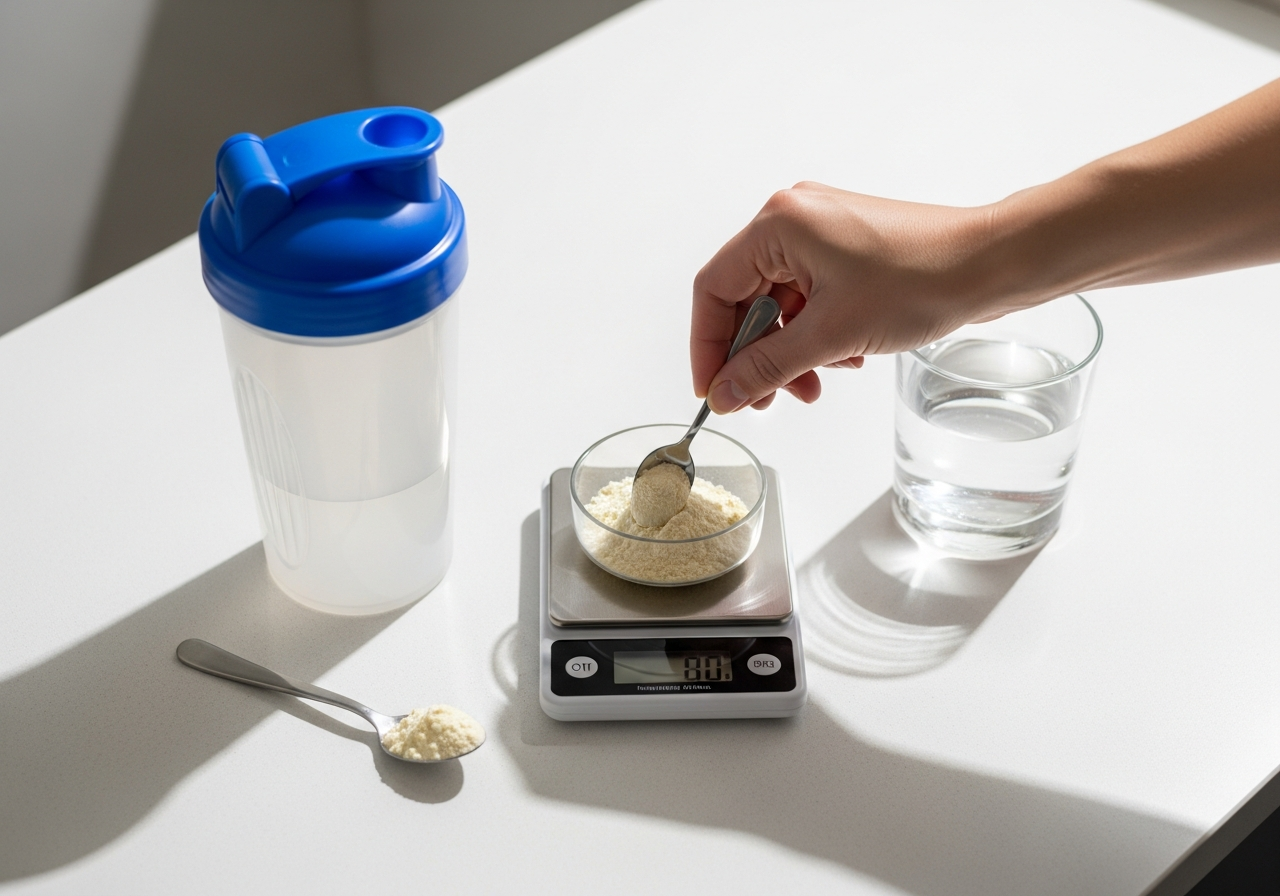
The easiest way to take creatine is to pick one daily dose, one daily time, and one simple mixing routine you can repeat without thinking. If you are new and asking how much creatine per day for beginners, here is the practical plan most people should start with.
- Choose creatine monohydrate. It is the most studied form, the one used in most research, and usually the best value. If you are shopping, start with our best creatine rankings or compare options in the creatine product catalog.
- Pick your daily dose. Use 3 g/day if you are smaller-bodied and cautious with digestion, or 5 g/day if you want the standard simple dose. If you want faster saturation, use 20 g/day for 5 to 7 days split into 4 doses of 5 g, then 3 to 5 g/day.
- Measure it properly. Use the scoop that comes with the product only if the label clearly states the gram amount per scoop. A kitchen scale is more accurate. If you need help, see how to measure creatine.
- Mix it in a liquid you already use. Water is fine. Juice, a protein shake, or a smoothie is also fine. If the powder settles, stir again before finishing. For mixing tips, visit how to mix creatine.
- Take it every day. Training days and rest days both count. Consistency is what raises and maintains creatine stores.
- Give it enough time. Without loading, expect a slower build over several weeks. With loading, you may notice training effects within the first week or two.
A simple week-by-week expectation looks like this:
- Week 1 with loading: possible slight body-weight increase from intracellular water, and some people notice better gym output quickly.
- Weeks 2 to 4: more people notice improved reps, power, or training capacity.
- Weeks 4 to 8: results become clearer in progressive training, especially if protein intake and sleep are decent.
How do you know it is working? Look for better repeat performance, not a stimulant buzz. An extra rep at a given load, less drop-off between sets, or slightly better sprint repeatability are more realistic signs than “feeling” creatine in the moment. If you want the complete walkthrough, see how to take creatine and creatine for beginners.
Creatine dose by body weight and goal: muscle gain, strength, cutting, and general health
The best creatine dose depends slightly on body size and goal, but for most goals the maintenance answer still lands at 3 to 5 grams per day. If you are searching how much creatine per day per kg or how much creatine per day to build muscle, a useful rule is 0.03 g/kg/day for maintenance after saturation.
| Body weight | Maintenance dose | Optional loading dose | Best for |
|---|---|---|---|
| 50-60 kg | 3 g/day | 15-18 g/day for 5-7 days, split doses | Smaller adults, beginners, women, lighter athletes |
| 60-80 kg | 3-5 g/day | 18-24 g/day for 5-7 days, split doses | Most adults training for muscle or strength |
| 80-100 kg | 5 g/day | 24-30 g/day for 5-7 days, split doses | Larger lifters, field athletes, power athletes |
| 100 kg+ | 5 g/day, sometimes slightly more by formula | 30 g/day for 5-7 days, split doses | Very large athletes using body-weight-based loading |
For specific goals:
- To build muscle: 3 to 5 g/day is usually enough, with loading optional if you want faster saturation.
- For maximal strength or power: the same 3 to 5 g/day works, because the mechanism is the same.
- During a cut: keep taking 3 to 5 g/day to help preserve training quality and lean mass. See creatine during a cut.
- For general fitness: 3 g/day is often adequate, especially for lighter individuals.
- For brain-related goals: research exists, but dosing is less standardized than in sports nutrition, so evidence is still emerging and more context-dependent.
If you are wondering whether a bigger person always needs much more, not necessarily. The classic 5 g/day maintenance dose works well in many larger adults because it is maintaining saturation, not trying to spike an immediate effect. Body-weight formulas are most useful during loading or for very small or very large individuals.
In practice, if you are under about 60 kg, 3 g/day is a reasonable place to start. If you are average-sized to large and train seriously, 5 g/day is the standard simple answer.
How much creatine should women, older adults, and athletes take?
Women generally take the same amount of creatine as men: 3 to 5 grams per day, with no special “women’s dose” required in most cases. If you are searching how much creatine should a woman take, how much creatine should women take, or how much creatine per day women, the evidence-based answer is usually the same standard monohydrate dose used for everyone else.
Women do not need a pink-labelled, lower-dose creatine product to get results. A lighter woman may choose 3 g/day, while an average-sized or highly active woman may use 5 g/day. The goal is still tissue saturation. If you want a full female-specific breakdown, see creatine for women.
Older adults also commonly use 3 to 5 g/day, particularly alongside resistance training. In aging populations, creatine is often studied for support of muscle function, lean mass, and performance in training. The practical advice is unchanged: pick a tolerable daily dose and stay consistent. Our guide on creatine for older adults covers this in more detail.
Athletes in strength, sprint, team-sport, and repeated-effort settings often benefit the most from creatine because their sports rely heavily on high-rate ATP turnover. The 2018 International Olympic Committee consensus on dietary supplements includes creatine among the small group of supplements with strong evidence for specific sports-performance uses when appropriately applied.
For athletes, the main choice is not a different product but a different speed of saturation:
- In-season or close to competition: a loading phase may make sense if you want faster saturation.
- Off-season or general development: 3 to 5 g/day without loading is usually fine.
Vegetarians and vegans may respond especially well because they often start with lower baseline dietary creatine intake. If that is you, a standard 3 to 5 g/day is still the usual plan, but your noticeable response may be stronger.
So whether you are a beginner woman, a masters lifter, or a competitive athlete, the answer to how much creatine should I take per day usually stays boringly consistent: 3 to 5 grams daily, adjusted mainly for body size and tolerance, not marketing category.
When to take creatine, rest days, and what happens if you miss a dose
The best time to take creatine is the time you will remember to take it every day, because daily consistency matters far more than precise timing. If you are deciding between morning, pre-workout, post-workout, or before bed, the evidence does not show a large, universally meaningful difference for most people once total daily intake is controlled.
That makes the practical answer easy:
- Training days: take your usual 3 to 5 g at any convenient time.
- Rest days: still take your usual 3 to 5 g.
- Missed one day: just resume your normal dose the next day; do not double up to “catch up”.
Why? Because creatine works through storage saturation, not a one-day on/off effect. Skipping a single day will not suddenly empty your muscles of creatine. What hurts results is repeated inconsistency over time.
Many people find it easiest to attach creatine to an existing habit:
- After brushing teeth in the morning.
- With breakfast.
- In a post-workout protein shake.
- With lunch at work.
Taking creatine with food is fine, and taking it without food is also fine. If your stomach is sensitive, taking it with a meal and plenty of fluid may feel better. If you use coffee, protein powder, or a smoothie, that is usually fine too. For deeper timing questions, read when to take creatine, creatine on rest days, and what happens if you miss a day of creatine.
A helpful mindset is this: creatine is a daily habit supplement, not a pre-workout rush supplement. Once you understand that, timing becomes much less stressful. Build the routine around adherence, not perfection.
If you care about hydration alongside your routine, especially during loading or heavy training blocks, pair this guide with how much water should you drink with creatine.
How much creatine is too much? Safety, side effects, and daily-use limits
For healthy adults, 3 to 5 grams of creatine monohydrate per day is a well-established safe maintenance dose, and 20 grams per day for 5 to 7 days is the standard short loading protocol. If you are asking how much creatine is too much or how much creatine can I take, the key point is that more is not better once saturation is achieved.
The most common side effects from taking too much at once are digestive, not dramatic toxicity. Large single servings are more likely to cause stomach upset, loose stools, or bloating than to improve performance. Splitting larger doses across the day is why loading protocols use multiple smaller servings rather than one giant scoop.
The 2021 JISSN review on common creatine questions and misconceptions reinforced that many fears around creatine are overstated or unsupported, while also acknowledging the importance of appropriate use and context. See Antonio et al. (2021), JISSN.
Practical safety guidelines:
- Start with 3 g/day if you are cautious or prone to stomach sensitivity.
- Use 5 g/day as the standard simple dose if you tolerate it well.
- Use loading only if you want faster saturation, and split it into 4 doses.
- Do not megadose indefinitely expecting better results.
- Stay hydrated normally; creatine is not a reason to chug excessive amounts of water, but severe underhydration is never a good idea.
People with kidney disease, significant renal concerns, or complex medical conditions should speak with a qualified clinician before starting creatine. Also remember that creatine supplementation can raise creatinine, a breakdown marker on bloodwork, without necessarily indicating kidney damage. That is one reason context matters. For deeper reading, see is creatine safe and creatine and kidney concerns explained.
For healthy users following standard dosing, the evidence base on daily use is reassuring. The real risk is usually not taking too little; it is taking too much in one sitting, buying low-quality product, or expecting instant stimulant-like effects.
How much creatine is in steak and beef, and can food replace a daily supplement?
Beef and steak do contain creatine, but getting a full supplemental dose from food alone is less practical than most people think. If you are searching how much creatine in a steak, how much creatine in beef, or how much creatine is in steak, the honest answer is that meat provides creatine naturally, but the exact amount varies by animal, cut, water content, and cooking method.
That variability matters. Food creatine is real, but it is not as standardized as a measured supplement dose. Cooking can also reduce creatine content because some creatine converts during heating and some is lost with juices. That means a steak is not a precise way to hit a reliable 3 to 5 g/day target.
For most people, the practical comparison looks like this:
- Food sources: nutritious, but variable and less precise for dosing.
- Creatine monohydrate powder: cheap per serving, easy to measure, and research-matched.
If your goal is simply to eat well, beef and fish can contribute to your background creatine intake. If your goal is to confidently saturate muscle stores, a supplement is much easier. This is especially true for vegetarians and vegans, who consume little to no dietary creatine and may therefore respond particularly well to supplementation.
Another important point: asking how much creatine is in a steak is useful nutritionally, but it does not change the supplementation recommendation. Even for regular meat eaters, the most reliable performance-oriented strategy is usually still a measured daily dose of creatine monohydrate.
If you want a full list of natural sources, see foods high in creatine. If you are plant-based, our guide to creatine for vegetarians explains why supplementation often matters more.
Bottom line: yes, steak has creatine; no, steak is not the simplest or most precise way to reach a proven supplementation dose every day.
What to buy in Canada: the best form, label checks, and what actually matters
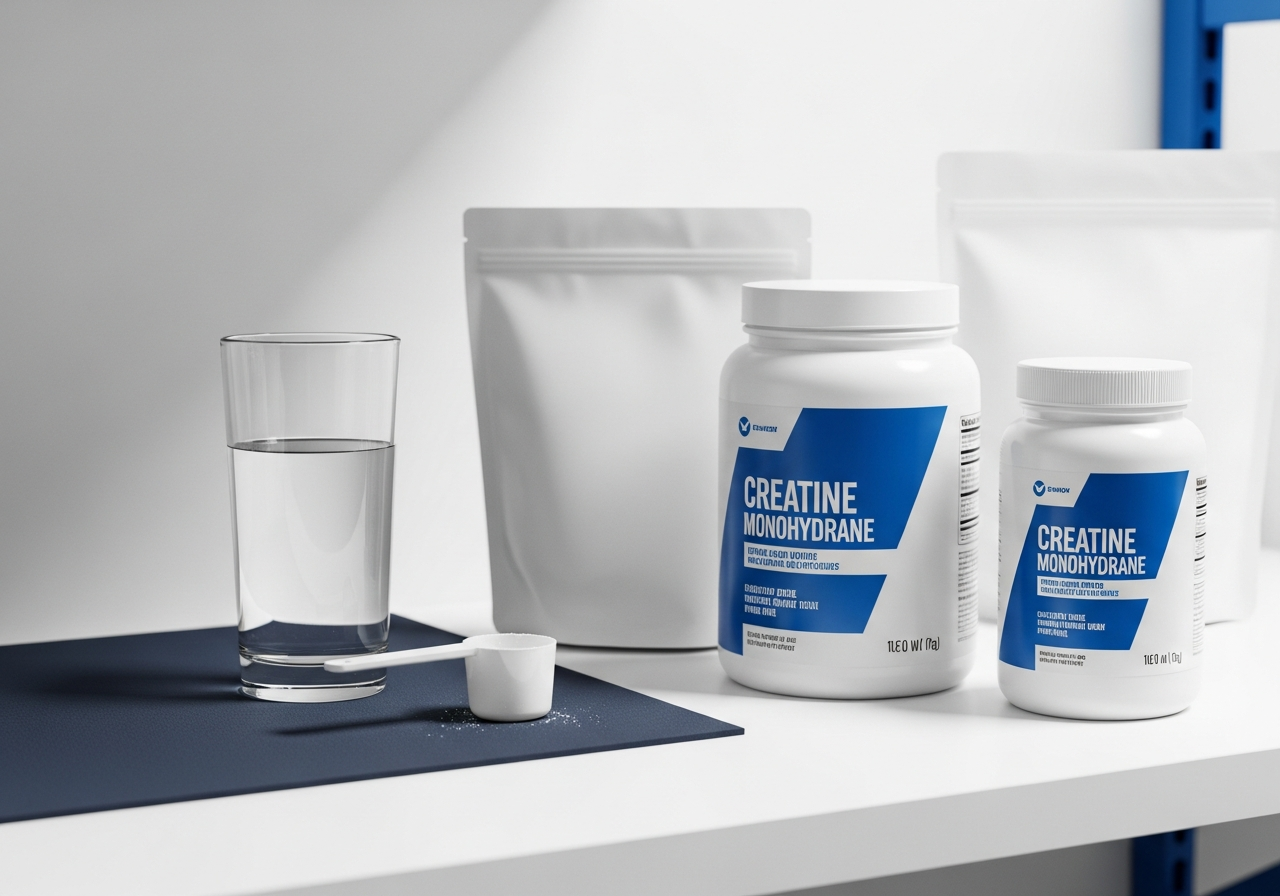
If you are buying creatine in Canada, the smart choice is plain creatine monohydrate from a reputable brand with clear dosing, a Natural Product Number when applicable, and preferably third-party testing. The dose only works if the product actually contains what the label says.
Creatine monohydrate remains the benchmark because it is the form used in the overwhelming majority of studies and is typically the most cost-effective gram for gram. Fancy forms often promise better absorption, less bloating, or lower required doses, but current evidence does not show they consistently outperform monohydrate in real-world outcomes.
| What to look for | Why it matters | What to avoid |
|---|---|---|
| Creatine monohydrate | Best-studied and research-backed form | Paying extra for weakly supported forms |
| Clear grams per serving | Makes accurate daily dosing easy | Proprietary blends or vague serving sizes |
| NPN on Canadian label when applicable | Shows Health Canada product licensing under natural health product rules | Missing regulatory details on mainstream retail products |
| Third-party testing or strong brand transparency | Improves confidence in purity and label accuracy | Unknown sellers with no testing information |
| Minimal ingredients | Reduces unnecessary fillers and confusion | Overbuilt formulas you do not need |
In Canada, an NPN, or Natural Product Number, is a product licence number used on many natural health products sold legally in Canada. It is not a guarantee of athletic suitability or contamination-free status by itself, but it is one useful sign that the product is being sold within the Canadian regulatory framework. Brand quality and testing still matter.
Start with our creatine brand reviews and best creatine rankings if you want vetted options, or browse the creatine product catalog if you already know the format you want.
If you are torn between forms, our breakdown of the best type of creatine and why monohydrate still wins will save you money and decision fatigue.
The biggest dosing mistakes, myths, and fixes if creatine seems not to work
The most common reason creatine seems not to work is not that the supplement failed, but that the dosing, consistency, expectations, or training context were off. If you think you are a non-responder, troubleshoot the basics before you blame creatine.
Here are the big mistakes:
- Not taking it daily. Missing doses repeatedly slows or prevents full saturation.
- Expecting a stimulant feeling. Creatine usually improves training output subtly, not your mood or buzz.
- Underdosing. Tiny “pixie dust” servings in blends may not provide enough daily creatine.
- Taking huge single doses. This raises the chance of stomach upset more than results.
- Switching products constantly. Consistency with plain monohydrate beats supplement hopping.
- Training too lightly to notice the effect. Creatine helps most when your training actually challenges the ATP-phosphocreatine system.
Common myths also deserve a direct answer:
- “You need to cycle creatine.” No, routine cycling is not required for most healthy adults. See do you need to cycle creatine?
- “Creatine makes you fat.” No, early weight gain is usually water stored inside muscle, not body fat. See water vs. fat vs. muscle.
- “Creatine is a steroid.” No, creatine is not an anabolic steroid and works through a completely different mechanism.
- “More creatine always means more gains.” No, once saturated, extra intake has sharply diminishing returns.
If creatine still seems ineffective after 4 to 8 weeks, ask yourself:
- Am I taking 3 to 5 g every day?
- Did I measure the dose accurately?
- Am I doing repeated high-effort training?
- Am I sleeping enough and eating enough protein?
- Am I judging progress by performance logs rather than feelings?
For more myth-busting, see creatine myths debunked and why creatine might not seem to work. In many cases, the fix is boring but effective: plain monohydrate, correct dose, every day, for long enough.
Bottom line: the best daily creatine dose for most people
If you want the single best answer to how much creatine per day, take 3 to 5 grams of creatine monohydrate daily, every day. That is the evidence-based default for most adults who want better strength, power, training capacity, and support for lean mass gains.
If you want faster results, use an optional loading phase of 20 g/day split into 4 doses for 5 to 7 days, then continue with 3 to 5 g/day. If you prefer the simplest possible plan, skip loading and just take your daily dose consistently. You will still reach saturation; it just takes longer.
Use 3 g/day if you are lighter, older, very cautious with digestion, or just want a minimal effective dose. Use 5 g/day if you are average-sized to large, train hard, or want the classic easy recommendation. A body-weight formula of 0.03 g/kg/day is a helpful cross-check, especially at size extremes.
Women generally use the same dose as men. Beginners do not need anything more complicated. Athletes do not need a magical form beyond monohydrate. Timing matters less than adherence. Rest days still count. One missed day is not a disaster. Huge doses are usually more likely to upset your stomach than improve your results.
If you want to put this into action today, do this:
- Buy a reputable creatine monohydrate product.
- Measure 3 to 5 g.
- Take it daily for at least 4 weeks.
- Track reps, loads, sprint repeatability, and body weight.
- Adjust only for tolerance, not hype.
For the next step, use the creatine dosage calculator, then read how long creatine takes to work and creatine maintenance dose if you want to fine-tune your routine.
The boring answer is still the best one: 3 to 5 grams per day, consistently, from creatine monohydrate.
Daily Creatine Dose at a Glance
- 3-5 g/day Standard maintenance dose — Works for most adults once muscle stores are saturated.
- 20 g/day Optional loading phase — Usually split into 4 doses for 5 to 7 days.
- 0.03 g/kg/day Body-weight maintenance rule — Useful for very small or very large individuals.
- 5-7 days Typical loading duration — After that, shift to 3 to 5 g/day.
Frequently Asked Questions
How much creatine should I take per day to build muscle?
For building muscle, most people should take 3 to 5 grams of creatine monohydrate per day. That dose is enough to maintain elevated muscle creatine stores, which can support better training quality over time. If you want to saturate faster, you can load with 20 grams per day split into 4 doses for 5 to 7 days, then return to 3 to 5 grams daily.
How much creatine per day for beginners?
For beginners, 3 to 5 grams of creatine monohydrate per day is the best starting dose. A beginner does not need a complicated protocol or a fancy form of creatine. If you want the simplest option, take 5 grams once daily and stay consistent for at least 4 weeks before judging the results.
How much creatine per day per kg of body weight?
A practical maintenance formula is about 0.03 grams of creatine per kg of body weight per day. That means a 60 kg person lands around 1.8 grams and an 80 kg person around 2.4 grams, but in real-world supplementation most adults still use 3 to 5 grams daily because it is simple and reliably effective.
How much creatine should a woman take?
Most women should take the same creatine dose as men, which is usually 3 to 5 grams per day. A smaller woman may choose 3 grams daily, while an average-sized or highly active woman may use 5 grams daily. There is usually no need for a special lower “women’s formula” if the product is plain creatine monohydrate.
Can you take creatine daily?
Yes, you can take creatine daily, and daily use is exactly how creatine is meant to work. Creatine raises and maintains tissue stores over time, so regular daily intake matters much more than taking it only on workout days. For healthy adults using standard doses, daily creatine monohydrate is widely studied and well established.
How much creatine is too much?
Creatine becomes “too much” when the dose exceeds what you need and starts causing side effects without added benefit. For most healthy adults, 3 to 5 grams daily is a standard maintenance dose, while 20 grams daily for 5 to 7 days is a common short loading phase. Much larger single doses are more likely to cause stomach upset than better results.
Do I need a loading phase, or can I just take 5 grams a day?
No, you do not need a loading phase if you are happy to take 5 grams a day and wait longer for full saturation. Loading helps fill muscle stores faster, but it is optional rather than necessary. Taking 3 to 5 grams daily without loading still works; it just reaches the same endpoint more gradually.
How much creatine is in a steak?
Steak contains creatine, but the exact amount varies by cut, animal, water content, and cooking method. That means steak can contribute useful dietary creatine, but it is not a precise way to hit a proven supplemental target like 3 to 5 grams per day. For reliable dosing, a measured creatine monohydrate supplement is much easier.
How much creatine for brain health?
Creatine dosing for brain health is less standardized than sports-performance dosing, so the evidence-based answer is more cautious. Many people still use the familiar 3 to 5 grams per day, but research in cognition is more population-specific and still developing compared with the strong exercise literature. If brain health is your primary goal, context matters more than with standard gym use.
Should I take creatine on rest days too?
Yes, you should take creatine on rest days because creatine works by maintaining elevated body stores over time. Skipping rest days does not help and can make your routine less consistent. The same 3 to 5 gram daily dose you use on training days should usually be taken on non-training days as well.