Do You Need to Cycle Creatine? On/Off Phases vs. Daily Use
By The Creatine Canada Research Team — Evidence-based supplement analysts
No, you do not need to cycle creatine. For most healthy adults, the evidence-based approach is simple daily use of creatine monohydrate at 3 to 5 g per day, with no mandatory on/off phases; if you stop, your muscle creatine stores gradually fall back toward baseline over several weeks and any performance benefit fades with them.
Evidence-based · Cites 4 sources · Editorial standards
Key Takeaways
- You do not need to cycle creatine; daily maintenance use is the standard evidence-based approach.
- A typical maintenance dose is 3 to 5 g of creatine monohydrate per day, every day, including rest days.
- A loading phase of 20 g per day split into 4 doses for 5 to 7 days is optional, not required.
- If you stop taking creatine, you do not 'crash'; muscle creatine stores simply decline gradually over roughly 4 to 6 weeks.
- Stopping creatine may reduce training performance, muscle fullness, and scale weight from water, but it does not cause fat gain.
- Cycling is mainly a preference or logistics choice, not a physiological requirement.
- Choose plain creatine monohydrate from a reputable Canadian product with clear labelling and ideally third-party testing.
The short answer: no, you do not need to cycle creatine
No, you do not need to cycle creatine, and most people who use it for strength, muscle, power, or training capacity are better served by taking it consistently every day. The core reason is simple: creatine works by increasing your muscles' stored creatine and phosphocreatine, the fast-energy compounds that help regenerate ATP, your cells' immediate fuel for high-intensity effort. Once your muscle stores are elevated, stopping supplementation lets those stores slowly drift back down; staying on a modest maintenance dose helps keep them topped up.
The idea of cycling creatine usually means taking it for a set block, such as 6 to 12 weeks, then stopping for a few weeks. That practice became popular in gyms, but it is not required by the evidence. The 2017 ISSN position stand concluded that creatine monohydrate is effective and safe for healthy individuals when used as directed, and it did not recommend routine cycling. The 2021 JISSN review on common creatine questions likewise addressed misconceptions and reinforced that continuous use is a normal, evidence-based strategy.
For practical purposes, there are only three good reasons to stop creatine temporarily:
- You personally do not like the effect on body mass or muscle fullness.
- Your stomach does not tolerate your current dosing method and you want to reset and retry more carefully.
- A physician has told you to pause supplements because of a specific medical issue, test, or procedure.
What about dependence, tolerance, or your body 'forgetting how to make creatine'? There is no good evidence that standard creatine supplementation makes healthy people dependent on it or permanently suppresses their natural creatine production in a clinically meaningful way. Your body continues to make creatine from amino acids and you also get some from food, especially meat and fish. Supplementation simply raises total available stores above baseline.
If you are new to the topic, our guides on what creatine is, creatine for beginners, and the creatine dosage calculator can help you set up a simple routine without overcomplicating it.
Why cycling is usually unnecessary: creatine works by saturation, not by stimulation
Cycling is usually unnecessary because creatine is a saturation supplement, not a stimulant that stops working when taken regularly. That distinction matters. Caffeine gives an acute effect within hours and can involve tolerance. Creatine works differently: over days to weeks, it increases the amount of creatine and phosphocreatine stored inside muscle, and those larger stores support repeated high-intensity contractions, sprint efforts, heavy sets, and training volume.
Think of muscle creatine like filling a battery pack. Loading or steady daily use fills the pack; daily maintenance keeps it near full; stopping gradually drains it back toward your normal level. There is no known performance advantage to intentionally letting that battery empty and refilling it over and over unless you are making a personal choice for body-mass reasons.
The mechanism is well established. Phosphocreatine donates a phosphate group to help rapidly regenerate ATP during short, intense work. More phosphocreatine means a greater ability to maintain force output across repeated efforts and recover between bouts. Over time, that often translates into better training quality, which is one reason creatine can support greater gains in strength and lean mass. If you want a deeper primer, see creatine benefits and does creatine build muscle.
Another reason cycling is not needed is that there is no convincing evidence that continuous, standard-dose creatine use causes healthy muscles to 'stop responding.' People sometimes confuse the levelling-off of visible early changes with loss of effect. In reality, the fast first-week weight gain from intracellular water often slows after saturation, but the ongoing benefit is maintained training capacity and performance support, not endless week-by-week scale jumps.
Some people still choose cycles because they prefer periodic breaks, travel often, or want to reduce body mass for a weigh-in sport. Those are practical decisions, not biological requirements. For most gym-goers, team-sport athletes, sprinters, lifters, vegetarians, and older adults using creatine for training support, daily use is the simplest and most rational approach.
If you are comparing forms, note that the best evidence still supports monohydrate as the default choice. Our guides on best type of creatine and why monohydrate still wins explain why fancy alternatives rarely justify the price.
What happens when you stop taking creatine: a gradual fade, not a rebound crash
When you stop taking creatine, your muscle creatine stores gradually return toward baseline over several weeks, and any performance benefit you were getting fades with that decline. This is the direct answer to searches like 'what happens when you stop taking creatine' and 'what happens after you stop taking creatine': you do not suddenly lose all your progress, but you may notice less muscle fullness, a small drop in body weight from water, and a subtle reduction in high-intensity training performance.
Here is what typically changes after stopping:
- Muscle creatine stores decline gradually. They do not disappear in a few days.
- Scale weight may drop. This is usually water stored inside muscle, not body fat.
- Muscle size may look slightly flatter. Again, this is often reduced cell hydration rather than muscle tissue loss.
- Performance can dip modestly. Repeated sprint ability, extra reps, explosive efforts, and training volume may feel a bit worse once stores fall.
What does not usually happen is just as important:
- You do not become dependent on creatine.
- You do not 'shock' your body by stopping.
- You do not gain fat because you stopped creatine.
- You do not automatically lose all the muscle you built while taking it.
How fast do effects fade? Exact timing varies by body size, diet, starting muscle stores, and whether you loaded, but a common rule of thumb is that stores trend back toward baseline over roughly 4 to 6 weeks after stopping. That means if you stop for 3 days or even a week, you have not erased your saturation status. If you stop for a month or longer, the effect is more likely to be noticeable.
One practical point: if your strength drops after stopping creatine, the reason is not that creatine was 'covering up' weakness. The more likely explanation is that your muscles have less phosphocreatine available to rapidly regenerate ATP during hard sets and repeated efforts.
If your main concern is weight fluctuation, read does creatine make you gain weight and does creatine cause bloating for a clearer breakdown of water versus fat.
Missed a few days? Here is what happens if you stop creatine for 3 days, 7 days, or a month
If you stop taking creatine for 3 days, almost nothing meaningful happens to your muscle stores or results. Creatine does not work like a pre-workout that must be felt each day; it works by maintaining elevated tissue stores, and those stores do not empty overnight.
Here is the practical breakdown:
- Stopped for 1 day: no real issue; just resume your normal dose the next day.
- Stopped for 3 days: likely no noticeable change in gym performance or body composition.
- Stopped for 1 week: most people still retain much of their elevated muscle creatine; performance changes are usually minimal.
- Stopped for 2 to 4 weeks: benefits may start fading noticeably, especially for repeated high-intensity efforts.
- Stopped for 4 to 6 weeks: stores may return close to baseline, depending on your starting level and diet.
This is why the best answer to 'can I stop taking creatine for a week?' is yes, you can, and it is not a disaster. The best answer to 'what happens if you stop taking creatine for 3 days?' is that very little likely changes. In both cases, the simplest move is to restart your usual maintenance dose. You generally do not need to reload after a short break, though some people choose to if they have been off long enough to believe stores are back near baseline.
If you miss doses often because your routine is inconsistent, solve the adherence problem instead of worrying about cycling rules. Easy fixes include:
- Keep the tub next to your toothbrush or coffee gear.
- Pre-portion servings into travel containers.
- Mix it into a shake you already drink daily.
- Use a recurring reminder on your phone.
For travellers and busy professionals, the lowest-friction plan wins. Creatine only works when you actually take it. If you want a practical guide to making the habit stick, see how to take creatine, creatine on rest days, and what happens if you miss a day of creatine.
The bigger picture is that short interruptions are not the same as a deliberate cycle. Missing a few days is normal life. It is not a reason to overcorrect with oversized doses afterward.
If you still want to cycle creatine, here is how to do it without sabotaging results
If you still want to cycle creatine, the safest way is to treat cycling as a preference, not a performance upgrade. There is no evidence-based requirement to cycle off, but if you prefer periodic breaks for travel, making weight, or personal comfort, keep the plan simple and do not use extreme dosing.
A sensible self-directed creatine cycle looks like this:
- Choose creatine monohydrate. It is the most studied, most cost-effective form and the default choice in the evidence.
- Optional loading phase: take 20 g per day split into 4 doses of 5 g for 5 to 7 days if you want faster saturation.
- Maintenance phase: take 3 to 5 g per day, every day, for your chosen training block.
- Off phase if desired: stop for several weeks only if you have a practical reason, knowing muscle stores will gradually decline.
- Restart: resume 3 to 5 g per day, or reload if you want to restore saturation faster after a long break.
The key rule is that a cycle should never be built around the myth that your body needs a 'reset.' It does not. If your goal is maximum training support year-round, staying on a steady maintenance dose is simpler and usually more effective.
Here is a useful comparison:
| Approach | How it works | Pros | Cons |
|---|---|---|---|
| Continuous daily use | 3 to 5 g every day with optional one-time loading | Maintains saturation, easiest for performance, simplest routine | No planned breaks if you prefer coming off supplements |
| Cycled use | Use for a training block, then stop for a period | Can suit travel, weigh-ins, or personal preference | Benefits fade during off phase; no proven physiological advantage |
| On-and-off inconsistency | Frequent missed weeks or random use | None | Poor saturation, less predictable results, more confusion |
If you are asking 'how long should I take creatine before cycling off,' the honest answer is that there is no evidence-based deadline. You can continue standard daily use as long as it suits your goals and health status. If you want to fine-tune dose rather than invent a cycle, use the creatine dosage calculator or read how much creatine per day.
The right dose by body weight and goal: muscle, strength, sport, and general fitness
The right creatine dose for most people is 3 to 5 g of creatine monohydrate per day, but body size and goal can help you choose the most practical end of that range. For a general fitness audience, this is where people often overthink things. The evidence-backed basics are straightforward: use enough to saturate and maintain muscle stores, not more.
Use this quick framework:
- Smaller adults or light body weight: 3 g per day is often adequate.
- Average-sized adults: 3 to 5 g per day works well.
- Larger athletes or people with higher lean mass: 5 g per day is a common practical choice.
- Want faster results: optional loading at 20 g per day, split into 4 doses, for 5 to 7 days, then 3 to 5 g per day.
Examples:
- A 55 kg beginner who trains 3 times per week can usually do well with 3 g daily.
- A 75 kg recreational lifter may use 5 g daily for simplicity.
- A 95 kg strength athlete will often also choose 5 g daily, especially if training hard year-round.
Goal matters too:
- Muscle and strength: 3 to 5 g daily is the standard.
- Power and repeated sprint performance: 3 to 5 g daily, with loading if you want quicker saturation before a training block.
- General healthy ageing or training support: 3 to 5 g daily is still the usual evidence-based range.
What should you not do? Do not assume more is better. Once stores are saturated, extra creatine is not a shortcut to extra gains and is more likely to increase the chance of stomach upset. Also avoid random scoop sizes. A kitchen teaspoon can be imprecise, so check the product scoop or weigh doses if you want accuracy. Our guides on how to measure creatine and creatine maintenance dose make this easy.
If you eat little or no meat, you may respond particularly well because your baseline muscle creatine stores can be lower. That does not change the basic daily dose, but it can make the benefits feel more noticeable.
When to take creatine and how to make daily use automatic
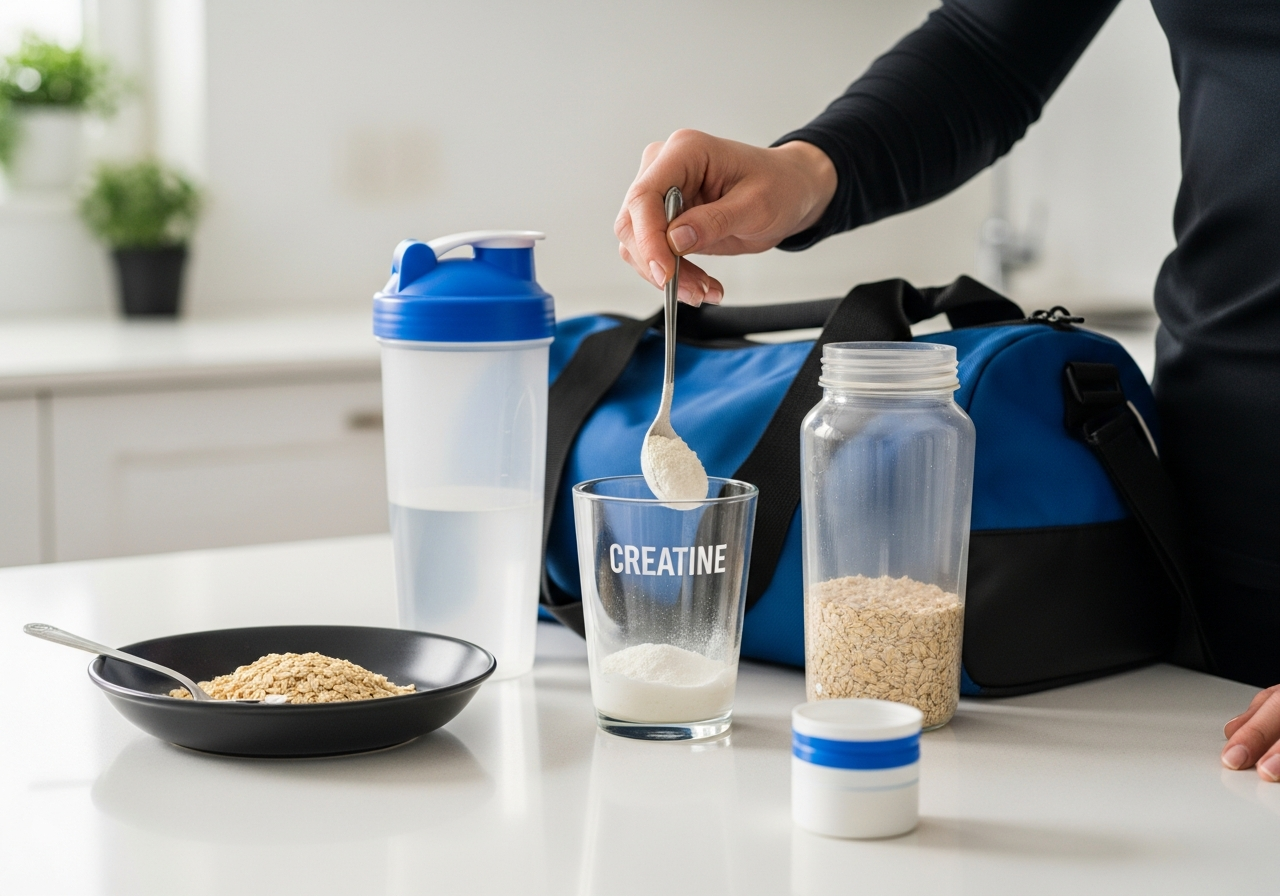
The best time to take creatine is the time you will consistently remember, because daily adherence matters far more than clock timing. This is the practical answer most people need. You can take creatine in the morning, after training, with a meal, or on rest days at any convenient time; the goal is to maintain elevated muscle stores, not to chase a narrow anabolic window.
That said, some habits make consistent use easier:
- Pick one anchor habit. Tie creatine to something you already do every day, such as breakfast, coffee, a post-workout shake, or brushing your teeth.
- Use the same dose daily. Most people should take 3 to 5 g every day, including non-training days.
- Mix it simply. Water, juice, or a protein shake are all fine. If you prefer, read how to mix creatine and can you mix creatine with protein powder.
- Do not dry scoop. It is unnecessary and can irritate your throat or stomach.
- Stay normally hydrated. You do not need absurd water intake, just sensible daily fluid habits.
Should you take creatine before or after your workout? The evidence does not support a dramatic difference for most users. If post-workout is easiest, take it then. If morning works better, use morning. If you train at inconsistent times, your off-day routine is often the best anchor because it is stable.
What about taking creatine when sick? If you have a mild illness and are still eating and drinking normally, there is usually no special rule that says you must stop. But if you have significant gastrointestinal symptoms, poor fluid intake, or simply do not feel like supplementing, it is reasonable to pause and restart later. The supplement is not urgent enough to force during a rough illness.
For a full timing breakdown, see when to take creatine. If hydration is your concern, our guide on how much water to drink with creatine covers realistic fluid targets without scare tactics.
Who creatine is for, and the special cases people ask about most
Creatine is appropriate for many healthy adults, including beginners, women, older adults, vegetarians, and athletes, and none of those groups need a unique 'cycling' rule by default. The same core principle applies: if creatine fits your goals and health status, consistent daily use is generally the evidence-based approach.
Beginners: Creatine is one of the simplest supplements to get right. You do not need a fancy stack, and you do not need a cycle. Start with 3 to 5 g per day and train consistently.
Women: Women can use creatine effectively for strength, lean mass, training performance, and potentially broader benefits discussed in emerging research. The practical dose is still usually 3 to 5 g daily. If you want a deeper women-specific overview, see creatine for women.
Can creatine affect your menstrual cycle? Current evidence does not support a clear, established effect of creatine on the menstrual cycle itself. Some women notice temporary water-weight changes or body-feel changes that can be confused with cycle-related fluctuations, but that is not the same as creatine disrupting the cycle. This remains an area where anecdote often outruns evidence.
Older adults: Creatine can be especially useful when paired with resistance training, because preserving muscle and strength matters more with age. Older adults also do not need routine cycling. See creatine for older adults for specifics.
Athletes in weight-sensitive sports: This is one group that may choose strategic stops. If a small amount of body-mass gain matters before a weigh-in or in certain endurance contexts, an athlete might pause creatine temporarily. That is a sport-specific tactic, not a general health requirement.
Vegetarians and vegans: People who eat little or no meat may start with lower muscle creatine stores and often respond well to supplementation. Daily use is typically more valuable here, not less.
Who should ask a clinician first? Anyone with kidney disease, significant medical conditions, pregnancy-related questions, or physician-directed testing concerns should discuss supplementation with a qualified healthcare professional before starting or continuing. For more on contraindications, read who should not take creatine.
Safety, side effects, and the kidney myth: what the evidence actually says
Creatine monohydrate is generally considered safe for healthy people when used at standard doses, and routine cycling is not needed for safety in that context. This is one of the most important points to get right because fear-based advice about creatine often comes from confusion between creatine and creatinine, a waste marker measured on blood tests.
The ISSN position stand and the International Olympic Committee consensus on dietary supplements both support creatine as one of the better-established performance supplements. Standard use in healthy individuals has not been shown to require periodic washout phases for kidney protection.
What side effects can happen?
- Water-weight increase: common early on, especially after loading.
- Stomach upset or diarrhea: more likely with large single doses or poor mixing.
- Bloating sensation: sometimes reported, often improved by lower divided doses or skipping loading.
What about kidneys? In healthy people, creatine supplementation can increase creatinine somewhat because creatinine is a breakdown product related to creatine metabolism. That can complicate lab interpretation without meaning the supplement harmed the kidneys. This is why context matters. If you are having blood work, tell your clinician you use creatine. If you have known kidney disease or are under kidney-related medical care, do not self-prescribe based on general internet advice.
To reduce side effects:
- Use 3 to 5 g per day rather than giant doses.
- If loading causes issues, skip it and use steady maintenance.
- Take creatine with food or split doses if your stomach is sensitive.
- Buy plain monohydrate rather than overloaded proprietary blends.
Our deeper explainers on is creatine safe, is creatine bad for your kidneys, and creatine digestive side effects cover the common worries in more detail.
Common myths about cycling creatine, debunked one by one
Most reasons people think they need to cycle creatine are myths, not evidence-based rules. If you have heard that you must take breaks because your body stops making creatine, because creatine stops working, or because continuous use is dangerous, here is the cleaner reality.
- Myth: You have to cycle creatine so your body keeps responding.
Fact: Creatine works by maintaining saturated stores, not by giving a stimulant-like jolt that fades with tolerance. - Myth: Your body stops making creatine if you supplement.
Fact: Your body still produces creatine naturally; supplementation adds to your total pool rather than permanently switching your system off. - Myth: You must cycle off to protect your kidneys.
Fact: In healthy users at standard doses, routine cycling is not an evidence-based kidney-protection strategy. - Myth: If you stop creatine, your muscle turns to fat.
Fact: Muscle does not turn into fat. You may lose water weight and some fullness, but that is not the same as gaining fat. - Myth: Creatine only works if you load and cycle.
Fact: Loading is optional, and cycling is optional; what matters most is reaching and maintaining elevated stores. - Myth: You should only take creatine during a bulk.
Fact: Creatine can support strength and training quality during maintenance, recomposition, and cutting as well.
Another persistent misconception is that if you stop after one month, you have somehow done it wrong. In reality, you can stop whenever you want. The question is not whether you are allowed to stop; it is whether stopping aligns with your goal. If your goal is maximum ongoing benefit, staying on is usually better. If your goal is simply to simplify travel or reduce scale weight briefly, stopping can be reasonable.
If you want a broader myth roundup, visit creatine myths debunked or creatine myths vs. facts. These pages pair well with this guide because a lot of cycling advice comes from old gym folklore rather than current evidence.
Buying creatine in Canada: what to look for on the label and what matters most
If you are buying creatine in Canada, the smartest choice is usually a plain creatine monohydrate product with clear dosing, minimal added ingredients, and reputable quality controls. You do not need a special 'cycle support' formula, and you do not need expensive alternative forms to avoid cycling.
When comparing products, prioritize these factors:
- Form: creatine monohydrate is the default evidence-based choice.
- Dose clarity: the label should clearly state the grams per scoop.
- Ingredient simplicity: fewer unnecessary extras means easier dosing and fewer digestive surprises.
- Quality signals: look for good manufacturing practices and, ideally, third-party testing.
- Canadian compliance: for products sold as natural health products in Canada, an NPN, or Natural Product Number, indicates Health Canada-authorized licensing for that product category and label claims.
Consumers often pay too much for marketing language such as 'buffered,' 'alkaline,' 'ultra-absorbed,' or 'no cycling needed.' Monohydrate already has the strongest research base. If a product's main promise is to solve a problem that plain monohydrate does not actually have, be skeptical.
| What to check | Best sign | Red flag |
|---|---|---|
| Creatine form | Creatine monohydrate | Proprietary blend hiding dose |
| Dose per serving | Clearly listed in grams | Only 'one scoop' with no exact grams |
| Ingredient list | Plain or minimally flavoured | Many fillers, sugars, or hype ingredients |
| Quality assurance | Third-party testing or strong brand transparency | No quality information at all |
| Canadian labelling | NPN where applicable | Missing key compliance details for Canadian sale |
If you are comparing options, browse our best creatine rankings, creatine brand reviews, and creatine product catalog. If you want the premium monohydrate angle specifically, our guide to best creatine monohydrate in Canada is the most relevant next read.
Bottom line: daily creatine beats unnecessary on/off phases
You do not need to cycle creatine, and for most healthy adults the best practice is steady daily use of creatine monohydrate at 3 to 5 g per day. If you want faster saturation, you can optionally load with 20 g per day split into 4 doses for 5 to 7 days, but that is about speed, not necessity.
If you stop taking creatine, nothing dramatic happens. Your muscle creatine stores slowly fall back toward baseline over the following weeks, and you may notice less muscle fullness, a small drop in water weight, and a modest decline in repeated high-intensity performance. That is not a rebound, a withdrawal effect, or muscle turning into fat. It is simply the supplement no longer keeping your tissues saturated.
So should you cycle creatine? In most cases, no. Should you stop taking creatine when sick, travelling, or making weight? Sometimes, if that is practical for your situation. Can you just stop taking creatine after one month or for a week? Yes, you can. The more useful question is whether stopping serves your goal.
If your goal is the best long-term return from one of the most proven sports supplements available, keep it boring:
- Buy plain creatine monohydrate from a reputable source.
- Take 3 to 5 g every day.
- Use loading only if you want quicker saturation.
- Do not worry about cycling unless you have a specific reason.
- Train hard enough to actually benefit from the extra phosphocreatine.
That is the evidence-based answer in 2026, and it has the advantage of being both effective and easy to stick with.
Creatine Cycling: The Numbers That Actually Matter
- 3-5 g/day Standard maintenance dose — Typical daily amount for most healthy adults using creatine monohydrate.
- 20 g/day Optional loading dose — Usually split into 4 doses for 5 to 7 days to saturate faster.
- 5-7 days Loading timeline — A loading phase can raise muscle stores faster, but it is not required.
- 4-6 weeks Approximate washout period — Muscle creatine stores generally trend back toward baseline gradually after stopping.
Frequently Asked Questions
Do you need to cycle creatine?
No, you do not need to cycle creatine. For most healthy adults, the standard approach is to take creatine monohydrate daily at 3 to 5 g per day, with no required on/off phases, because creatine works by keeping muscle stores saturated rather than by producing a short-term stimulant effect.
Should I cycle creatine?
You probably do not need to cycle creatine unless you have a specific personal reason, such as making weight for sport, simplifying travel, or testing whether you prefer being off it. Cycling is a preference decision, not an evidence-based requirement for effectiveness or safety in healthy users.
What happens when you stop taking creatine?
When you stop taking creatine, your muscle creatine stores gradually fall back toward baseline over several weeks. You may notice a small drop in body weight from water, slightly less muscle fullness, and some reduction in repeated high-intensity performance, but you do not experience a dangerous rebound or sudden muscle loss.
What happens if you stop taking creatine for 3 days?
If you stop taking creatine for 3 days, very little usually happens. Your muscles do not lose saturation that quickly, so most people will not notice meaningful changes in strength, training performance, or body composition after such a short break.
Can I stop taking creatine for a week?
Yes, you can stop taking creatine for a week, and it is usually not a big deal. Most users will still retain much of their elevated muscle creatine stores after only 7 days off, so any performance change is likely to be small or unnoticeable.
Can I just stop taking creatine after 1 month?
Yes, you can stop taking creatine after 1 month if you want to. The main downside is that the benefits will gradually fade as muscle stores decline, so stopping is more a question of whether it fits your goal than whether it is allowed or dangerous.
How do I cycle creatine if I still want to?
If you still want to cycle creatine, use a simple plan: optional loading at 20 g per day split into 4 doses for 5 to 7 days, then 3 to 5 g per day during your training block, followed by an off period only if you have a practical reason. There is no proven need for a reset phase.
Are you supposed to take a break from creatine?
No, you are not supposed to take a break from creatine in the sense of a universal rule. Healthy users can take standard doses continuously, and planned breaks are optional rather than mandatory according to current evidence and sports-nutrition consensus.
Should I stop taking creatine when sick?
Not necessarily, but it can be reasonable to pause creatine when sick if you have stomach symptoms, poor fluid intake, or simply do not want to supplement. A short break will not ruin your progress, and you can restart your usual daily dose once you feel normal again.
Can creatine affect your menstrual cycle?
Current evidence does not clearly show that creatine disrupts the menstrual cycle. Some women notice temporary water-weight or body-feel changes that can overlap with normal cycle fluctuations, but that is different from a proven direct effect on cycle timing or regularity.