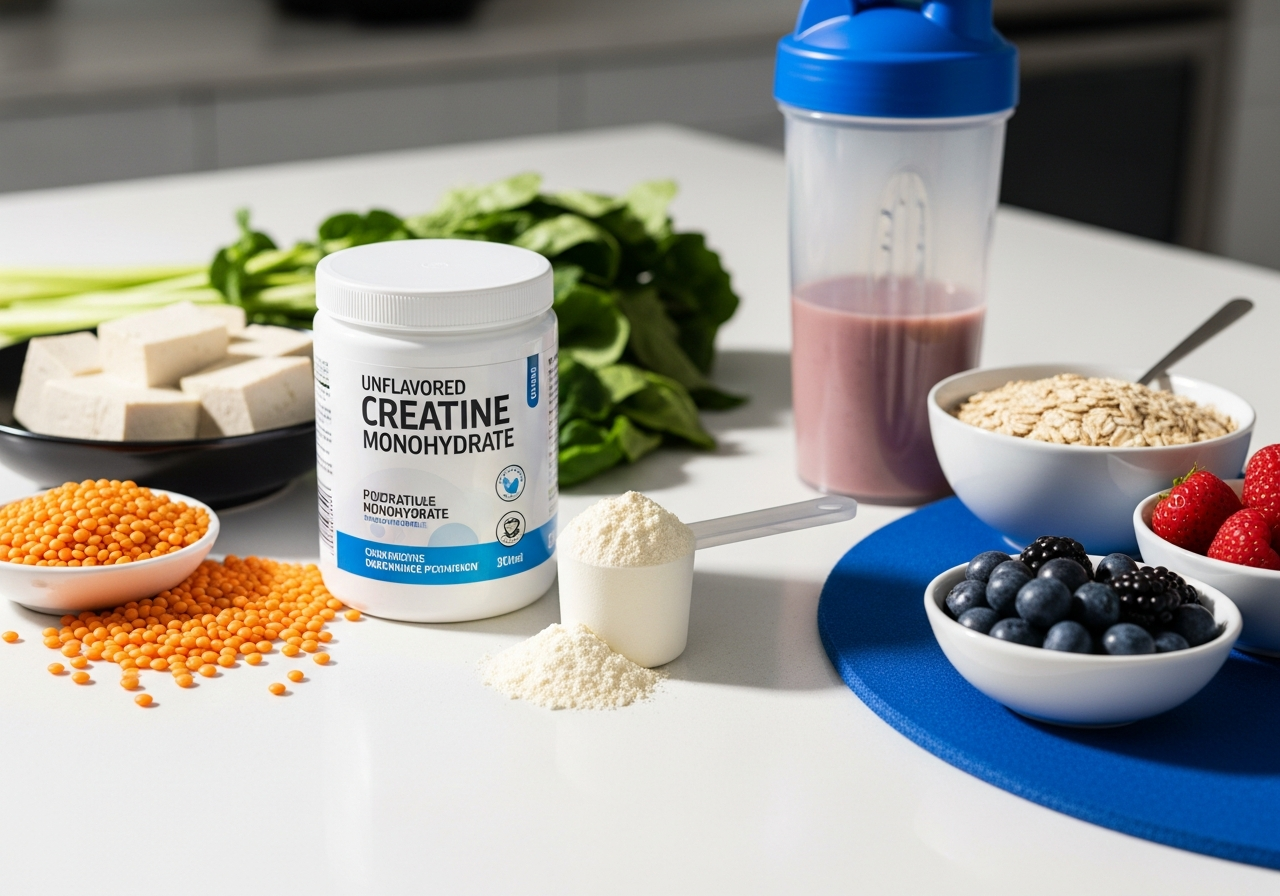
Creatine for Vegetarians: Why It Matters More Than You Think
By The Creatine Canada Research Team — Evidence-based supplement analysts
Yes—creatine often matters more for vegetarians and people on plant-based diets because they typically consume little to no dietary creatine from food, which can leave baseline muscle creatine stores lower than omnivores. That lower starting point is exactly why vegetarians often respond especially well to creatine monohydrate for strength, training performance, lean mass, and possibly some cognitive tasks.
Evidence-based · Cites 4 sources · Editorial standards
Key Takeaways
- Vegetarians do not always “need” creatine, but they are among the groups most likely to benefit from it.
- Creatine monohydrate is the best-supported form: take 3-5 g daily, every day, or use a 5-7 day loading phase at 20 g/day split into 4 doses.
- Plant-based eaters often start with lower muscle creatine stores because creatine is naturally found mainly in meat and fish.
- The main vegetarian creatine benefits are better high-intensity performance, improved strength gains, and slightly greater lean-mass gains over time when training.
- Timing matters far less than consistency; take creatine whenever you can remember it and keep using it on rest days.
- Most side effects are avoidable with sensible dosing, enough fluid, and by choosing plain monohydrate instead of over-marketed blends.
- In Canada, look for a Health Canada Natural Product Number (NPN) when applicable and preferably third-party testing or strong brand transparency.
Do vegetarians need creatine? Here’s the direct answer
Vegetarians do not strictly need creatine to be healthy, but creatine is one of the most logical and evidence-based supplements for vegetarians because plant-based diets provide little to no preformed creatine from food. If you eat no meat or fish, your body still makes creatine from amino acids in the liver, kidneys, and pancreas, but endogenous production does not always fully match the higher muscle stores seen in people who also get creatine from diet.
That difference matters because creatine helps regenerate ATP, or adenosine triphosphate, the cell’s immediate energy currency, during short bursts of hard effort. When muscle phosphocreatine stores are higher, you can usually perform a bit more total work across repeated sets, sprints, jumps, or explosive efforts. Over weeks and months, that extra training quality can translate into better strength and lean-mass gains.
For searchers asking “creatine for vegetarians” or “do vegetarians need creatine”, the practical answer is this: if you are vegetarian, vegan, or mostly plant-based and you lift weights, do sprint-style sport, CrossFit, team sport, or simply want a low-cost supplement with unusually strong evidence, creatine monohydrate belongs near the top of your list. The 2017 ISSN position stand concluded that creatine monohydrate is the most effective nutritional supplement currently available for increasing high-intensity exercise capacity and lean body mass during training.
Creatine is also relevant beyond bodybuilding. Some evidence suggests plant-based eaters may see cognitive benefits in certain situations, likely because the brain also uses creatine-phosphocreatine energy buffering. That evidence is less settled than the sports-performance evidence, but it is plausible and worth knowing about. If you want the full basics first, see what creatine is.
Bottom line: vegetarians are not deficient in the medical sense just because they do not eat meat, but they are more likely to have lower baseline creatine stores and, therefore, more room to benefit from supplementation.
Why creatine often works better for vegetarians than omnivores
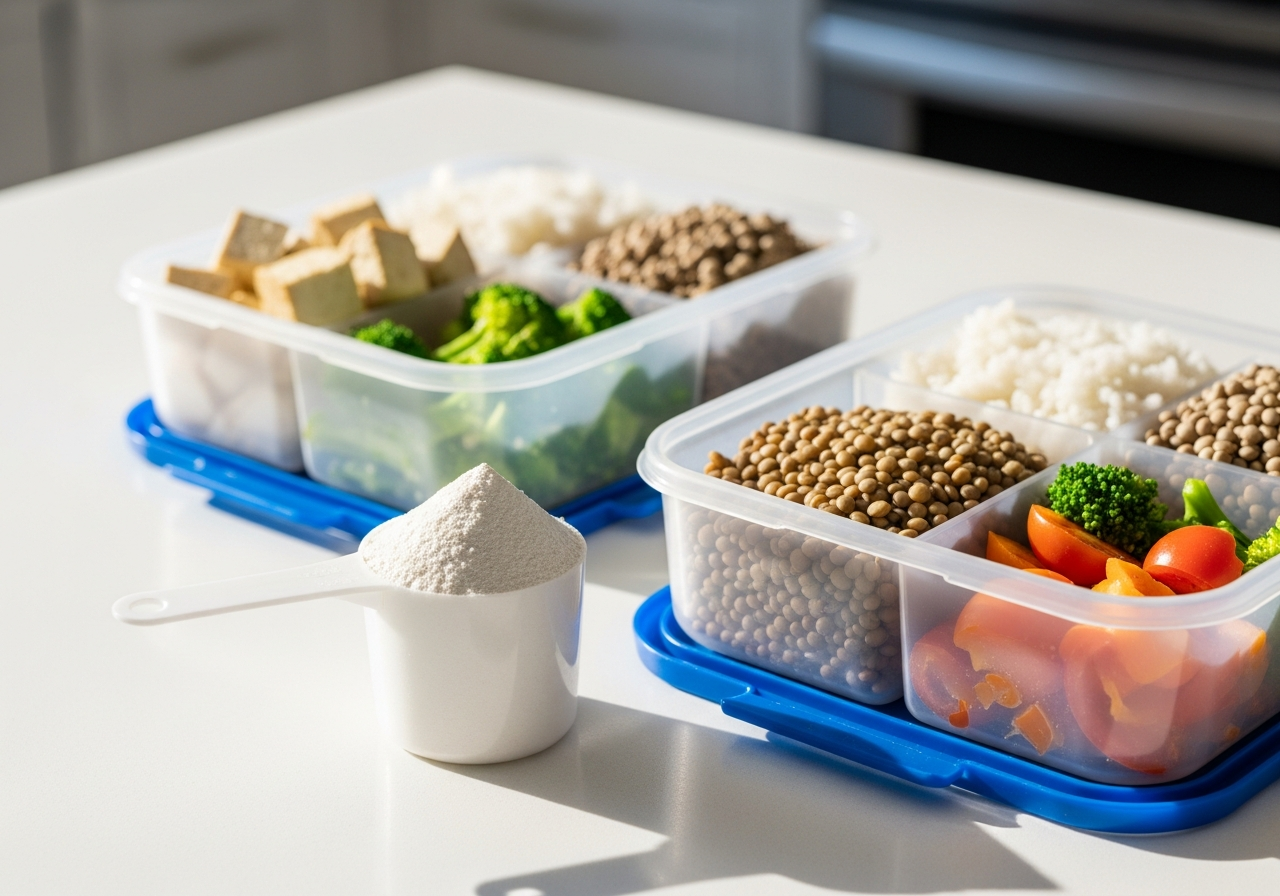
Creatine often works better for vegetarians because they usually start with lower muscle creatine stores, and supplements tend to produce the biggest visible effect when baseline stores are lower. Creatine is naturally concentrated in animal tissues such as meat and fish, so a vegetarian or vegan diet removes the main direct dietary source.
Mechanistically, creatine is stored in muscle as free creatine and phosphocreatine, a high-energy phosphate donor that rapidly helps remake ATP during intense effort. Think of phosphocreatine as a short-term energy buffer: when you do a heavy set of squats, a maximal bike sprint, or repeated accelerations in sport, your muscles burn through ATP fast. Phosphocreatine helps restore ATP quickly enough to sustain performance for a few more reps, a little more power, or better repeat efforts. That small edge is exactly why creatine shines in resistance training and intermittent high-intensity sport.
Vegetarians are also a classic example of people who may be “good responders”. The 2021 JISSN review on common creatine questions and misconceptions noted that individuals with lower initial creatine stores often see larger increases after supplementation. That does not mean every vegetarian responds dramatically, but it does mean the odds are favourable.
Here is what that can look like in practice:
- In the gym: you may complete 1 extra rep on hard sets, maintain bar speed better, or hold performance deeper into a workout.
- In sport: you may repeat short bursts more effectively, especially in sports with sprints, jumps, or collisions.
- Over time: the accumulated training effect may improve strength and lean mass more than training alone.
This is also why creatine for plant-based diets is not just a trend phrase. It is a physiologically sensible match between a lower-creatine diet pattern and a supplement that restores tissue stores. If you want the broader evidence-based list, see creatine benefits.
Important nuance: creatine is not a stimulant, and you do not “feel” it like caffeine. Its effect is usually noticed as better training quality, better repeat power, and better progression over several weeks rather than as an instant buzz.
Is creatine vegetarian? Usually yes—and often vegan too
Yes, most creatine supplements sold today are vegetarian, and many are vegan, because commercial creatine monohydrate is generally synthesised rather than extracted from animal tissue. That distinction is crucial for anyone searching “is creatine vegetarian” before buying.
Creatine as a molecule exists naturally in the human body and in animal foods, but the powdered creatine monohydrate in supplements is typically produced through industrial chemical synthesis. In plain language, that means the finished supplement is not usually made by grinding up animal tissue. However, “usually” is the right word, because product quality varies and some formulas include non-vegan capsules, flavour systems, or add-ins.
To check whether a creatine product fits your diet, verify four things:
- The ingredient list says creatine monohydrate, ideally as the only active ingredient.
- The capsule shell, if any, is vegetarian or vegan. Powders are often simpler than capsules or gummies.
- There are no animal-derived extras, such as gelatin in capsules or certain flavour additives.
- The company clearly states suitability for vegetarians or vegans when relevant.
If you want the most straightforward choice, plain unflavoured creatine monohydrate powder is usually the easiest option. It is typically just one ingredient, avoids gelatin capsules, and is usually the best value per gram. For more on formats and selection, compare options in our best creatine rankings and creatine product catalog.
In Canada, also pay attention to label quality. Many supplements carry a Natural Product Number, or NPN, which is the licence number Health Canada assigns to approved natural health products. An NPN does not prove superior performance, but it does signal the product has gone through the Canadian natural health product framework. Third-party testing for identity and contaminants adds another layer of reassurance.
So, is creatine vegetarian? In most cases, yes. Is every creatine product automatically vegan? No. The creatine itself often is, but the full product may not be, so read the label rather than assuming.
The real vegetarian creatine benefits: strength, muscle, performance, and possibly the brain
The best-supported vegetarian creatine benefits are improved high-intensity training performance, greater strength gains, and modestly better lean-mass gains over time when combined with training. Those outcomes are backed far more strongly than trendy claims about fat loss, hormones, or detox.
For muscle and performance, the evidence base is robust. The ISSN position stand and the International Olympic Committee consensus both support creatine as one of the most effective and best-researched sports supplements for repeated high-intensity exercise. In practical terms, creatine can help you train harder, recover your power faster between efforts, and accumulate more productive volume over time.
What vegetarians may notice most:
- More reps at a given weight: especially on sets lasting roughly 5-30 seconds of high effort.
- Better sprint repeatability: useful in field, court, combat, and interval-based sports.
- Faster strength progression: because slightly better sessions add up over months.
- Greater muscle fullness: partly from increased intracellular water, meaning water stored inside muscle cells.
- Potentially more pronounced response than omnivores: because baseline stores may be lower.
There is also growing interest in brain effects. The evidence summary from Examine.com and the broader literature suggest creatine may help some cognitive tasks under specific conditions such as sleep deprivation, high mental demand, or low baseline stores. That said, the cognition literature is still less consistent than the strength-and-performance literature. It is reasonable to say creatine may support brain energy metabolism and certain mental tasks, but it is not yet as definitive as the athletic data.
What creatine does not do: it does not directly build muscle in the absence of calories, protein, and training stimulus; it does not replace smart programming; and it is not a steroid. If you want a deeper myth breakdown, see creatine myths debunked.
For a vegetarian beginner, the realistic expectation is not a miracle transformation in a week. The realistic expectation is better training quality, a small increase in scale weight from water pulled into muscle, and more noticeable changes in strength and muscular development over several weeks of consistent use.
How to take creatine on a vegetarian or plant-based diet: the simplest step-by-step plan
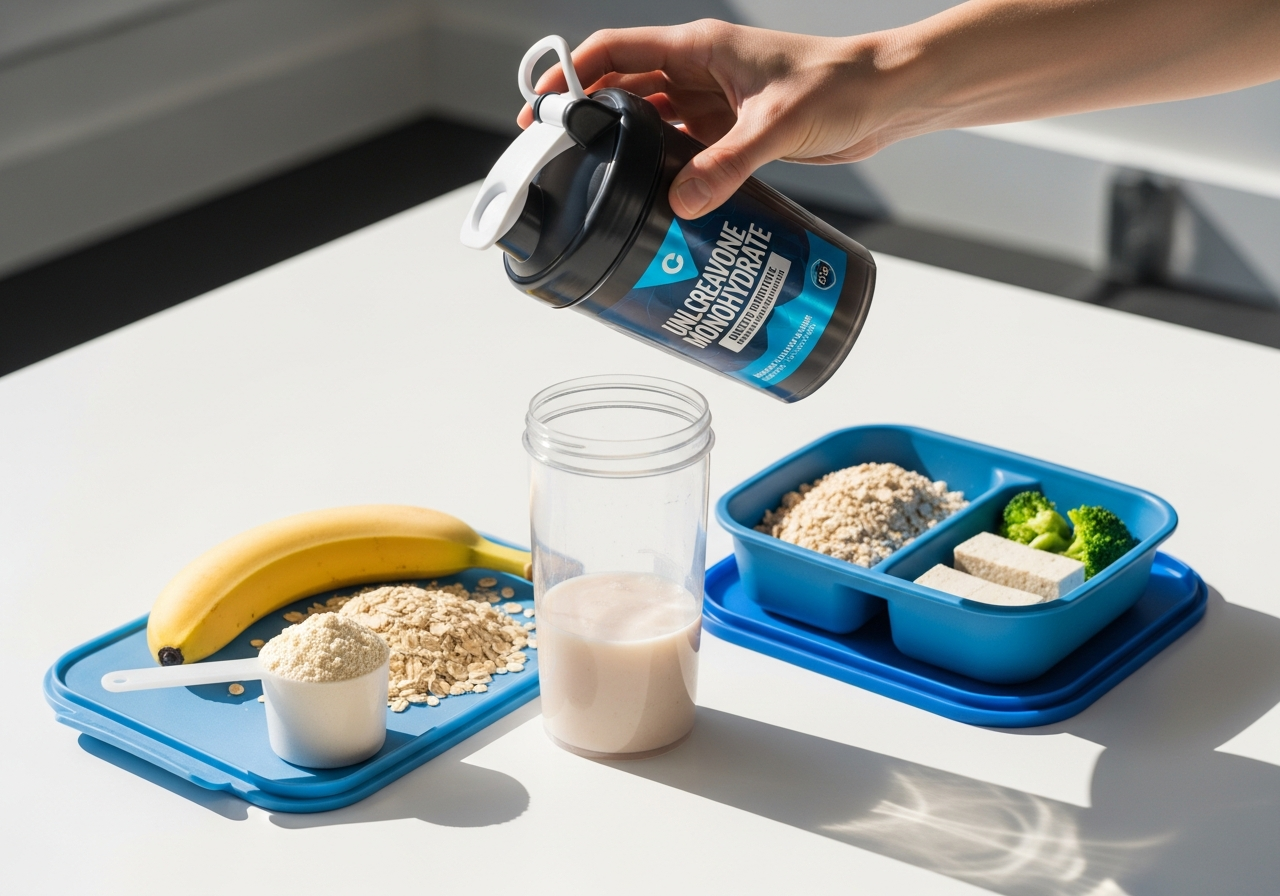
The simplest way to take creatine on a vegetarian diet is 3-5 g of creatine monohydrate once daily, every day, with any meal or shake you reliably consume. Consistency matters far more than a perfect clock time.
Here is the practical step-by-step approach that works for almost everyone:
- Choose plain creatine monohydrate. This is the most studied, most cost-effective, and easiest form to dose accurately.
- Pick your starting method. Use either a maintenance-only approach at 3-5 g/day or a loading phase at 20 g/day split into 4 doses for 5-7 days, then 3-5 g/day.
- Take it daily, not just on training days. Creatine works by saturating tissues over time, so off-days still count.
- Mix it in water, a protein shake, or a meal-adjacent drink. You do not need a sugary transport drink for it to work.
- Drink to thirst and maintain normal hydration habits. You do not need to force excessive water, but under-drinking is unhelpful.
- Keep going for at least 4 weeks before judging. If you skip loading, tissue saturation takes longer.
If you want exact dose calculations, use our creatine dosage calculator. If you want a more detailed walkthrough, see how to take creatine and the creatine loading phase guide.
A few practical plant-based examples:
- Morning oats eater: stir 3-5 g into your post-breakfast shake.
- Lunch lifter: take 3-5 g with your post-workout protein and fruit.
- Busy shift worker: keep a small tub at work and tie it to your first meal break.
If creatine upsets your stomach, split the dose into 2 smaller servings, use warm liquid to help dissolution, or skip loading and take 3 g daily instead. Micronized monohydrate can also be easier to mix, though standard monohydrate works just as well.
The biggest beginner mistake is inconsistency. A perfectly timed dose taken three days a week is less useful than a boring daily dose taken every single day.
Best creatine dose for vegetarians: by body weight, goal, and how fast you want results
The best creatine dose for most vegetarians is 3-5 g of creatine monohydrate per day, but heavier athletes and those who want faster saturation may benefit from weight-based planning or a loading phase. The mainstream evidence-based options are straightforward, and most marketing around “advanced dosing” adds more confusion than value.
Use this table as a practical starting point:
| Goal / body size | Loading option | Maintenance option | What to expect |
|---|---|---|---|
| General fitness, under ~70 kg | 20 g/day for 5-7 days, split into 4 x 5 g | 3 g/day | Faster saturation with loading; slower but effective saturation without it |
| General fitness, ~70-100 kg | 20 g/day for 5-7 days, split into 4 x 5 g | 3-5 g/day | Most people in this range do well on 5 g/day |
| Larger athletes, over ~100 kg | 20 g/day for 5-7 days or roughly 0.3 g/kg/day | 5 g/day, sometimes slightly more by body size | Heavier, more muscular athletes may prefer the upper end |
| Cognition interest only | Usually not necessary | 3-5 g/day | Evidence is less settled than sports performance |
| Sensitive stomach | Skip loading | 3 g/day or split 2-3 smaller doses | Slower onset but fewer GI issues |
The classic loading protocol comes from taking roughly 0.3 g/kg/day for 5-7 days, then around 0.03 g/kg/day for maintenance. For a 60 kg person, that is about 18 g/day during loading and about 1.8 g/day by the formula, though in real-world use 3 g/day is a practical minimum. For an 80 kg person, loading is about 24 g/day and maintenance is about 2.4 g/day, though many simply use 5 g/day for convenience and margin.
If you are unsure, start with 5 g/day. It is simple, effective, and consistent with mainstream practice. Learn more in how much creatine per day and maintenance dose guidance.
For vegetarians asking whether they need a higher dose because they eat no meat: usually no. Lower baseline stores mean you may respond better, not that you need megadoses.
When to take it, how long it takes to work, and how to tell it’s actually helping
The best time to take creatine is the time you will remember every day, because daily consistency matters much more than pre-workout versus post-workout timing. Creatine is a saturation supplement, not an acute stimulant.
If you load at 20 g/day for 5-7 days, you may notice body-weight changes and training benefits within about a week. If you skip loading and take 3-5 g/day, full saturation usually takes several weeks, often around 3-4 weeks. That is why people sometimes think creatine “isn’t working” after just a few doses.
What to expect, week by week:
- Days 1-7 with loading: scale weight may rise modestly as water is pulled into muscle cells; some people notice better repeat effort quickly.
- Weeks 2-4 without loading, or after loading settles: workouts may feel slightly more productive, especially on compound lifts and repeated intervals.
- Weeks 4-8: strength progress may outpace your previous baseline if your training and protein intake are in order.
- Months 2-6: the real payoff is often cumulative—better training quality becomes better adaptation.
How do you know creatine is helping?
- Track performance. Log reps, load, sprint times, or work completed.
- Watch repeat efforts. Creatine often shows up in second, third, and fourth hard bouts.
- Expect small, not dramatic, daily differences. Creatine is often subtle session to session but meaningful over time.
- Do not rely on “feeling” it. There is often no buzz or pump that proves it is active.
Some vegetarians notice a quicker or more obvious response because they started lower. Others need a full month to judge. Both are normal. For deeper guides, see when to take creatine and how long creatine takes to work.
If results seem absent after 6-8 weeks, check the basics first: are you taking the right dose daily, training hard enough, eating enough protein and calories, and using a plain monohydrate product from a trustworthy source?
Who should consider creatine most on a plant-based diet: beginners, women, older adults, and athletes
Creatine is useful for many plant-based eaters, but the strongest case is for vegetarians and vegans who resistance train, do repeated high-intensity sport, or want to preserve strength and muscle with ageing. You do not have to be a bodybuilder to benefit.
Beginners: creatine is beginner-friendly because the protocol is simple and the evidence is strong. If you are new to lifting, creatine will not replace learning technique, but it can support better training volume while you build habits. If that is you, start with 3-5 g/day and read creatine for beginners.
Women: women benefit from creatine too. Creatine does not make women bulky by itself; it supports performance, lean mass, and recovery in the same basic way it does for men. The scale may rise slightly from intracellular water, but that is not fat gain. See our women’s guide for the full picture.
Older adults: creatine is particularly interesting for older vegetarians because ageing increases the importance of maintaining muscle, strength, and function. Combined with resistance training, creatine may support better training adaptations and help defend against age-related muscle loss. There is also growing interest in brain-related applications, though that remains less established than the muscle data.
Athletes: field sport athletes, sprinters, lifters, swimmers, and many CrossFit-style competitors can benefit because their events depend heavily on repeated high-intensity output. Endurance athletes may still benefit, but the trade-off of a small water-related body-mass increase can be less desirable in some contexts.
Strict vegans and low-protein plant-based eaters: this group often has the clearest rationale because both dietary creatine intake and sometimes total protein quality can be lower if diet planning is poor.
Who may care less? Someone doing only low-intensity steady walking with no interest in strength, power, muscle, or repeated high-output performance may notice less obvious benefit. Creatine is still safe and reasonable, but the payoff is simply smaller.
So if you are asking about creatine for plant-based diets, the answer is broad but especially compelling for active vegetarians, older adults, and performance-minded trainees.
Safety, side effects, and the kidney myth vegetarians should understand
Creatine monohydrate is generally considered safe for healthy people when used at recommended doses, and the most common side effects are mild digestive upset or a small water-related increase in body weight. That safety profile is one reason creatine remains a staple recommendation from evidence-based sports nutrition professionals.
The 2017 ISSN position stand and the 2021 JISSN review both addressed safety and common misconceptions, including concerns about kidneys, dehydration, cramps, and hair loss. In healthy individuals, creatine supplementation at recommended intakes has not been shown to damage the kidneys. What often confuses people is creatinine, a breakdown product measured on blood tests. Creatine supplementation can sometimes affect creatinine readings without indicating kidney injury, which is why context matters. If you have known kidney disease or are under medical supervision for renal issues, talk with your physician before using creatine.
Common side effects and fixes:
- Stomach upset or loose stools: usually caused by too much at once; split the dose or skip loading.
- Bloating: often overstated; many people actually experience intracellular water retention, not puffy subcutaneous bloating.
- Weight gain: typically an early increase from water stored in muscle, not body fat.
- Cramping or dehydration fears: these claims are not well supported in healthy users when hydration is normal.
Mayo Clinic also notes that creatine appears to be safe for up to several years in healthy adults when used appropriately, while still advising medical guidance for those with underlying conditions. See Mayo Clinic’s creatine overview for a mainstream clinical summary.
If you want deeper myth-specific explainers, our guides on creatine safety, creatine and kidneys, and bloating go further.
For a healthy vegetarian adult using 3-5 g/day of monohydrate, the risk-benefit profile is unusually favourable by supplement standards.
The biggest mistakes vegetarians make with creatine—and the myths to ignore
The biggest creatine mistakes vegetarians make are buying the wrong form, underdosing, taking it inconsistently, and expecting a stimulant-like feeling. Most disappointment comes from execution errors, not from creatine itself.
Here are the mistakes that matter most:
- Choosing fancy forms over monohydrate. Monohydrate remains the reference form because it is the most studied and most cost-effective. Claims that HCL, buffered creatine, or exotic blends are inherently superior are not supported by stronger evidence.
- Skipping daily use. Creatine should be taken on rest days too because tissue saturation is the goal.
- Taking too little. A low-dose gummy or underfilled scoop may leave you below an effective daily amount.
- Stopping after one week. Without loading, effects take time.
- Confusing water gain with fat gain. Early scale changes are often muscle-cell hydration, not body-fat increase.
- Assuming it is not vegetarian. Many products are vegetarian or vegan, but you still need to read the full label.
Now the myths:
Myth: Creatine is only for meat eaters or bodybuilders.
Fact: Creatine may be even more relevant for vegetarians because dietary intake is low, and it benefits many sports and training goals beyond bodybuilding.
Myth: Creatine damages healthy kidneys.
Fact: Current evidence does not support kidney damage in healthy users at recommended doses, though people with kidney disease should seek medical advice.
Myth: You must cycle creatine.
Fact: There is no evidence-based requirement to cycle creatine on and off.
Myth: You have to take it immediately post-workout with sugar.
Fact: Timing is secondary to daily consistency, and special carb loading is unnecessary for most users.
Myth: Plant foods can replace supplementation if you just eat enough legumes.
Fact: Legumes are excellent foods, but they do not meaningfully supply preformed creatine the way meat and fish do.
If you want a broader comparison of claims versus evidence, browse our creatine brand reviews and myths page before spending extra on premium-marketed formulas.
How to choose the best creatine for vegetarians in Canada
The best creatine for vegetarians in Canada is usually a plain creatine monohydrate powder from a reputable brand with transparent labelling, ideally backed by third-party testing and, where applicable, a Health Canada NPN. For most buyers, simpler is better.
Use this buying checklist:
- Choose creatine monohydrate first. It has the deepest evidence base and usually the best price per gram.
- Read the full ingredient panel. Plain powder is easiest for vegetarians and vegans because there are fewer hidden animal-derived extras.
- Check for Canadian compliance. An NPN can be a useful legitimacy signal in Canada.
- Prefer transparent brands. Look for batch testing, contaminant screening, and clear serving sizes in grams.
- Beware underdosed formats. Gummies and proprietary blends can make it harder or pricier to reach an effective 3-5 g daily dose.
A useful comparison:
| Format | Best for | Pros | Cons |
|---|---|---|---|
| Unflavoured monohydrate powder | Most vegetarians | Best evidence, lowest cost, usually one ingredient | Needs mixing |
| Micronized powder | People who dislike grit | Mixes more easily | Usually costs a bit more |
| Capsules | Travel convenience | No mixing, easy portability | Many capsules needed to hit 3-5 g |
| Gummies | Taste-focused users | Convenient and pleasant | Often expensive or underdosed; check ingredients carefully |
| Flavoured blends | People who want a drink format | Taste and convenience | May include unnecessary extras or sweeteners |
If you want current options, see our best creatine rankings, brand reviews, and product catalog. Canadian shoppers should also be cautious with imported marketplace listings that provide weak ingredient disclosure or unclear regulatory information.
The short version: if the tub says creatine monohydrate, gives a clear 3-5 g serving, suits your dietary preferences, and comes from a trustworthy company, you are probably looking at the right product.
Bottom line: should a vegetarian take creatine?
Yes—if you are vegetarian or plant-based and care about strength, high-intensity performance, lean mass, or potentially brain energy support, creatine monohydrate is one of the smartest supplements you can take. It is especially sensible because vegetarians generally consume little to no preformed creatine from food and may start with lower tissue stores.
The practical recommendation is simple: take 3-5 g of creatine monohydrate daily, every day, and stay with it long enough to judge results properly. If you want faster saturation, use a loading phase of 20 g/day split into 4 doses for 5-7 days, then return to 3-5 g/day. Most people do not need anything fancier than that.
If you are still weighing the decision, ask yourself three questions:
- Do I train with weights or perform repeated hard efforts?
- Do I eat little or no meat or fish?
- Do I want a low-cost supplement with unusually strong evidence?
If the answer is yes to two or three of those, creatine is very likely worth trying. It will not replace training, sleep, protein, or calories, but it can make those fundamentals work slightly better. And in sports nutrition, small reliable edges are often the ones that matter most.
For next steps, use our creatine dosage calculator, review daily dosing, and explore whether creatine is vegan if your diet is fully plant-based.
Final answer in one sentence: creatine for vegetarians is not mandatory, but it is more relevant, more rational, and often more beneficial than many people realise.
Creatine for Vegetarians: the numbers that matter
- 3-5 g/day Standard daily maintenance dose — The simplest evidence-based protocol for most adults using creatine monohydrate.
- 20 g/day Classic loading dose — Usually split into 4 doses for 5-7 days to saturate muscles faster.
- 5-7 days Typical loading timeline — Useful if you want faster results rather than waiting several weeks.
- 3-4 weeks Typical time to saturate without loading — Daily 3-5 g use works well; it just takes longer.
Frequently Asked Questions
Do vegetarians need creatine more than meat eaters?
Often yes, or at least they have a stronger case for using it. Vegetarians usually consume little to no preformed creatine from food, so their baseline muscle creatine stores can be lower than omnivores, which is one reason they may respond especially well to supplementation.
What are the main vegetarian creatine benefits?
The main vegetarian creatine benefits are better high-intensity exercise performance, improved strength gains, and slightly greater lean-mass gains over time when combined with training. Some plant-based eaters may also notice benefits in mental performance under certain conditions, but that evidence is less settled than the sports data.
Is creatine vegetarian or vegan?
Most creatine supplements are vegetarian, and many are vegan, because commercial creatine monohydrate is typically synthesised rather than sourced from animal tissue. Still, the full product may include non-vegan capsules, gummies, or flavour ingredients, so check the label rather than assuming.
Can you get enough creatine from a plant-based diet?
No, not in the same way you can from meat or fish. Your body can make creatine on its own, but plant foods do not meaningfully supply preformed creatine, which is why supplementation is often attractive for vegetarians and vegans.
What is the best creatine for plant-based diets?
The best creatine for plant-based diets is usually plain creatine monohydrate powder. It is the most studied form, the most cost-effective form, and often the easiest to verify as vegetarian or vegan because it commonly contains only one ingredient.
How much creatine should a vegetarian take?
Most vegetarians should take 3-5 g of creatine monohydrate daily. If faster saturation is important, a loading phase of 20 g/day split into 4 doses for 5-7 days is a standard evidence-based option before returning to 3-5 g/day.
How long does creatine take to work for vegetarians?
Creatine can start working within about a week if you use a loading phase, but it usually takes several weeks with a standard 3-5 g daily approach. Vegetarians may sometimes notice a more obvious response because they often start with lower baseline stores.
Should vegetarians take creatine on rest days?
Yes, vegetarians should take creatine on rest days as well. Creatine works by increasing and maintaining tissue saturation over time, so daily use matters more than whether you trained that day.
Does creatine cause weight gain in vegetarians?
Creatine can cause a small increase in body weight, but this is usually water stored inside muscle cells rather than fat gain. For many lifters and athletes, that muscle-cell hydration is part of the supplement’s normal effect rather than a problem.
Is creatine safe for vegetarian women and older adults?
Yes, creatine is generally considered safe for healthy women and older adults at recommended doses, and these groups may benefit meaningfully when creatine is combined with resistance training. Anyone with kidney disease or another significant medical condition should still speak with a healthcare professional first.