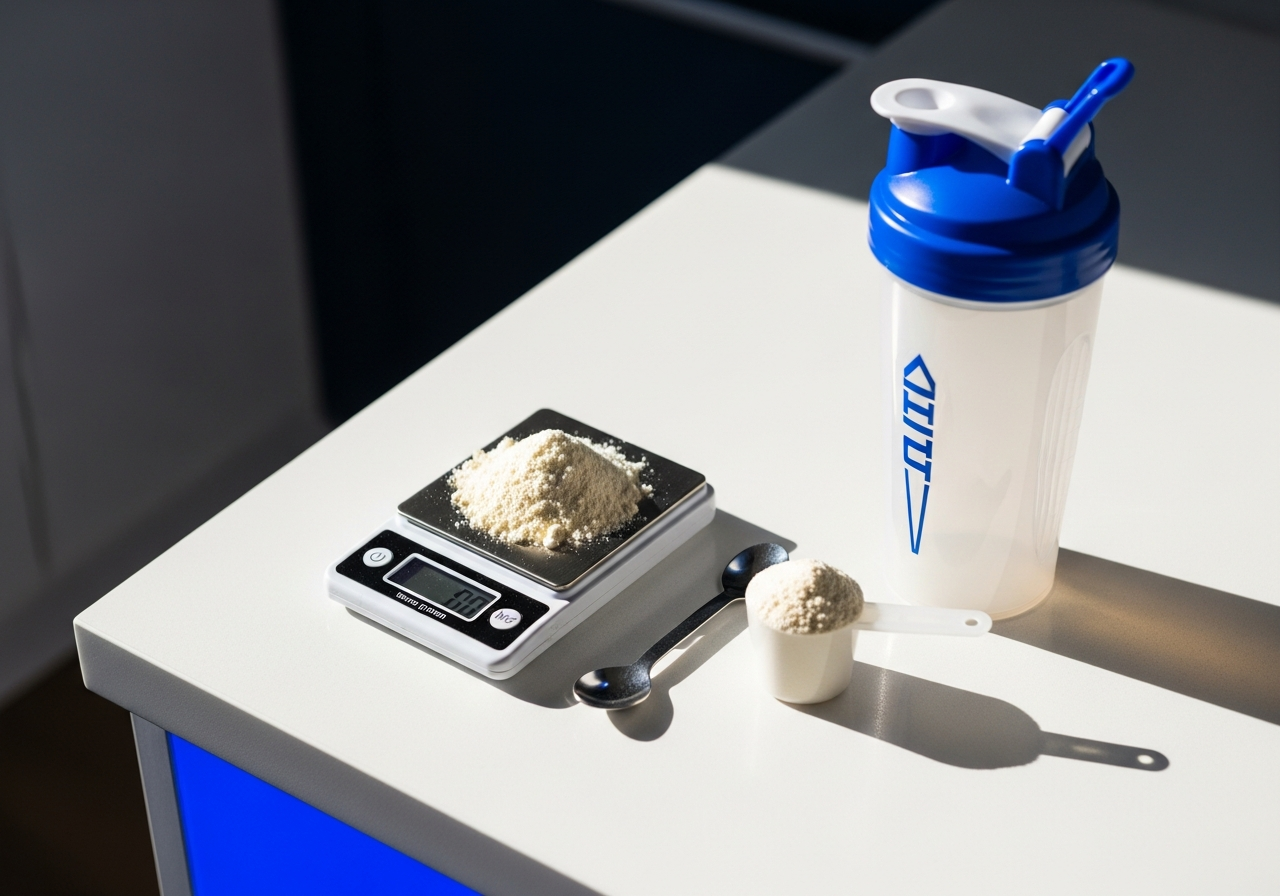
How to Measure 5g of Creatine Without a Scale (Teaspoon Guide)
By The Creatine Canada Research Team — Evidence-based supplement analysts
To measure creatine accurately, use a gram scale and aim for 3-5 g per day; if you do not have a scale, 5 g of creatine monohydrate is usually about one level teaspoon, but scoop size and powder density vary by brand. The most reliable method is to follow the serving in grams on the label, not the scoop alone.
Evidence-based · Cites 4 sources · Editorial standards
Key Takeaways
- The best way to measure creatine is by grams, using a digital kitchen or jewellery scale.
- For most creatine monohydrate powders, 5 g is roughly 1 level teaspoon, but this is only an estimate.
- A scoop is not automatically 5 g unless the label explicitly says so.
- Most adults do well with 3-5 g daily; a loading phase is optional at 20 g/day split into 4 doses for 5-7 days.
- Measuring slightly high or low on a given day is not a big problem because creatine works through muscle saturation over time.
- If your powder clumps, settles, or has a different grain size, re-check the weight because volume measurements become less accurate.
- In Canada, look for clear gram-based serving sizes, an NPN where applicable, and ideally third-party testing.
How to measure creatine correctly: the direct answer first
The most accurate way to measure creatine is to weigh it in grams, because creatine dosing recommendations are based on grams per day, not on spoon size or scoop shape. If you do not own a scale, 5 grams of creatine monohydrate is commonly about 1 level teaspoon, but that shortcut is only approximate and can be off when powder texture, moisture, or brand density differs.
This matters less than people think for day-to-day use, but it still matters. Creatine works by gradually saturating your muscles with more phosphocreatine, the stored form that helps regenerate ATP, your cells' immediate energy currency during short, hard efforts. Because the goal is saturation over days and weeks, being 0.5-1 g off once in a while is not a disaster. Still, if you want to know exactly how to measure creatine powder, especially during a loading phase or if you are troubleshooting side effects, a scale is the gold standard.
For most adults, the practical target is simple:
- Maintenance: 3-5 g daily
- Loading phase, if used: 20 g daily split into 4 doses of 5 g for 5-7 days
The 2017 ISSN position stand concluded that creatine monohydrate is the most effective ergogenic nutritional supplement currently available for increasing high-intensity exercise capacity and lean mass, and standard dosing is expressed in grams rather than teaspoons or scoops. If you want a personalised starting point, use our creatine dosage calculator and then measure to that gram target.
If your tub includes a scoop, treat it as a convenience tool, not proof of dose accuracy. A scoop may be heaped, packed, loosely filled, or designed for a serving size that is not exactly 5 g. Always check the label line that states the actual serving in grams.
Bottom line: if you are asking how many teaspoons is 5g of creatine, the best quick answer is about 1 level teaspoon for many monohydrate powders, but if you want to get 5 g right consistently, weigh it.
Why grams beat teaspoons and scoops every time
Grams are better than teaspoons because weight stays constant while volume changes with powder density, clumping, humidity, and how tightly you pack the scoop. Two creatine powders can look similar but still occupy slightly different volume for the same 5 g dose.
This is the core reason people get confused about measuring creatine powder. A teaspoon measures space, not mass. A scoop also measures space, unless the manufacturer has calibrated it to a specific product density and then listed the result clearly on the label. Even then, user technique changes the outcome. A level scoop, rounded scoop, and compressed scoop are not the same dose.
Creatine monohydrate is usually sold as a fine powder, and finer powders often settle more tightly. Micronized creatine can also pour differently than a coarser product. If you have ever wondered why one brand's scoop seems smaller or larger than another's, that is exactly why. The scoop volume may differ, or the powder may have a different bulk density. Neither tells you the true dose unless you compare it to the labelled grams.
In practical terms:
- 1 gram always means 1 gram.
- 1 teaspoon may or may not equal 5 g.
- 1 scoop only equals the labelled serving if filled the same way the manufacturer intended.
This is also why experienced lifters who use creatine long term often stop obsessing over tiny daily variation but still buy a small scale. It removes guesswork, especially during a loading phase or when comparing products from our best creatine rankings and creatine brand reviews.
From an evidence standpoint, the big picture is reassuring. According to Antonio et al. (2021) in JISSN, creatine is one of the most studied sports supplements, and the standard, evidence-based approach is still plain creatine monohydrate in gram-based doses. Precision matters, but perfection is not required. Your muscles respond to consistent intake over time, not to whether Tuesday's scoop was 4.7 g or 5.2 g.
If accuracy, repeatability, and easier troubleshooting matter to you, use grams. If convenience matters most and you know your product, a level teaspoon can work as a backup, but it should stay a backup.
How many teaspoons is 5 g of creatine, really?
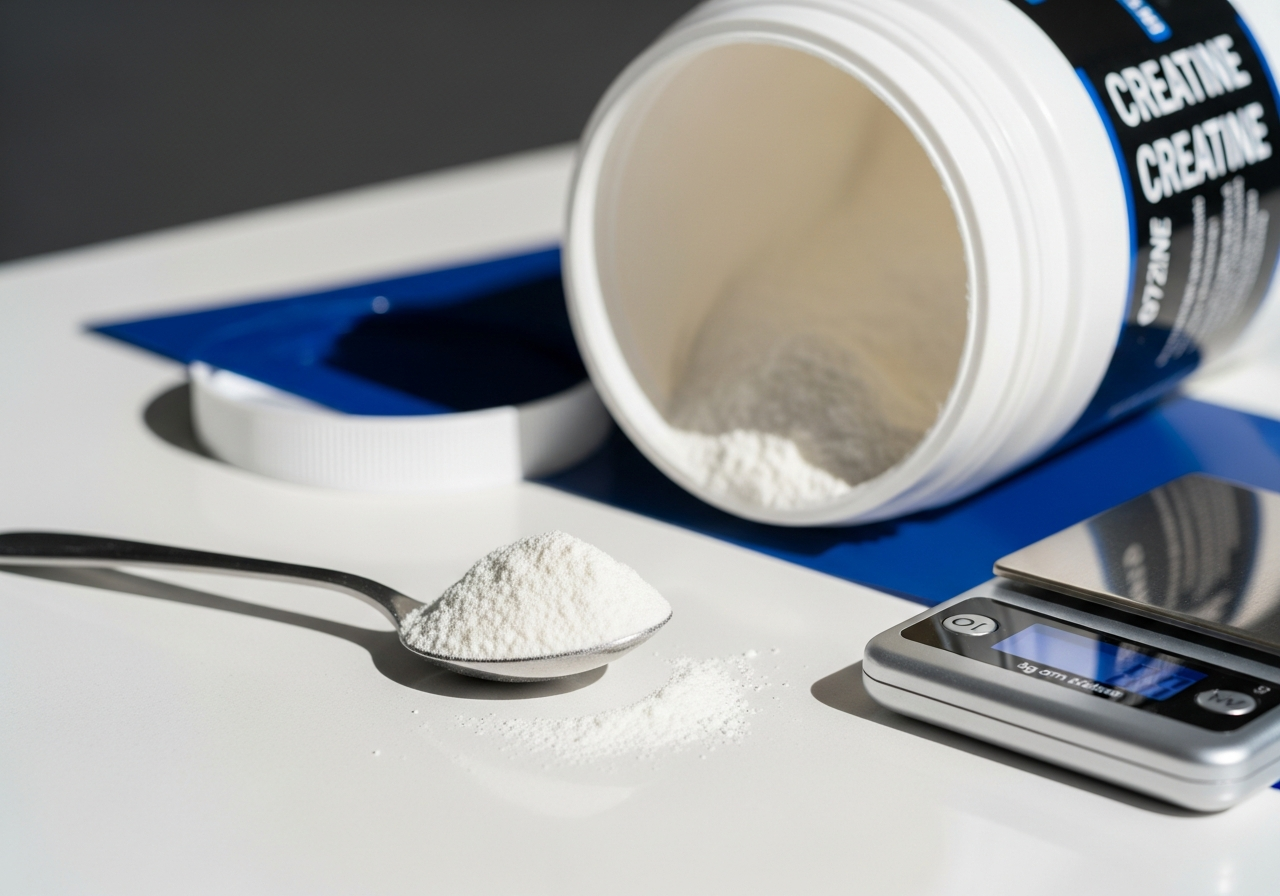
For many creatine monohydrate powders, 5 grams is roughly 1 level teaspoon, but that estimate is not universal enough to replace the label or a scale. If you searched for 5 grams of creatine in teaspoons, this is the honest answer: about 1 level teaspoon for many products, but verify your own tub.
Why the uncertainty? Powder density changes with:
- grain size and whether the creatine is micronized
- moisture exposure and clumping
- how full and level the spoon is
- whether the powder is fluffed or settled
- brand-specific processing
That means one person's “teaspoon of creatine” can be noticeably different from another's. The same problem applies to the tiny scoop inside a tub. Some labels say 1 scoop equals 5 g, others say 1 scoop equals 3 g, and some include a scoop that is not filled to the brim for the stated serving.
Here is the best way to turn teaspoon estimates into something useful:
- Read your product label and find the serving size in grams.
- If it says 5 g per scoop, check whether the instructions specify level or rounded.
- If you do not trust the scoop, weigh one level teaspoon on a scale once.
- Write the result on the tub lid or keep a note on your phone.
Once you have weighed your own powder one time, you can use that spoon or scoop much more confidently. This is especially useful for travel, work, or gym bags where carrying a scale is impractical.
If your powder is clumpy, break up the clumps before measuring. Clumps change how much powder fits in the spoon and make volume estimates less reliable. If you need help with dissolving and clumping, see how to mix creatine.
For most people using plain monohydrate, the most practical takeaway is this: if your goal is a standard daily maintenance dose, a level teaspoon is usually close enough to 5 g to work, but if you are trying to be exact, a scale wins every time.
Step-by-step: how to measure creatine with a scale and without one
The easiest way to measure creatine correctly is to follow a simple repeatable routine, and the routine is slightly different depending on whether you own a scale. Both methods work, but the scale method is more accurate.
Method 1: Measure creatine with a digital gram scale
- Place a small cup, shot glass, or folded piece of parchment on the scale.
- Press tare so the display returns to 0.0 g.
- Add creatine slowly until you reach your target, such as 3.0 g, 5.0 g, or another planned amount.
- Pour it into water, a shaker, or a protein shake.
- Repeat the same method daily for consistency.
Method 2: Measure creatine without a scale
- Read the label for the stated serving size in grams.
- Use the included scoop only if the label clearly states what 1 level scoop weighs.
- If there is no scoop or it is missing, use a standard measuring teaspoon.
- For many monohydrate products, use about 1 level teaspoon to approximate 5 g.
- Keep the spoon level, not heaped, and try to measure the same way each day.
Method 3: Calibrate your scoop once, then stop guessing
- Borrow or buy a cheap digital scale.
- Weigh your usual scoop or teaspoon exactly once.
- Note whether your “level scoop” is really 4 g, 5 g, or 6 g.
- Adjust future servings accordingly.
This third method is the best compromise for anyone wondering about a creatine dose without a scale every day. One quick calibration gives you much better accuracy for months.
Helpful technique details:
- Do not pack the powder down unless the brand specifically says to.
- Do not use a wet scoop; moisture encourages clumping.
- Store the tub tightly sealed so the powder texture stays consistent.
- If the scoop settles to the bottom, use a dry utensil to retrieve it and wash it before regular use.
If you are just starting, pairing this with a beginner guide can help: creatine for beginners. If you also want full daily-use instructions, see how to take creatine.
The key is consistency. A perfect scoop is less important than taking the right approximate amount every day for long enough to saturate muscle stores.
The right creatine amount by goal, body weight, and loading vs maintenance
The right creatine dose depends more on your goal and whether you want to load quickly than on finding a magical exact teaspoon. For most adults, 3-5 g daily is the standard maintenance dose, while a loading phase uses 20 g daily split into four 5 g doses for 5-7 days.
The ISSN position stand describes two common evidence-based approaches: a rapid loading protocol of about 0.3 g/kg/day for 5-7 days followed by 3-5 g/day, or a slower approach of 3-5 g/day from the start. The loading method saturates muscle creatine stores faster; the maintenance-only method reaches the same place more gradually, usually over about 3-4 weeks.
| Goal or situation | Typical dose | How to measure it | Practical note |
|---|---|---|---|
| General fitness maintenance | 3-5 g/day | Weigh 3-5 g or use roughly 3/5 to 1 teaspoon depending on your product | 5 g is the simplest default for most adults |
| Rapid saturation/loading | 20 g/day for 5-7 days | 4 separate 5 g doses | Split doses can reduce stomach upset |
| Body-weight based loading | 0.3 g/kg/day | Use a scale | More precise for larger or smaller athletes |
| After loading | 3-5 g/day | Scale or calibrated scoop | Maintains elevated muscle stores |
| Larger athletes with high lean mass | Often 5 g/day | Scale preferred | Some may choose the upper end consistently |
Here are simple examples:
- 60 kg beginner: 3-5 g/day is reasonable; 3 g is fine if you prefer a lower start.
- 75 kg recreational lifter: 5 g/day is the usual practical choice.
- 95 kg strength athlete: 5 g/day is still standard; loading can make sense if you want faster saturation.
If you want the most personalised recommendation, use the creatine dosage calculator or read how much creatine per day. What matters most is not chasing a hyper-precise teaspoon conversion. What matters is taking an evidence-based dose consistently enough to raise and maintain muscle creatine stores.
If you accidentally undershoot by a little one day, just resume your normal dose the next day. Do not double up unless you are intentionally following a structured loading protocol.
When to take measured creatine, and how to tell it is working
The best time to take creatine is the time you will remember every day, because consistency matters far more than clock timing for most people. Once you have measured the right dose, taking it daily is what drives results.
Creatine does not work like a stimulant, so you should not expect an immediate buzz. It works by increasing intramuscular phosphocreatine stores over time, which helps you regenerate ATP more quickly during repeated high-intensity efforts such as sprinting, hard sets, and explosive training. That is why the effects are usually noticed in performance and training quality, not in a dramatic feeling minutes after swallowing it.
Typical timelines:
- With loading: many people reach near-saturated levels in about 5-7 days.
- Without loading: noticeable benefits often build over about 3-4 weeks of daily use.
- Body weight changes: some people notice a small increase in scale weight early on from increased water stored inside muscle.
Ways to tell it is working:
- you squeeze out an extra rep on hard sets
- you maintain power better across repeated sprints or intervals
- your training volume improves slightly over weeks
- your muscles may look a bit fuller once stores are elevated
If you do not notice anything in the first week without loading, that is normal. Creatine is not broken; you are just taking the gradual route. For a full timeline, read how long creatine takes to work. For the timing question specifically, see when to take creatine.
Whether you take it with water, juice, or a protein shake is mostly a convenience issue. The bigger priorities are taking the full daily dose and sticking with it. If you are measuring carefully but still worrying about whether you should take it on rest days, the answer is yes: muscle saturation is maintained by daily intake, not workout-only intake.
The practical lesson is straightforward. Measure the dose, choose a routine you will actually follow, and judge success over weeks of training performance, not over one workout or one spoonful.
Who should be extra careful measuring creatine: beginners, women, older adults, and athletes
Most healthy adults can use standard creatine doses safely, but some groups benefit from more careful measuring because they are either new to supplementation, more sensitive to side effects, or trying to meet sport-specific performance goals. In those cases, using a scale instead of eyeballing a scoop is especially smart.
Beginners should measure carefully because they have no reference point yet. Starting at 3-5 g daily removes guesswork and makes it easier to tell whether digestive issues are from dose, product quality, or something else. Beginners often do best with 3 g for a few days, then 5 g if they tolerate it well.
Women use the same evidence-based creatine ranges as men; the dose is not sex-specific in any special way. What changes is often body size, supplement experience, and goals. A smaller woman does not need a pink label or a mystery scoop; she needs the same gram-based clarity. See creatine for women for a fuller breakdown.
Older adults may benefit from careful routine and consistent dosing because the goal is often maintaining muscle function, training quality, and healthy ageing support rather than chasing a gym pump. Using measured doses helps adherence and makes it easier to discuss all supplements clearly with a physician if needed.
Competitive athletes should measure accurately because repeatability matters. If you are using creatine to support sprint power, repeated efforts, or strength performance, you want the same daily intake during training blocks. The IOC consensus on dietary supplements recognises creatine as one of the few supplements with strong evidence for certain performance contexts, which makes disciplined use more worthwhile.
Vegetarians and vegans may sometimes notice stronger responses because baseline muscle creatine stores can be lower when dietary creatine intake is low. That is another reason to dose consistently rather than randomly scoop.
If you are under 18, pregnant, breastfeeding, have kidney disease, or have a condition requiring medical supervision, get individual medical advice before supplementing. For broader safety context, read is creatine safe and who should not take creatine.
In short, creatine is simple, but simplicity is not the same as sloppiness. The more your goals, health context, or sport performance matter, the more valuable accurate measurement becomes.
What happens if you measure too much or too little?
Taking slightly too much or too little creatine on one day usually does not matter much, because creatine works through long-term saturation rather than a single acute dose. The main downside of overmeasuring is usually stomach upset, not some dramatic toxicity in a healthy adult using normal supplemental ranges.
Common dose-related side effects include:
- stomach discomfort
- loose stools or diarrhoea
- a heavy feeling if you take a large amount at once
- temporary water-weight gain inside muscle
These effects are more likely when people take too much at once, dry scoop it, or use a heaped spoon without realising it. If 1 “teaspoon” gives you digestive trouble, the issue may be that your spoon is delivering more than 5 g. That is one more reason to calibrate it against a scale.
If you accidentally take 6 g instead of 5 g, do not panic. Just resume your normal dose tomorrow. If you accidentally take 2-3 g, that is also not a crisis; your weekly consistency matters far more than any single day. Problems usually arise when people repeatedly overshoot during a loading phase and then wonder why their stomach is unhappy.
According to Mayo Clinic and the broader sports nutrition literature, creatine is generally considered safe for healthy adults when used appropriately. The 2021 JISSN review by Antonio et al. also addresses many common creatine misconceptions, including exaggerated safety fears that are not supported by the bulk of evidence.
Smart ways to reduce side effects:
- split large doses into smaller servings
- take it with a meal or shake if your stomach prefers that
- drink enough fluid across the day
- use plain monohydrate from a reputable brand
- avoid guessing with oversized kitchen spoons
If stomach upset is ongoing, read creatine digestive side effects. If you are concerned about kidneys specifically, see is creatine bad for your kidneys.
The real safety lesson is boring but useful: measure reasonably well, keep the dose evidence-based, and do not confuse a heaped scoop with “more gains”.
The biggest measuring mistakes and myths, debunked
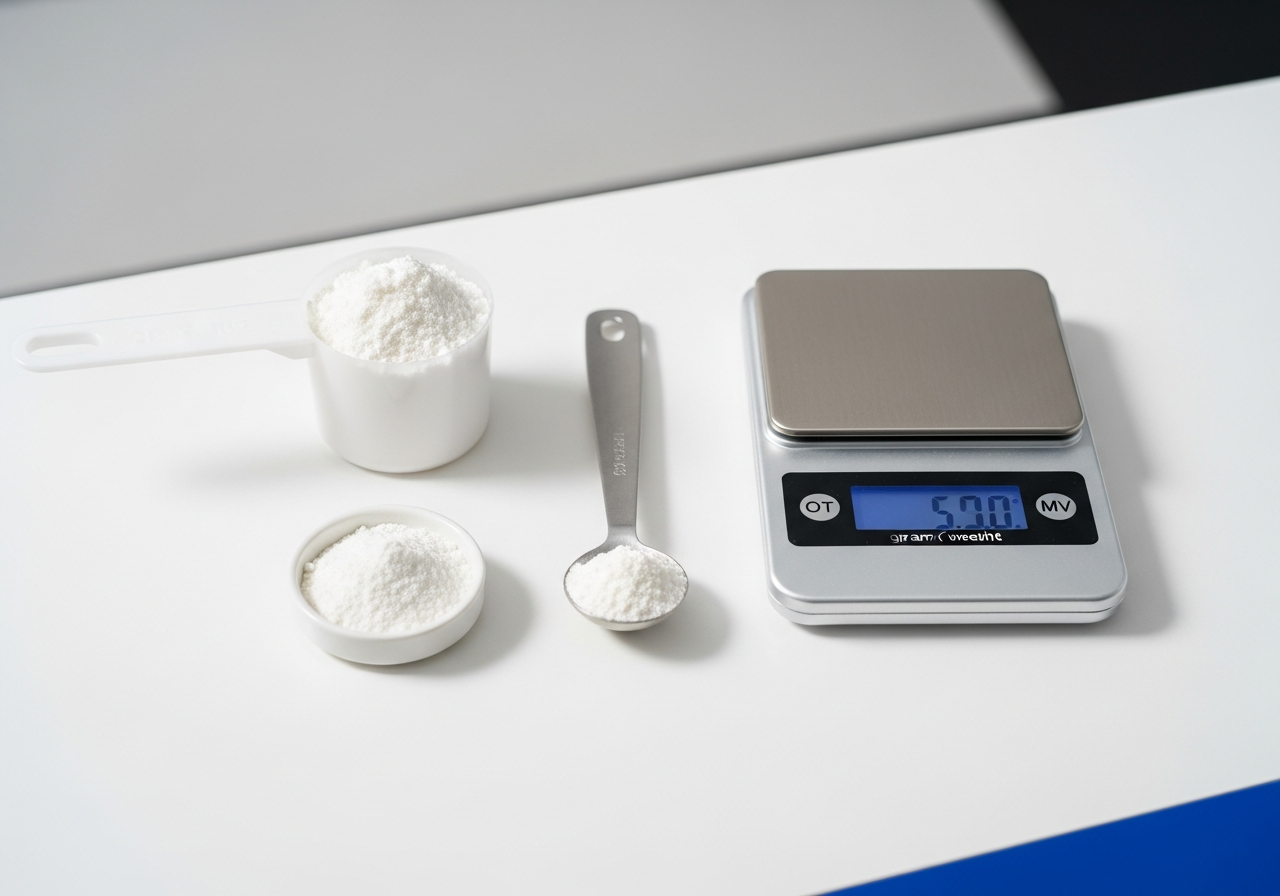
The most common creatine measuring mistakes are using a scoop without reading the label, treating a teaspoon estimate as exact, and believing you need laboratory-level precision for creatine to work. The truth sits in the middle: measurement should be sensible and consistent, but it does not need to be obsessive.
Myth 1: Every creatine scoop is 5 g.
False. Scoops vary by product, and some products use 3 g servings, some 5 g, and some require a not-quite-full scoop for the labelled amount.
Myth 2: One heaped teaspoon is better than one level teaspoon.
False. A heaped teaspoon can easily overshoot the intended dose and is more likely to cause stomach upset than extra benefit.
Myth 3: If you miss the dose by a gram, the supplement will not work.
False. Daily consistency over weeks matters much more than tiny single-day variation.
Myth 4: You must load, and loading demands perfect exactness.
False. Loading is optional. It speeds saturation, but 3-5 g daily also works if you are patient. If you do load, accuracy helps mainly to reduce digestive issues.
Myth 5: Dry scooping makes it stronger or faster.
False. Dry scooping does not improve absorption and can increase coughing, choking risk, and dose sloppiness. See dry scooping creatine.
Myth 6: Different fancy forms solve measuring issues.
Mostly false. Whether a product is monohydrate, HCl, or another form, poor measurement is still poor measurement. And monohydrate remains the most studied and usually most cost-effective option. For more, see why monohydrate still wins.
A better mindset is this: measure well enough to be repeatable, then focus on training, recovery, and adherence. If you want a full roundup of broader misconceptions, our creatine myths debunked guide is worth bookmarking.
Creatine is one of the least mysterious supplements in sports nutrition. Most confusion comes from packaging, inconsistent scoops, and internet folklore, not from the science itself.
Buying creatine in Canada: label clues that make measuring easier
If you are buying creatine in Canada, the easiest products to measure are plain creatine monohydrate powders with a clearly stated serving size in grams, simple ingredient lists, and reputable manufacturing or third-party testing details. Good labels make good dosing easy.
When comparing products, look for:
- Serving size listed in grams, not just “1 scoop”
- Type of creatine clearly named, ideally creatine monohydrate
- Minimal ingredients if you want straightforward measurement
- NPN, which stands for Natural Product Number, on products regulated as natural health products in Canada where applicable
- Third-party testing or quality assurance information
A product that only says “take one scoop” without specifying the gram weight is harder to trust. The best tubs tell you both the scoop instruction and the exact weight, for example “1 level scoop = 5 g.” That makes life simpler whether you are measuring at home or travelling.
Flavoured creatine products can still work, but blends sometimes create more confusion because a scoop may represent a total flavoured mix rather than pure creatine alone. If your main goal is precise measuring creatine powder, unflavoured monohydrate is usually the cleanest choice.
If you are shopping now, browse our creatine product catalog, compare options in the best creatine rankings, and use creatine brand reviews to check label transparency. For Canadian regulatory context, the presence of an NPN can be a useful sign that the product is being marketed within the expected framework, although label quality and manufacturing standards still matter.
One more buying tip from real-world experience: avoid choosing a product based purely on the scoop size. Scoop size is a packaging detail, not evidence of superior dosing, absorption, or results. Choose based on monohydrate form, label clarity, testing, and value per gram.
The best creatine product is not the one with the fanciest spoon. It is the one you can dose accurately, afford consistently, and trust enough to take every day.
Bottom line: the simplest way to get 5 g right every day
The simplest way to get 5 g of creatine right is to buy creatine monohydrate, read the serving in grams on the label, and use a small digital scale until you know exactly what your scoop or teaspoon delivers. If you do not have a scale, use about 1 level teaspoon as a backup estimate for many monohydrate powders, but remember it is still an estimate.
Here is the no-nonsense daily plan:
- Choose a plain, reputable creatine monohydrate product.
- Confirm the serving size in grams on the label.
- Measure 3-5 g daily, with 5 g as the easiest standard default for most adults.
- If loading, take 4 separate 5 g doses per day for 5-7 days.
- Take it every day, including rest days.
- Use the same scoop, spoon, or scale method consistently.
If you want the shortest featured-snippet style answer to the question “how much is a scoop of creatine?”, it is this: a scoop of creatine is only whatever the label says it weighs, and many but not all products use 5 g scoops. And if you want the shortest answer to “how to measure creatine?”, it is this: measure by grams, not by guesswork.
Creatine is forgiving enough that small daily variation will not ruin your results, but precise enough that a scale is still worth owning. That balance is what makes it a practical supplement: easy to use, evidence-based, and highly effective when taken consistently.
For your next steps, use the creatine dosage calculator, read how much creatine per day, and check best creatine monohydrate options if you are still deciding what to buy.
Measure in grams when you can, use a level teaspoon only as a rough backup, and prioritise daily consistency over perfection.
Creatine measuring quick facts
- 3-5 g/day Standard maintenance dose — Typical evidence-based daily range for most adults
- 20 g/day Typical loading dose — Usually split into 4 doses of 5 g for 5-7 days
- ≈1 tsp 5 g in teaspoons — For many creatine monohydrate powders, a level teaspoon is a rough estimate only
- 3-4 weeks Time to saturate without loading — Daily 3-5 g dosing reaches elevated stores more gradually
Frequently Asked Questions
How do I measure creatine without a scale?
You can measure creatine without a scale by using the labelled scoop or, for many creatine monohydrate powders, roughly 1 level teaspoon for 5 g. This is only an estimate, so the best compromise is to weigh your usual teaspoon or scoop once, note the result, and then reuse that method consistently.
How many teaspoons is 5g of creatine?
Five grams of creatine is usually about 1 level teaspoon for many monohydrate powders. Because powder density differs by brand, grind size, and clumping, a teaspoon is not exact, so a digital scale or the product's gram-based serving is more reliable.
Is one scoop of creatine always 5 grams?
No, one scoop of creatine is not always 5 grams. Some products use 3 g servings, some use 5 g, and some scoops are designed to be level rather than heaped, so you should always check the label for the serving size in grams.
Can I just eyeball my creatine dose?
Yes, you can eyeball a creatine dose in a pinch, but it is not the best habit if you want consistency. Creatine is forgiving enough that a small error will not ruin results, yet using a scale or a calibrated scoop makes daily intake more repeatable and helps avoid overshooting.
Does it matter if I take 4 g instead of 5 g?
No, taking 4 g instead of 5 g on a given day usually does not matter much for most people. Creatine works by building muscle saturation over time, so long-term consistency matters more than tiny single-day differences, although standard daily targets still sit around 3-5 g.
What if I accidentally take too much creatine?
If you accidentally take a bit too much creatine once, the most likely issue is mild stomach upset, not a major problem in a healthy adult. Just return to your normal dose the next day, and if this keeps happening, calibrate your scoop or teaspoon against a scale.
Is a heaped teaspoon of creatine okay?
A heaped teaspoon of creatine is usually more than you need and is less accurate than a level teaspoon. If you are aiming for 5 g, a heaped spoon can overshoot enough to increase the chance of digestive discomfort without adding meaningful benefit.
Should I measure creatine differently during a loading phase?
Yes, it is smarter to measure creatine more carefully during a loading phase because the total daily amount is much higher. A typical loading phase uses 20 g per day split into four 5 g doses for 5-7 days, and accurate measuring helps reduce stomach upset from accidental overpouring.
Does micronized creatine change teaspoon measurements?
Yes, micronized creatine can change teaspoon measurements slightly because finer powders can settle and pack differently. It is still usually dosed the same way in grams, but volume-based tools like teaspoons become less dependable when texture and density differ.
What is the best creatine form if I want easy measuring?
The best creatine form for easy measuring is usually plain creatine monohydrate with a clearly labelled gram-based serving size. It is the most studied form, typically the best value, and the easiest to dose accurately with either a scale or a calibrated scoop.