How Much Water Should You Drink With Creatine?
By The Creatine Canada Research Team — Evidence-based supplement analysts
Most people do not need a special “creatine water rule”: take your creatine with enough fluid to mix it comfortably, then aim for normal good hydration across the day. For most adults, that means mixing 3–5 g of creatine monohydrate in roughly 250–500 mL of water and drinking extra only as needed for heat, sweat loss, larger body size, or a 20 g/day loading phase.
Evidence-based · Cites 4 sources · Editorial standards
Key Takeaways
- Mix 3–5 g creatine monohydrate in about 250–500 mL of water; more is fine, but not required for absorption.
- Creatine does not inherently dehydrate you, and current evidence does not support the old myth that it pulls dangerous amounts of water away from the rest of the body.
- During a loading phase, split 20 g/day into 4 doses of 5 g and take each with 250–500 mL of fluid to reduce stomach upset.
- Your total daily fluid needs matter more than the exact amount of water in the glass with creatine.
- If you train hard, sweat heavily, or live in hot weather, increase fluids and electrolytes based on sweat losses, not just because you are taking creatine.
- Stomach upset, bloating, and loose stools are more often caused by taking too much at once or using too little mixing fluid than by creatine itself.
- Micronized creatine monohydrate is usually the easiest form to mix, and a product with a Health Canada NPN and third-party testing is the safest Canadian buying standard.
The direct answer: how much water should you drink with creatine?
You do not need to force huge amounts of water just because you are taking creatine. For most people, 3–5 g of creatine monohydrate mixed into roughly 250–500 mL of water is practical, easy to drink, and enough to take the dose comfortably.
The bigger issue is your total daily hydration, not the exact amount in the glass. Creatine works by increasing intramuscular phosphocreatine, the stored form of creatine phosphate that helps rapidly regenerate ATP, your cells’ immediate energy currency, during short high-intensity efforts. That intracellular water shift is real, but it does not mean creatine dehydrates healthy people. The best current summaries, including the 2021 JISSN review on common creatine questions and misconceptions, do not support the claim that creatine causes dehydration under normal use.
If you want a simple rule, use this:
- Maintenance dose: 3–5 g/day with 250–500 mL water.
- Loading dose: 20 g/day split into 4 doses of 5 g, each with 250–500 mL water.
- Hot weather, hard training, or heavy sweating: drink more across the day based on thirst, urine colour, body size, and sweat loss.
If you are asking “how much water should I drink with creatine” or “how much water should you drink when taking creatine,” the practical answer is: enough to dissolve the powder and support normal hydration, but not so much that it becomes a chore.
For beginners, consistency matters far more than perfection. Taking creatine daily at a proven dose will do more for results than obsessing over whether you used 300 mL or 450 mL of water. If you need help with the dose itself, use a creatine dosage calculator or read our guide on how much creatine per day.
One useful exception: if creatine upsets your stomach, start by increasing the mixing fluid and lowering the dose per serving rather than quitting. In real-world use, that solves a lot of “creatine doesn’t agree with me” complaints.
Does creatine dehydrate you? No — and here is why that myth persists
Creatine does not dehydrate healthy users when taken at standard doses. The dehydration myth mainly comes from misunderstanding where creatine draws water: it increases water content inside muscle cells, not in a way that meaningfully dries out the rest of your body when your daily fluid intake is normal.
This myth also got repeated for years in locker rooms because early concerns about muscle cramps, heat illness, and water retention sounded plausible. But plausibility is not proof. The 2017 ISSN position stand and the 2021 JISSN misconceptions paper both concluded that creatine is safe and that fears about dehydration and cramping are not supported by the broader body of evidence in healthy populations.
Here is the mechanism in plain English:
- Creatine increases intramuscular creatine and phosphocreatine stores.
- Muscle cells hold slightly more water as creatine content rises.
- That water retention is intracellular, meaning inside the muscle, which is one reason muscles can look fuller.
- That is not the same as becoming systemically dehydrated.
What people sometimes experience instead is this:
- They start creatine during a hard training block.
- They also sweat more, eat more protein, or train in summer heat.
- They drink the same as before and feel off.
- They blame creatine, when the more likely issue is inadequate overall hydration for the new routine.
So if you are searching “does creatine dehydrate you” or “can creatine dehydrate you,” the evidence-based answer is no, not by itself. However, creatine also does not magically protect you from dehydration during long sessions, hot conditions, or poor fluid habits. You still need to hydrate like any athlete should.
If you want a deeper dive on the myth itself, see our creatine myths debunked page and the dedicated guide on creatine and dehydration. The short version: creatine changes water distribution in muscle, but that is not a reason to panic or chug litres beyond comfort.
How creatine and water work together inside your muscles
Creatine helps high-intensity performance by increasing phosphocreatine stores, and water supports that process by helping you tolerate the supplement and maintain normal fluid balance. Water is not a special “activator” for creatine, but good hydration helps training quality, digestion, and overall recovery.
Creatine is a naturally occurring compound made from amino acids and stored largely in skeletal muscle. Its most important job in exercise is supporting the phosphagen system, your fastest energy system for heavy sets, short sprints, jumps, and repeated explosive efforts. When ATP is broken down to release energy, phosphocreatine helps regenerate ATP quickly so you can sustain force output for a bit longer or recover slightly faster between efforts.
Why water matters:
- Mixing: Creatine monohydrate is a powder, and enough fluid makes it easier to consume and less likely to sit heavily in the stomach.
- Tolerance: Taking a large scoop dry or in too little water can increase the chance of nausea, cramping, or loose stools.
- Cell hydration: Creatine’s osmotic effect means muscle cells retain more water as they store more creatine.
- Training performance: Separate from creatine, dehydration itself can impair performance, especially in heat or long sessions.
That leads to an important distinction: water helps the user more than it helps the molecule. Creatine absorption does not require a massive water bolus. It is not like a powder that becomes ineffective unless you hit some magic dilution ratio. Instead, the right amount is the amount that lets you take it daily without stomach issues.
If you are new to the supplement, start with plain creatine monohydrate. It remains the most studied, the most cost-effective, and the reference form behind most dosing guidance. You can learn more in what is creatine and compare options in our best creatine rankings.
One more search-intent question worth answering here: “what does creatine monohydrate do?” It increases muscle creatine stores, which can improve strength, power, repeated-sprint capacity, and lean mass gains over time when paired with training. Water is part of using it well, but the performance benefit comes from saturating muscle creatine stores, not from drinking extraordinary amounts.
Exactly how to take creatine with water, step by step
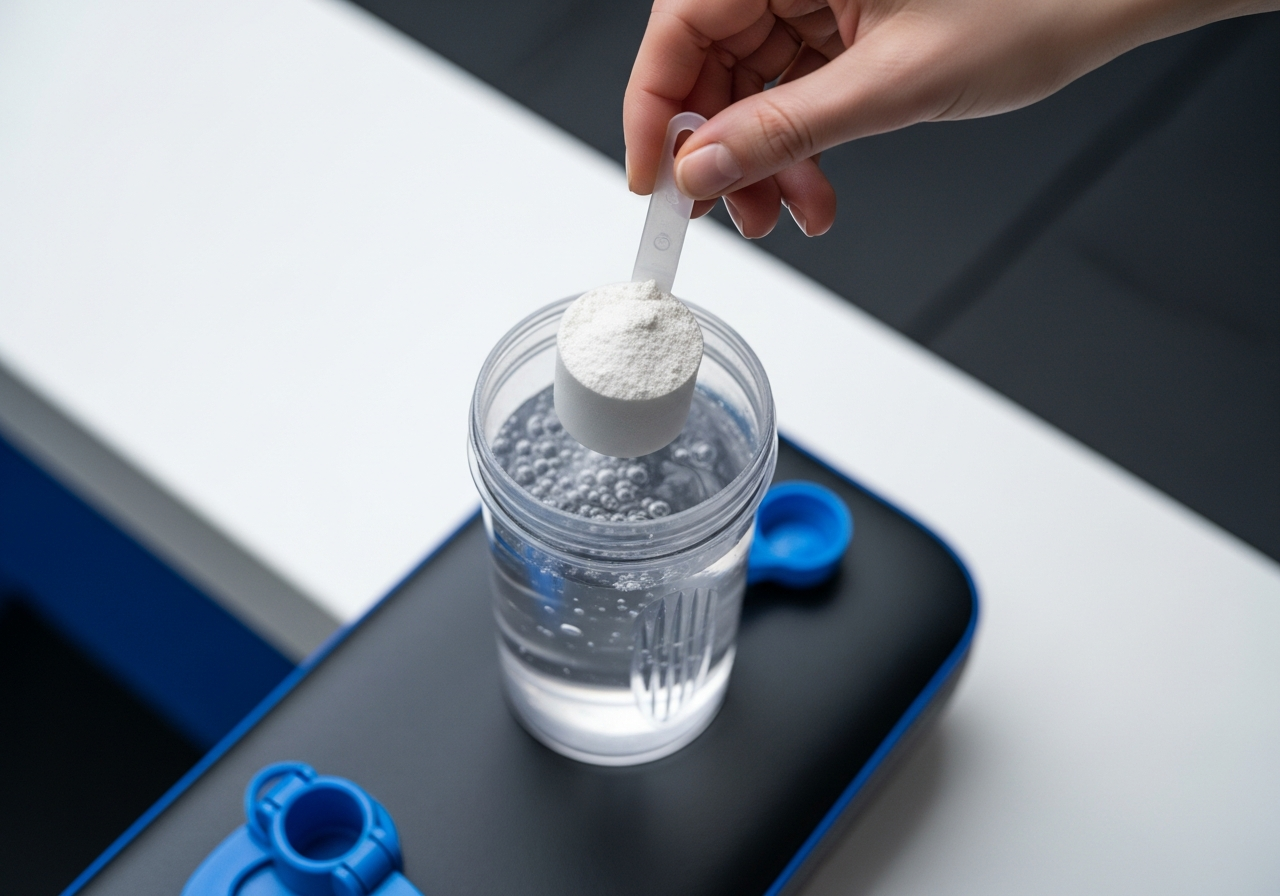
The easiest way to take creatine is to mix 3–5 g in 250–500 mL of water once daily and drink it right away. That approach works for most people, and it is the best place to start if you are wondering how much water to drink on creatine.
- Measure the dose accurately. Use a scoop only if the label clearly states how many grams it holds. For most adults, maintenance is 3–5 g/day.
- Add creatine to a glass or shaker. Use about 250–500 mL of cool or room-temperature water.
- Stir or shake well. Regular monohydrate can settle; that is normal. Micronized powder mixes more easily.
- Drink it, then swirl the residue. Add a small splash of water and finish what sticks to the glass.
- Take it daily. Consistency matters more than timing.
If you want even fewer mixing issues:
- Use slightly warm water for better dissolving, then drink once mixed.
- Choose micronized monohydrate if texture bothers you.
- Mix it into a protein shake if that helps adherence; see can you mix creatine with protein powder.
For a loading phase, use 20 g/day split into 4 doses of 5 g for 5–7 days. Taking the full 20 g in one go is where many people run into digestive problems. Split dosing plus enough fluid per serving is a much better plan. Our guide on the creatine loading phase covers the tradeoffs in detail.
Practical beginner notes:
- If 500 mL feels like too much, use 250–300 mL. The dose still works.
- If you get stomach upset, increase fluid first and reduce the amount per serving.
- If you forget a dose, just take the next one as normal. Do not double up unless you are following a planned split loading protocol.
For a full walkthrough, see how to take creatine and how to mix creatine. The ideal routine is the one you will still be following in eight weeks.
How much water should you drink on creatine by body size, training load, and goal?
Your body size, training volume, and sweat losses matter more than creatine itself when deciding how much water to drink each day. Creatine changes the picture only slightly: you want enough fluid to mix each dose comfortably and enough total hydration to match your activity level.
A practical way to think about it is in two layers:
- Layer 1: Water with the dose. Usually 250–500 mL per 3–5 g serving.
- Layer 2: Water across the day. Adjust based on thirst, urine colour, climate, activity, and body size.
Here is a simple real-world framework:
| Situation | Creatine dose | Water with dose | Daily hydration note |
|---|---|---|---|
| Smaller adult, light training | 3 g/day | 250–300 mL | Drink normally to thirst and meals; more if urine stays dark. |
| Average gym-goer | 3–5 g/day | 300–500 mL | Prioritize steady fluids through the day, especially around training. |
| Larger lifter or athlete | 5 g/day | 400–500 mL | Often benefits from a higher total intake because body mass and sweat losses are higher. |
| Loading phase | 20 g/day in 4 x 5 g doses | 250–500 mL each dose | Spacing doses and fluids reduces GI discomfort. |
| Hot weather or heavy sweating | 3–5 g/day | 300–500 mL | Increase fluid and consider electrolytes based on sweat loss. |
If you are searching “how much water should I drink with creatine calculator,” use a calculator for the creatine dose, then apply common-sense hydration. Our creatine dosage calculator can help you set the supplement amount, but no serious evidence says everyone on creatine needs the same fixed litres per day.
What should you expect in the first few weeks?
- Week 1 with loading: a quick increase in body mass is common, mostly from increased water held in muscle.
- Weeks 2–4: many users notice better training volume, extra reps, or stronger repeated efforts.
- Weeks 4–8: strength and lean mass differences become more noticeable if training and protein intake are solid.
Signs your hydration is probably adequate include normal thirst, pale-to-light-yellow urine most of the day, stable training performance, and no persistent headaches or dizziness. Signs to increase fluids include dark urine, unusually dry mouth, a big drop in training quality in heat, or repeated stomach upset when taking your dose.
Best time and best liquid: does it matter what you drink creatine with?
The best time to take creatine is the time you will remember every day, and plain water is perfectly effective. Timing has a much smaller impact than daily consistency because creatine works by gradually saturating muscle stores, not by giving an immediate stimulant-like effect.
So, if your question is “how much water to drink when on creatine” or “how much water to take with creatine,” the answer does not change much based on timing. Morning, pre-workout, post-workout, or with a meal are all fine if you take the right daily dose consistently.
Best liquids to use:
- Water: simplest, cheapest, and completely effective.
- Protein shake: convenient if you already have one daily.
- Juice or a carb-containing drink: acceptable, though not necessary.
- Electrolyte drink: useful if you are training long in heat or losing a lot of sweat.
What matters least is the fantasy that you need a specific “absorption hack.” The evidence does not show that creatine requires a special beverage to work. If a flavoured drink helps you be more consistent, that is a behavioural win, not necessarily a biochemical one.
Useful timing advice by scenario:
- Beginner: tie creatine to breakfast or your post-workout shake.
- Strength athlete: post-workout is convenient because you are already eating and drinking.
- Busy professional: keep a small tub at work and mix it into your first bottle of water.
- Older adult: take it with a meal if that improves stomach comfort and routine.
If you are curious about timing details, read when to take creatine and creatine on rest days. The same hydration rule still applies: enough fluid to mix the dose, then normal hydration through the day.
One caution: dry scooping is mostly pointless and can irritate your throat, trigger coughing, and increase stomach discomfort. It is a poor tradeoff compared with simply mixing the powder in water.
Who should pay extra attention to water intake with creatine?
Most healthy adults can follow the standard approach, but athletes, larger lifters, older adults, and anyone training in heat should pay closer attention to total fluid intake. The creatine dose often stays the same; the hydration context changes.
Beginners: New users tend to overcomplicate hydration. Start with 3–5 g/day in 250–500 mL water and focus on taking it daily. If you are also increasing training volume, drink more generally because your routine changed, not because creatine is dangerous.
Women: Women do not need a separate “female creatine water protocol.” The same mixing guidance applies. Body size and training load matter more than sex. For more, see creatine for women.
Older adults: Older adults may benefit from creatine for muscle and function, but they should be extra mindful of daily hydration if they already tend to under-drink or use medications that affect fluid balance. Taking creatine with a meal and a glass of water is often the easiest routine. Related reading: creatine for older adults.
Athletes and heavy sweaters: Team-sport athletes, CrossFit athletes, labourers, and anyone doing long sessions in summer need to think beyond the scoop. Sweat loss can exceed what casual gym-goers expect, so fluids and electrolytes may need to go up independently of creatine. The IOC consensus on dietary supplements supports creatine as one of the more evidence-based ergogenic aids, but sport hydration still has to be managed separately.
Vegetarians and vegans: People with lower baseline dietary creatine may respond well to supplementation, but they do not need unusual water strategies. They just need a consistent dose.
People cutting weight or doing endurance work: If you are deliberately restricting body mass, training in heat, or running long sessions, poor hydration can sneak up faster. That is a training and environment issue first, creatine issue second.
Bottom line: very few people need to micromanage the water in the creatine glass, but many people need to take overall hydration more seriously once their training gets harder.
If creatine upsets your stomach, this is usually the water fix that works
If creatine causes bloating, nausea, or loose stools, the most common fixes are smaller doses, more mixing fluid, and switching to plain monohydrate from flashy blends. The problem is often the dose size or delivery, not creatine itself.
Common issues and fixes:
- Loose stools: Usually from taking too much at once, especially 10–20 g in one serving. Fix it by splitting the dose and using more water.
- Stomach heaviness: Try 300–500 mL water instead of a tiny splash, or take it with food.
- Bloating: This can mean either temporary water retention in muscle or GI discomfort. If it feels abdominal, reduce single-dose size and avoid sugar alcohol-heavy blends.
- Grittiness: Use micronized creatine, warmer water, or a shaker bottle.
A good troubleshooting sequence is:
- Drop to 3 g/day for a week.
- Use at least 300–500 mL fluid.
- Take it with a meal or after training.
- If loading, switch from one large dose to 4 x 5 g.
- Check the product label for extra ingredients that may be the real issue.
When to be more cautious: if you have kidney disease, a significant medical condition affecting fluid balance, or you have been told to restrict fluids, speak with your clinician before supplementing. Also, remember that creatine can raise creatinine on bloodwork because creatinine is a breakdown product of creatine; that does not automatically mean kidney damage. Our guide on creatine and kidneys explains that distinction.
The Mayo Clinic and major sports-nutrition reviews agree that creatine is generally safe for healthy adults when used appropriately. But “safe” does not mean “take it carelessly.” Using enough water to tolerate the powder well is part of smart supplementation.
Buying creatine in Canada: what matters more than fancy hydration claims
The best creatine product for hydration is usually just a well-made creatine monohydrate powder with a clean label, accurate dosing, and good testing. You do not need a premium “hydration matrix” to use creatine well.
In Canada, practical buying criteria should come before marketing:
- Form: creatine monohydrate is still the evidence-based default.
- Label clarity: look for grams per serving, ingredient simplicity, and use directions.
- NPN: an NPN is a Natural Product Number, meaning the product has been licensed by Health Canada as a natural health product.
- Third-party testing: useful for purity and label confidence.
- Micronized texture: helpful if mixing and mouthfeel matter to you.
Hydration blends can be useful in some cases, but only if they match your actual needs. If you train indoors for 45–60 minutes and sweat moderately, plain monohydrate plus regular food and fluids is often enough. If you play field sports in August or do long sessions in heat, then separate electrolytes may be helpful — but that is about sweat replacement, not creatine activation.
| Product type | Who it suits | Pros | Cons |
|---|---|---|---|
| Plain monohydrate powder | Most people | Most studied, cheapest per gram, flexible dosing | Can be slightly gritty |
| Micronized monohydrate | People who dislike texture | Mixes easier, gentler mouthfeel | Usually costs a bit more |
| Creatine + electrolytes | Heavy sweaters, hot-climate athletes | Convenient all-in-one | Often pricier and not necessary for everyone |
| Gummies/capsules | Convenience-focused users | No mixing | More expensive and less flexible dosing |
If you are shopping now, browse our creatine product catalog, compare creatine brand reviews, or start with the best creatine rankings. The key point for this topic is simple: buy a product that makes daily compliance easy, because the best hydration advice in the world is useless if you stop taking creatine after ten days.
How creatine monohydrate is made, and why that has little to do with water needs
Creatine monohydrate is a manufactured form of the same creatine molecule found naturally in the body and in foods, and how it is made does not change your basic water needs. This section addresses the related searches “how is creatine monohydrate made,” “how is creatine monohydrate manufactured,” and “how is creatine monohydrate produced.”
Commercial creatine monohydrate is synthesised industrially rather than extracted from meat. In broad terms, manufacturers produce creatine through a chemical process using precursor compounds, then bind it with one molecule of water to form monohydrate. “Monohydrate” simply means the creatine crystal includes water in its structure; it does not mean you need to flood your body with water for it to work.
That naming detail confuses a lot of people. The “hydrate” in monohydrate refers to the chemical form of the powder, not to a special hydration requirement for the user. Once ingested, creatine monohydrate behaves like dietary creatine with an excellent research base behind it.
Quality differences come more from:
- purity of raw materials,
- manufacturing controls,
- testing for contaminants, and
- honest labelling.
This is why reputable sourcing matters more than exotic form claims. Most newer forms are marketed as mixing better, requiring less water, or causing less bloating, but monohydrate remains the benchmark because it has the deepest evidence for effectiveness, safety, and value. Examine’s evidence summary and the ISSN position stand both place monohydrate at the centre of evidence-based use.
If you want a deeper primer, read where creatine comes from and how it is made and what creatine is made of. For hydration purposes, the takeaway is simple: whether your monohydrate is regular or micronized, you still only need a sensible amount of water to mix the dose and stay normally hydrated through the day.
The biggest water-and-creatine mistakes people make
The most common mistakes are overdrinking, underdrinking during hard training, taking too much creatine at once, and believing myths that distract from consistency. If you avoid those four, you are already ahead of most users.
Mistake 1: Thinking there is a magic litre target because of creatine. There is no universal evidence-based number that everyone on creatine must drink. Hydration should be personalised to body size, sweat loss, weather, and diet.
Mistake 2: Using almost no water with the powder. Dry scooping or swallowing creatine with a tiny sip can increase throat irritation and stomach discomfort.
Mistake 3: Taking the full loading dose in one serving. A 20 g bolus is much more likely to cause GI issues than 4 doses of 5 g.
Mistake 4: Confusing water weight with bloating or fat gain. Early scale increases usually reflect more water stored in muscle, not fat. See does creatine make you gain weight.
Mistake 5: Assuming dark urine means creatine is harmful. Dark urine more often reflects low fluid intake, heat, supplements like B vitamins, or other factors. It is not a standard sign that creatine is damaging you.
Mistake 6: Buying gimmicky formulas because they promise “no water retention.” Some water retention inside muscle is part of how creatine works. A product claiming to avoid that entirely is not necessarily superior.
Mistake 7: Ignoring the obvious. If you start training harder, sweating more, and eating differently at the same time you start creatine, any hydration problem may have little to do with creatine itself.
Myths worth debunking plainly:
- Myth: Creatine makes you dehydrated. Fact: Standard use in healthy adults does not support that claim.
- Myth: You must drink a gallon of water a day on creatine. Fact: No universal gallon rule exists.
- Myth: More water with the scoop means better absorption. Fact: Enough to mix and tolerate it is what matters most.
For a broader myth breakdown, our creatine myths vs. facts guide goes deeper.
Bottom line: the smart hydration rule for creatine users
If you want the simplest correct answer, mix your creatine in 250–500 mL of water and keep your normal daily hydration solid. That is enough for most people.
Here is the practical summary:
- Daily dose: 3–5 g creatine monohydrate for most adults.
- Water with each dose: about 250–500 mL.
- Loading phase: 20 g/day split into 4 doses for 5–7 days, each with 250–500 mL.
- Special cases: drink more across the day if you are larger, train hard, sweat heavily, or are in hot weather.
- No need for panic drinking: creatine does not inherently dehydrate you.
If your real question was “how much water should I drink on creatine,” the honest answer is that there is no special creatine-only hydration number that fits everyone. There is only a sensible mixing amount plus normal sports-hydration common sense.
Choose a proven monohydrate, take it daily, train hard, and adjust total fluids to your life, not internet bro-science. If you are just getting started, the best next reads are creatine for beginners, how long creatine takes to work, and is creatine safe.
One-sentence takeaway: Most people taking creatine only need enough water to mix the dose comfortably — roughly 250–500 mL per 3–5 g serving — plus normal good hydration based on body size, sweat loss, and training conditions.
Creatine + Water: the practical numbers that matter
- 3–5 g/day Standard creatine monohydrate maintenance dose — The evidence-based daily amount used by most adults.
- 250–500 mL Practical water amount to mix with each dose — Usually enough for comfort, mixing, and good tolerance.
- 20 g/day Typical loading phase total — Best split into 4 doses of 5 g for 5–7 days.
- 5–7 days Common loading duration — A faster way to saturate muscle creatine stores than maintenance alone.
Frequently Asked Questions
How much water should I drink with creatine every day?
Most people should mix each 3–5 g creatine dose in about 250–500 mL of water, then simply maintain normal good hydration through the day. There is no evidence-based rule that everyone on creatine must drink a fixed number of litres, because total needs depend more on body size, weather, sweat loss, and training load than on creatine itself.
How much water should you drink when taking creatine during a loading phase?
During a loading phase, take 20 g/day split into 4 doses of 5 g, and use roughly 250–500 mL of fluid with each dose. Splitting the dose and using enough water helps reduce stomach upset, which is the main reason people think they need a special hydration strategy during loading.
Does creatine dehydrate you?
No, creatine does not inherently dehydrate healthy people when used at standard doses. The dehydration myth came from confusion about creatine increasing water inside muscle cells, but current evidence summaries do not support the idea that it causes systemic dehydration under normal use.
Can creatine make you pee more?
Creatine is not a diuretic in the way caffeine can be, so it does not reliably make you pee more by itself. If you notice more bathroom trips, the more likely explanation is that you started drinking more fluids when you began creatine, not that creatine is forcing water out of your body.
What is the best liquid to take creatine with?
Plain water is the best liquid for most people because it is simple, effective, and easy on the stomach. You can also mix creatine into a protein shake, juice, or an electrolyte drink, but none of those is required for creatine to work as long as you take the right daily dose consistently.
Do you need to drink extra water on creatine if you work out hard?
Yes, but mainly because hard training increases sweat loss, not because creatine is uniquely dehydrating. If you lift hard, do conditioning, play sports in heat, or sweat heavily, increase fluids and possibly electrolytes based on workout conditions and body losses, while still using the usual 250–500 mL to mix your creatine dose.
Can you take creatine with too little water?
Yes, taking creatine with too little water can make it less comfortable to consume and may increase the chance of stomach upset or throat irritation. The supplement will still work if absorbed, but using around 250–500 mL of fluid is a much better practical habit than dry scooping or chasing it with a tiny sip.
How do I know if I am drinking enough water on creatine?
You are probably drinking enough if your thirst feels normal, your urine is usually pale to light yellow, and your training feels stable without headaches or unusual fatigue in heat. If your urine stays dark, your mouth is dry, or your workouts drop off sharply during hot sessions, increase total fluids and review your overall hydration habits.
How is creatine monohydrate made?
Creatine monohydrate is manufactured industrially rather than extracted from meat, using a controlled chemical process that produces the creatine molecule and binds it with one molecule of water in the crystal structure. That “monohydrate” name describes the powder’s chemical form and does not mean you need unusually large amounts of drinking water for it to work.
What does creatine monohydrate do?
Creatine monohydrate increases muscle creatine and phosphocreatine stores, which helps regenerate ATP faster during short, intense efforts like heavy sets, sprints, and repeated explosive work. Over time, that can improve strength, power, training volume, and lean mass gains when combined with proper training and nutrition.