Creatine for Beginners: Everything to Know Before Your First Scoop
By The Creatine Canada Research Team — Evidence-based supplement analysts
Creatine for beginners is simple: most healthy adults can start with 3 to 5 grams of creatine monohydrate once daily, every day, without overthinking timing. It is one of the most studied sports supplements for strength, power, lean mass, and high-intensity performance, and the beginner mistakes are usually buying the wrong form, taking too much at once, or expecting instant results.
Evidence-based · Cites 4 sources · Editorial standards
Key Takeaways
- Start with 3 to 5 g of creatine monohydrate daily; that is the evidence-based beginner dose.
- You do not need a loading phase, but 20 g/day split into 4 doses for 5 to 7 days saturates muscles faster.
- Take creatine every day, including rest days, because muscle saturation matters more than exact timing.
- Creatine can help even if you are not lifting, but the biggest benefits show up with resistance training or repeated high-intensity exercise.
- A small scale-weight increase in the first 1 to 2 weeks is usually water pulled into muscle, not body-fat gain.
- Choose plain monohydrate first; it is the most studied, most cost-effective, and usually the easiest form to dose accurately.
- If you have kidney disease, are pregnant or breastfeeding, or take medications that affect kidney function or fluid balance, speak with your clinician before starting.
Creatine for beginners, in plain English: what it is, who should take it, and who probably should not
Creatine for beginners usually means one thing: plain creatine monohydrate at 3 to 5 grams per day, taken consistently, is the best starting point for most healthy adults. If your goal is better gym performance, more training volume, gradual lean-mass gain, or improved sprint and repeated-effort output, creatine is one of the few supplements with a strong evidence base. The 2017 ISSN position stand concluded that creatine monohydrate is the most effective nutritional supplement currently available for increasing high-intensity exercise capacity and lean body mass during training.
Creatine is a compound your body makes from amino acids and stores mostly in muscle. It is not a steroid, not a hormone, and not a stimulant. If you want the deep basics first, see what creatine is and our creatine myths debunked guide.
Should you take creatine? Usually yes, if you are a healthy adult who does any of the following:
- Lift weights or want to start
- Play team sports with sprints, jumps, or repeated efforts
- Do HIIT, CrossFit, or martial arts
- Want a simple, evidence-based supplement before spending money on trendier products
- Eat little or no meat, because baseline muscle creatine stores may be lower
Do you need creatine? No supplement is mandatory. You can build muscle and get fitter without it. But creatine is one of the highest-value add-ons once training, protein intake, and sleep are in place.
Who should pause and ask a clinician first? People with known kidney disease, those under medical care for kidney-related issues, people taking medications that can affect kidney function or fluid balance, and anyone who is pregnant or breastfeeding. Evidence for healthy adults is strong; evidence in pregnancy and lactation is not strong enough for casual self-experimentation.
Beginners also ask, can I take creatine without working out? Yes, you can, and we cover that below. The short answer is that creatine still raises body stores without training, but the most noticeable physical benefits happen when you pair it with exercise.
How creatine actually works: the phosphocreatine system, saturation, and why strength goes up
Creatine works by helping your muscles recycle ATP, the body’s immediate energy currency, faster during short, hard efforts. In muscle, creatine is stored partly as phosphocreatine, which donates a phosphate group to rebuild ATP during high-intensity work such as heavy sets, sprints, jumps, and repeated intervals.
That mechanism matters because many gym sets and sport bursts are limited not by motivation but by how quickly you can regenerate ATP. When your muscle stores are more saturated with creatine, you can often squeeze out an extra rep, a bit more load, or better repeated sprint quality. Over weeks and months, those small performance wins compound into more productive training and, for many people, greater strength and lean mass gains.
Creatine also draws water into muscle cells, which is why scale weight often rises early. This is intracellular water, meaning water stored within muscle, not the same thing as body-fat gain. That fuller cellular environment may also support training adaptation, though the main beginner-relevant point is simple: initial weight gain from creatine is usually water in muscle, not belly fat.
How long does creatine take to work? Without a loading phase, daily 3 to 5 gram dosing usually saturates muscle stores over roughly 3 to 4 weeks. With loading, saturation can happen within about 5 to 7 days. If you want a full timeline, see how long creatine takes to work.
Not everyone responds identically. People who eat little meat, have lower starting muscle creatine stores, or are new to training often notice clearer benefits. Some people still improve less than others, which is why the idea of a universal dramatic response is a myth. The evidence supports creatine as a reliable average performer, not a magic powder.
The best-supported benefits are for strength, power, lean mass, and repeated high-intensity performance. Evidence for recovery is decent but less central. Evidence for brain-health outcomes is promising but still more mixed and context-dependent than the muscle-performance evidence. For a broader overview, compare our guides on creatine benefits and creatine and the brain.
Exactly how to start creatine: a beginner-friendly 7-step plan you can follow today
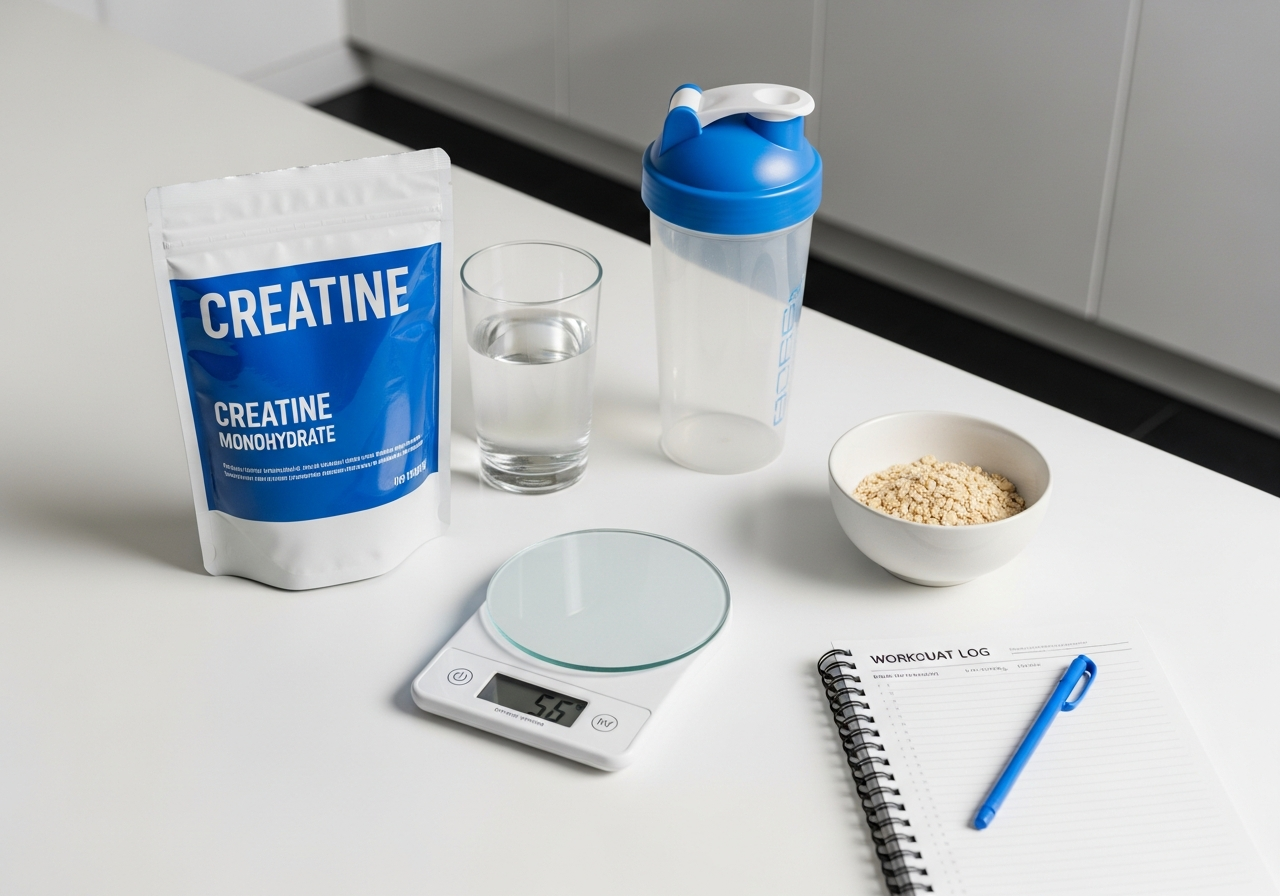
The easiest way to start creatine is to buy plain monohydrate, measure 3 to 5 grams, take it once daily, and keep doing that every day for at least 4 weeks before judging results. Consistency beats complexity.
- Choose the right product. Buy plain creatine monohydrate powder first. Micronized monohydrate may mix a bit easier, but the key point is still monohydrate. Browse our best creatine rankings, creatine brand reviews, or product catalog if you want vetted options.
- Check the label. In Canada, look for a Natural Product Number, or NPN, on supplements sold as natural health products, and prefer brands that disclose third-party testing or purity standards.
- Decide whether to load. If you want faster saturation, take 20 grams per day for 5 to 7 days, split into 4 doses of 5 grams. If you want the simplest approach, skip loading and take 3 to 5 grams daily.
- Take it with liquid and a meal if your stomach is sensitive. You can mix it in water, juice, or a protein shake. If you want better dissolving tips, see how to mix creatine.
- Take it every day, including rest days. Muscle saturation is the goal, so a rest day is not a day off from creatine.
- Track 3 things. Track body weight, gym performance, and how the powder feels on your stomach. Those three markers usually tell you whether your setup is working.
- Give it enough time. Judge creatine after 4 to 6 weeks without loading, or after 2 to 3 weeks if you loaded first.
What should you expect week by week?
- Week 1: Possibly no obvious feeling at all, or a slight scale increase if you loaded.
- Week 2: Some people notice slightly better work capacity, pump, or repeated-set quality.
- Weeks 3 to 4: The no-loading group is often reaching useful saturation; performance changes become easier to notice.
- Weeks 5 to 8: The real payoff is often cumulative training progress rather than a dramatic sensation from the supplement itself.
If you miss a day, do not double up the next day. Just resume your normal dose. For most beginners, the best plan is the boring one you will actually stick to.
How much creatine should beginners take? The right dose by body weight, goal, and whether you load
Most beginners do well with 3 to 5 grams of creatine monohydrate per day, and larger or more muscular people often land closer to 5 grams. The classic loading option is 20 grams per day for 5 to 7 days, split into 4 doses, followed by a maintenance dose of 3 to 5 grams daily.
Body weight matters most at the margins, not because tiny dosing errors ruin results, but because a 50 kg person and a 110 kg strength athlete do not always need the exact same approach. If you want a personalised estimate, use our creatine dosage calculator or read how much creatine per day.
| Body weight | Simple daily dose | Optional loading phase | Best for |
|---|---|---|---|
| Under 60 kg | 3 g/day | 15 to 20 g/day split into 3 to 4 doses for 5 to 7 days | General fitness, smaller body size, cautious stomachs |
| 60 to 90 kg | 3 to 5 g/day | 20 g/day split into 4 doses for 5 to 7 days | Most beginners |
| Over 90 kg | 5 g/day | 20 g/day split into 4 doses for 5 to 7 days | Larger lifters, field-sport athletes, higher lean mass |
By goal:
- Strength and muscle gain: 3 to 5 g/day, or load first if you want faster saturation.
- HIIT, sprints, team sports: 3 to 5 g/day; loading can make sense in-season if you want quicker results.
- General health or trying it cautiously: Start at 3 g/day.
- Fat-loss phase: Keep 3 to 5 g/day. Creatine does not block fat loss, and maintaining training quality during a cut is a major reason to keep it in.
Should you load? Loading is optional, not superior in the long run. It gets you saturated faster, but after a few weeks the end result is similar if total daily maintenance has been consistent. The downside is a higher chance of stomach upset or a more noticeable early water-weight bump.
Beginners often ask how to measure 5 grams. The best answer is a small kitchen scale. Scoop sizes vary by brand, so grams beat guesswork.
When should beginners take creatine? Before or after a workout, at night, and on rest days
For beginners, the best time to take creatine is the time you will remember every day, because total daily intake matters more than exact timing. Creatine is not a stimulant and does not need to be taken right before training to work.
Should you take creatine every day? Yes. Daily use keeps muscle creatine stores topped up. Taking it only on workout days is a common beginner mistake because saturation, not acute pre-workout buzz, is the point.
Should you take creatine before and after a workout? You do not need both. One daily dose is enough. If you like routines, attach it to your post-workout shake on training days and to breakfast on rest days.
Can you take creatine after working out? Yes. Post-workout is a perfectly good time if it improves consistency. Can you take it before working out? Also yes. The difference is likely small for most people compared with simply taking it daily.
Should you take creatine before sleeping? You can. Creatine is not known to act like caffeine, so taking it at night is generally fine if it sits well in your stomach and helps you stay consistent. If you personally notice mild stomach heaviness before bed, move it earlier.
What about food? Creatine can be taken with or without food, but beginners with sensitive digestion often do better taking it with a meal or a shake. If hydration is a concern, pair it with a normal glass of water and maintain sensible daily fluid intake; there is no need to force extreme water consumption.
For a deeper timing breakdown, see when to take creatine, creatine on rest days, and creatine before bed.
A practical habit stack works well: keep the tub near the shaker bottle, take 5 grams after training or with breakfast, and use a recurring reminder for the first few weeks. In real life, the best timing strategy is whichever one makes missed doses rare.
Can you take creatine without working out, while cutting fat, or for brain health?
Yes, you can take creatine without working out, but the most obvious physical benefits are larger when you combine it with resistance training or repeated high-intensity exercise. Creatine still increases body creatine stores in non-lifters, and that may matter for some general or cognitive goals, but do not expect dramatic muscle or performance changes if there is no training stimulus.
Can I take creatine if I am not working out? Yes. Some people use it because they are about to start training, are between training blocks, follow a vegetarian or vegan diet, or are interested in emerging brain-health research. If you are inactive and do not plan to train, creatine is less essential than if you lift or play sport, but it is not pointless.
Should I take creatine while trying to lose belly fat? Usually yes, if you tolerate it well. Creatine does not directly burn belly fat, but it can help you preserve training quality, strength, and lean mass during a calorie deficit. That makes it a useful supplement during a cut. The catch is that early water retention can mask fat loss on the scale, so use waist measurements, progress photos, and training numbers too. See creatine during a cut and does creatine make you gain weight.
Should I take creatine for brain health? Creatine for brain health is promising but not as settled as creatine for strength and power. The rationale is plausible because the brain also uses creatine in energy metabolism, and some research suggests benefit in certain contexts such as sleep deprivation, cognitive stress, or lower baseline creatine status. But this is still a more emerging use case than gym performance. For that nuance, read creatine and cognition.
Should I take creatine in my 40s? Often yes. Adults in their 40s and beyond can benefit from support for strength training, lean mass retention, and performance capacity, especially as training recovery and muscle retention become more important with age. Creatine is not just a young lifter supplement.
Bottom line: if you are cutting fat, starting the gym, returning after time off, or simply want one low-drama supplement with broad relevance, creatine still makes sense.
Who tends to benefit most: beginners, women, older adults, vegetarians, and athletes
Creatine is useful across many groups, but some beginners are especially likely to notice it. People with lower baseline muscle creatine stores, higher training intensity, or a new resistance-training stimulus often see the clearest payoff.
- Beginners to lifting: New lifters often improve quickly from training alone, and creatine can amplify that by supporting more total quality work over time.
- Women: Women can take creatine just as men can. It does not make women “bulky” on its own; training style, calorie intake, and genetics matter far more. If this is your use case, our creatine for women guide goes deeper.
- Adults over 40 and older adults: Creatine paired with resistance training can support strength and lean mass retention, which become more important with age. See creatine for older adults.
- Vegetarians and vegans: Because dietary creatine comes mainly from animal foods, people who avoid meat and fish may start with lower creatine stores and may respond well. See creatine for vegetarians.
- Power and team-sport athletes: Sports involving repeated bursts, collisions, jumps, sprints, and explosive efforts are classic creatine territory.
Who may care less? Someone doing only low-intensity steady-state cardio with no interest in strength, sprint capacity, lean mass, or high-intensity repeat performance may find creatine less compelling. That does not mean it is useless, just lower priority.
What if you are a “non-responder”? True non-response is often overstated. Some people already have relatively high muscle creatine stores, some dose inconsistently, some under-dose, and some judge results too quickly. Others expect a noticeable stimulant-like feeling that creatine does not provide. If you think it is not working, first check your dose, consistency, training quality, and timeline before assuming you are a non-responder.
One more practical point: beginners often think they need multiple supplements at once. You do not. A basic stack of creatine, enough protein, and solid training is usually far more effective than a shelf full of branded blends.
Safety, side effects, and when beginners should get medical advice first
Creatine monohydrate is generally considered safe for healthy adults at standard doses, but that does not mean every person in every medical situation should start without a second thought. The 2021 JISSN review on common questions and misconceptions about creatine reinforced that many long-running safety fears are not supported in healthy users, while still leaving room for appropriate medical caution in specific populations.
Common side effects are usually practical, not dangerous:
- Mild stomach upset, especially if you take too much at once
- Temporary bloating feeling in some users
- Early scale-weight increase from water held in muscle
Most side effects improve by taking smaller doses, taking creatine with food, or skipping the loading phase. If digestion is the issue, our creatine digestive side effects guide can help.
Can I take creatine with high blood pressure? You should ask your clinician if you have diagnosed hypertension or take blood-pressure medication, but creatine itself is not established as a blood-pressure raiser in healthy users. The more relevant issue is your overall medical picture and medication list. See creatine and blood pressure.
Can I take creatine and spironolactone? That is a doctor-or-pharmacist question, not a forum question. Spironolactone affects fluid balance and is used in medical contexts where personal risk matters. The same caution applies to other medications with kidney or fluid implications.
Can I take creatine if I have IBS? Sometimes yes, but start low, choose plain monohydrate, avoid giant doses, and consider 3 grams daily with meals first. IBS tolerance is individual.
Can I take creatine while breastfeeding? Do not self-prescribe it casually during breastfeeding. Human evidence is not strong enough to make a broad routine recommendation, so discuss it with your physician or midwife.
What about kidneys? In healthy people, standard-dose creatine has not been shown to damage kidneys, but it can raise creatinine, a breakdown marker sometimes used on blood tests, which can confuse interpretation. That is one reason to tell your clinician you take creatine before labs. For the full nuance, see creatine and kidneys.
What beginners should buy: monohydrate vs HCl, gummies, capsules, and what to look for in Canada
Beginners should usually buy creatine monohydrate first, because it is the most studied, most cost-effective, and easiest form to recommend with confidence. Other forms can work, but they rarely beat monohydrate on evidence, value, or simplicity.
| Form | Best beginner verdict | Main upside | Main downside |
|---|---|---|---|
| Monohydrate powder | Best first choice | Most studied, lowest cost per gram, easy to hit 3 to 5 g/day | Can feel gritty if poorly mixed |
| Micronized monohydrate | Also excellent | Mixes a bit easier | Usually costs a bit more |
| Capsules | Convenient but not ideal for most | No mixing, travel friendly | You may need many capsules to reach 5 g |
| Gummies | Convenience play, not value play | Easy for people who hate powder | Often pricey and may require multiple pieces |
| HCl and other premium forms | Usually unnecessary first buy | Marketed as easier on digestion or lower dose | Less evidence superiority, higher cost |
How should beginners buy creatine in Canada?
- Look for an NPN, the Natural Product Number used for regulated natural health products.
- Prefer brands that disclose third-party testing, lot traceability, or recognised purity standards.
- Read the actual grams per serving, not just the scoop size.
- Beware flashy blends that under-dose creatine or bundle it with ingredients you do not need.
If you are comparing formats, see our guides on powder vs capsules, gummies vs powder, and the best type of creatine. If you want current product options, start with best creatine monohydrate in Canada.
For most people, the smartest first purchase is a plain monohydrate powder from a reputable Canadian seller, with a simple ingredient list and transparent labelling. Fancy branding does not make muscle creatine stores rise faster.
The biggest beginner mistakes and myths: bloating, hair loss, dehydration, cycling, and more
The most common beginner creatine mistakes are under-dosing, skipping rest days, buying expensive forms for no reason, and mistaking normal water retention for fat gain. Most creatine myths persist because people confuse unrelated issues, old rumours, or bad dosing habits with the supplement itself.
- Myth: Creatine is a steroid. False. Creatine is a naturally occurring compound involved in energy metabolism, not an anabolic steroid.
- Myth: You need to cycle creatine. False for most users. There is no standard evidence-based need to cycle on and off if you tolerate it well. See do you need to cycle creatine.
- Myth: Creatine dehydrates you or causes cramps. Not supported as a general rule in healthy users. It shifts water into muscle, but that is not the same as causing dehydration. Normal hydration habits still matter.
- Myth: Creatine automatically causes bloating. Overstated. Some users feel temporary stomach bloating, especially with loading or large single doses, but many do not. See does creatine cause bloating.
- Myth: Creatine makes you gain fat. False. Early weight gain is usually water in muscle. Fat gain depends on sustained calorie surplus, not creatine alone.
- Myth: Creatine causes hair loss. Evidence is limited and far from proving that standard creatine supplementation causes hair loss in the general population. See the DHT and hair-loss guide.
- Myth: Dry scooping works better. False and unnecessary. Mix it with liquid and swallow like a normal person.
Beginner troubleshooting:
- If your stomach is upset, reduce to 3 grams daily, take it with meals, or split the dose.
- If it feels “not working,” check whether you have taken it daily for at least 3 to 4 weeks without loading.
- If the scale jumps quickly, remember that body composition and waist size matter more than body weight alone.
- If the powder clumps, that does not automatically mean it is ruined, but store it dry and sealed.
The most useful myth filter is simple: if a claim says you need a proprietary form, a secret timing window, or a huge dose to make creatine “activate,” be sceptical.
Real-world beginner questions: mixing with protein or vitamin D, flying with creatine, and staying consistent
Creatine fits easily into normal life, and beginners usually do best when they treat it like brushing their teeth: simple, repeatable, and not dramatic. You can mix it with many common supplements and foods without much fuss.
Can I take creatine with vitamin D? Yes. There is no standard reason healthy adults need to separate creatine and vitamin D. They do different jobs and can be taken in the same routine.
Can I mix creatine with protein powder? Yes. This is one of the easiest beginner habits because a post-workout or breakfast shake becomes your daily trigger. See creatine with protein powder.
Can I take creatine with coffee? Yes, generally. The old idea that caffeine cancels creatine is overstated. If hot coffee leaves grit, dissolve the powder first in a bit of warm water or add it to a cooler drink. If this matters to you, read creatine with coffee.
Can I take creatine on a plane? Usually yes, though travel rules and screening practices can vary. Original packaging is the easiest option, especially for powders. If you travel often, capsules may be more convenient despite the higher cost. For the detailed travel angle, see can you bring creatine on a plane.
How long should you take creatine? Many people take it long term, provided they tolerate it and have no medical reason not to. There is no standard need to stop after a set number of weeks. If your training and goals remain relevant, ongoing daily use is common.
How often should you take creatine? Once daily is enough for maintenance. Loading is the only time you split it into several daily doses.
In practice, long-term success comes from making the habit frictionless: keep it visible, pre-plan travel portions, and avoid turning a 5-gram supplement into a lifestyle puzzle.
Bottom line for your first scoop: the simplest evidence-based plan that works
If you are a healthy beginner asking whether you should take creatine, the practical answer is usually yes: start with 3 to 5 grams of creatine monohydrate once daily, take it every day, and give it at least a month before judging it. That one sentence covers most of what matters.
The most important truths are straightforward. Monohydrate is the best first form. Loading is optional. Timing matters far less than consistency. Early scale gain is usually water in muscle, not fat. Creatine can still be taken without working out, but training is what turns higher creatine stores into bigger visible results. And while creatine is well-supported for healthy adults, anyone with kidney disease, complex medical conditions, pregnancy, breastfeeding, or medication questions should get individual medical advice first.
If you want the shortest possible beginner checklist, use this:
- Buy plain creatine monohydrate from a reputable Canadian seller.
- Take 3 to 5 grams daily with water or a meal.
- Use 20 grams per day split into 4 doses for 5 to 7 days only if you want faster saturation.
- Keep taking it on rest days.
- Track body weight, gym performance, and digestion for 4 to 6 weeks.
That is enough to get started correctly. You do not need a loading phase, a special transport matrix, or a boutique form. You need a good product, a consistent habit, and realistic expectations.
For your next step, the most useful reads are how to take creatine, is creatine safe, and why monohydrate still wins. If you want a dose matched to your size and goal, use our calculator.
Creatine for Beginners: The Numbers That Actually Matter
- 3-5 g/day Standard beginner maintenance dose — The evidence-based daily range for most healthy adults using creatine monohydrate.
- 20 g/day Classic loading dose — Usually split into 4 doses for 5 to 7 days to saturate muscles faster.
- 5-7 days Time to faster saturation with loading — Loading is optional; it speeds the timeline rather than improving the long-term end result.
- 3-4 weeks Typical time to saturate without loading — Daily 3 to 5 gram dosing gradually raises muscle creatine stores over several weeks.
Frequently Asked Questions
Can I take creatine without working out?
Yes, you can take creatine without working out, and it will still raise your body’s creatine stores over time. The catch is that the most noticeable benefits for strength, muscle, and performance usually show up when creatine is paired with resistance training or repeated high-intensity exercise.
Should I take creatine every day?
Yes, you should take creatine every day if you want to keep muscle stores saturated. Creatine works through consistent daily intake, so taking it only on training days is less effective than taking the same dose on both workout days and rest days.
How can I take creatine as a beginner?
The simplest beginner method is to take 3 to 5 grams of creatine monohydrate once daily mixed into water, juice, or a protein shake. If your stomach is sensitive, take it with food and avoid taking large doses all at once.
Should I take creatine before or after a workout?
You can take creatine either before or after a workout, because daily consistency matters more than exact timing. If a post-workout shake helps you remember it, that is a perfectly good routine, but one daily dose is enough.
How long should I take creatine?
Many healthy adults take creatine long term, provided they tolerate it well and have no medical reason to stop. There is no standard evidence-based need to cycle creatine on and off, and ongoing daily use is common when training goals remain the same.
Should I take creatine while trying to lose belly fat?
Yes, creatine can still make sense while trying to lose belly fat because it helps support strength and training quality during a calorie deficit. It does not directly burn fat, but it can help you maintain lean mass and performance while dieting.
Can I take creatine with vitamin D?
Yes, creatine can generally be taken with vitamin D without any special spacing. They work through different mechanisms, and for most healthy adults there is no practical reason to separate them.
Can I take creatine while breastfeeding?
You should speak with your clinician before taking creatine while breastfeeding. Creatine has a strong safety record in healthy adults, but evidence in breastfeeding is not established enough to recommend routine self-use without professional guidance.
Can I take creatine with high blood pressure?
If you have high blood pressure, especially if you take medication for it, you should check with your clinician before starting creatine. Creatine is not clearly established as a blood-pressure raiser in healthy people, but your full medical context matters more than a generic internet answer.
Can I take creatine on a plane?
Yes, you can usually take creatine on a plane, especially if it is in its original packaging. Travel screening rules and practical hassles can vary, so frequent travellers may prefer capsules or small labelled portions for convenience.