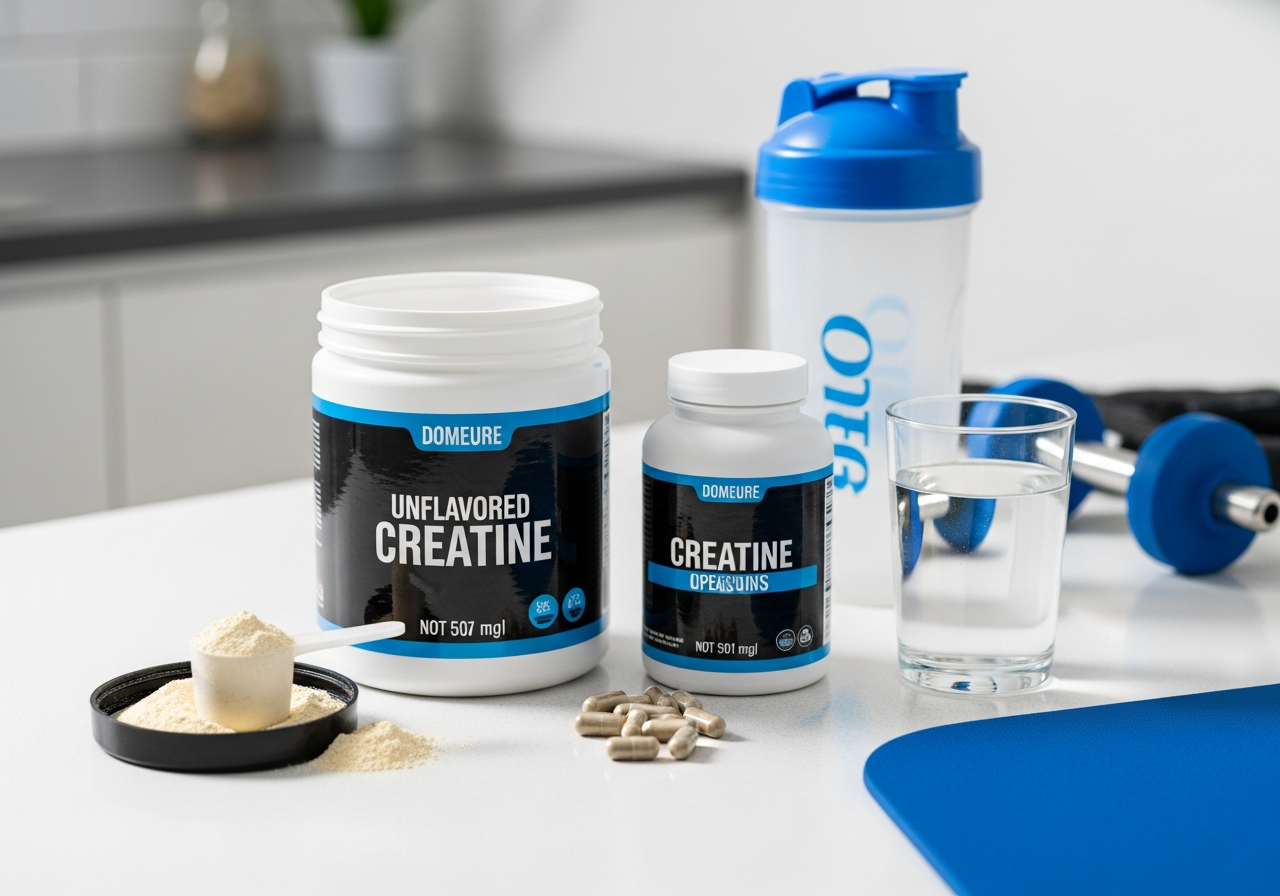
Creatine Powder vs Capsules: Which Should You Choose?
By The Creatine Canada Research Team — Evidence-based supplement analysts
Creatine powder is the better choice for most people because it is cheaper per effective dose, easier to dose accurately, and just as effective as capsules when both provide the same amount of creatine monohydrate. Creatine capsules are mainly a convenience format: better for travel, taste avoidance, and no-mixing routines, but usually worse on cost and often less practical at full 3–5 g daily doses.
Evidence-based · Cites 4 sources · Editorial standards
Key Takeaways
- Powder and capsules work equally well if they deliver the same grams of creatine monohydrate.
- Powder is usually the better value because you pay less per 3–5 g daily dose.
- Capsules are more convenient, but you may need several capsules to reach an effective dose.
- Most adults do well with 3–5 g/day; loading is optional, not required.
- Timing matters far less than taking creatine consistently every day.
- Monohydrate is still the most studied, most cost-effective, and best-supported form.
- In Canada, look for an NPN and ideally third-party testing or a reputable brand.
Creatine powder vs capsules: the short answer for most buyers
Creatine powder is usually the better buy, while capsules are usually the better convenience option. If you are asking whether capsules or powder are better creatine, the evidence-based answer is simple: neither format is inherently more effective if both provide the same daily amount of creatine monohydrate, the most studied form of creatine.
What changes is everything around that dose: cost, ease, portability, taste, and how likely you are to actually take it every day. The 2017 ISSN position stand concluded that creatine monohydrate is the most effective ergogenic nutritional supplement currently available for increasing high-intensity exercise capacity and lean mass during training. That conclusion applies to the ingredient itself, not whether it arrives in a scoop or a capsule.
For most lifters, runners doing speed work, team-sport athletes, and beginners, powder wins because it makes the standard maintenance dose of 3–5 g/day easy and affordable. Capsules often require multiple pills per serving, which is fine if you prefer swallowing pills, but can become annoying during a loading phase or when you want a full 5 g daily dose.
Choose powder if you want:
- Lower cost per gram
- Easy full-dose intake
- Flexible dosing for body size or loading
- Simple mixing with water, protein, or a shake
Choose capsules if you want:
- No measuring or scooping
- No taste or gritty texture
- Easy travel and gym-bag use
- A cleaner routine with less mess
If you are still unsure, use this rule: buy powder for home use and capsules only if convenience is the reason you will stay consistent. Consistency drives results because creatine works by gradually saturating muscle stores over days to weeks, not by creating a big acute effect the moment you take it. If you need help with the actual amount, our creatine dosage calculator and guide on how much creatine per day make it straightforward.
Why the format barely changes the science, but changes the user experience a lot
Creatine works the same way in powder and capsules because the active ingredient is the same once digested and absorbed. The key mechanism is that supplemental creatine increases your muscle stores of phosphocreatine, a stored high-energy compound that helps regenerate ATP, the cell’s immediate energy currency, during short, hard efforts like sprinting, lifting, jumping, and repeated intervals.
That is why creatine helps most with activities that depend on rapid energy turnover rather than long, steady low-intensity output. Higher intramuscular phosphocreatine availability can improve your ability to maintain training quality across sets or repeated bouts, and over time that often leads to better strength and muscle gains. For a full primer, see what is creatine and creatine benefits.
The format matters less biologically than behaviourally. Powder dissolves in liquid and delivers the full amount quickly. Capsules dissolve in the digestive tract and still deliver creatine, but they can slow you down practically because each capsule contains only a fraction of a full dose. If a bottle’s serving is 4 capsules for 3 g, for example, you may need 6 or more capsules to reach 5 g. That is not a problem for absorption; it is a problem for adherence.
The 2021 JISSN paper on common questions and misconceptions about creatine notes that creatine monohydrate remains the reference standard against which newer forms are compared, and newer forms have generally not shown superior efficacy. In other words, the important decision is monohydrate first, format second. You can read the review here: Antonio et al. (2021).
What the format can affect:
- Adherence: the best creatine is the one you actually take daily.
- GI comfort: some people tolerate divided powder doses better; others prefer capsules.
- Loading practicality: powder is far easier if taking around 20 g/day split into doses.
- Travel: capsules are simpler for flights, work, and gym lockers.
What the format does not meaningfully affect:
- Muscle saturation if total daily grams are matched
- Long-term strength and lean-mass potential when dose and training are equal
- The need for consistency over weeks
So, is powder creatine better? Only in practical terms like value and dosing ease, not because the molecule somehow works better in powder form.
Creatine pills vs powder cost: the comparison that decides it for most people
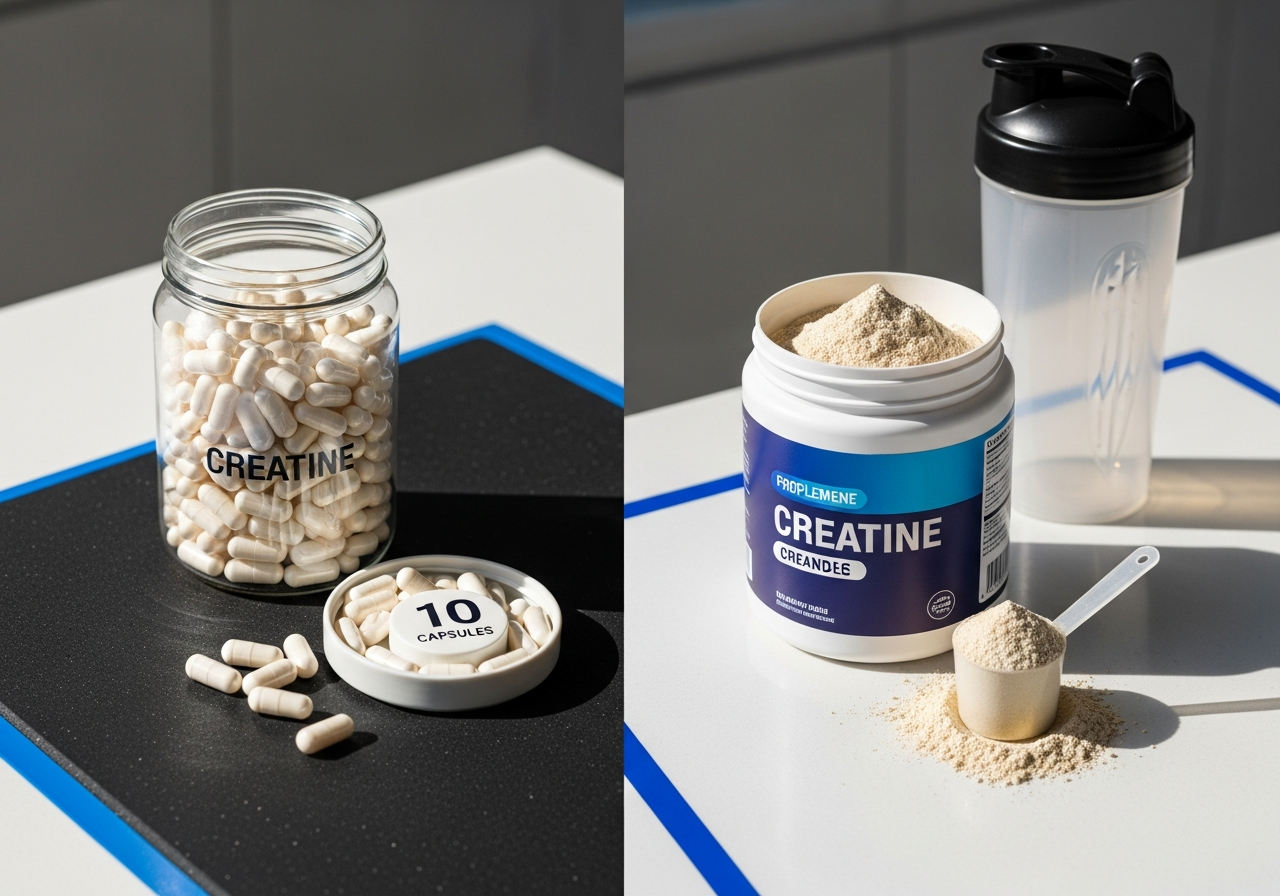
Creatine powder is usually the better value because capsules add manufacturing, bottling, and capsule-shell costs without improving the active ingredient. If your main question is creatine pills vs powder cost, powder almost always wins on cost per gram of creatine monohydrate and cost per effective daily serving.
That matters because creatine is not a one-off pre-workout hit; it is a daily supplement you may take for months or years. A small difference per serving compounds over time. Powder also lets you scale easily between 3 g and 5 g without guessing how many capsules you need.
| Factor | Creatine Powder | Creatine Capsules |
|---|---|---|
| Effectiveness | Equal when the daily grams match | Equal when the daily grams match |
| Typical maintenance dose | Easy to measure 3–5 g | May require several capsules |
| Loading phase practicality | Very practical for 20 g/day split doses | Often inconvenient due to pill count |
| Cost per gram | Usually lowest | Usually higher |
| Taste/texture | Can be slightly gritty if not well mixed | No taste |
| Travel convenience | Less convenient unless pre-portioned | Very convenient |
| Dose flexibility | Excellent | Limited by capsule size |
| Mess/cleanup | Can spill; needs scoop or scale | Minimal |
Here is the practical way to decide:
- If budget matters, choose powder.
- If you hate mixing supplements, choose capsules.
- If you plan to load, choose powder.
- If you travel often, capsules become more attractive.
One more detail many buyers miss: compare labels by grams of creatine monohydrate per serving, not by serving count alone. A bottle with many servings can still be poor value if each serving provides only 1–2 g. The same logic applies when shopping our creatine product catalog, checking creatine brand reviews, or browsing the best creatine rankings.
For most Canadians buying for daily gym use, powder is the clear default. Capsules make sense when convenience is important enough that it outweighs the higher cost.
How to take creatine powder or capsules correctly, step by step
The best way to take creatine is the method you can repeat daily without friction, and both powder and capsules can work if you dose them properly. The biggest mistake is not choosing the wrong format; it is underdosing, taking it sporadically, or assuming timing matters more than total daily intake.
Step-by-step for powder:
- Measure 3–5 g of creatine monohydrate using the included scoop or, better yet, a digital scale.
- Mix it into water, a protein shake, juice, or a smoothie.
- Stir or shake well; micronized powder tends to dissolve more easily.
- Take it once daily, ideally at the same time so you do not forget.
Step-by-step for capsules:
- Read the label carefully to see how many grams are in each capsule and serving.
- Count enough capsules to reach your target dose, usually 3–5 g/day.
- Take them with water, ideally with a meal if that feels better on your stomach.
- Repeat daily; keep a bottle at work, in your gym bag, or by your toothbrush if that improves adherence.
If you want to load:
- Take about 20 g/day split into 4 doses of 5 g for 5–7 days.
- Then switch to 3–5 g/day maintenance.
- Loading is easier with powder than capsules because the pill count can become tedious.
If you do not want to load:
- Take 3–5 g/day from day one.
- Expect muscle saturation and performance benefits to build more gradually over roughly 3–4 weeks.
For detailed walkthroughs, see how to take creatine, creatine loading phase, and how to mix creatine.
Two helpful troubleshooting tips: if powder feels gritty, use more liquid or warm water first, then top up cold. If capsules upset your stomach, split the dose across the day instead of taking everything at once. Neither trick changes effectiveness, but both can improve consistency, which is what actually determines whether creatine works for you.
Best dose by body weight, training goal, and whether you choose powder or capsules
The right creatine dose is usually 3–5 g/day for most adults, but larger athletes and people who want faster saturation may benefit from body-weight-based dosing. Format does not change the dose requirement; powder just makes custom dosing easier.
The most common evidence-based approaches are:
- Standard maintenance: 3–5 g/day
- Loading: about 0.3 g/kg/day for 5–7 days, then 3–5 g/day
- Body-weight maintenance: around 0.03 g/kg/day after loading
Practical examples:
- 60 kg person: 3 g/day is usually sufficient
- 75 kg person: 3–5 g/day is appropriate
- 90 kg person: 5 g/day is a sensible default
- 110 kg strength athlete: 5 g/day is often more practical than 3 g/day, especially with high training volumes
By goal, the same basic daily dosing still applies:
- General fitness or beginner gains: 3–5 g/day
- Maximizing strength and lean mass: 5 g/day is a common default
- Rapid start before a training block: load for 5–7 days, then maintain
- Older adults: 3–5 g/day alongside resistance training is commonly used
- Vegetarians and vegans: standard doses still apply, though response can be especially noticeable because baseline muscle creatine stores may be lower
Powder is clearly superior if you want precise body-weight dosing. Capsules can still work, but you must do the math carefully. If each capsule contains 750 mg, for example, 5 g requires nearly 7 capsules. If each capsule contains 1 g, 5 capsules gets you there more cleanly. Always check the actual label.
For a more exact plan, use the creatine dosage calculator or read creatine maintenance dose. The important point is that under-dosing capsules is one of the main reasons people conclude capsules are weaker, when the real issue is they never reached an effective daily amount.
If you are unsure where to start, 5 g/day of monohydrate powder is a simple, effective choice for most training adults.
When to take it, what to mix it with, and what results to expect week by week
Creatine timing matters far less than daily consistency, so take powder or capsules whenever you are most likely to remember them. If your question is whether powder is better because it can be mixed into a post-workout shake, the answer is that this can be convenient, but it is not the main reason powder works well.
Creatine is not like caffeine, where timing strongly affects the acute experience. Its main benefit comes from gradually increasing muscle creatine stores over time. The IOC consensus on dietary supplements recognises creatine as one of the few supplements with strong evidence for performance support in appropriate contexts, especially for repeated high-intensity work.
Simple timing rules:
- Take it daily, including rest days.
- Pick a routine anchor: breakfast, post-workout shake, lunch, or dinner.
- If capsules are easier to remember with meals, that is perfectly fine.
- If powder mixes best for you after training, that is also perfectly fine.
Good mixing options for powder:
- Water
- Protein shakes
- Smoothies
- Juice
- Coffee, if you tolerate it and prefer the habit pairing
Useful reads here include when to take creatine, creatine with or without food, and can you mix creatine with coffee.
What to expect week by week without loading:
- Week 1: usually no dramatic feeling; you are building stores.
- Week 2: some people notice slightly better training volume or recovery between hard sets.
- Weeks 3–4: muscle saturation is typically approaching useful levels; performance benefits become more noticeable.
- Weeks 4–8: the real payoff is often better quality training, more reps at a given load, or more repeat sprint capacity.
What to expect with loading:
- Faster saturation within about 5–7 days
- Potentially faster body-mass increase from intracellular water retention
- Possibly more GI discomfort if you take too much at once
How do you know it is working? Usually not from a buzz. It is working when your training quality improves subtly but consistently: one extra rep, less drop-off across sets, slightly better sprint repeatability, or steady progress in lean mass over time.
Who should choose powder, who should choose capsules, and who should think twice
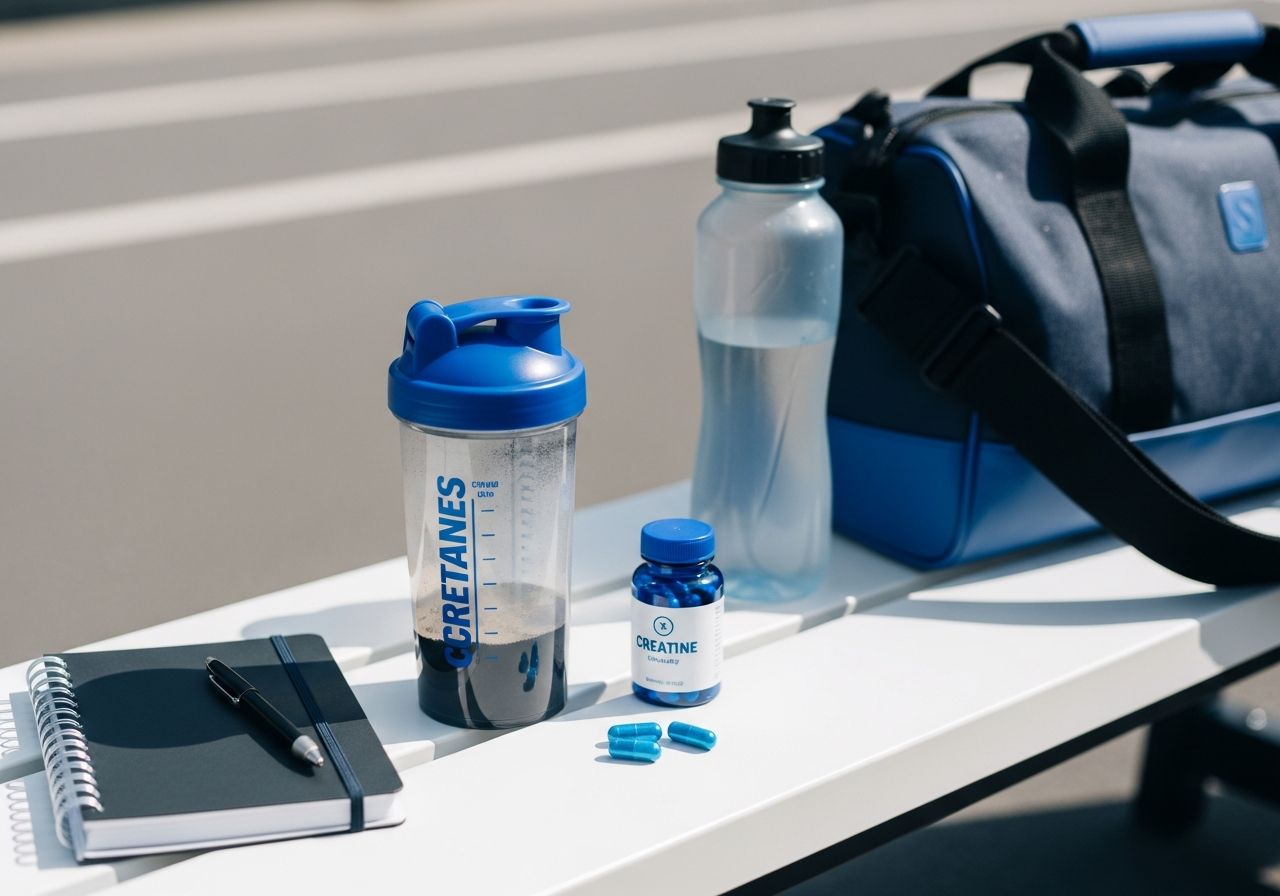
Powder suits most people, but capsules are a smart choice for specific lifestyles and preferences. The format decision should fit your routine, swallowing preference, travel habits, and tolerance for mixing supplements, not your sex or whether you are a beginner.
Powder is usually best for:
- Beginners who want the cheapest effective option
- Strength trainees taking a full 5 g/day
- Athletes considering loading before a training block
- People stacking creatine with protein shakes
- Larger athletes who want flexible dosing
Capsules are usually best for:
- Frequent travellers
- Office workers who want a desk-drawer supplement
- People who dislike powder texture
- Anyone who values convenience enough to pay more
Women: women can use either format, and the idea that one format is more “for women” is marketing, not physiology. What matters is dose, consistency, and product quality. For more, see creatine for women.
Older adults: both formats can work, but capsules may be less practical if pill burden is already high from other supplements or medications. Powder mixed into water or yogurt can be simpler. Resistance training plus creatine is often a stronger combination than creatine alone; see creatine for older adults.
Athletes: team-sport and power athletes usually benefit from creatine’s repeated high-intensity support, and powder is often easier during loading or higher-dose routines. Endurance athletes may still use creatine strategically, but should weigh the small likelihood of body-mass gain against their sport demands.
Vegetarians and vegans: either format can work well, and some may notice stronger benefits because habitual dietary creatine intake is lower.
Who should think twice or speak with a clinician first:
- People with known kidney disease or significant renal concerns
- People taking medications that warrant medical review
- Pregnant or breastfeeding individuals, because evidence is still limited for routine supplementation decisions
If you simply want a default recommendation: beginners should start with monohydrate powder unless they know convenience is the only way they will stay compliant.
Safety, side effects, and what to look for on a Canadian label
Creatine monohydrate is well supported for safety in healthy people when used at recommended doses, and powder is not safer or riskier than capsules just because of the format. The most common side effects are mild and practical: stomach upset from taking too much at once, temporary scale weight gain from water retention inside muscle, and occasional bloating complaints, especially during loading.
The ISSN position stand and the 2021 JISSN misconceptions paper both support creatine’s safety profile in healthy populations when used appropriately. Mayo Clinic also notes that creatine appears to be generally safe for many people when used as directed. The bigger concern in real life is not the molecule; it is choosing poor-quality products or misunderstanding bloodwork like creatinine. If that topic matters to you, read is creatine safe and is creatine bad for your kidneys.
Common side effects and fixes:
- Stomach upset: reduce dose per sitting, take with food, or switch from loading to standard daily dosing.
- Bloating sensation: avoid huge single doses and consider micronized powder.
- Weight increase: usually reflects increased water inside muscle, not body fat.
- Constipation or loose stools: more often a dosing or hydration issue than a format issue.
Canadian buying checklist:
- Look for a Natural Product Number (NPN), which means the product is licensed for sale as a natural health product in Canada.
- Check the ingredient panel for creatine monohydrate rather than flashy proprietary blends.
- Prefer brands that mention third-party testing or provide transparent quality control.
- Compare by grams of creatine per serving, not just scoop size or capsule count.
- Be cautious with heavily flavoured formulas if you only want pure creatine.
Pure powder often has the simplest label and the fewest unnecessary extras. Capsules can also be clean, but some include more fillers to stabilise the format. If clean-label buying matters, reputable products in the creatine product catalog and best creatine rankings are the best place to start.
Bottom line: for healthy adults, both formats are typically safe at standard doses, but the smartest buy is a plain, well-made creatine monohydrate product with clear dosing and Canadian-compliant labelling.
The biggest myths about creatine capsules, powder, absorption, and bloating
Most format myths come from marketing, not physiology. The most common false belief is that capsules are more “absorbable” or that powder is stronger because it hits faster, but standard creatine monohydrate works based on regular intake and tissue saturation, not a dramatic delivery trick.
Myth 1: Capsules absorb better than powder.
Fact: there is no strong evidence that standard capsules outperform standard powder when the ingredient and dose are matched.
Myth 2: Powder is better because it is more anabolic.
Fact: powder is not more anabolic; it is simply easier to take at evidence-based doses and usually cheaper.
Myth 3: Capsules are too weak to work.
Fact: capsules work fine if you take enough total grams, but many people accidentally underdose them.
Myth 4: You must load or creatine will not work.
Fact: loading only speeds saturation; daily 3–5 g without loading still works.
Myth 5: Creatine causes fat gain.
Fact: early body-mass increases are usually water stored within muscle, not fat gain; see does creatine make you gain weight.
Myth 6: Powder always causes bloating.
Fact: large doses and poor mixing can contribute to GI discomfort, but standard daily doses are commonly well tolerated. See does creatine cause bloating and creatine digestive side effects.
Common mistakes that actually matter:
- Buying a format first and ignoring whether it is monohydrate
- Not checking grams per serving on capsule labels
- Skipping days and expecting full benefits
- Taking 10–20 g at once and blaming creatine for stomach issues
- Judging success by feeling stimulated instead of tracking training output
If you want the no-nonsense version, start with 3–5 g/day of creatine monohydrate, stick with it for a month, and judge results by performance and training progression. That is far more useful than chasing claims that one format has secret absorption advantages. For broader myth-busting, visit creatine myths debunked or creatine myths and facts.
A simple buying framework: which creatine format should you choose today?
If you want the shortest reliable buying framework, choose monohydrate powder by default and choose capsules only when convenience clearly matters more than cost. That rule answers most creatine format comparison searches because it reflects how the science and real-world use actually intersect.
Use this decision tree:
- Do you care most about value? Buy powder.
- Do you hate mixing, measuring, or texture? Buy capsules.
- Do you want to load? Buy powder.
- Do you travel often or keep supplements at work? Capsules become attractive.
- Do you already drink shakes daily? Powder fits naturally.
- Do you struggle to swallow multiple pills? Avoid capsules.
Best fit by person:
- Budget-conscious beginner: plain monohydrate powder
- Serious lifter: powder, typically 5 g/day
- Frequent traveller: capsules or pre-portioned powder packs
- Minimalist supplement user: either, but pick the one you will never skip
There is also a hybrid strategy many experienced users end up with: powder at home, capsules for travel. That often gives you the best of both worlds without forcing one format into every situation.
When you shop, prioritise these criteria in order:
- Creatine monohydrate as the ingredient
- Adequate grams per serving
- Clear label transparency
- NPN and reputable Canadian compliance where relevant
- Third-party testing or strong brand reputation
- Only then: flavour, packaging, and format preference
If you want a curated shortlist, compare options in our best creatine rankings, review labels in the creatine product catalog, and cross-check manufacturers in creatine brand reviews. If your question is still “are capsules or powder better creatine?”, the honest answer remains the same: powder is better for most people, but capsules are better for the subset of people who value convenience enough to stick with them more consistently.
Bottom line: powder for value, capsules for convenience, monohydrate for results
Creatine powder is the best choice for most people because it is cheaper, easier to dose at 3–5 g/day, and more practical for loading, while creatine capsules are best for convenience, travel, and people who dislike mixing supplements. That is the most accurate one-sentence answer to the creatine powder vs capsules question.
The science does not show that capsules build more muscle or that powder has a special absorption advantage. What matters is that you take enough creatine monohydrate consistently enough to raise muscle creatine stores over time. Once that happens, both formats can support better repeated high-intensity performance and, through better training quality, stronger long-term gains in strength and lean mass.
If you want the practical recommendation:
- Choose powder if you are new, budget-conscious, taking 5 g/day, or planning to load.
- Choose capsules if you travel a lot, hate the taste or texture of powder, or know convenience is what will keep you compliant.
- Choose monohydrate regardless of format unless you have a very specific reason not to.
Your next steps are simple:
- Pick a monohydrate product.
- Take 3–5 g/day.
- Use loading only if you want faster saturation.
- Take it every day, not just workout days.
- Judge success after 3–4 weeks by training performance and progression.
If you want help choosing the exact dose or product, start with the creatine dosage calculator, then compare formats in creatine capsules and broader options in best type of creatine. For the vast majority of buyers, though, the final verdict is straightforward: powder is the smarter default, and capsules are the smarter exception.
Creatine Powder vs Capsules: The Numbers That Matter
- 3–5 g/day Standard maintenance dose — Works for most adults regardless of format
- 20 g/day Common loading dose — Usually split into 4 doses for 5–7 days
- 5–7 days Typical loading timeline — Speeds muscle saturation compared with maintenance only
- 3–4 weeks Typical timeline without loading — Daily 3–5 g usually reaches useful saturation gradually
Frequently Asked Questions
Are capsules or powder better creatine?
Powder is better for most people, while capsules are better for convenience. Both work equally well if they provide the same grams of creatine monohydrate, but powder is usually cheaper, easier to dose at 3–5 g/day, and more practical if you want to use a loading phase.
Is powder creatine better than capsules for muscle gain?
Powder is not inherently better for muscle gain than capsules if the daily dose is the same. The reason powder often looks better in practice is that people are more likely to hit a full effective dose with one scoop than with several capsules.
Do creatine capsules work as well as powder?
Yes, creatine capsules work as well as powder when they deliver the same total amount of creatine monohydrate. The main downside is practical rather than scientific: many capsule products require multiple pills to reach 3–5 g, so underdosing is more common.
Why is creatine powder usually cheaper than capsules?
Creatine powder is usually cheaper because capsules add extra manufacturing, encapsulation, and packaging costs without improving the active ingredient. Over months of daily use, that higher per-serving cost can make capsules noticeably less economical than a plain monohydrate powder.
How many creatine capsules equal 5 grams?
The number of creatine capsules needed for 5 grams depends entirely on how much creatine is in each capsule. If a capsule contains 1 g, you need 5 capsules; if it contains 750 mg, you need nearly 7 capsules, so always read the Supplement Facts or product label carefully.
Should beginners choose creatine powder or capsules?
Beginners should usually choose creatine powder because it is the simplest low-cost way to get an effective daily dose. Capsules are still fine for beginners who know they dislike mixing supplements and are more likely to stay consistent with a pill-based routine.
Is creatine powder harder on your stomach than capsules?
Creatine powder is not automatically harder on your stomach than capsules. Digestive issues are more often caused by taking too much at once, loading aggressively, or not using enough fluid, and those same issues can happen with capsules if the total dose is large.
Do you need a loading phase with capsules or powder?
You do not need a loading phase with either capsules or powder. Loading at about 20 g/day for 5–7 days only speeds saturation, while taking 3–5 g/day from the start still works and is often more comfortable, especially if you are using capsules.
What is the best time to take creatine powder or capsules?
The best time to take creatine powder or capsules is the time you will remember every day. Consistency matters much more than timing because creatine works by gradually increasing muscle stores over days and weeks rather than creating a major immediate effect.
What should Canadians look for when buying creatine capsules or powder?
Canadians should look for creatine monohydrate, a clear dose per serving, and ideally a Natural Product Number on the label. It is also smart to favour reputable brands that disclose third-party testing or strong quality-control practices rather than relying on flashy format marketing.