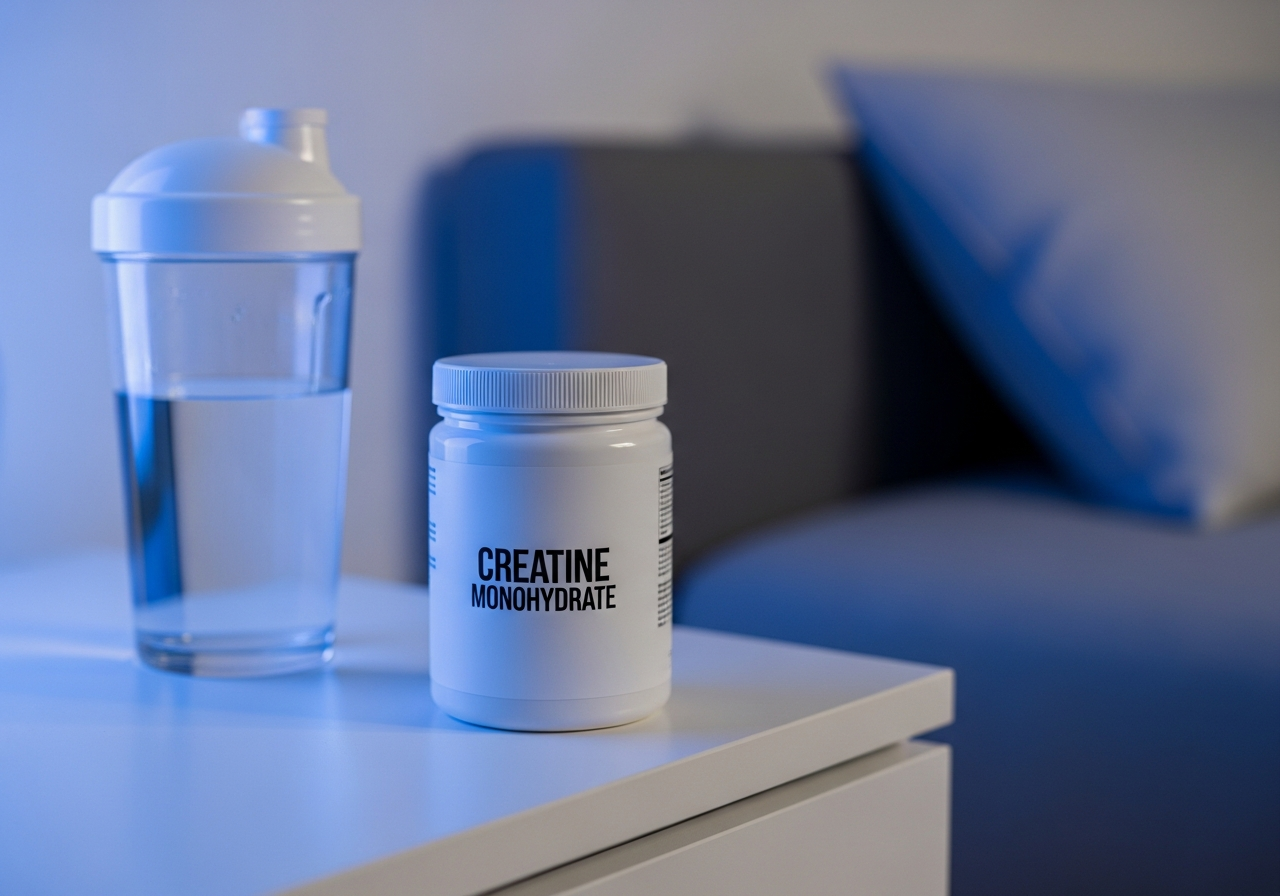
Can You Take Creatine Before Bed? Yes — Here Is What the Research Shows
By The Creatine Canada Research Team — Evidence-based supplement analysts
Yes, you can take creatine before bed, and for most people it works just as well as taking it earlier in the day. Creatine’s benefits depend far more on taking the right dose consistently enough to saturate your muscles than on whether you use it in the morning, post-workout, or at night.
Evidence-based · Cites 4 sources · Editorial standards
Key Takeaways
- Taking creatine before bed is fine for most healthy adults if it fits your routine.
- Daily consistency matters more than clock time once muscle creatine stores are saturated.
- A standard maintenance dose is 3-5 g of creatine monohydrate per day.
- A loading phase of 20 g/day split into 4 doses for 5-7 days can speed up results, but is optional.
- Creatine itself is not a stimulant and does not normally keep people awake.
- If bedtime creatine causes stomach upset or extra late-night bathroom trips, move it earlier.
- Choose plain creatine monohydrate with clear dosing, an NPN when sold in Canada, and preferably third-party testing.
Yes, you can take creatine before bed — and timing usually matters less than consistency
Yes, you can take creatine before bed, and for most people there is no special downside to taking it at night. Creatine works by gradually increasing your body’s stores of phosphocreatine, the stored high-energy compound in muscle that helps regenerate ATP, the immediate energy currency used during short, intense efforts like lifting, sprinting, and repeated hard intervals.
That mechanism is why the question “does creatine before bed work?” has a simple answer: yes, because creatine is not an acute stimulant or one-time pre-workout effect. Creatine is a saturation supplement. Once your muscle stores are topped up, the exact time of day matters much less than whether you take enough often enough to stay saturated.
The best-supported form is creatine monohydrate, and the best-supported daily maintenance dose is 3-5 g per day. The 2017 ISSN position stand concluded that creatine monohydrate is the most effective ergogenic nutritional supplement currently available for increasing high-intensity exercise capacity and lean mass during training. That conclusion is about regular use, not a magic timing window.
If you prefer taking supplements at night because it is easier to remember, bedtime creatine is a good strategy. In practice, the “best” time to take creatine is the time you will actually take every day. For many people, that means linking it to a stable habit such as brushing teeth, having dinner, or making a nightly protein shake.
There are a few exceptions worth noting. If taking creatine before bed causes stomach discomfort, reflux, or extra trips to the bathroom from drinking a large glass of water right before sleep, move it earlier in the evening. If your product is a stimulant-heavy pre-workout that happens to include creatine, that is different: the caffeine and other stimulants may absolutely affect sleep, but the creatine itself is not the problem.
For a broader timing breakdown, see when to take creatine. If you are brand new, our creatine for beginners guide covers the basics of what to buy, how much to use, and what to expect.
Creatine and sleep: what the science supports, what it does not, and why bedtime is usually neutral
Creatine does not appear to act like a stimulant, so bedtime creatine is usually neutral for sleep in healthy adults. The reason is straightforward: creatine does not work through the same pathways as caffeine, nicotine, or other compounds that directly increase alertness.
Creatine primarily helps your cells recycle ATP faster during high-energy demand. In muscle, that supports repeated hard efforts. In the brain, creatine also plays a role in cellular energy buffering, which is one reason researchers remain interested in cognition and sleep-loss resilience. But that is not the same thing as saying creatine before bed will make you wired or unable to fall asleep.
The current evidence does not support a broad claim that taking creatine at night harms sleep quality. At the same time, the evidence also does not support a broad claim that bedtime creatine improves normal sleep. Most people should think of creatine and sleep as largely separate issues unless a practical factor gets in the way, such as drinking too much fluid too close to bed or using a flavoured product that causes digestive upset.
The 2021 JISSN review on common creatine questions and misconceptions reinforces a useful principle here: many claims around creatine go beyond what the direct evidence can prove. Creatine is very well studied for performance, lean mass, and safety, but much less conclusively studied for specific bedtime effects on sleep architecture in the average gym-goer.
Where nuance matters: if you train late and mix creatine into a caffeinated pre-workout or energy drink, your sleep may suffer. If that happens, the culprit is likely the caffeine dose and late sympathetic stimulation, not creatine monohydrate itself. Likewise, if you take 10 g or more in one hit before bed and feel bloated, that discomfort may indirectly disturb sleep.
Bottom line: “can you take creatine at night?” Yes. “Will creatine and sleep clash?” Usually no. “Should you expect better sleep because of creatine?” Not as a standard outcome. Treat bedtime creatine as a convenience option, not a sleep aid.
Why creatine before bed still works: saturation beats a narrow timing window
Creatine before bed works because your muscles care more about total stored creatine than about the exact hour you swallowed your dose. After you supplement consistently, your muscle creatine and phosphocreatine stores rise over days to weeks, and that larger reservoir is what supports training performance and recovery between hard efforts.
This is the key mechanism to understand. Creatine is absorbed through the gut, transported in the blood, and taken up into tissues including skeletal muscle. Over time, repeated daily dosing increases intramuscular creatine content. Once those stores are closer to saturation, you have more phosphocreatine available to rapidly regenerate ATP during short bursts of intense exercise.
That is why creatine timing night versus day is usually a second-order detail. Unlike caffeine, which you feel within an hour, creatine is not mainly about what happens right after a single dose. It is more like filling a battery reserve over time. A bedtime dose still contributes to that reserve.
Loading can speed up saturation. A common protocol is 20 g/day split into 4 doses of 5 g for 5-7 days, followed by 3-5 g/day. Without loading, taking 3-5 g/day still works, but it usually takes longer to fully elevate muscle stores. If you want the deeper breakdown, see creatine loading phase and how long creatine takes to work.
There may be small timing differences around workouts in some studies, but they are not large or consistent enough to matter more than adherence for most people. If someone remembers their nightly dose 95% of the time and their post-workout dose only 50% of the time, the nightly routine wins in the real world.
This is especially useful for people with irregular schedules: shift workers, students, parents, and anyone who does not train at the same time every day. Creatine is one of the few sports supplements where the practical advice is refreshingly simple: pick a routine you can repeat.
If you want a refresher on the basics of what creatine is doing inside the body, read what is creatine and creatine benefits.
Exactly how to take creatine before bed without overthinking it
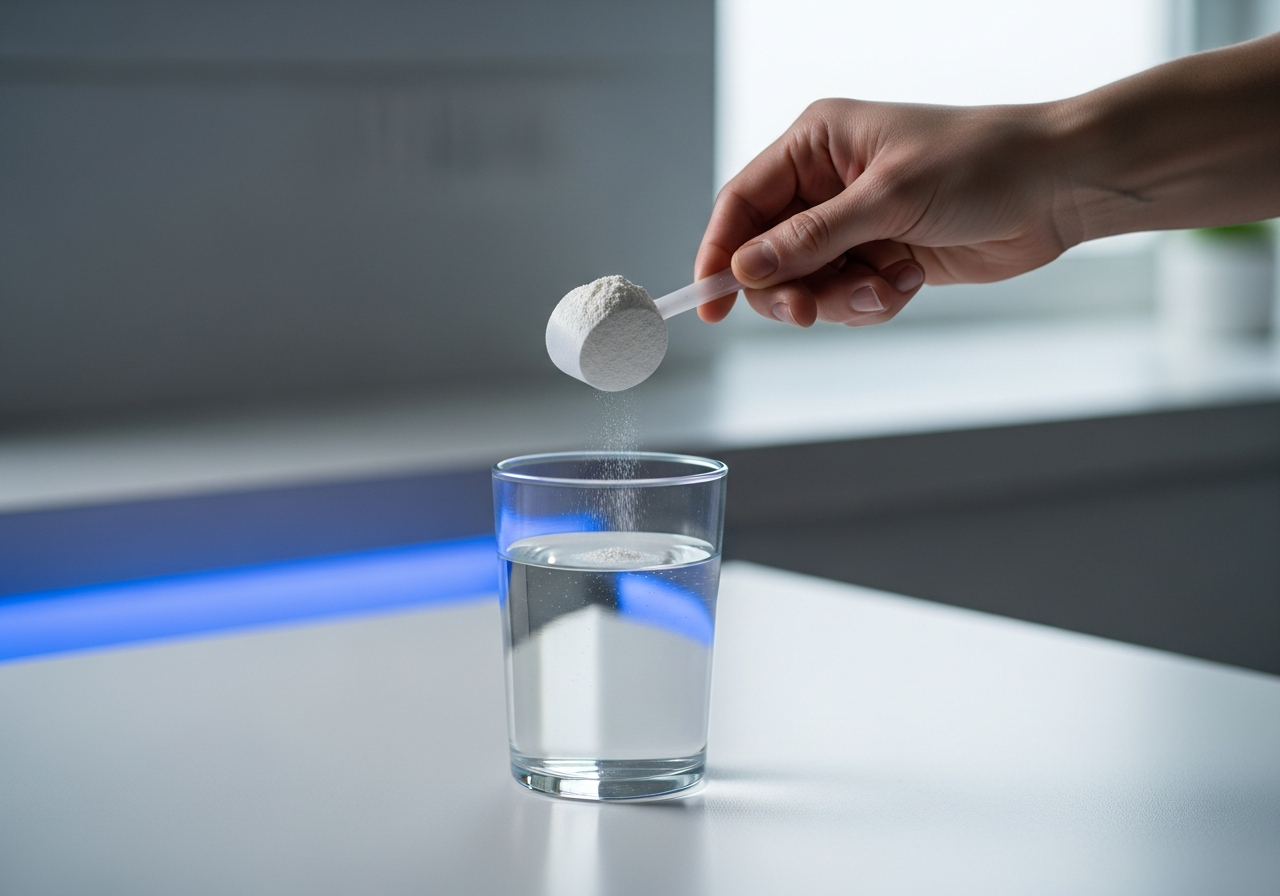
The easiest way to take creatine before bed is to use 3-5 g of creatine monohydrate once nightly with water or another non-caffeinated drink. That is enough for most adults to maintain saturation after stores are built up, and it avoids the unnecessary complexity that causes people to quit.
- Choose creatine monohydrate. It is the most studied, most cost-effective, and the reference form used in most research. Plain powder is the simplest option.
- Measure the dose accurately. Use a scale or a labelled scoop rather than guessing. If you need help, use the creatine dosage calculator or read how much creatine per day.
- Take it 30-90 minutes before sleep if that feels best. There is no physiologic requirement for this exact window, but it is a practical habit anchor.
- Mix it in enough fluid to drink comfortably. A small glass is fine. You do not need to chug a litre of water right before bed.
- Pair it with an existing habit. Dinner, evening protein, or brushing your teeth all work. Habit stacking is often the difference between success and forgetting.
- Keep taking it on rest days. Saturation is maintained by regular intake, not only by workout-day dosing.
Good bedtime options include water, milk, a protein shake, or a non-acidic flavoured drink. If your powder clumps or feels gritty, warm water can help it dissolve, and micronized powders usually mix more easily. For practical mixing tips, see how to mix creatine.
A few things to avoid at night: dry scooping, taking a giant loading dose all at once, or combining creatine with a late-night stimulant product. Also avoid turning a simple 5 g habit into a complicated ritual involving “anabolic windows” and exact-minute timing. The evidence does not justify that level of obsession.
If you miss a bedtime dose, do not double up the next morning unless you are in a structured loading phase and intentionally splitting doses. Just resume your normal schedule. One missed day is unlikely to meaningfully affect saturated stores.
Best creatine dose at night by body weight, training goal, and whether you load
The right bedtime creatine dose is usually the same as the right daytime dose: 3-5 g/day for maintenance, with optional loading if you want faster saturation. Most healthy adults do not need a special “night dose” different from standard evidence-based creatine dosing.
For most people, these rules work well:
- Smaller adults or light-framed beginners: 3 g/day is often sufficient.
- Average active adults: 5 g/day is the standard practical dose.
- Larger athletes with more lean mass: 5 g/day is still common, though some coaches use body-size-based adjustments within standard evidence-based ranges.
- Loading phase: 20 g/day split into 4 doses for 5-7 days, then 3-5 g/day.
Here is a simple comparison:
| Goal / Situation | Suggested Dose | How to Take It at Night | What to Expect |
|---|---|---|---|
| General fitness beginner | 3-5 g/day | One nightly dose | Gradual benefits over several weeks |
| Strength or muscle gain | 5 g/day | One nightly dose, every day | Better training capacity and lean-mass support over time |
| Need faster saturation | 20 g/day for 5-7 days, then 3-5 g/day | Split into 4 doses; one can be before bed | Faster water-weight and performance changes |
| Sensitive stomach | 3 g/day to start | Take with food earlier in the evening if needed | Better tolerance, slower but steady progress |
By goal, the dose does not change much. Whether you care most about strength, sprint performance, lean mass, recovery between hard sets, or preserving muscle while dieting, maintenance intake still usually lands in the 3-5 g/day range. The more meaningful differences come from training quality, body size, and whether you respond strongly to creatine.
If you want a more personalised estimate, especially if you are heavier, vegetarian, or highly trained, use our creatine dosage calculator. Also see creatine maintenance dose for a deeper look at what “enough” really means.
Night-time vs post-workout creatine: which timing actually wins in practice?
For most people, night-time creatine and post-workout creatine will produce very similar results if the daily dose and long-term consistency are the same. That is the most useful answer to the search for “creatine timing night” and “does creatine before bed work”.
Why the lack of a huge difference? Because creatine is not primarily driven by a narrow anabolic window. Muscles do not become permanently saturated or unsaturated based on a single hour of timing. What matters is the cumulative rise in intramuscular creatine stores over repeated daily use.
Post-workout timing can still make sense for one practical reason: people already have a routine around training shakes, meals, or gym bags. But bedtime can be just as good if your evenings are more predictable than your workouts. This is especially true for people who train at varied hours or skip post-workout nutrition on busy days.
Use this simple decision rule:
- Take creatine post-workout if you reliably remember it after every session and you train most days.
- Take creatine before bed if your evening routine is more stable than your training routine.
- Take creatine with a meal if food improves tolerance and helps you stay consistent.
What about training late at night? If you finish your workout close to bedtime, combining your post-workout dose with your bedtime dose is fine because it is still just one daily dose. The only caution is to avoid stimulant-heavy workout products late in the evening if sleep is a priority.
There is no need to “cycle” between morning and night or stress if your timing changes day to day. Creatine is forgiving. If your schedule is unpredictable, simply take it at the first reliable point in the day and move on.
For a dedicated timing guide, read when to take creatine. If you train with shakes, you may also like mixing creatine with protein powder.
Who bedtime creatine works best for: beginners, women, older adults, and busy athletes
Bedtime creatine works especially well for people who need a simple, repeatable routine more than a theoretically perfect one. That includes beginners, women, older adults, shift workers, and athletes whose training times change from day to day.
Beginners often do best with a low-friction habit. One nightly 3-5 g dose is easier to sustain than trying to remember pre-workout timing, gym-bag scoops, and rest-day adjustments. A beginner who takes creatine nightly for 12 weeks will usually do better than a beginner who takes it only on workout days because they thought timing mattered more than consistency.
Women can absolutely take creatine before bed. The dose is generally the same as for men, usually 3-5 g/day, and there is no evidence-based reason women need a special night-only protocol. If anything, bedtime use may be especially helpful for women balancing work, family, and training because it reduces decision fatigue. For more, see creatine for women.
Older adults can also benefit from creatine, particularly when paired with resistance training to support muscle and strength. A nightly routine may be easier to remember than workout-linked dosing, especially in retirement schedules where training times vary. For this group, starting with 3 g/day and taking it with food can be a sensible tolerance-first approach.
Athletes in team sports, sprint sports, CrossFit, and strength sports can use bedtime creatine if it protects adherence during heavy travel or irregular competition schedules. The IOC consensus on dietary supplements recognises creatine as one of the few supplements with strong evidence for certain performance uses; that support is based on proper intake, not a mandatory bedtime or post-workout window.
Vegetarians and vegans may respond particularly well because baseline muscle creatine stores can be lower when dietary creatine intake from meat and fish is lower. Again, a nightly dose works fine.
The people who may want to avoid bedtime specifically are those with reflux, sensitive digestion close to sleep, or anyone who already wakes frequently to urinate and does not want extra fluid late at night.
Is taking creatine at night safe, and what side effects actually matter?
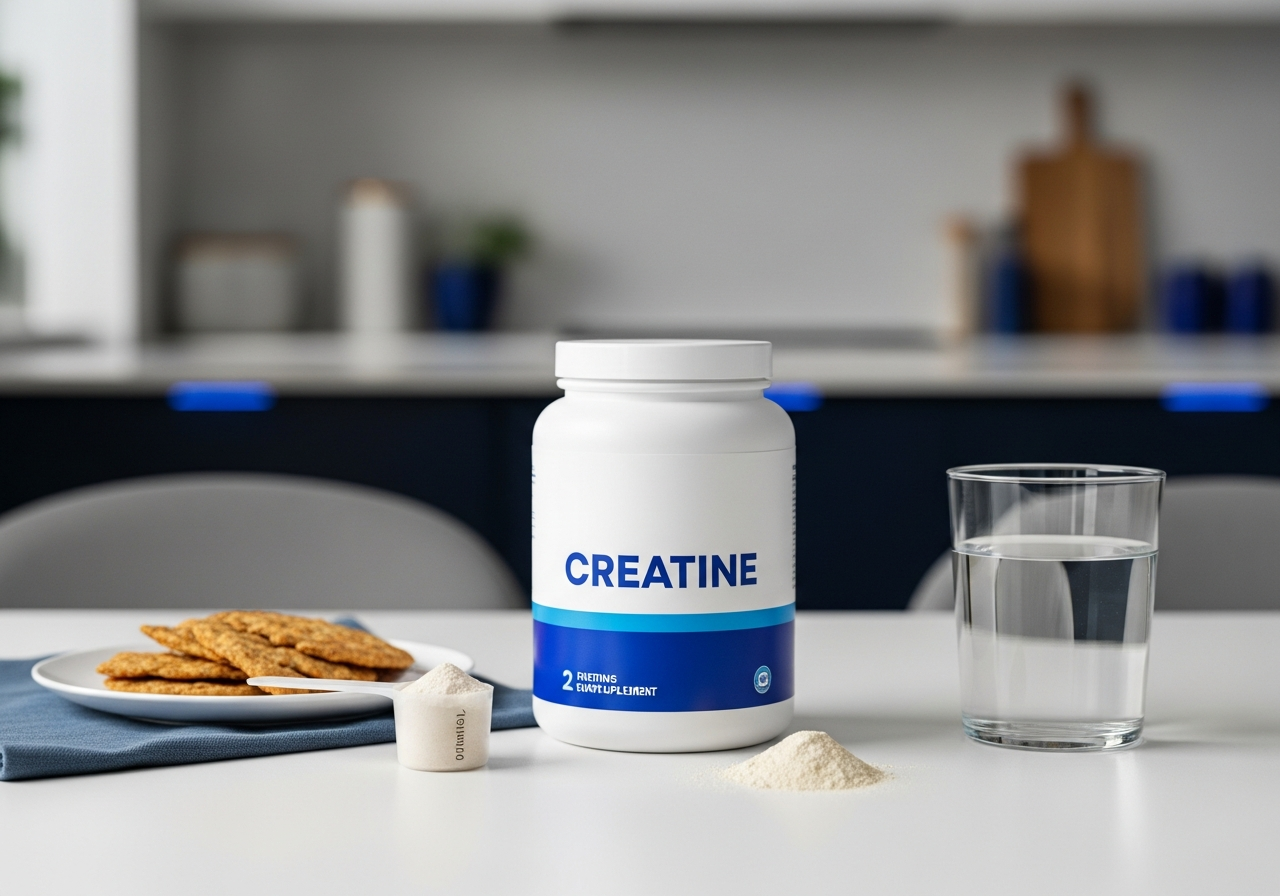
Taking creatine at night is considered safe for most healthy adults when used at standard doses, and the main real-world issues are stomach comfort and late-night fluid timing, not hidden sleep toxicity. Creatine monohydrate has one of the strongest safety profiles in sports nutrition when used appropriately.
The ISSN position stand and the Mayo Clinic overview both support the general safety of creatine in healthy individuals at recommended intakes. Commonly reported issues are usually mild and manageable:
- Water-weight gain: often noticeable in the first 1-2 weeks, especially with loading, because creatine draws more water into muscle cells.
- Stomach upset or loose stools: more likely with large single doses rather than standard 3-5 g maintenance doses.
- Bloating or fullness: often improved by splitting doses, taking it with food, or switching to a micronized monohydrate powder.
- Extra bathroom trips: usually from drinking a large volume of fluid right before bed rather than from creatine acting as a diuretic.
Creatine itself is not well supported as a cause of dehydration, cramps, or kidney damage in healthy users taking recommended doses. One recurring confusion is that creatine can raise creatinine, a breakdown marker seen on blood tests, without necessarily harming the kidneys. That laboratory nuance matters, especially if a clinician is unfamiliar with your supplement use.
You should still use caution if you have known kidney disease, are under medical evaluation for kidney issues, are pregnant or breastfeeding, or are taking medications that affect kidney function. In those cases, speak with a qualified healthcare professional before starting supplementation.
If your main concern is side effects rather than timing, read is creatine safe, creatine digestive side effects, and creatine and kidneys.
Common mistakes and myths about creatine before bed, debunked clearly
The biggest mistake people make with creatine before bed is assuming timing matters more than total daily intake. In reality, most “creatine at night” problems come from poor dosing habits, misattributing side effects, or confusing creatine with stimulant products.
Here are the most common myths:
- Myth: Creatine before bed will keep you awake.
Fact: Creatine is not a stimulant, and standard creatine monohydrate does not usually impair sleep on its own. - Myth: Creatine only works if you take it right before or right after training.
Fact: Daily saturation matters more than a narrow timing window, so bedtime use can work perfectly well. - Myth: You need a huge dose at night to make up for the day.
Fact: Large single doses are more likely to cause stomach upset and are not necessary for maintenance. - Myth: Creatine causes dehydration, cramps, or automatic bloating at night.
Fact: These claims are often overstated, and any night-time discomfort is more often related to big doses or too much fluid close to sleep. - Myth: If you miss one night, your creatine cycle is ruined.
Fact: Missing a single day is usually trivial once stores are saturated; just resume your normal dose. - Myth: Fancy creatine forms are better for bedtime.
Fact: Monohydrate remains the best-supported and most cost-effective choice.
Common practical mistakes are just as important as myths:
- Taking creatine only on training days.
- Using an unmeasured scoop and underdosing without realising it.
- Dry scooping before bed and then blaming creatine for throat or stomach irritation.
- Mixing creatine with a caffeinated pre-workout at 9 p.m. and assuming creatine ruined sleep.
- Buying a proprietary blend without knowing how much creatine it actually contains.
If you want a larger fact-checking guide, visit creatine myths debunked or creatine myths vs facts. For form comparisons, see monohydrate vs HCL.
What to buy in Canada if you plan to take creatine at night
If you plan to take creatine before bed, the best product to buy in Canada is usually a plain creatine monohydrate powder with clear gram dosing, an NPN on the label when applicable, and preferably third-party testing. Night-time use does not require a special “sleep creatine” formula.
An NPN is a Natural Product Number issued for licensed natural health products in Canada. It is not a magic proof of superiority, but it does tell you the product has gone through Health Canada’s natural health product framework. For many Canadian shoppers, that adds a useful layer of confidence alongside reputable manufacturing and testing.
When comparing products, focus on these buying criteria:
- Form: creatine monohydrate first.
- Dose transparency: 3-5 g per serving clearly shown.
- Minimal extras: avoid bedtime formulas packed with stimulants or unnecessary proprietary blends.
- Third-party testing: useful for purity and label accuracy.
- Value per 100 g or per 5 g serving: monohydrate is usually the cost winner.
| Product Type | Best For | Pros | Cons |
|---|---|---|---|
| Plain monohydrate powder | Most people | Most studied, flexible dose, best value | Needs mixing |
| Micronized monohydrate | People who dislike gritty powder | Mixes a bit easier, same core ingredient | Sometimes slightly pricier |
| Capsules | Travel or convenience | No mixing, easy to carry | Often need many capsules to reach 3-5 g |
| Gummies | Taste-first users | Convenient format | Often pricier, may require multiple pieces, formula quality varies |
| Pre-workout with creatine | Not ideal for bedtime | Convenient if used earlier in the day | May contain caffeine and hide actual creatine dose |
If you are shopping now, browse our best creatine rankings, creatine brand reviews, and creatine product catalog. If you specifically want help finding reputable options domestically, see best creatine monohydrate in Canada.
What to expect week by week from bedtime creatine, and the real bottom line
If you take creatine before bed consistently, expect the same general results timeline you would get from taking it at any other time of day. The visible and performance effects depend mainly on whether you loaded, your baseline creatine stores, your training quality, and how responsive you are as an individual.
Here is a realistic timeline:
- Days 1-7 with loading: muscle stores rise faster, and some people notice an early increase in scale weight from intracellular water retention.
- Weeks 1-2 without loading: not much may feel different yet, though saturation is building.
- Weeks 2-4: many users start noticing better performance on repeated hard sets, slightly improved training volume, or better top-end output in explosive work.
- Weeks 4-8: strength progress and lean-mass benefits become more noticeable when training and nutrition are also dialled in.
- Beyond 8 weeks: the main advantage is sustained support for high-intensity training capacity and long-term adaptation.
How do you tell it is working? Look for small but repeatable improvements: an extra rep on key lifts, better sprint repeatability, less drop-off between hard sets, or more total training volume at the same effort. Creatine is not usually a dramatic overnight feeling. It is a background performance enhancer that becomes obvious on paper before it becomes obvious emotionally.
If bedtime use is easy for you, stick with it. If it causes stomach discomfort or interrupts sleep because of late fluids, move it to dinner, post-workout, or another reliable time. The supplement does not care about the clock nearly as much as internet arguments suggest.
Bottom line: yes, you can take creatine before bed, and for most people it works just as well as other times of day. Use 3-5 g of creatine monohydrate daily, load only if you want faster saturation, keep taking it on rest days, and choose the timing that you will follow for months, not just for a week.
If you want the next step, read how to take creatine and how much creatine per day.
Creatine Before Bed: The Numbers That Matter
- 3-5 g/day standard maintenance dose — The usual evidence-based daily amount for most adults using creatine monohydrate.
- 20 g/day common loading dose — Typically split into 4 doses for 5-7 days to raise muscle stores faster.
- 5-7 days typical loading period — A short loading phase can speed saturation but is optional.
- 2-4 weeks common time to notice benefits without loading — Performance effects often become more noticeable after consistent daily use.
Frequently Asked Questions
Can you take creatine at night?
Yes, you can take creatine at night, and for most people it works just as well as taking it earlier in the day. Creatine is a saturation supplement, so the main driver of results is consistent daily intake rather than the hour you take it.
Does creatine before bed work?
Yes, creatine before bed works because it still contributes to raising and maintaining muscle creatine stores over time. As long as you use an evidence-based daily dose, bedtime supplementation can be fully effective for strength, power, and muscle-support goals.
Will creatine before bed keep me awake?
Usually no, creatine before bed should not keep you awake because creatine is not a stimulant. If sleep worsens after taking it at night, the more likely causes are caffeine in the same product, stomach discomfort, or drinking too much fluid too close to bedtime.
Is creatine and sleep a bad combination?
No, creatine and sleep are not usually a bad combination for healthy adults using standard doses. Most people tolerate creatine at night without any meaningful sleep issue, though individual comfort still matters.
Should I take creatine before bed or after workout?
Take creatine at the time you are most likely to remember every day, because consistency matters more than choosing bedtime or post-workout on theory alone. If your post-workout routine is unreliable but your evenings are stable, bedtime is often the better real-world choice.
How much creatine should I take before bed?
Most adults should take 3-5 g of creatine monohydrate before bed if using it as a daily maintenance dose. If you are doing a loading phase, one of your split doses can be taken at night, but taking the full 20 g at once before bed is not a good idea.
Can I mix creatine with water before bed?
Yes, you can mix creatine with water before bed, and that is one of the simplest ways to take it. You can also mix it with milk or a protein shake if that is easier on your stomach or fits your evening routine better.
Should I take creatine before bed on rest days too?
Yes, you should usually take creatine before bed on rest days too because muscle saturation is maintained by regular daily intake. Skipping rest days makes adherence worse and can reduce how effectively you maintain elevated stores over time.
Is there a best type of creatine to take at night?
Yes, the best type of creatine to take at night is generally plain creatine monohydrate. It is the most studied form, the most cost-effective form, and there is no strong evidence that more heavily marketed forms are better specifically for bedtime use.
What if creatine before bed upsets my stomach?
If creatine before bed upsets your stomach, move it earlier in the evening, take it with food, reduce the single dose, or switch to a micronized monohydrate powder. Stomach issues are usually a dosing or tolerance problem, not a sign that creatine only works during the day.