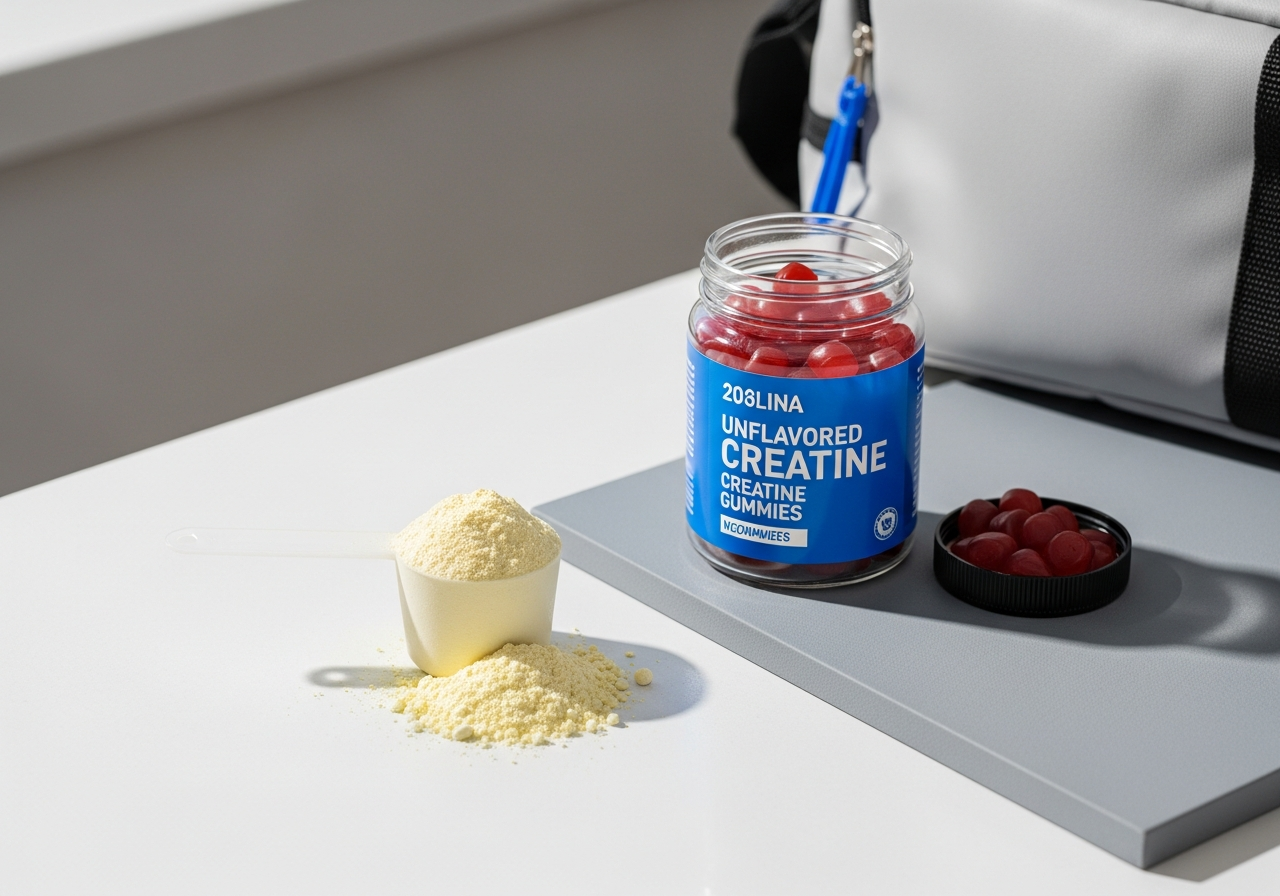
Creatine Gummies vs. Powder: Do Gummies Actually Work?
By The Creatine Canada Research Team — Evidence-based supplement analysts
Creatine gummies can work, but they are usually not as practical or cost-effective as creatine powder because the ingredient that matters is the total grams of creatine monohydrate you actually get each day. If a gummy product reliably delivers an evidence-based daily dose, it can be effective; the catch is that many gummies underdose creatine, add sugar, or require eating a surprisingly large number per serving.
Evidence-based · Cites 4 sources · Editorial standards
Key Takeaways
- Creatine gummies work if they provide enough creatine monohydrate per day, but many products make that harder than powder does.
- For most adults, 3-5 g of creatine monohydrate daily is the proven maintenance dose regardless of format.
- Powder is usually the best value, easiest to dose accurately, and the most straightforward way to reach full muscle saturation.
- Gummies are mainly a convenience option for people who hate mixing powder or dislike swallowing capsules.
- Check the label for grams of creatine per serving, number of gummies per serving, sugar content, and third-party testing.
- Capsules are generally as effective as powder too, but you may need several capsules per day to reach 3-5 g.
- Timing matters far less than consistency; taking creatine every day is what drives results.
Creatine gummies vs powder: the direct answer most people need
Creatine gummies can be as effective as powder only if they deliver the same daily dose of creatine, ideally as creatine monohydrate, every day. Powder still wins for most people because it is easier to dose at 3-5 g per day, usually costs less per effective serving, and has the simplest ingredient profile.
If you are asking, are creatine gummies as good as powder? the honest answer is: sometimes, but often not in practice. The reason is not that gummies are a worse delivery method biologically. Your muscles do not care whether creatine came from a scoop, capsule, or gummy. Your muscles care about whether intramuscular creatine stores become saturated, meaning your muscle has built up enough creatine and phosphocreatine to support high-energy effort. If a gummy gives you enough creatine daily, it can work. If it gives too little, or you skip doses because the serving size is huge, it will underperform.
The 2017 ISSN position stand concluded that creatine monohydrate is the most effective ergogenic nutritional supplement currently available for increasing high-intensity exercise capacity and lean body mass, and that conclusion applies to the ingredient rather than the candy-like format around it. Read the source directly here: Kreider et al. (2017), ISSN Position Stand.
For beginners, the simplest rule is this:
- Choose powder if you want the easiest, cheapest, most evidence-based option.
- Choose gummies only if you know you will be more consistent with them and the label clearly gives enough creatine.
- Choose capsules if you want portability without sugar, but understand you may need multiple capsules daily.
If you are still learning the basics, start with our guides on what creatine is, how to take creatine, and the creatine dosage calculator to see what a realistic daily target looks like for your body size and goal.
The bottom line up front: gummies are not a scam by definition, but powder is usually the better buy and the better default.
Do creatine gummies work? Yes—because creatine works, not because gummies are special
Creatine gummies work when they raise your body’s creatine stores enough to improve phosphocreatine availability in muscle, which helps regenerate ATP, the cell’s immediate energy currency, during short, hard efforts. In plain English, creatine helps you repeat explosive work better: heavy sets, sprints, jumps, and hard intervals.
Here is the mechanism that matters. Creatine is stored in muscle partly as phosphocreatine, a compound that donates a phosphate group to rapidly remake ATP during high-intensity exercise lasting roughly a few seconds to about half a minute. When you supplement, total muscle creatine stores rise over days to weeks. That can improve training quality by giving you a little more output, a little more repeatability, or one extra rep across enough sessions to matter over time. Those small session-by-session gains are why creatine supports strength and lean mass accrual.
This is also why the format itself is secondary. A gummy does not bypass digestion in some superior way, and powder does not become magically more effective just because it is mixed in water. If both deliver the same amount of creatine monohydrate, both can support saturation. That is the answer to variations like do creatine gummies work, are creatine gummies effective, and do creatine gummies work as well as powder: yes, potentially, if the dose is matched.
The 2021 JISSN review on common questions and misconceptions about creatine reinforces several points consumers miss: creatine is one of the most studied supplements in sport nutrition, its benefits are well-established for high-intensity performance, and many popular concerns about safety are overstated or incorrect in healthy people. See: Antonio et al. (2021), Common questions and misconceptions about creatine supplementation.
What creatine is not: it is not a stimulant, not a steroid, and not a quick pump-only product. If you want a deeper beginner explanation, see what is creatine and creatine benefits.
The practical takeaway is simple: pick the format that makes daily adherence easiest, but only after confirming the label supplies enough grams to do the job.
Gummies, powder, or capsules: which format is actually best for results, cost, and convenience?
Powder is usually the best overall format, gummies are the most convenient for some people, and capsules sit in the middle as a portable but often pill-heavy option. The best choice is the one that lets you hit an evidence-based dose consistently without overpaying or tolerating unnecessary extras.
| Format | How effective? | Main advantages | Main drawbacks | Best for |
|---|---|---|---|---|
| Creatine powder | Excellent when taken daily at 3-5 g | Most studied, cheapest per gram, easy to load, flexible dosing | Needs mixing, some people dislike texture | Most beginners, lifters, athletes, value-focused buyers |
| Creatine gummies | Good if the full daily dose is reached | Convenient, no mixing, easy to remember, travel-friendly | Often underdosed, may contain sugar, can be expensive per gram, serving size may require many gummies | People who hate powder and struggle with consistency |
| Creatine capsules | Excellent if the full daily dose is reached | No mixing, portable, usually fewer extra ingredients than gummies | May require several capsules daily, can cost more than powder | Travellers, office workers, people who prefer pills |
This section also answers questions like do they make creatine pills and does creatine come in capsule form: yes, absolutely. Creatine is commonly sold as powder, capsules, tablets, chewables, and gummies. Capsules are generally as effective as powder if the dose is equivalent, which covers searches like are creatine capsules as effective as powder, are creatine capsules as good as powder, and are creatine capsules the same as powder.
Where powder usually wins is practicality at the proven dose. A standard maintenance target of 3-5 g per day is easy with one scoop. With gummies, you may need multiple pieces to get there. With capsules, you may need several caps, depending on how much creatine each contains.
Where gummies win is behavioural compliance. If you consistently forget powder but never forget a gummy, the gummy can outperform the dusty tub in your cupboard. Adherence beats theory.
If you want help comparing products available in Canada, browse our best creatine rankings, creatine brand reviews, and creatine product catalog.
How many creatine gummies should you take a day? Start with grams, not gummies
You should take enough creatine gummies to reach 3-5 g of creatine monohydrate per day for maintenance, and the exact number of gummies depends entirely on how many grams of creatine the label provides per serving. Never copy someone else’s gummy count without checking the grams.
This is where people get tripped up. The important number is not “2 gummies” or “4 gummies.” The important number is the total grams of creatine delivered. One brand’s two-gummy serving might provide far less creatine than another brand’s four-gummy serving.
Use this step-by-step method:
- Read the Supplement Facts or Natural Health Product panel. Find the total grams or milligrams of creatine per serving.
- Check the serving definition. Confirm whether that amount is for 1 gummy, 2 gummies, or a larger serving.
- Set your daily target. Most adults should aim for 3-5 g daily; larger athletes often sit near the top of that range.
- Do the math. If one serving gives 2.5 g, you may need more than one serving to hit 5 g.
- Check sugar and calories. Multiple servings can turn a “tiny supplement” into a meaningful sugar add-on.
Body-weight examples for a practical maintenance target:
- Under 60 kg: often 3 g/day is sufficient.
- 60-90 kg: 3-5 g/day is the standard range.
- Over 90 kg or very muscular athletes: many choose 5 g/day for simplicity.
If you are doing a loading phase, the classic protocol is about 20 g/day split into 4 doses for 5-7 days, followed by 3-5 g/day. That is straightforward with powder and often awkward with gummies unless the product is highly dosed. Our guides on how much creatine per day and creatine loading phase walk through the numbers in detail.
For search queries like does creatine gummy work, do gummy creatine work, and does creatine gummies work, the clearest answer is this: yes, but only if your daily gummy count adds up to a clinically useful gram amount.
How to tell whether a creatine gummy is good, underdosed, or just clever marketing
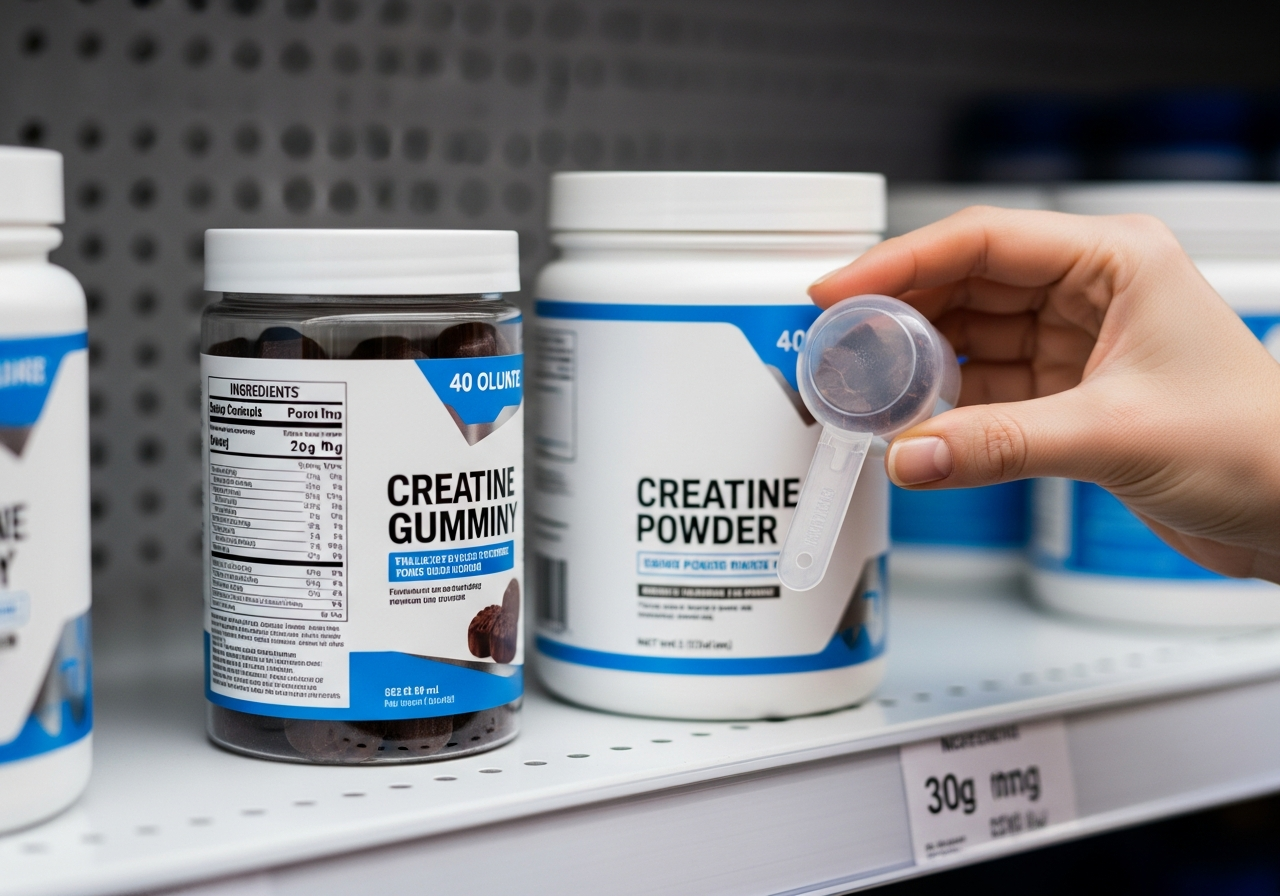
A good creatine gummy clearly lists the amount of creatine monohydrate per serving, reaches a practical daily dose without excessive sugar, and comes from a brand that provides quality controls such as third-party testing. A bad one leans on the word “creatine” on the front label while hiding a weak dose on the back.
When evaluating any product, use this checklist:
- Form of creatine: Creatine monohydrate is still the gold standard because it is the most studied and most cost-effective form.
- Total dose per day: Can you realistically get 3-5 g daily without eating a pile of gummies?
- Sugar content: A few grams is not automatically a problem, but high sugar per effective dose can be a drawback for cutting phases, diabetes management, or parents buying for teens.
- Ingredient simplicity: Fewer unnecessary blends and “proprietary” claims are better.
- Testing and transparency: Look for third-party testing, lot information, and clear labelling.
- Canadian compliance: In Canada, check for an NPN, or Natural Product Number, which indicates the product is licensed by Health Canada as a natural health product.
If you are wondering are creatine gummies any good or are creatine gummies a scam, the answer is that some are useful and some are mostly convenience marketing. The scam-like behaviour is usually not fake creatine; it is poor value, low dosing, or distracting buyers with flavour and lifestyle branding while underdelivering the clinically relevant ingredient.
Questions like are Bear Balanced creatine gummies good should always be answered by label analysis rather than brand hype. We do not rate a gummy by its popularity, flavour, or TikTok presence. We rate it by the same criteria we would use for powder: dose, form, purity, price per effective serving, and transparency.
In Canada, consumers should also prefer brands that make it easy to verify what is in the product. If you need help narrowing options, start with best creatine monohydrate in Canada, where to buy creatine in Canada, and Canadian supplement regulations.
When to take gummies or powder, whether to load, and when you will actually notice results
Creatine timing is far less important than daily consistency, and both gummies and powder should be taken whenever you are most likely to remember them every day. Loading can speed up results, but it is optional.
The two evidence-based ways to take creatine are:
- Loading approach: about 20 g/day split into 4 doses for 5-7 days, then 3-5 g/day maintenance.
- No-loading approach: 3-5 g/day from day one, reaching saturation more gradually over roughly 3-4 weeks.
If you choose gummies, loading may be impractical because the number of gummies required can become ridiculous. That is one of the strongest real-world arguments for powder. Powder makes both loading and maintenance simple.
What to expect:
- Days 1-7 with loading: some people notice a small body-weight increase from more water being stored inside muscle cells.
- Weeks 1-2: better repeat effort in the gym, less drop-off between hard sets, or slightly improved sprint power may start to show.
- Weeks 3-6: if training and nutrition are solid, strength progress and training quality become easier to notice.
- Longer term: the real payoff is cumulative. Creatine helps you train better often enough that muscle and strength gains add up.
If you are wondering whether to take it pre-workout or post-workout, the best answer is: take it at any time you can stick to. More on that here: when to take creatine and creatine on rest days.
The IOC consensus on dietary supplements recognises creatine as one of the few supplements with strong support for performance use in specific contexts, particularly repeated high-intensity exercise. See: International Olympic Committee consensus on dietary supplements (2018).
If you want the fastest route to full saturation, powder is usually easier. If you just need consistency, gummies can still get you there.
Best choice by person and goal: beginners, women, older adults, athletes, and people who hate powder
The best creatine format depends less on sex and more on your goal, digestion, routine, and willingness to take enough of it consistently. Powder is still the best default for most groups, but gummies and capsules have a place.
Beginners: Powder is usually best because it teaches you the correct dose and keeps cost low while you learn what to expect. If you are brand new, read creatine for beginners.
Women: Women respond to creatine by the same core mechanism as men, and they do not need a special “women’s creatine” formula for it to work. Gummies may be attractive for convenience, but the same label scrutiny applies. See creatine for women.
Older adults: Older adults often benefit from low-friction routines, so capsules or gummies can help with adherence, but the full daily dose still matters. Powder may remain the most economical long-term choice. More here: creatine for older adults.
Athletes: Athletes in strength, sprint, team-sport, and repeated-effort events should usually favour powder because it makes precise dosing and loading easier. For travel and competition logistics, capsules can be very handy. See creatine for athletes.
Vegetarians and vegans: Creatine can be particularly useful because dietary creatine intake is often lower in plant-based diets, and some people in this group may notice a strong response. Format choice is still secondary to dose consistency.
People with sensitive stomachs: Some tolerate smaller divided doses better than one large serving. Micronized powder or capsules may be easier than large gummy servings, especially if gummies contain sugar alcohols.
People who hate mixing powder: This is the strongest case for gummies. If you have tried powder repeatedly and keep quitting, a properly dosed gummy can be the better option for real-life compliance.
In short, there is no elite-only format. There is only the format you will actually use at the right dose for long enough to saturate muscle creatine stores.
Safety, side effects, and the capsule questions people ask most
Creatine is generally well-supported as safe for healthy people when taken at recommended doses, and gummies, powder, and capsules share the same core safety profile because the active ingredient is the same. Most issues come from dose size, extra ingredients, or misunderstanding normal effects such as water retention inside muscle.
Common, manageable issues include:
- Stomach upset: More likely with large single doses, poorly dissolved powder, or gummies with lots of sugar alcohols.
- Temporary weight increase: Often reflects increased water stored in muscle, not fat gain.
- Bloating complaints: Usually improved by avoiding very large doses at once and using daily maintenance instead of aggressive loading.
For healthy adults, major myths such as “creatine damages kidneys” are not supported by the bulk of evidence in recommended-use contexts, although people with kidney disease, significant medical conditions, or who are under physician care should speak with their clinician first. For a broader safety review, see is creatine safe, is creatine bad for your kidneys, and creatine digestive side effects.
This section also answers the capsule queries directly:
- Do you swallow creatine capsules whole? Yes. Creatine capsules are intended to be swallowed whole with water unless the label specifically says otherwise.
- Does creatine come in capsule form? Yes. Capsules are a common format and can be as effective as powder if the daily dose matches.
- Are creatine capsules good? Yes, especially for convenience and travel, but they are often less economical than powder.
- Are creatine capsules better than powder? Usually no for value and dosing flexibility, but they may be better for people who prioritise portability and no-mix convenience.
Mayo Clinic’s overview is conservative but useful for consumers who want a mainstream medical summary: Mayo Clinic — Creatine.
The key principle is that side effects are usually manageable, while underdosing is the far more common reason people think creatine “doesn’t work.”
The biggest mistakes with creatine gummies and the myths that keep people from getting results
The biggest mistake with creatine gummies is assuming a tasty format guarantees an effective dose, and the biggest myth is that gummies, capsules, or powders have dramatically different biological effects when the actual creatine dose is matched. Most format arguments are really dosing and adherence arguments.
Here are the most common mistakes:
- Buying based on flavour instead of grams. If you cannot quickly find total creatine per serving, that is a red flag.
- Ignoring serving size. “Two gummies” sounds convenient until you realise you need multiple servings to reach 5 g.
- Expecting instant results. Creatine is not a stimulant; it works by saturating muscle over time.
- Taking it only on workout days. Daily use matters more than workout timing.
- Confusing water gain with fat gain. Small early weight increases are common and not the same as getting fatter.
- Thinking expensive forms are automatically superior. Monohydrate remains the evidence-based benchmark.
Now the myths:
- “Creatine gummies are automatically a scam.” False. Some are properly dosed and useful; many are just poor value.
- “Powder works better because it absorbs better.” Usually false. Dose and consistency matter more than format.
- “Capsules do not work as well as powder.” False if the daily grams are equivalent.
- “You must load to get any benefit.” False. Loading speeds saturation; it is not required.
- “Creatine is only for bodybuilders.” False. It is relevant to many athletes, recreational lifters, vegetarians, and older adults.
If you enjoy myth-busting, our dedicated pages on creatine myths debunked, creatine myths vs. facts, and why monohydrate still wins go deeper.
The most reliable mindset is boring but effective: hit the right dose, every day, long enough to saturate, then judge the product by results and practicality rather than by marketing.
Buying creatine gummies or powder in Canada: what to look for on the label
In Canada, the smartest creatine purchase is one that combines a proven form of creatine, a practical daily dose, transparent labelling, and preferably an NPN and third-party quality signals. Canadian shoppers should be more sceptical of flashy formats, not less.
Here is a practical Canadian label checklist:
- NPN present: An NPN, or Natural Product Number, means the product is licensed by Health Canada as a natural health product.
- Clear medicinal ingredient listing: The label should state creatine monohydrate clearly and show the amount per serving.
- Minimal non-medicinal ingredients: Especially important for gummies, where fillers, sweeteners, and colouring can pile up.
- Third-party testing: Especially valuable if the brand makes purity claims.
- Price per effective daily dose: Compare the cost to get 3-5 g per day, not the cost per jar.
For many Canadian buyers, powder remains the strongest value play because imported trendy formats can get expensive quickly. Gummies may also be more likely to fluctuate in stock, melt in warm shipping conditions, or include extra ingredients that add cost without adding creatine effectiveness.
If you are comparing Canadian availability, shipping, and trusted sellers, these guides help: buying creatine online in Canada, creatine shipping in Canada, and best creatine rankings.
One more practical point: because gummies are newer and more lifestyle-marketed, they deserve more scrutiny, not less. A plain tub of monohydrate powder is often exactly what it claims to be. A premium-looking gummy jar may or may not be delivering enough creatine to justify the price.
If you want the simplest shopping rule possible, it is this: in Canada, buy the most transparent creatine monohydrate product you can find at a realistic daily dose, then choose the format that makes adherence easiest for you.
Bottom line: should you buy creatine gummies or stick with powder?
You should usually stick with creatine powder unless gummies clearly fit your routine better and still provide an effective daily dose of creatine monohydrate. Powder is still the best all-around choice for evidence, value, flexibility, and ease of reaching 3-5 g per day.
If you want the simplest recommendation by situation:
- Choose powder if you want the highest-value, lowest-fuss evidence-based option.
- Choose gummies if you know convenience will dramatically improve your consistency and the label delivers enough creatine.
- Choose capsules if you want travel convenience without sugar and do not mind taking several caps.
For the exact headline question, creatine gummies vs powder, the science-based answer is that gummies can work, but powder is usually better. Not because gummies are biologically inferior, but because powder makes correct dosing cheaper and easier.
That also answers the cluster of common queries directly:
- Are creatine gummies as effective as powder? They can be if the dose matches.
- Are creatine gummies just as good as the powder? Sometimes, but often less practical or more expensive.
- Are creatine capsules or powder better? Powder is usually better overall; capsules are better for portability.
- Are creatine capsules as effective as powder? Yes, when the dose is equivalent.
If you are ready to choose, use our creatine dosage calculator, compare options in the creatine product catalog, and review the creatine gummies and creatine powder vs capsules guides next.
The final verdict is simple: the best creatine is the one that delivers enough monohydrate, every day, for months—not the one with the prettiest format.
Creatine gummies vs powder: the numbers that actually matter
- 3-5 g/day Standard maintenance dose — The usual evidence-based daily range for most adults once you are taking creatine consistently.
- 20 g/day Classic loading dose — Typically split into 4 doses daily for 5-7 days to accelerate saturation.
- 5-7 days Typical loading timeline — A loading phase can raise muscle creatine stores faster than maintenance-only dosing.
- 3-4 weeks No-loading saturation window — Taking 3-5 g daily without loading usually works, just more gradually.
Frequently Asked Questions
Are creatine gummies as good as powder?
Creatine gummies can be as good as powder if they provide the same full daily dose of creatine monohydrate consistently. In real life, powder is usually better because it is easier to dose at 3-5 g per day, usually cheaper per effective serving, and less likely to include sugar or underdosed servings.
Do creatine gummies work as well as powder?
Yes, creatine gummies can work as well as powder when the total daily grams of creatine are matched. The problem is practical rather than biological: many gummies require several pieces per day or provide less creatine than people assume, so users may end up underdosing without realising it.
How many creatine gummies should I take a day?
You should take however many gummies are needed to reach 3-5 g of creatine monohydrate per day, based on the label. Do not count gummies first and grams second; always reverse that logic and confirm the total creatine per serving before deciding your daily gummy number.
Are creatine gummies effective?
Yes, creatine gummies are effective if they deliver an evidence-based amount of creatine every day for long enough to saturate muscle stores. They are not effective just because they contain creatine somewhere on the label, so dose size and consistency still decide whether they work.
Are creatine gummies a scam?
Creatine gummies are not automatically a scam, but some are poor value or underdosed. A legitimate gummy should clearly list creatine monohydrate, show the amount per serving, and make it realistic to reach 3-5 g per day without excessive sugar, inflated cost, or vague proprietary claims.
Do they make creatine pills?
Yes, creatine is widely sold in capsule and tablet form as well as powder and gummies. Creatine pills can be just as effective as powder if the daily dose is equivalent, but many products require several capsules to reach the standard 3-5 g daily maintenance range.
Do you swallow creatine capsules whole?
Yes, creatine capsules are normally swallowed whole with water unless the product label says otherwise. The main thing to watch is not absorption but dose, because one or two capsules may not provide enough creatine unless the product is highly concentrated.
Are creatine capsules as effective as powder?
Yes, creatine capsules are as effective as powder when they provide the same amount of creatine monohydrate per day. Powder still tends to be better for loading, accurate dosing, and cost per gram, while capsules are better for portability and convenience.
Are creatine capsules or powder better?
Creatine powder is usually better overall because it is cheaper, easier to dose, and simpler to use for both maintenance and loading. Capsules are better only if portability or dislike of powder is the main barrier stopping you from taking creatine consistently.
Does creatine come in capsule form?
Yes, creatine commonly comes in capsule form, and capsules can work very well. The main downside is that you may need multiple capsules daily to reach an effective dose, so always check how many milligrams or grams of creatine each capsule actually contains.