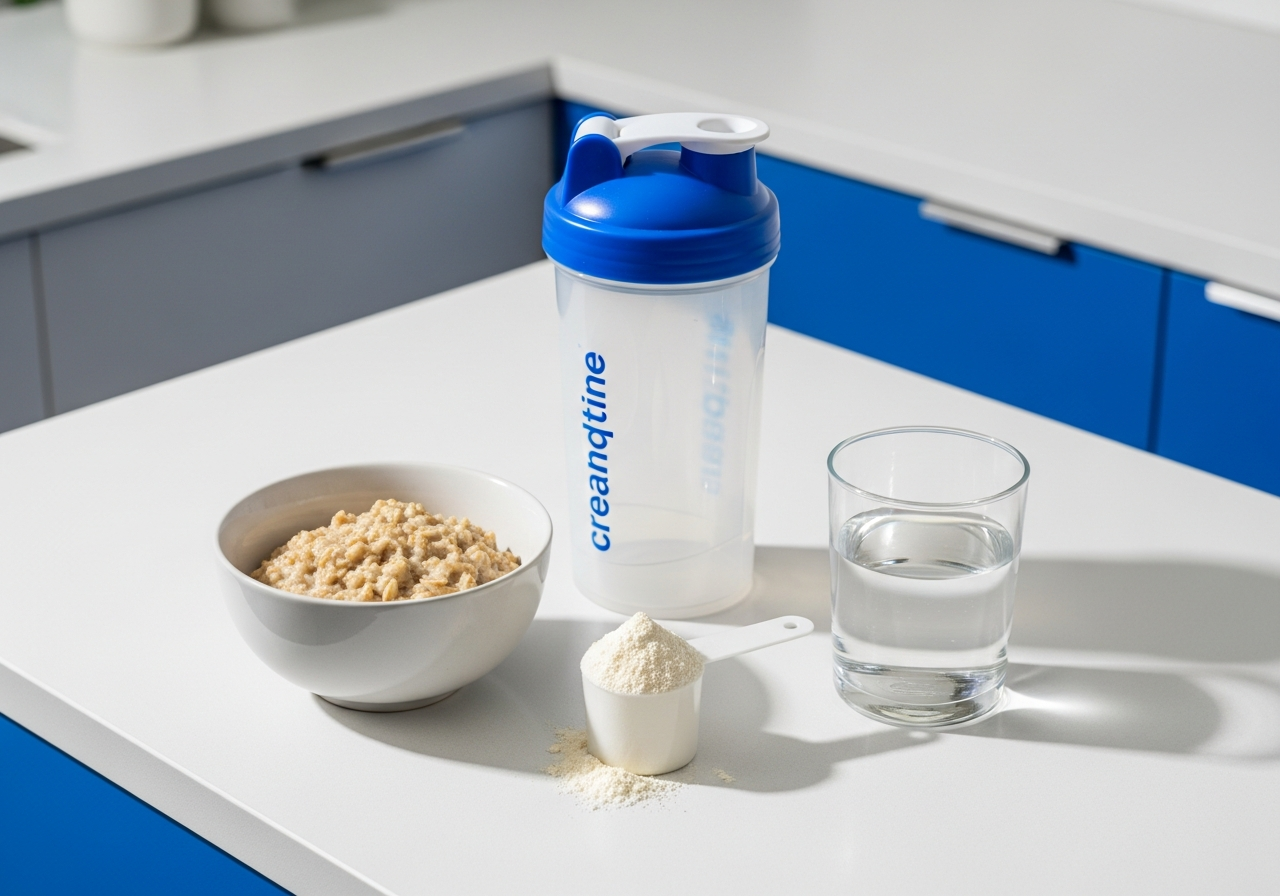
Should You Take Creatine With or Without Food?
By The Creatine Canada Research Team — Evidence-based supplement analysts
Yes, you can take creatine with food, and for most people that is the easiest and often most comfortable way to use it. Creatine does not have to be taken with a meal to work, but taking 3 to 5 g daily with food or a shake can improve routine, reduce stomach upset, and may slightly support uptake compared with taking it completely fasted.
Evidence-based · Cites 4 sources · Editorial standards
Key Takeaways
- Creatine monohydrate works whether you take it with food or without food.
- For most adults, 3 to 5 g per day is the standard maintenance dose.
- Taking creatine with a meal can reduce the chance of stomach upset, especially during a loading phase.
- A loading phase is optional: 20 g per day split into 4 doses for 5 to 7 days saturates muscles faster.
- Consistency matters more than timing, because creatine works by saturating muscle over days and weeks, not by giving an instant boost.
- Mixing creatine into yogurt, oatmeal, smoothies, or a protein shake is fine if that helps you remember it.
- If you train fasted or use intermittent fasting, taking creatine without food is still effective.
Should you take creatine with food? Here’s the direct answer
Yes, you can take creatine with food, and most people do very well taking it that way. You do not have to take creatine with a meal for it to work, but taking it with food is often the most practical option because it improves adherence and can be gentler on digestion.
If your main question is is it better to take creatine with food or without?, the evidence-based answer is this: food is helpful, but not essential. Creatine works by gradually increasing your muscles’ stored creatine and phosphocreatine, the rapidly available energy system your body uses for short, hard efforts like lifting, sprinting, and repeated explosive work. Because the goal is muscle saturation over time, the biggest driver of results is taking enough creatine consistently, not whether your stomach is full at that exact moment.
That is why the standard advice remains simple: take 3 to 5 g of creatine monohydrate daily. If taking it with breakfast, lunch, dinner, or a post-workout shake helps you remember it, that is an excellent strategy. If you prefer taking it in water between meals, that is also fine.
There are, however, a few reasons food can make sense:
- Better routine compliance: attaching creatine to a meal makes missed doses less likely.
- Better stomach comfort: some people get mild cramping, nausea, or loose stools when they take a larger dose on an empty stomach.
- Potentially better uptake context: insulin, the hormone that rises after eating carbohydrate and protein, may support creatine transport into muscle, although the real-world advantage of this for normal daily use is likely modest.
The 2017 International Society of Sports Nutrition position stand concluded that creatine monohydrate is the most effective ergogenic nutritional supplement currently available for increasing high-intensity exercise capacity and lean mass, and that core benefits come from proper dosing and saturation rather than any magic timing window. See Kreider et al. (2017), ISSN Position Stand.
If you are brand new to supplementation, start with monohydrate and keep it boringly consistent. Our guides on how to take creatine and creatine for beginners walk through the basics in more detail.
Does creatine absorb better with food? The mechanism, without the myths
Creatine may be taken up slightly more efficiently in the context of a meal, especially one containing carbohydrate and protein, but the practical difference is smaller than many supplement ads imply. In other words, yes, food can help, but daily intake and total dose matter far more.
Here is the mechanism. After you ingest creatine, it is absorbed in the intestine, enters the bloodstream, and is transported into muscle cells by a specific creatine transporter. Insulin can support nutrient transport processes, and meals that contain carbohydrate and protein raise insulin more than water alone. That is the main reason some people say creatine should be taken with food.
But this point often gets exaggerated. Creatine is not like a stimulant pre-workout that depends on immediate timing for an acute effect. Its performance benefits come after your muscles accumulate more total creatine and phosphocreatine. Once muscle stores are elevated, you have more rapidly available phosphate to help regenerate ATP, or adenosine triphosphate, the cell’s immediate energy currency, during high-output exercise.
That means two statements can both be true:
- Taking creatine with a mixed meal is a reasonable, evidence-based practice.
- You do not need food for creatine to work well.
The 2021 JISSN review on common questions and misconceptions about creatine makes a key practical point: many popular beliefs around creatine are overstated, and monohydrate remains the best-supported form by far. See Antonio et al. (2021).
So, if you are asking do you need to take creatine with food or does creatine have to be taken with food, the evidence-based answer is no. If you are asking can creatine be taken with food, can you drink creatine with food, or should creatine be taken with food, the answer is yes, and that is often the most convenient choice.
A good rule is to think in priorities:
- Pick creatine monohydrate.
- Take the correct daily dose.
- Take it every day.
- Use food if it helps tolerance and consistency.
If you want a deeper breakdown of forms, see our best creatine rankings and creatine brand reviews.
How to take creatine with food: the simplest step-by-step plan
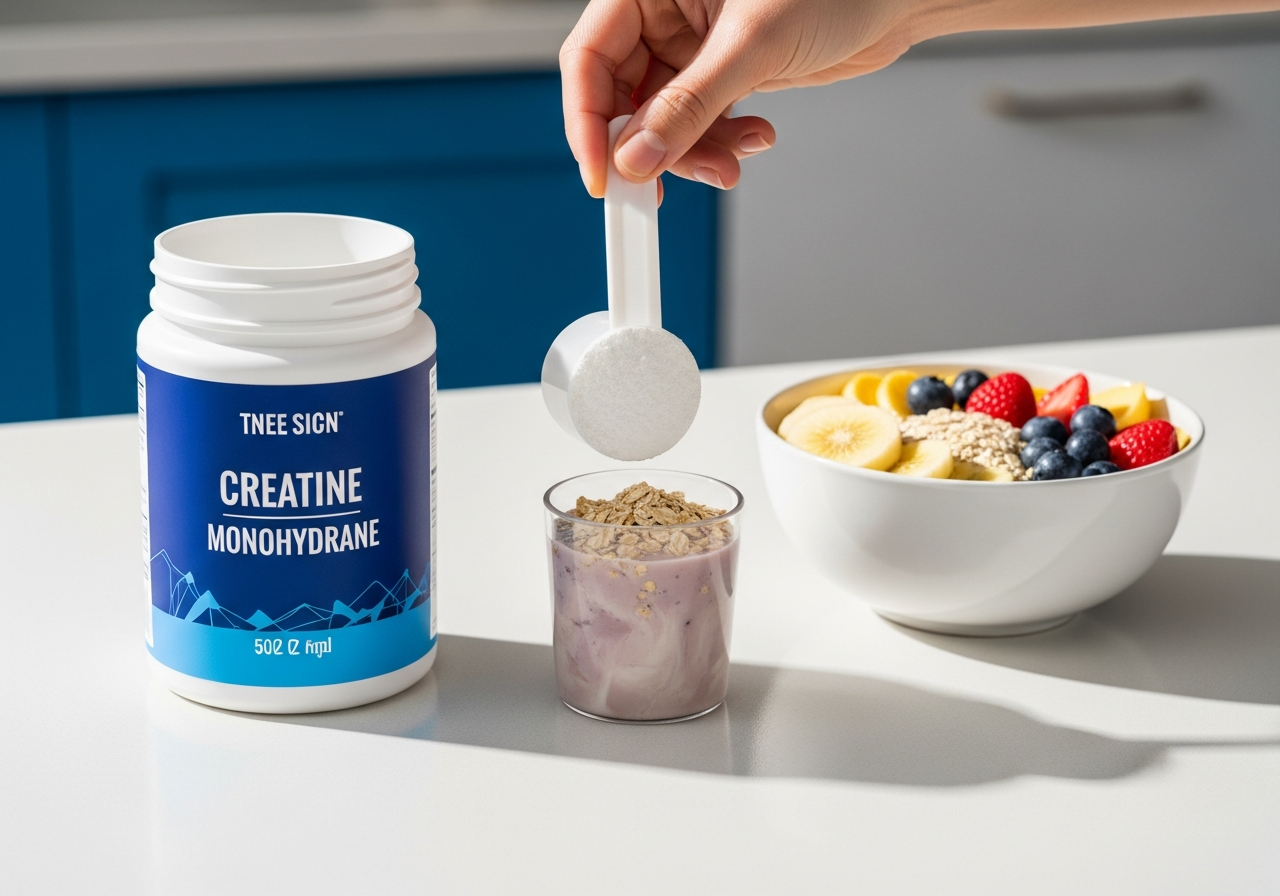
The easiest way to take creatine with food is to add 3 to 5 g of creatine monohydrate to one meal or shake you already have every day. That single habit solves most beginner problems.
- Choose creatine monohydrate. It is the most studied, most reliable, and usually the most cost-effective form.
- Measure your dose. Most people should take 3 to 5 g daily. Use a gram scale or the scoop provided if it is clearly labelled.
- Pair it with an existing meal. Breakfast oatmeal, a smoothie, lunch yogurt, or a post-workout protein shake all work well.
- Mix thoroughly. Stir it into water, juice, protein, yogurt, or soft foods until evenly distributed. Micronized creatine usually dissolves a bit better, but regular monohydrate works too.
- Take it every day. Rest days count. Saturation falls gradually if intake stops.
- Adjust if your stomach complains. Split the dose into two smaller servings, or move it from an empty stomach to a meal.
Best food pairings include:
- Protein shake after training
- Greek yogurt with fruit
- Oatmeal or overnight oats
- Smoothies
- Applesauce or soft foods if you dislike gritty drinks
If you prefer, you can also take creatine before, during, or after a meal in the same glass of water. There is no need to overcomplicate the exact sequence. The practical question is not “what is the perfect minute to take creatine?” but “what daily setup will I actually keep doing for months?”
During a loading phase, taking creatine with food is even more useful. A loading phase typically means 20 g per day for 5 to 7 days, split into 4 servings of 5 g. That dose is much more likely to cause stomach upset if you slam it all at once or take repeated servings on a fully empty stomach. Pairing each 5 g serving with meals and snacks can make loading far easier.
If you are unsure about exact dosing, use our creatine dosage calculator and then compare with our full guide on how much creatine per day.
Creatine dose by body weight and goal: with food or without, these numbers matter most
Your daily dose matters more than whether you take creatine with food, and most people do well with 3 to 5 g per day. Larger bodies, more muscle mass, and aggressive saturation strategies can justify the higher end of that range or a structured loading phase.
For general fitness, strength, muscle gain, and most sport uses, start here:
| Body weight | Goal | Simple daily dose | Optional loading phase |
|---|---|---|---|
| Under 60 kg | General fitness or beginner use | 3 g/day | 20 g/day split into 4 doses for 5 to 7 days, then 3 g/day |
| 60-90 kg | Most lifters and active adults | 3-5 g/day | 20 g/day split into 4 doses for 5 to 7 days, then 3-5 g/day |
| Over 90 kg | Larger athletes or high muscle mass | 5 g/day | 20 g/day split into 4 doses for 5 to 7 days, then 5 g/day |
Some sport-nutrition texts also describe loading as roughly 0.3 g per kg per day for 5 to 7 days, followed by a maintenance intake around 0.03 g per kg per day. For everyday use, however, fixed gram dosing is easier and works well.
Examples:
- 55 kg beginner: 3 g daily with breakfast is enough.
- 75 kg recreational lifter: 5 g daily in a post-workout shake or lunch yogurt is a simple default.
- 98 kg strength athlete: 5 g daily is reasonable; loading can help if you want faster saturation.
Goal-based guidance:
- Muscle and strength: 3 to 5 g daily.
- Fastest possible saturation: loading phase, then maintenance.
- Trying to minimize stomach upset: skip loading and use 3 to 5 g daily with food.
- Budget and simplicity: 5 g once daily, any time.
If you train hard and want results quickly, loading can make creatine “work” sooner because your muscles reach near-saturation faster. If you are patient, daily maintenance alone still gets you there over several weeks. For exact timelines, see how long creatine takes to work and our guide to the creatine loading phase.
Best timing: with breakfast, post-workout, on rest days, or fasted?
The best time to take creatine is the time you will reliably take it every day, and that is often with a meal or shake. Breakfast, lunch, post-workout, and dinner are all acceptable. Rest days matter just as much as training days.
If you are asking do you take creatine with food or can you take creatine with a meal, the answer is yes. If you are asking whether post-workout is dramatically better than breakfast, the evidence does not support a huge practical difference for most users. Creatine is not acutely performance-enhancing the way caffeine can be. It is a saturation supplement.
Here is a simple timing hierarchy:
- Most important: take it daily.
- Second most important: take enough.
- Third: take it in a way that feels good on your stomach.
- Fourth: if helpful, pair it with a meal or post-workout shake.
What to do in common scenarios:
- You eat breakfast daily: take creatine with breakfast.
- You already drink a protein shake: add creatine there.
- You train fasted in the morning: take creatine after training with your first meal, or take it pre-workout in water if that is easier.
- You use intermittent fasting: taking creatine during your eating window is simplest, but taking it without food is still effective.
- You forget supplements easily: keep the tub beside the meal or shaker you use every day.
On rest days, take the same dose you take on training days. There is no need to “save” creatine for workouts. Once your muscles are saturated, daily intake simply helps maintain those stores.
If your main issue is routine, read when to take creatine and creatine on rest days. If your main issue is hydration, see how much water to drink with creatine.
The bottom-line timing answer is simple: take creatine with food if that makes the habit easy and comfortable, but do not skip a dose just because you are not eating a full meal.
Can you mix creatine powder into food? Yes — and these foods work best
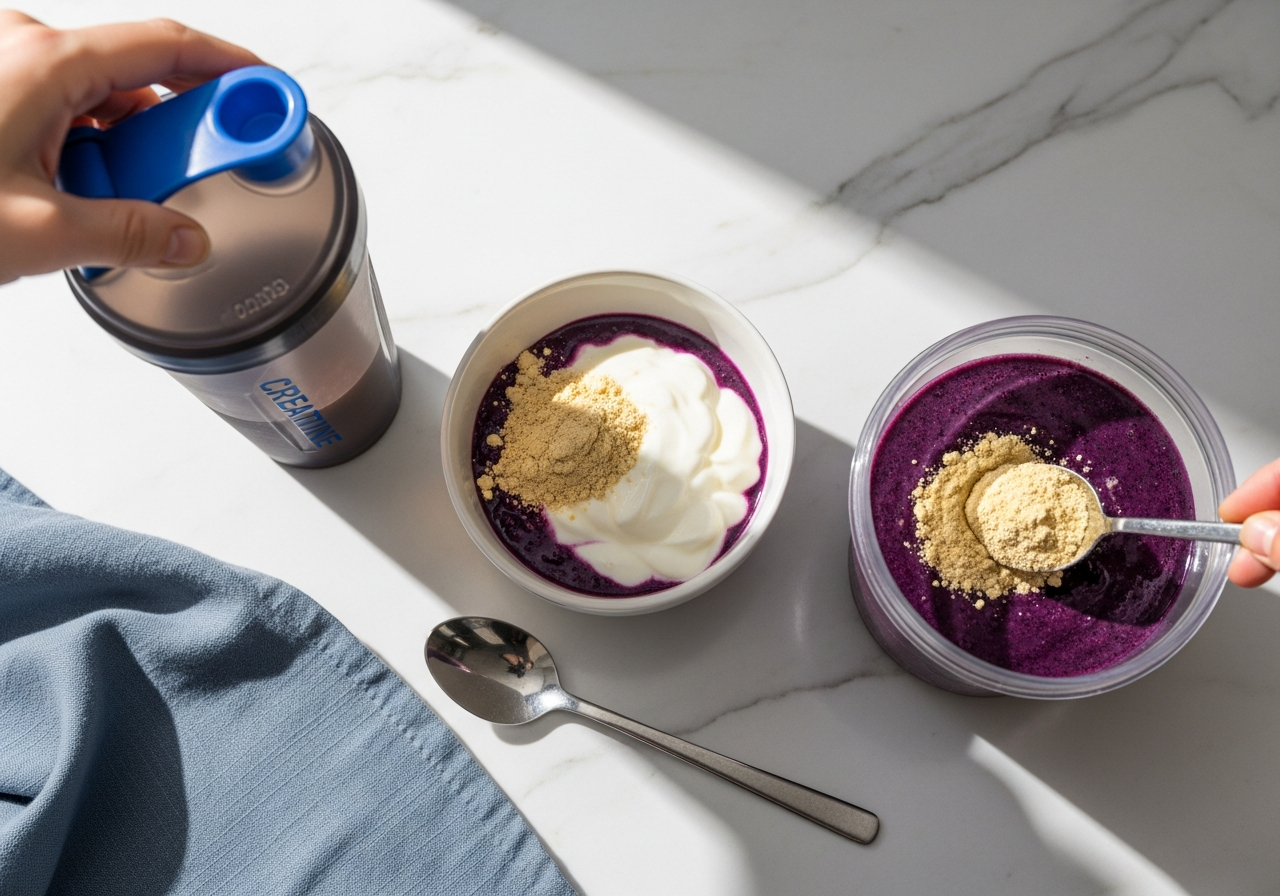
Yes, you can mix creatine powder into food, and many people find that easier than drinking it plain. Creatine monohydrate can be stirred into soft foods and drinks without losing its usefulness in normal real-world use.
If you are asking can you mix creatine powder with food, can you eat creatine with food, or can you have creatine with food, the practical answer is yes. Good options include yogurt, oatmeal, smoothies, applesauce, and protein shakes. These choices help if you dislike the slight grit that some creatine powders leave in plain water.
Best ways to use it:
- Yogurt: stir in 3 to 5 g and eat right away.
- Oatmeal: mix into warm, not boiling, oats after cooking.
- Smoothies: blend with fruit, milk, and protein powder.
- Protein shakes: one of the easiest all-in-one options.
- Applesauce: a simple low-volume option if you do not want another drink.
A few practical notes matter. Creatine is reasonably stable as a dry powder, but once mixed into liquid it is best consumed in a normal time frame rather than left sitting for long periods. You do not need to panic about a shaker sitting for 20 or 30 minutes, but it is not ideal to pre-mix creatine into liquid and store it for extended periods. Soft foods mixed shortly before eating are perfectly reasonable.
Texture is the main issue, not effectiveness. Micronized creatine has smaller particles and can feel smoother, but standard monohydrate is still the benchmark form. If you struggle with clumping or undissolved powder, use more fluid, stir longer, or choose warm room-temperature liquid instead of ice-cold water.
For many beginners, the best routine is simply this: put 5 g of creatine into the same food or shake you already consume after training or with breakfast. That turns supplementation from a chore into an automatic habit.
If you want mixing tips and format comparisons, see how to mix creatine and mixing creatine with protein powder.
Who benefits most from taking creatine with food: beginners, women, older adults, and athletes
Taking creatine with food is especially useful for beginners, people with sensitive stomachs, older adults, and anyone who needs a simple routine they will actually follow. The supplement itself does not change by population, but the best implementation often does.
Beginners usually benefit most from simplicity. A once-daily dose with breakfast or a post-workout shake removes guesswork. If you are new and wondering are you supposed to take creatine with food, the honest answer is not “supposed to,” but “it is often the easiest and smartest place to start.”
Women can use the same evidence-based dosing as men in most cases: generally 3 to 5 g daily. There is no rule that women need a separate formula or special timing. Taking it with a meal can help reduce GI discomfort and improve consistency. For more, see creatine for women.
Older adults may benefit from creatine for strength, lean mass support, and function, especially when paired with resistance training. For this group, meal pairing is useful because regular routines matter and digestive comfort becomes more important. A consistent 3 to 5 g daily with breakfast or lunch is often the easiest set-up.
Athletes in power, sprint, team-sport, and repeated high-intensity settings often choose loading phases to saturate faster. In those cases, taking each 5 g serving with meals or snacks is a practical way to reduce stomach upset. The International Olympic Committee consensus on dietary supplements identifies creatine as one of the better-supported performance supplements for specific exercise contexts.
Vegetarians and vegans may notice a particularly strong response because baseline creatine stores can be lower when dietary intake from meat and fish is minimal. Food timing is still secondary to consistency, but taking creatine with meals can make the habit easier to maintain long term.
People who may prefer without food include those who train fasted, use very early workouts, or simply dislike mixing powder into meals. That is fine. Creatine does not stop working outside a meal window.
The main match-up is simple: if meals make creatine easier on your stomach and easier to remember, meals are the better choice for you.
Side effects, stomach issues, and how to troubleshoot taking creatine with or without food
Creatine monohydrate is widely considered safe for healthy people when used at recommended doses, and taking it with food can reduce the most common short-term complaint: mild digestive upset.
The best-supported safety overview remains the 2017 ISSN position stand, which concluded that creatine monohydrate is not only effective but also safe for healthy individuals across a broad range of applications. The Mayo Clinic similarly notes that creatine appears to be safe when used appropriately. See Mayo Clinic — Creatine.
Common short-term issues are usually practical, not dangerous:
- Bloating or stomach discomfort: more likely with large single doses, especially during loading.
- Loose stools: often caused by taking too much at once.
- Temporary weight gain: usually from increased water held inside muscle, not fat gain.
- Grittiness or poor mixing: an inconvenience, not a safety issue.
How to troubleshoot:
- Take it with food. This is often the easiest fix if you have nausea or cramping.
- Split the dose. Instead of 5 g once, try 2 to 3 g twice daily for a few days.
- Skip loading. If 20 g per day causes GI issues, use 3 to 5 g daily instead.
- Drink enough fluid. You do not need absurd water intake, but do maintain normal hydration.
- Use monohydrate from a reputable brand. Fancy forms are not automatically gentler or better.
If you have kidney disease, are under active medical care for renal concerns, are pregnant, or have other significant medical conditions, speak with your physician or pharmacist before supplementing. Creatine can also raise blood creatinine, which is a breakdown product used in lab tests, without necessarily indicating kidney damage. That distinction confuses many people.
If side effects are your main concern, our guides on creatine digestive side effects, is creatine safe, and creatine and kidney health go deeper.
In practice, most people who think they “cannot tolerate creatine” are either taking too much at once, taking it on an empty stomach, or using an inconsistent routine.
Common mistakes and myths: what people get wrong about taking creatine with food
The biggest myth is that creatine must be taken with food to work, and that is false. The second biggest myth is that timing matters more than daily saturation, and that is also false for most people.
Let’s clear up the most common mistakes.
- Myth: Creatine has to be taken with food.
Fact: Creatine can be taken with or without food. Food may improve comfort and slightly support uptake, but it is not required. - Myth: Taking creatine on an empty stomach ruins absorption.
Fact: Absorption still occurs without food. The main downside is that some people feel more stomach discomfort. - Myth: You need sugar to “activate” creatine.
Fact: Carbohydrate and protein can create a favourable uptake environment, but creatine does not need a sugary drink to work. - Myth: Dry scooping is stronger or faster.
Fact: Dry scooping offers no proven advantage and can increase choking risk and stomach irritation. - Myth: More is better.
Fact: Once you are taking enough to saturate and maintain stores, extra creatine is usually just extra creatine. - Myth: If you miss the “anabolic window,” the dose is wasted.
Fact: Creatine is a long-game supplement. A missed post-workout window is not a meaningful problem if your daily intake is consistent.
Another mistake is spending more on forms marketed as easier to absorb when plain monohydrate already has the strongest evidence base. If you want the shortest recommendation possible, here it is: buy reputable creatine monohydrate, take 3 to 5 g daily, and use meals only as a tool for comfort and consistency.
In Canada, it is also worth checking supplement labels carefully. Look for clear ingredient listing, dosage in grams, and a Natural Product Number where applicable. Third-party testing and transparent batch quality practices add confidence, especially when buying online. Our creatine product catalog and creatine myths debunked pages can help you sort substance from marketing.
If you are still comparing options, do not let meal timing distract you from the bigger purchasing question: product quality and monohydrate content matter more than bells and whistles.
Best creatine format for taking with food: powder, capsules, gummies, and what to buy in Canada
If you plan to take creatine with food, powder is usually the most practical and cost-effective format, while capsules and gummies mainly trade convenience for price and dosing flexibility.
| Format | Best for | Pros | Cons |
|---|---|---|---|
| Powder | Most people | Easy to mix into shakes or food, cheapest per gram, flexible dosing | Can be slightly gritty, requires measuring |
| Capsules | Travel or no-mix convenience | No taste, portable, simple | Often many capsules needed to reach 3-5 g, usually costs more |
| Gummies | Taste-first users | Convenient and easy to use | Can be expensive, may require multiple pieces, ingredient profiles vary |
| Flavoured blends | People who dislike plain powder | Improved taste, easy in water | May include sweeteners, colours, or add-ons you do not need |
For Canadians, the buying checklist is straightforward:
- Choose creatine monohydrate first.
- Check the serving size in grams. Some products make a serving sound bigger than it is.
- Look for clean labels. Fewer unnecessary extras is often better.
- Look for an NPN where applicable. An NPN, or Natural Product Number, shows the product has been licensed by Health Canada as a natural health product.
- Prefer reputable brands with quality control or third-party testing.
If your goal is taking creatine with meals, powder wins because it integrates naturally into shakes, yogurt, and oats. Capsules are best if you need convenience at work or while travelling. Gummies can work, but they are rarely the best value per effective gram.
If you want help choosing, see our best creatine rankings, best creatine monohydrate in Canada, and where to buy creatine in Canada. The short version is that plain monohydrate powder remains the smartest default for most Canadian buyers in 2026.
Bottom line: take creatine with food if it helps — but take it daily no matter what
Yes, you can take creatine with food, and for many people that is the best practical choice, but creatine does not need food to be effective. If you remember only one thing from this guide, make it this: consistency beats timing.
The evidence-based default plan is simple:
- Form: creatine monohydrate
- Dose: 3 to 5 g daily
- Timing: any time you will reliably take it
- With food? helpful, especially for stomach comfort and routine, but not required
- Loading: optional, 20 g per day split into 4 doses for 5 to 7 days if you want faster saturation
So, should you take creatine with food? Usually yes, if that makes the habit easier or your stomach happier. Do you have to take creatine with food? No. Can you take creatine without food? Absolutely.
A practical beginner plan would be: mix 5 g of creatine monohydrate into your daily shake, yogurt, or oatmeal and keep doing that every day for at least several weeks. Expect the first noticeable changes to be subtle at first: a small increase in body weight from water stored in muscle, slightly better performance across repeated hard sets, and gradual support for strength and lean mass gains over time.
If you want to build the full routine from here, the best next reads are how to take creatine, when to take creatine, how long creatine takes to work, and creatine maintenance dose.
The simplest winning strategy is almost never the fanciest one: buy a solid monohydrate, take the right dose, and use meals as a convenience tool, not as a superstition.
Creatine With Food: The Numbers That Actually Matter
- 3-5 g/day Standard maintenance dose — Effective for most adults whether taken with food or without
- 20 g/day Optional loading dose — Usually split into 4 doses for 5 to 7 days
- 5-7 days Typical loading timeline — Faster route to muscle saturation
- 4 doses Best way to split loading — Dividing 20 g into 4 x 5 g servings helps tolerance
Frequently Asked Questions
Should you take creatine with food or without food?
You can take creatine either with food or without food, and both can work well. For most people, taking it with food is slightly more practical because it may reduce stomach upset and makes daily use easier to remember, but food is not required for creatine to increase muscle creatine stores.
Can you take creatine with a meal?
Yes, you can take creatine with a meal, and that is one of the easiest ways to use it consistently. Mixing 3 to 5 g of creatine monohydrate into a shake, yogurt, oatmeal, or water alongside a meal is a perfectly effective routine for most adults.
Do you have to take creatine with food?
No, you do not have to take creatine with food for it to work. Creatine absorption still occurs without a meal, and many people take it in water on an empty stomach, although some find that taking it with food feels better on digestion.
Does creatine absorb better with food?
Creatine may absorb or be taken up slightly more favourably with food, especially in the presence of carbohydrate and protein, but the real-world advantage is modest. The most important factor is taking enough creatine every day so your muscles become saturated over time.
Can you mix creatine powder with food?
Yes, creatine powder can be mixed with food such as yogurt, oatmeal, smoothies, or applesauce. That can be a very useful option if you dislike the texture in plain water or want to build creatine into a daily eating habit.
Can you take creatine without food if you train fasted?
Yes, you can take creatine without food if you train fasted, and it will still be effective. If you prefer, you can also take it later with your first meal; what matters most is reaching your daily dose consistently rather than matching it to a specific feeding window.
Can I drink creatine with food or after eating?
Yes, you can drink creatine with food or after eating, and both are fine. There is no meaningful penalty for taking creatine just before, during, or shortly after a meal as long as you are hitting your total daily intake regularly.
Is it better to take creatine with protein or carbs?
Creatine can be taken with protein, carbs, or a mixed meal, and none of those is mandatory. A mixed meal or post-workout shake is often the easiest setup because it combines convenience, decent palatability, and a lower chance of stomach upset.
Why does creatine upset my stomach on an empty stomach?
Creatine can upset your stomach on an empty stomach because larger doses may draw water into the gut and feel harsher when taken without food. The easiest fixes are to take it with a meal, reduce the single serving size, or avoid loading if repeated large doses are bothering you.
What is the best way for a beginner to take creatine with food?
The best beginner method is to take 3 to 5 g of creatine monohydrate once daily with a meal or protein shake you already have every day. That keeps the routine simple, improves consistency, and lowers the odds of stomach discomfort compared with random or irregular use.