Is Creatine a Steroid? How Creatine Actually Works vs. Anabolic Steroids
By The Creatine Canada Research Team — Evidence-based supplement analysts
No, creatine is not a steroid. Creatine is a naturally occurring compound your body makes from amino acids and stores mainly in muscle, while anabolic steroids are synthetic hormone drugs that mimic testosterone and change gene signalling, muscle protein synthesis, and hormone balance in fundamentally different ways.
Evidence-based · Cites 4 sources · Editorial standards
Key Takeaways
- Creatine is not a steroid, not testosterone, and not an anabolic drug.
- Creatine is naturally found in red meat, fish, and in small amounts made by your liver, kidneys, and pancreas.
- You are still considered natty if you take creatine because it is a legal dietary supplement, not a performance-enhancing hormone.
- Creatine does not usually make you fail a drug test because standard drug screens do not test for it.
- The best-studied dose is 3 to 5 g of creatine monohydrate daily, with an optional 20 g/day loading phase for 5 to 7 days.
- Creatine works by raising muscle phosphocreatine stores to help you regenerate ATP faster during short, hard efforts.
Creatine is not a steroid — here is the direct answer and why people confuse the two
No, creatine is not a steroid. Creatine is a naturally occurring compound involved in cellular energy production, whereas anabolic steroids are synthetic or modified hormone drugs related to testosterone.
That direct answer covers most searches for is creatine a steroid, is creatine steroids, are creatine steroids, is creatine same as steroids, and does creatine contain steroids. The confusion usually comes from the fact that both creatine and anabolic steroids can be used by people trying to gain muscle, improve training performance, or look more muscular. But they get there by entirely different routes.
Creatine helps your muscles recycle energy faster. It increases intramuscular phosphocreatine, which is stored creatine bound to phosphate and used to rapidly regenerate ATP, the immediate energy currency your cells spend during short, intense effort. That means creatine supports better performance in repeated hard sets, sprinting, jumping, and strength work.
Anabolic steroids work through hormone signalling. They bind to androgen receptors, alter gene expression, increase muscle protein synthesis more directly, suppress natural hormone production, and carry a very different risk profile. Steroids are drugs. Creatine is a nutrient-like supplement compound that your body already produces and that you also get from food.
The 2017 ISSN position stand concluded that creatine monohydrate is the most effective nutritional supplement available for increasing high-intensity exercise capacity and lean mass during training. That is not the kind of language used for steroids because creatine is discussed in sports nutrition, not anabolic pharmacology.
If your real question is social rather than chemical, the answer is still straightforward: taking creatine does not mean you are “on steroids,” and it does not stop you from being natural. For a broader beginner-friendly primer, see what creatine is and our creatine myths debunked guide.
- Steroid? No.
- Natural? Yes, creatine occurs in the body and in food.
- Drug? In normal consumer use, creatine is sold and used as a dietary supplement, not an anabolic drug.
- Same as testosterone boosters or steroids? No.
What creatine actually is: natural, dietary, and made in your body
Creatine is natural. Your body makes creatine from the amino acids glycine, arginine, and methionine, and you also get creatine from animal foods such as beef, pork, salmon, and herring.
This directly answers searches like is creatine natural, is creatine natural or not, what food is creatine naturally in, and what foods is creatine naturally found in. Creatine is not an artificial hormone and not a hidden steroid ingredient. It is a normal compound present in human physiology whether you supplement or not.
Most of the creatine in the body is stored in skeletal muscle. A smaller amount is found in the brain and other tissues. In muscle, creatine exists in two main forms: free creatine and phosphocreatine. Phosphocreatine acts as a rapid reserve of high-energy phosphate that helps restore ATP during all-out or near-all-out efforts that last only seconds.
Food sources matter because omnivores generally start with higher baseline creatine stores than vegetarians or vegans. That is one reason some plant-based athletes notice a stronger response when they begin supplementing. If you want a deeper food list, see foods high in creatine and, for plant-based context, is creatine vegan.
Common natural sources include:
- Beef
- Pork
- Salmon
- Tuna
- Herring
- Cod
The catch is that food is not a practical way to fully saturate muscle creatine stores for most people. Cooking losses vary, and the amount of creatine in whole foods is modest relative to what supplementation can reliably provide. That is why creatine monohydrate powder remains the standard supplement format.
In Canada, creatine products are generally sold as natural health products, and many reputable products carry an NPN, or Natural Product Number, which is Health Canada’s licence identifier for approved natural health products. An NPN does not mean a product is “better” than all others, but it is a useful legitimacy check alongside third-party testing and transparent labelling. If you are shopping, start with the best creatine rankings or compare options in our product catalog.
Creatine vs. anabolic steroids: the mechanism, results, and risks are completely different
Creatine and anabolic steroids both can influence physique and performance, but they do so through entirely different biological mechanisms. Creatine primarily helps with rapid energy turnover, while anabolic steroids primarily alter hormone signalling and muscle-building pathways.
Creatine’s main job is to support the phosphagen system, the fastest energy system in the body. During a heavy set of squats, a short sprint, or repeated jumps, ATP is burned quickly. Phosphocreatine donates a phosphate to ADP so your body can regenerate ATP fast enough to keep producing force. More stored phosphocreatine can mean a little more total work, a little better training quality, and over weeks to months, better gains in strength and lean mass.
Anabolic-androgenic steroids are different at the root level. They are hormone-based drugs that mimic or modify testosterone activity. They bind androgen receptors, change transcription of genes related to muscle growth, can increase nitrogen retention and protein synthesis, and often suppress the body’s own hormone production. That is why their effects, side effects, legal status, and anti-doping consequences are dramatically different from creatine.
| Feature | Creatine | Anabolic steroids |
|---|---|---|
| What it is | A naturally occurring energy compound | Synthetic or modified hormone drugs |
| Main mechanism | Increases phosphocreatine to regenerate ATP faster | Activates androgen signalling and alters gene expression |
| Natural presence in body | Yes | Testosterone is natural, but steroid drugs are not the same as supplementing creatine |
| Typical use | Sports nutrition supplement | Medical use or illicit performance enhancement |
| Legal supplement status | Yes | No, not as standard over-the-counter supplements |
| Drug-test concern | Usually no | Yes, often prohibited in sport |
The 2021 JISSN review on common creatine questions specifically addresses misconceptions around creatine’s safety, water retention, and clinical relevance, which reflects its place in evidence-based supplementation rather than hormone manipulation.
If someone says creatine is “basically steroids,” the accurate response is simple: creatine can improve training performance, but it does not act like anabolic steroids and should not be classified as one. For more on how creatine affects physique without changing hormones, see does creatine build muscle and does creatine affect testosterone.
Is creatine a drug, and are you still natty if you take it?
Creatine is not a steroid drug, and in normal fitness culture you are still considered natty if you take creatine. Creatine is generally classified and used as a dietary supplement or natural health product, not as an anabolic drug.
This section answers a cluster of common searches: is creatine a drug, is creatine drugs, does creatine count as a drug, am i natty if i take creatine, am i still natty if i take creatine, are you natty if you take creatine, are you still considered natty if you take creatine, and are you still natty with creatine.
In everyday gym language, “natty” usually means not using anabolic steroids, SARMs, growth hormone, or other pharmacological performance-enhancing drugs. Creatine does not belong in that group. It is closer to protein powder, caffeine, or electrolyte supplementation than to banned or hormone-based compounds.
There is one nuance worth stating clearly: in the broadest legal sense, any substance that has physiological effects can be called a “drug” in some contexts. But that is not how people usually mean it in fitness or sport. When most people ask whether creatine is a drug, they are really asking whether it is a hormone-like performance enhancer or something that disqualifies them from being natural. The answer is no.
The International Olympic Committee’s 2018 consensus on dietary supplements discusses creatine as one of the few supplements with meaningful evidence for certain performance settings, which again places it squarely in the sports nutrition category rather than the steroid category. In tested sport, creatine itself is not a standard prohibited substance.
So if you use creatine monohydrate at 3 to 5 g per day, you are not “on creatine drugs” in the way people mean “on drugs,” and you are not crossing into steroid use. You are using a legal, well-studied supplement that supports training performance.
If you are just getting started, read creatine for beginners and use our creatine dosage calculator to find a practical starting dose.
How creatine actually works in your body, and what to expect week by week
Creatine works by increasing muscle phosphocreatine stores, which helps you regenerate ATP faster during short, intense efforts. The result is usually better performance in repeated high-output work, not a sudden hormone-driven transformation.
That distinction matters because people often expect creatine to feel like a stimulant or to change them overnight. It does neither. Creatine is a saturation supplement, meaning its effects build as muscle stores rise.
Here is the practical timeline most people can expect:
- Days 1 to 7 with loading: If you take 20 g/day split into four 5 g doses for 5 to 7 days, muscle creatine stores rise quickly. You may notice a small body-weight increase from greater intracellular water storage and a fuller muscle look.
- Weeks 1 to 4 without loading: If you take 3 to 5 g/day, stores rise more gradually and approach saturation after roughly 3 to 4 weeks.
- Weeks 2 to 6: Training quality may improve subtly. Common signs are one extra rep on hard sets, slightly better repeat sprint output, or less drop-off across repeated efforts.
- Weeks 4 to 12: The real payoff often shows up as better long-term strength and lean mass gains because you are able to train a little harder or recover better between sets.
Creatine does not build muscle in isolation the way a drug is expected to act. It supports the training process. If you do not resistance train, you may still saturate muscle stores, but the visible physique payoff is usually smaller. For a fuller timeline, see how long creatine takes to work.
The Mayo Clinic and JISSN reviews both describe creatine as generally safe for healthy adults when used appropriately. The effects are strongest for activities that rely heavily on rapid ATP regeneration: powerlifting, bodybuilding, sprinting, team sports with repeated bursts, and many HIIT-style sessions.
A good rule of thumb is this: if your training includes short, hard efforts and repeated sets, creatine is doing its job when your output falls off less across the session.
Exactly how to take creatine if you want results without overthinking it
The simplest effective way to take creatine is 3 to 5 g of creatine monohydrate every day, at any time you can consistently remember. You do not need a complicated stack, a loading phase, or special cycling rules to get the core benefits.
- Choose creatine monohydrate. Monohydrate is the most studied, most cost-effective, and the form consistently supported by evidence. For product comparisons, see our best creatine rankings and creatine brand reviews.
- Pick your dose. Most adults do well with 3 to 5 g/day. Larger athletes and those with more lean mass often choose 5 g/day.
- Decide whether to load. Loading is optional. If you want faster saturation, take 20 g/day divided into four 5 g servings for 5 to 7 days, then shift to 3 to 5 g/day.
- Take it daily. Consistency matters more than timing. Training days and rest days both count.
- Mix it in any convenient liquid or soft food. Water, juice, a protein shake, or yoghurt all work. If you want mixing tips, see how to mix creatine.
- Stay normally hydrated. You do not need absurd water intake, but do drink sensibly across the day. Our guide on how much water to drink with creatine can help.
- Give it enough time. Assess results after at least 3 to 4 weeks without loading or 1 to 2 weeks after a loading phase.
What not to do:
- Do not dry scoop it just because social media says so.
- Do not keep changing brands every few days.
- Do not judge it based on one workout.
- Do not expect a caffeine-like rush.
If you want the beginner-proof version, use a 5 g daily routine and tie it to an existing habit, such as breakfast or your post-workout shake. That one habit solves most compliance problems.
For a full walkthrough, read how to take creatine and whether a loading phase is necessary.
Best creatine dose by body weight, goal, and who is taking it
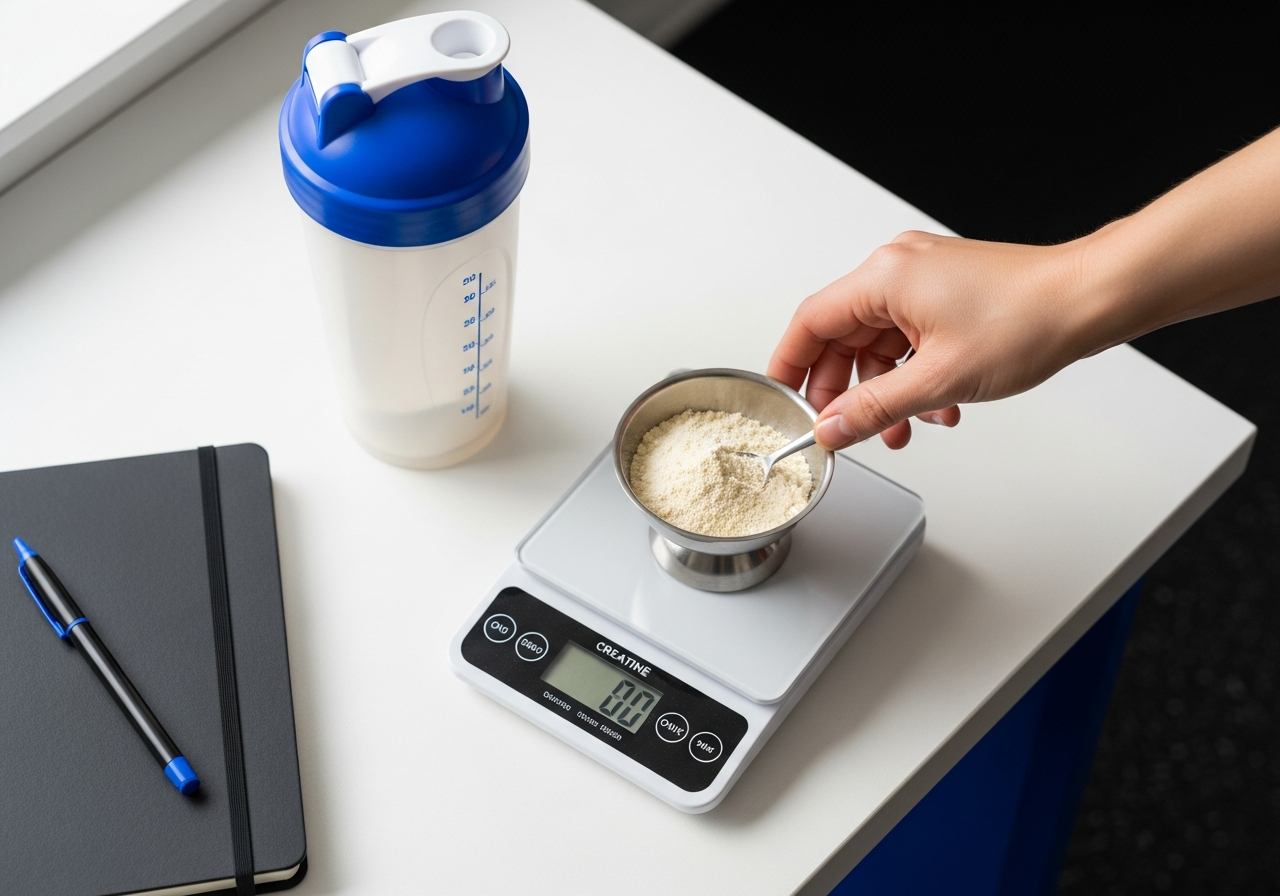
The standard evidence-based maintenance dose is 3 to 5 g/day, but body size, diet, and training goal can justify choosing the upper end of that range. Most people do not need to overcomplicate it, though athletes with more lean mass often prefer 5 g/day.
| Body weight | Simple daily dose | When this makes sense |
|---|---|---|
| Under 60 kg | 3 g/day | Smaller beginners, lighter athletes, or those easing in |
| 60 to 90 kg | 3 to 5 g/day | Most adults training for strength, muscle, or sport |
| Over 90 kg | 5 g/day | Larger athletes, higher lean mass, or those wanting a simple default |
| Any body weight with loading | 20 g/day for 5 to 7 days, then 3 to 5 g/day | When you want faster saturation |
Some practitioners also use a loading formula of about 0.3 g/kg/day for 5 to 7 days, followed by a maintenance intake around 0.03 g/kg/day. That is useful for precision, but for everyday fitness use, the standard scoop-based approach works very well.
Beginners: Start with 3 to 5 g/day and focus on consistency. You do not need cycling. See creatine for beginners.
Women: Women use the same general dose range as men because the mechanism is based on tissue saturation, not on taking a “women’s” amount. See creatine for women.
Older adults: Creatine can be especially useful when paired with resistance training to support strength and lean mass retention. See creatine for older adults.
Vegetarians and vegans: Because baseline stores may be lower, some people in this group notice a more obvious response. See creatine for vegetarians.
Athletes in power or repeated-sprint sports: These groups are among the best fits for creatine because the phosphocreatine system is heavily involved in their sport demands.
If you want exact math instead of a rule of thumb, use the creatine dosage calculator or read how much creatine per day.
Timing, drug tests, and sport rules: does creatine affect a drug test?
Creatine does not usually make you fail a drug test because standard employment and sport drug tests do not test for creatine as a banned drug. That directly answers searches like can creatine cause you to fail a drug test, can creatine make you fail a drug test, and does creatine affect drug test.
Most routine drug testing panels screen for substances such as cannabinoids, cocaine metabolites, amphetamines, opioids, benzodiazepines, or specific banned performance-enhancing drugs. Creatine monohydrate is not typically one of them. In tested sport, creatine itself is not generally prohibited.
Another common question is the opposite: can creatine help pass a drug test or can creatine help you pass a drug test? No, creatine should not be relied on to influence drug-test outcomes. It is not a legitimate or dependable strategy for altering the result of a standard drug screen. If someone is talking about “creatine for passing a drug test,” they are usually referring to internet myths around urine sample characteristics, not to any approved or reliable use of creatine supplementation.
Where timing does matter is habit formation. Research and real-world results both suggest that daily adherence is more important than whether you take creatine before or after training. If post-workout is easiest because it is already in your shake, use that. If breakfast is easier, use breakfast. For the full nuance, see when to take creatine and whether to take creatine on rest days.
One testing nuance worth knowing is that creatine supplementation can increase creatinine, which is a breakdown product of creatine often measured on blood work. That can confuse people into thinking creatine is damaging the kidneys when the explanation may simply be altered lab interpretation rather than harm. If that topic concerns you, read creatine vs creatinine and the kidney myth explained.
Bottom line: creatine is not a steroid, is not a typical target of drug tests, and should not be treated as a workaround for drug screening.
Safety, side effects, and who should think twice before starting
Creatine monohydrate is well studied and is generally considered safe for healthy adults when used at recommended doses, but a few side effects and medical caveats still matter.
The strongest evidence-backed side effects are usually mild and manageable:
- Temporary water-weight gain: Often noticeable early, especially with loading, because creatine increases intracellular water in muscle.
- Stomach upset or loose stools: More likely with large single doses, poor mixing, or taking too much at once.
- Bloating sensation: Often overreported, but some people do feel GI discomfort if dosing is sloppy.
The practical fix is simple: use creatine monohydrate, take 3 to 5 g/day or split larger doses, mix it well, and avoid huge one-shot servings. Our guides on digestive side effects, bloating, and weight gain go deeper.
The ISSN position stand and the 2021 JISSN review both support creatine’s safety profile in healthy populations when used properly. That said, people with pre-existing kidney disease, those advised to restrict certain supplements by their clinician, or anyone with a complex medical condition should speak with a physician or pharmacist first.
In Canada, it is smart to choose products with clear ingredient lists, lot information, and ideally third-party testing or a reputable manufacturing standard. An NPN on the label adds another layer of confidence that the product has gone through Health Canada’s natural health product process.
Who should be more cautious before self-starting?
- People with known kidney disease
- People who are pregnant or breastfeeding unless advised by a clinician
- People taking medications where their clinician wants to review supplement use
- Athletes under strict team or federation supplement policies who need batch-tested products
If you want a deeper evidence review, start with is creatine safe and who should not take creatine.
Biggest myths to ignore, common beginner mistakes, and how to buy creatine in Canada
The biggest creatine myths are that it is a steroid, that it is unnatural, that it ruins kidneys in healthy users, and that fancy forms beat monohydrate by default. Most of those claims do not hold up well against the evidence.
Myth 1: Creatine is a steroid. False. Creatine is an energy-support compound, not a testosterone-like drug.
Myth 2: Creatine is not natty. False. Using creatine does not move you out of the natural category in normal fitness language.
Myth 3: You need to cycle creatine. Usually false. Daily maintenance use is standard, and routine cycling is not required for most people. See do you need to cycle creatine.
Myth 4: More is better. False. Once stores are saturated, taking far more than needed does not create proportionally better results and can increase stomach issues.
Myth 5: Expensive designer forms are automatically superior. Usually false. Monohydrate remains the benchmark for efficacy, cost-effectiveness, and research support. Compare monohydrate vs HCL and why monohydrate still wins.
Common beginner mistakes include:
- Skipping days and expecting saturation anyway
- Taking one giant scoop that causes GI distress
- Judging results after two workouts
- Buying underdosed gummies or proprietary blends without checking grams per serving
- Choosing products based only on influencer hype
In Canada, look for:
- Creatine monohydrate as the main and ideally only active ingredient
- A clear serving size in grams, not vague “scoops” only
- NPN-labelled products when applicable
- Reputable manufacturing and, ideally, third-party testing
- Simple pricing per 100 g rather than flashy packaging
To shop smarter, use our product catalog, brand reviews, and best creatine rankings. For a broader myth clean-up, see creatine myths vs facts.
Bottom line: is creatine a steroid, a drug, or a natural supplement?
Creatine is not a steroid. It is a naturally occurring compound involved in rapid energy production, and as a supplement it is best understood as a legal, evidence-based sports nutrition aid rather than a hormone drug.
If you came here asking whether creatine is natural, the answer is yes: your body makes it, and foods such as meat and fish contain it. If you came here asking whether creatine is a drug in the sense of anabolic steroids or banned muscle drugs, the answer is no. If you came here asking whether you are still natty if you take creatine, the answer is yes.
The reason creatine gets lumped in with steroids is simple optics: both are associated with muscle and performance. But the science could not be clearer. Creatine works by increasing phosphocreatine availability so you can regenerate ATP faster during short, intense efforts. Steroids work by altering hormone signalling and gene expression. Those are not small differences. They are category-defining differences.
For most healthy adults who lift, sprint, play field or court sports, or want a simple evidence-based supplement, creatine monohydrate at 3 to 5 g/day is the default starting point. Loading with 20 g/day split into four doses for 5 to 7 days is optional if you want faster saturation. Timing is secondary to consistency. Safety is strong in healthy adults when used appropriately, though anyone with kidney disease or a relevant medical issue should speak with a clinician first.
If you want to act on this today, do three things: choose a reputable creatine monohydrate product, take 3 to 5 g every day, and give it at least a few weeks before judging results. That is the evidence-based path.
For next steps, read what creatine is, how much to take per day, whether creatine is safe, and how to choose monohydrate in Canada.
Creatine vs. Steroids: The numbers that matter
- 3–5 g/day Standard creatine maintenance dose — The evidence-based daily dose for most adults using creatine monohydrate.
- 20 g/day Typical loading dose — Usually split into 4 doses for 5–7 days to saturate muscle faster.
- 3–4 weeks Time to near saturation without loading — Daily 3–5 g dosing works, just more gradually.
- 0 steroids Creatine contains anabolic steroids — Creatine is not a steroid and does not work through testosterone-like signalling.
Frequently Asked Questions
Is creatine a steroid?
No, creatine is not a steroid. Creatine is a naturally occurring compound stored in muscle and used to help regenerate ATP during short, intense exercise, while anabolic steroids are hormone-based drugs related to testosterone that work through androgen signalling and gene expression.
Is creatine natural or not?
Yes, creatine is natural. Your body makes creatine from amino acids, and you also get it from foods like beef, pork, salmon, tuna, and herring, which is why creatine supplementation is considered adding to an existing natural compound rather than introducing a steroid.
Is creatine a drug?
Creatine is not a drug in the way most people mean it in fitness conversations. It is generally used and sold as a dietary supplement or natural health product, not as an anabolic drug, even though it has physiological effects like many nutrients and supplements do.
Am I still natty if I take creatine?
Yes, you are still natty if you take creatine. In gym culture, 'natty' usually means not using steroids, SARMs, growth hormone, or other pharmacological performance enhancers, and creatine does not belong in that category.
Does creatine contain steroids?
No, pure creatine monohydrate does not contain steroids. A legitimate creatine product should list creatine monohydrate clearly on the label, which is why buying from reputable brands with transparent ingredient lists and, in Canada, an NPN where applicable is a smart move.
What foods is creatine naturally found in?
Creatine is naturally found mainly in animal foods. The best-known food sources are red meat and fish, including beef, pork, salmon, tuna, herring, and cod, though the amounts in food are much smaller than what a standard 3 to 5 g supplement dose provides.
Can creatine make you fail a drug test?
No, creatine does not usually make you fail a drug test. Standard workplace and sport drug screens do not normally test for creatine as a banned substance, although athletes should still buy reputable products to reduce contamination risk from poor manufacturing.
Can creatine help you pass a drug test?
No, creatine should not be used to try to pass a drug test. It is not a reliable or approved method for changing drug-test outcomes, and internet claims about using creatine this way are not a sound basis for decision-making.
Is creatine the same as steroids because it helps build muscle?
No, creatine is not the same as steroids just because it can help muscle gain. Creatine helps you train harder by improving rapid energy recycling, whereas steroids directly alter hormone signalling and muscle-building pathways, so the mechanism and risk profile are entirely different.
What is the best dose if I want to start creatine?
The best simple starting dose for most adults is 3 to 5 g of creatine monohydrate per day. If you want faster saturation, you can use a loading phase of 20 g/day split into four 5 g doses for 5 to 7 days, then continue with 3 to 5 g/day.