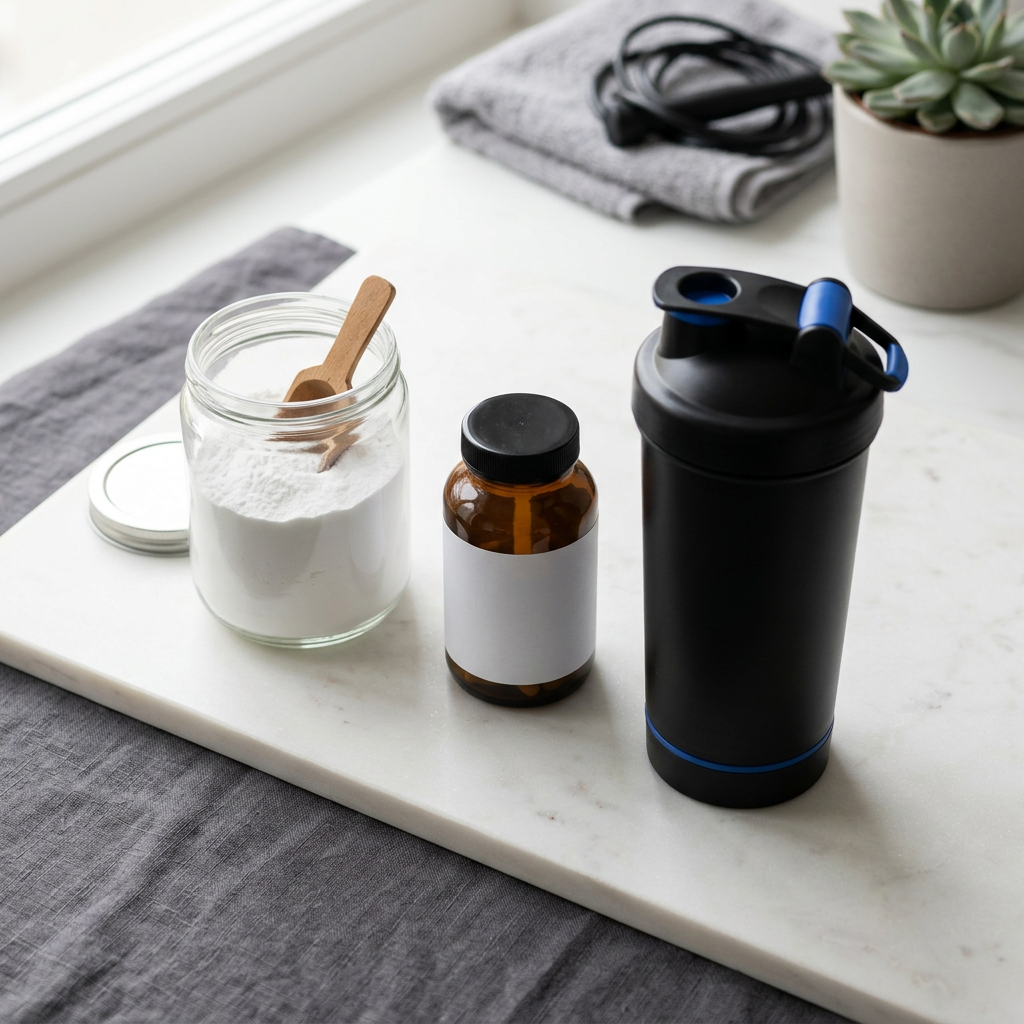
Creatine and Vitamin B12: Why Vegans Especially Should Monitor Both
By The Creatine Canada Research Team — Evidence-based supplement analysts
Creatine and vitamin B12 can be taken together, and for vegans especially, both deserve attention because they solve different problems: creatine directly supports high-intensity energy production, while B12 supports red blood cell formation, nerve function, and the methylation pathways linked to creatine synthesis. The key point is that B12 deficiency does not make creatine unsafe, but low B12 can impair overall performance, recovery, and health even if you supplement creatine perfectly.
Evidence-based · Cites 4 sources · Editorial standards
Key Takeaways
- Creatine and B12 do not conflict; most people can use both at the same time.
- Creatine monohydrate remains the best-studied form, with 3–5 g/day as the standard maintenance dose.
- Vitamin B12 does not replace creatine, because B12 helps metabolism while creatine directly increases muscle phosphocreatine stores.
- Vegans and many vegetarians are more likely to benefit from creatine supplementation and more likely to need routine B12 monitoring.
- B12, folate, and creatine intersect through one-carbon metabolism, but taking B12 does not reliably raise muscle creatine stores on its own.
- If you are tired, weak, short of breath, numb, or cognitively foggy, do not assume creatine is the fix; rule out B12 deficiency.
- In Canada, choose creatine and B12 products with clear ingredient labels, an NPN where applicable, and preferably third-party testing.
Can you take creatine and vitamin B12 together? Yes — and they do different jobs
Yes, you can take creatine and vitamin B12 together, and there is no established evidence that the two interfere with each other. Creatine and B12 are often discussed together because they sit near the same broad metabolic neighbourhood, but they are not interchangeable supplements and they are not redundant.
Creatine is a compound made from the amino acids glycine, arginine, and methionine, and its main sports-nutrition role is to raise muscle phosphocreatine stores. Phosphocreatine is the rapidly available stored form that helps regenerate ATP, the cell’s immediate energy currency, during short, explosive efforts such as sprinting, jumping, repeated intervals, and heavy sets. The 2017 ISSN position stand concluded that creatine monohydrate is the most effective ergogenic nutritional supplement currently available for increasing high-intensity exercise capacity and lean mass during training.
Vitamin B12, also called cobalamin, is an essential vitamin involved in red blood cell production, neurological function, and methylation reactions. Methylation is a core biochemical process that helps transfer one-carbon units in metabolism. B12 matters because low B12 can reduce energy, training capacity, and cognitive function, but B12 does not act like supplemental creatine and does not saturate muscle creatine stores the way creatine monohydrate does.
This is why the phrase creatine and B12 can be confusing. The practical answer is simple:
- Take creatine if you want the well-established performance, training-volume, and lean-mass benefits.
- Take B12 if your diet or labs suggest low intake or deficiency risk, especially if you are vegan, mostly plant-based, older, or have absorption issues.
- Use both if both needs apply.
For beginners, the most useful starting plan is 3–5 g of creatine monohydrate daily plus appropriate B12 intake from fortified foods or supplements if you do not eat enough animal-source foods. If you need a basic primer first, see creatine product catalog, creatine dosage calculator, and our guide to best creatine rankings.
Bottom line: creatine and vitamin B12 can absolutely be used together, but creatine improves muscle energy availability directly, while B12 supports the systems that keep the rest of you functioning properly.
Why vegans especially should monitor both creatine and B12

Vegans are the group most likely to need close attention to both creatine and B12 because plant-based diets supply little to no dietary creatine and unreliable natural B12. That does not mean a vegan diet is inadequate for performance, but it does mean you should manage these two nutrients intentionally rather than by accident.
Creatine is found naturally in meaningful amounts mainly in animal foods such as meat and fish. A vegan diet therefore provides negligible creatine, so baseline muscle creatine stores are often lower in vegans and vegetarians than in omnivores. That matters because people who start with lower muscle creatine stores often see a clearer response when they begin supplementing. This is one reason plant-based athletes are frequently strong candidates for daily creatine monohydrate. If you want the bigger context, see our guide on is creatine vegan and creatine for vegetarians.
Vitamin B12 is different. B12 is produced by microorganisms and is naturally present in reliable human dietary amounts mostly through animal-derived foods or fortified products. A person eating no animal foods without using fortified foods or supplements is at clear risk of low intake. Over time, deficiency can contribute to fatigue, weakness, numbness or tingling, balance problems, brain fog, and megaloblastic anaemia.
Here is the important practical distinction:
- Creatine status affects high-intensity performance and training capacity more directly.
- B12 status affects general health, oxygen delivery, nerve function, and energy metabolism more broadly.
A vegan lifter can therefore have two separate issues at once: lower-than-optimal muscle creatine stores and inadequate B12 status. Fixing only one does not automatically fix the other. Someone can take creatine perfectly and still feel poorly if they are B12 deficient. Someone can correct B12 status and still benefit from creatine supplementation for training performance.
For women, older adults, and recreational lifters eating mostly plant-based diets, this matters as much as it does for competitive athletes. The day-to-day signs to watch are persistent fatigue out of proportion to your training, unexplained performance stagnation, brain fog, neuropathy symptoms, or a diet pattern with no fortified B12 source.
In practice, vegans should usually do three things: maintain reliable B12 intake, consider routine medical monitoring if intake has been inconsistent, and use creatine monohydrate daily if the goal is strength, power, muscle, repeated-sprint ability, or possibly cognitive support. For a deeper training-focused overview, see creatine on a plant-based diet and creatine for vegan athletes.
The actual science: how B12, folate, methionine, and creatine synthesis connect
B12 is linked to creatine synthesis indirectly through methylation, but supplemental B12 does not work like creatine supplementation. This is the key mechanism behind searches for b12 and creatine synthesis, creatine and cobalamin, and creatine and folate.
Your body synthesizes creatine in a multi-step process. First, glycine and arginine are combined to form guanidinoacetate. Then guanidinoacetate is methylated to creatine. That methyl donation comes from S-adenosylmethionine, which is generated through pathways that depend on methionine availability and interact with folate and vitamin B12 metabolism. In plain English, B12 and folate help keep one-carbon metabolism running, and one-carbon metabolism helps support endogenous creatine production.
That biochemical link is real, but it is often overstated online. It does not mean that if you take more B12 you will build up muscle creatine the same way you would by taking 3–5 g/day of creatine monohydrate. Endogenous synthesis and exogenous supplementation are not the same thing. Supplemental creatine bypasses the rate-limited need to make all of it yourself and increases the amount available for storage in muscle and other tissues.
Folate deserves mention here too. Folate and B12 work together in methylation cycles, and deficiencies in either can disrupt metabolic flow. That is why the phrase creatine and folate appears in health discussions. But again, the performance implication is indirect: folate and B12 support normal physiology, whereas creatine supplementation directly increases the substrate used in the phosphocreatine energy system.
This distinction helps clear up a common misconception: normalizing B12 or folate status supports your body’s ability to function normally, but it should not be treated as a replacement for creatine supplementation when the goal is raising tissue creatine stores.
If you are healthy and not deficient, extra B12 is unlikely to create a creatine-like ergogenic effect. If you are deficient, correcting that deficiency may improve fatigue, training tolerance, and neurological symptoms, which can make your workouts feel better overall. Those are valuable benefits, but they are not the same mechanism as creatine loading or daily creatine maintenance.
For a broader primer on the molecule itself, see what is creatine and our guide to creatine biosynthesis.
Creatine vs. B12: what each one actually does for performance, muscle, and energy
Creatine helps you do more high-intensity work, while B12 mainly helps prevent the fatigue, anaemia, and neurological problems that can undermine performance. If you want to know whether creatine and vitamin B12 are complementary, the answer is yes precisely because their main jobs are different.
Creatine’s best-supported benefits are in short-duration, repeated, high-output efforts. By increasing intramuscular phosphocreatine, creatine helps regenerate ATP faster between and during intense efforts. In real gym terms, that can mean an extra rep, slightly better sprint repeatability, more total training volume, or better maintenance of power across repeated sets. Over weeks and months, that extra training quality can support greater gains in lean mass and strength. The ISSN position stand and the International Olympic Committee consensus both support creatine as one of the most evidence-based sports supplements available.
B12 does not increase phosphocreatine stores. Its importance is more foundational. If B12 status is poor, oxygen delivery and nerve function can suffer, and people may experience low energy, exercise intolerance, paleness, numbness, tingling, poor balance, or cognitive issues. Correcting deficiency can improve how you feel and function, but it is a restoration of normal physiology rather than a direct ergogenic loading effect.
Here is the cleanest way to think about it:
- Creatine: performance-forward, especially for lifting, sprinting, repeated intervals, team sports, and muscle gain.
- B12: health-foundational, especially for vegans, older adults, and people with low intake or absorption issues.
- Together: sensible when you need both, particularly on plant-based diets.
This also explains why some people say creatine “gives them energy” and others say B12 “gives them energy.” They mean different things. Creatine improves rapid cellular energy availability in working muscle and possibly brain tissue. B12 helps prevent deficiency-related tiredness and supports red blood cell and neurological function. Both matter, but not in the same way.
If your main goal is strength, muscle, explosive performance, or better gym progression, creatine is the evidence-based tool. If your main issue is suspected deficiency symptoms or a diet low in B12 sources, B12 status needs attention. Many active Canadians need both conversations at once. For more, see creatine benefits, does creatine give you energy, and creatine and cognition.
A simple step-by-step plan: how to take creatine and B12 without overthinking it
The easiest plan is to take creatine every day at a consistent dose and take B12 according to your diet pattern, product instructions, or clinician guidance if deficiency is a concern. You do not need a complicated stack, a special mixing ritual, or precise minute-by-minute timing.
- Choose the right creatine form. Start with plain creatine monohydrate. It is the most studied, typically the most cost-effective, and the form supported by the best evidence. Our best type of creatine and why monohydrate still wins guides explain why.
- Pick your dose. Use 3–5 g/day for maintenance. If you want faster saturation, use a loading phase of about 20 g/day split into 4 doses for 5–7 days, then switch to 3–5 g/day. The ISSN position stand describes these standard protocols.
- Take it consistently. Consistency matters more than timing. Morning, post-workout, with lunch, or before bed can all work if you actually remember it. If you want specifics, see when to take creatine and creatine on rest days.
- Mix it in any practical liquid. Water, a shake, or juice is fine. Warm liquid may dissolve it a bit better, but this is a convenience issue, not a major effectiveness issue.
- Handle B12 separately. If you are vegan, assume B12 needs deliberate attention from fortified foods or supplements. If you are omnivorous, B12 may still matter if intake is poor, you are older, or you have absorption issues.
- Watch for the right outcomes. Creatine should improve training quality over time. B12 should prevent or resolve deficiency-related issues if low status was the problem.
A beginner-friendly routine could look like this:
- Breakfast: B12 supplement or fortified food if needed.
- Any time of day: 3–5 g creatine monohydrate in water or a protein shake.
- Training days and rest days: same creatine habit.
If you prefer exact numbers, use our creatine dosage calculator and read how to take creatine. If you dislike gritty shakes, see how to mix creatine.
The big mistake to avoid is treating B12 like a pre-workout and creatine like a vitamin. Creatine works by tissue saturation over days to weeks. B12 works by maintaining or restoring adequate vitamin status. They are both useful, but they reward different kinds of consistency.
Exact dosing by body weight and goal, plus what to expect week by week
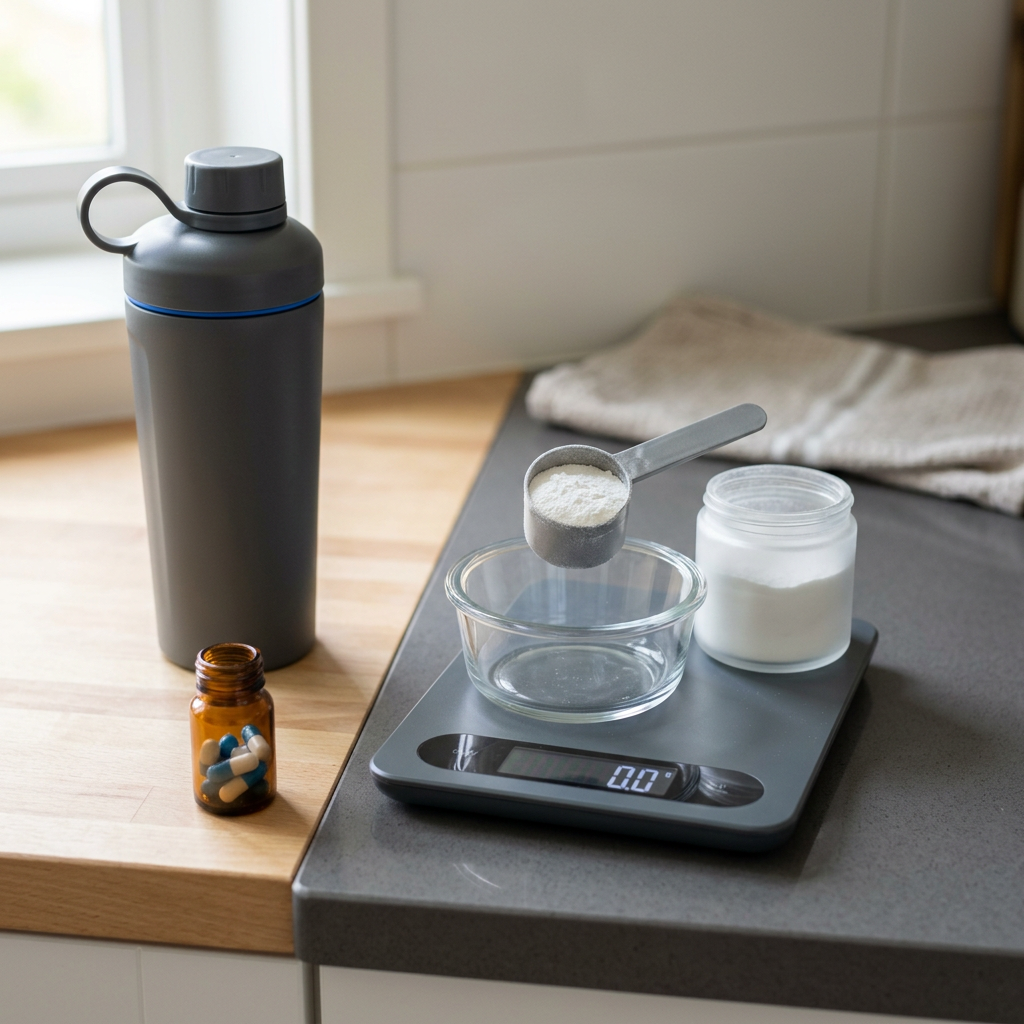
For most adults, 3–5 g/day of creatine monohydrate is enough, while a faster-start option is about 20 g/day split into 4 doses for 5–7 days followed by 3–5 g/day. Body weight can help fine-tune the choice, but it rarely needs to make things complicated.
| Body weight | Conservative daily dose | Common maintenance dose | Optional loading phase | Best for |
|---|---|---|---|---|
| Under 60 kg | 3 g/day | 3–5 g/day | 20 g/day split into 4 doses for 5–7 days | Beginners, smaller adults, general fitness |
| 60–90 kg | 3–5 g/day | 5 g/day | 20 g/day split into 4 doses for 5–7 days | Most lifters and team-sport athletes |
| Over 90 kg | 5 g/day | 5 g/day | 20 g/day split into 4 doses for 5–7 days | Larger athletes, strength-focused goals |
What should you expect?
- Days 1–7 with loading: quicker rise in muscle creatine stores; some people notice body-mass increase from intracellular water and fuller muscles.
- Weeks 1–2 without loading: little dramatic “feeling,” but tissue stores are building if you are consistent.
- Weeks 2–4: many people notice better repeat performance in the gym, stronger final reps, or improved sprint repeatability.
- Weeks 4–8: the real payoff is usually better training quality and potentially more progress from that better training.
How do you tell creatine is working? The best signs are not mystical. Look for slightly improved strength endurance, more total reps at a given load, better maintenance of output across sets, and sometimes a small increase on the scale from water stored inside muscle. If you are expecting a stimulant-like buzz, you are expecting the wrong thing.
B12 dosing is not standardized in the same way here because need depends heavily on dietary intake, absorption, age, and clinical context. That is why this page focuses on creatine dosing and encourages people at risk of low B12 to follow product instructions or clinician advice rather than self-diagnosing from gym fatigue alone.
For more detail, see how much creatine per day, creatine loading phase, and how long creatine takes to work.
Timing, stacking, and mixing: do creatine and cobalamin need to be taken at the same time?
No, creatine and cobalamin do not need to be taken at the same time to work properly. The timing question matters far less than people think because creatine works through saturation over time, and B12 works through maintaining adequate vitamin status.
Creatine timing is a compliance issue first and a marginal optimisation issue second. If taking it after training helps you remember it, great. If breakfast is more consistent, also great. The evidence does not support a dramatic advantage from obsessing over exact timing compared with simply taking it daily. The same logic applies to rest days: keep taking it. You are maintaining tissue stores, not chasing an acute pre-workout effect.
B12 timing is even less performance-sensitive for most people. If you use a B12 supplement, taking it at a time you reliably remember is usually the best plan. It can be taken with or without food depending on the product and your tolerance. There is no established evidence-based reason that creatine must be separated from B12 by hours.
What about stacking with other supplements?
- Protein powder: fine with creatine and often convenient in one shake. See creatine and protein powder.
- Coffee or caffeine: generally fine for most people, though tolerance and GI comfort vary. See creatine and caffeine.
- Multivitamins or B-complex products: usually fine, but check whether you are duplicating ingredients.
- Electrolytes: also fine if training or sweating heavily.
What should you mix creatine in? Water is enough. A protein shake is enough. Juice is enough. Warm liquid may reduce grit. What matters most is reaching the full daily dose. The 2021 JISSN review on creatine misconceptions reinforces how many creatine concerns are based more on gym folklore than on meaningful physiological barriers.
A good default routine for busy adults is this:
- Training days: creatine in your post-workout shake or with any meal.
- Rest days: creatine with breakfast or lunch.
- B12: with breakfast or according to your product instructions.
If you want the simplest possible rule, use this one: take creatine daily, take B12 reliably if you need it, and stop worrying about whether the scoop and the vitamin touched the same glass.
Who should pay the closest attention: beginners, women, older adults, and athletes
The people most likely to benefit from thinking about both creatine and B12 are plant-based eaters, older adults, women with low dietary intake, and athletes whose performance depends on repeated high-intensity output. The specific reason differs by group.
Beginners often assume creatine is only for bodybuilders and B12 is only for “energy.” Both ideas are too narrow. A beginner on a plant-based diet may improve training quality with creatine while also needing B12 sufficiency for basic health and recovery. If you are just starting, read creatine for beginners.
Women can benefit from creatine as much as men for strength, lean mass support, and training quality, and some women on lower-calorie or lower-animal-food diets may also need to review B12 intake. Creatine is not a steroid and does not inherently “bulk” women in the way internet myths suggest. See creatine for women.
Older adults deserve special mention because both issues become more relevant with age. Creatine can support resistance training outcomes and healthy aging goals, while B12 status may become more vulnerable because absorption can decline in some people. An older adult who is eating less overall may quietly underconsume protein, creatine-rich foods, and B12 at the same time. See creatine for older adults.
Athletes in sprint, power, repeated-effort, and collision sports often benefit most from creatine’s established performance effects. Vegan or vegetarian athletes have an even stronger rationale because dietary creatine intake is lower to begin with. The IOC consensus on supplements recognises creatine as one of the few supplements with meaningful sports-performance evidence.
People with fatigue or neurological symptoms should be careful not to self-diagnose a “creatine problem” when the real issue could be B12 deficiency, iron deficiency, under-fuelling, poor sleep, or overtraining. Creatine is not a substitute for medical assessment when symptoms are persistent or concerning.
The practical takeaway is that creatine is a strong option for many active people, but B12 becomes non-negotiable when diet pattern or absorption risk makes deficiency plausible. For Canadians buying supplements, clear labels, reputable brands, and third-party testing matter more than flashy formulas. Our creatine brand reviews and third-party tested creatine in Canada guide can help.
Safety, side effects, and what to look for when buying in Canada
Creatine monohydrate is well-supported as safe for healthy people when used at standard doses, while B12 is generally well tolerated; the bigger risk is poor product choice or ignoring an underlying deficiency. This is where evidence and common sense need to meet.
The safety profile for creatine monohydrate is strong. The ISSN position stand and the Mayo Clinic overview both support creatine’s general safety for healthy users when taken appropriately. Common minor issues are digestive discomfort, bloating, or loose stools, especially when people take too much at once. Splitting doses during a loading phase or using a simple 3–5 g/day plan solves most of this.
Creatine does not dehydrate you, ruin your kidneys in healthy people, or require cycling just because a label says so. Those are recurring myths. If you have kidney disease, are under active medical care for renal issues, or take medications that raise concern, talk to your clinician first. Otherwise, normal evidence-based use is straightforward. Related reading: is creatine safe, creatine and kidneys, and creatine digestive side effects.
B12 is usually low-risk, but the bigger issue is not side effects — it is missing a real deficiency because you assumed a general energy supplement would fix everything. Persistent fatigue, pallor, neuropathy symptoms, mouth soreness, or cognitive changes warrant proper medical follow-up rather than endless supplement experiments.
For Canadians, buying quality matters. Look for:
- Creatine monohydrate as the ingredient, ideally without unnecessary proprietary blends.
- NPN where applicable. An NPN is a Natural Product Number, Health Canada’s product licence identifier for many natural health products sold legally in Canada.
- Third-party testing or sport certifications if you are a tested athlete.
- Transparent labels with serving size clearly stated in grams, not just “scoops.”
If you are comparing options, start with our best creatine rankings, creatine product catalog, and how to choose creatine. Expensive “advanced” forms are rarely necessary when plain monohydrate already has the evidence lead.
The safety bottom line is simple: standard-dose creatine and appropriately used B12 can coexist safely for most healthy adults, but symptoms suggesting deficiency deserve more than guesswork.
Common mistakes and myths: B12 does not replace creatine, and creatine does not fix B12 deficiency
The biggest mistake people make with creatine and B12 is assuming that because the nutrients are biochemically connected, one can substitute for the other. That is false, and it leads to poor decisions.
Myth 1: If B12 helps creatine synthesis, extra B12 should work like creatine.
Reality: B12 supports metabolic pathways involved in normal physiology, including one-carbon metabolism tied to endogenous creatine synthesis, but supplemental creatine directly raises creatine availability for storage. These are not equivalent interventions.
Myth 2: If I take creatine, I do not need to worry about B12.
Reality: Creatine does not correct B12 deficiency. You may still develop fatigue, neurological symptoms, or anaemia if B12 intake or absorption is inadequate.
Myth 3: Creatine only matters if you eat meat.
Reality: It arguably matters even more if you do not eat meat because dietary creatine intake is lower, which is one reason plant-based athletes often respond well.
Myth 4: B12 is just an energy booster.
Reality: B12 is an essential vitamin, not a generic stimulant. If you are deficient, correcting it can markedly improve wellbeing. If you are not deficient, more is not automatically better for performance.
Myth 5: You need a fancy creatine form when you also take vitamins.
Reality: Monohydrate remains the gold standard. The 2021 JISSN review specifically addresses many misconceptions around branded or alternative forms.
Myth 6: If I feel tired during training, I should just add B12 and creatine.
Reality: Tiredness can come from poor sleep, low calories, iron deficiency, low B12, under-recovery, illness, stress, or training errors. Supplements can help, but they are not a diagnosis.
The best troubleshooting questions are practical:
- Are you actually taking 3–5 g creatine daily?
- Have you given it at least a few weeks without loading?
- Are you vegan or mostly plant-based without a reliable B12 source?
- Do you have symptoms that suggest medical follow-up instead of self-experimentation?
If creatine seems not to be working, read creatine not working and creatine myths vs. facts. If the concern is low energy with plant-based eating, think bigger than one supplement tub.
The bottom line: the smartest way to approach creatine and vitamin B12
Creatine and vitamin B12 are complementary, not competing, and vegans especially should monitor both because low creatine intake and low B12 intake often travel together on plant-based diets. If you remember only one thing from this guide, remember that sentence.
Creatine monohydrate is the evidence-based choice for improving high-intensity performance, supporting greater training volume, and helping drive long-term gains in strength and lean mass when combined with training. The standard maintenance dose is 3–5 g/day, and loading is optional. B12, or cobalamin, is essential for red blood cell formation, nerve function, and methylation pathways that intersect with creatine synthesis, but B12 does not replace the direct muscle-saturating effect of creatine supplementation.
For omnivores with decent dietary intake, the main decision may simply be whether to use creatine for performance and body-composition goals. For vegans, vegetarians, older adults, and anyone with inconsistent B12 intake or symptoms of deficiency, the smarter approach is dual awareness: use creatine if it fits your goals, and do not neglect B12 status just because your supplement stack looks healthy.
Your simplest action plan is this:
- Take creatine monohydrate daily at 3–5 g.
- If you are vegan or at risk of low intake, ensure reliable B12 intake from fortified foods or supplements.
- If symptoms suggest deficiency, get proper medical advice rather than guessing.
- Buy simple, transparent products from reputable brands, ideally with Canadian-compliant labelling and third-party testing.
If you want to keep learning, the most relevant next reads are how much creatine per day, is creatine safe, creatine and vitamins, and the complete creatine guide.
Final answer: yes, you can take creatine and vitamin B12 together; just do not confuse a vitamin that supports normal metabolism with a supplement that directly increases muscle creatine stores.
Creatine and B12: the practical numbers that matter
- 3–5 g/day Standard creatine maintenance dose — The mainstream evidence-based daily amount for most adults using creatine monohydrate.
- 20 g/day Typical loading protocol — Usually split into 4 doses daily for 5–7 days, then reduced to 3–5 g/day.
- 5–7 days Typical loading duration — Used when faster creatine saturation is desired.
- 2–4 weeks Common time to notice benefits without loading — A realistic window for many people taking 3–5 g/day consistently.
Frequently Asked Questions
Can I take creatine and vitamin B12 together?
Yes, most people can take creatine and vitamin B12 together safely. They do different jobs, with creatine raising muscle phosphocreatine stores for high-intensity energy and B12 supporting red blood cells, nerve function, and methylation pathways. There is no established need to separate them by hours.
Does vitamin B12 help with creatine synthesis?
Yes, vitamin B12 is linked indirectly to creatine synthesis through methylation pathways. B12 helps support one-carbon metabolism alongside folate and methionine, which is relevant to endogenous creatine production, but taking B12 does not replace creatine supplementation for raising muscle creatine stores.
Do vegans need both creatine and B12?
Vegans are the group most likely to need deliberate attention to both. Plant-based diets provide little to no dietary creatine and can be low in reliable natural B12, so creatine may help performance while B12 remains essential to prevent deficiency-related health problems.
Can B12 deficiency affect creatine results?
Yes, B12 deficiency can indirectly undermine your overall results even if you take creatine correctly. Creatine may still raise muscle stores, but low B12 can reduce energy, training tolerance, oxygen delivery, and neurological function, which can make your workouts and recovery worse.
Is creatine and cobalamin the same as creatine and B12?
Yes, cobalamin is simply another name for vitamin B12. When people search for creatine and cobalamin, they are asking about the same pairing as creatine and vitamin B12.
What is the best creatine dose if I also take B12?
The best standard creatine dose is still 3–5 g/day of creatine monohydrate, even if you also take B12. B12 use does not change mainstream creatine dosing, although some people choose a 5–7 day loading phase at about 20 g/day split into 4 doses.
Do creatine and folate interact?
Creatine and folate are metabolically connected rather than directly interactive in a supplement-conflict sense. Folate, like B12, supports methylation pathways involved in normal physiology and endogenous creatine synthesis, but folate supplementation does not act like taking creatine monohydrate.
Will B12 give the same gym benefits as creatine?
No, B12 will not give the same gym benefits as creatine unless you are correcting a deficiency that was holding you back. Creatine directly supports repeated high-intensity performance and training volume, while B12 mainly restores normal function when intake or absorption is inadequate.
Should I take creatine if I am tired and plant-based?
Maybe, but do not assume creatine is the whole answer. A plant-based eater may benefit from creatine because dietary creatine intake is low, but persistent tiredness should also raise the question of B12 status, iron status, calorie intake, sleep, and overall recovery.
What kind of creatine should I buy in Canada if I also want a B12 supplement?
Buy plain creatine monohydrate from a reputable brand with transparent labelling, and preferably an NPN and third-party testing where applicable. For B12, choose a clearly labelled product that fits your dietary needs, and avoid assuming that complicated multi-ingredient formulas are better than simple, verified products.