Beyond the Gym: Creatine for Brain Health, Memory, and Healthy Aging in 2026
By The Creatine Canada Research Team — Evidence-based supplement analysts
Yes—creatine for brain health is plausible, practical, and increasingly relevant, but the evidence is strongest for muscle and still emerging for cognition. In 2026, the best-supported take is that creatine may help mental energy, memory, focus, and resilience most in higher-need situations such as sleep deprivation, mental fatigue, vegetarian diets, and healthy aging—not as a guaranteed nootropic for every well-rested adult.
Evidence-based · Cites 4 sources · Editorial standards
Key Takeaways
- Creatine helps recycle ATP, the brain’s immediate energy currency, through the creatine-phosphocreatine system in neurons.
- The cognitive evidence is promising but uneven; benefits appear more likely under stress states like sleep loss, mental fatigue, and aging than in well-rested young adults.
- Creatine monohydrate is still the best first choice for brain and cognitive use because it is the most studied, most reliable, and usually the best value.
- A practical starting dose for most adults is 3–5 g daily; some cognition studies use 5–10 g daily or more, but higher doses are not automatically better.
- Loading with 20 g daily split into 4 doses for 5–7 days can saturate stores faster, but it is optional for brain-focused use.
- Older adults, vegetarians and vegans, athletes under heavy training stress, and people dealing with poor sleep are the groups most likely to notice a meaningful effect.
- In Canada, look for a Natural Product Number (NPN), clear grams-per-serving labelling, and ideally third-party testing when buying creatine.
Does creatine help brain health? The direct answer, without the hype
Yes, creatine may support brain health and cognition, but the fairest evidence-based answer is that it seems most useful when the brain is under higher energy strain rather than as a dramatic everyday “smart drug” for everyone. Creatine for brain health works by supporting the rapid regeneration of ATP, the cell’s immediate energy source, and that matters because the brain is one of the body’s most energy-demanding organs.
The key nuance is that the research base for creatine cognitive benefits is not as strong or as consistent as the research base for muscle performance. The 2017 ISSN position stand established creatine monohydrate as effective and safe for increasing intramuscular creatine stores and improving high-intensity exercise capacity, but cognitive uses sit in a newer, still-developing evidence bucket. That does not mean the brain benefits are imaginary; it means the best current interpretation is promising, context-dependent, and not yet universal.
Where does creatine seem most interesting? The strongest practical signals tend to show up in:
- Sleep deprivation, when mental energy and working memory are strained.
- Mental fatigue or heavy cognitive load, when ATP turnover rises.
- Older adults, whose energy metabolism and reserve capacity may be less robust.
- Vegetarians and vegans, who often start with lower creatine intake from food.
- Periods of stress or intense training, when both body and brain face higher recovery demands.
For a beginner, the practical takeaway is simple: if your goal is creatine for memory, focus, brain fog, or healthy aging, start with plain creatine monohydrate at 3–5 g daily and judge it over several weeks, not several hours. Creatine is not like caffeine; you do not “feel” it acutely in most cases. Instead, you are gradually increasing tissue creatine availability over time.
That is also why a lot of people wrongly think it is not working. Brain-related effects, when they occur, often feel subtle: slightly steadier focus, better mental stamina late in the day, less drop-off after poor sleep, or fewer “foggy” periods. If you want the basics first, read what creatine is and our guide to creatine and the brain.
Market-research estimates help explain why this topic is exploding in 2026. Creatine’s mainstream narrative has moved decisively beyond the gym toward memory, focus, mood, and healthy aging, helping push the overall supplement market to an estimated USD $1.85 billion in 2026, with projections near USD $2.86 billion by 2030. That market shift is real, but the science still demands careful language: brain benefits are credible enough to take seriously, not settled enough to oversell.
How creatine works in the brain: ATP, phosphocreatine, and mental energy explained
Creatine helps the brain by buffering and rapidly regenerating ATP through the creatine-phosphocreatine system, which is the same core energy mechanism that makes it useful in muscle. In plain English, phosphocreatine acts like a fast-access energy reserve that can donate a phosphate group to help rebuild ATP when a cell needs energy quickly.
ATP, or adenosine triphosphate, is the cell’s immediate usable energy currency. Neurons burn through ATP continuously to maintain electrical signalling, neurotransmitter cycling, ion gradients, and other high-cost tasks. When demand spikes—during intense thinking, sleep loss, stress, or aging-related inefficiency—the ability to rapidly restore ATP becomes more relevant. Creatine does not “stimulate” the brain the way caffeine does; it supports the brain’s energy system so mental performance may degrade less under strain.
That mechanism matters because it explains why creatine and focus is not a simple yes-or-no question. In a healthy, well-rested, well-fed young adult on an easy cognitive day, there may be little room for creatine to produce a noticeable difference. But under higher-demand conditions, the same ATP-buffering system may become more functionally important.
Emerging research also suggests that brain creatine status may differ across people and situations. People who consume little or no meat may begin with lower dietary creatine intake. Older adults may have different baseline reserves or altered energy metabolism. Sleep deprivation can increase the mismatch between energy demand and supply. These are all reasons the cognitive signal is often stronger in “stress state” studies than in ideal-lab, well-rested-student studies.
One more practical point: brain saturation may not mirror muscle saturation perfectly. That is one reason some cognition studies have used higher doses such as 5–10 g/day or more. Higher study doses do not prove that everyone needs higher daily intake; they simply show that researchers often treat the brain as a distinct target with potentially different uptake dynamics.
If you want the broader physiology background, the ISSN position stand remains the foundational review, and Examine’s creatine evidence summary is useful for a living overview of performance and non-performance findings. For practical use, the same evidence-based rule still applies: start with monohydrate, use it daily, and evaluate over time rather than expecting an immediate mental jolt.
What the evidence actually shows for memory, focus, brain fog, sleep loss, and mood
Creatine may help cognition, but the quality and consistency of evidence varies by outcome, with the best signals appearing for memory and mental resilience under stress rather than broad, dramatic IQ-style gains. If you are asking, does creatine help cognition, the most accurate answer in 2026 is “sometimes, in the right person and situation.”
Here is the evidence-based breakdown:
- Memory: Creatine for memory is one of the more plausible uses, especially working memory and short-term task performance under cognitive stress or in lower-baseline groups.
- Focus and mental fatigue: Creatine and focus appears most relevant when concentration is slipping because of poor sleep, long work blocks, overreaching in training, or cumulative fatigue.
- Brain fog: Creatine for brain fog is not a medical diagnosis or guaranteed treatment, but some people report steadier mental energy when low energy availability is part of the problem.
- Sleep deprivation: This is one of the most interesting niches. Under acute sleep loss, creatine may help preserve aspects of mental performance better than it does in rested conditions.
- Mood and depression: Creatine mood depression research is intriguing but still emerging. It is not established as a standalone treatment, and it should not replace evidence-based mental health care.
- Healthy aging: Creatine for older adults’ brain health is a credible area of interest because aging can reduce physiological reserve, but results are not yet uniform enough to promise a clear cognitive upgrade.
The most important interpretation rule is this: lack of a universal effect is not the same as lack of a real effect. The brain is complex, study designs vary, tasks differ, and the people most likely to benefit may be precisely the people under-represented in small young-adult trials.
That is why you should be wary of two extremes. One extreme says creatine is a miracle nootropic; the other says it does nothing for the brain because not every study in healthy students shows a benefit. Neither view reflects the current evidence well. The more accurate middle ground is that creatine is a biologically plausible, relatively low-risk intervention with enough encouraging human data to justify practical use, especially in higher-need contexts.
For myth-busting around exaggerated claims, see creatine myths debunked and creatine myths vs. facts. For a deeper practical explainer, our creatine and cognition guide expands on how these outcomes are measured and why the results can look mixed without actually being contradictory.
Who is most likely to notice benefits from creatine for brain health
The people most likely to notice creatine’s cognitive benefits are those with higher energy demand, lower baseline creatine intake, or less metabolic reserve. In practice, that means creatine is often more compelling for older adults, vegetarians and vegans, people under sleep stress, and athletes or busy professionals with heavy mental and physical loads.
Older adults: Creatine for older adults’ brain health is appealing because healthy aging often comes with reduced reserve capacity, lower training volumes, variable protein intake, and more concern about preserving both physical and cognitive function. The evidence is still emerging, but the risk-benefit profile is reasonable when discussed with a healthcare professional, especially if the person also wants muscle and function support. Our related guide on creatine for older adults covers the broader aging context.
Vegetarians and vegans: People who avoid meat and fish typically consume less dietary creatine, which can make them more responsive to supplementation. This does not mean omnivores cannot benefit; it means plant-based eaters may start from a lower baseline. See also is creatine vegan? and creatine for vegetarians.
Sleep-deprived adults: Shift workers, parents of young children, students during exams, medical residents, and travellers crossing time zones may be better candidates for noticeable benefit than someone sleeping nine hours a night.
Athletes under hard training: Heavy training loads drain both physical and mental resources. Athletes often first take creatine for performance, then notice secondary benefits such as better mental stamina or less cognitive fade late in the day. If that is you, our creatine for athletes guide is worth reading.
Women: Women can use creatine just as effectively as men. Interest in creatine for women has grown sharply because the discussion now includes not only strength and body composition but also cognition, menstrual-cycle-related fatigue, and healthy aging.
Beginners: You do not need to be a lifter to use creatine. If you are simply looking for a low-friction supplement with a strong safety profile and a plausible upside for mental energy, monohydrate is still the place to start.
The least likely group to notice a clear effect is the stereotypical well-rested, omnivorous, healthy young adult already performing near ceiling on short lab tasks. Even there, absence of a dramatic subjective effect does not necessarily mean there is no benefit; it may simply mean the practical value is smaller.
Exactly how much creatine to take for brain health, by goal and body size
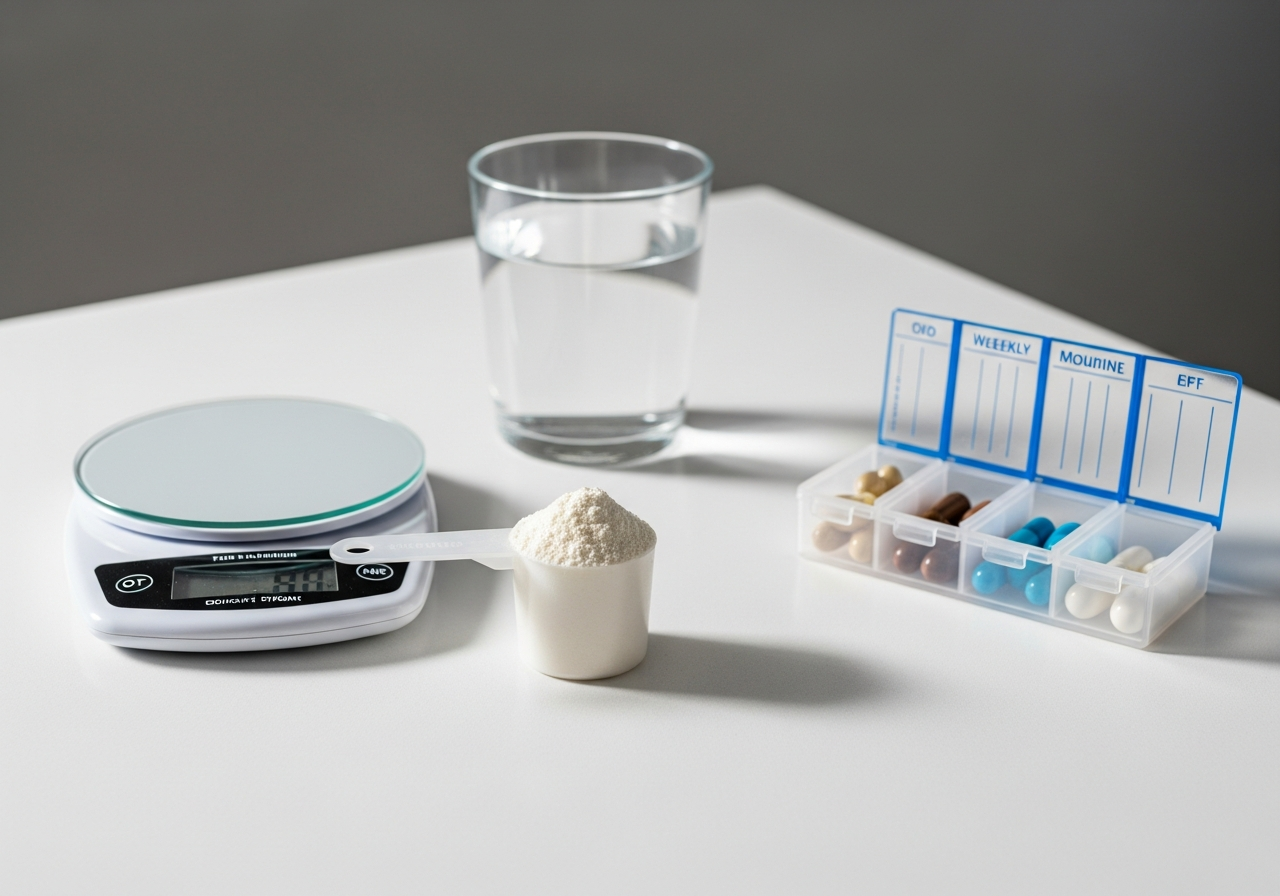
For most adults using creatine for brain health, a practical evidence-based dose is 3–5 g of creatine monohydrate daily, with some higher-demand or research-driven cases using 5–10 g daily. The main rule is consistency: brain-focused creatine use works through saturation over time, not by taking random large scoops on hard days.
Here is the simplest framework:
- Standard start: Take 3 g daily if you are smaller-bodied, cautious, or prone to stomach upset.
- Default adult dose: Take 5 g daily if you want the simplest all-purpose option.
- Higher-demand trial: Consider 5–10 g daily only if you are larger-bodied, older, plant-based, or specifically testing cognition under guidance and tolerating creatine well.
- Optional loading: If you want faster saturation, take 20 g daily split into 4 doses for 5–7 days, then drop to maintenance.
Use body weight as a sanity check, not an excuse to overcomplicate it. A 55 kg adult can reasonably start at 3 g/day. A 70–90 kg adult will usually do well on 5 g/day. A 100 kg-plus adult experimenting for dual muscle-and-cognition goals may choose 5–10 g/day, ideally split into smaller servings for comfort.
| Goal / Body Size | Practical Dose | Best Use Case | Notes |
|---|---|---|---|
| Smaller adult, cautious starter | 3 g/day | Beginner, sensitive stomach | Fine long-term option if taken consistently |
| Most adults | 5 g/day | General brain, training, and wellness use | Best simple default for monohydrate |
| Higher-demand cognitive trial | 5–10 g/day | Older adults, plant-based eaters, heavy stress, sleep loss | Split doses if digestion is an issue |
| Fast saturation approach | 20 g/day for 5–7 days, then 3–5 g/day | People who want stores topped up quickly | Usually divided into 4 servings of 5 g |
If you want a precise starting point, use our creatine dosage calculator and our detailed guide on how much creatine per day. If you are curious about loading specifically, see the creatine loading phase.
The biggest dosing mistake is assuming more is always better for the brain. Higher study doses exist because researchers are probing a difficult target, not because every person needs a large daily amount forever. Start sensible, stay consistent, and judge outcomes over weeks.
How to take creatine for memory, focus, and brain fog: a simple 4-step plan
The best way to take creatine for memory, focus, or brain fog is to choose plain monohydrate, take it daily, and track changes for at least 4–8 weeks. You do not need a complicated stack, and you do not need to time it perfectly around workouts if your main goal is the brain.
- Choose the right form. Buy creatine monohydrate, ideally micronized if you prefer easier mixing. Monohydrate remains the most studied and most cost-effective form. If you are comparing forms, our best type of creatine and monohydrate vs. HCL guides help.
- Pick your dose. Start with 3–5 g daily. If you are an older adult, vegan, or under unusually heavy stress, a carefully monitored trial at 5–10 g/day can be reasonable if tolerated well.
- Take it the same way every day. Mix it into water, a shake, yoghurt, or another routine meal. The best time is the time you will remember. If you want more on timing, read when to take creatine and with or without food.
- Track real-world outcomes. Do not judge it by a “buzz.” Track afternoon slump, task endurance, sleep-loss resilience, working-memory-heavy tasks, and how mentally flat or sharp you feel across a week.
A practical tracking template can be as simple as rating these from 1 to 10 every day for two weeks before and after starting: morning mental clarity, afternoon focus, error rate in mentally demanding work, and how hard poor sleep hits you the next day. For older adults, add reading stamina, word-finding ease, and consistency of attention.
What should you expect week by week?
- Week 1: Usually nothing dramatic unless you loaded.
- Weeks 2–4: Some people notice steadier mental energy or less crash under stress.
- Weeks 4–8: This is a more realistic evaluation window for subtle cognition-related effects.
If you miss a day, do not panic; just resume your usual dose. If you dislike the texture, use warm—not boiling—liquid first, then top up with cool water, or choose a more finely milled product. Our mixing guide and step-by-step creatine guide cover these basics in more detail.
The people who get the worst results from creatine for brain health are usually not “non-responders”; they are inconsistent users expecting acute stimulant-like effects from a saturation-based supplement.
Does timing matter for brain benefits? What to take it with, and what not to overthink
Timing matters far less than daily adherence for creatine’s brain benefits, because creatine works by gradually increasing tissue availability rather than producing an immediate pharmacological effect. If your goal is cognition, the best time to take creatine is simply the time you can repeat every day.
That means any of these are reasonable:
- With breakfast if you want a stable morning habit
- After training if you already use a shake then
- With lunch if that is when you remember supplements
- Before bed if it does not bother your routine
Should you take it with food? It can be helpful, but it is not essential. Some people find monohydrate gentler on the stomach when taken with a meal or mixed into a protein shake. If you already use whey, combining them is completely normal; see creatine with protein powder. If you prefer coffee, mixing them is generally fine too; see creatine with coffee and creatine and caffeine.
What about hydration? You do not need to force extreme water intake, but normal good hydration habits are sensible. Creatine increases intracellular water in tissues as stores rise, which is not the same thing as dehydration. If you want practical guidance, read how much water with creatine and creatine and dehydration.
For brain-focused users, the biggest “stack” mistake is chasing fancy nootropic blends before proving you can be consistent with plain creatine monohydrate. Start with one ingredient you can evaluate clearly. If you later add caffeine, protein, electrolytes, or a pre-workout, add them one at a time so you can tell what is helping and what is just marketing noise.
Another common question is whether rest days matter. They do, because creatine saturation is maintained by regular intake, not by only taking it when you train or when you feel mentally tired. That is why our guidance aligns with broader consensus documents such as the International Olympic Committee supplement consensus: choose evidence-backed supplements, use them for a clear purpose, and apply them in a disciplined way rather than sporadically.
In short, stop overthinking the clock. Creatine and focus is more about saturation than timing, more about routine than hacks, and more about weeks than minutes.
Safety, side effects, and how to buy a trustworthy creatine in Canada
Creatine monohydrate is generally considered safe for healthy adults when used at standard doses, and its safety profile is much stronger than most people assume. The 2017 ISSN position stand and the 2021 JISSN review on common creatine questions both support creatine as a well-studied supplement with a favourable safety record when used appropriately.
The most common side effects are practical rather than dangerous:
- Stomach upset: More likely with large single doses. Split the dose or take it with food.
- Temporary weight increase: Usually from increased water inside muscle, not fat gain.
- Mild bloating: More common during aggressive loading than steady maintenance.
Concerns about kidney damage are often confused with creatinine, a normal breakdown product measured on blood tests. Creatine can raise creatinine somewhat without meaning creatine has harmed your kidneys. That said, anyone with known kidney disease, significant medical conditions, or medication concerns should speak to a healthcare professional before supplementing. If that topic worries you, read the creatinine confusion explained and our full safety guide.
For mood-related goals, another safety point matters: creatine is not a substitute for mental health treatment. The research on creatine mood depression is interesting, but it remains emerging. If you are dealing with depression, persistent brain fog, or major cognitive changes, use creatine only as a possible adjunct and not as a replacement for medical care.
In Canada, buying well matters. Look for:
- NPN: A Natural Product Number indicates the product is licensed by Health Canada as a natural health product.
- Straightforward label: Ideally just creatine monohydrate, with grams per serving clearly stated.
- Third-party testing: Useful for purity reassurance, especially in a crowded market.
- Reputable seller: Buy from established Canadian retailers or brands with transparent quality practices.
Need a shortlist? See our best creatine rankings, creatine brand reviews, and product catalog. If you are comparing labels in Canada specifically, our guides to Canadian supplement regulations and best creatine monohydrate in Canada are the natural next reads.
For a mainstream medical overview, the Mayo Clinic’s creatine page offers a conservative summary. The short version: for healthy adults, standard creatine monohydrate use is one of the safer bets in supplements.
The biggest mistakes and myths about creatine for cognition
The biggest mistake people make with creatine for cognition is expecting a stimulant-like effect from a saturation-based supplement. Creatine does not work like caffeine, so if you take one scoop and wait for a noticeable “brain boost” in 30 minutes, you will likely conclude it failed when you simply used the wrong expectation.
Here are the most common myths and the reality behind them:
- Myth: Creatine only helps muscles, not the brain.
Reality: Creatine’s core mechanism is energy buffering through ATP regeneration, and that mechanism exists in the brain as well as muscle. - Myth: If I do not work out, creatine is pointless.
Reality: Creatine can still be useful without training because the target is tissue creatine availability, not just gym performance. See taking creatine without working out. - Myth: Higher doses always mean better cognitive benefits.
Reality: Some brain studies use 5–10 g/day or more, but that does not prove everyone should megadose. - Myth: Creatine causes dehydration and cramps.
Reality: These fears are not supported the way people think, and intracellular water retention is not the same as systemic dehydration. - Myth: Creatine is unsafe long-term.
Reality: In healthy adults, monohydrate has one of the better long-term safety profiles in sports nutrition. - Myth: You need fancy brain blends or exotic creatine forms.
Reality: Monohydrate remains the benchmark. Most premium-priced alternatives have more marketing than evidence.
Another subtle mistake is using “brain fog” as a catch-all explanation for every symptom. If your fog is driven by iron deficiency, sleep apnoea, thyroid issues, depression, overtraining, perimenopause, medication effects, or under-eating, creatine may not solve the underlying problem. It may still help as part of the picture, but it should not become a substitute for proper diagnosis when symptoms are persistent.
Finally, many users change too many variables at once. If you start creatine, a new pre-workout, a sleep supplement, and a coffee cutback in the same week, you cannot tell what moved the needle. Good supplementation is boring: one evidence-backed tool, one clear dose, enough time, and honest tracking.
If you want a broader roundup of misconceptions, our creatine myths debunked and myths vs. facts pages go deeper.
Why 2026 is the year creatine goes beyond the gym
In 2026, creatine’s mainstream story has clearly moved beyond muscle toward cognition, mood, focus, and healthy aging, and that market shift reflects both biology and demographics. Market-research estimates put the global creatine supplement market near USD $1.85 billion in 2026, with projections roughly reaching USD $2.86 billion by 2030, or about 11.5% annual growth, and cognitive positioning is widely seen as a key driver.
Why now? Three trends are colliding.
- Consumers are older and broader. Creatine is no longer marketed only to young male lifters. Women, older adults, professionals, active parents, and plant-based consumers now see it as a general performance and healthy-aging supplement.
- The mechanism makes intuitive sense. Once people understand that the brain is highly energy-demanding and that creatine helps regenerate ATP in neurons, the leap from gym use to mental-energy use feels logical.
- Stress-state benefits are highly relatable. Sleep deprivation, burnout, cognitive fatigue, and “brain fog” are far more common search intents than elite sprint performance for the average adult.
That said, the market trend should not be confused with clinical proof. A supplement can be commercially hot before every use case is fully nailed down by long-term trials. The right takeaway is not “everyone should take creatine for their brain,” but rather “creatine is one of the few mainstream supplements with a credible mechanistic case and enough emerging human evidence to deserve serious attention.”
This broader positioning also explains the rise in premium formats, clean-label claims, and educational buying content in Canada. As audiences widen, people want reassurance around purity, NPN status, and simple dosing more than hardcore bodybuilding branding. For that reason, pages like clean-label creatine, women’s creatine, and why monohydrate still wins are increasingly relevant.
The good news is that the product answer has not changed much despite the new marketing. For most users interested in creatine for brain health, the same old, boring answer still wins: plain creatine monohydrate, a sensible daily dose, and enough patience to evaluate it properly.
Bottom line: is creatine worth trying for memory, focus, and healthy aging?
Yes, creatine is worth trying for brain health if you keep your expectations realistic and your protocol simple. The evidence in 2026 supports creatine as a plausible, low-cost, generally safe tool for mental energy, memory, focus, and healthy aging, with the clearest upside likely in older adults, vegetarians and vegans, sleep-deprived people, and anyone under heavy cognitive or training stress.
The strongest facts are these:
- Creatine supports ATP regeneration through the phosphocreatine system.
- The brain is energy-hungry, so that mechanism is relevant outside sport.
- Cognitive benefits appear more likely in stress states than in ideal conditions.
- Creatine monohydrate remains the most studied, most reliable form.
- A standard daily dose of 3–5 g is the best place for most people to start.
The biggest limitation is also clear: the cognition evidence is promising but still emerging. We do not yet have the same degree of certainty for memory, mood, focus, and brain fog that we have for strength, lean mass, and repeated high-intensity performance. If anyone tells you otherwise, they are overselling.
Still, creatine has something rare in the supplement world: a strong mechanistic rationale, a broad safety literature, low cost, and a realistic chance of meaningful benefit in the right person. That is enough to justify a structured personal trial.
If you want the simplest action plan, do this:
- Buy a reputable creatine monohydrate product.
- Take 3–5 g daily for 4–8 weeks.
- Track memory, focus, mental stamina, and resilience to poor sleep.
- Adjust only if you tolerate it well and have a clear reason.
For next steps, start with our creatine dosage calculator, compare options in our best creatine rankings, and read how long creatine takes to work so you know what a realistic timeline looks like.
That is the honest 2026 answer: creatine for brain health is not magic, but it is far more than a gym supplement.
Creatine for Brain Health in 2026: The Numbers That Matter
- 3–5 g/day Practical daily starting dose — Best evidence-based starting range for most adults using creatine monohydrate.
- 20 g/day Optional loading dose — Typically split into 4 doses for 5–7 days to saturate stores faster.
- USD $1.85B Estimated 2026 creatine market — Market-research estimate reflecting creatine’s shift beyond sport into cognitive and healthy-aging positioning.
- ~11.5% Projected CAGR to 2030 — Market-research estimate, with broader mainstream and older-adult adoption as a key driver.
Frequently Asked Questions
Does creatine help cognition?
Yes, creatine may help cognition, but the benefits are not equally strong in every person or setting. The most convincing practical use cases are sleep deprivation, mental fatigue, vegetarian or vegan diets, and healthy aging, while effects in well-rested young adults are less consistent.
What is the best creatine for brain health?
Creatine monohydrate is the best creatine for brain health because it is the most studied, most reliable, and usually the most cost-effective form. You do not need a special “brain creatine” formula to start; a plain monohydrate product with clear dosing is the evidence-based choice.
How much creatine should I take for memory and focus?
Most adults can start with 3–5 g of creatine monohydrate daily for memory and focus. Some cognition studies use 5–10 g per day or more, but a higher dose is not automatically better and should usually be treated as a deliberate trial rather than a default.
Can creatine help with brain fog?
Creatine can help some cases of brain fog, especially when low mental energy, fatigue, poor sleep, or heavy training stress are contributing factors. It is not a diagnosis or cure, though, so persistent or unexplained brain fog still deserves proper medical evaluation.
Does creatine improve focus right away?
No, creatine usually does not improve focus right away because it is not an acute stimulant. It works by gradually increasing creatine availability in tissues over days and weeks, so most people should judge it over at least 4–8 weeks rather than after one serving.
Is creatine good for older adults’ brain health?
Yes, creatine is a reasonable supplement for older adults to consider for brain health, especially when the goal also includes muscle function and healthy aging. The cognitive evidence is still emerging, but older adults are one of the groups most likely to have a meaningful upside from improved cellular energy support.
Can creatine help after poor sleep or sleep deprivation?
Yes, creatine may be more helpful during sleep deprivation than during fully rested conditions. That is because the brain’s energy demands are harder to meet when sleep loss strains attention, working memory, and mental stamina, making creatine’s ATP-buffering role more relevant.
Does creatine help mood or depression?
Creatine may have potential as an adjunct for mood, but the evidence for depression is still emerging and not strong enough to treat it as a primary therapy. If mood is your main concern, creatine should complement—not replace—evidence-based mental health care.
Should I load creatine for cognitive benefits?
No, you do not have to load creatine for cognitive benefits, but loading can raise stores faster. A common loading approach is 20 g daily split into 4 doses for 5–7 days, followed by a 3–5 g daily maintenance dose.
Is creatine safe to take every day for brain health?
Yes, creatine monohydrate is generally safe to take daily for healthy adults at standard doses. As with any supplement, people with kidney disease, complex medical conditions, or medication concerns should check with a healthcare professional first.