Creatine for Volleyball: Jump Power, Explosive Speed, and Recovery
By The Creatine Canada Research Team — Evidence-based supplement analysts
Yes — creatine can help volleyball players by improving repeated jump power, short-burst speed, strength training quality, and recovery between explosive efforts, especially over a long match or dense tournament schedule. For most players, 3–5 g of creatine monohydrate per day is the simplest, best-supported way to support vertical jump training and on-court power.
Evidence-based · Cites 4 sources · Editorial standards
Key Takeaways
- Creatine helps volleyball most when the sport demands repeated explosive efforts: jumps, approaches, blocks, dives, and short accelerations.
- The best creatine for volleyball is plain creatine monohydrate because it is the most studied, most effective, and usually the best value.
- A standard maintenance dose is 3–5 g daily; a loading phase of 20 g/day split into 4 doses for 5–7 days works faster but is optional.
- Expect faster gym progress first, then better repeated-power output and less drop-off across hard practices, matches, or beach tournaments.
- A small body-mass increase from intracellular water is common, so athletes sensitive to jump-to-weight tradeoffs should monitor how they feel over 2–4 weeks.
- Creatine is not a steroid, does not need cycling, and is considered safe for healthy people when used at evidence-based doses.
- Canadian buyers should look for a Health Canada Natural Product Number (NPN), transparent grams-per-serving labelling, and preferably third-party testing.
Does creatine help volleyball players? Yes — especially for repeated jumps, power, and late-match performance
Yes, creatine can help volleyball players because volleyball is built on repeated high-intensity efforts that rely heavily on the phosphocreatine energy system, which is the muscle's rapid ATP regeneration system for very short, explosive actions. That matters in volleyball because a match is not one jump — it is dozens to hundreds of explosive actions: approach jumps, blocks, lateral shuffles, quick first steps, dives, and repeated rallies with incomplete rest.
Creatine does not magically add inches to your vertical overnight, but it can improve the qualities that support volleyball performance: peak power, repeated sprint ability, training volume in the gym, and the ability to maintain explosiveness across sets. The best evidence for creatine is strongest in activities involving brief, repeated, high-power output. That profile fits indoor volleyball well and can also fit beach volleyball, where repeated accelerations and jump efforts occur under greater heat and fatigue stress.
The practical answer to does creatine help volleyball is this: creatine helps most when your limiting factor is repeated explosive output rather than pure aerobic endurance. If you are a middle blocker trying to keep your block jump sharp in the fifth set, an outside hitter doing many approach jumps, or a beach player grinding through multiple matches in a day, creatine is far more relevant than it would be for a purely low-intensity sport.
The 2017 ISSN position stand concluded that creatine monohydrate is the most effective nutritional supplement available for increasing high-intensity exercise capacity and lean body mass during training. The International Olympic Committee consensus on supplements also places creatine among the few supplements with strong evidence for specific performance uses in sport.
For volleyball players, the key tradeoff is simple:
- Potential upside: better repeated power, stronger training sessions, improved resistance-training gains, and possibly less performance drop-off over time.
- Potential downside: a modest increase in body mass from intracellular water, which some highly jump-sensitive athletes may notice.
If you are new to the supplement, start with evidence-based basics rather than fancy formulas. Plain monohydrate from a trustworthy source is the standard. If you want the broad fundamentals first, see what creatine is and what it does and our guide to creatine for competitive athletes.
How creatine works for volleyball: the mechanism behind jump power, explosive speed, and repeated efforts
Creatine works for volleyball by increasing intramuscular phosphocreatine stores, which helps your muscles regenerate ATP faster during short, maximal efforts like jumping, sprinting, and forceful direction changes. ATP, or adenosine triphosphate, is the immediate energy currency your muscle fibres use to contract, and it runs low quickly during explosive sport actions.
In a volleyball rally, the first few seconds of effort are powered heavily by the ATP-phosphocreatine system. When your muscles have more phosphocreatine available, they can resynthesise ATP more rapidly between explosive contractions and between closely spaced bursts. In plain English, creatine does not act like a stimulant. It helps your muscles recharge the fuel used for maximal efforts.
That mechanism matters in three distinct volleyball situations:
- Single explosive actions: an approach jump, block jump, or 2–5 metre acceleration may feel more forceful when your power output improves.
- Repeated explosive actions: creatine shines when you must repeat high-power movements with incomplete rest, such as during long rallies, back-to-back points, or tournament days.
- Training adaptation: creatine often lets athletes complete slightly more quality reps, sets, or load in strength and power training, which can compound into better gains over weeks and months.
This is why creatine vertical jump volleyball searches often get oversimplified answers. Creatine does not directly target your vertical jump technique, arm swing, or tendon stiffness. Instead, it supports the energy system and training quality that help build the lower-body force and repeated-power capacity behind better jumping. If a player uses creatine but never trains strength, rate of force development, landing mechanics, or jump skill, the benefit will be smaller.
Some athletes also notice fuller muscles or a slight body-mass increase. That happens mainly because creatine draws more water into muscle cells, not because it adds fat. For volleyball, this can be either neutral or beneficial if the power gain outweighs the extra scale weight. If you are worried about that tradeoff, read does creatine make you gain weight and how creatine powers your muscles.
The 2021 JISSN review on common questions and misconceptions notes that creatine's benefits are well established for short-duration, high-intensity exercise, while many claims outside that lane are weaker or more context-dependent. That is exactly why volleyball is a strong fit and marathon-style endurance is not the main use case.
Creatine and vertical jump in volleyball: what the evidence supports, and what it does not
Creatine can support vertical jump performance in volleyball, but the most honest answer is that it usually helps the system around jumping more consistently than it guarantees a dramatic instant increase in jump height. In other words, the evidence is strongest for high-intensity performance and training adaptation, not for a universal promise of a huge vertical-jump jump.
Why the nuance? Vertical jump depends on multiple inputs:
- relative strength
- rate of force development
- jump technique and timing
- body mass
- fatigue resistance
- training history
Creatine can improve several of those, especially strength/power training quality and repeated-effort performance. Over time, that can help volleyball players jump better or maintain jump performance deeper into sessions and matches. But if a player gains a little water weight without gaining enough force output to offset it, the net vertical effect may be smaller at first.
This is why the best question is not just, “Will creatine add inches to my vertical?” The better question is, “Will creatine help me produce and repeat explosive force, recover between efforts, and get more from my lower-body training?” For many volleyball athletes, the answer is yes.
Here is the practical pattern coaches often see:
- Weeks 1–2: body mass may rise slightly, while performance changes are subtle unless you loaded.
- Weeks 2–4: gym lifts, repeated jumps, and hard practice quality may improve first.
- Weeks 4–8: if training is good, some athletes notice better approach pop, less fade in jump height across sets, or stronger repeated block/jump efforts.
For creatine volleyball players, that means success should be measured by more than a single max-jump test. Track things like:
- best and average jump during repeated-jump sets
- bar speed or reps completed in squats, trap-bar jumps, or split squats
- how explosive you feel in the final third of practice
- number of quality jumps before visible drop-off
If you want a realistic timeline, see how long creatine takes to work. If your goal is pure power development, our creatine for strength and creatine for sprinting and speed guides cover adjacent evidence that also applies well to volleyball movement demands.
How to take creatine for volleyball: the simplest step-by-step plan that works
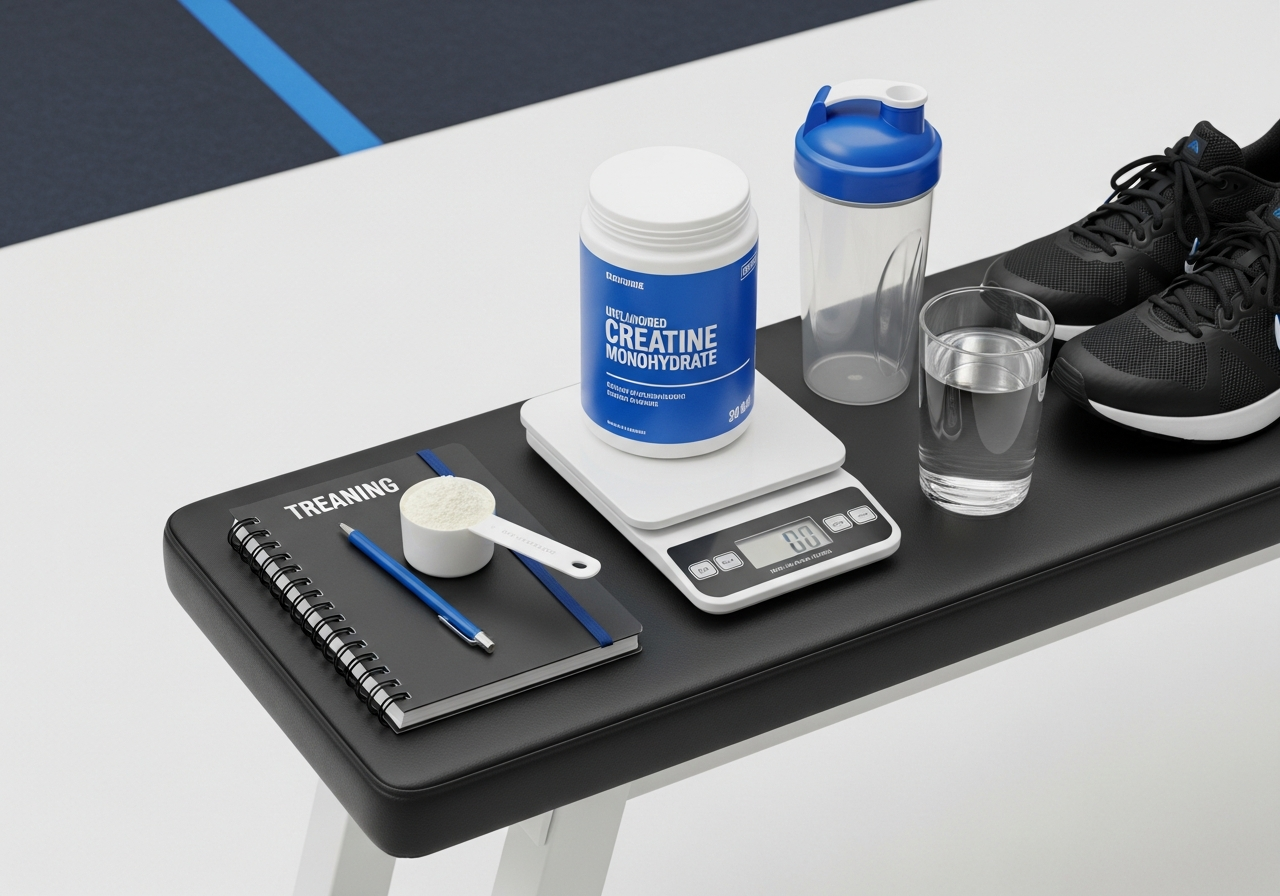
The simplest way to take creatine for volleyball is to use 3–5 g of creatine monohydrate every day, with or without food, and keep taking it consistently on training days and rest days. Consistency matters more than perfect timing because creatine works by saturating muscle stores over time.
- Choose the right form. Buy plain creatine monohydrate powder unless you have a specific reason to prefer capsules. Monohydrate is the best creatine for volleyball because it has the strongest evidence and best cost-effectiveness.
- Pick your dosing approach. Use either a maintenance-only approach of 3–5 g/day or an optional loading phase of 20 g/day split into 4 doses for 5–7 days, then 3–5 g/day.
- Take it daily. Take creatine every day, including off-days, because muscle saturation drops gradually if intake stops.
- Mix it in something easy. Water, juice, or a protein shake all work. If it settles at the bottom, swirl and finish it. More on that in how to mix creatine.
- Pair it with training. Creatine works best when your programme already includes strength, power, and jump work.
- Monitor body mass and performance. Weigh yourself 2–3 times per week under similar conditions and log jumps, sprint times, or lifting performance for 4–8 weeks.
- Troubleshoot if needed. If you get stomach upset, split the dose, take it with food, or use micronized monohydrate.
For most volleyball athletes, there is no need to cycle creatine, no need to “save it” for match days, and no special benefit to dry scooping. The 2021 JISSN review specifically addresses several myths around creatine and reinforces that daily, evidence-based use is the smart approach.
Here is a practical weekly expectation:
- Week 1: no major change if you did not load; mild weight gain is possible.
- Week 2: some players notice better gym pop or less decline in repeated efforts.
- Weeks 3–4: saturated athletes usually have enough time to judge whether training quality is improving.
- Weeks 5–8: on-court benefits are most noticeable when backed by structured power training.
If you want a more personalised starting point, use our creatine dosage calculator, then compare your plan with how to take creatine step by step and whether a loading phase is worth it.
Creatine dose for volleyball players: by body weight, position, and goal
The right creatine dose for most volleyball players is still 3–5 g per day, but body size and goal can help you choose the most sensible point within that range. Larger athletes, harder trainers, and players who want the fastest saturation often do better at the upper end.
| Player profile | Daily dose | Best use case | Notes |
|---|---|---|---|
| Smaller athlete under ~60 kg | 3 g/day | Beginner, maintenance, cautious start | Good first step if body-mass sensitivity is high |
| Most volleyball players ~60–90 kg | 3–5 g/day | General performance, strength, repeated jump support | Most evidence-based real-world range |
| Larger athlete over ~90 kg | 5 g/day | Higher lean mass, heavy training load | Useful if training volume is high |
| Rapid saturation plan | 20 g/day for 5–7 days, split into 4 doses | Need results sooner | Then drop to 3–5 g/day maintenance |
| Body-mass-sensitive jumper | 3 g/day, no loading | Outside hitter/libero converting to front row, beach player | Slower saturation, often less noticeable scale jump |
Volleyball position can shape the decision, though it does not fundamentally change the supplement:
- Middles and opposites: repeated jump and power demands are high, so creatine often makes sense.
- Setters: quick movement, repeated small explosive actions, and training support can still justify use.
- Liberos: benefits are more indirect, mainly through gym training quality and short-burst movement.
- Beach volleyball players: creatine can still help, but body-mass changes and heat-management habits matter more.
If you want to use body-weight maths, a loading phase is often described as roughly 0.3 g/kg/day for 5–7 days, followed by about 0.03 g/kg/day. In practice, that usually lands in the familiar real-world ranges above. Exact perfection is unnecessary; consistency matters more.
If you miss a dose, do not double up in panic. Just resume your normal intake the next day. If you need a broader dosing reference, see how much creatine per day, creatine maintenance dose, and what happens if you miss a day.
Best time to take creatine for volleyball: timing matters less than saturation
The best time to take creatine for volleyball is the time you will remember to take it every day, because muscle saturation matters far more than whether you take it before practice, after lifting, or with breakfast. Creatine is not an acute pre-workout in the way caffeine is.
That said, timing can still be organised in a practical way:
- After lifting: convenient because you already have a routine and may mix it into a shake.
- With a meal: often easiest on the stomach and easiest to remember.
- Before practice: fine, but do not expect a same-day stimulant effect.
- On rest days: still take it, ideally with any regular meal.
For volleyball schedules, the best approach is usually habit-based:
- Morning athletes: take 3–5 g at breakfast.
- After-school or evening athletes: take it with your post-training meal or shake.
- Tournament players: keep taking your usual daily dose; do not increase it on match day expecting a sudden boost.
For creatine beach volleyball, consistency matters just as much, but hydration planning becomes more important because matches often happen in hot, sunny, sweat-heavy conditions. Creatine itself does not dehydrate you, but outdoor athletes need a disciplined hydration routine regardless. See how much water to drink with creatine and the dehydration myth explained.
If you also use caffeine, coffee, or a pre-workout before matches, that is usually compatible with creatine. The old idea that caffeine “cancels out” creatine is not supported as a blanket rule. The more relevant issue is whether the combination irritates your stomach or affects sleep. For more detail, read when to take creatine and creatine and caffeine.
Bottom line: do not overcomplicate timing. Build a routine you can repeat for months, because the athletes who benefit most from creatine are usually the ones who simply take it consistently while training hard.
Who should use creatine for volleyball — and who should think twice
Creatine is a strong fit for many volleyball players, but it is not equally useful for every athlete in every situation. The best candidates are players who want more explosive training output, better repeated-effort capacity, and stronger long-term adaptation to lifting and power work.
Creatine is often a good choice for:
- Beginners who already train seriously: if your basics are in place, creatine is one of the few supplements worth considering early.
- Intermediate and advanced players: athletes with structured strength and jump training often get the clearest performance benefit.
- Women volleyball players: creatine is not just for men, and the “bulking” fear is often misunderstood. Most weight gain is water in muscle, not fat. See creatine for women.
- Vegetarian or vegan athletes: these athletes often start with lower baseline creatine intake from food and may respond especially well. See is creatine vegan and creatine for vegetarians.
- Older adult volleyball players and masters athletes: creatine can support strength and lean mass training, which helps keep power from dropping with age. See creatine for older adults.
- Beach volleyball competitors: useful if repeated-power output is a priority and body-mass tradeoffs are monitored.
Use more caution, or speak to a qualified clinician first, if you:
- have known kidney disease or another significant medical condition
- are pregnant or breastfeeding
- are under 18 and not using supplements under informed adult and professional guidance
- take medications where medical oversight is appropriate
For teenage athletes, context matters. Creatine is not inherently uniquely dangerous for teens, but younger athletes should first nail sleep, food, training, and coaching. Parents and coaches should also avoid “more is better” thinking. If that applies, start with creatine for teenagers and who should not take creatine.
If you are an athlete who gets anxious about any body-mass change, run a 4-week test in the off-season or pre-season rather than starting right before a key tournament. That gives you enough time to judge whether the performance return outweighs any change in scale weight.
Safety, side effects, and the real volleyball tradeoff: more power vs. a little more body mass
Creatine monohydrate is considered safe for healthy people at recommended doses, and the most common side effects are mild digestive upset and a small increase in body mass from water retained inside muscle cells. That safety profile is supported by decades of research and summarised clearly by the ISSN position stand, the JISSN misconceptions review, and mainstream clinical references like the Mayo Clinic overview.
For volleyball, the main practical side effects and tradeoffs are:
- Scale weight increase: often noticeable within the first 1–3 weeks, especially with loading.
- Digestive upset: more likely with large single doses or poor mixing.
- Bloating confusion: many athletes say “bloating,” but true puffiness is less common than simple muscle water retention.
What creatine does not reliably do, based on current evidence:
- It is not a steroid.
- It does not need cycling.
- It does not inherently damage healthy kidneys when used appropriately.
- It does not dehydrate you by default.
- It does not directly make you fat.
The kidney myth persists partly because creatine can raise creatinine, a breakdown marker sometimes used in blood tests. That does not automatically mean kidney damage. It often reflects the normal metabolism of a person taking creatine, which is why context matters when interpreting lab work. If this concerns you, read the creatinine confusion explained and our full safety guide.
How to reduce side effects:
- Use plain monohydrate from a trusted brand.
- Take 3–5 g rather than huge unmeasured scoops.
- Split doses if loading.
- Take it with food if your stomach is sensitive.
- Stay on top of normal hydration, especially for beach volleyball.
For jump-dependent athletes, the real question is not “Is water weight bad?” It is “Does my power increase enough to improve my power-to-weight ratio?” The only good answer comes from your own 4–8 week trial with objective tracking.
Best creatine for volleyball: what to buy in Canada, what to ignore, and how to compare products
The best creatine for volleyball is plain creatine monohydrate from a reputable brand with transparent labelling, a Health Canada Natural Product Number when applicable, and ideally third-party testing. You do not need a “sport-specific” volleyball formula, proprietary blend, or premium creatine form to get the proven benefits.
When buying in Canada, prioritise these checkpoints:
- Form: creatine monohydrate first.
- Dose clarity: grams per serving should be obvious, ideally 3 g or 5 g.
- Ingredient simplicity: fewer extras is usually better if your goal is reliable dosing.
- NPN: a Natural Product Number indicates the product is licensed for sale by Health Canada in the natural health product framework.
- Third-party testing: valuable for athletes who care about purity and contamination risk.
- Cost per 5 g serving: the smartest value metric.
| Option | Best for | Pros | Cons |
|---|---|---|---|
| Creatine monohydrate powder | Most volleyball players | Most studied, best value, easy to dose | Can feel gritty if not mixed well |
| Micronized monohydrate | Sensitive stomachs, easier mixing | Mixes more smoothly | May cost slightly more |
| Capsules | Travel and convenience | No mixing, portable | Usually pricier per gram, many capsules needed |
| Gummies | Taste/convenience seekers | Easy to take | Often poorer value and less efficient dosing |
| HCL or fancy forms | Marketing-driven buyers | Claims of easier digestion | Less evidence than monohydrate, often higher price |
If you compete, especially in university or high-performance settings, product quality matters more than novelty. Buy from reputable Canadian retailers and brands with clear compliance and testing practices. Start your comparison with our best creatine rankings, browse creatine brand reviews, or shop the product catalog. If you are comparing forms, see best type of creatine and monohydrate vs HCL.
The short version is boring but true: the best product is the one that gives you pure monohydrate, accurate dosing, and repeatable daily use at a fair cost.
Common creatine mistakes volleyball players make — plus the myths that still refuse to die
The biggest creatine mistakes in volleyball are taking too much, expecting a same-day jump boost, quitting after a week, and blaming every normal body change on the supplement. Most creatine problems come from bad expectations, not from creatine itself.
Mistake 1: Treating creatine like a pre-workout.
Creatine is not a stimulant and usually does not create an immediate “feel.” Its effect is cumulative through muscle saturation.
Mistake 2: Loading aggressively when you hate stomach upset.
Loading is optional. If 20 g/day bothers your stomach, skip it and use 3–5 g/day.
Mistake 3: Taking it only on practice days.
You need consistent daily intake to keep stores elevated. Rest-day dosing matters.
Mistake 4: Using a fancy form because the label sounds advanced.
Monohydrate remains the evidence standard. More expensive does not mean more effective.
Mistake 5: Ignoring body-mass tracking.
For volleyball, especially jump-sensitive athletes and beach players, you should actually monitor whether body-mass change helps or hurts your performance profile.
Now the common myths:
- “Creatine is a steroid.” False. It is a naturally occurring compound involved in cellular energy metabolism.
- “Creatine causes dehydration and cramps.” Not supported as a general rule. Normal hydration habits are still important.
- “Creatine ruins kidneys.” Not in healthy users at recommended doses, though people with kidney disease should get medical guidance.
- “Creatine makes women bulky.” False. It may increase muscle-cell water and support training, but it does not inherently cause unwanted bulk.
- “You need to cycle it.” False for standard use.
If creatine seems not to be working, troubleshoot systematically:
- Confirm you are actually taking 3–5 g daily.
- Give it at least 3–4 weeks without loading, or 1–2 weeks with loading.
- Check whether your training is power-focused enough to reveal benefits.
- Track repeated-effort performance, not just one jump test.
- Consider that some people respond less strongly than others.
For deeper myth-busting, see creatine myths debunked, myths vs facts, and why creatine may not seem to work.
Bottom line: should indoor and beach volleyball players take creatine?
Yes, many indoor and beach volleyball players should at least consider creatine monohydrate, because it is one of the best-supported supplements for repeated high-intensity performance, strength training quality, and long-term power development. For a sport built on jumping, hitting, blocking, accelerating, and repeating those efforts under fatigue, that is highly relevant.
If you want the shortest practical recommendation, here it is:
- Buy plain creatine monohydrate from a reputable Canadian source.
- Take 3–5 g every day.
- Use a 5–7 day loading phase only if you want faster saturation.
- Keep taking it on rest days.
- Track body mass, gym performance, and repeated jump quality for 4–8 weeks.
Indoor volleyball players often benefit most through better repeated jump power and stronger adaptation to resistance training. Beach volleyball players can also benefit, but should watch hydration habits and body-mass changes a little more closely because sand, heat, and movement cost change the equation.
The supplement is not magic. It will not replace jump technique, sleep, calories, protein, lower-body strength, tendon capacity, or a smart power programme. But when those basics are in place, creatine is one of the few legal, affordable, evidence-based tools that can realistically move the needle.
If you are deciding today, the safe starting point for nearly everyone is maintenance dosing: 3–5 g/day of monohydrate. If after 4–8 weeks your body-mass increase feels unhelpful and your objective power metrics do not improve, you can stop with little downside. But if your lifts improve, your repeated jumps hold up better, and you feel stronger late in sessions, you have your answer.
For next steps, compare products in our best creatine rankings, dial in your dose with the creatine dosage calculator, and learn the fundamentals in creatine for beginners. In volleyball terms, creatine is not a trick play. It is a simple, high-percentage play you can run every day.
Creatine for Volleyball: the numbers that matter
- 3–5 g/day standard daily maintenance dose — The evidence-based range most volleyball players use to stay saturated.
- 20 g/day optional loading dose — Typically split into 4 doses for 5–7 days, then reduced to maintenance.
- 5–7 days typical loading-phase length — Useful if you want faster saturation before a training block.
- 2–4 weeks common time to notice clear benefits without loading — Gym performance and repeated-effort quality often improve before jump tests do.
Frequently Asked Questions
Does creatine help volleyball players jump higher?
Creatine can help volleyball players jump higher, but usually by improving the power and training quality that support jumping rather than by causing an instant dramatic vertical jump increase. Many athletes notice better repeated jump performance, stronger lifting sessions, or less drop-off under fatigue before they see a clear change in max jump height.
What is the best creatine for volleyball?
The best creatine for volleyball is plain creatine monohydrate. It has the strongest evidence, the best cost-effectiveness, and the most reliable dosing, while newer forms are usually more expensive without better proof of superior results.
How much creatine should a volleyball player take?
Most volleyball players should take 3–5 g of creatine monohydrate per day. A loading phase of 20 g/day split into 4 doses for 5–7 days is optional if you want faster saturation, but it is not necessary for creatine to work.
Is creatine good for beach volleyball?
Yes, creatine can be good for beach volleyball because the sport still involves repeated explosive jumps, accelerations, and rallies under fatigue. The main added consideration is that beach players should monitor hydration and body-mass changes more carefully due to heat, sand, and the cost of moving extra weight.
Will creatine make volleyball players gain too much weight?
Creatine usually causes a modest increase in body mass from water stored inside muscle cells, not from fat gain. For volleyball players, that can be either acceptable or counterproductive depending on whether the added power outweighs the extra weight, so tracking both scale weight and performance is important.
Should volleyball players load creatine?
Volleyball players do not need to load creatine, but loading can help saturate muscle stores faster. If you want quicker results before a heavy training phase, 20 g/day split into 4 doses for 5–7 days is reasonable; if you prefer simplicity or have a sensitive stomach, 3–5 g/day works well too.
When should I take creatine for volleyball?
Take creatine whenever you can remember it consistently, because daily saturation matters more than exact timing. Many volleyball players find it easiest to take after lifting, with breakfast, or alongside a post-practice meal or shake.
Can women volleyball players take creatine?
Yes, women volleyball players can absolutely take creatine. The benefits and dosing are broadly similar to men, and the common fear that creatine automatically causes unwanted bulk is misleading because any early weight increase is usually intracellular water, not fat.
Does creatine help volleyball recovery?
Creatine can help volleyball recovery, especially recovery between repeated explosive efforts and the quality of subsequent high-intensity training. It is not a replacement for sleep, calories, and protein, but it may help you maintain output across hard practices, matches, and tournament schedules.
Is creatine safe for volleyball athletes?
Creatine is considered safe for healthy volleyball athletes when used at recommended doses. The most common issues are mild digestive upset and small increases in body mass, while serious concerns are mainly relevant for people with pre-existing medical conditions who should seek professional guidance first.