Creatine for CrossFit: Power, Capacity, and Recovery
By The Creatine Canada Research Team — Evidence-based supplement analysts
Yes—creatine can help CrossFit athletes by improving repeated high-intensity efforts, strength, power output, and training quality across hard WODs, lifts, and sprint-style intervals. For most people doing functional fitness, 3–5 g of creatine monohydrate daily is the simplest, best-supported way to support performance and recovery without overcomplicating timing.
Evidence-based · Cites 4 sources · Editorial standards
Key Takeaways
- Creatine helps CrossFit most when workouts include repeated sprints, heavy lifts, jumps, rowing bursts, and short rest periods.
- Creatine monohydrate is the best creatine for CrossFit because it is the most studied, most effective, and usually the best value.
- A standard maintenance dose is 3–5 g daily; a loading phase of 20 g daily split into 4 doses for 5–7 days saturates muscles faster.
- Expect faster benefits with loading in about 1 week, or in roughly 3–4 weeks without loading.
- Small body-mass increases from intracellular water are common, but that does not mean fat gain.
- Take creatine every day, including rest days, because consistency matters more than workout timing.
- Choose products sold in Canada with clear dosing, an NPN when applicable, and preferably third-party testing.
Does creatine help CrossFit athletes? Yes—especially for power, repeated efforts, and better training quality
Yes, creatine helps many CrossFit athletes because CrossFit demands exactly the energy systems creatine supports best: short, explosive efforts repeated with incomplete rest. If your training includes Olympic lifts, heavy sets, assault bike sprints, rowing intervals, gymnastics power work, or hard WODs with repeated bursts, creatine is one of the most evidence-backed supplements you can take.
Creatine does not act like a stimulant. It will not feel like pre-workout, and it does not give an instant buzz. Instead, it works by increasing your muscle stores of phosphocreatine, the stored high-energy compound your body uses to rapidly regenerate ATP, or adenosine triphosphate, which is the immediate energy currency for muscular contractions. That matters in CrossFit because many key moments in a WOD are decided by how well you can repeat hard efforts: one more unbroken set, a faster bike sprint, a stronger final clean, or less drop-off from round 1 to round 5.
The strongest evidence supports creatine for:
- Strength and power: better output in lifts, sled pushes, jumps, and short sprint efforts.
- Repeated high-intensity capacity: less performance decline across intervals or rounds.
- Training volume: the ability to do slightly more quality work over time, which can compound into better adaptation.
- Lean mass support: often useful in off-season or strength blocks.
For CrossFit specifically, the benefit is usually indirect but valuable: creatine may not magically slash your Fran time overnight, yet it can improve the power and repeatability that underpin many benchmark workouts. That is why creatine and WODs are a practical match, particularly for functional fitness athletes who combine strength, anaerobic conditioning, and skill work in the same week.
The 2017 ISSN position stand concluded that creatine monohydrate is the most effective nutritional supplement currently available for increasing high-intensity exercise capacity and lean body mass during training. For a deeper primer on the supplement itself, see what creatine is and what it does.
The direct answer is simple: if you do CrossFit or functional fitness and want a safe, proven supplement for repeated explosive performance, creatine monohydrate is usually worth taking.
How creatine works in WODs: the exact mechanism behind power, capacity, and recovery
Creatine helps CrossFit by raising intramuscular phosphocreatine stores, which lets you regenerate ATP faster during short, intense efforts and between repeated bursts. That mechanism is why creatine is far more relevant to a 12-minute mixed-modality WOD than many people realise.
Here is the practical physiology. Your body stores only a small amount of ATP directly in muscle. During maximal or near-maximal efforts such as a heavy thruster, a box jump rebound, or a 10-second bike sprint, ATP is used rapidly. Phosphocreatine donates a phosphate to help rebuild ATP quickly. More stored phosphocreatine means a larger buffer for explosive work and slightly better recovery between bursts.
In CrossFit, that can matter in several ways:
- Barbell cycling: You may sustain power a little longer before output drops.
- Short intervals: Rest periods between rounds become more productive because ATP restoration is faster.
- Gymnastics fatigue resistance: Repeated contractions in movements like kipping pull-ups or toes-to-bar may feel more repeatable when your high-energy system is better supported.
- Strength pieces before or after conditioning: Better session quality can help if your programming stacks lifts and metabolic work on the same day.
Creatine may also support training adaptation over weeks and months, not just one workout. If you can hold output a little better, accumulate a little more quality volume, and recover between hard training days a little more effectively, those small edges can add up. This is why creatine for functional fitness is often more about better overall training quality than about a dramatic effect in one single benchmark.
There is also some evidence that creatine may help with muscle recovery markers and glycogen-related training support in certain contexts, but those effects are less central and less consistently meaningful than its role in high-intensity performance. The well-established use case remains short-duration, repeated, high-force exercise.
If you want the short version, it is this: creatine supports the energy system most stressed by lifts, sprints, jumps, and repeated hard intervals, which is why it fits CrossFit programming so well. For a broader performance overview, see the evidence-based list of creatine benefits and our guide to creatine for HIIT.
Best creatine for CrossFit: why monohydrate still beats fancier forms
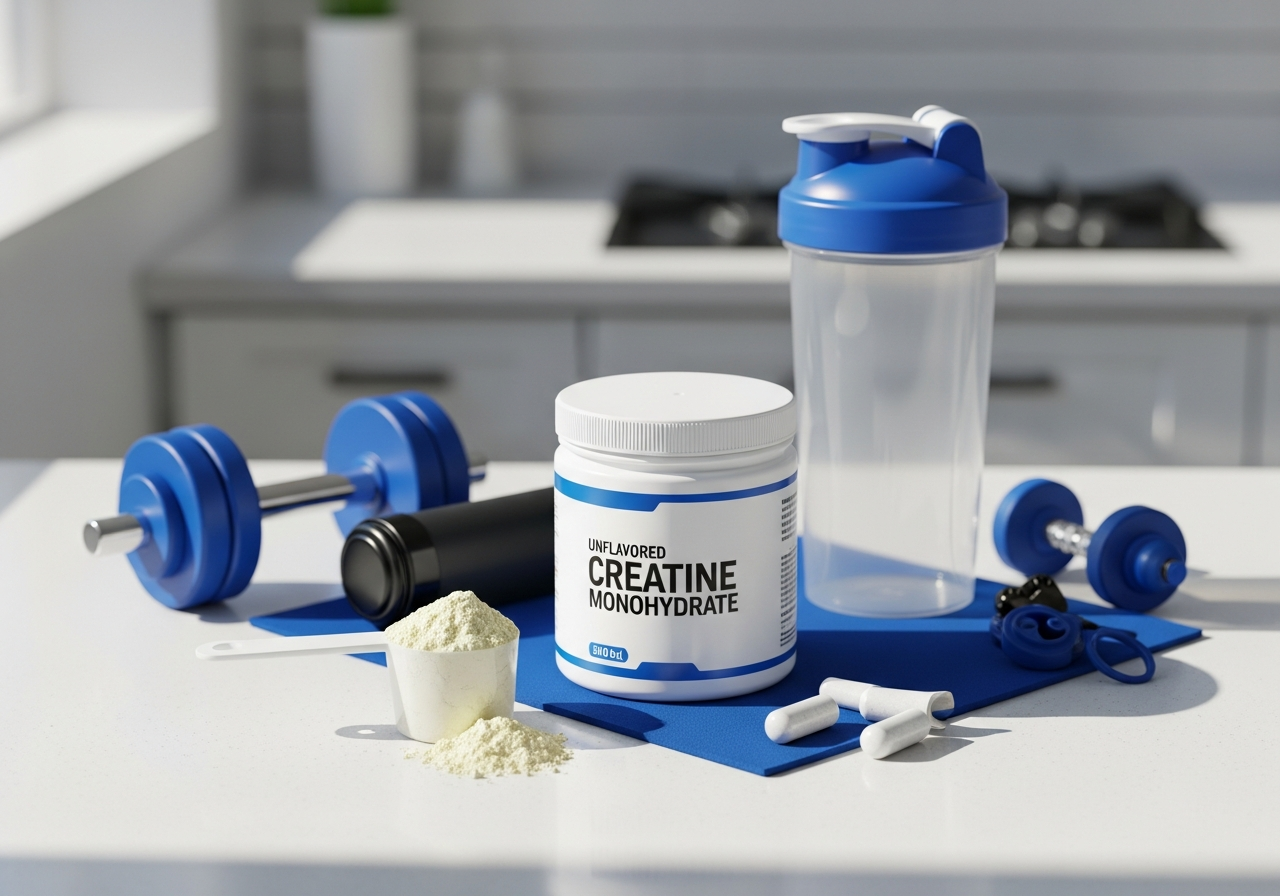
The best creatine for CrossFit is creatine monohydrate, plain and simple. Creatine monohydrate is the most studied form, the form used in the vast majority of positive performance research, and usually the most cost-effective option per effective dose.
Many athletes get distracted by HCL, buffered creatine, gummies, liquids, and proprietary blends marketed for absorption or zero bloating. The problem is not that every alternative form is useless; the problem is that none has consistently beaten monohydrate in the evidence that matters. When a supplement already works well, is inexpensive, and has decades of safety data, the burden of proof is on the more expensive version.
For CrossFit athletes, the practical buying decision should usually come down to purity, price per 5 g, and ease of daily use. Micronized monohydrate can mix more easily, but it is still monohydrate. Creapure is a well-known raw material standard, but non-Creapure monohydrate can also be perfectly good if the brand is reputable.
| Form | Best for | Evidence for performance | Typical verdict for CrossFit |
|---|---|---|---|
| Creatine monohydrate | Almost everyone | Strongest by far | Best default choice |
| Micronized monohydrate | Easier mixing | Same active ingredient | Good if you prefer smoother texture |
| Creatine HCl | People who prefer tiny servings | Much less robust | Usually not worth the premium |
| Buffered/Kre-Alkalyn | Marketing-heavy alternatives | No clear advantage over monohydrate | Skip unless price is similar |
| Gummies/liquids | Convenience | Format can be less economical | Fine if dose and price make sense |
In Canada, look for a product with clear ingredient labelling, lot transparency, and ideally third-party testing. A Natural Product Number, or NPN, on supplements sold in Canada indicates the product has been licensed under Health Canada rules. NPN status is not a guarantee of athletic suitability or contamination testing, but it is a useful legitimacy signal alongside reputable manufacturing.
If you want help choosing, compare options in our best creatine rankings, browse creatine brand reviews, or see the full creatine product catalog. For a deeper form comparison, read best type of creatine.
How to take creatine for CrossFit: the simplest step-by-step plan that actually works
The best way to take creatine for CrossFit is to use 3–5 g of creatine monohydrate every day, including rest days, and keep doing it consistently. Most athletes do not need a complicated protocol.
- Choose creatine monohydrate. Powder is usually the simplest and cheapest format.
- Decide whether you want to load. Loading means 20 g per day split into 4 doses of 5 g for 5–7 days. It saturates muscles faster, but it is optional.
- If not loading, take 3–5 g daily. This reaches saturation more gradually.
- Take it whenever you will remember. Post-workout with your shake, with breakfast, or after dinner all work if you are consistent.
- Mix it well. Stir into water, juice, or a protein shake. If it settles, swirl and finish it.
- Keep taking it on rest days. Creatine works by maintaining saturation, not by acutely boosting one workout.
Here is what a beginner-friendly rollout looks like:
- Option 1: No loading. Take 5 g once daily every day. This is easiest for most people.
- Option 2: Loading. Take 5 g four times per day for 5–7 days, then switch to 3–5 g daily.
If you get stomach upset, the fix is usually practical rather than dramatic:
- Split the dose into smaller servings.
- Take it with food.
- Use fully dissolved powder in more liquid.
- Do not dry scoop it.
CrossFit athletes often ask whether creatine should be saved for only training days. The answer is no. Your muscles do not reset every morning; creatine works through tissue saturation over time. Skipping rest days makes your routine less consistent for no benefit.
If you train early, take it whenever it fits. If you train late, same answer. Timing matters much less than daily intake. For detailed practical instructions, see how to take creatine, how to mix creatine, and our creatine dosage calculator.
The shortest effective plan is this: buy monohydrate, take 5 g per day, do not overthink the clock, and stay consistent for at least a month before judging results.
Creatine dose by body weight and goal: maintenance, loading, cutting, and competition prep
For most CrossFit athletes, the right creatine dose is 3–5 g daily, but body size and goal can help you fine-tune where you sit in that range. Bigger athletes and those with more lean mass often do well near the higher end.
The evidence-based loading protocol is 20 g daily, usually split into 4 doses of 5 g, for 5–7 days, followed by a maintenance dose of 3–5 g daily. A common alternative described in sports nutrition is about 0.3 g/kg/day for loading and roughly 0.03 g/kg/day for maintenance, though most people can use simpler fixed doses successfully.
| Body weight | Conservative daily dose | Common daily dose | When to use the higher end |
|---|---|---|---|
| Under 60 kg | 3 g | 3–5 g | High training frequency or loading follow-up |
| 60–80 kg | 3 g | 5 g | Most CrossFit athletes fit here |
| 80–100 kg | 5 g | 5 g | Usually ideal for larger athletes |
| Over 100 kg | 5 g | 5–7 g | Large lean athletes may prefer upper range |
Goal-specific guidance:
- General CrossFit performance: 5 g daily is the easiest and most common choice.
- Trying to feel effects quickly: Use a 5–7 day loading phase, then 3–5 g daily.
- Cutting or fat loss phase: Keep taking creatine. It can help preserve training quality even in a calorie deficit. Read more in creatine during a cut.
- Weight-class or appearance-sensitive phase: Consider skipping loading if a quick 1–2 kg scale increase from water would bother you.
- Travel or competition week: Stay on your normal daily dose; do not stop unless weigh-in strategy demands it.
CrossFit athletes are often caught between wanting maximum power and wanting to stay light for gymnastics or running. That is where strategy matters. If you are entering a phase where relative strength and movement efficiency matter more than peak mass, choose the lower end of maintenance and skip loading. If you are in a strength cycle, off-season block, or trying to improve barbell repeatability, standard dosing is usually ideal.
For more precise planning, see how much creatine per day and creatine maintenance dose.
When to take creatine around CrossFit workouts: timing matters less than consistency
The best time to take creatine for CrossFit is the time you will reliably remember every day, because total daily intake matters more than pre- versus post-workout timing. For most athletes, consistency beats precision.
This point matters because CrossFit attracts people who already have pre-workout drinks, intra-workout carbs, post-workout shakes, and recovery habits. Creatine is simpler than most of those. It is not a stimulant, and it does not need to be “felt” during the session to work. Once your muscle stores are saturated, the key is maintaining them.
Practical timing options:
- Post-workout: Convenient if you already use a shake or meal after training.
- Pre-workout: Fine if that is your habit, especially if you mix it into a regular drink.
- With a meal: Good for people prone to mild digestive upset.
- Rest-day breakfast or lunch: Easy habit anchor for non-training days.
What about taking creatine with protein or carbs? That is completely fine. You can mix creatine into a protein shake without reducing its effectiveness, and many athletes find that pairing it with an existing meal improves adherence. If you routinely use caffeine before CrossFit, current evidence does not justify avoiding creatine because of caffeine. The old idea that they cancel each other out is not supported strongly enough to change normal practice.
The bigger timing issue for many CrossFit athletes is routine disruption. If your class schedule changes, if you alternate early mornings and evening open gym, or if weekends are inconsistent, tying creatine only to workouts may cause missed doses. Tying it to a daily anchor such as breakfast or your post-training shake is more reliable.
If you miss one day, do not panic and do not double your dose the next day. Just resume your normal amount. Missing a single day is unlikely to meaningfully change muscle saturation.
For more on timing, caffeine, and stacking, read when to take creatine, creatine and caffeine, and mixing creatine with protein powder.
The direct answer remains the same: take creatine daily at a time that makes compliance nearly automatic.
What results to expect from creatine in CrossFit: realistic week-by-week changes and how to tell it is working
Creatine usually works gradually in CrossFit, and the earliest signs are often better repeatability, slightly stronger training sessions, and less drop-off across rounds rather than an obvious dramatic feeling. That is normal.
If you use a loading phase, you may notice effects within about a week. If you start with 3–5 g daily without loading, many athletes notice useful changes after roughly 3–4 weeks, once muscle creatine stores are more fully saturated. For more on timelines, see how long creatine takes to work.
A realistic timeline looks like this:
- Week 1 with loading: Body weight may rise slightly from intracellular water. Some athletes feel better pop in sprints or lifting.
- Weeks 2–3: Better consistency in intervals, repeated efforts, and barbell work may become more noticeable.
- Weeks 4–8: Training quality improvements can accumulate into better strength progress, more completed reps at a given load, or less fade late in a WOD.
- Months 2–3 and beyond: The biggest payoff is often the adaptation from more quality training, not a single acute performance spike.
Good ways to track whether creatine is helping:
- Log split times on repeated intervals such as row or bike efforts.
- Track whether later rounds stay closer to your first round pace.
- Note whether heavy doubles, triples, or EMOM power work feel more stable.
- Compare total reps completed in benchmark interval sessions.
- Monitor body weight and how you feel in gymnastics movements.
What should you not expect? Creatine is unlikely to turn a poor aerobic base into great engine performance by itself, and it will not replace good programming, sleep, hydration, or food intake. It also may not help every single workout equally. Long, steady, low-intensity efforts are not its main domain.
If you feel nothing after a month, that does not automatically mean it failed. You may be a less noticeable responder, your testing may be too subjective, or your event demands may skew more aerobic. Read why creatine may not seem to work if results are unclear.
Who should use creatine in functional fitness: beginners, women, masters athletes, and plant-based competitors
Creatine is useful for many types of CrossFit and functional fitness athletes, including beginners, women, older adults, and plant-based athletes. The dose is usually similar across these groups, but the reasons it helps can differ.
Beginners: Yes, beginners can take creatine. In fact, new athletes often benefit because they are building strength, work capacity, and movement confidence all at once. Creatine will not teach technique, but it can support the training adaptations beginners are chasing. If you are new, start with a simple 3–5 g daily routine. Our creatine for beginners guide covers the basics.
Women: Women benefit from creatine too, and the common fear of “bulking” is usually misplaced. The scale may rise a little from water stored inside muscle, but that is not the same thing as body fat gain. Women doing CrossFit often use creatine for strength, performance, and training recovery support. See creatine for women for a deeper breakdown.
Older adults and masters athletes: Creatine can be particularly relevant for athletes over 50 because preserving muscle, strength, and high-intensity performance becomes more important with age. In masters CrossFit, maintaining power output and recovery between training days can matter just as much as absolute strength.
Vegetarian and vegan athletes: Plant-based athletes may respond especially well because dietary creatine intake is often lower when little or no meat is eaten. That makes supplementation a practical way to close the gap. See is creatine vegan and creatine for vegetarians.
Athletes in strength-biased programming: If your current cycle includes Olympic lifting, heavy squats, sprint intervals, or repeated power pieces, creatine is especially well matched.
Who should be more cautious? Anyone with a known medical condition, especially pre-existing kidney disease, or anyone using medication that raises a concern about supplementation should speak with a qualified healthcare professional first. That is not because creatine is broadly unsafe in healthy people, but because individual medical context matters.
Direct answer: most healthy CrossFit athletes can use creatine effectively, and several groups—women, masters athletes, and plant-based athletes—often have especially compelling reasons to consider it.
Safety, side effects, and CrossFit myths: water weight, kidneys, cramps, dehydration, and hair loss
Creatine is generally considered safe for healthy people when used at recommended doses, and the most common side effects are minor digestive upset or temporary body-weight increase from water stored inside muscle. Most scary creatine claims do not hold up well against the full evidence base.
The 2017 ISSN position stand and the 2021 review on common questions and misconceptions both concluded that creatine monohydrate is safe for healthy individuals across a wide range of populations when used appropriately. The Mayo Clinic also notes that creatine appears to be safe for up to several years in healthy people at recommended doses.
Common concerns, answered directly:
- Does creatine harm the kidneys? In healthy people, standard creatine use has not been shown to damage kidneys. Confusion often comes from creatinine, a blood marker that can rise with creatine use without indicating kidney injury. See the kidney guide.
- Does creatine dehydrate you? No, creatine does not appear to cause dehydration when normal fluid intake is maintained. The idea that it pulls water away from the body in a harmful way is outdated. Read creatine and dehydration.
- Does it cause cramps? The evidence does not support creatine as a cause of muscle cramps in healthy athletes. Myth explained here.
- Does it cause bloating? Some people feel stomach fullness or notice a scale increase, especially during loading, but true persistent bloating is not inevitable. Troubleshooting guide.
- Does creatine cause hair loss? The evidence is far too limited to say creatine causes hair loss in general use. The claim is based largely on indirect concern, not strong clinical proof. See the DHT research breakdown.
The most common real-world side effect in CrossFit athletes is simply this: you may gain a small amount of scale weight from increased intracellular water. That can be helpful for leverage and training quality, neutral for most people, or mildly annoying if you are very sensitive to gymnastics efficiency or weight-class targets. If that matters, skip loading and use a straight maintenance dose.
For a broader evidence review, read is creatine safe and creatine myths debunked.
The biggest creatine mistakes CrossFit athletes make—and how to fix them fast
The biggest mistakes with creatine in CrossFit are choosing the wrong product, taking it inconsistently, expecting stimulant-like effects, and abandoning it because of normal water-weight changes. Most creatine “doesn't work for me” stories come down to execution, not the supplement itself.
Here are the common errors and the fix for each one:
- Taking it only before hard WODs. Creatine is not a one-off performance shot. Fix: take it every day, including rest days.
- Using underdosed blends. Many pre-workouts sprinkle in small amounts that do not match evidence-based dosing. Fix: check the label and ensure you are actually getting 3–5 g daily.
- Switching forms constantly. Chasing the latest “better absorbed” version often just costs more. Fix: stick to monohydrate unless you have a specific reason not to.
- Judging it after a few days without loading. Without loading, saturation takes time. Fix: give it at least 3–4 weeks.
- Stopping because the scale went up. A mild increase is usually water in muscle, not fat gain. Fix: assess performance and body composition in context. See water vs fat vs muscle.
- Taking huge doses forever. More is not better once saturated. Fix: use maintenance after loading.
- Ignoring digestion issues. Upset stomach is often a dosing or mixing problem. Fix: split doses, take with food, and use more water. See digestive side effects explained.
A subtle CrossFit-specific mistake is using creatine while ignoring the real limiters of performance. If your sleep is poor, your carbs are too low for your training volume, or your pacing is reckless, creatine cannot rescue that. It is a useful tool, not a replacement for smart programming and recovery habits.
Another mistake is dropping creatine during deloads or light weeks. There is usually no advantage to stopping. Stable saturation supports continuity, and a deload week is often the easiest week to stay on routine.
The practical fix is boring but effective: buy a basic monohydrate, measure the dose accurately, anchor it to a daily habit, and evaluate results over training blocks rather than one workout.
Buying creatine in Canada for CrossFit: what to look for on the label and what actually matters
If you are buying creatine for CrossFit in Canada, the main things to check are the form, the effective dose per serving, the ingredient list, manufacturing quality signals, and overall cost per gram. The right label tells you more than flashy marketing ever will.
Start with these buying criteria:
- Form: Look for creatine monohydrate first.
- Dose transparency: A serving should clearly provide the grams of creatine, typically 3 g or 5 g.
- Minimal extras: Unflavoured monohydrate with few ingredients is often the cleanest value play.
- Canadian compliance: An NPN, or Natural Product Number, indicates Health Canada licensing where applicable.
- Third-party testing: Particularly useful for competitive athletes who want extra assurance around purity and contamination risk.
- Value: Compare price by number of effective servings, not by tub size or branding.
Competitive CrossFit athletes should be especially cautious with multi-ingredient products marketed as “performance matrices” or “strength complexes.” These may contain unnecessary ingredients, underdose creatine, or make it harder to know what is actually helping. Plain monohydrate keeps things simple and auditable.
Also consider format. Powder is usually the best value. Capsules can work if you hate mixing, but reaching a full 5 g dose may require multiple capsules. Gummies may be convenient, but they are often pricier per effective dose and sometimes include added sugars.
If you buy online in Canada, stick to reputable retailers and brands with clear lot and contact information. If a label hides the exact amount of creatine behind a proprietary blend, that is usually a pass.
Useful next steps:
- Best creatine monohydrate in Canada
- Buying creatine online in Canada
- Canadian supplement regulations and NPNs
The direct answer is this: for CrossFit in Canada, buy a straightforward creatine monohydrate from a reputable brand, make sure the dose is explicit, and treat fancy claims with healthy skepticism.
Bottom line: should you take creatine for CrossFit?
Yes—if you do CrossFit or functional fitness and want a supplement with strong evidence for repeated high-intensity performance, strength, and training support, creatine monohydrate is one of the best choices you can make. It is not magic, but it is one of the few supplements that consistently earns its place.
The key points are straightforward:
- Use creatine monohydrate.
- Take 3–5 g daily, every day.
- Use a 20 g daily loading phase for 5–7 days only if you want faster saturation.
- Do not obsess over timing; consistency matters more.
- Expect the biggest payoff in power, repeated efforts, and the ability to sustain training quality.
- Be prepared for a possible small water-weight increase, especially if you load.
For CrossFit specifically, creatine is most useful when your training includes hard intervals, explosive work, and repeated bouts with incomplete recovery. That describes a large share of WODs. It may be less obviously helpful for long, easy aerobic work, but CrossFit is rarely only that.
If you are still deciding, the risk-reward profile is favourable for most healthy athletes: low cost, strong evidence, easy dosing, and a realistic chance of measurable performance benefit over a training block. That is why creatine for CrossFit remains such a common recommendation among evidence-based sports nutrition practitioners.
Before you start, you can use the creatine dosage calculator to set your dose, then compare options in the best creatine rankings. If you want a wider safety review, read the ISSN position stand, the JISSN misconceptions review, and the IOC consensus on supplements.
Final answer: for most healthy CrossFit athletes, creatine monohydrate is a smart, evidence-based supplement for better power, capacity, and long-term training quality.
Creatine for CrossFit: the numbers that matter
- 3–5 g/day Standard maintenance dose — Best fit for most CrossFit athletes using creatine monohydrate
- 20 g/day Optional loading dose — Usually split into 4 doses for 5–7 days to saturate muscles faster
- 5–7 days Fastest saturation window — Typical timeline when using a proper loading phase
- 3–4 weeks Typical no-loading timeline — Common time to fuller saturation when taking 3–5 g daily
Frequently Asked Questions
Does creatine help CrossFit workouts?
Yes, creatine can help CrossFit workouts, especially when they involve repeated high-intensity efforts, heavy lifts, jumps, sprints, and short rest periods. It works by increasing muscle phosphocreatine stores, which helps regenerate ATP faster during explosive efforts. The benefit is usually better repeatability and training quality rather than a stimulant-like feeling.
What is the best creatine for CrossFit?
The best creatine for CrossFit is creatine monohydrate. It is the most studied form, the one used in the majority of positive sports-performance research, and usually the most cost-effective option. Micronized monohydrate is also fine if you want easier mixing, but the core recommendation remains monohydrate.
How much creatine should a CrossFit athlete take?
Most CrossFit athletes should take 3–5 g of creatine monohydrate daily. If you want faster saturation, you can use a loading phase of 20 g per day split into 4 doses for 5–7 days, then switch to 3–5 g daily. Larger athletes often prefer the higher end of the maintenance range.
Should I take creatine before or after a WOD?
You can take creatine either before or after a WOD, because timing is less important than daily consistency. Creatine works by saturating muscle stores over time, not by producing an acute effect in a single session. The best time is the time you are most likely to remember every day.
Will creatine make me heavier for gymnastics or running in CrossFit?
Creatine can increase body weight slightly because it draws more water into muscle cells, but that does not mean fat gain. For some athletes, that small increase is neutral or even beneficial for strength and power; for others who are highly sensitive to relative body weight, skipping the loading phase can reduce the sudden change.
Is creatine good for functional fitness beginners?
Yes, creatine is good for many functional fitness beginners because it supports the same adaptations they are trying to build: strength, power, and repeated training quality. Beginners do not need a special protocol beyond a simple 3–5 g daily routine. Technique practice and sound programming still matter more than any supplement.
Can women take creatine for CrossFit?
Yes, women can absolutely take creatine for CrossFit, and the evidence does not support the idea that it automatically causes unwanted bulk. The usual dose is the same 3–5 g daily used by men. Many women use creatine to support strength, high-intensity performance, and recovery between hard sessions.
Is creatine safe for CrossFit athletes?
Creatine is generally considered safe for healthy CrossFit athletes when used at recommended doses. The best-supported evidence reviews, including the ISSN position stand, report a strong safety profile for creatine monohydrate in healthy people. Anyone with a medical condition, especially known kidney disease, should check with a qualified healthcare professional first.
Do you need to cycle creatine for CrossFit?
No, you do not need to cycle creatine for CrossFit. Creatine works best when taken consistently to keep muscle stores saturated, and there is no evidence-based requirement to rotate on and off in healthy users. Most athletes can simply take their daily maintenance dose year-round.
Why doesn't creatine seem to work for my WODs?
Creatine may seem like it is not working if you have not taken it long enough, are using too little, are taking it inconsistently, or are judging it by feeling instead of by performance trends. It also helps high-intensity repeat efforts more than long steady aerobic work. Give it at least several weeks unless you use a loading phase, and track objective training markers.