Liquid Creatine: Convenient, but Does It Actually Work?
By The Creatine Canada Research Team — Evidence-based supplement analysts
Liquid creatine is convenient, but most ready-to-drink liquid creatine products are a weaker bet than plain creatine monohydrate powder because creatine breaks down in water over time. If your goal is proven strength, muscle, and performance benefits, creatine monohydrate mixed shortly before drinking remains the most evidence-based choice.
Evidence-based · Cites 4 sources · Editorial standards
Key Takeaways
- Yes, liquid creatine can work if the creatine is still intact when you drink it, but long-stored ready-to-drink forms are often less reliable than powder.
- Creatine monohydrate powder is still the most studied, most cost-effective, and most dependable form of creatine.
- The main issue with liquid creatine is stability: creatine in water gradually converts to creatinine, which does not deliver the same performance benefit.
- A standard effective dose is 3-5 g per day, or about 0.1 g/kg/day for many active adults.
- Timing matters far less than consistency; daily intake is what raises and maintains muscle creatine stores.
- If you want convenience without the stability downside, powder mixed right before use or capsules are usually smarter choices than pre-bottled liquid creatine.
- In Canada, look for a Natural Product Number (NPN), a clear creatine amount per serving, and preferably third-party testing.
What liquid creatine actually is, and the short answer on whether it works
Liquid creatine usually means creatine sold already dissolved in a fluid, and the short answer is that it can work, but it is generally less dependable than creatine powder because dissolved creatine is less stable over time. That is the central issue behind the question “does liquid creatine work”: the problem is not that creatine stops being creatine in your body, but that some of it may no longer be creatine by the time you drink it.
Creatine itself is a naturally occurring compound stored mostly in muscle, where it helps regenerate adenosine triphosphate, or ATP, the cell’s immediate energy currency, during short, intense efforts. The most researched supplemental form is creatine monohydrate. The 2017 ISSN position stand concluded that creatine monohydrate is the most effective nutritional supplement available for increasing high-intensity exercise capacity and lean body mass when paired with training. That conclusion is about creatine as an ingredient, not every delivery format marketed around it. Kreider et al. (2017), ISSN Position Stand
So, is liquid creatine effective? Sometimes, yes, but only if the product delivers enough intact creatine at the time of use. Freshly mixed creatine in water is effectively just creatine powder taken as a drink, and that is fine. A shelf-stable bottle that has sat in liquid for weeks or months is where doubt increases. Many consumers hear “liquid” and assume faster absorption or better results, but the research does not show a reliable advantage over standard powder.
For most people, the practical answer is simple:
- Best evidence: creatine monohydrate powder mixed and consumed soon after mixing.
- Good convenience option: capsules or travel sachets.
- Higher uncertainty option: pre-mixed liquid creatine bottles, shots, or long-stored RTDs.
If you are new to the supplement, start with the basics in what creatine is and what it does and use a creatine dosage calculator to set your daily target. If you already own a liquid product, the next question is not “liquid vs powder” in the abstract; it is whether the label, formulation, and storage conditions make that specific liquid product trustworthy.
Why liquid creatine has a stability problem that powder largely avoids
Liquid creatine’s biggest drawback is stability, because creatine dissolved in water gradually degrades into creatinine over time. Creatinine is a breakdown product, not the performance-enhancing form you are trying to load into muscle.
This is the key mechanism behind the “liquid creatine stability” concern. Dry creatine monohydrate powder is relatively stable when stored properly in a sealed container away from moisture and heat. Once creatine sits in a liquid environment, especially for extended periods, the chance of degradation increases. The rate depends on factors such as pH, temperature, time in solution, and the product’s formulation. Acidic drinks and warm storage conditions can make the problem worse.
That is why “liquid creatine vs powder” is not really about whether your gut absorbs liquids better. It is about whether the bottle still contains the labelled amount of active creatine by the time you drink it. Freshly mixed powder in water is not the same thing as a ready-to-drink creatine beverage that has been bottled and stored. In practice, they should be treated as different products.
Antonio et al. (2021) reviewed common questions and misconceptions about creatine supplementation and reinforced a broader point that matters here: many marketed creatine formats have far less supporting evidence than monohydrate. The burden of proof is on a novel delivery system to show it delivers at least as much active creatine, as consistently, as standard monohydrate.
Here is the simple chemistry-to-real-world translation:
- Powder in a dry tub: usually stable and predictable.
- Powder mixed and drunk soon after: generally fine.
- Pre-mixed liquid stored for long periods: less certain, because some creatine may have converted to creatinine.
This is also why many experienced users skip liquid creatine entirely and stick with plain monohydrate. You are not paying for “better absorption”; you may be paying for water, flavouring, packaging, and a more fragile format. If your priority is a format that simply works, see best type of creatine and why monohydrate still wins.
The bottom line in one sentence: the main scientific objection to liquid creatine is not that creatine itself is ineffective, but that creatine in solution is harder to keep intact until the moment you consume it.
What the research actually supports for performance, muscle, and recovery
The research strongly supports creatine monohydrate for strength, lean mass, and repeated high-intensity performance, but it does not give liquid creatine a special advantage. When people ask “is liquid creatine effective,” the evidence-based answer is that the benefits come from saturating muscle with creatine, not from using a liquid format.
Creatine works by increasing muscle phosphocreatine, which is stored creatine bound to phosphate and used to rapidly regenerate ATP during intense efforts such as sprinting, jumping, or heavy sets. Over time, higher phosphocreatine availability can help you perform a little more work, recover better between repeated bouts, and build more strength and lean mass through improved training quality. The performance effect is not magic; it is usually modest but meaningful, especially over weeks and months of consistent training.
The 2017 ISSN position stand remains one of the clearest summaries: creatine monohydrate is the most effective supplement for increasing high-intensity exercise capacity and lean body mass. The International Olympic Committee consensus on supplements also recognises creatine as one of the few sports supplements with strong evidence for specific performance uses. IOC consensus (2018)
What does that mean in practical terms?
- Strength and power: best-supported benefit, especially for repeated high-intensity effort.
- Lean mass: commonly improved over training blocks when combined with resistance exercise.
- Recovery between efforts: often improved in sprint-style or repeated-bout exercise.
- Endurance: less direct benefit, though some endurance athletes may benefit in sprint finishes, repeated surges, or strength support.
What the evidence does not support well is the idea that liquid creatine provides faster uptake, superior absorption, or bigger gains than powder. If the same amount of intact creatine reaches the body, the body does not care whether that creatine came from a scoop mixed in water, a capsule, or a bottle. The issue is simply whether the labelled dose is still present and bioavailable.
If your goal is to maximise results with the least guesswork, choose a form with the strongest evidence and the fewest stability problems. That usually means monohydrate from a reputable brand. For a broader benefits overview, see the evidence-based list of creatine benefits and how creatine helps build muscle.
Liquid creatine vs powder: the practical comparison most buyers actually need
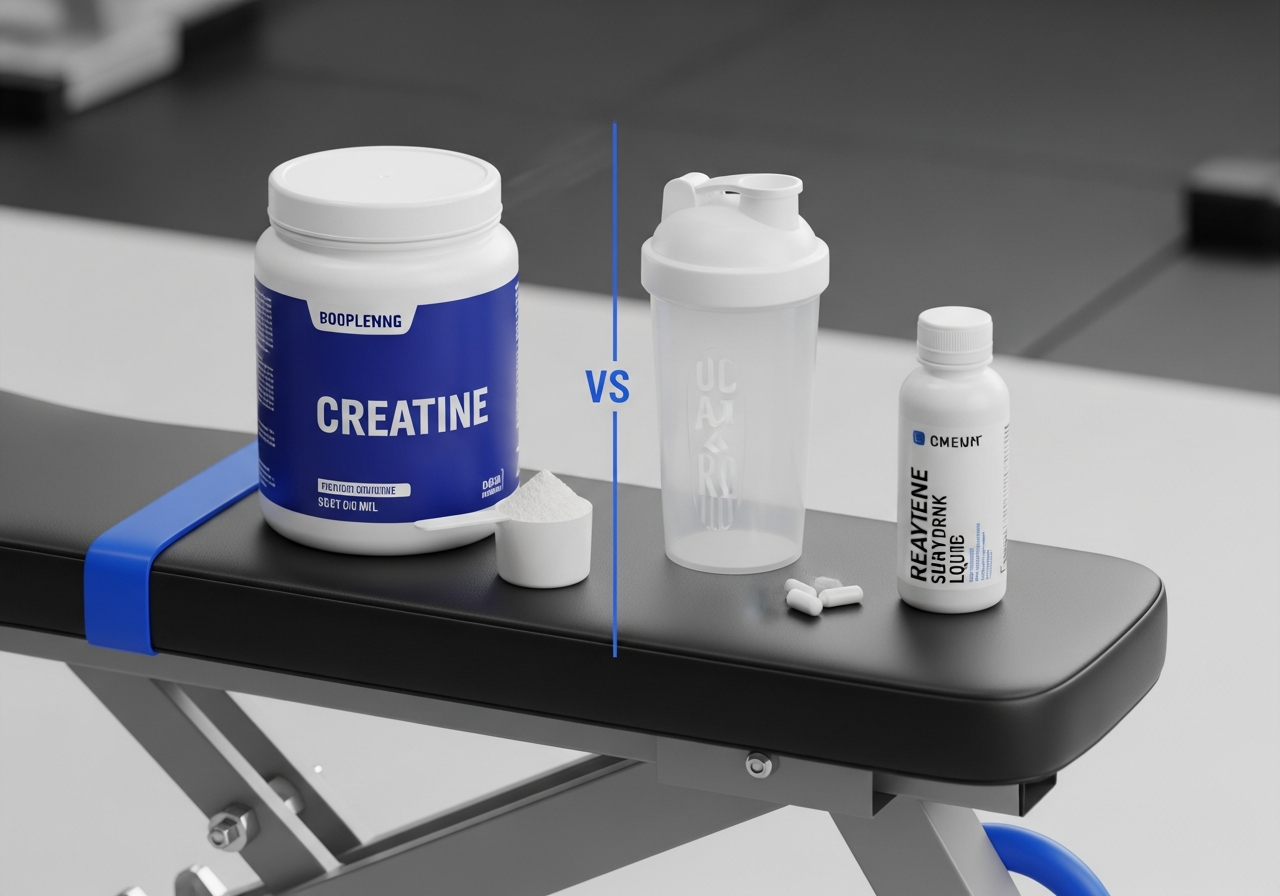
Creatine powder is usually the better buy than liquid creatine because it is more stable, more researched, and typically more cost-effective per effective gram. Liquid creatine mainly wins on grab-and-go convenience, not on evidence or value.
The comparison below captures the tradeoffs clearly.
| Format | Main advantage | Main drawback | Evidence strength | Best for |
|---|---|---|---|---|
| Creatine monohydrate powder | Most studied, stable in dry form, easy to dose 3-5 g/day | Requires mixing | Strongest | Most people |
| Freshly mixed creatine drink | Same ingredient benefits with easy drinking | Should be consumed reasonably soon after mixing | Strong, if using monohydrate | People who dislike dry scooping or capsules |
| Capsules | Portable, no mixing, stable | Often many capsules needed to reach 3-5 g | Strong, if label dose is accurate | Travel, work, convenience |
| Ready-to-drink liquid creatine | Most convenient to grab and drink | Stability concerns in solution; often pricier | Weaker and product-specific | Niche use only |
For beginners, the smartest question is not “what feels easiest right now?” but “what am I most likely to take daily for months, at the right dose, with confidence that it still works?” Powder usually wins that test. One scoop into water, a shake, and you are done. If mixing is the only barrier, look at how to take creatine properly or how to mix creatine without clumping.
There are a few cases where liquid creatine might still make sense:
- You need an occasional travel-friendly option and trust the manufacturer’s quality controls.
- You strongly dislike powders and will otherwise skip creatine entirely.
- You are using a product designed to be mixed immediately before drinking rather than long-stored in solution.
But even then, compare labels carefully. Some liquid products underdose creatine per serving, blend it with proprietary ingredients, or distract from the actual gram amount with marketing language like “advanced transport system” or “rapid uptake matrix.” Those phrases do not replace a simple, transparent dose of creatine monohydrate.
If you are shopping, compare options in the creatine product catalog, read creatine brand reviews, and see our best creatine rankings before paying a premium for convenience alone.
If you already bought liquid creatine, here is how to use it as intelligently as possible
If you already have liquid creatine, the best approach is to verify the actual creatine dose, use it consistently, and minimise storage and heat exposure. You do not need to throw it out automatically, but you should be realistic about the format’s limitations.
Use this step-by-step process:
- Read the label carefully. Look for the exact amount of creatine per serving in grams, not vague blend names. If it does not clearly tell you how many grams of creatine you get, that is a red flag.
- Check the serving size against proven dosing. Most adults need 3-5 g of creatine per day for maintenance, or roughly 0.1 g/kg/day in many practical cases. If one bottle or shot gives much less, you may be underdosing.
- Check storage instructions. If the product says refrigerate after opening or avoid heat, follow that closely. Warm cars, gym bags, and sunny windows are bad places for a liquid creatine product.
- Use it daily. Creatine works by saturation, not by a one-off pre-workout buzz. Take it every day, including rest days. For more on consistency, see creatine on rest days.
- Do not assume more is better. Chasing higher doses will not compensate elegantly for a poor product. If the label dose is unclear or low, switching to powder is usually smarter than improvising.
- Track outcomes for 3-4 weeks. Watch gym performance, body weight, muscle fullness, and repeated-effort quality. If nothing changes and your training and nutrition are solid, question the product before assuming creatine “doesn’t work for you.”
If you are deciding between using up liquid creatine or switching today, the answer depends on your tolerance for uncertainty. If the product is from a reputable brand, clearly labelled, and recently purchased and stored properly, using it up is reasonable. If it is old, heat-exposed, underdosed, or marketed with more buzzwords than grams, move on.
The simplest low-risk alternative is this: buy plain creatine monohydrate powder, measure 3-5 g, mix it with water or a shake, and drink it soon after mixing. That gives you the convenience of a liquid dose without the long-term stability issue. If you want a precise maintenance target, see how much creatine per day and the right maintenance dose.
The right dose by body weight and goal, whether you use liquid or not
The effective creatine dose is based on total daily creatine intake, not on whether the supplement is liquid, powder, or capsules. For most people, 3-5 g per day is enough to maintain saturated muscle stores once you have built them up.
There are two standard ways to take creatine:
- No loading: take 3-5 g daily. This usually saturates muscle stores in about 3-4 weeks.
- Loading phase: take about 20 g per day, split into 4 doses of 5 g, for 5-7 days, then continue with 3-5 g daily. This saturates stores faster.
A body-weight method also works well: roughly 0.1 g/kg/day as a practical daily target for many active adults. That does not mean everyone must dose precisely by kilogram, but it is useful when body size is far from average.
| Body weight | Practical daily maintenance target | Example goal |
|---|---|---|
| 55 kg | 3 g/day | General fitness, smaller body size |
| 70 kg | 3-5 g/day | Most recreational lifters |
| 85 kg | 5 g/day | Strength, hypertrophy, team sports |
| 100 kg+ | 5 g/day, sometimes slightly more by coach/practitioner preference | Larger athletes wanting consistent saturation |
By goal, here is the practical breakdown:
- Strength and muscle gain: 3-5 g/day; load if you want faster effects.
- HIIT, sprint, CrossFit-style repeated efforts: 3-5 g/day; loading can be helpful before a training block.
- General health, healthy ageing, or cognitive interest: 3-5 g/day is the usual practical range, though these areas are broader and some applications remain emerging.
- Vegetarians or vegans: standard dosing still applies, but they may notice a stronger response because baseline creatine stores are often lower.
With liquid creatine specifically, dosing discipline matters more because some products provide oddly small servings. If a bottle provides only 1-2 g per serving, that is not equivalent to a standard 3-5 g monohydrate dose unless you take multiple servings.
For help personalising the numbers, use the creatine dosage calculator, then compare it with our guides on the creatine loading phase and how long creatine takes to work.
Best timing, mixing, and what to expect week by week
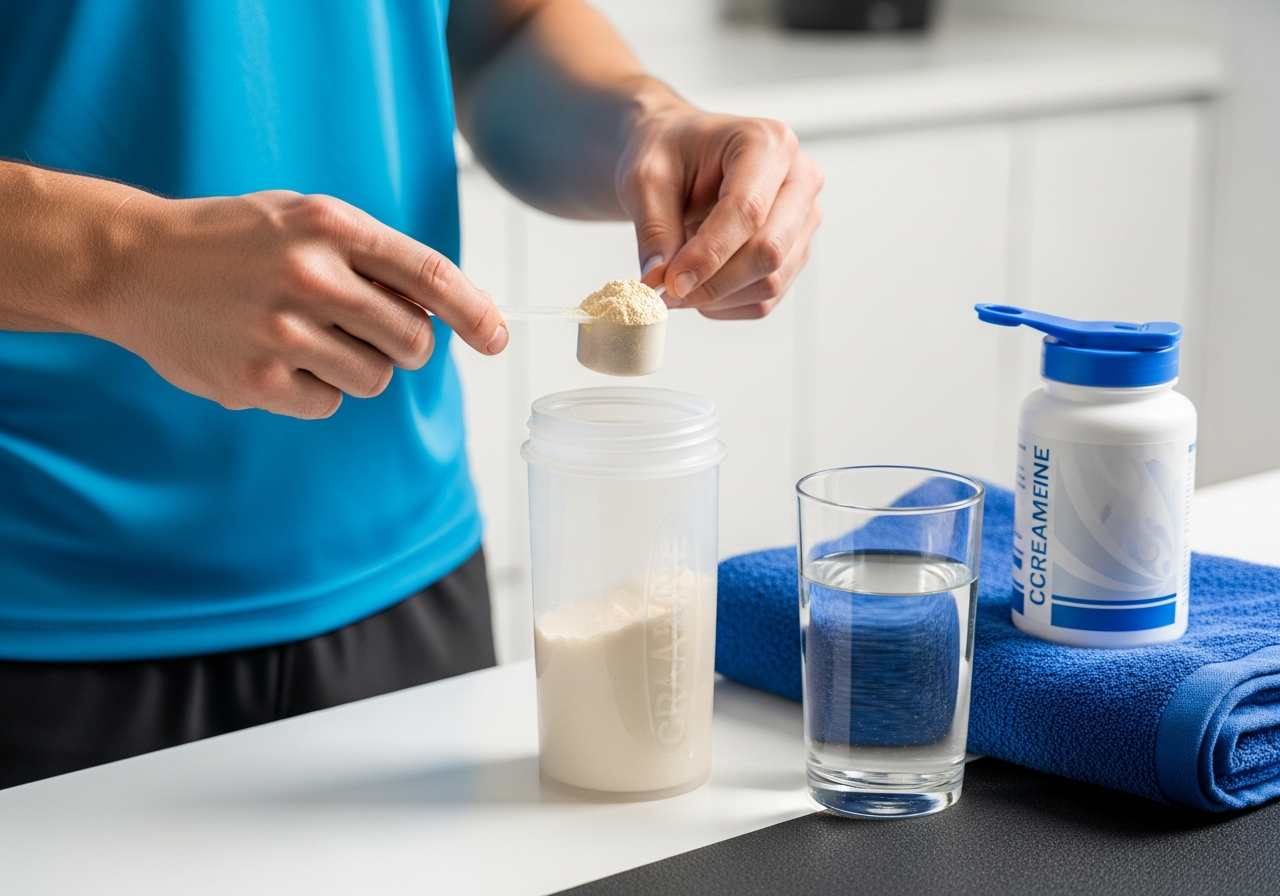
The best time to take creatine is the time you will remember every day, because consistency matters far more than timing. Liquid creatine does not earn special points for being taken pre-workout unless it helps you stick to your daily dose.
If you use powder, mixing it shortly before drinking is the most practical way to get the convenience of a liquid without the stability downside. You can mix creatine into water, a protein shake, or another beverage you tolerate well. For deeper timing guidance, see when to take creatine and whether to take it with food.
What should you expect?
- Days 1-7 with loading: muscle stores rise quickly; some people notice a small body weight increase from intracellular water, meaning more water stored inside muscle cells.
- Weeks 2-4 without loading: this is when many people start noticing better repeated sets, slightly stronger top sets, improved sprint repeatability, or better training volume.
- Weeks 4-8: gym performance improvements compound into better strength and lean-mass progress, assuming training and nutrition are solid.
Signs it may be working include:
- A slight increase in body mass, often early on
- Better performance on repeated sets of 3-12 reps
- Less drop-off across repeated sprints or intervals
- A fuller muscle feel during training
Signs something may be off include:
- You are taking less than 3 g/day of actual creatine
- You only take it on workout days
- Your liquid product has unclear dosing or has been poorly stored
- Your expectations are unrealistic, such as expecting a stimulant-like immediate feeling
Creatine is not supposed to feel like caffeine or a pre-workout. It improves your capacity to perform and adapt over time. That is why a boring but dependable powder often beats a flashy liquid formula. If you want the easiest habit, pair it with an existing routine: breakfast, post-workout shake, or your evening meal. Daily rhythm beats perfect timing.
Who liquid creatine makes sense for, and who should probably skip it
Liquid creatine makes sense for a small group of people who prioritise convenience above all else, but most beginners, athletes, women, and older adults are still better served by monohydrate powder or capsules. The goal is not to find the trendiest form; it is to find the form you can trust and use consistently.
Beginners should usually skip liquid creatine because it adds confusion without adding proven benefit. A basic monohydrate routine is easier to understand, easier to dose, and easier to evaluate. If you are new, start with creatine for beginners.
Women do not need a special liquid format. Creatine works through the same muscle phosphocreatine mechanism regardless of sex, and standard daily dosing still applies. Women often do well with 3-5 g/day, with the exact choice based on body size and training goals. See creatine for women.
Older adults may benefit from creatine, especially when combined with resistance training, but reliability matters here too. A dependable monohydrate product is usually preferable to a questionable liquid. See creatine for older adults.
Competitive athletes should be especially cautious with fancy delivery systems. The International Olympic Committee notes that evidence-backed supplements should be chosen carefully and sourced responsibly. For athletes subject to testing, a third-party tested product with transparent labelling matters more than novelty. In practice, that often points back to mainstream monohydrate. See creatine for competitive athletes.
Who might still choose liquid creatine?
- Travellers who hate powder mess and cannot manage capsules
- People with a strong sensory aversion to powders
- Users of single-serve products intended for rapid consumption rather than long-term storage in solution
Who should probably skip it?
- Anyone on a budget
- Anyone wanting the strongest evidence base
- Anyone confused by labels or proprietary blends
- Anyone who can easily mix powder in water once per day
The pattern is clear: the more your goal is measurable results, the less reason there is to pay extra for liquid creatine.
Safety, side effects, and what Canadian buyers should check on the label
Creatine is generally considered safe for healthy people when used at standard doses, but liquid creatine does not become safer simply because it is in a bottle. The core safety questions are the same: appropriate dosing, sensible expectations, relevant medical context, and product quality.
The ISSN position stand and the 2021 JISSN review both support creatine’s strong safety profile in healthy populations when used appropriately. Antonio et al. (2021) also addresses many persistent myths directly, including exaggerated fears around dehydration, cramps, or kidney harm in healthy users. If you have kidney disease, are under medical supervision, or take relevant medications, speak with your clinician first. For the full safety discussion, see is creatine safe and the kidney question explained.
Common side effects are usually dose- or method-related rather than format-specific:
- Stomach upset: more likely with large single doses, especially during loading
- Temporary body weight increase: often due to water being pulled into muscle, not fat gain
- Bloating complaints: often improved by splitting doses or avoiding unnecessary megadoses
Canadian buyers should check a few extra details:
- NPN: A Natural Product Number indicates the product is licensed by Health Canada as a natural health product.
- Exact creatine amount: Look for grams of creatine per serving, not just a “matrix” name.
- Form listed: Creatine monohydrate should be explicitly named if that is what you want.
- Third-party testing: Especially valuable for athletes or anyone prioritising purity.
- Storage instructions: Extra important for liquid products because heat and time matter more.
Also be cautious with imported products sold through vague marketplaces. In Canada, transparent labels and reputable retailers reduce your risk of buying an underdosed or poorly stored product. If you are shopping domestically, compare options through our brand reviews and the guide to buying creatine online in Canada.
One useful rule: if a liquid creatine product cannot clearly explain how it preserves creatine stability and how many grams of active creatine you actually get, it has not earned your trust.
The biggest mistakes and myths about liquid creatine, debunked
Most confusion about liquid creatine comes from mixing up convenience, absorption, and actual effectiveness. The biggest myth is that a liquid format is automatically better because your body absorbs liquids faster.
Here are the main myths and the reality behind them:
- Myth: Liquid creatine works better because it absorbs faster.
Reality: The main goal is delivering enough intact creatine to saturate muscle stores. Faster swallowing does not matter if less active creatine is present by the time you drink it. - Myth: If it is sold as a ready-to-drink supplement, stability must not be an issue.
Reality: Stability is exactly the main issue with creatine in solution. Packaging does not erase chemistry. - Myth: Liquid creatine gives an immediate energy rush.
Reality: Creatine is not a stimulant. It supports ATP regeneration over time through saturation. - Myth: Powder is old-fashioned, so newer forms must be superior.
Reality: In sports nutrition, newer often means more marketed, not more effective. Monohydrate keeps winning because the evidence keeps supporting it. - Myth: If creatine makes you gain weight, it is making you fat.
Reality: Early weight gain is often intracellular water in muscle, not body fat. See does creatine make you gain weight.
The most common user mistakes are just as important:
- Taking too little actual creatine because the liquid serving is underdosed
- Taking it only before workouts instead of daily
- Assuming “advanced transport” marketing equals better results
- Storing a liquid product in hot conditions
- Giving up after a week without understanding the normal timeline
If you suspect creatine is not working for you, first rule out the obvious: dose, consistency, storage, and training quality. True non-response exists, but it is not the first explanation. Often the problem is simply that the user never reliably reached or maintained saturation. Our creatine myths debunked hub and non-responder guide can help you troubleshoot that properly.
The simplest myth-proof approach is still the most boring one: 3-5 g of creatine monohydrate, every day, from a reputable product, for long enough to judge results fairly.
Bottom line: should you buy liquid creatine or stick with monohydrate?
For most people, you should stick with creatine monohydrate powder rather than buy liquid creatine. Liquid creatine is convenient, but convenience alone does not outweigh weaker stability, less certainty, and usually worse value.
If you want the most defensible recommendation in one sentence, here it is: take 3-5 g of creatine monohydrate daily, mixed shortly before use, and do that consistently for weeks and months. That is the protocol with the strongest evidence for strength, lean mass, and repeated high-intensity performance.
Buy liquid creatine only if all of the following are true:
- You know the exact creatine grams per serving
- You trust the manufacturer and storage chain
- You value grab-and-go convenience enough to pay more for it
- You understand that it is unlikely to outperform powder
Skip liquid creatine if any of the following are true:
- You want the best science-backed option
- You are cost-conscious
- You are an athlete who cares about transparent, tested products
- You can tolerate one quick scoop mixed in water each day
If you still prefer a no-mixing format, capsules are often the cleaner compromise because they avoid the liquid stability problem. If you want the broadest evidence base, monohydrate remains the standard by which every other form is judged. That was true in 2017 when the ISSN position stand summarised the literature, and it remains true in 2026.
So, does liquid creatine work? It can, but it is not the form most experts would choose first. If your goal is results you can trust, powder wins. If your goal is convenience at any cost, liquid may be acceptable, but only with careful label reading and realistic expectations.
Liquid Creatine: The Numbers That Matter
- 3-5 g/day Standard effective daily creatine dose — Typical maintenance range for most adults
- 20 g/day Common loading dose — Usually split into 4 x 5 g doses for 5-7 days
- 5-7 days Time to saturate with a loading phase — Then shift to 3-5 g/day maintenance
- 3-4 weeks Time to saturate without loading — Daily 3-5 g intake usually reaches full effect more gradually
Frequently Asked Questions
Does liquid creatine work as well as powder?
Usually not as reliably. Liquid creatine can work if the creatine is still intact when you drink it, but powder is generally more dependable because creatine is more stable in dry form than in long-stored liquid.
Is liquid creatine effective for building muscle?
It can be, but only if it delivers enough active creatine consistently. Muscle-building benefits come from saturating muscle creatine stores with an effective daily dose, and powder makes that easier to trust.
Why is liquid creatine less stable?
Liquid creatine is less stable because creatine dissolved in water gradually converts to creatinine over time. Heat, time in solution, and acidic conditions can make that breakdown more likely.
Is freshly mixed creatine in water the same as bottled liquid creatine?
No, they are not the same in practice. Freshly mixed creatine in water is generally fine because it has not spent long in solution, while bottled liquid creatine may have been sitting dissolved for much longer.
What is the best dose for liquid creatine?
The best dose is the same as for other forms: usually 3-5 g of actual creatine per day. The key is checking that the liquid product truly provides that amount per serving.
Should you take liquid creatine before or after a workout?
Either is fine, because timing is less important than daily consistency. Take it at the time you are most likely to remember every day, including rest days.
Can liquid creatine go bad?
Yes, liquid creatine can become less useful over time because the creatine in solution can degrade. That does not necessarily mean it becomes dangerous, but it may no longer deliver the labelled amount of active creatine.
Is liquid creatine better absorbed?
There is no strong evidence that liquid creatine is meaningfully better absorbed than powder. What matters more is whether the full dose of intact creatine is still present at the time of consumption.
Who should avoid liquid creatine?
People who want the strongest evidence, best value, or most transparent dosing should usually avoid it. Competitive athletes and budget-conscious users are often better off with tested creatine monohydrate powder or capsules.
What should Canadians look for when buying liquid creatine?
Canadians should look for an NPN, clear grams of creatine per serving, storage instructions, and preferably third-party testing. Those details matter even more with liquid products because stability is the main concern.