Creatine Gummies: Do They Work and Are They Worth It?
By The Creatine Canada Research Team — Evidence-based supplement analysts
Creatine gummies can work, but only if they deliver a real, evidence-based creatine dose every day. For most people, gummies are a convenience format rather than the best value, because plain creatine monohydrate powder is usually cheaper, easier to dose accurately, and backed by the strongest research.
Evidence-based · Cites 4 sources · Editorial standards
Key Takeaways
- Yes, creatine gummies work if they provide enough creatine monohydrate to reach the standard daily dose.
- Most adults need 3-5 g of creatine per day, which can require several gummies depending on the product.
- Creatine timing matters far less than total daily intake and consistency.
- Powder usually beats gummies on cost per gram, dosing flexibility, and label simplicity.
- Gummies can be worth it for travel, convenience, or people who hate mixing powders.
- Choose products with clear grams-per-serving, low unnecessary sugar, and Canadian-compliant labelling such as an NPN when sold here.
- Side effects are usually dose-related and digestive; splitting the dose often fixes the problem.
Creatine gummies do work, but only when the dose is high enough
Creatine gummies do work if they supply enough creatine to raise and maintain your muscle creatine stores, but many products make that harder than powder does. That is the direct answer to both “do creatine gummies work” and “are creatine gummies effective”. The active ingredient matters far more than the format: if a gummy gives you the same total daily creatine as powder, the physiological effect should be similar.
Creatine is a naturally occurring compound stored mainly in muscle, where it helps regenerate adenosine triphosphate, or ATP, the cell’s fast energy currency during short, intense efforts. When you supplement with creatine, you increase intramuscular phosphocreatine, which is the stored form used to rapidly remake ATP during heavy lifts, sprints, jumps, and repeated hard intervals. That is why creatine tends to help most with strength, power, training volume, and over time, lean mass gains when paired with resistance training.
The key issue with gummies is not whether gummy creatine is “real” creatine. The key issue is dose density. A scoop of powder can easily provide 3-5 g in seconds. Gummies often provide smaller amounts per piece, so you may need multiple gummies every day to reach an evidence-based dose. If a label gives 1-2 g per serving, and that serving is only two gummies, you may need two or three servings daily to match what one scoop of monohydrate powder delivers.
Research and expert consensus strongly support creatine monohydrate as the most studied and most effective form. The 2017 ISSN position stand concluded that creatine monohydrate is the most effective ergogenic nutritional supplement currently available for increasing high-intensity exercise capacity and lean body mass during training. That matters because some gummy products lean heavily on flavour and convenience while being vague about the actual grams of creatine or the form used. If the label does not clearly state creatine monohydrate and grams per serving, treat it cautiously.
For a broader primer on what creatine is actually doing in the body, see what creatine is and what it does. If you simply want the fastest practical takeaway: gummies can work, but only when they reliably get you to your full daily dose, every day.
How creatine gummies work: the gummy is just the delivery system
Creatine gummies work through the same mechanism as creatine powder, because your muscles respond to the amount of creatine absorbed, not the format it came in. Once digested and absorbed, creatine enters the bloodstream and is transported into muscle, where it increases total creatine and phosphocreatine stores over time.
Phosphocreatine acts like a rapid backup battery for intense exercise. During a hard set of squats, a 10-second sprint, or repeated explosive efforts in sport, ATP is used very quickly. Phosphocreatine donates a phosphate group to help restore ATP fast enough to maintain force output for a bit longer. That does not turn creatine into a stimulant. Instead, it improves short-duration energy recycling, which can translate into one more rep, slightly more volume, or a small boost in repeated power output. Those small session-by-session improvements are how creatine helps training add up.
Creatine also increases water inside muscle cells, which is normal and not the same as gaining fat. This rise in intracellular water may contribute to the fuller look many people notice in the first week or two. Over longer periods, the real value comes from better training quality and possibly improved recovery between repeated intense efforts. The ISSN position stand and the 2021 JISSN review on common creatine questions both reinforce that creatine’s benefits are well-established for high-intensity performance and training adaptations.
Where gummies can differ in practice is consistency. Powder makes it easy to measure exactly 3 g, 4 g, or 5 g. Gummies can vary more from brand to brand, and some formulas include sugars, syrups, flavouring systems, or added ingredients that have nothing to do with creatine’s core effect. None of those extras make creatine “activate” better in a meaningful way if the creatine dose itself is too low.
If you are wondering how long this mechanism takes to produce noticeable results, the answer depends on saturation, meaning how full your muscles become with stored creatine. Loading fills stores faster, while a smaller daily maintenance dose fills them gradually. For a deeper timeline, read how long creatine takes to work. The important point here is simple: gummies work by the same biology as powder, but only if the total grams are there.
The right creatine gummies dose: how many gummies most people actually need
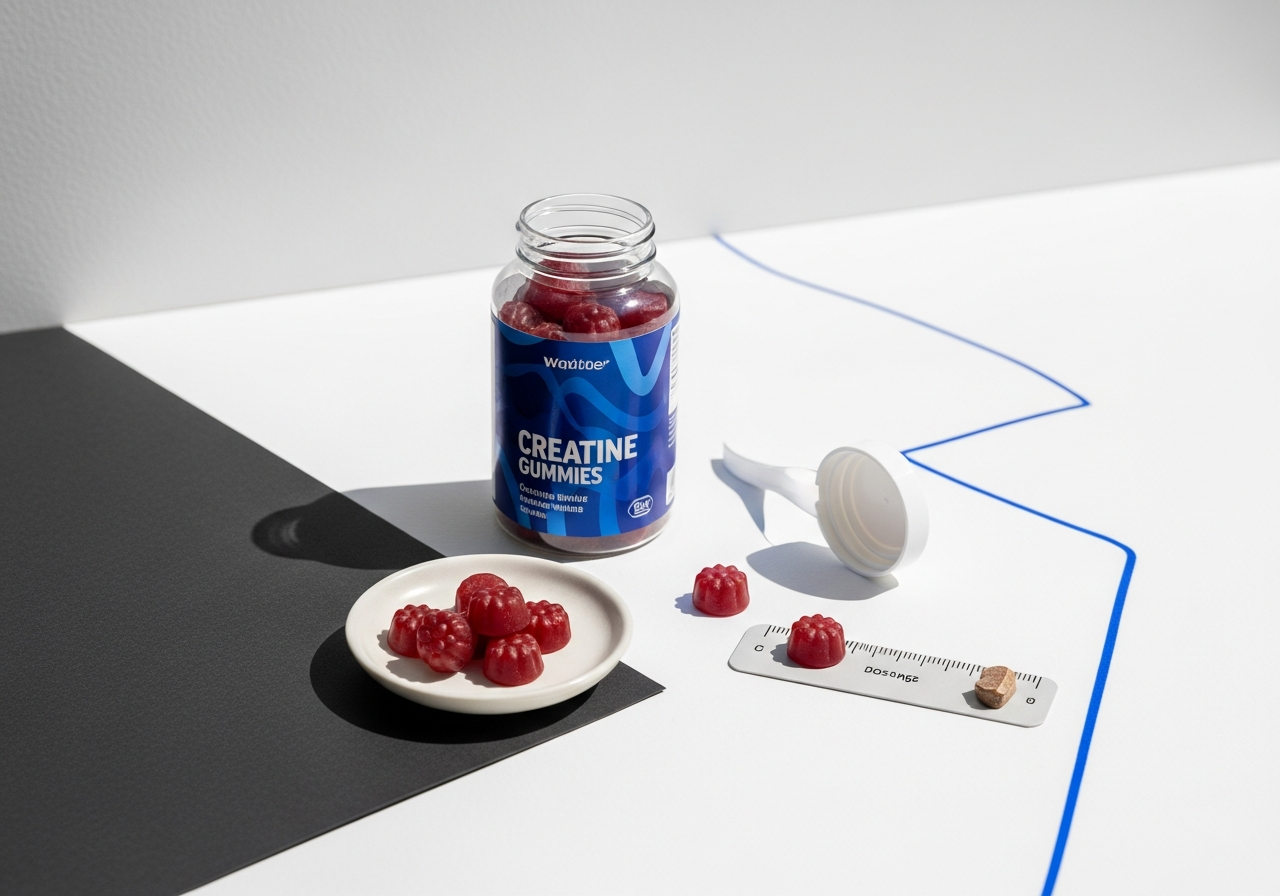
The correct creatine gummies dose for most adults is still 3-5 g of creatine daily, exactly the same target used for powder. The challenge is that the number of gummies needed can be surprisingly high, so you must read the label carefully.
Mainstream creatine science supports two standard approaches. The first is a loading phase of about 20 g per day, usually split into four 5 g doses, for 5-7 days, followed by 3-5 g per day. The second is no loading at all, using 3-5 g daily from day one, which saturates muscles more gradually over roughly 3-4 weeks. Both methods work; loading just works faster. If you want a personalized estimate, use our creatine dosage calculator or read how much creatine per day.
Body weight can help refine the plan. A practical rule for maintenance is:
- Under 60 kg: 3 g/day is often enough.
- 60-90 kg: 3-5 g/day suits most people.
- Over 90 kg or very muscular athletes: 5 g/day is a sensible default.
For loading, a common evidence-based guideline is about 0.3 g/kg/day for 5-7 days. That means:
- 60 kg person: about 18 g/day during loading
- 75 kg person: about 22.5 g/day during loading
- 90 kg person: about 27 g/day during loading
Here is where gummies become less convenient than they first appear. If a product provides 1 g per gummy, a 75 kg person doing a standard 5 g maintenance dose needs 5 gummies daily. If the same person wanted to load at roughly 20 g/day, that would mean around 20 gummies daily, which is why most gummy users skip loading and simply take a maintenance dose consistently.
| Goal | Evidence-based dose | What that means with 1 g gummies | What that means with 2.5 g gummies |
|---|---|---|---|
| Daily maintenance | 3 g/day | 3 gummies | Just over 1 gummy; follow label serving |
| Daily maintenance | 5 g/day | 5 gummies | 2 gummies |
| Loading phase | 20 g/day for 5-7 days | 20 gummies | 8 gummies |
The best creatine gummies are not the ones with the loudest claims. They are the ones that make it easy to reach an evidence-based daily dose without forcing you into huge serving sizes, excessive sugar, or vague proprietary blends.
How to take creatine gummies properly, step by step
The best way to take creatine gummies is to pick a target daily gram amount, check the grams per gummy, and take the same total dose every day. Consistency matters more than perfect timing.
- Check the label for total grams of creatine per serving and per gummy. Do not stop at the front-of-package marketing. You need the exact creatine amount.
- Confirm the form. Creatine monohydrate is still the gold standard because it has the strongest evidence and is usually the most cost-effective form.
- Choose your dosing strategy. Most beginners do well with 3-5 g daily and no loading. If you want faster saturation and your product makes it practical, load for 5-7 days, then drop to maintenance. For help, see our loading phase guide.
- Take the same total amount every day, including rest days. Creatine works by building muscle stores over time, not by creating a one-time pre-workout buzz.
- Take gummies whenever you will reliably remember them. Breakfast, post-workout, lunch, or before bed can all work if adherence is better.
- Drink normal fluids and train as usual. You do not need to force extreme water intake, but you should avoid being chronically underhydrated. See how much water to drink with creatine.
- Assess after 3-4 weeks without loading, or after 1-2 weeks with loading. Look for better training performance, a slightly fuller muscle look, and sometimes a small increase in body weight from muscle water.
A practical beginner example: if your gummies provide 1.5 g each, taking two gummies gives 3 g/day, which is a reasonable maintenance dose for a lighter beginner. A larger lifter using the same product may want three gummies for 4.5 g/day. Another example: if your product provides 2.5 g per serving and that serving is two gummies, you may need two servings daily to reach 5 g.
Take them with food or without food based on what feels best for your stomach. There is no strong evidence that gummies become significantly more effective only when paired with a particular meal. The bigger practical mistake is underdosing because the serving size seems small and snack-like. Gummies feel like candy, but creatine dosing still follows physiology, not candy habits.
If you are switching from powder and want a broader walkthrough, read how to take creatine step by step. The process is the same; only the delivery format changes.
Creatine gummies vs. powder: convenience wins for gummies, but powder usually wins overall
Creatine gummies are more convenient, but creatine powder is usually the better choice for value, dosing flexibility, and evidence-aligned simplicity. That is why powder remains the default recommendation for most people.
When people search “creatine gummies vs powder”, they usually want to know which one works better. If the same amount of creatine is absorbed, the effect should be comparable. The real-world differences are cost, practicality, and label quality. Powder makes it easy to hit 3-5 g every day with one measured scoop. Gummies often cost more per gram and can require multiple pieces to equal one scoop.
| Factor | Creatine gummies | Creatine powder |
|---|---|---|
| Effectiveness | Effective if the total daily grams are sufficient | Effective and easiest to dose at research-backed levels |
| Convenience | Very convenient; no mixing needed | Needs water or another drink |
| Dosing precision | Can be limited by fixed gummy size | High precision; easy to adjust 3-5 g |
| Loading phase practicality | Often inconvenient because many gummies are required | Very practical |
| Cost per gram | Usually higher | Usually lower |
| Extra ingredients | Often includes sweeteners, gels, flavourings, or sugars | Often just creatine monohydrate |
| Travel use | Excellent | Good, but less grab-and-go |
Gummies are best for people who consistently skip powder because they dislike mixing, texture, or routine friction. A supplement you take consistently can beat a theoretically ideal one you keep forgetting. That said, if you are price-sensitive, heavier, or want a full 5 g dose without extra calories or sugar, powder is usually the smarter buy. For product comparisons, see our best creatine rankings and creatine brand reviews.
There is also a quality-control angle. In Canada, look for proper Natural Product Number, or NPN, labelling where applicable, a full ingredient list, and preferably third-party testing or strong manufacturing transparency. Gummy products can be perfectly legitimate, but they deserve closer label scrutiny because the format naturally allows more filler ingredients than a simple monohydrate powder.
If you want the short version, gummies are for convenience; powder is for efficiency. For most lifters, athletes, and beginners trying to get the most evidence-based results per dollar, powder still comes out ahead.
Who creatine gummies are best for, and who should probably skip them
Creatine gummies are best for people who value convenience and compliance, while powder is usually better for heavier users, budget-conscious buyers, and anyone wanting flexible dosing. The right format depends less on physiology than on habits, budget, and how likely you are to take it daily.
Beginners often do well with gummies because the format is simple and unintimidating. If you are new to supplements and the idea of weighing powder feels like overkill, a clearly labelled gummy product can reduce friction. The catch is that beginners are also the group most likely to underdose by assuming a small serving is automatically enough. If you are new, pair this guide with creatine for beginners.
Women can use creatine gummies exactly as effectively as men when the daily grams are equivalent. Creatine is not a male-only supplement, and it does not “bulk women up” by itself. It supports training performance, lean mass retention, and possibly broader benefits that are increasingly discussed in women’s health. For more, see creatine for women.
Older adults may appreciate gummies if chewing them is easier than mixing drinks, particularly when creatine is being used alongside resistance training to support muscle function and healthy ageing. The main practical issue is again dose density. Older adults often benefit from simple routines, but the label still needs to deliver a real daily amount.
Athletes in sports involving repeated high-intensity efforts can benefit from creatine regardless of format, and the International Olympic Committee consensus recognizes creatine as one of the few supplements with strong performance evidence. For competitive athletes, though, powder often remains the cleaner, more economical choice, especially during loading or heavier training blocks.
Vegetarians and vegans may respond especially well to creatine because baseline muscle creatine stores can be lower when dietary creatine intake is low. The form still does not matter as much as the dose, but check whether the gummy’s ingredients fit your dietary preferences.
Who should probably skip gummies? Very large athletes needing the top end of daily dosing, anyone doing repeated loading phases, anyone avoiding added sugars, and anyone who wants the lowest cost per gram. Those groups generally get more from a basic monohydrate powder in the creatine product catalog or a well-reviewed monohydrate from our best creatine rankings.
When to take creatine gummies, how fast they work, and what results are realistic
You can take creatine gummies any time of day, and most people notice benefits once muscle creatine stores rise enough from consistent daily use. Timing is secondary; adherence and total daily dose are primary.
If you load with about 20 g/day split across the day for 5-7 days, you may notice changes within the first week: a small body-weight increase, a slightly fuller muscle look, and better repeated performance in the gym. If you skip loading and take 3-5 g/day, results usually become more noticeable after roughly 3-4 weeks. That is because muscle saturation happens more gradually. This is why people who ask “are creatine gummies effective” after only a few days may be judging too early.
What should you realistically expect? Creatine is not a stimulant, so you should not expect a caffeine-like rush. Instead, look for subtle but meaningful signs:
- One or two extra reps on hard sets over time
- Slightly better repeated sprint or interval performance
- Improved ability to maintain training quality across sets
- A modest body-weight increase, often from intracellular water
- Better long-term strength and lean mass progress when training is consistent
Many people like taking creatine post-workout simply because it is easy to remember next to another habit, such as a protein shake. Others take gummies with breakfast or lunch because gummies are more portable than powder. That is fine. The evidence does not show that a narrow timing window makes or breaks creatine’s effectiveness in the way total daily intake does. For a deeper look, see when to take creatine and creatine on rest days.
If you are not noticing anything after a month, the usual causes are underdosing, inconsistent use, low training intensity, or already-high baseline muscle creatine stores. Some people do respond less dramatically than others, but many apparent “non-responders” are really just underdosed or undertrained. Before giving up, check the label math carefully. Gummies can make it easy to think you are taking a full dose when you are not.
The bottom line on timing is straightforward: take creatine gummies whenever you will remember them every day, then judge results over weeks, not hours.
Safety, side effects, and how to buy creatine gummies wisely in Canada
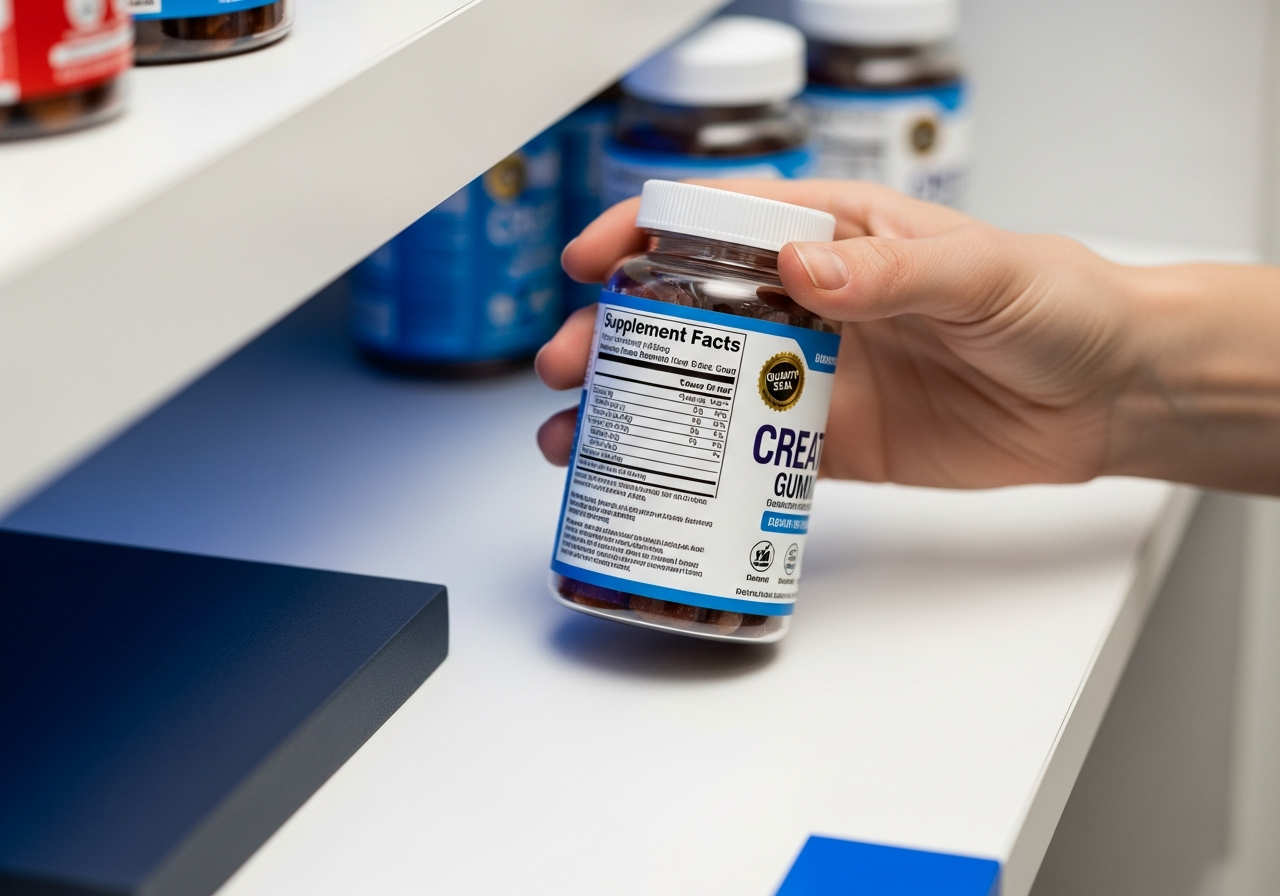
Creatine gummies are generally safe for healthy adults when used at standard doses, but product quality and total daily intake matter more than the gummy format itself. The overall safety profile of creatine is one of the reasons it remains so widely recommended.
The 2017 ISSN position stand and the 2021 JISSN paper on common misconceptions both support creatine monohydrate as safe and effective for healthy individuals when used appropriately. Mayo Clinic also notes that creatine is likely safe when used orally at appropriate doses. Common side effects are usually practical rather than dangerous: stomach upset, loose stools, or feeling overly full, especially when large amounts are taken at once. Splitting the dose often helps. If your gummy product contains sugar alcohols or certain gel bases, those ingredients can also contribute to digestive issues independently of the creatine itself.
One normal effect people sometimes misread as a side effect is scale weight gain. Creatine often increases water inside muscle cells, particularly in the early phase. That is not the same as gaining body fat. If this worries you, read does creatine make you gain weight and does creatine cause bloating.
Who should be more cautious? People with pre-existing kidney disease, significant medical conditions, or those advised by a clinician to limit certain supplements should speak to a qualified healthcare professional first. This is especially sensible if you have lab monitoring concerns, since creatinine blood markers can confuse people who do not realize they are supplementing with creatine. Our guide on creatine and kidneys explains that issue in detail.
In Canada, inspect labels closely. Look for:
- Clear creatine amount in grams, not just marketing claims
- The form listed as creatine monohydrate
- An NPN, which is the Natural Product Number used on regulated natural health products sold in Canada
- Third-party testing or strong manufacturing transparency
- A simple ingredient list without excessive fillers if you want the cleanest option
The IOC consensus on supplements also highlights the importance of contamination risk and choosing products from reputable manufacturers, which is particularly relevant for athletes. If you are shopping broadly, compare options in our creatine product catalog and cross-check labels against our creatine brand reviews.
The biggest creatine gummy mistakes and myths, debunked
The biggest mistake with creatine gummies is assuming convenience guarantees effectiveness; in reality, the wrong dose can make an expensive product underperform. Most myths around gummies are really old creatine myths wearing new packaging.
Myth 1: Gummies work differently from powder. False. The delivery format is different, but the underlying mechanism is the same. What matters is how much creatine gets absorbed consistently over time.
Myth 2: If a product says “creatine gummies”, one serving must be enough. False. Some servings provide less than the standard 3-5 g daily target. Always do the math based on grams, not on servings alone.
Myth 3: You need to take creatine right before training for it to work. False. Creatine is not a fast-acting pre-workout stimulant. Daily consistency matters much more than timing.
Myth 4: Creatine gummies are better because they taste better. Taste can improve adherence, which is useful, but taste does not improve creatine’s biology. A delicious underdosed gummy is still underdosed.
Myth 5: Gummies avoid water retention. False. If the product supplies enough creatine to work, it can still increase intracellular water in muscle, which is part of normal creatine saturation.
Myth 6: Creatine must be cycled. False for most healthy users. Standard creatine use does not require cycling. If you want the full evidence-based breakdown, see do you need to cycle creatine.
The most common practical mistakes are simple:
- Buying based on flavour instead of grams of creatine
- Ignoring how many gummies equal one real dose
- Taking it only on workout days
- Expecting an instant energy buzz
- Confusing normal water-related scale changes with fat gain
- Choosing flashy forms over monohydrate without evidence
If you want a more complete myth-by-myth breakdown, visit creatine myths debunked or creatine myths vs facts. Creatine gummies are neither miracle candy nor a scam by definition. They are simply a creatine delivery format that can be excellent, mediocre, or poor depending on dose, formula, and whether you actually use them correctly.
How to choose the best creatine gummies without falling for marketing
The best creatine gummies are the ones that provide an evidence-based daily dose clearly, use creatine monohydrate, and keep extra ingredients to a minimum. “Best” is not about trendiness; it is about making the correct dose easy, affordable, and trustworthy.
Start with the label math. Ask four questions in order:
- How many grams of creatine are in one serving?
- How many gummies are in that serving?
- What form of creatine is used?
- How many servings per container will I actually get at my real daily dose?
If a product sounds impressive but forces you to take a large handful of gummies every day to reach 5 g, it may not be the best choice for long-term use. Cost per container can be misleading; cost per effective daily dose is the more honest number.
Next, scan the non-creatine ingredients. Some gummy bases are fine, but very high sugar, large amounts of sugar alcohols, unnecessary proprietary blends, or “matrix” language should make you pause. Extra ingredients are not automatically bad, but they should not distract from the central question: does this product efficiently deliver a proper creatine dose?
For Canadian shoppers, a clean buying checklist looks like this:
- Creatine monohydrate listed clearly
- 3-5 g/day achievable without absurd serving sizes
- NPN present if sold as a regulated natural health product in Canada
- Transparent manufacturer contact details
- Third-party testing, lot testing, or a strong quality reputation
- Reasonable cost per effective daily dose
If you are comparing forms more broadly, our guides on the best type of creatine, best creatine monohydrate in Canada, and creatine gummies vs. powder will help. The main theme stays the same: the best creatine gummy is not the one that looks most like candy. It is the one that behaves most like a properly dosed creatine supplement.
A final rule that saves people money: if the label makes it hard to figure out your actual daily grams, skip it. The best products are easy to understand because the best companies know informed customers are looking for grams, form, and proof.
Bottom line: are creatine gummies worth it?
Creatine gummies are worth it if they help you take a full daily creatine dose consistently, but they are usually not the best option for value or dosing efficiency. For most people, plain creatine monohydrate powder remains the smartest default recommendation.
If your main barrier to using creatine is that you hate mixing powders, forget shaker bottles, or want a travel-friendly option, gummies can absolutely be worth buying. In that scenario, convenience can improve adherence, and adherence is what allows creatine to work. A well-formulated gummy that reliably gives you 3-5 g/day is a legitimate supplement choice.
If your priority is cost per gram, precise dosing, or avoiding lots of sweeteners and extra ingredients, powder is usually the better buy. This is especially true for larger athletes, people who want to load, and anyone using creatine long term. Powder is not more “advanced”; it is simply a more efficient way to implement the evidence.
So, do creatine gummies work? Yes, when dosed properly. Are creatine gummies effective? Yes, but not automatically. Are they the best creatine format for most people? Usually not. They are a convenience-first format, not a science-superior one.
If you want the simplest decision rule, use this:
- Choose gummies if convenience is the only thing that will keep you consistent.
- Choose powder if you want the most evidence-backed, cost-effective, flexible option.
Either way, the fundamentals do not change: use creatine monohydrate, hit 3-5 g per day for maintenance, take it daily, and judge progress over weeks of training, not by whether you feel a dramatic buzz. If you want to compare options now, start with our best creatine rankings and product catalog.
Self-contained takeaway: Creatine gummies can be effective, but only if the label provides enough creatine to reach the standard 3-5 g daily dose, which is why powder still beats gummies for most people on value, dose precision, and practicality.
Creatine Gummies at a Glance
- 3-5 g/day Standard maintenance dose — Applies whether you use gummies or powder.
- 20 g/day Typical loading dose — Usually split into 4 doses for 5-7 days.
- 5-7 days Fast saturation timeline — Expected when using a standard loading phase.
- 3-4 weeks No-loading timeline — Common timeframe for saturation at 3-5 g/day.
Frequently Asked Questions
Do creatine gummies work as well as powder?
Yes, creatine gummies can work as well as powder if they deliver the same total daily creatine dose. The difference is usually not absorption or biology, but practicality: powder is easier to dose at 3-5 g per day and is often cheaper per gram.
Are creatine gummies effective for building muscle?
Yes, creatine gummies can be effective for supporting muscle gain if they help you consistently reach a full creatine dose while training properly. Creatine does not build muscle by itself, but it can improve training volume and performance, which helps drive lean mass gains over time.
How many creatine gummies should I take per day?
The right number depends entirely on how many grams of creatine are in each gummy or serving. Most adults need 3-5 g per day, so if each gummy contains 1 g, you would typically need 3-5 gummies daily.
Can you do a creatine loading phase with gummies?
Yes, you can load with creatine gummies, but it is often impractical because the number of gummies required is high. A standard loading phase is about 20 g per day for 5-7 days, so a 1 g gummy would require around 20 gummies per day.
When should I take creatine gummies?
You can take creatine gummies any time of day, as long as you take them consistently every day. Timing matters far less than maintaining your total daily intake, so most people should attach them to the meal or routine they are least likely to miss.
Are creatine gummies better for beginners?
Creatine gummies can be better for beginners if convenience helps them stay consistent. They are not inherently more effective than powder, but they can feel simpler and easier to use, provided the label clearly delivers an evidence-based dose.
Do creatine gummies cause weight gain?
Yes, creatine gummies can cause a small increase in body weight if they deliver an effective dose, because creatine increases water stored inside muscle. That is normal and is not the same as gaining body fat.
Are creatine gummies safe?
Yes, creatine gummies are generally safe for healthy adults when used at standard doses from reputable products. The main issues are usually digestive, especially if the product contains large doses, added sugars, or sugar alcohols.
What should I look for in the best creatine gummies?
Look for creatine monohydrate, clear grams per serving, a realistic path to 3-5 g per day, and minimal unnecessary fillers. In Canada, proper labelling such as an NPN and good manufacturing transparency are also useful trust signals.
Are creatine gummies worth it?
Creatine gummies are worth it if they solve a consistency problem that powder does not. If you already have no issue taking powder, gummies are usually harder to dose, more expensive per gram, and not meaningfully more effective.