Creatine and Muscle Hypertrophy: The Mechanisms Behind Size Gains
By The Creatine Canada Research Team — Evidence-based supplement analysts
Creatine causes muscle hypertrophy mainly by helping you train harder and recover better, not by directly acting like a steroid or magic muscle builder. By increasing muscle phosphocreatine stores, creatine helps regenerate ATP faster during hard sets, which can increase training volume, improve cell hydration, and support the long-term signals and conditions that lead to bigger muscle fibres.
Evidence-based · Cites 4 sources · Editorial standards
Key Takeaways
- Creatine builds muscle indirectly by increasing training quality, especially repeated high-intensity effort.
- The best-supported form for hypertrophy is creatine monohydrate at 3-5 g per day.
- A loading phase of 20 g per day split into 4 doses for 5-7 days saturates muscles faster, but is optional.
- Early scale weight gain is usually intramuscular water, not fat, and can precede real muscle growth.
- Creatine does not replace protein, calories, or progressive overload; it amplifies a good training plan.
- Evidence for satellite cells and muscle protein synthesis is promising but secondary to the training-volume mechanism.
- Most healthy adults can use creatine safely, but anyone with kidney disease or complex medical issues should ask a clinician first.
How creatine causes muscle hypertrophy, in one clear answer
Creatine causes muscle hypertrophy primarily by increasing your capacity to do high-quality training over time, which then produces more of the mechanical tension and total volume that drive muscle growth. In plain English, creatine helps you squeeze out more productive reps, maintain force better across sets, and recover enough to repeat that work session after session.
The core mechanism starts with phosphocreatine, the stored form of creatine in muscle that helps rapidly regenerate ATP, the cell’s immediate energy currency. During short, intense efforts like sets of squats, presses, rows, sprints, or jumps, ATP is used very quickly. When muscle phosphocreatine stores are higher, ATP can be restored faster, so performance drops off less sharply during repeated hard efforts.
That matters for hypertrophy because muscle size is mostly built by consistent exposure to high-tension contractions, enough hard sets, and progressive overload. Creatine does not directly force muscle fibres to grow on its own. Instead, it improves the training environment that makes hypertrophy more likely. The 2017 ISSN position stand concluded that creatine monohydrate is the most effective nutritional supplement available for increasing high-intensity exercise capacity and lean body mass.
Creatine may also contribute through several secondary mechanisms:
- Cell volumization: creatine draws water into muscle cells, which can increase muscle fullness and may act as a growth-supportive signal.
- Better glycogen handling: creatine can support muscle carbohydrate storage, which helps training quality.
- Satellite cell and myogenic signalling effects: some research suggests creatine may support the muscle-repair machinery involved in long-term growth, though this is not the primary proven pathway.
- Lower effective fatigue between efforts: better repeated-bout performance can translate into more useful weekly training volume.
If you want the practical version, it is this: creatine helps you do more quality work, and more quality work is what builds bigger muscles. For the fundamentals, see what creatine is and our full guide on whether creatine builds muscle.
The science of how creatine builds muscle: ATP, volume, swelling, and growth signals
Creatine and muscle growth mechanism is best understood as a chain: more phosphocreatine leads to faster ATP regeneration, which supports more high-quality work, which increases the training stimulus that causes hypertrophy. That is the central, best-supported explanation.
Inside muscle, creatine exists as free creatine and phosphocreatine. During very hard effort, your body splits ATP to release energy. Because ATP stores are tiny, they must be replenished rapidly. Phosphocreatine donates a phosphate to ADP to remake ATP, buying you a little more high-output work before fatigue forces performance down. Supplementation raises muscle creatine stores, so this rapid energy system becomes more available during repeated contractions.
From a hypertrophy perspective, that extra support shows up in ways lifters actually notice:
- One or two extra reps at a given load.
- Less drop-off across later sets.
- Better repeated sprint or power output in mixed training.
- Higher quality work during a whole mesocycle, not just one workout.
That repeated benefit matters more than any single workout. Hypertrophy is the result of many weeks of sufficient tension and volume. Creatine is valuable because it modestly shifts the odds in your favour every session.
A second mechanism is cell hydration or cell swelling. Creatine increases intracellular water, meaning more water is held inside muscle cells rather than simply under the skin. This is why many people look a bit fuller within the first week or two. Cell swelling is not the same as contractile tissue gain, but it may help create an anabolic environment by altering cellular stress and signalling.
What about creatine and muscle protein synthesis? The evidence suggests creatine does not act like a direct protein-synthesis trigger in the same way that essential amino acids or resistance training do. Instead, it appears to support protein accretion indirectly by enabling better training and possibly by influencing the cellular environment in which growth happens. That distinction matters: creatine is not a substitute for eating enough protein.
What about creatine and satellite cells or creatine myosin? Some studies suggest creatine may increase satellite cell activity and myogenic regulatory factors, and over time this may help fibres add nuclei and support growth. There is also interest in whether creatine helps preserve or build more contractile proteins such as myosin through training adaptations. These are plausible supporting mechanisms, but the strongest evidence still points to improved training performance as the main driver. For a broader evidence summary, see Examine’s creatine review.
Water weight first, real hypertrophy after: what changes are actually happening
Creatine muscle size gains usually begin with more water inside muscle cells, and only later become measurable increases in actual muscle tissue. That is why early scale changes are real but should be interpreted correctly.
During the first several days to two weeks, especially if you use a loading phase, many people gain body weight because creatine increases intramuscular water retention. This is not fat gain. It is also not fake in the sense of being useless, because fuller muscle cells can improve leverage, training feel, and possibly the cellular environment related to growth. Still, it is important to separate water-related fullness from new contractile tissue.
A practical timeline often looks like this:
- Days 3-7 with loading: body weight may rise and muscles may feel fuller.
- Weeks 2-4: performance benefits become easier to notice, especially more reps or better repeated effort.
- Weeks 4-8: if training and nutrition are solid, actual hypertrophy becomes more likely to show in measurements, photos, and gym performance.
- Weeks 8-12+: the cumulative effect of better training can produce clearly better lean mass outcomes than training alone.
This is one reason people sometimes say creatine “works instantly” and others say it “takes a month.” Both are partly right. The visible fullness can appear quickly, but meaningful hypertrophy takes time because muscle proteins are built slowly.
To tell whether creatine is working beyond water, track three things:
- Your body weight under the same morning conditions.
- Your gym log, especially total reps completed at a given weight.
- Your circumference measurements and progress photos every 2-4 weeks.
If weight goes up but strength, reps, and measurements do not improve over several weeks, creatine itself is probably not the issue. More often, the missing ingredient is progressive overload, enough hard sets, enough food, or enough protein. Our guides on creatine and weight gain and how long creatine takes to work go deeper on this timeline.
The bottom line is simple: water comes first, but for lifters who train hard and eat properly, that is often just the opening act before real hypertrophy follows.
How to use creatine for muscle growth: the step-by-step hypertrophy protocol
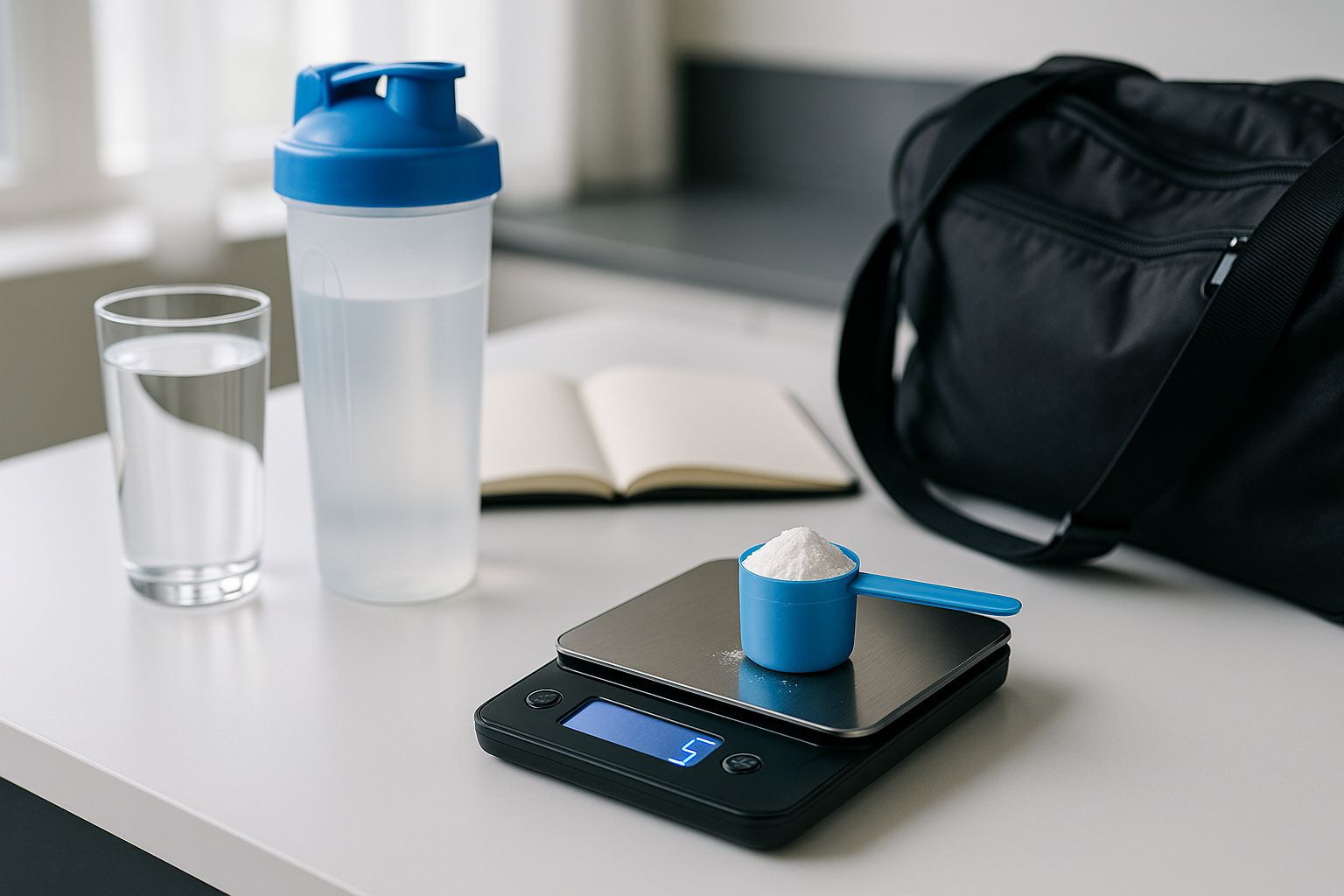
The best way to use creatine for hypertrophy is to take creatine monohydrate consistently every day while following a progressive resistance-training plan and eating enough protein and calories. The supplement is simple; the consistency is what makes it work.
- Choose creatine monohydrate. Monohydrate is the most studied, most effective, and usually the most cost-effective form. Start with plain powder unless you strongly prefer capsules or gummies.
- Decide whether to load. If you want faster saturation, take 20 g per day split into 4 doses of 5 g for 5-7 days. If you prefer simplicity or have a sensitive stomach, skip loading and take 3-5 g per day from day one.
- Move to maintenance. After loading, take 3-5 g per day. Most people do well in that range long term.
- Take it daily, including rest days. Creatine works by saturating muscle, not by producing a one-time stimulant effect on workout day.
- Pair it with hypertrophy training. Aim for hard resistance training 3-6 days per week, with enough volume and progressive overload to give creatine something to amplify.
- Eat enough protein. Creatine helps performance; protein provides amino acids for repair and growth. Both matter.
- Track results for at least 4-8 weeks. Use a logbook, body weight, and measurements instead of guessing.
For beginners, the easiest protocol is 3-5 g once daily in water, a shake, or a meal. You do not need to cycle it. You do not need to “save it” for workout days. You do not need a sugary transport matrix. The 2021 review of common questions and misconceptions about creatine confirms many of these long-standing practical points: Antonio et al. (2021).
Simple example routines:
- Beginner gaining muscle: 5 g daily with breakfast or post-workout shake.
- Experienced lifter in a mass phase: loading phase, then 5 g daily.
- Dieting lifter trying to preserve size: 3-5 g daily to support training quality.
If you want a personalised amount, use our creatine dosage calculator. For a full walkthrough, see how to take creatine and whether to use a loading phase.
Creatine dose for size gains: by body weight, goal, and training style
The usual effective creatine dose for muscle hypertrophy is 3-5 g per day, but larger and more muscular people often sit at the higher end of that range. Body weight matters somewhat, yet consistency matters more than chasing a hyper-precise number.
A practical framework is to use standard maintenance dosing for most people and body-weight-based loading if you want to saturate quickly. Many evidence-based guidelines also use about 0.3 g per kg per day for loading, then about 0.03 g per kg per day for maintenance.
| Body weight | Maintenance dose | Optional loading dose | Best use case |
|---|---|---|---|
| Under 60 kg | 3 g/day | ~18 g/day for 5-7 days | Smaller beginners, lighter athletes |
| 60-90 kg | 3-5 g/day | ~20 g/day for 5-7 days | Most gym-goers focused on hypertrophy |
| Over 90 kg | 5 g/day | ~25-30 g/day for 5-7 days | Larger lifters or high lean-mass athletes |
Use the lower end if you are smaller, new to creatine, or prone to stomach upset. Use the higher end if you are larger, heavily muscled, or trying to saturate and stay saturated reliably.
By goal, the decision is even simpler:
- Maximum speed to results: load, then maintain.
- Lowest chance of GI discomfort: skip loading and take 3-5 g daily.
- Lean bulk or body recomposition: 3-5 g daily is enough.
- Cutting phase: keep taking 3-5 g daily to help preserve training output.
For people asking whether more is better for hypertrophy, the answer is usually no. Once muscle creatine stores are saturated, extra grams do not keep increasing muscle growth. They mostly increase cost and the chance of digestive side effects.
If you are unsure, start at 3 g daily for a week, then move to 5 g if desired. The practical difference between 3 and 5 g is small for many people, but 5 g is the most common gym standard. You can calculate a more tailored intake at our dosage calculator, and compare protocols in how much creatine per day and maintenance dosing.
Does timing matter for hypertrophy, and should you take creatine with protein or carbs?
Creatine timing matters far less than taking it every day, because muscle saturation is the main goal. If you take the right dose consistently, whether it is before training, after training, or with a meal is a second-order detail.
That said, a few timing habits can make adherence easier or digestion smoother:
- Post-workout: convenient if you already drink a shake and want one fixed routine.
- With a meal: often easier on the stomach and easy to remember.
- Any time on rest days: choose the time you are least likely to forget.
Some people ask whether carbs or insulin are required for uptake. The nuanced answer is no: insulin can help drive nutrients into muscle, but ordinary daily creatine dosing works well without needing a high-sugar drink. Mixing creatine with protein powder, milk, or a regular mixed meal is perfectly reasonable if it improves consistency.
For hypertrophy specifically, the best “stack” is not exotic. It is:
- Creatine monohydrate daily.
- Adequate total daily protein.
- Enough calories to support your goal.
- A progressive training plan.
Creatine and whey are complementary because they do different jobs. Creatine helps energy availability for high-intensity work; protein supplies amino acids for repair and growth. If you use both after training, it is mainly a convenience play, not a mandatory biochemical hack.
Absorption tips that actually matter:
- Dissolve it in enough fluid so you will drink the full dose.
- Split larger loading doses to reduce stomach upset.
- Take it daily rather than trying to “double up” only on workout days.
Absorption tips that are mostly overrated:
- Taking it at the exact anabolic window minute.
- Buying expensive transport blends.
- Using only one special beverage.
If you are choosing between before and after workouts, pick the time you will stick to. For deeper guidance, see when to take creatine, mixing creatine with protein powder, and whether to take creatine with food.
Who benefits most from creatine for muscle hypertrophy: beginners, women, older adults, and athletes
Creatine can support hypertrophy in most resistance-trained people, but the biggest practical wins often show up in beginners, vegetarians or vegans, older adults, and athletes who rely on repeated high-intensity output. The mechanism is the same, but the size and feel of the benefit can differ by person.
Beginners often respond well because almost any improvement in training quality compounds quickly when they are learning lifts and building momentum. They should keep it simple: 3-5 g daily, no need to overcomplicate timing or cycles.
Women benefit for the same reason men do: better training quality and support for lean mass. Creatine does not inherently make women “bulky.” Muscle gain still depends on training, total calories, and time. Early water-related fullness can happen, but that is not the same as uncontrolled size gain. See our women’s guide for nuances around goals and expectations.
Older adults may benefit because resistance training plus creatine can help support lean mass and functional strength at a time when age-related muscle loss becomes more relevant. In this group, the combination with strength training matters especially. Creatine is not a substitute for lifting, walking, and adequate protein.
Vegetarians and vegans sometimes notice stronger effects because their baseline dietary creatine intake is lower. With lower starting stores, supplementation may create a larger relative increase in muscle creatine content. That is one reason plant-based athletes are often strong candidates. See whether creatine is vegan.
Power and team-sport athletes often benefit because repeated sprints, jumps, accelerations, and lifts rely heavily on the phosphocreatine system. Better repeated effort can improve both performance and the quality of hypertrophy-oriented training blocks.
People who may notice less dramatic effects include those who already eat a lot of meat and have relatively high baseline stores, or so-called non-responders who may still get some benefit but not as much as average. If you suspect that is you, read our non-responder guide.
The practical takeaway is that creatine is broadly useful, but it is most effective when matched with the kind of training that actually causes hypertrophy.
Safety, side effects, and what to buy in Canada if muscle growth is your goal
Creatine monohydrate is considered safe for most healthy adults when used at recommended doses, and the most common side effects are mild and practical rather than dangerous. For hypertrophy, the main concerns are usually water weight, occasional stomach upset, and buying a quality product.
The strongest safety position remains the 2017 ISSN review, which found creatine monohydrate to be effective and generally safe in healthy individuals across a wide range of contexts. Mayo Clinic also notes creatine is likely safe for many people when used appropriately: Mayo Clinic — Creatine.
Common side effects and what they usually mean:
- Scale weight increase: often water in muscle, especially early on.
- Stomach discomfort or loose stool: usually from taking too much at once, especially during loading.
- Perceived bloating: often dose-related or a matter of GI tolerance, not fat gain.
Who should be more cautious:
- People with known kidney disease.
- Anyone with a complex medical condition or who takes medications that warrant clinician review.
- People who are pregnant or breastfeeding, where routine gym-use recommendations should be individualised rather than assumed.
In Canada, pay attention to product legitimacy. Good buying signals include:
- NPN on the label: an NPN is a Natural Product Number showing the product is licensed by Health Canada.
- Third-party testing: useful for purity and, for tested athletes, contamination risk reduction.
- Plain ingredient panel: ideally just creatine monohydrate if your goal is simple, effective dosing.
For most people chasing hypertrophy, expensive “advanced” forms are unnecessary. Plain monohydrate is still the benchmark. If you are comparing options, browse our best creatine rankings, creatine brand reviews, and product catalog. If safety concerns are your main question, see is creatine safe and the kidney myth explained.
In short, buy a straightforward monohydrate product, use a sensible dose, and treat creatine like a long-term nutrition habit rather than a flashy pre-workout.
Common mistakes and myths: what creatine does not do for hypertrophy
The biggest creatine mistake is expecting it to build muscle in the absence of proper training and nutrition. Creatine helps hypertrophy, but it does not replace progressive overload, sufficient protein, sleep, or enough total calories for your goal.
Here are the most common myths and the accurate answer to each:
- “Creatine directly stimulates muscle protein synthesis like anabolic drugs.” False. Creatine is not a steroid and does not build muscle through hormone-like drug effects. It mainly supports the training and cellular conditions that make growth more likely.
- “The size gain is only water, so it is fake.” False. Early gains are often water-related, but better training output over time can absolutely contribute to real hypertrophy.
- “You need fancy forms like HCl for absorption.” Usually false. Monohydrate remains the best-supported option for effectiveness, safety, and value.
- “If 5 g works, 10 g must work better.” Usually false once saturated. More is not better after your muscles are full.
- “You only need creatine on workout days.” False. Daily intake is the point.
- “Creatine causes fat gain.” False. It can increase body weight through water and later lean mass, but it does not inherently add fat.
Common practical errors include:
- Skipping doses frequently and never reaching stable saturation.
- Judging results after only a few days without loading.
- Ignoring protein intake and overall calories.
- Using poor training progression, then blaming the supplement.
- Taking large single doses that irritate the gut.
If your goal is hypertrophy, the supplement hierarchy is simple: good training first, enough protein second, creatine as a proven amplifier. It works best when the basics are already in place.
For a deeper myth-by-myth breakdown, see creatine myths debunked, myths vs facts, and why creatine is not a steroid. If results seem disappointing, visit why creatine may not seem to be working.
Best creatine form for hypertrophy: why monohydrate still wins
The best creatine form for muscle hypertrophy is creatine monohydrate because it has the strongest evidence base, the best long-term track record, and usually the lowest cost per effective dose. For muscle growth, newer forms have not consistently outperformed it.
| Form | Evidence for hypertrophy | Typical practical verdict | Value |
|---|---|---|---|
| Creatine monohydrate | Strongest by far | Best first choice for almost everyone | Excellent |
| Micronized monohydrate | Same active ingredient, mainly easier mixing | Good if you prefer smoother texture | Usually good |
| Creatine HCl | Less evidence than monohydrate | May suit some stomach-sensitive users, but not proven superior | Usually worse |
| Buffered, ethyl ester, nitrate, blends | Weak or unimpressive versus monohydrate | Mostly marketing unless a specific preference justifies them | Often poor |
Monohydrate wins because the active mechanism is muscle creatine saturation, and monohydrate already does that very well. The burden of proof is on alternative forms to show better real-world hypertrophy outcomes, not just better marketing claims about absorption or comfort.
Micronized monohydrate can be useful if you dislike gritty texture, but it is not a different hypertrophy mechanism. HCl is often marketed as needing a smaller dose, yet it does not have a stronger evidence base for building muscle. For most buyers, plain monohydrate remains the smart choice.
If you are shopping in Canada, compare labels carefully. Prioritise:
- Creatine monohydrate as the sole active ingredient.
- Clear serving size in grams.
- NPN where applicable.
- Third-party testing if you are a competitive athlete.
- Reasonable cost per gram, not flashy packaging.
For product selection help, see best type of creatine, best creatine monohydrate in Canada, and why monohydrate still wins. The short version is blunt: if your goal is hypertrophy, start with monohydrate and make it boringly consistent.
Bottom line: how to make creatine actually translate into bigger muscles
Creatine causes muscle hypertrophy mainly by helping you train harder, maintain performance across sets, and accumulate more growth-producing work over time. The direct answer is that creatine improves the phosphocreatine energy system, which supports better resistance-training quality, and that better training quality is what leads to larger muscles.
The most evidence-based way to use it is straightforward:
- Take creatine monohydrate.
- Use 3-5 g daily, or load at 20 g daily split into 4 doses for 5-7 days if you want faster saturation.
- Keep taking it on rest days.
- Combine it with progressive resistance training, adequate protein, and enough food for your goal.
Expect early fullness and some water-related body weight gain, then look for improved reps, better repeated effort, and stronger training over the next several weeks. That is the bridge between creatine and real hypertrophy. If your training, diet, and recovery are in place, creatine is one of the few supplements with enough evidence to be worth recommending confidently.
If you want the next step, use our dosage calculator, read creatine for beginners, and compare options in our best creatine guide. If you remember only one sentence from this article, make it this one: creatine does not bypass the rules of muscle growth, but it can make those rules work better in your favour.
Creatine hypertrophy facts at a glance
- 3-5 g/day Standard maintenance dose — The usual long-term daily amount used to maintain muscle saturation.
- 20 g/day Typical loading protocol — Usually split into 4 doses for 5-7 days to saturate muscles faster.
- 5-7 days Fast saturation timeline — How quickly loading can meaningfully raise muscle creatine stores.
- 2-4 weeks Slow saturation timeline — How long daily 3-5 g often takes without a loading phase.
Frequently Asked Questions
How does creatine build muscle if it is not a protein?
Creatine builds muscle indirectly by helping you perform more high-quality work in the gym, not by acting as a protein itself. It increases phosphocreatine stores in muscle, which helps regenerate ATP during hard efforts, so you can maintain force and volume better across sets and over time create a stronger hypertrophy stimulus.
Does creatine directly increase muscle protein synthesis?
Creatine does not appear to directly increase muscle protein synthesis in the same way resistance training and protein feeding do. The best-supported view is that creatine supports protein accretion indirectly by improving training performance, increasing cell hydration, and possibly influencing the cellular environment around growth.
Is creatine muscle growth just water weight?
No, creatine muscle growth is not just water weight, although water retention inside muscle often happens first. Early scale increases are commonly due to intramuscular water, but with proper training and nutrition, creatine can help translate better workout quality into real long-term hypertrophy.
What is the main creatine hypertrophy mechanism?
The main creatine hypertrophy mechanism is improved phosphocreatine availability for rapid ATP regeneration during high-intensity exercise. That lets you do more productive reps, maintain power better across sets, and accumulate more weekly training volume, which is the primary driver of muscle growth.
Does creatine increase satellite cells?
Creatine may increase satellite cell activity in some training contexts, but this is best viewed as a secondary mechanism rather than the main reason it helps hypertrophy. The stronger evidence still supports improved training capacity as the primary pathway, with satellite cell effects remaining supportive and plausible.
How long does creatine take to cause visible muscle size gains?
Creatine can increase muscle fullness within days if you use a loading phase, but visible real muscle size gains usually take several weeks. A realistic pattern is early water-related fullness in the first 1-2 weeks, then better gym performance, followed by measurable hypertrophy over roughly 4-8 weeks or longer.
Is creatine good for beginners trying to gain muscle?
Yes, creatine is a good option for beginners trying to gain muscle because it is simple, well-studied, and supports training quality. Beginners should keep the protocol basic: take creatine monohydrate daily, train consistently with progressive overload, and make sure protein and calorie intake match the goal of growth.
Does creatine affect myosin or contractile proteins?
Creatine may help support increases in contractile tissue over time by improving the training conditions that build proteins such as myosin, but it does not act as a direct myosin booster on its own. The real effect is cumulative: better workouts can eventually lead to more contractile protein accretion.
What is the best dose of creatine for hypertrophy?
The best dose of creatine for hypertrophy is usually 3-5 g of creatine monohydrate per day. If you want faster saturation, a common loading protocol is 20 g per day split into 4 doses for 5-7 days, followed by a 3-5 g daily maintenance dose.
Do you need to cycle creatine when using it for muscle growth?
No, you do not need to cycle creatine for muscle growth. Creatine works by maintaining elevated muscle stores over time, so a steady daily intake is the practical evidence-based approach, and cycling usually adds complexity without a clear hypertrophy advantage.