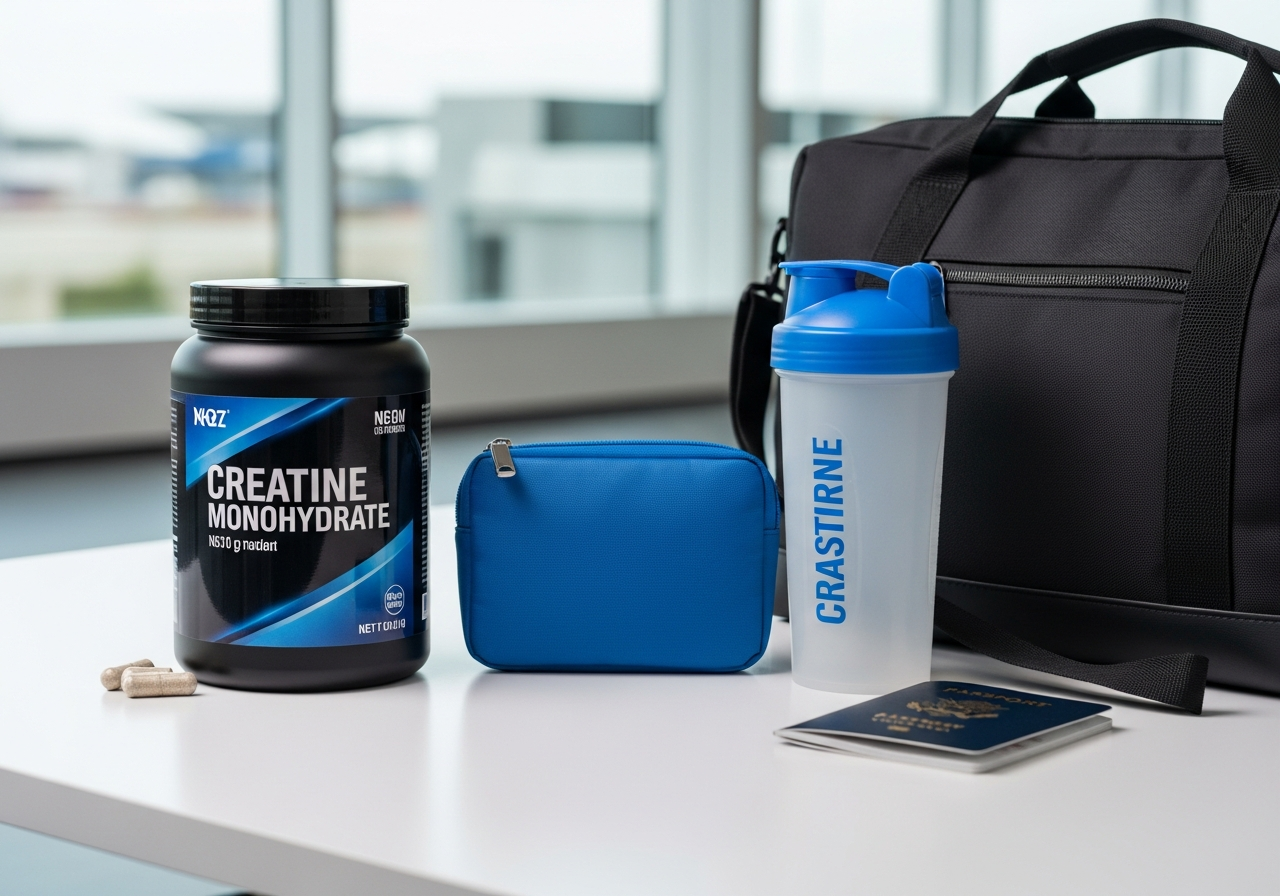
Can You Bring Creatine on a Plane? Travel and TSA Rules
By The Creatine Canada Research Team — Evidence-based supplement analysts
Yes — you can usually bring creatine on a plane in both carry-on and checked luggage, including creatine powder, capsules, and sealed tubs. The practical catch is that powders in carry-on can trigger extra screening, so the smoothest approach is to keep creatine in its original labelled container, pack larger amounts in checked baggage when possible, and separate small daily portions for convenience.
Evidence-based · Cites 4 sources · Editorial standards
Key Takeaways
- Yes, creatine is generally allowed on planes in carry-on and checked luggage.
- Creatine powder in carry-on may get extra screening, especially if you bring a large unlabelled bag.
- The safest travel option is a sealed or clearly labelled original tub.
- For short trips, pre-portioning single servings can be easier than carrying a full container.
- Capsules are often the least hassle at security, but usually cost more per gram than powder.
- International travel adds customs and import considerations, so check the destination country's rules before you fly.
- Missing creatine for a day or two is not a big deal, but daily consistency is still the ideal.
Yes, you can bring creatine on a plane — here is the short answer
Yes, you can bring creatine on a plane in most cases, and that includes creatine powder, capsules, gummies, and a full tub of creatine monohydrate. If your question is can you bring creatine on a plane, can I bring creatine in my carry on, or can I carry creatine in checked luggage, the practical answer is usually yes.
The reason this is usually straightforward is that creatine is a common legal dietary supplement, not a controlled drug and not an anabolic steroid. Creatine is a naturally occurring compound stored in muscle and used to help regenerate ATP, the cell's quick energy currency, during short, high-intensity efforts. If you need a fuller primer, see what creatine is and what it does.
What changes the airport experience is not that creatine is banned, but that loose powders can attract additional inspection. Airport screeners may want to look more closely at any white powder, especially if it is in an unmarked plastic bag or mixed into a mystery container. That does not mean you are doing anything wrong; it means you may be delayed if your packaging looks suspicious or hard to identify.
For most travellers, the lowest-friction approach is simple:
- Keep creatine in its original labelled tub or pouch.
- If you are carrying powder, make it easy to inspect.
- Pack larger amounts in checked luggage if you do not need them in flight.
- Carry only the amount you need for the trip when possible.
If you are flying from or within Canada, the same practical logic applies. Creatine products sold legally in Canada often carry a Natural Product Number, or NPN, which is Health Canada's product licence identifier for natural health products. A visible NPN and ingredient panel can make a product easier to identify, though it is not a guarantee against extra screening.
The bottom line is simple: yes, you are allowed to bring creatine on a plane, but labelled packaging and sensible packing make the process much smoother.
Carry-on vs checked luggage: where should you pack creatine?
You can usually pack creatine in either carry-on or checked luggage, but checked baggage is often the easier choice for larger tubs of powder. If you are asking can I pack creatine in my carry on or can I pack creatine in my luggage, the answer is yes to both, with slightly different tradeoffs.
Carry-on is convenient if you want access to creatine as soon as you land, do not want to risk lost luggage, or are travelling with only a cabin bag. The drawback is that powders in carry-on are more likely to be inspected. A sealed, labelled container helps. An unlabelled zip bag full of white powder does not.
Checked luggage is often best if you are bringing a full-size tub, a long-trip supply, or multiple supplements. Security screening still happens, but you are less likely to deal with an in-person bag check at the checkpoint. The downside is that if your checked bag is delayed, your creatine goes with it.
Here is the practical comparison:
| Option | Best for | Pros | Cons |
|---|---|---|---|
| Carry-on | Short trips, one-bag travel, immediate access | Keep supplement with you, no lost-bag risk | Powder may trigger extra screening |
| Checked luggage | Full tubs, long trips, multiple supplements | Usually less hassle at security for large powder containers | No access if bag is delayed or lost |
| Capsules in carry-on | Travellers who want the least fuss | Easy to identify, tidy, portable | Often pricier and may require many capsules to reach 3 to 5 g |
If you use creatine every day and hate interruptions, split your supply: put a few days' worth in your carry-on and the main container in checked baggage. That way you still have creatine if your checked suitcase goes missing.
For athletes, business travellers, and frequent flyers, portability matters. If that is you, you may prefer capsules or a compact travel pouch. If you are comparing formats, our guides on best creatine rankings and creatine product catalog can help you choose a travel-friendly option.
Rule of thumb: small, labelled amounts are fine in carry-on; big tubs are usually easier in checked luggage.
How to bring creatine through TSA or airport security without problems
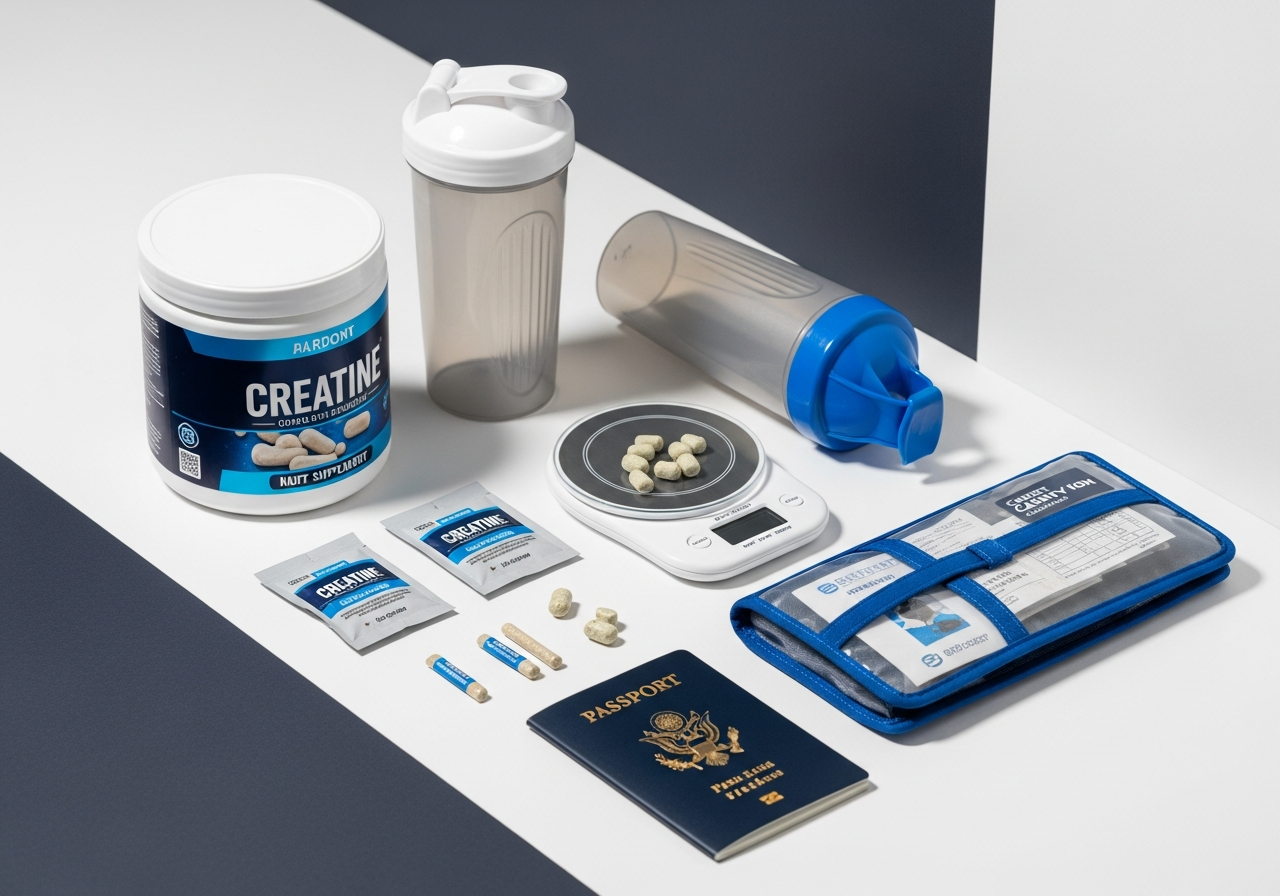
The best way to travel with creatine is to make it obvious what it is, keep it tidy, and avoid loose unlabelled powder. If you are wondering how to bring creatine on a plane, how to bring creatine through TSA, or how to travel with creatine, these steps are the most practical.
- Choose your format. Powder is the most cost-effective and most studied form when it is creatine monohydrate, but capsules are often easier at security. The 2017 ISSN position stand identified creatine monohydrate as the most effective ergogenic nutritional supplement currently available for increasing high-intensity exercise capacity and lean body mass gains in training.
- Use original packaging if possible. A labelled tub or pouch with the ingredient list is easier to inspect than a mystery bag.
- Pack only what you need. For a 7-day trip at 5 g per day, you need just 35 g. Carrying a 1 kg tub is usually unnecessary unless you are travelling for weeks.
- If you pre-portion, label it. A small supplement container marked “creatine monohydrate” is better than an unmarked bag.
- Keep it separate in carry-on. If you expect screening, placing powders where they are easy to remove can speed things up.
- Do not mix multiple white powders together. That makes identification harder and invites more questions.
- Bring a scoop or know your dose. A level teaspoon is not perfectly precise, so frequent travellers may want a small gram scoop or use our creatine dosage calculator.
One smart travel tactic is to pack single-day servings. For example, if you take 5 g daily, pre-portion 5 g packets for each day of the trip. This keeps dosing easy, prevents overpacking, and reduces the mess of carrying a large tub.
Another useful step is to save a photo of the label on your phone. If the outer packaging gets damaged, you still have ingredient and brand information ready.
If you want detailed usage help once you arrive, see how to take creatine and how to mix creatine.
Security is usually not about whether creatine is allowed; it is about whether your powder is easy to identify.
Powder, capsules, gummies, or a full tub: which travel format works best?
The best creatine format for travel is the one you will actually take consistently, but plain creatine monohydrate powder is still the evidence-based default. If you are asking can I bring a tub of creatine on a plane or whether capsules are easier, the answer depends on convenience versus cost.
Creatine monohydrate powder is the gold standard because it is the most studied, typically the most cost-effective per gram, and easy to dose at 3 to 5 g per day. Micronized powder can mix a bit more easily, but the important part is still the monohydrate form. If you want to compare forms, our guides on the best type of creatine and why monohydrate still wins go deeper.
Capsules are the travel convenience champion. They are tidy, discreet, and less likely to create a mess in your bag. The tradeoff is pill count. Depending on the product, reaching 3 to 5 g may take several capsules. For some travellers that is still worth it.
Gummies can be convenient, but many products deliver less creatine per serving than powder and may include sugar or fillers. They can work, but they are rarely the most economical way to stay saturated. Liquid creatine is also not the first choice because creatine's stability over time in solution is a concern, which is why plain dry powder remains the default recommendation.
For travel, use this ranking:
- Best all-around: creatine monohydrate powder in original packaging
- Best for easiest airport screening: capsules
- Best for very short trips: pre-portioned powder servings
- Least cost-effective: gummies and many specialty formats
If you are shopping in Canada, look for clear dosing information, lot numbers, and ideally a visible NPN where applicable. Third-party testing and transparent labelling add confidence, especially if you are flying internationally and want your supplement to look professional rather than improvised. Our creatine brand reviews can help you compare options.
For most travellers, plain monohydrate powder is still best; capsules simply trade higher cost for lower hassle.
How much creatine should you pack for a trip? Exact doses by goal and body size
Most people should pack 3 to 5 g of creatine per day while travelling, because that is the standard maintenance range used to keep muscle creatine stores saturated. If you are asking how much creatine to bring on a plane, the answer is usually just your daily dose multiplied by the number of days away, plus a small buffer.
The most common evidence-based strategy is simple:
- Maintenance: 3 to 5 g daily
- Loading phase: about 20 g daily split into 4 doses of 5 g for 5 to 7 days
- Alternative loading method: around 0.3 g per kg per day for 5 to 7 days, then 3 to 5 g daily
The 2017 ISSN position stand supports these standard dosing patterns, and the 2021 JISSN review on common creatine questions reinforced that monohydrate remains the best-supported form and that daily consistency matters more than perfect timing.
Practical examples:
- 60 kg traveller: 3 g daily is usually reasonable for maintenance.
- 75 kg traveller: 3 to 5 g daily is standard.
- 90 kg traveller: 5 g daily is a simple default.
- 14-day trip at 5 g per day: pack 70 g, plus 10 to 15 g extra in case of delays.
If you are in the middle of a loading phase, travelling can make things awkward because four separate 5 g doses per day are less convenient. In that case, you have two sensible options: continue loading if you can manage the servings, or switch to a standard maintenance dose and accept a slower rise in saturation. Missing the “perfect” loading plan is not a disaster.
One overlooked point is that you do not need special “travel dosing”. Creatine works by increasing intramuscular phosphocreatine, which is the stored form used to rapidly regenerate ATP during repeated high-power efforts. That saturation process depends on total daily intake over time, not on being in your home kitchen.
If you want a more tailored daily amount, use our creatine dosage calculator and read how much creatine per day.
Pack the amount that matches your usual daily routine; travel does not change the core dose.
Timing on travel days, missed doses, and what to expect if your routine gets messy
The best time to take creatine while travelling is simply the time you are most likely to remember it, because daily consistency matters more than precise timing. If you are crossing time zones, flying early, or missing a workout, the practical rule is easy: take your normal daily dose at any convenient point that day.
Creatine is not an acute stimulant, so you will not feel an immediate “kick” from taking it before a flight or before a hotel workout. It works by gradually increasing phosphocreatine stores in muscle. Once stores are saturated, creatine can help support repeated short bursts of high-intensity work, like sprints, heavy sets, jumps, and repeated accelerations. That is why your long-term pattern matters more than whether you take it at 8 a.m. or 8 p.m.
Here is a practical travel timeline:
- Day 1 to 7 without loading: you may notice nothing yet, especially if you are already saturated.
- After 2 to 4 weeks from starting creatine: many users notice better training performance, extra reps, slightly improved power output, or improved recovery between hard sets.
- If already saturated before your trip: staying at 3 to 5 g daily simply maintains your levels.
If you miss one day, very little changes. If you miss two or three days, it is still not a major problem. Muscle creatine stores do not disappear overnight. You do not need to “double up” aggressively the next day. Just resume your usual dose. If you routinely forget creatine while travelling, connect it to a stable habit like brushing your teeth, making coffee, or eating breakfast.
For people who want every detail, see when to take creatine, creatine on rest days, and what happens if you miss a day of creatine.
One useful reality check: travel itself often disrupts sleep, hydration, meal timing, and training quality more than creatine timing does. So if you are trying to preserve results on the road, focus first on getting the dose in consistently, drinking enough fluid, and keeping at least some training structure.
On travel days, the best timing is the timing you will actually stick to.
Who should bother bringing creatine while travelling — and who probably does not need to?
People who already take creatine daily should usually bring it on a trip, while people who do not use creatine regularly do not need to start just because they are travelling. If you are asking whether it is okay to bring creatine in airport settings or whether it is worth the effort, the answer depends on your training goals and routine.
Beginners can absolutely travel with creatine, but there is no need to overcomplicate it. A simple 3 to 5 g daily dose is enough. Travel is not the time to experiment with mega-doses, dry scooping, or stacking several new supplements at once.
Women can use and travel with creatine just as men can. Creatine is not a male-only supplement and it is not a steroid. Our guide on creatine for women covers common concerns about scale weight and “bulking”.
Older adults may benefit from staying consistent with creatine while travelling, especially if they use it to support resistance training, muscle function, or healthy ageing goals. See creatine for older adults for more.
Athletes in sports with repeated high-intensity efforts often have the strongest reason to bring creatine. The International Olympic Committee's 2018 consensus on dietary supplements lists creatine among the few supplements with strong evidence for specific performance uses. That matters if you are travelling for competition, training camp, or a tournament and want to avoid interruptions.
Vegetarians and vegans may want to be especially consistent because baseline creatine stores can be lower when dietary creatine intake from meat or fish is lower. See is creatine vegan and creatine for vegetarians.
Who might skip it? If your trip is only one or two days and packing space is very tight, missing a brief window is unlikely to matter much. Also, if you have a medical condition, take prescription medication, or have been told to avoid certain supplements, your first stop should be your clinician rather than an airport packing guide.
If creatine is already part of your routine, bring it; if it is not, travel does not create a special need to start.
Safety, side effects, and the biggest airport myths about creatine
Creatine is one of the most studied sports supplements, and for healthy people using standard doses, the evidence supports a strong safety profile. The 2017 ISSN position stand and the 2021 JISSN review both concluded that creatine monohydrate is effective and generally safe when used appropriately. You can read those directly here: Kreider et al. (2017), ISSN Position Stand and Antonio et al. (2021), Common questions and misconceptions.
The most common side effects are practical rather than dangerous: mild stomach upset, loose stool when large doses are taken at once, and temporary water-weight gain from increased intracellular water, meaning water stored inside muscle cells. That is not the same thing as gaining fat. If you want the full breakdown, see is creatine safe, does creatine make you gain weight, and creatine digestive side effects.
Now the common myths:
- Myth: Creatine is a steroid. False. Creatine is not an anabolic steroid and does not work like one.
- Myth: Creatine is banned for travellers. False. It is generally allowed, though powders can be screened.
- Myth: Creatine dehydrates you on flights. The evidence does not support the old dehydration myth; normal good hydration habits are enough. For more, see creatine and dehydration.
- Myth: You must cycle creatine. False for most users. Daily use is standard. See do you need to cycle creatine.
One nuance matters: people with kidney disease, significant renal impairment, or other relevant medical concerns should not self-prescribe creatine casually. Creatine can also raise serum creatinine, which is a blood marker sometimes used to assess kidney function, without necessarily meaning kidney damage. That confusion is common, and our guide on creatine and kidney concerns explains it.
Airport travel does not make creatine less safe; it simply makes packing and screening more important.
Can you bring creatine on a plane in Canada or on international trips?
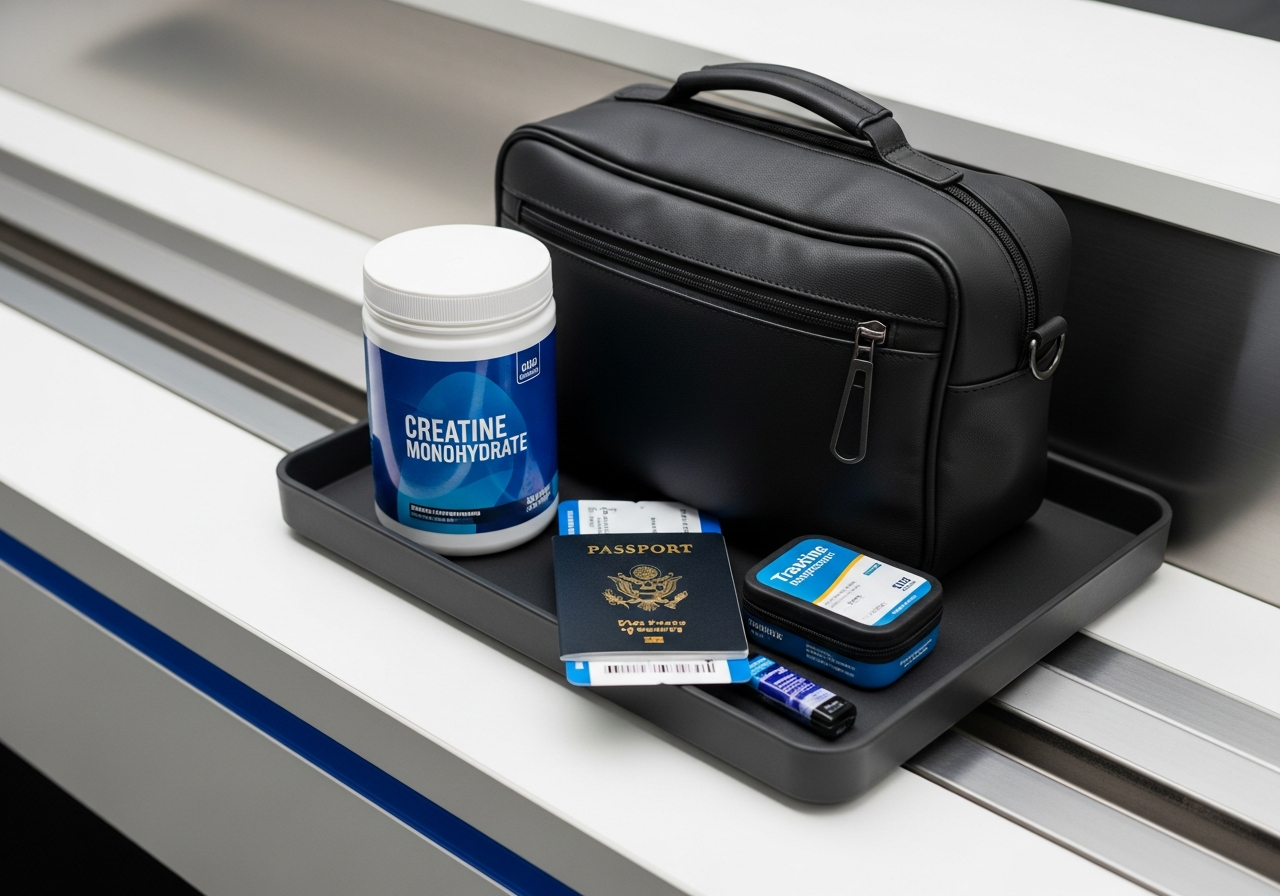
Yes, you can usually bring creatine on a plane in Canada and on international trips, but international travel adds customs rules that are separate from airport security rules. If you are asking can I bring creatine on a plane Canada or can I bring creatine on a plane international, the key distinction is this: security checks what you can carry onto the aircraft, while customs may care about what you are importing into another country.
Within Canada, creatine sold legally as a natural health product often carries an NPN, or Natural Product Number. That can help show that the product is a legitimate consumer supplement with reviewed labelling. It is not required for every travel scenario, but it can be reassuring to have the original Canadian label intact.
For international trips, check three things before you leave:
- Destination-country supplement rules. Some countries are stricter about imported supplements, even common ones.
- Quantity. A reasonable personal-use amount is less likely to raise questions than several large tubs.
- Ingredients. Plain creatine monohydrate is cleaner and easier to explain than a flashy multi-ingredient pre-workout blend.
This is one reason plain creatine monohydrate is such a strong travel choice. It is simple, widely recognised, and easy to identify. A complicated proprietary formula with stimulant ingredients is much harder to explain at a border.
If you are buying specifically for travel, choose brands with clear lot numbers, full ingredient lists, and professional packaging. Our guides on buying creatine online in Canada, where to buy creatine in Canada, and Canadian supplement regulations can help.
For a broad evidence summary on creatine's role in sport and practical use, see the International Olympic Committee consensus on dietary supplements and Examine.com's creatine evidence summary.
In Canada, creatine is usually easy to travel with; internationally, the extra homework is about import rules, not creatine itself.
The most common mistakes people make when flying with creatine
The biggest mistake people make when flying with creatine is turning a simple supplement into a suspicious-looking powder situation. If you want to avoid delays, these are the main errors to avoid.
- Putting creatine in an unlabelled sandwich bag. This is probably the most avoidable mistake. It is legal-looking to you and unclear to everyone else.
- Bringing far more than you need. A weekend trip does not require a jumbo tub.
- Mixing creatine with other powders in one container. This makes identification harder and dosing less precise.
- Starting a loading phase on a travel week. Four 5 g doses per day can be a nuisance and may increase stomach upset.
- Dry scooping at the airport. It is unnecessary, messy, and can irritate your throat or lungs.
- Assuming timing matters more than consistency. It does not.
- Ignoring hydration because of old myths. You do not need to chug absurd amounts of water, but normal hydration matters, especially on flights.
Another common mistake is chasing exotic forms because they seem more “premium” or easier to travel with. In reality, plain monohydrate is still the benchmark. Fancy marketing does not beat the evidence. Our creatine myths debunked page and monohydrate vs HCL guide cover this in depth.
Travellers also forget that hotel routines are less predictable than home routines. If your only plan is “I'll remember later,” there is a good chance you will skip doses. Set a phone reminder or keep your daily serving beside a toothbrush, protein powder, or coffee setup.
Finally, do not overreact if one travel day goes sideways. A delayed flight, late check-in, or missed gym session does not erase your progress. Creatine works over weeks and months, not from one perfect scoop.
The smoothest creatine travel plan is boring: labelled, measured, consistent, and easy to explain.
Bottom line: the simplest creatine travel checklist to follow every time
Yes, you can take creatine on a plane, and the easiest way to do it is to pack a labelled product, bring only what you need, and keep your daily dose simple. If you have read this far because you were worried about whether you are allowed to bring creatine on a plane, the practical answer is that most travellers will have no issue when they pack it sensibly.
Use this checklist before every trip:
- Choose plain creatine monohydrate. It is the most studied, most cost-effective, and easiest to explain.
- Decide carry-on or checked. Small amounts in carry-on are fine; larger tubs are usually better in checked baggage.
- Keep the label. Original packaging is ideal.
- Pack your dose. Most people need 3 to 5 g per day. Multiply by days away and add a little extra.
- Bring a measuring method. Scoop, capsules, or pre-portioned packets.
- Stay consistent. Timing is flexible; daily intake matters more.
- Check destination rules for international travel. Customs rules vary more than airport security rules.
For a beginner, that may be all you need. For a competitive athlete, the same checklist still works; you just care more about not interrupting saturation before key training or competition. For women, older adults, vegetarians, and recreational lifters, the advice stays broadly the same because travel does not change how creatine works.
If you still need help choosing a product, calculating dose, or troubleshooting side effects, start with our guides on creatine for beginners, how much creatine per day, how long creatine takes to work, and best creatine monohydrate in Canada.
Final answer: yes, you can bring creatine on a plane, and for most people the best approach is a labelled monohydrate product, packed neatly, dosed at 3 to 5 g per day, with larger amounts placed in checked baggage when convenient.
Flying With Creatine: The Numbers That Actually Matter
- 3-5 g/day Standard maintenance dose — The usual daily range for most healthy adults to maintain saturation.
- ~20 g/day Typical loading dose — Usually split into 4 doses of 5 g for 5-7 days.
- 5-7 days Classic loading timeline — Used to raise muscle creatine stores more quickly.
- 2-4 weeks Typical no-load timeline — How long creatine often takes to fully show effects when started without loading.
Frequently Asked Questions
Can you bring creatine powder on a plane?
Yes, you can usually bring creatine powder on a plane. The main issue is not legality but screening, because loose powders in carry-on may get extra inspection, especially if they are in an unlabelled bag. Keeping creatine in its original labelled container is the simplest way to avoid problems.
Can I bring creatine in my carry-on bag?
Yes, you can usually bring creatine in your carry-on bag. Small, clearly labelled amounts are the easiest option, while large tubs of powder are more likely to be inspected. If you want the smoothest checkpoint experience, keep the label visible and consider packing bigger amounts in checked luggage.
Can I carry creatine in checked luggage?
Yes, you can generally carry creatine in checked luggage. In fact, checked baggage is often the easier place for full tubs or larger quantities because you are less likely to deal with an in-person powder inspection at the checkpoint. Just seal it well so it does not leak in transit.
Can I bring a tub of creatine on a plane?
Yes, you can usually bring a tub of creatine on a plane. A factory-sealed or clearly labelled tub is usually much easier to explain than a loose bag of powder. If the tub is large and you do not need it during the flight, checked luggage is often the more convenient place to pack it.
Can you travel internationally with creatine?
Yes, you can often travel internationally with creatine, but you should check the destination country's import rules before you go. Airport security and customs are different issues: security is about what can be carried onboard, while customs may care about supplements being brought into the country.
Can I bring creatine on a plane in Canada?
Yes, you can usually bring creatine on a plane in Canada. A Canadian product with clear labelling and, where applicable, a Natural Product Number can be easier to identify. The same practical advice still applies: original packaging is better than an unmarked powder bag.
Is creatine allowed through TSA?
Yes, creatine is generally allowed through TSA screening, but powder may be subject to additional inspection. That does not mean creatine is prohibited; it just means security officers may want a closer look at powders. A labelled container and reasonable amount make the process easier.
What is the best way to pack creatine for a flight?
The best way to pack creatine for a flight is in its original labelled container or in clearly labelled pre-portioned servings. For short trips, pack only the amount you need at 3 to 5 g per day. For long trips, consider splitting your supply between carry-on and checked baggage.
Do creatine capsules travel better than powder?
Yes, creatine capsules often travel more smoothly than powder because they are tidier and less likely to trigger powder-related screening. The tradeoff is that capsules usually cost more per gram and may require several capsules to reach a full 3 to 5 g daily dose.
What happens if I miss a day of creatine while travelling?
Missing a day of creatine while travelling is usually not a big deal. Muscle creatine stores do not vanish overnight, so one missed dose will not erase your progress. Just resume your normal daily dose the next day instead of trying to overcompensate with an unnecessarily large catch-up dose.