What Happens If You Take Creatine Without Working Out?
By The Creatine Canada Research Team — Evidence-based supplement analysts
Yes, you can take creatine without working out, and for most healthy adults it is fine to do so. Creatine still raises your muscle creatine stores even on non-training days, but without resistance training you should expect much smaller visible changes: more cellular water, possible support for energy-demanding tissues, and far less impact on muscle size, strength, and body composition.
Evidence-based · Cites 4 sources · Editorial standards
Key Takeaways
- Yes, creatine can be taken even when you are not working out.
- Creatine works by saturating muscle with phosphocreatine, not by requiring a workout to be swallowed with it.
- Without training, the main noticeable effect is often 0.5-2.0 kg of water weight from increased intracellular water.
- A standard maintenance dose is 3-5 g of creatine monohydrate daily, with or without food.
- Loading is optional: 20 g/day split into 4 doses for 5-7 days saturates stores faster.
- Creatine is most useful without exercise for vegetarians, older adults, and people between training blocks who want to stay saturated.
- Choose plain creatine monohydrate and, in Canada, look for an NPN and preferably third-party testing.
Yes — you can take creatine without working out, but your results will be different
Yes, you can take creatine without working out, and for most healthy adults it is generally fine to do so. The key point is that creatine supplementation saturates body stores over time whether or not you trained that day, but the biggest benefits people care about — more strength, more lean mass, better repeated high-intensity performance — show up most clearly when creatine is paired with exercise.
If you are asking, “can you just take creatine without working out?” the practical answer is yes. Creatine is not a stimulant and it does not only “activate” during a workout. It is a compound your body already makes from amino acids, and you also get small amounts from foods like red meat and fish. Supplementing increases the amount stored in muscle as free creatine and phosphocreatine, the rapid-energy form used to help regenerate ATP, your cells’ immediate fuel.
What changes if you are not training is the outcome. If you are lifting weights, sprinting, or doing repeated hard efforts, higher phosphocreatine availability can support more total training quality over time. If you are inactive, between training phases, injured, travelling, or simply not in the gym right now, creatine can still raise tissue stores, but you should not expect it to build noticeable muscle on its own the way some marketing implies.
- Fine to take without gym: yes, especially if your goal is maintaining saturation, supporting future training, or exploring non-performance benefits.
- Will taking creatine without working out do anything? yes, but usually less visibly than when training.
- Will it cause fat gain? no, creatine has no calories and does not directly add body fat.
- Will it make you stronger if you do nothing? usually not in a meaningful real-world way.
The 2017 ISSN position stand concluded that creatine monohydrate is the most effective ergogenic nutritional supplement currently available for increasing high-intensity exercise capacity and lean body mass during training. That wording matters: the strongest evidence is for training plus creatine, not creatine replacing training.
If you are new to the topic, start with our guides on what creatine is and creatine for beginners, because most confusion comes from expecting a training supplement to produce training-like results in the absence of training.
What happens if you take creatine without working out? Usually water retention first, not dramatic muscle gain
If you take creatine without working out, the most common short-term effect is an increase in body water stored inside muscle cells, not a dramatic increase in muscle tissue. That is why many people notice the scale move before they notice any change in performance or appearance.
Here is the realistic sequence. During the first several days to weeks, creatine supplementation raises intramuscular creatine stores. As muscle creatine increases, water tends to move into the muscle cell as well. This is intracellular water retention, meaning water held inside muscle cells rather than under the skin. That can make muscles look a bit fuller in some people, but it is not the same thing as gaining fat.
If you are not exercising, the likely outcomes are:
- Higher muscle creatine stores: this is the primary biological effect.
- Possible body weight increase: often about 0.5-2.0 kg, especially if you load or respond strongly.
- Little to no visible muscle growth at first: because the training stimulus that drives hypertrophy is missing.
- No direct fat loss effect: creatine does not burn fat on its own.
- Potential support in certain populations: older adults, vegetarians, and some people interested in cognitive or healthy-aging angles may still see value.
So if you are wondering, “what happens when I take creatine without working out?” the honest answer is that your muscles become more saturated with creatine, you may gain some water weight, and you are setting the stage for better performance later if you resume training. That is why many people continue creatine during deloads, rest days, injuries, or busy periods. You do not “lose progress” because you were not in the gym the day you took it; supplementation works by maintaining saturation over time.
The 2021 JISSN review on common questions and misconceptions about creatine noted that many fears around creatine are overstated, while also reinforcing that expectations should match the evidence. Creatine is not an anabolic steroid, it is not magic, and it does not replace progressive training. For a deeper myth breakdown, see creatine myths debunked and our guide on whether creatine makes you gain weight.
In short: yes, it does something without exercise, but what it does is mostly biochemical saturation and water handling, not instant physique transformation.
How creatine works even without exercise: the phosphocreatine system still fills up
Creatine can work without exercise because the first job of supplementation is to increase stored creatine and phosphocreatine in tissues, and that storage process does not require a workout session to happen. Exercise determines how much of that stored energy system you use and how much benefit you can convert into performance and training adaptation.
Mechanistically, creatine is stored mostly in skeletal muscle, with smaller amounts in the brain and other tissues. Inside muscle, part of it is held as phosphocreatine. Phosphocreatine donates a phosphate group to help regenerate ATP during very short, intense efforts such as heavy sets, sprints, jumps, and repeated bursts. More stored phosphocreatine means you can typically recover ATP a bit faster between hard efforts.
Without exercise, that same saturation process still occurs. What is missing is the repeated high-demand use case that makes the advantage obvious. Think of creatine as filling a battery buffer. The buffer can be charged whether or not you are training today, but you only notice its performance value when you ask the body to do hard, repeated work.
This is also why timing is less important than consistency. Once muscles are saturated, day-to-day intake matters more than taking creatine exactly before or after a workout. If you are not currently training, you can still take it daily and maintain those stores until you restart. For more on timing nuance, see when to take creatine and creatine on rest days.
There may also be non-exercise use cases. Creatine has been studied in areas such as cognition, healthy aging, and support during immobilization or inactivity, but the evidence there is more mixed and more context-dependent than the exercise performance literature. The strongest, most settled evidence remains in high-intensity exercise and resistance training. The non-training benefits are promising in some populations, but they are not as universally predictable.
So if you are asking, “can creatine work without working out?” the precise answer is yes: it can raise creatine stores and influence body water and cellular energy buffering without training. But if you are asking whether it can replace exercise for muscle and strength gains, the answer is no.
Are there benefits to taking creatine without working out? Yes, but they are more niche and less dramatic
Yes, there can be benefits to taking creatine without working out, but they are usually more modest and more situation-specific than the classic gym-related benefits. The people most likely to benefit without regular training are those with lower baseline creatine stores, older adults, and people trying to maintain saturation between training periods.
One group that often responds well is vegetarians and vegans. Because dietary creatine comes mainly from animal foods, people who eat little or no meat and fish often start with lower muscle creatine stores. Lower starting stores often means more room to increase saturation, which can make supplementation more noticeable even before structured training is added. If that is you, our guide on creatine for vegetarians is worth reading.
Older adults are another important group. Creatine has been studied alongside resistance training for preserving muscle and function with aging, and some interest extends to cognitive and functional support even outside structured training. The caveat is important: the biggest benefits still tend to appear when exercise is included. Still, maintaining creatine stores may be reasonable for some older adults who are intermittently active or rebuilding from time off. See creatine for older adults for the full context.
Creatine can also be useful if you are:
- Between training blocks: staying saturated lets you resume with full stores.
- Injured or temporarily inactive: you may prefer not to stop supplementation if you plan to return.
- Starting soon: beginning creatine now means you are already saturated once training begins.
- Interested in brain-related research: evidence is emerging, but it is not as definitive as the sports data.
What creatine without exercise is not especially good at doing is visibly transforming body composition by itself. If your goal is to build muscle, lose fat, or improve athletic output, training remains the main driver. Creatine is an amplifier, not a substitute.
For a broader evidence summary, the Examine.com creatine evidence summary is useful, and our own breakdown of creatine benefits separates well-established effects from emerging ones.
Exactly how much creatine to take if you are not working out
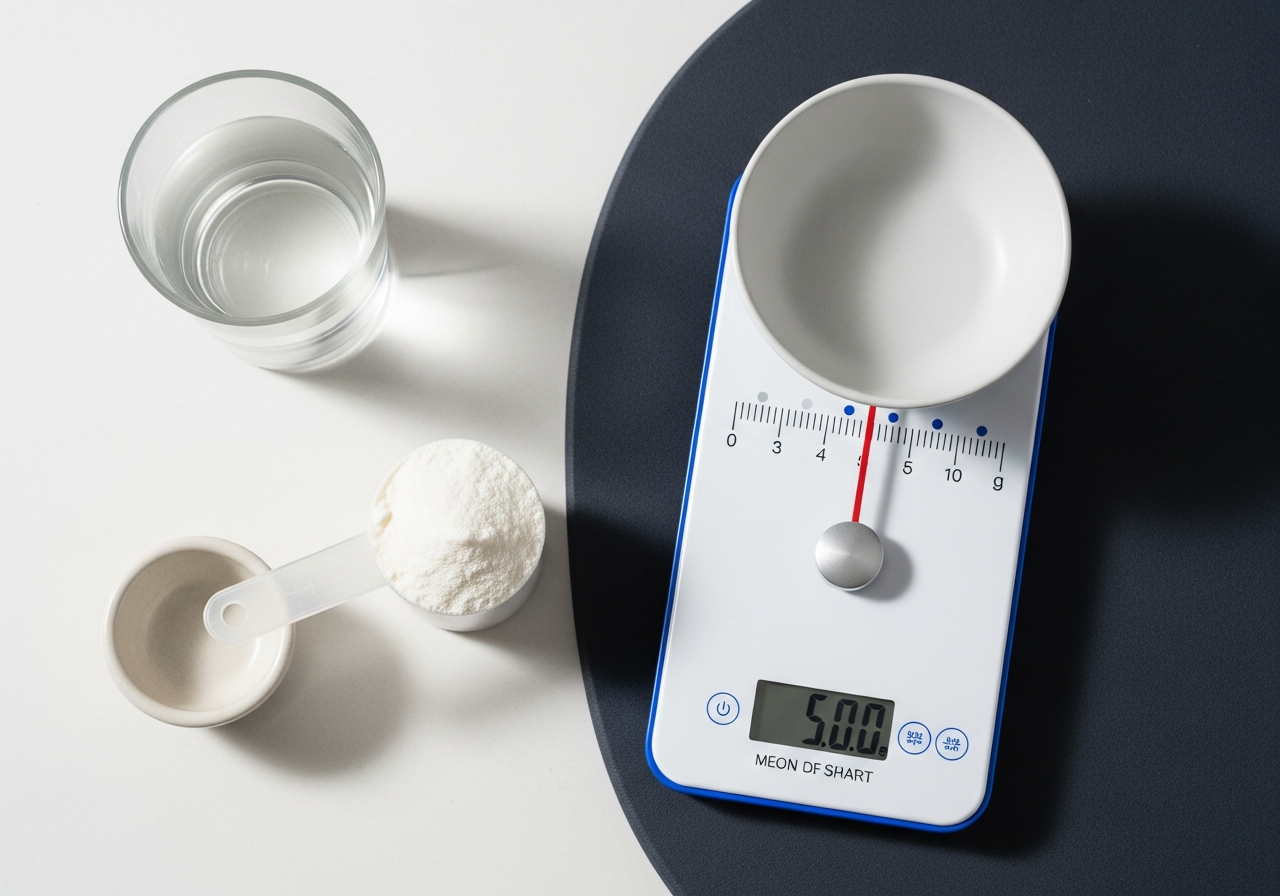
If you are not working out, the best creatine dose is usually the same standard daily maintenance dose used by most lifters: 3-5 g of creatine monohydrate per day. The goal is still saturation, and that does not change just because you are not in the gym right now.
For most adults, use one of two evidence-based approaches:
- No loading: take 3-5 g once daily. This reaches near-full muscle saturation in about 3-4 weeks.
- Optional loading: take 20 g/day split into 4 doses of 5 g for 5-7 days, then continue with 3-5 g/day. This saturates stores faster.
If you are smaller, highly cautious about stomach comfort, or simply want the easiest routine, 3 g/day is completely reasonable. If you are larger, very muscular, or want a simple one-scoop habit, 5 g/day is the standard practical dose. Some sports nutrition frameworks also use body weight formulas such as about 0.3 g/kg/day for loading and roughly 0.03 g/kg/day for maintenance.
| Body weight | Simple daily dose | Optional loading dose | Best for |
|---|---|---|---|
| Under 60 kg | 3 g/day | ~18 g/day for 5-7 days | Smaller adults, cautious starters |
| 60-90 kg | 3-5 g/day | 20 g/day for 5-7 days | Most adults |
| Over 90 kg | 5 g/day | ~25-30 g/day for 5-7 days | Larger or more muscular adults |
If you want a precise number, use our creatine dosage calculator or read how much creatine per day. If you are sensitive to digestive upset, split the dose into smaller servings and take it with a meal. Micronized monohydrate can also mix more easily, though regular monohydrate is still the evidence standard.
One important point: taking more than you need after saturation does not create extra benefit. Once stores are full, larger intakes mostly add cost and increase the chance of stomach issues. Creatine is one of the simplest supplements in sports nutrition, so the winning strategy is consistency, not complexity.
A simple step-by-step plan if you want to take creatine even when you are not working out
If you want to take creatine when not working out, the best approach is to make it boringly consistent: choose monohydrate, pick a daily dose you will not forget, and stick to it long enough to saturate your muscles. That matters more than brand hype, fancy timing, or stacking.
- Choose creatine monohydrate. Monohydrate is the most studied, most reliable, and usually the most cost-effective form. If you are comparing options, start with our best creatine rankings and creatine brand reviews.
- Pick your dose. Take 3-5 g daily, or load with 20 g/day split into 4 doses for 5-7 days if you want faster saturation.
- Take it at a convenient time. Morning, lunch, or evening all work. Choose the time you are least likely to miss.
- Mix it properly. Stir into water, juice, or a protein shake. Warm liquid can help it dissolve, but it is not necessary. If mixing is a pain point, read how to mix creatine.
- Drink normally. You do not need extreme water intake, but you should stay generally well hydrated. See how much water to drink with creatine.
- Give it time. With no loading, assess after 3-4 weeks. With loading, assess after about 1 week.
- Decide based on your goal. If you are about to return to training, staying saturated makes sense. If you dislike the extra water weight and have no clear reason to take it, stopping is also reasonable.
What should you expect week by week?
- Week 1 with loading: faster saturation, possible slight weight increase, occasional stomach upset if doses are too large.
- Week 1 without loading: usually little noticeable change.
- Weeks 2-4: saturation gradually rises; some people notice fuller muscles or a small scale increase.
- After 4 weeks: if you still are not training, visible effects often plateau because creatine has done its main storage job.
If your aim is pure convenience, put the tub beside something you use every day — coffee maker, toothbrush, or breakfast bowl. Adherence is the real trick.
Do you need to time creatine around workouts if you are not training right now?
No, if you are not currently training, you do not need special creatine timing. When there is no workout to anchor it to, simply take creatine at any consistent time of day that helps you remember your dose.
This answer also resolves several common searches at once: “can I still take creatine when not working out?”, “can you take creatine even when not working out?”, and “can you still take creatine without working out?” Yes — and no workout-window timing is required.
Creatine is not like caffeine, where acute timing strongly changes the effect you feel. Creatine works by accumulating in tissues across days and weeks. Once muscle stores are elevated, the exact hour you take it matters far less than whether you keep taking it regularly. That is why most experts prioritise daily adherence over pre-workout or post-workout precision.
If you are on a rest day, travelling, between programs, or off training for a few weeks, there are two rational options:
- Keep taking it daily if you want to maintain saturation and plan to train again.
- Pause it if you have no near-term use for it and do not care about staying saturated.
Neither option is morally superior; it depends on your goal. If you stop, your elevated stores gradually drift back toward baseline over time rather than disappearing overnight. If you continue, you preserve saturation so there is no need to re-build it later. For more, read creatine on rest days, what happens if you miss a day, and whether you need to cycle creatine.
Taking creatine with food can be easier on the stomach for some people, but it is not mandatory. Taking it before bed is also generally fine if it suits your routine. The practical rule is simple: the best timing is the one you can repeat every day for long enough to maintain saturation.
So if you are not in the gym this month, do not overthink timing. Treat creatine like a daily nutritional routine, not like a pre-workout ritual.
Who should consider creatine without exercise — and who should pause and ask a clinician first
Creatine without exercise is most worth considering for people who have a specific reason to stay saturated or who may have lower baseline creatine stores; it is less compelling for someone fully sedentary with no training plan and no clear goal. The supplement is useful, but context matters.
Good candidates can include:
- Beginners about to start training: starting now means your muscles may already be saturated when your program begins.
- People on temporary breaks: illness, travel, exams, work crunches, or deloads are common reasons to continue.
- Vegetarians and vegans: often lower starting stores means more potential upside.
- Older adults: especially if combining creatine with even light resistance exercise or trying to support muscle preservation.
- Women: creatine is not just for men, and it does not inherently cause “bulking.” Our guide on creatine for women covers the details.
- Athletes during off-seasons or rehab: maintaining saturation can make return-to-play smoother.
People who should get personalised medical advice first include those with known kidney disease, significant liver disease, pregnancy or breastfeeding concerns, or anyone on medication where their clinician wants to review supplement use. The best broad consumer reference for general caution is the Mayo Clinic’s creatine overview, though the sports-nutrition literature is generally more favourable on safety in healthy people.
In Canada, it is also smart to buy from reputable sellers and check the label for an NPN, which stands for Natural Product Number, Health Canada’s identifier for approved natural health products. An NPN is not a guarantee of perfection, but it is a useful legitimacy signal. Third-party testing is another major plus, especially for competitive athletes. If you are shopping, compare the creatine product catalog and our guide to best creatine monohydrate in Canada.
The short version: creatine can still make sense without workouts, but it should serve a real purpose rather than being taken out of vague supplement FOMO.
Is it fine to take creatine without working out? Safety, side effects, and the myths people still get wrong
Yes, for healthy adults it is generally fine to take creatine without working out, and the safety profile of creatine monohydrate is much better established than many people realise. The biggest practical side effects are usually mild digestive upset and temporary water-weight gain, not organ damage in healthy users.
The 2017 ISSN position stand and the 2021 JISSN misconceptions paper both support creatine monohydrate as a well-studied supplement with a strong safety record in healthy individuals when used at standard doses. That does not mean everyone should take it blindly, but it does mean many internet fears are outdated or exaggerated.
Common side effects and how to manage them:
- Water weight gain: often the most noticeable effect, especially early on. This is usually intracellular water, not fat gain.
- Stomach upset or loose stools: more likely if you take too much at once. Split doses and take with food if needed.
- Temporary bloating sensation: often improved by avoiding large loading doses or by using smaller divided servings. See does creatine cause bloating.
Myths worth correcting directly:
- “Creatine is a steroid.” False. Creatine is a naturally occurring compound involved in energy metabolism, not an anabolic steroid. See is creatine a steroid.
- “Creatine dehydrates you.” The evidence does not support the idea that creatine inherently causes dehydration when normal fluid intake is maintained.
- “Creatine damages kidneys in healthy people.” The literature does not support this claim at standard doses in healthy individuals, though people with kidney disease should get medical advice first. See the creatinine confusion explained.
- “If you are not lifting, creatine is pointless.” Too strong. It is less impactful without training, but not automatically pointless.
If you ever develop persistent GI symptoms, swelling that concerns you, or lab-test confusion around creatinine, pause and speak with a qualified clinician. Creatine is simple, but your health history still matters.
What type of creatine should you buy if you are not working out? Monohydrate still wins
If you are not working out and still want creatine, plain creatine monohydrate is the best choice for almost everyone. It has the strongest evidence, the best value, and the least reason to overpay for a form that promises more than the data supports.
Marketing often pushes alternative forms such as HCl, buffered creatine, nitrate, ethyl ester, gummies, or liquid creatine. Some of these are convenient, and a few may mix or travel more easily, but none consistently outperforms monohydrate on the outcomes that matter most. When the goal is simply maintaining saturation — especially without training — there is even less reason to chase novelty.
| Form | Best use case | Evidence strength | Value | Bottom line |
|---|---|---|---|---|
| Creatine monohydrate | Almost everyone | Strongest | Best | Default recommendation |
| Micronized monohydrate | Easier mixing | Strong, via same core ingredient | Usually good | Fine if texture matters |
| Creatine HCl | People who prefer smaller servings | Weaker than monohydrate | Usually poorer | Not clearly superior |
| Gummies/capsules | Convenience and travel | Depends on total dose delivered | Often poorer | Useful, but check cost per gram |
| Liquid creatine | Convenience claims | Less compelling | Often poorer | Usually skip |
In Canada, favour products with:
- An NPN on the label.
- Clear ingredient listing with creatine monohydrate as the main ingredient.
- Third-party testing where available.
- Transparent dosing in grams, not vague “performance blend” wording.
If you want help comparing real options, check our product catalog, best creatine rankings, and brand reviews. If you are debating specialty formats, our guides on monohydrate vs HCl and why monohydrate still wins go deeper.
The simplest buying advice is also the best: buy a reputable monohydrate you can afford to take consistently.
The biggest mistakes people make when taking creatine without the gym
The biggest mistakes with creatine without training are expecting muscle-building magic, using inconsistent doses, and buying expensive forms that do not add meaningful value. Most “creatine didn’t work” stories are really expectation or adherence problems.
Here are the errors we see most often:
- Expecting creatine to replace exercise. Creatine supports training adaptation; it does not substitute for resistance training, protein intake, sleep, and progressive overload.
- Quitting after a few days. Without loading, saturation takes roughly 3-4 weeks. Stopping in week one often means you never gave it time.
- Taking random doses. One scoop some days, none on others, and double on weekends is not a smart plan. Daily consistency matters.
- Confusing water gain with fat gain. A small early increase on the scale is usually fluid shift, not body fat.
- Using too much at once. Large single doses increase the chance of GI upset and diarrhoea.
- Buying on marketing, not evidence. Fancy forms are often more expensive without better outcomes.
- Ignoring your goal. If you have no training plan, no aging-related reason, and no desire to stay saturated, taking creatine may simply not be necessary right now.
If you are asking, “is creatine beneficial without exercise?”, the best answer is: sometimes, but only if the benefit matches your actual use case. For example, a vegan beginner planning to start lifting in a month has a strong reason. Someone fully sedentary who wants visible muscle without training does not.
A better way to judge whether it is working is to look for the right signs:
- Did you take it daily for at least 3-4 weeks, or complete a proper loading phase?
- Did body weight rise slightly, especially if you loaded?
- Do your muscles feel or look slightly fuller?
- When you resume training, do you feel a bit better on repeated hard efforts over the next several weeks?
Creatine is one of the least flashy but most reliable supplements in sports nutrition. It rewards patience, routine, and realistic expectations.
Bottom line: should you take creatine if you are not working out right now?
Yes, you can take creatine without working out, and for many healthy adults that is perfectly reasonable — but whether you should depends on why you are taking it. If your goal is to stay saturated during a break, prepare for upcoming training, or support a lower-creatine baseline such as vegetarian eating, daily creatine monohydrate can make sense. If your goal is to build obvious muscle or strength without exercise, creatine will not do that job by itself.
The practical rule is simple:
- Take it if you have a clear reason and are happy with modest benefits outside training.
- Skip it for now if you are fully sedentary, dislike potential water-weight gain, and have no near-term plan to train or other specific use case.
If you decide to use it, keep the protocol simple:
- Buy plain creatine monohydrate.
- Take 3-5 g daily.
- Optional: load with 20 g/day split into 4 doses for 5-7 days.
- Take it any time of day you will remember.
- Stay normally hydrated.
- Reassess after 3-4 weeks if you did not load.
The evidence hierarchy matters here. The strongest evidence supports creatine for high-intensity performance and lean mass gains when combined with training. Evidence for benefits without exercise exists, but it is more limited, less visible, and more dependent on the individual and the goal.
If you want the shortest possible answer to the main query — “can you take creatine without working out?” — here it is: yes, absolutely. Just do not confuse taking creatine without working out with getting the full training-related benefits of creatine without working out.
Creatine Without Working Out: The Numbers That Matter
- 3-5 g/day Standard maintenance dose — Works for most adults whether or not they are training.
- 20 g/day Typical loading amount — Usually split into 4 doses for 5-7 days to saturate faster.
- 3-4 weeks Time to saturate without loading — Daily maintenance reaches near-full stores gradually.
- 0.5-2.0 kg Common early water-weight change — Usually intracellular water, not fat gain.
Frequently Asked Questions
Can you take creatine even if you're not working out?
Yes, you can take creatine even if you are not working out. Creatine still increases muscle creatine and phosphocreatine stores without exercise, but the most noticeable benefits for strength, muscle gain, and performance are much greater when it is paired with training.
What happens if you take creatine without working out?
If you take creatine without working out, the most likely effects are increased muscle creatine stores and some water retention inside muscle cells. You may notice a small increase in body weight or a slightly fuller look, but you should not expect major muscle gain or fat loss from creatine alone.
Is it fine to take creatine without working out?
Yes, for most healthy adults it is fine to take creatine without working out. The main cautions are the same as usual: use a standard dose, expect possible water-weight gain or mild stomach upset, and speak with a clinician first if you have kidney disease or another relevant medical condition.
Will taking creatine without working out do anything?
Yes, taking creatine without working out still does something because it raises stored creatine in muscle. What it usually does not do is create the full strength, power, and lean-mass benefits that come from using those higher stores during repeated training sessions.
Can I still take creatine when not working out for a few weeks?
Yes, you can still take creatine when not working out for a few weeks, and many people do exactly that during rest periods, travel, injury rehab, or busy life phases. Keeping intake consistent helps maintain saturation so you do not have to rebuild stores once training resumes.
Can creatine build muscle without exercise?
Not in the way most people mean. Creatine may increase intracellular water and support muscle energy storage without exercise, but meaningful muscle hypertrophy is driven mainly by resistance training, adequate protein, and recovery rather than creatine by itself.
Should I stop taking creatine on days I don't go to the gym?
No, you do not need to stop taking creatine on days you do not go to the gym. Creatine works through long-term saturation, so daily consistency is usually better than only taking it on workout days.
Can I drink creatine without working out that day?
Yes, you can drink creatine without working out that day. Your body does not require a workout session for creatine to be absorbed and stored, so taking it on rest days or non-training days is normal and often recommended.
Do I need a loading phase if I'm not working out?
No, you do not need a loading phase if you are not working out. Loading simply saturates muscle faster; if speed is not important, taking 3-5 g daily is the simpler and more comfortable option for most people.
Will creatine make me gain weight if I'm not exercising?
Possibly, yes, but usually through water rather than fat. A small early increase in body weight is common because creatine pulls more water into muscle cells, especially during a loading phase or in people who respond strongly to supplementation.