
Does Creatine Increase Appetite? What the Research Shows
By The Creatine Canada Research Team — Evidence-based supplement analysts
No, creatine does not reliably increase appetite in most people, and the research does not show that creatine monohydrate consistently makes you hungry. If your hunger seems higher after starting creatine, the more likely explanation is harder training, changes in body weight or water retention, meal timing, or the calories and sweeteners in the product you paired it with.
Evidence-based · Cites 4 sources · Editorial standards
Key Takeaways
- Creatine itself is not known to directly raise hunger hormones or trigger appetite in a consistent way.
- Standard creatine monohydrate has no calories, so it does not increase appetite by adding dietary energy.
- If you feel hungrier on creatine, the most common reason is better training output and recovery, not the creatine molecule itself.
- A maintenance dose of 3 to 5 g daily is enough for most adults; loading can increase stomach discomfort but is not required.
- Temporary scale weight gain from creatine is mainly water stored inside muscle, not body fat.
- Take creatine with whatever meal or drink helps you remember it, and adjust if a flavoured product seems to affect cravings or digestion.
- For Canadians, plain creatine monohydrate with an NPN and preferably third-party testing is the smartest default buy.
Does creatine increase appetite? The short answer is usually no
No, creatine does not usually increase appetite, and there is no strong evidence that creatine supplementation consistently raises hunger levels in healthy adults. That direct answer matters because many people confuse the effects of creatine itself with the effects of training harder, eating on a bulking plan, or using flavoured supplement products that change eating behaviour.
Creatine is a compound your body stores mostly in muscle, where it helps regenerate ATP, the cell’s immediate energy currency, during short, intense efforts. Its best-established effects are on strength, repeated sprint performance, training capacity, and over time, lean mass gains when paired with resistance training. Appetite regulation is not one of creatine’s core, proven actions.
The evidence base backs that up. The 2017 ISSN position stand concluded that creatine monohydrate is effective and well studied for performance and body composition, but appetite increase is not listed as an expected effect. The 2021 JISSN review on common creatine questions and misconceptions similarly addresses safety and practical use without identifying hunger as a typical side effect.
So why do people search for “does creatine make you hungry” or “creatine and appetite” so often? Usually because several things happen at once:
- You train harder: better gym performance can increase overall energy needs.
- You gain a bit of water weight: this can change how full, flat, or “empty” you feel.
- You change routines: adding shakes, post-workout drinks, or earlier training sessions can alter meal timing.
- You start a bulk: many people begin creatine when they also intentionally start eating more.
That does not mean appetite changes are impossible. Individual responses vary, and some people report feeling hungrier, less hungry, or no different at all. But based on current evidence, if someone asks whether creatine affects appetite in a predictable way, the most accurate answer is that creatine itself does not appear to reliably increase or suppress appetite.
If you are new to supplementation, start with plain monohydrate and a simple daily routine rather than overthinking side effects. Our creatine dosage calculator and guide to how to take creatine can help you set up the basics correctly.
Why some people feel hungrier on creatine even if creatine is not the direct cause
Some people do feel hungrier after starting creatine, but the most likely cause is the context around creatine use rather than creatine directly stimulating appetite. In practice, creatine often arrives at the exact moment someone begins lifting more seriously, adding training volume, chasing muscle gain, or becoming more consistent with meals.
The simplest explanation is energy turnover. Creatine helps replenish phosphocreatine, the stored high-energy phosphate that helps muscles rapidly remake ATP during short bursts of hard work. When that system works better, many lifters can squeeze out an extra rep, hold power output a bit longer, or recover slightly better between sets. That extra work is not magic, but over days and weeks it can increase total training stress enough to make you notice more hunger.
There is also a behavioural effect. Plenty of people take creatine in juice, a post-workout shake, or a flavoured drink. If the vehicle contains calories, sweetness, or becomes part of a broader mass-gain routine, you may associate the whole routine with eating more. Creatine itself has no calories, which is worth remembering if you are asking about creatine and food cravings.
Another factor is expectation. People often start creatine while reading that it will make muscles look fuller or body weight rise. They may then monitor their body more closely and interpret normal fluctuations in fullness, stomach comfort, or post-workout hunger as proof that creatine changed appetite.
Finally, stomach upset can muddy the picture. Large doses, especially during a loading phase, can cause bloating, nausea, or loose stools in some people. Those symptoms may briefly reduce appetite in one person and create a misleading “empty stomach” hunger feeling in another. If that sounds familiar, the issue is usually dosing strategy, not a unique hunger effect. See our guide to creatine digestive side effects if you suspect this is happening.
Here is the practical rule: if your hunger rises after starting creatine, first ask what else changed that week. Did your training volume increase? Did you start a calorie surplus? Did you switch to a sugary or highly flavoured product? In most cases, one of those answers explains the change better than the creatine itself.
What the science says about creatine, hunger hormones, and appetite mechanisms
Creatine is not known to have a strong, established direct effect on the main hormones and brain pathways that regulate appetite. That is the key scientific point: creatine’s primary role is cellular energy metabolism, especially in muscle and to some extent the brain, not appetite signalling.
Appetite is regulated by a mix of signals including ghrelin, often called the hunger hormone, leptin, which helps signal long-term energy status, peptide YY and GLP-1 from the gut, blood glucose changes, stomach stretching, sleep, stress, and learned meal patterns. Creatine monohydrate has not been shown in mainstream sports nutrition guidance to consistently push those systems in one direction the way caffeine can suppress appetite for some people or fibre can increase fullness.
Mechanistically, creatine works by increasing intramuscular creatine and phosphocreatine stores. That gives you a larger reserve for rapid ATP regeneration during high-intensity work. Over time, this can support better training quality and may contribute to lean mass gains through improved training output, cell hydration, and downstream training adaptations. None of those mechanisms requires creatine to make you hungry.
Some people wonder whether cell hydration could influence appetite. Creatine does draw more water into muscle cells, which is why early weight gain on creatine is typically water stored inside muscle tissue rather than fat. But intracellular water retention in muscle is not the same thing as changing stomach fullness or directly altering hunger hormones. They are different systems.
Another common question is whether creatine affects blood sugar enough to drive cravings. Current evidence does not support the idea that standard creatine use predictably causes blood sugar swings that would explain cravings in most healthy users. If cravings appear, the more likely culprits are under-eating, intense training, poor sleep, or high-palate-reward flavoured products taken around workouts.
The bottom line from the current evidence base, including summaries like Examine’s creatine evidence review and the ISSN position stand, is straightforward: creatine has strong evidence for performance-related benefits, but weak to absent evidence for a direct, predictable effect on appetite.
If you want a deeper foundation on what creatine actually does, read what creatine is and how the creatine phosphate system powers intense effort.
Can creatine suppress appetite or change cravings during a cut?
Creatine is not a proven appetite suppressant, and it should not be used as a hunger-control supplement during fat loss. If you are dieting and notice less hunger after starting creatine, that effect is usually indirect, inconsistent, and not something you should count on.
There are a few reasons people perceive creatine appetite suppression. First, some users drink more water when supplementing, and better hydration can slightly reduce the tendency to mistake thirst for hunger. Second, if you take creatine with a meal or protein shake, the meal itself may improve fullness. Third, seeing the scale rise from water retention can make some dieters become more rigid or attentive to eating patterns, which can change reported appetite even when physiology has not changed much.
On the flip side, some people cutting calories report more hunger once they add creatine. Again, the likely explanation is not that creatine makes them hungry, but that better gym performance lets them maintain higher output while dieting. Harder sessions can absolutely raise hunger, especially when carbohydrates are low and sleep is mediocre.
Food cravings are even more complicated. Cravings are shaped by restriction, stress, sleep debt, reward-driven eating, and the foods you keep around. Creatine has no established direct role in increasing cravings for sweets, junk food, or late-night snacks. If cravings appear only after switching from plain powder to a flavoured gummy, candy-like chew, or sweet pre-workout that contains creatine, the format may be the issue rather than creatine itself.
For body recomposition or cutting, creatine still makes sense because it can help you preserve training quality and lean mass while calories are lower. That is one reason it appears often in evidence-based fat-loss stacks even though it is not a fat burner. For more on that specific use case, see does creatine help you lose fat and creatine in a caloric deficit.
The practical takeaway is simple: do not expect creatine to suppress appetite, and do not fear it as a craving trigger. Use it for its real strengths, then manage hunger with protein, fibre, meal structure, sleep, and sensible calorie targets.
How to take creatine without confusing appetite signals: a simple step-by-step plan
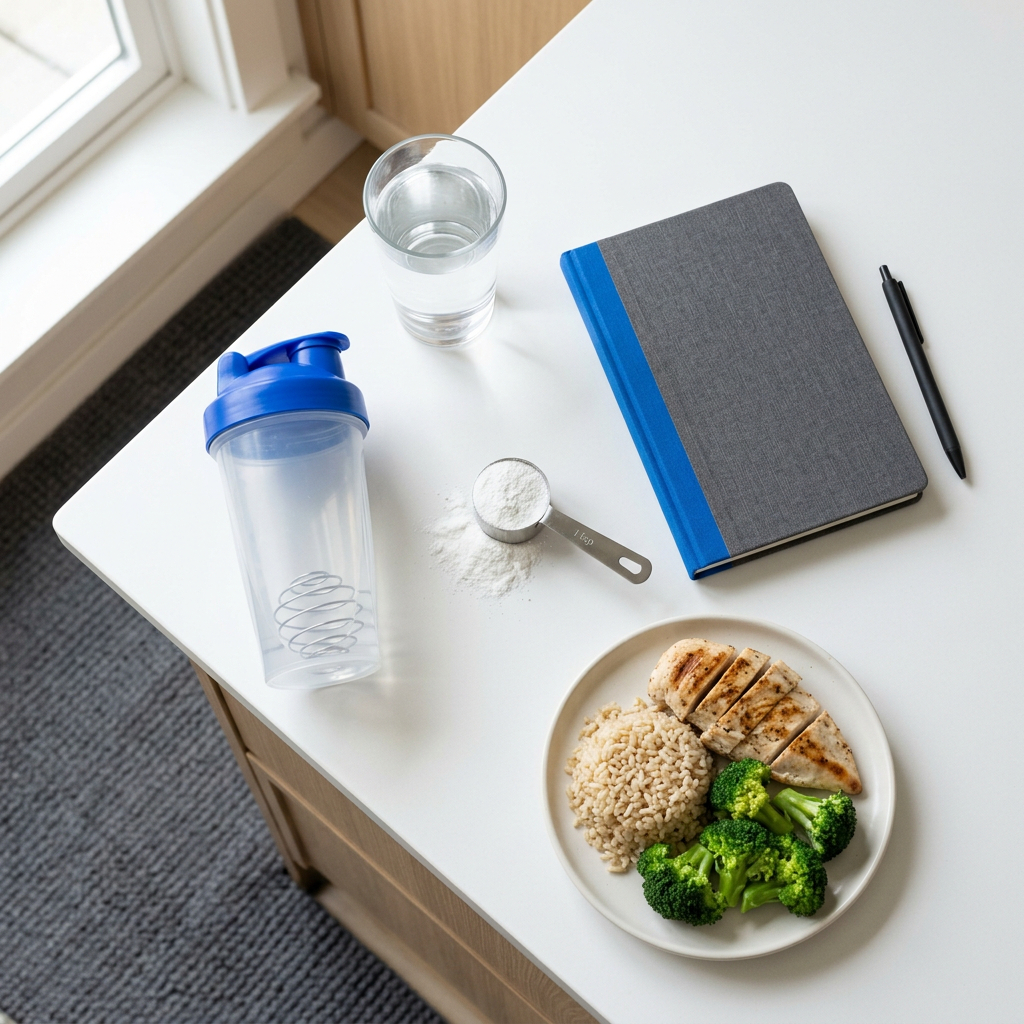
The best way to assess creatine and appetite is to keep everything else as consistent as possible for two to four weeks. If you change your supplement, calories, training plan, and meal timing all at once, you cannot tell what is affecting hunger.
- Choose plain creatine monohydrate. Use an unflavoured powder with a short ingredient list so sweeteners, sugars, caffeine, or other add-ons do not muddy the picture. If you need help choosing, compare options in our best creatine rankings and creatine brand reviews.
- Start with 3 to 5 g once daily. A maintenance dose is enough for most people and avoids the higher chance of stomach upset seen with aggressive loading.
- Take it at the same time every day. Attach it to breakfast, lunch, or your post-workout meal so adherence is easy. Timing matters far less than consistency.
- Mix it in water or a familiar drink. Keep the rest of your routine steady. If you usually train fasted, do not suddenly add a 400-calorie shake and blame creatine for hunger changes.
- Track three things for 14 days. Note your daily dose, training duration and intensity, and a simple hunger score before lunch and dinner.
- Weigh yourself under the same conditions. Morning body weight after using the washroom is best. Small increases early on are often water, not fat.
- Troubleshoot only one variable at a time. If you feel unusual hunger, first check sleep, training volume, and missed meals before changing the creatine.
What should you expect? In week 1, most people notice nothing dramatic apart from maybe a routine change. By weeks 2 to 4, if creatine is helping, you may see slightly better training quality, better repeat effort, or a modest body-weight bump from water in muscle. That does not automatically mean you will eat more.
If you do feel digestive discomfort, switch from a single larger serving to split doses, take it with food, or skip loading altogether. Our guides on creatine with or without food and how to mix creatine go deeper on setup.
Creatine dosing by body weight and goal, plus the appetite-friendly approach
If your goal is to avoid side effects and keep appetite observations clean, the safest default is 3 to 5 g of creatine monohydrate daily rather than an aggressive loading phase. Loading works, but it is optional, and skipping it reduces the chance that temporary stomach discomfort gets mistaken for appetite changes.
Mainstream sports nutrition practice uses two evidence-based approaches. The first is a loading phase of about 20 g per day split into 4 doses for 5 to 7 days, then 3 to 5 g daily. The second is simply taking 3 to 5 g daily from the start, which reaches saturation more gradually over roughly 3 to 4 weeks. Both can work; the slower route is often easier on the stomach.
| Body weight | Typical daily maintenance | Loading option | Best if appetite-sensitive |
|---|---|---|---|
| Under 60 kg | 3 g/day | 20 g/day split for 5-7 days | 3 g/day, no loading |
| 60-90 kg | 3-5 g/day | 20 g/day split for 5-7 days | 3-5 g/day, no loading |
| Over 90 kg | 5 g/day | 20 g/day split for 5-7 days | 5 g/day, or split into 2 smaller servings |
Body weight can help fine-tune the dose, but it is not worth overcomplicating. For most gym-goers, 5 g daily is a practical ceiling for standard use. Very large athletes may sometimes use slightly more, but the appetite question rarely requires that level of precision.
Here is the key appetite-related point: bigger doses do not make creatine work better once stores are topped up, but they can make digestive issues more likely. Digestive discomfort can blur your sense of hunger and fullness, especially if you take a large scoop quickly or on an empty stomach. That is one reason our default beginner advice is conservative and boring: plain monohydrate, one daily dose, consistent timing.
If you want the fastest route to a personalised intake, use our creatine dosage calculator or read how much creatine per day. If you are considering loading, the dedicated creatine loading phase guide explains when it is useful and when it is not.
Who is most likely to notice changes in hunger levels after starting creatine?
The people most likely to notice hunger changes after starting creatine are not necessarily those most sensitive to creatine itself; they are usually the people whose training or nutrition routine changes the most at the same time. In other words, context matters more than category.
Beginners often start creatine at the exact moment they begin resistance training consistently. Their appetite may rise because they are finally training hard enough to create a meaningful energy demand. Creatine gets blamed simply because it was new.
People in a bulk often pair creatine with a calorie surplus, more carbohydrates, and high-volume workouts. Naturally, hunger and eating more become part of the process. Creatine and eating more can appear linked even when the real driver is the bulk itself.
Women can use creatine effectively, and there is no good evidence that it uniquely increases appetite in women compared with men. Monthly cycle changes, stress, sleep, and dieting history are much more likely to affect hunger than creatine is. If this is your use case, see creatine for women.
Older adults may notice little to no appetite effect from creatine. Their benefit tends to centre more on supporting resistance training quality and lean mass retention, not hunger changes. Read more in creatine for older adults.
Vegetarians and vegans may respond especially well to creatine because baseline muscle creatine stores can be lower when dietary creatine intake is low. That stronger performance response could indirectly nudge appetite if training output climbs. Even then, it is still an indirect effect. Relevant guides include is creatine vegan and creatine for vegetarians.
Competitive athletes in high-output sports may feel hungrier when creatine helps them maintain repeated sprint or power work. Again, that points to workload, not a direct appetite signal from creatine.
If you are trying to work out whether creatine affects appetite for you personally, match your observation to your context. Ask whether you changed training load, calorie intake, hydration, supplement format, or body-weight goal. That simple check solves most of the mystery.
Side effects that can feel like appetite changes, but usually are not
Several normal or known creatine side effects can be mistaken for appetite changes even though they are not true changes in hunger regulation. The most common are water-weight gain, stomach upset from large doses, and the sensation of muscle fullness.
Water retention in muscle is the classic example. Creatine can increase body weight early on because more water is stored inside muscle cells. This may make you look or feel fuller, but it does not mean you are gaining fat or that creatine is stimulating appetite. For a full explanation, see does creatine make you gain weight.
Bloating is another misunderstood issue. Some users say “creatine makes me hungry” when what they really feel is abdominal discomfort, trapped air, or the odd empty-full sensation that follows a poorly mixed large dose. That is particularly common with loading or taking too much at once. Our guide on does creatine cause bloating covers fixes.
Nausea or loose stools can also distort appetite. If your stomach feels off, you may eat less for a day or two and conclude creatine caused appetite suppression. Or, once the discomfort fades, you may feel ravenous and conclude creatine increased appetite. In both cases, digestion is the more likely explanation.
Higher thirst can be confused with hunger too. Some people report feeling thirstier when they supplement consistently, especially if they also increase training intensity. If you mistake thirst for hunger, it may seem like creatine raises appetite. In reality, a glass of water and a more consistent hydration routine may solve the problem.
To reduce confusion, watch for these signs that the issue is probably side-effect related rather than appetite related:
- The feeling appears only after taking the dose, not across the whole day.
- It improves when you split the dose or take it with food.
- It happens mainly during loading.
- It comes with bloating, cramping, nausea, or urgency.
- It disappears when you switch from a flavoured blend to plain monohydrate.
The Mayo Clinic overview of creatine and ISSN guidance both support the broader point that creatine is generally well tolerated at recommended doses, with digestive issues being far more plausible than appetite shifts as an early complaint.
Best creatine to buy if you are worried about hunger, cravings, or stomach issues

If you are concerned about creatine and appetite, the best choice is usually plain creatine monohydrate powder with no extras. That keeps the ingredient list simple and removes common confounders like sugar, intense sweeteners, stimulants, and proprietary blends.
The evidence-based reason is straightforward: creatine monohydrate is the most studied form, the most cost-effective form, and still the benchmark that other forms are compared against. Fancier versions often market better digestibility or superior absorption, but the burden of proof is still on them. For most people, plain monohydrate remains the smartest first buy.
| Product type | Appetite-related upside | Potential downside | Best fit |
|---|---|---|---|
| Unflavoured monohydrate powder | No calories, minimal ingredients, easiest to isolate effects | Can feel gritty if poorly mixed | Best default for most people |
| Flavoured creatine powder | Better taste, easier adherence | Sweeteners or added carbs may affect cravings or digestion in some users | Good if plain powder makes you skip doses |
| Capsules | No taste, easy portioning | Often more expensive per gram; many capsules needed for 3-5 g | Good for travel or convenience |
| Gummies or chewables | Convenient and palatable | Can contain sugars or candy-like flavour systems that muddy appetite signals | Only if convenience outweighs cost |
| Pre-workout blends with creatine | One product instead of two | Caffeine and other actives can change appetite, energy, and digestion | Poor choice for isolating creatine effects |
For Canadians, also check the label for an NPN, which stands for Natural Product Number, indicating the product is licensed by Health Canada as a natural health product. An NPN is not a guarantee of athletic suitability or third-party sport certification, but it is a useful legitimacy check. If you compete, look for third-party testing such as Informed Sport or NSF where relevant.
If you are shopping now, start with our creatine product catalog, compare the best creatine rankings, and read best creatine monohydrate in Canada for a Canada-specific buying framework.
Common myths about creatine and hunger, debunked clearly
Many claims about creatine and appetite sound plausible but do not hold up well when you compare them with how creatine actually works. Here are the big myths worth clearing up.
Myth 1: Creatine makes everyone hungry. False. There is no strong evidence that creatine consistently increases appetite across users. Reports of hunger are more likely explained by harder training, more total activity, or changes in eating patterns.
Myth 2: If you gain weight on creatine, it means you are overeating because creatine boosted appetite. False. Early weight gain on creatine is usually water retained inside muscle, not a sign that you ate more or gained fat.
Myth 3: Creatine appetite suppression is a fat-loss hack. Unsupported. Some dieters feel different after starting creatine, but it is not an established appetite suppressant and should not be treated like one.
Myth 4: Flavoured creatine and plain creatine affect appetite the same way. Not necessarily. The creatine molecule may be the same, but the product format can matter. Sweeteners, added carbohydrates, caffeine, or even just taste reward can change how a product feels to use.
Myth 5: If you feel hungry after taking creatine, it proves creatine is working. False. The best signs creatine is working are gradual improvements in high-intensity training performance, recovery between hard efforts, or changes in body composition over time. Hunger is not a reliable indicator.
Myth 6: You need sugar with creatine or it will not absorb, and that sugar will make you hungry. Overstated. Creatine can be taken with or without food, and while insulin can assist uptake, normal daily dosing works well without special sugar-loading tactics for most people.
Myth 7: Newer forms like HCl fix appetite or digestive issues better than monohydrate. Not proven. Some individuals may prefer a different format, but monohydrate remains the best-supported option. If digestion is the issue, adjusting dose size and timing usually helps first.
For a broader myth breakdown, visit creatine myths debunked and creatine myths vs. facts. The short version is that creatine deserves credit for its real benefits, not imaginary ones tied to hunger or cravings.
When appetite changes on creatine deserve a closer look
If your appetite changes dramatically after starting creatine, it is worth stepping back, but creatine is rarely the first suspect. A large, persistent increase or drop in appetite usually has a broader explanation than a standard 3 to 5 g dose of creatine monohydrate.
Consider getting advice from a qualified healthcare professional or sports dietitian if any of the following apply:
- You have persistent nausea, vomiting, or diarrhoea that does not improve when you lower the dose.
- You experience severe bloating, abdominal pain, or unexplained weight change.
- Your appetite drops sharply for more than several days and you are unintentionally under-eating.
- You have an existing kidney condition, are pregnant or breastfeeding, or take medications that warrant review before using supplements.
- You are using multiple products at once, especially stimulant pre-workouts, fat burners, or appetite-control supplements.
Also remember that appetite is highly sensitive to sleep debt, emotional stress, illness, changes in work schedule, menstrual cycle phase, and large swings in training load. If your hunger levels changed during a hard block, a cut, exam season, travel, or shift work, those factors are usually more biologically plausible than creatine alone.
From a safety standpoint, creatine monohydrate remains one of the best-studied sports supplements available. The International Olympic Committee consensus on dietary supplements recognises creatine as one of the few supplements with strong evidence for certain performance uses, and the ISSN position stand supports its safety and efficacy in healthy populations at recommended doses.
If you simply are not sure whether creatine suits you, a good middle-ground test is to use plain monohydrate at 3 g daily for three weeks while keeping calories and training stable. That is usually long enough to tell whether you tolerate it well without the noise created by loading, stacked formulas, or major diet changes.
Bottom line: what to believe about creatine and appetite
Creatine does not reliably increase appetite, and for most people it does not directly change hunger in a noticeable, predictable way. If you are asking “does creatine make you hungry,” the evidence-based answer is that creatine itself is unlikely to be the cause unless what you are really noticing is a side effect, a training-related increase in energy needs, or a change in the product format you are using.
The most practical way to think about creatine and appetite is this:
- Creatine’s proven job is to support rapid energy production for hard, short efforts.
- Creatine’s common early effect is mild water retention in muscle, not fat gain.
- Creatine’s likely indirect effect is that better training may make some people naturally eat more.
- Creatine’s least likely role is acting as a direct appetite stimulant or suppressant.
For most adults, the best protocol is plain creatine monohydrate at 3 to 5 g daily, taken consistently, with loading optional rather than necessary. If you are trying to judge whether creatine affects appetite for you, keep your training, calories, and meal timing stable for a few weeks and avoid blended products that contain extra variables.
If your real goal is better strength, power, training quality, and long-term lean mass support, creatine remains one of the highest-value supplements you can buy. If your real goal is appetite control, look elsewhere. Creatine is simply not the tool for that job.
For next steps, the most useful companion reads are creatine for beginners, is creatine safe, how long creatine takes to work, and how to choose creatine.
Creatine and Appetite: The Numbers That Actually Matter
- 3-5 g/day Typical maintenance dose — Enough for most adults to maintain muscle creatine stores once taken consistently.
- 20 g/day Optional loading dose — Usually split into 4 servings daily for 5-7 days; faster saturation, more chance of stomach upset.
- 3-4 weeks Time to saturate without loading — Daily maintenance-only use reaches effective muscle saturation more gradually.
- 0 calories Creatine monohydrate itself — Plain creatine does not add energy intake, so it does not increase appetite by adding calories.
Frequently Asked Questions
Does creatine make you hungry?
Usually no, creatine does not reliably make you hungry. If your hunger goes up after starting it, the more likely reason is that you are training harder, recovering better, or changing your meal routine at the same time rather than creatine directly increasing appetite.
Does creatine affect appetite at all?
Creatine can affect appetite indirectly for some people, but it does not appear to have a consistent direct effect on appetite regulation. Most noticeable changes in hunger are better explained by exercise volume, calorie intake, hydration, digestive tolerance, or the type of product used.
Can creatine suppress appetite?
Creatine is not a proven appetite suppressant. Some people feel less hungry when they improve hydration or take creatine with meals, but that is not the same as creatine directly suppressing hunger, and it is not a reliable fat-loss strategy.
Why do I feel hungrier after starting creatine?
The most likely reason is that creatine is helping you train a bit harder, which can increase energy needs and normal hunger. Also check whether you started a bulk, changed your shake routine, or added a flavoured product with calories or sweeteners.
Does creatine increase food cravings?
Creatine itself is not known to increase food cravings in a predictable way. If cravings rise, look first at sleep, dieting stress, under-eating, or whether you switched to a candy-like gummy or flavoured formula that changes eating behaviour.
Will creatine make me eat more and gain fat?
Creatine does not automatically make you eat more or gain fat. Early weight gain on creatine is usually water stored inside muscle, and any fat gain would come from a sustained calorie surplus, not from creatine alone.
Does taking creatine with food change appetite?
Taking creatine with food may change how full you feel in the moment because the meal affects satiety, but that does not mean creatine itself changed appetite. Many people prefer taking it with a meal simply because it is easier on the stomach and easier to remember.
Is creatine better for appetite control during a bulk or a cut?
Creatine is not really an appetite-control supplement in either phase. During a bulk it may support better training, and during a cut it may help maintain performance and lean mass, but hunger management still depends mainly on calorie intake, protein, fibre, hydration, and sleep.
Does creatine loading increase hunger more than a regular dose?
Not in any proven direct way, but loading is more likely to cause stomach discomfort that can confuse hunger signals. If you are sensitive to digestive changes, a steady 3 to 5 g daily approach is usually easier to tolerate and easier to evaluate.
What type of creatine is best if I am worried about appetite or cravings?
Plain unflavoured creatine monohydrate is usually the best choice if you want the cleanest test. It has no calories, minimal ingredients, and avoids extra sugars, sweeteners, stimulants, or blend ingredients that can complicate appetite and digestion.