Creatine for Firefighters: Strength, Endurance, and High-Heat Demands
By The Creatine Canada Research Team — Evidence-based supplement analysts
Yes — creatine for firefighters is one of the few supplements with strong evidence for improving repeated high-intensity performance, strength, lean mass, and recovery, all of which matter in fire service work. For most firefighters and first responders, 3 to 5 g of creatine monohydrate daily is the simplest, best-supported protocol, with no need to cycle it and no evidence that it causes dehydration when used properly.
Evidence-based · Cites 4 sources · Editorial standards
Key Takeaways
- Creatine monohydrate is the best-studied, most cost-effective form for firefighters and first responders.
- A standard dose of 3 to 5 g daily works for most people; loading with 20 g/day for 5 to 7 days only speeds saturation.
- Creatine helps most with repeated stair climbs, carries, drags, lifts, sprints, and gym training that support fireground performance.
- Expect faster benefits with loading, or gradual benefits over about 3 to 4 weeks without it.
- Creatine does not act like a stimulant and is not a substitute for hydration, sleep, fitness, or electrolytes in high heat.
- Short-term scale weight often rises by about 1 to 2 kg from increased intracellular water, not body fat.
- Choose a plain monohydrate product with a Health Canada NPN and, ideally, third-party testing if your department or competition standards make purity important.
Is creatine good for firefighters? Yes — because fireground work is built on repeated high-power efforts
Yes, creatine for firefighters is a smart, evidence-based choice when the goal is better performance in short, repeated, physically demanding tasks. Firefighting is not a pure endurance job; it is a stop-start, high-output occupation built around bursts of effort such as stair climbs, hose advances, forcible entry, victim drags, equipment carries, ladder work, and rapid transitions under load.
Creatine helps those demands because it supports the body’s fastest energy system: the phosphocreatine system. Phosphocreatine is stored in muscle and helps regenerate ATP, the immediate energy currency used for explosive movement. When a firefighter has to sprint up stairs in gear, lift awkward loads, or repeat hard efforts with limited recovery, faster ATP resynthesis can mean slightly better power output, less drop-off from one effort to the next, and more useful training quality over time.
The practical result is not magic. Creatine will not turn poor conditioning into operational readiness, and it will not replace structured strength work, aerobic base training, heat acclimation, hydration, or sleep. What it can do is improve the physical qualities that support those systems: strength, power, repeated-effort capacity, and lean mass. The 2017 ISSN position stand concluded that creatine monohydrate is the most effective ergogenic nutritional supplement currently available for increasing high-intensity exercise capacity and lean body mass during training.
That matters for creatine firefighting use because much of fire department training is gym-based and task-based. If creatine helps you get more from heavy lifts, sled pushes, loaded carries, intervals, and job-specific circuits, it can indirectly improve real-world readiness. Think of it as a force multiplier for the training that prepares you for calls.
For most healthy adults in the fire service, the best entry point is plain monohydrate at 3 to 5 g daily. If you want a broader beginner overview first, see creatine for beginners, and if you want the quick version of what it does physiologically, our guide to what creatine is breaks down the basics.
- Best fit: firefighters, recruits, first responders, and anyone in physically demanding jobs with repeated bursts of effort
- Less relevant use case: very low-intensity desk work with no meaningful training plan
- Main expectation: better gym performance first, then better job-specific capacity built from better training
How creatine works in the body under fire service demands
Creatine works by increasing muscle phosphocreatine stores, which helps your muscles recycle ATP faster during hard, brief efforts. That mechanism is especially relevant in fire service tasks because many operational efforts last seconds to a couple of minutes and are repeated with incomplete recovery.
Here is the simplest way to think about it. Your muscles use ATP immediately, but stored ATP runs out quickly. Phosphocreatine donates a phosphate group to help rebuild ATP rapidly, which supports explosive muscular work. Supplementing with creatine increases the amount of creatine stored in muscle, so your body has a larger reserve to draw from during demanding efforts. In practice, that can support:
- higher power output in short bursts
- better maintenance of performance across repeated bouts
- greater training volume in the gym
- better long-term strength and lean mass gains when paired with training
For firefighters, this matters because fireground work combines strength, anaerobic power, local muscular endurance, and decision-making under fatigue. Creatine’s best-proven role is muscular, but emerging interest also exists around cognitive resilience under sleep deprivation and mental fatigue. That said, the evidence for creatine and cognition is promising but not as operationally settled as the evidence for strength and repeated high-intensity work. It is fair to say the muscular case for creatine for first responders is strong; the brain-performance case is still developing.
Creatine also tends to increase intracellular water, meaning water is pulled into muscle cells rather than causing fat gain. This is one reason users often feel a slightly fuller, better-recovered musculature and may see a short-term increase on the scale. For firefighters worried about body composition, that is not the same as getting softer or fatter. If that concern is front of mind, read does creatine make you gain weight.
Because the effect is based on saturation, creatine is not like caffeine. You do not feel an instant jolt after a single scoop. Instead, muscle stores gradually rise until they are more fully saturated, and benefits show up as better output in training and repeated efforts. That is why consistency matters more than perfect timing. Our deeper primer on creatine and ATP and creatine saturation explains the physiology in more detail.
Bottom line: creatine for fire department training makes sense because it targets the exact energy system used in climbing, carrying, dragging, lifting, striking, and repeating hard work under fatigue.
The real-world benefits firefighters can expect — and the limits of what creatine can do
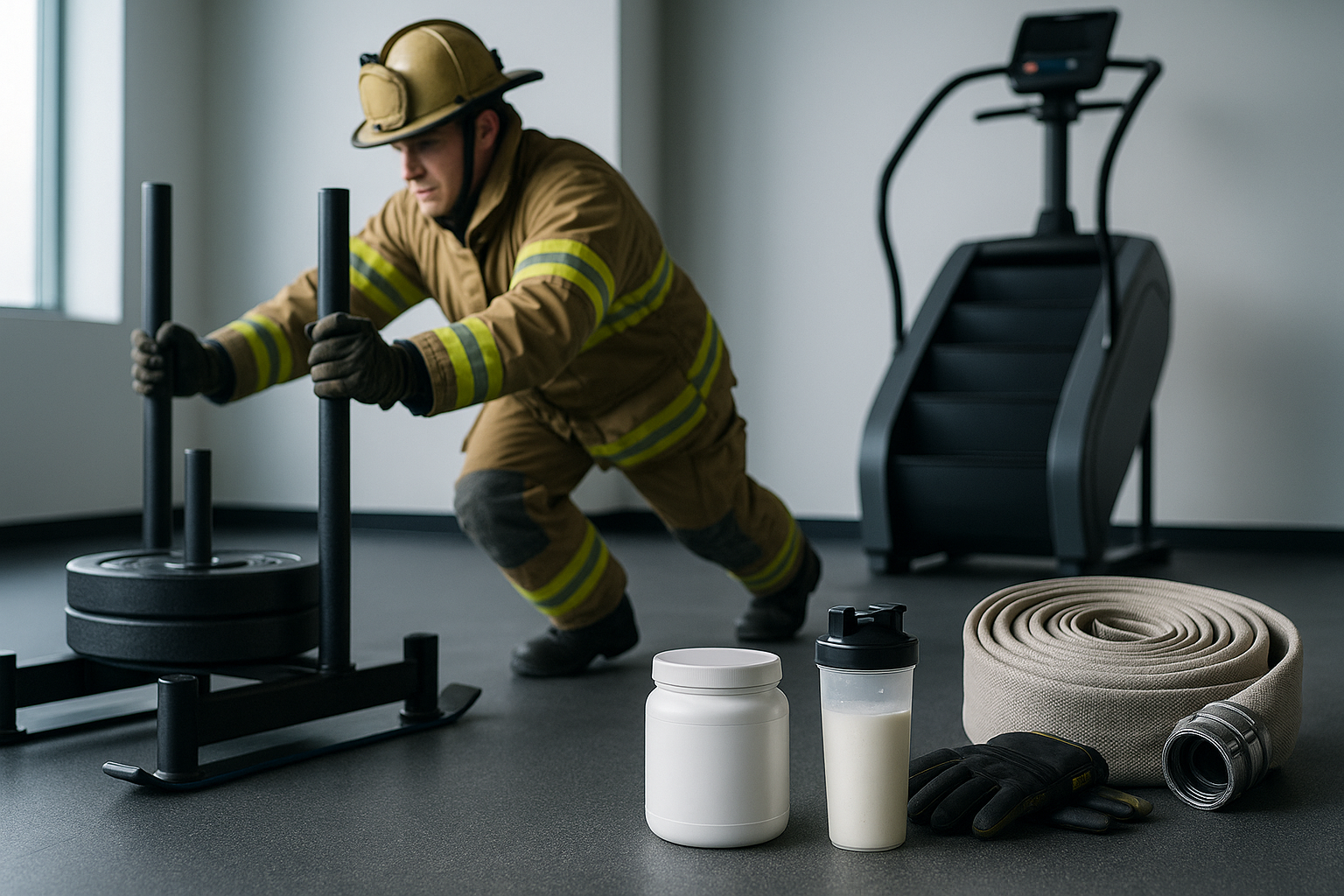
Firefighters can expect creatine to help most with strength, power, repeated-effort capacity, and training adaptations, not with turning them into ultra-endurance athletes. That distinction matters because creatine for physical demanding jobs works best when the job includes repeated hard muscular efforts rather than long, steady, low-output movement.
In practical fire service terms, creatine may help you:
- Improve force production: useful for deadlifts, squats, presses, carries, drags, and sled work that build operational capacity.
- Reduce performance drop-off between repeated bouts: relevant to intervals, stair repeats, circuit training, and multi-task training evolutions.
- Gain lean mass more effectively during training: helpful if you need more absolute strength and robustness for load carriage.
- Support recovery between training sessions: mainly by helping you train harder and recover your performance better over time.
The evidence is strongest for high-intensity exercise and resistance training. The 2021 JISSN review on common questions and misconceptions about creatine reinforced that creatine is effective, well-studied, and widely misunderstood, especially around water balance, kidney myths, and sex-specific use.
What creatine does not do is equally important:
- It does not replace aerobic fitness, which still matters for recovery between calls and longer operations.
- It does not prevent heat illness; hydration, acclimation, and operational rehab protocols still dominate there.
- It does not work as a stimulant for alertness the way caffeine does.
- It does not automatically improve body composition if diet and training are poor.
For firefighters cutting body fat, creatine can still be useful because it helps preserve training quality during a calorie deficit. For larger firefighters already near a fitness-test cutoff, the short-term water-weight increase may require planning, especially before a weigh-in or gear-fit concern. Those cases do not rule out creatine, but they do change timing.
If your goals are broader than operational performance, our guide to creatine benefits covers the full evidence-based list, and creatine for strength goes deeper on force and power outcomes.
The smartest expectation is this: creatine helps firefighters get more from their physical preparation, and better preparation is what shows up on the fireground.
Exactly how firefighters should take creatine: the simple step-by-step plan
The best way for firefighters to take creatine is to use 3 to 5 g of creatine monohydrate every day, with or without food, and to stay consistent for weeks rather than chasing perfect timing. That protocol works for most people and is easier to stick with than overcomplicated supplement routines.
- Buy the right form. Choose plain creatine monohydrate, ideally unflavoured. It is the most studied form and usually the best value. If you are comparing options, start with our best creatine rankings or browse the creatine product catalog.
- Pick your dose. Most firefighters do well with 3 to 5 g daily. Larger athletes and those doing harder training usually choose 5 g.
- Decide whether to load. If you want faster saturation, take 20 g/day split into 4 doses of 5 g for 5 to 7 days, then drop to 3 to 5 g/day. If you would rather minimize stomach upset, skip loading and just take 3 to 5 g/day from day one.
- Take it daily. Training day, rest day, day shift, night shift — it all counts. Saturation depends on regular intake.
- Mix it in a way you will actually use. Water, a shake, or a meal all work. The best option is the one you will remember consistently.
- Track simple outcomes. Monitor gym performance, repeated-effort tolerance, body weight, and how recovered you feel across hard training weeks.
If you want a personalized estimate, use our creatine dosage calculator. If you are unsure whether to load, see creatine loading phase. If you just want the practical mixing basics, our guide on how to take creatine covers all the small details.
A sample firefighter routine might look like this:
- Morning shift worker: 5 g in water with breakfast.
- Pre-gym after shift: 5 g with your post-workout shake.
- Night-shift firefighter: 5 g with the meal you are least likely to skip.
The key is friction reduction. Put the tub near your coffee setup, in your lunch bag, or beside your shaker bottle. The best creatine protocol for fire service is the one that survives rotating schedules, interrupted sleep, and unpredictable call volume.
Dosing by body weight, training goal, and urgency
For most firefighters, the right creatine dose is 3 to 5 g per day, but body size and goal can help you choose the most practical end of that range. Heavier or more muscular firefighters often lean toward 5 g daily, while smaller users often do well with 3 g daily once saturated.
| Body weight / goal | Loading option | Daily maintenance | Best for |
|---|---|---|---|
| Under 70 kg, general fitness | 20 g/day split into 4 x 5 g for 5-7 days, optional | 3 g/day | Smaller firefighters or recruits wanting simplicity |
| 70-95 kg, strength and job readiness | 20 g/day split into 4 x 5 g for 5-7 days, optional | 3-5 g/day | Most firefighters and first responders |
| Over 95 kg, high training volume | 20 g/day split into 4 x 5 g for 5-7 days, optional | 5 g/day | Larger athletes, heavy lifters, tactical populations |
| Need faster effect before testing block | Use loading | 3-5 g/day after loading | Those wanting saturation within about a week |
| History of stomach upset | Skip loading | 3-5 g/day from day one | Users prioritizing comfort and adherence |
These are practical ranges, not rigid laws. The classic loading protocol saturates muscles faster, but it is not required. Without loading, saturation usually takes roughly 3 to 4 weeks. With loading, it usually happens in about 5 to 7 days. That is why a firefighter preparing for a CPAT-style block, academy testing, or a concentrated training cycle may choose loading, while someone building year-round capacity may prefer the simpler maintenance-only approach.
If you want a more granular dosing discussion, our guides on how much creatine per day and creatine maintenance dose walk through the logic. If you have trouble measuring servings accurately, how to measure creatine helps convert scoops and teaspoons to real grams.
One more tactical note: if you are worried about a small scale increase before a fitness assessment, avoid starting a loading phase right before that date. Start earlier, or begin after the assessment so you are not surprised by normal water-weight changes.
Timing, hydration, and heat: what matters most for firefighters
For firefighters, daily consistency and hydration matter far more than the exact minute you take creatine. Creatine is a saturation supplement, so once muscle stores are elevated, timing becomes a small detail compared with taking it every day and managing fluid losses from training, turnout gear, and hot environments.
The best timing options are simple:
- Any convenient time daily: ideal for most users
- Post-workout: a common habit anchor because you already use a shaker or meal
- With a meal: useful if taking it on an empty stomach bothers you
If you want the detailed timing breakdown, see when to take creatine. But the short answer is that a missed “perfect” window does not matter nearly as much as missed days.
Hydration is where firefighters should pay closer attention. Creatine does not dehydrate you, and the literature does not support the old claim that it causes cramping or heat intolerance in healthy users. The misconception likely came from confusion about water shifting into muscle. In reality, water retention from creatine is primarily intracellular. The Mayo Clinic overview and the ISSN position stand both reflect that creatine is generally safe when used appropriately.
That said, the fact that creatine is not dehydrating does not mean firefighters can ignore fluid planning. High-heat operations, long training evolutions, and sweating under PPE can create real fluid and electrolyte deficits. Creatine does not replace:
- adequate water intake
- sodium and electrolyte replacement when sweating heavily
- department rehab and cooling practices
- heat acclimation and aerobic conditioning
A practical rule is to take creatine with a full glass or bottle of fluid and to treat your overall hydration habits seriously, especially on live-burn days, stair sessions, or hot-weather calls. If hydration questions are your main concern, our guides on how much water to drink with creatine and creatine and dehydration go deeper.
For fire department training, the best stack is often boring but effective: creatine, enough water, sensible electrolytes when warranted, adequate protein, and disciplined sleep whenever shift work allows.
Who creatine is for in the fire service: recruits, veterans, women, older adults, and plant-based eaters
Creatine is appropriate for most healthy adult firefighters, including beginners, women, older firefighters, and plant-based eaters, because the underlying mechanism is the same across groups: more stored creatine in muscle supports high-intensity performance and training adaptation. The dose usually does not need to change dramatically by sex; it changes more by body size, tolerance, and training load.
Beginner firefighters and recruits: Creatine is absolutely reasonable for beginners. You do not need to “earn” it first. In fact, beginners often get excellent value from creatine because it helps them progress faster in strength and repeated-effort training. Start simple with 3 to 5 g daily.
Women in the fire service: Women can use creatine just as effectively as men. It is not a steroid, and it does not inherently cause “bulking” in the sloppy sense many people fear. The same monohydrate, same evidence base, and same general daily dose apply. For more, see creatine for women.
Older firefighters and officers: Creatine becomes more compelling with age because maintaining strength, lean mass, and training capacity gets harder over time. Older adults often benefit especially when creatine is paired with resistance training. Our guide on creatine for older adults covers this in depth.
Vegetarian or vegan firefighters: People who eat little or no meat often begin with lower baseline creatine stores, so they may respond particularly well to supplementation. If that is you, see creatine for vegetarians.
Athletes who also serve: If you compete in hockey, CrossFit, powerlifting, or tactical fitness while working in the fire service, creatine remains one of the strongest evidence-based tools in sports nutrition. The IOC consensus on dietary supplements lists creatine among the few supplements with good evidence for certain performance goals.
Who should be more cautious? Anyone with known kidney disease, complicated medical conditions, or medication concerns should speak with a qualified clinician before starting. That is not because creatine is broadly dangerous; it is because professional oversight is sensible when underlying disease is present. If you want a full risk-screening framework, see who should not take creatine.
Safety, side effects, and medical cautions firefighters should actually care about
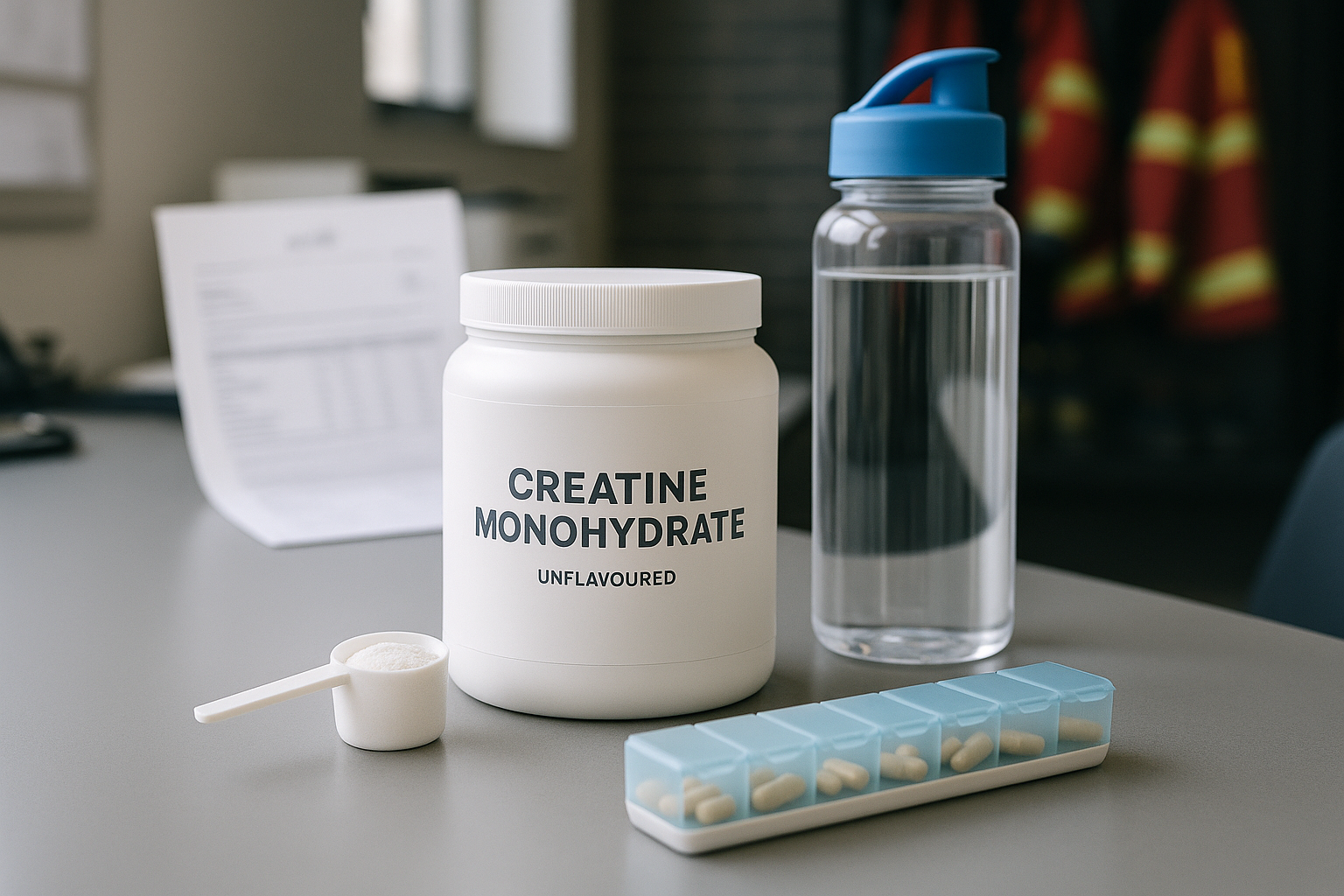
Creatine monohydrate is generally considered safe for healthy adults at recommended doses, and the side effects firefighters are most likely to notice are mild gastrointestinal upset or a small increase in body weight from intracellular water. That is the evidence-based reality, not the old locker-room mythology.
The best-supported safety points are straightforward:
- Kidney fear is often overstated in healthy people. Creatine can increase creatinine on bloodwork because creatinine is a breakdown product, but that is not the same as causing kidney damage. This is a common source of confusion.
- Dehydration and cramps are not supported as typical outcomes. The research does not show that creatine inherently causes these issues when used properly.
- Long-term use does not require cycling. Daily ongoing use is common and evidence-based.
The most common side effects and fixes:
- Stomach upset or loose stools: usually from taking too much at once, poor mixing, or loading too aggressively. Split doses or use 3 to 5 g/day instead.
- Temporary weight gain: often around 1 to 2 kg early on, largely from water held inside muscle cells.
- Bloating sensation: more often reported with larger doses or loading than with steady maintenance dosing.
Firefighters should also understand the creatinine issue. If you are getting occupational medical screening, tell the clinician you use creatine. A slightly elevated creatinine level can be misread without context, especially in muscular or highly active people. Our guide to creatine vs creatinine explains this clearly, and is creatine bad for your kidneys goes deeper into the evidence.
Use extra caution and medical guidance if you:
- have diagnosed kidney disease
- are under specialist care for a significant chronic condition
- take medications where your clinician has flagged renal monitoring or fluid balance issues
- are pregnant or breastfeeding
If you want a full evidence summary, our safety hub is creatine safe and digestion guide creatine digestive side effects answer the most common worries. For healthy firefighters, the main lesson is simple: use the standard dose, buy a quality product, and do not confuse normal creatine-related lab changes with harm.
Common firefighter creatine mistakes and myths, debunked
The biggest creatine mistakes firefighters make are choosing fancy forms over monohydrate, using it inconsistently, mistaking normal water retention for fat gain, and assuming it causes dehydration or kidney damage by default. Most creatine problems come from misinformation, not from creatine itself.
Myth 1: “Creatine is only for bodybuilders.”
False. Creatine helps any person doing repeated high-intensity muscular work, which makes it relevant to the fire service, police, military, and other physical jobs.
Myth 2: “Creatine dehydrates firefighters in heat.”
False as a blanket claim. Creatine is not a substitute for hydration, but it is not inherently dehydrating either.
Myth 3: “You need a pre-workout blend or advanced formula.”
False. Plain monohydrate remains the benchmark. Fancy versions usually cost more without better real-world outcomes.
Myth 4: “You have to cycle creatine.”
False. There is no established need to cycle creatine on and off for healthy users.
Myth 5: “If I do not feel anything, it is not working.”
False. Creatine is not a stimulant. You judge it by training performance, repeated efforts, and recovery trends over weeks, not by an acute buzz.
The most common practical mistakes:
- starting and stopping every few days
- taking one giant dose and getting stomach upset
- buying under-dosed gummies or blends without checking grams of actual creatine
- starting a loading phase right before a weigh-in or fitness assessment
- expecting creatine alone to fix poor conditioning
If you think creatine is “not working,” the usual explanation is that you have not been saturated long enough, your dose is too inconsistent, or your training does not actually challenge the energy systems creatine helps most. Troubleshooting that is usually easy: take it every day for 3 to 4 weeks minimum, use 5 g if you are larger, and track actual performance numbers.
For a broader myth roundup, visit creatine myths debunked, and if you suspect a response issue, read creatine not working and creatine non-responders.
What firefighters in Canada should buy: monohydrate, NPNs, testing, and value
The best creatine for firefighters in Canada is usually a plain creatine monohydrate powder with clear dosing, a Health Canada NPN, and reputable quality controls. You do not need a tactical-branded formula or a flashy ingredient stack to get the benefit.
In Canada, an NPN is a Natural Product Number issued for licensed natural health products. It is not a guarantee of athletic superiority, but it does indicate the product is sold within the Canadian regulatory framework. For firefighters who care about product legitimacy, clean labelling, and buying domestically, that is a useful checkpoint.
Here is what to look for:
- Ingredient list: ideally just creatine monohydrate
- Dose transparency: 3 to 5 g per serving, or clear scoop instructions
- NPN: useful Canadian legitimacy marker
- Third-party testing: especially valuable for athletes, tactical populations, and anyone concerned about contamination
- Cost per gram: often the smartest value metric
| Option | Pros | Cons | Best choice? |
|---|---|---|---|
| Plain monohydrate powder | Most studied, cheapest per gram, easy to dose | Can feel gritty if not mixed well | Yes — best default |
| Micronized monohydrate | May mix more easily, same active ingredient | Sometimes costs more | Good if you value mixability |
| Capsules | Convenient for travel and shifts | Usually more expensive and require many capsules for 5 g | Fine, but less economical |
| Gummies or blends | Convenient, flavoured | Often under-dosed or pricier per gram | Only if label is strong |
| HCL or other specialty forms | Marketing claims, smaller scoop sizes | Less evidence, higher cost | Usually no advantage over monohydrate |
If you are comparing brands, browse our creatine brand reviews or start with best creatine monohydrate in Canada. If certification matters because you compete in sport as well as serve, also see third-party tested creatine in Canada and Canadian supplement regulations.
The buying rule for creatine for fire service is brutally simple: buy boring, verified monohydrate from a reputable source, then use it consistently enough for the science to matter.
What firefighters should expect in week 1, week 4, and beyond
Firefighters usually notice creatine first in training quality, not in dramatic mirror changes, and the timeline depends on whether they load. With loading, effects can begin within about a week; without loading, benefits usually build across roughly 3 to 4 weeks as muscle stores rise.
Week 1 with loading: You may notice a small body-weight increase, a slightly fuller muscle feel, and better tolerance for repeated hard sets or intervals. Some users notice nothing obvious yet, which is still normal.
Week 1 without loading: Usually not much to feel. That does not mean it is failing; saturation is just slower.
Weeks 2 to 4: This is where many firefighters begin to see clearer benefits in the gym: extra reps at a given load, less power drop-off in circuits, stronger sled work, or more stable output in stair intervals and repeated carries.
Weeks 4 to 8: If training and nutrition are solid, strength gains and lean mass improvements become more noticeable. The supplement is not building muscle by itself; it is helping you train harder and adapt better.
Beyond 8 weeks: Creatine becomes part of your baseline. You may stop “noticing” it, but your training performance can remain better than it would be without it.
How to tell whether creatine for firefighting is working:
- your repeated hard efforts fade less across a session
- you add reps or load on key lifts
- your carries, drags, and stair intervals feel more repeatable
- you recover your performance better between demanding training days
How to know it may not be working yet:
- you miss doses frequently
- you have only been on it a few days without loading
- your training is too easy to reveal a benefit
- your expectations are based on stimulant-like sensations
If you want a deeper timeline, see how long creatine takes to work and realistic creatine results. The main message is reassuring: if you are consistent and training properly, creatine often pays off gradually, then quietly keeps paying off.
Bottom line: the smartest way to use creatine in the fire service
Creatine for firefighters is worth it for most healthy adults because it reliably supports the exact physical qualities the job demands most: repeated high-intensity output, strength, power, lean mass, and the ability to train hard enough to build those traits. It is one of the rare supplements where the evidence is both deep and practically useful.
If you want the shortest evidence-based protocol possible, do this:
- Buy plain creatine monohydrate from a reputable Canadian seller.
- Check for clear dosing and ideally an NPN; add third-party testing if purity matters to you.
- Take 3 to 5 g every day.
- Load at 20 g/day split into 4 doses for 5 to 7 days only if you want faster saturation.
- Keep taking it on rest days and shift days.
- Hydrate properly, but do not blame creatine for dehydration caused by heat, sweat, or poor fluid planning.
- Judge results over weeks by performance, not by instant sensations.
For firefighter supplements, creatine deserves its place because it is not hype-driven, exotic, or dependent on a complicated stack. It is useful precisely because it is simple, cheap relative to its evidence base, and directly relevant to the work capacity that matters in training and on scene.
The most honest conclusion is this: creatine will not replace discipline, but it can make disciplined firefighters better prepared. If you already strength train, do task-specific conditioning, and take recovery seriously, creatine monohydrate is one of the highest-confidence additions you can make.
For next steps, use the creatine dosage calculator, compare options in our best creatine rankings, or go deeper with is creatine safe and how to take creatine.
Creatine for Firefighters: The Numbers That Matter
- 3-5 g/day Standard daily creatine dose — Works for most firefighters once muscle stores are saturated.
- 20 g/day Classic loading protocol — Usually split into 4 doses for 5 to 7 days to speed saturation.
- 5-7 days Time to saturate with loading — Useful before a hard training block or fitness-prep phase.
- 1-2 kg Typical early weight increase — Usually reflects intracellular water, not fat gain.
Frequently Asked Questions
Is creatine good for firefighters?
Yes, creatine is good for firefighters because it improves repeated high-intensity performance, strength, and training capacity. Those benefits fit common fire service demands such as stair climbs, drags, carries, and lifting under load. It is most useful when paired with resistance training and job-specific conditioning, not as a replacement for them.
Can firefighters take creatine safely in hot environments?
Yes, most healthy firefighters can take creatine safely in hot environments when overall hydration and rehab practices are handled properly. Creatine does not inherently dehydrate you, but it also does not protect you from fluid loss caused by heat, sweat, PPE, and long operations. Good hydration, electrolytes when needed, and heat management still matter.
What is the best creatine for fire service training?
The best creatine for fire service training is plain creatine monohydrate. It is the most studied form, the most consistently effective, and usually the cheapest per gram. In Canada, it is smart to look for clear labelling, a Health Canada NPN, and reputable brand quality or third-party testing if purity matters to you.
How much creatine should a firefighter take?
Most firefighters should take 3 to 5 g of creatine monohydrate per day. Smaller users often do well with 3 g daily, while larger or more muscular firefighters commonly use 5 g daily. Loading at 20 g/day split into four 5 g doses for 5 to 7 days is optional if you want faster saturation.
Does creatine help first responders with endurance?
Creatine helps first responders most with repeated high-intensity efforts rather than pure long-duration endurance. It can improve the ability to repeat hard bouts with less performance drop-off, which is useful in tactical and emergency work. It is less likely to meaningfully improve steady-state aerobic endurance by itself.
Will creatine make firefighters gain weight?
Yes, creatine can make firefighters gain a small amount of scale weight at first, but that increase is usually water stored inside muscle cells rather than fat. A common early change is about 1 to 2 kg, especially with loading. Over time, creatine may also support lean mass gains if training is adequate.
Should firefighters load creatine or just take it daily?
Firefighters can do either, because both approaches work. Loading with 20 g/day for 5 to 7 days saturates muscles faster, while taking 3 to 5 g daily reaches the same place more gradually over roughly 3 to 4 weeks. If you want fewer digestive side effects, the slower daily approach is often easier.
Does creatine cause dehydration or cramps during firefighting?
No, creatine is not supported by good evidence as a cause of dehydration or cramps in healthy users. That old claim persists, but it is not a strong reflection of current evidence. Firefighters can still cramp or dehydrate from heavy sweating, heat stress, and inadequate fluid or electrolyte intake, but that is a separate issue.
Can women firefighters take creatine?
Yes, women firefighters can take creatine and often benefit from it for the same reasons men do: better high-intensity performance, strength support, and improved training adaptations. The supplement does not act like a steroid, and standard monohydrate dosing of 3 to 5 g daily is appropriate for most healthy adult women.
Do firefighters need to cycle creatine?
No, firefighters do not need to cycle creatine. Creatine works by maintaining elevated muscle stores, so ongoing daily use is the normal evidence-based approach. Cycling on and off is unnecessary for most healthy adults and can simply interrupt the consistency that makes creatine effective.