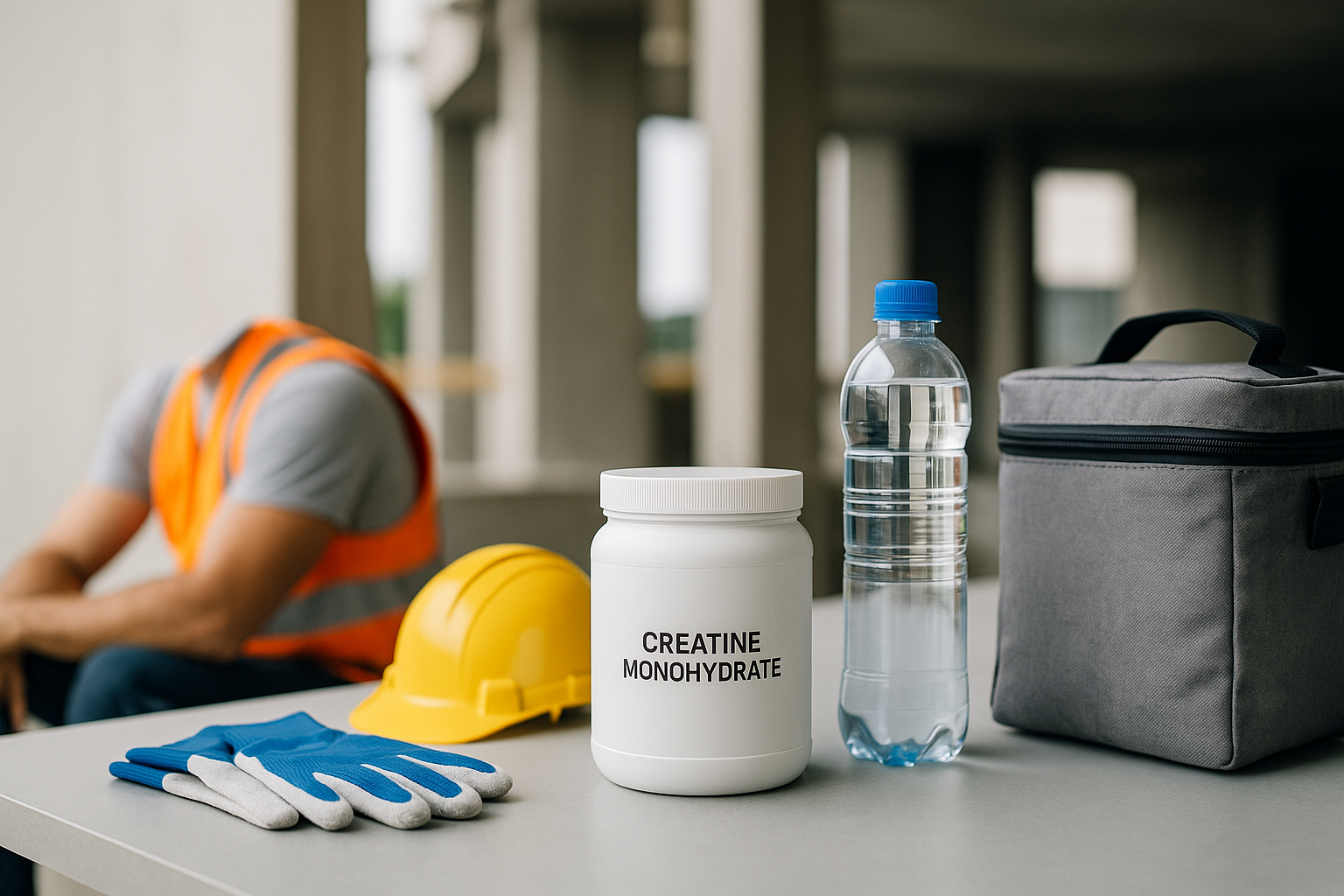
Creatine for Construction Workers: Physical Strength, Endurance, and Recovery
By The Creatine Canada Research Team — Evidence-based supplement analysts
Yes—creatine can be a smart, evidence-based supplement for construction workers and other manual labourers because it helps the muscles regenerate quick energy for repeated lifting, carrying, climbing, and hard bursts of work. It is not a stimulant, but daily creatine monohydrate can improve strength, repeated-effort performance, and training recovery when used at the right dose.
Evidence-based · Cites 4 sources · Editorial standards
Key Takeaways
- Creatine monohydrate is the best-studied, most cost-effective form for construction workers and trades workers.
- A standard maintenance dose is 3-5 g daily; a faster loading option is 20 g daily split into 4 doses for 5-7 days.
- Creatine helps most with repeated heavy efforts like lifting, carrying, shovelling, climbing, sprinting, and strength training after work.
- It is not an instant energy boost like caffeine; benefits build as muscle creatine stores become saturated over days to weeks.
- Some people gain 0.5-2 kg early from increased water stored inside muscle, not body fat.
- For hot, labour-intensive jobs, creatine should be paired with sensible water and electrolyte intake, not used as a substitute for hydration.
- Choose a simple Canadian-labelled product with clear dosing, an NPN when applicable, and ideally third-party testing.
Is creatine good for construction workers? Yes—if your job involves repeated physical effort
Yes, creatine can be useful for construction workers, trades workers, and other people in manual jobs because it supports the exact energy system used for short, repeated, high-output efforts. If your day includes lifting drywall, carrying lumber, climbing ladders, moving tools, pushing loaded carts, shovelling, digging, or doing repeated bouts of hard work with incomplete rest, creatine is relevant.
The key point is that creatine for physical labour is not about turning a workday into a bodybuilding session. It is about slightly improving your ability to produce force repeatedly, reducing the drop-off in output across the day, and helping you recover better from training and physically demanding work. The evidence base is strongest for strength, power, lean mass, and repeated high-intensity effort rather than steady-state endurance. That matters because most construction job tasks are intermittent: work hard, pause, reposition, carry again, climb again, lift again.
Creatine is a compound stored mostly in muscle, where part of it exists as phosphocreatine, a high-energy form that helps regenerate ATP, the immediate energy currency used for muscular contraction. When ATP runs low during a hard effort, phosphocreatine helps replenish it quickly. More stored creatine generally means a better buffer for these bursts.
For a construction worker, the practical benefits usually fall into three buckets:
- Strength and repeated effort: better performance on tasks involving repeated hard exertion.
- Training support: better quality gym sessions before or after work, which can improve long-term resilience and strength.
- Recovery support: potentially less performance drop-off from cumulative fatigue, especially when combined with adequate food, sleep, and hydration.
The 2017 ISSN position stand concluded that creatine monohydrate is the most effective nutritional supplement available for increasing high-intensity exercise capacity and lean body mass during training. That conclusion comes from athletic research, but the mechanism clearly maps onto many labour-intensive jobs.
If you want a broader primer first, read what creatine is and what it does. If you already know you want to try it, the short answer is simple: take 3-5 g of creatine monohydrate daily, every day, and give it at least 2-4 weeks to judge it fairly.
How creatine helps on the job: more quick energy for lifting, carrying, climbing, and repeated hard bouts
Creatine helps manual workers by increasing muscle phosphocreatine stores, which improves the speed at which muscles can regenerate ATP during short, intense efforts. That matters most when your work is stop-and-go and forceful rather than easy and continuous.
Here is the mechanism in plain English. Your muscles run on ATP, but the immediate ATP supply is tiny and gets used up fast during heavy exertion. Phosphocreatine acts like a rapid backup battery. It donates a phosphate group to help rebuild ATP almost immediately. Supplementing with creatine increases total muscle creatine stores, so that backup system can support more repeated efforts before fatigue catches up.
In a construction job, this may show up as:
- less drop in strength across repeated carries or lifts
- better power on stair climbs, ladder work, or moving awkward materials
- improved training quality outside work, which indirectly makes the job easier
- better support for lean mass retention during hard work and long weeks
Creatine does not work like a stimulant. It will not feel like a pre-workout drink, and it will not suddenly wake you up at 5 a.m. What it does is raise your baseline capacity for explosive and repeated muscular work once your stores are saturated. That is why many people think it is “not working” in week one when they are expecting a caffeine-like sensation.
The research is strongest for high-intensity, repeated-effort performance. It is weaker for pure low-intensity endurance. So if your workday is mostly walking, standing, or driving with little heavy exertion, creatine may still help your gym training and recovery, but the on-the-job effect may be less noticeable.
There is also emerging interest in creatine for cognitive resilience under sleep stress and fatigue, but that area is less established than the physical-performance evidence. If that interests you, see our guide on creatine and cognition. For most trades workers, the main reason to use creatine remains straightforward: it helps the body repeat hard muscular work more effectively.
Examine’s evidence summary also supports creatine’s role in improving strength and high-intensity exercise performance, with the clearest benefits appearing when people also resistance train. That is relevant because a worker who strength-trains a few times per week often gets more practical benefit than a worker who only supplements without training.
Who benefits most from creatine for workers, and who may notice less
Creatine tends to help workers most when their job or training includes repeated high-force efforts, and it may be less noticeable for workers whose day is mostly low-intensity movement. In other words, creatine for labour intensive jobs makes the most sense when the work is physically demanding in bursts.
Workers most likely to benefit include:
- Construction workers: carpenters, framers, concrete workers, roofers, drywallers, labourers, and general contractors doing repeated lifts and carries.
- Trades workers: electricians, plumbers, HVAC techs, welders, and mechanics who spend long days climbing, carrying gear, kneeling, bracing, and working in awkward positions.
- Warehouse and industrial workers: anyone doing repetitive material handling, loading, unloading, pushing, and pulling.
- Workers who also lift weights: the overlap between job stress and gym stress makes recovery and training quality especially important.
Some groups may notice particularly strong responses:
- Beginners: if you are new to structured strength training, creatine often helps you train better and progress faster.
- Vegetarians and vegans: because dietary creatine intake is often lower, baseline muscle stores may start lower, which can make the response more noticeable.
- Older adults: creatine combined with resistance training can support muscle and strength as recovery becomes more important with age.
- Women: women benefit too, and creatine does not act like a steroid or masculinizing hormone. For more, see our women’s guide.
Who may notice less?
- workers whose job is mostly sedentary
- people doing mainly easy aerobic work
- people who already have relatively high muscle creatine stores
- people expecting a dramatic same-day energy boost
That last point matters. Creatine is best viewed as a capacity supplement, not a feel-it-right-now supplement. The worker who says, “My shoulders and legs don’t fade as fast by the end of the shift, and my gym lifts hold up better,” is describing the type of benefit creatine plausibly provides.
If you are unsure whether your work pattern fits, ask a simple question: Does my day include repeated hard efforts that make my muscles burn, fatigue, or lose pop over time? If yes, creatine is worth considering. If no, it may still help training and lean mass, but the work-specific payoff may be smaller.
How to take creatine for a construction job: the simplest step-by-step plan that works
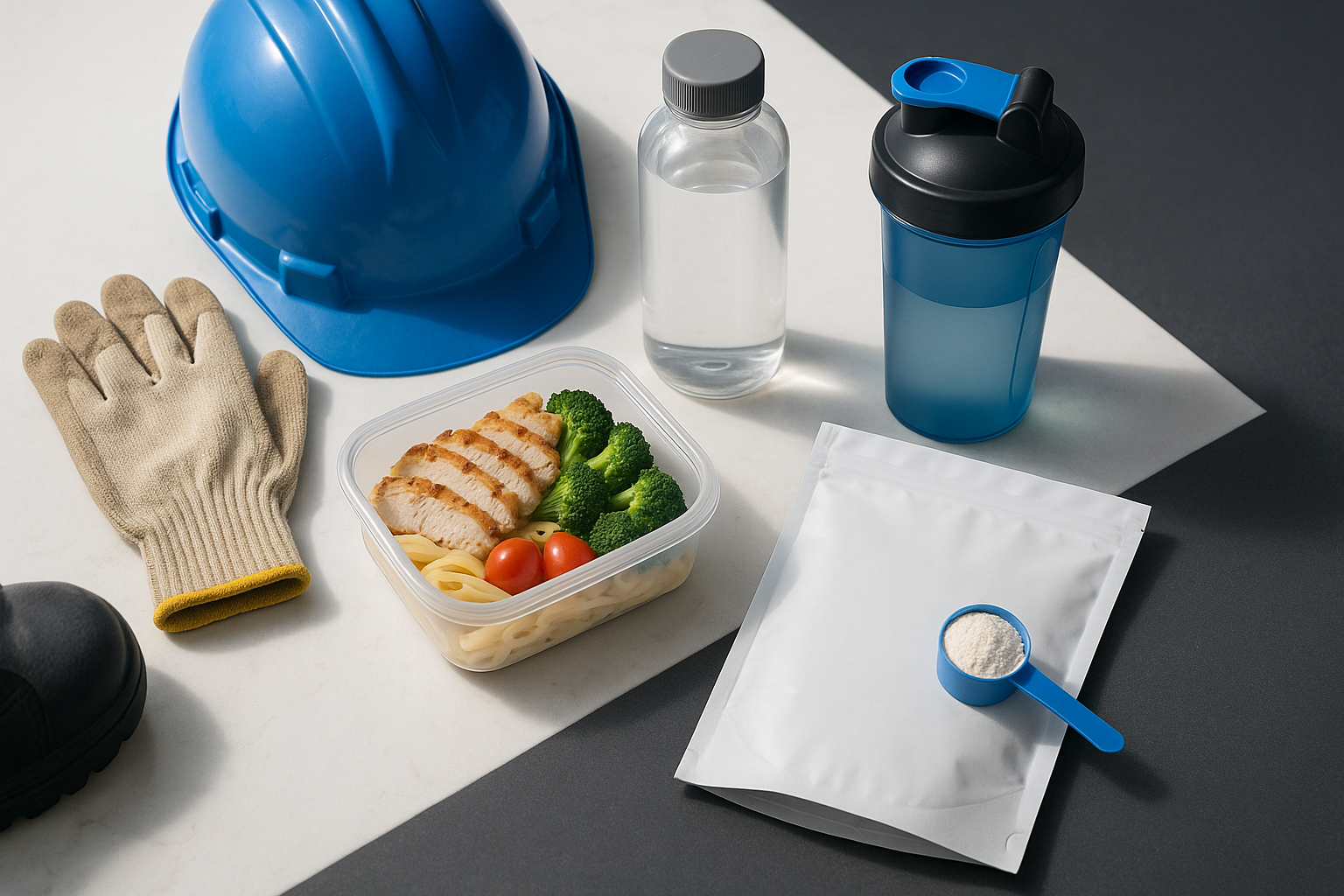
The simplest effective plan for a construction worker is to take 3-5 g of creatine monohydrate once daily, every day, with enough fluid to drink it comfortably. Consistency matters more than perfect timing.
- Choose creatine monohydrate. This is the gold-standard form, with the best evidence, best value, and the fewest reasons to overthink your purchase.
- Decide whether to load or not. If you want faster saturation, take 20 g per day split into 4 doses of 5 g for 5-7 days, then drop to 3-5 g daily. If you prefer simplicity or have a sensitive stomach, skip loading and just take 3-5 g daily.
- Pick a routine you will actually follow. Good options are with breakfast before work, with your lunch, or after training. The best time is the time you remember.
- Mix it in a practical drink. Water is fine. A shake is fine. Coffee is usually fine if it sits well with your stomach. If you need mixing help, see how to mix creatine.
- Keep taking it on weekends and days off. Creatine works by maintaining saturation, so rest days still count. Missing an occasional day is not a disaster, but daily use is ideal.
- Assess after 3-4 weeks. Judge it by work capacity, gym performance, and recovery, not by whether you “feel” a buzz.
Here is a very practical schedule for a worker on early starts:
- 4:30-6:00 a.m. shift start: mix 3-5 g into your first water bottle or breakfast shake.
- Long drive to site: take it with your packed lunch or first break.
- After-work training: add it to your post-workout shake or evening meal.
If you want more personalised dosing, use our creatine dosage calculator or read how much creatine per day. If you want the full protocol, our step-by-step creatine guide covers mixing, loading, and consistency in more detail.
The biggest mistake manual workers make is treating creatine like a pre-workout they only use on hard days. That is not how it works. Take it daily, not occasionally, and let the stored effect do the work.
Exact creatine dosing for manual workers: by body weight, goal, and urgency
Most construction workers do well with 3-5 g of creatine monohydrate per day, while larger workers and hard trainers often sit more comfortably at the top end of that range. Loading is optional if you want results faster.
| Body weight | Simple daily maintenance | Optional loading phase | Best for |
|---|---|---|---|
| Under 70 kg | 3 g/day | 20 g/day split into 4 x 5 g for 5-7 days, then 3 g/day | Smaller workers, beginners, lighter women |
| 70-90 kg | 3-5 g/day | 20 g/day split into 4 x 5 g for 5-7 days, then 3-5 g/day | Most male and female trades workers |
| Over 90 kg | 5 g/day | 20 g/day split into 4 x 5 g for 5-7 days, then 5 g/day | Larger workers, gym-goers, high muscle mass |
Goal also matters:
- For general work capacity: 3-5 g/day is enough.
- For gym performance plus physically demanding work: 5 g/day is a very sensible default.
- For fastest uptake before a hard project block or return to training: use a loading phase, then maintenance.
- For sensitive digestion: skip loading and use 3 g/day for a gentler start.
If you skip loading, full muscle saturation usually takes roughly 3-4 weeks. If you load properly, saturation is reached much faster, often within about a week. That is the trade-off: speed versus convenience and stomach comfort. Our loading-phase guide explains when loading is worth it.
Some research protocols also use approximately 0.1 g/kg/day as an ongoing amount in certain training contexts, but for real-world use, 3-5 g/day remains the mainstream, evidence-based recommendation. It is simple, inexpensive, and effective for most people.
If your tub uses scoops instead of grams, check the label carefully because scoop sizes vary. “One scoop” is only useful if it actually states the grams of creatine monohydrate provided. When in doubt, read how to measure creatine accurately.
Bottom line: start with 5 g/day if you are a larger or very active worker, 3 g/day if you are smaller or cautious, and only load if faster results matter to you.
Best timing, water, and workday habits: what matters most when the job is hot, long, and physical
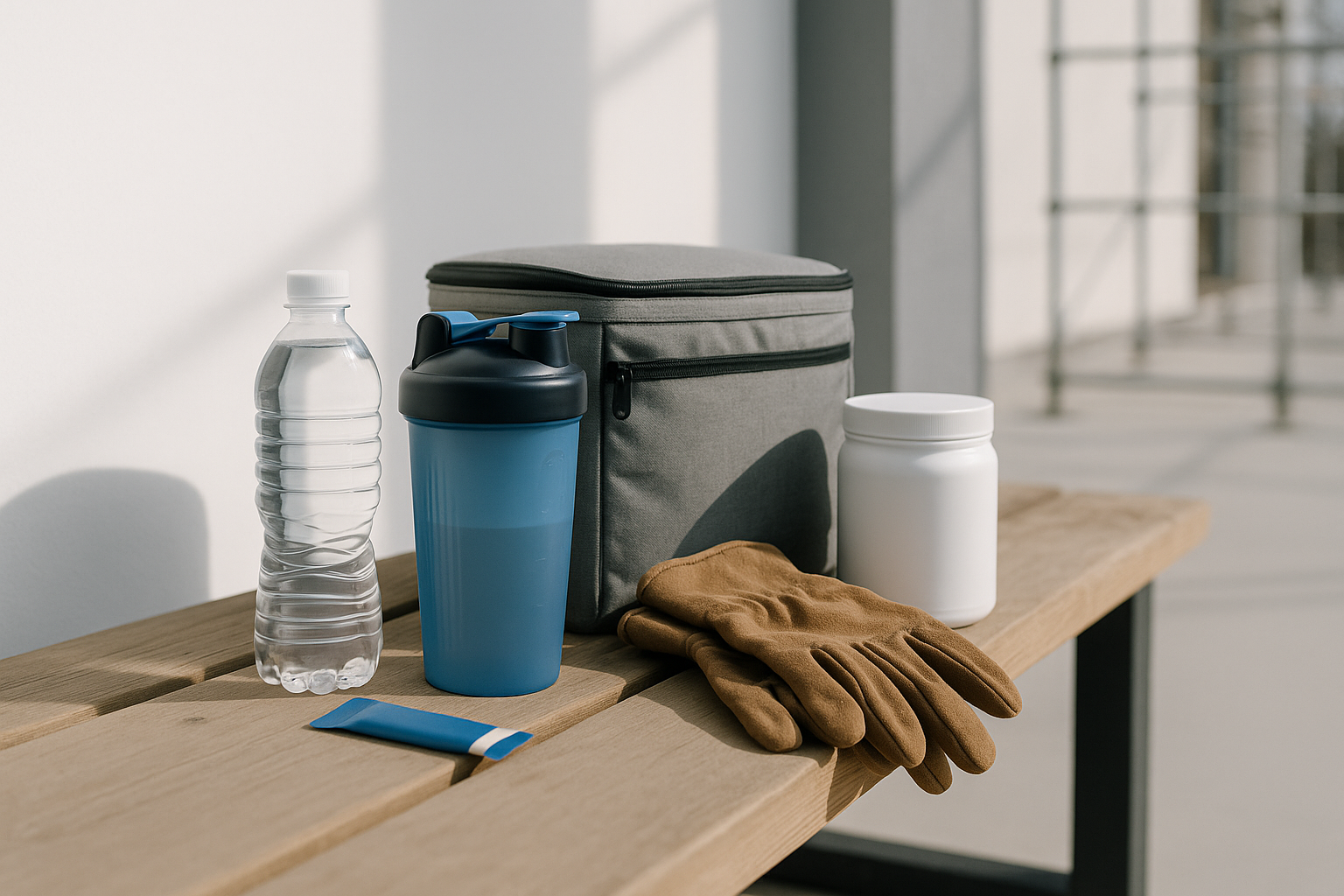
The best time to take creatine for a construction worker is any time you will remember it consistently, and hydration matters more than timing precision. Creatine is a daily saturation supplement, not a narrow-window performance booster.
Let’s clear up the timing question first. You do not need to slam creatine right before climbing scaffolding for it to work. Muscle creatine stores rise over time, and once they are elevated, the timing of an individual dose becomes much less important than simply taking it every day. If you want a deeper timing breakdown, see when to take creatine.
Practical timing options for trades workers:
- Morning with breakfast: ideal for early-shift workers who want a set routine.
- With lunch: good if breakfast is rushed or skipped.
- Post-workout: useful if you train after work and already have a shake habit.
- Before bed: also acceptable if that is the easiest habit to maintain.
Hydration is where manual workers need more common sense than most office workers. Creatine does not dehydrate you, and the belief that it automatically causes dehydration or cramps is not supported by the better evidence. The 2021 JISSN review on common questions and misconceptions addresses this directly. However, if you work in heat, sweat heavily, or wear heavy gear, you still need a sensible hydration plan because your job itself raises fluid and electrolyte needs.
Good rules of thumb:
- Take creatine with a normal amount of fluid; you do not need absurdly large water chugs.
- Drink to thirst plus job demands, especially in hot weather.
- Use electrolytes when sweat losses are heavy, shifts are long, or meals are delayed.
- Do not mistake thirst, missed meals, or sodium loss for “creatine side effects.”
For more, read how much water to drink with creatine and our guide on creatine and dehydration.
A final workday tip: keep creatine in the easiest format for your life. Powder is usually cheapest and easiest to dose. Capsules can be convenient in a lunch bag but often require multiple pills to hit 5 g. Convenience matters because the best protocol is the one you keep following through 6 a.m. starts, overtime weeks, and weekends.
What construction workers can realistically expect: week-by-week results, not supplement fantasy
Most workers should expect creatine to feel subtle at first and more obvious over 2-4 weeks, unless they use a loading phase. The most common early sign is better gym performance or less drop-off in repeated efforts, not a dramatic energy rush.
Here is a realistic timeline:
- Days 1-7 without loading: usually little noticeable change.
- Days 1-7 with loading: some people notice fuller muscles, slight scale-weight increase, and better repeated-effort performance.
- Weeks 2-4: many users start noticing better training quality, slightly stronger lifts, and less fade during physically demanding tasks.
- Weeks 4-8: the combination of saturated muscle stores plus improved training often becomes more obvious in strength, work capacity, and recovery.
- After 8+ weeks: the biggest benefits usually come from what creatine allowed you to do consistently—more quality reps, more strength training, and better maintenance of lean mass.
How do you tell whether creatine for manual workers is working?
- You recover faster between hard sets in the gym.
- Your top-end strength or reps improve modestly.
- You feel less flat on repeated carries, lifts, or climbs.
- You maintain output better late in the shift or late in the week.
- Your muscles may look slightly fuller from increased intracellular water.
Some early weight gain is normal. Creatine often increases water stored inside muscle cells, which is not the same as getting fatter. For most people, this is a feature, not a problem. If scale changes worry you, read does creatine make you gain weight.
What if you notice nothing? First, give it enough time. Second, ask whether your work and training actually involve repeated high-intensity effort. Third, check whether your dose is adequate and taken daily. Finally, recognise that responses vary. Some people are stronger responders than others, especially if they started with lower baseline muscle creatine stores.
If you want a full troubleshooting framework, our guide on why creatine may not seem to be working can help. The short version is this: judge creatine by performance trends over weeks, not by a feeling in the first few days.
Safety for construction and trades workers: what the evidence says, and when to be cautious
Creatine monohydrate is widely considered safe for healthy adults at recommended doses, but anyone with kidney disease, relevant medical conditions, or medication concerns should speak with a qualified clinician first. For healthy workers, the main real-world issues are usually stomach upset, minor water-weight changes, or poor product choice—not toxicity.
The 2021 JISSN review and the earlier ISSN position stand both support the overall safety of creatine in healthy populations when used appropriately. Mayo Clinic also notes that creatine appears to be safe for many people when used for several years at proper doses.
Common side effects or annoyances include:
- Stomach upset or loose stools: more common when people take too much at once, especially during loading.
- Temporary weight increase: usually from more water held inside muscle.
- Grittiness or poor mixing: a quality-of-life issue, not a safety issue.
Ways to reduce side effects:
- Use 3-5 g once daily instead of large single doses.
- Split loading doses if you load.
- Take it with food if your stomach prefers that.
- Choose micronized monohydrate if texture bothers you.
Important cautions:
- Kidney disease or impaired kidney function: do not self-prescribe; get medical advice first.
- Medication use: if you take medicines that affect kidney function or fluid balance, ask your clinician or pharmacist.
- Pregnancy or breastfeeding: evidence is still limited enough that personalised medical guidance matters.
- Heat stress jobs: creatine is not the problem, but hydration planning becomes even more important.
One frequent confusion is bloodwork. Creatine supplementation can raise creatinine, a breakdown product often used on lab panels, without meaning the kidneys are damaged. That is one reason it helps to tell your clinician if you supplement. For a deeper explanation, see our kidney guide and creatine vs. creatinine.
The practical verdict is simple: for healthy construction workers using evidence-based doses, creatine has a strong safety profile, but medical context always overrides generic advice.
Common myths and mistakes: dehydration, cramps, bloating, steroids, and other worker concerns
Most creatine myths that scare manual workers are either outdated, exaggerated, or based on confusing creatine with stimulants or anabolic drugs. The most common mistake is avoiding a useful supplement because of claims the better evidence does not support.
Let’s tackle the biggest myths directly.
- “Creatine is a steroid.” False. Creatine is not a steroid. It is a naturally occurring compound involved in cellular energy production. See also our full explanation.
- “Creatine dehydrates you.” Not supported by the stronger evidence. Creatine shifts more water into muscle, but that is not the same as causing dehydration. Hot, sweaty jobs still require proper fluids because of the job itself.
- “Creatine causes cramps.” This is a persistent myth, but the research does not convincingly show creatine causes muscle cramps in healthy users. Poor hydration, electrolyte imbalance, and fatigue are more likely culprits on a job site.
- “Creatine makes you bloated.” Some people notice fullness or a small scale increase, especially with loading, but this is usually intracellular water in muscle rather than puffy fat gain. If bloating bothers you, use a lower daily dose and skip loading. Our bloating guide goes deeper.
- “You need to cycle creatine.” Usually false. Most healthy adults do not need on-off cycling. Consistent daily use is the normal evidence-based approach.
- “You only need creatine on workout days.” False. Daily use is the point.
Now the most common mistakes among trades workers:
- Buying fancy forms instead of monohydrate. HCL, blends, and premium claims often cost more without outperforming monohydrate in the evidence.
- Expecting stimulant-like energy. Creatine will not feel like coffee.
- Stopping after one week. Without loading, one week is too soon to judge.
- Using random scoop sizes. Measure actual grams.
- Ignoring food, sleep, and hydration. Creatine cannot rescue a poor recovery plan.
If you want the longer myth-busting version, see creatine myths debunked and our guide to common creatine mistakes. For workers, the smart mindset is this: treat creatine as a boring, proven daily basic—not a magic powder and not a thing to fear.
How to choose the right creatine in Canada: monohydrate, labels, NPNs, and value
The best creatine for construction workers in Canada is usually a plain creatine monohydrate powder with clear grams-per-serving, minimal extra ingredients, and reputable quality control. Fancy marketing is less important than form, dose transparency, and trustworthiness.
| What to check | What you want | Why it matters |
|---|---|---|
| Form | Creatine monohydrate | Most studied, most effective, usually best value |
| Dose on label | 3-5 g creatine monohydrate per serving | Makes dosing simple and accurate |
| Ingredients | Ideally just creatine monohydrate | Less filler, easier troubleshooting |
| Testing | Third-party testing if possible | Adds confidence around purity and contamination control |
| Canadian compliance | Appropriate Health Canada labelling, often with an NPN | NPN means Natural Product Number, showing Health Canada-authorised sale as a natural health product |
| Format | Powder for value; capsules for convenience | Choose the form you will use consistently |
In Canada, an NPN is a Natural Product Number issued for authorised natural health products. It is not the only marker of quality, but it is a useful legitimacy signal when buying through Canadian channels. If you compete in tested sport or work in a context where contamination would be a serious concern, third-party testing becomes even more important.
For most workers, avoid overpaying for buzzwords like “buffered,” “alkaline,” or “ultra-absorbing” unless a product also offers something concrete you value, such as better texture or certification. The evidence still points to monohydrate as the default winner. Compare options in our best creatine rankings, browse the brand reviews, or search our product catalogue.
If you want the deeper buyer’s framework, see best creatine monohydrate in Canada and how to choose creatine. The punchline is refreshingly unsexy: plain monohydrate from a reputable seller is usually the smartest buy for a trades worker.
That means you can spend less money on marketing and more on the basics that actually affect how you feel on site: food, sleep, hydration, and good footwear.
Special cases: beginners, women, older workers, vegetarians, and after-work lifters
Creatine is not just for young men in the gym; it can be appropriate for beginners, women, older workers, and plant-based eaters when the goal is better strength, work capacity, or muscle support. The dose usually stays the same, but expectations and context change.
Beginners: If you are just starting to train after work, creatine can help because training quality matters more than perfection. New lifters often see the most practical benefit from the combination of consistent protein intake, a sensible programme, and 3-5 g/day of creatine. If that sounds like you, read creatine for beginners.
Women in trades: Women can benefit from creatine for strength, repeated effort, and lean mass support without “bulking” in the way many fear. The supplement does not work by spiking testosterone. Women typically use the same evidence-based daily dose range as men, adjusted only pragmatically for body size and tolerance.
Older construction workers: As workers age, recovery often becomes the limiting factor more than motivation. Creatine combined with resistance training can help support muscle mass and strength in older adults, which may translate into better physical resilience on the job. More detail is in creatine for older adults.
Vegetarians and vegans: People eating little or no meat often start with lower dietary creatine intake, so supplementation can be especially sensible. Many vegan workers report noticeable benefit once saturated. See creatine for vegetarians.
Workers who train after work: This may be the group that gets the most total value. Even if the job-specific effect feels modest, improved gym performance can build stronger legs, back, grip, and trunk over months, making the workday feel easier. In that sense, creatine often helps construction workers indirectly by helping them become harder to break down.
Where evidence is still weaker is claiming creatine will directly fix general tiredness from long hours, poor sleep, under-eating, or burnout. It is a useful tool, not a replacement for basic recovery. Still, if your life includes physical labour plus training plus not enough spare energy, creatine is one of the more rational supplements to consider.
Bottom line: when creatine is worth it for physical labour, and the simplest recommendation
Creatine is worth considering for construction workers and other manual workers if your days involve repeated hard muscular effort and you want a low-cost, well-studied supplement that may improve strength, repeated-effort performance, and training quality. It is especially sensible if you also lift weights, do labour-intensive tasks, or want to preserve strength through demanding work weeks.
The simplest recommendation is this:
- Buy plain creatine monohydrate.
- Take 3-5 g every day.
- Use 5 g if you are larger, very active, or train hard.
- Optional: load with 20 g/day split into 4 doses for 5-7 days if you want faster saturation.
- Keep taking it on workdays and off-days.
- Pair it with adequate food, water, sleep, and a basic strength programme.
Do not expect a stimulant hit. Expect a gradual improvement in your capacity to repeat hard effort and recover from it. For many trades workers, that shows up as better gym sessions, less fade across the week, and a little more strength in reserve when work gets heavy.
Creatine is not mandatory. If your budget is tight, the foundations still come first: calories, protein, hydration, sleep, and good training. But among legal, mainstream supplements, creatine monohydrate remains one of the most evidence-based and practical options for people whose bodies are part of their job description.
If you want to start today, use our creatine dosage calculator, compare products in the best creatine rankings, and keep the rule simple: daily monohydrate, sensible dose, enough time, no hype.
For construction workers, creatine is best thought of as a daily muscle-energy support supplement: modest in feel, proven in mechanism, and most valuable when your work or training demands repeated physical output.
Creatine for Construction Workers: The Numbers That Matter
- 3-5 g/day Standard daily maintenance dose — The mainstream evidence-based range for most healthy adults using creatine monohydrate.
- 20 g/day Optional loading dose — Typically split into 4 doses for 5-7 days to saturate muscles faster.
- 5-7 days Time to saturate with loading — A loading phase speeds up the rise in muscle creatine stores.
- 3-4 weeks Time to saturate without loading — Daily maintenance dosing works well; it just takes longer.
Frequently Asked Questions
Is creatine good for construction workers?
Yes, creatine can be good for construction workers because it supports the quick-energy system used for repeated lifting, carrying, climbing, and other high-effort tasks. It is most useful when the job includes bursts of hard physical work or when the worker also strength-trains outside work. It is less about instant energy and more about improving repeated-effort capacity over time.
Does creatine help with physical labour?
Yes, creatine can help with physical labour when that labour involves repeated forceful efforts rather than only light continuous movement. It works by increasing muscle phosphocreatine stores, which helps regenerate ATP during hard bouts of exertion. Many manual workers notice the benefit more in reduced performance drop-off and better recovery than in a dramatic day-one feeling.
Should trades workers take creatine every day?
Yes, trades workers should usually take creatine every day if they choose to use it. Daily dosing matters because creatine works by gradually saturating muscle stores, not by acting like a one-time stimulant. Taking it only on heavy workdays or workout days is a common mistake that reduces its effectiveness.
What is the best creatine dose for a manual worker?
The best creatine dose for most manual workers is 3-5 g of creatine monohydrate per day. Smaller adults often do well at 3 g, while larger workers or people who also train hard often prefer 5 g. A loading phase of 20 g per day split into 4 doses for 5-7 days is optional if faster saturation matters.
Can construction workers take creatine in hot weather?
Yes, construction workers can usually take creatine in hot weather, but they should also be disciplined about water and electrolyte intake. Creatine itself is not well-supported as a cause of dehydration, yet hot job sites dramatically raise fluid needs regardless of supplements. The key is to pair creatine with normal hydration habits, not use it as a substitute for them.
Does creatine cause cramps or dehydration on the job?
No, creatine is not convincingly shown to cause cramps or dehydration in healthy users at recommended doses. Those concerns are common myths that are not strongly supported by better-quality evidence. On physically demanding job sites, cramps are more often linked to heat, sweat loss, fatigue, inadequate fluids, or low electrolyte intake.
Will creatine make a construction worker gain weight?
Creatine may make a construction worker gain a small amount of body weight at first, but that early change is usually water stored inside muscle rather than fat gain. Some people see no obvious scale change, while others notice fuller muscles and a slight increase within the first couple of weeks. For most manual workers, this is not harmful and may reflect better muscle creatine storage.
Can you take creatine without going to the gym if you do manual labour?
Yes, you can take creatine without going to the gym if you do manual labour, and you may still benefit if your job includes repeated hard muscular effort. That said, the strongest evidence for creatine is in people doing resistance training or other high-intensity efforts. In practice, the biggest long-term payoff often comes when manual labour and structured training are combined.
What type of creatine is best for labour-intensive jobs?
Creatine monohydrate is the best type of creatine for labour-intensive jobs because it is the most studied, the most consistently effective, and usually the most affordable. Other forms may market better solubility or comfort, but they have not clearly outperformed monohydrate in the evidence. For most workers, plain monohydrate powder is the smartest default.
How long does creatine take to work for manual workers?
Creatine usually takes about 3-4 weeks to fully work without a loading phase, or about 5-7 days with a proper loading phase. Manual workers often notice subtle improvements first, such as better gym endurance, less drop-off in repeated efforts, or fuller muscles. It is best judged over several weeks rather than by a single work shift.