Creatine Ethyl Ester: Does It Work Better Than Monohydrate?
By The Creatine Canada Research Team — Evidence-based supplement analysts
Creatine ethyl ester does not work better than creatine monohydrate, and the best evidence suggests it is actually a worse choice for raising muscle creatine. If your goal is more strength, power, and muscle from creatine supplementation, monohydrate remains the most studied, most reliable, and usually most cost-effective form.
Evidence-based · Cites 4 sources · Editorial standards
Key Takeaways
- Creatine ethyl ester (CEE) is creatine chemically attached to an ethyl ester group, but that modification has not shown superior real-world results.
- The strongest evidence still supports creatine monohydrate at 3-5 g/day as the standard choice for performance and muscle creatine saturation.
- CEE is often marketed as better absorbed and less bloating-prone, but those claims are not well supported by head-to-head research.
- If you already bought CEE, it may still provide some creatine, but there is little reason to choose it over monohydrate on purpose.
- Most people do not need fancy dosing: take creatine daily, hit the full dose consistently, and judge results over 2-4 weeks.
- For Canadians, prioritize products with clear dosing, an NPN on the label when applicable, and preferably third-party testing over flashy form claims.
What creatine ethyl ester actually is — and the short answer on whether it is better
Creatine ethyl ester, often shortened to CEE creatine, is a form of creatine in which creatine is chemically bound to an ethyl ester group, but it is not better than creatine monohydrate for most people. That direct answer matters because CEE is still marketed as a more advanced form even though the evidence base behind monohydrate is far stronger.
In plain English, manufacturers modified the creatine molecule in an attempt to improve absorption and reduce side effects such as bloating or stomach upset. The marketing logic is simple: if a molecule crosses membranes more easily, maybe you need less of it and maybe more reaches muscle. The problem is that a plausible theory is not the same thing as better outcomes in humans.
Creatine itself is a natural compound stored mostly in skeletal muscle, where it helps regenerate adenosine triphosphate, or ATP, the cell's immediate energy currency, during short, intense efforts. The goal of any effective creatine supplement is to increase intramuscular phosphocreatine, which is stored creatine linked to phosphate and used to rapidly remake ATP during lifting, sprinting, jumping, and repeated hard efforts. If a form does not raise muscle creatine at least as well as monohydrate, it fails the main test that matters.
The 2017 ISSN position stand concluded that creatine monohydrate is the most effective ergogenic nutritional supplement currently available to athletes for increasing high-intensity exercise capacity and lean mass during training. That statement is important because it reflects the broader evidence, not one isolated study.
So what is creatine ethyl ester good for? Mostly, it is an example of how supplement innovation can outrun proof. If you are comparing forms, start with our guide to best creatine rankings and, if you want the fuller background, read what creatine is and what it does. For nearly every beginner, lifter, team-sport athlete, or older adult who simply wants creatine to work, monohydrate remains the benchmark CEE has failed to beat.
Creatine ethyl ester vs. monohydrate: the comparison most people actually need
Creatine ethyl ester vs. monohydrate is not a close contest on evidence, value, or confidence: monohydrate wins on all three. If you want the creatine form with the best proof for muscle saturation, strength, power, lean mass, safety, and price per effective dose, choose monohydrate.
The key issue is not whether CEE sounds more advanced, but whether it delivers more creatine to muscle. Monohydrate has decades of human data behind it. CEE has far less evidence, and the head-to-head work has not established superiority. In practice, that means you are paying for a more speculative form when an inexpensive standard already works extremely well.
| Feature | Creatine Ethyl Ester | Creatine Monohydrate |
|---|---|---|
| Human evidence base | Limited | Largest and best-established |
| Best-supported daily dose | No clear advantage over standard doses | 3-5 g/day maintenance |
| Loading protocol | Not clearly validated as superior | About 20 g/day split into 4 doses for 5-7 days |
| Effect on muscle creatine | Not shown to exceed monohydrate | Reliably increases stores when taken consistently |
| Marketing claims | Better absorption, less bloating | Often marketed less aggressively because it already has the data |
| Cost-effectiveness | Usually worse | Usually best |
| Evidence-backed recommendation | Hard to justify as first choice | Clear first choice for most people |
Another practical difference is troubleshooting. If monohydrate is not working, the problem is usually dosage, inconsistency, poor expectations, or lack of a training stimulus, not the form itself. You can use a creatine dosage calculator or read how much creatine per day to dial in the basics before assuming you need a specialty version.
Examine's evidence summary also continues to place monohydrate as the reference form because the performance and body-composition literature overwhelmingly uses it. From a buyer's perspective, that matters more than label claims. Supplement choices should be evidence-first, not adjective-first.
If you are in Canada and comparing products, look beyond phrases like esterified, advanced transport, or no water retention. Those terms are not the same as proven outcomes. A simple, clearly dosed monohydrate from a reputable brand is usually the smarter purchase than a more expensive CEE formula dressed up as innovation.
Does creatine ethyl ester work at all? Yes, but that is a much lower bar than 'works better'
Creatine ethyl ester may work to some extent because it still contains creatine, but the real question is whether it works as well as or better than monohydrate, and the answer appears to be no. That distinction is critical because many supplement buyers confuse 'not useless' with 'best choice'.
A creatine supplement does not need magical properties to have some effect. If it contributes creatine to the body and you take enough of it consistently, you might still see some benefit over time, especially if your baseline stores are relatively low. But performance nutrition is about choosing the option that most reliably produces the intended physiological result. With creatine, that result is saturating muscle creatine stores enough to improve repeated high-intensity performance and support training adaptations.
Where CEE falls short is evidence quality and comparative performance. The form has been promoted as more bioavailable, meaning more effectively absorbed and delivered, yet that theoretical benefit has not translated into a convincing advantage in the literature. According to Kreider et al. in the 2017 ISSN position stand, creatine monohydrate remains the most effective creatine form studied. Antonio et al. in 2021 also addressed common misconceptions and reinforced that many newer creatine forms have not demonstrated better efficacy than monohydrate in meaningful outcomes.
For a gym user, the practical takeaway is simple. If someone asks, 'Does creatine ethyl ester work?' the honest answer is: probably not better enough, if at all, to justify choosing it over monohydrate. If someone asks, 'Will I still notice anything from CEE?' possibly, especially if they are new to creatine and training hard, but that does not make it the optimal pick.
This is also why many experienced coaches look first at the basics: Is the athlete taking creatine every day? Are they training hard enough for creatine's ATP-regeneration benefits to matter? Are they expecting overnight changes instead of the more realistic timeline explained in how long creatine takes to work? When those variables are controlled, monohydrate is still the form with the strongest case.
The science and mechanism: why CEE sounded promising on paper
Creatine ethyl ester was designed to improve creatine delivery, but a good mechanism hypothesis is not enough unless it produces better muscle creatine retention in humans. The entire appeal of CEE rests on the idea that adding an ethyl ester group could change how the molecule behaves during digestion and absorption.
To understand that, start with how regular creatine works. After ingestion, creatine is absorbed, enters circulation, and is transported into muscle where it helps replenish phosphocreatine. Phosphocreatine then donates a phosphate group to rebuild ATP during very short, high-output efforts. This is why creatine is especially useful for sprinting, lifting, jumping, repeated intervals, and sports with repeated bursts.
The pitch for CEE has typically been that esterification could improve membrane permeability, potentially allowing more efficient uptake and reducing the need for larger doses. In theory, that sounds attractive. In practice, the body is not a chemistry diagram. A supplement must survive digestion, remain stable enough to be useful, and actually deliver superior tissue effects. Human physiology often turns elegant-sounding supplement chemistry into ordinary outcomes.
That is why evidence-based sports nutrition weighs end results more heavily than ingredient storytelling. If a form were truly better, we would expect clearer improvements in muscle creatine content, performance measures such as repeated sprint capacity or training volume, and body-composition outcomes over time. Monohydrate already does this reliably. CEE has not established a superior signal.
Mechanistically, the most important word is saturation, meaning filling muscle creatine stores to a higher steady level than baseline. Once those stores are elevated, benefits come from being able to regenerate ATP faster during hard efforts. If a product does not improve saturation as effectively, it undermines the whole reason to supplement in the first place.
For readers who want the broader physiology, our guides on how creatine gives you energy and creatine benefits explain the training-side effects you should actually care about: extra reps, better quality repeated efforts, and stronger long-term adaptation from more productive sessions.
If you already bought CEE, here is the smartest way to use it
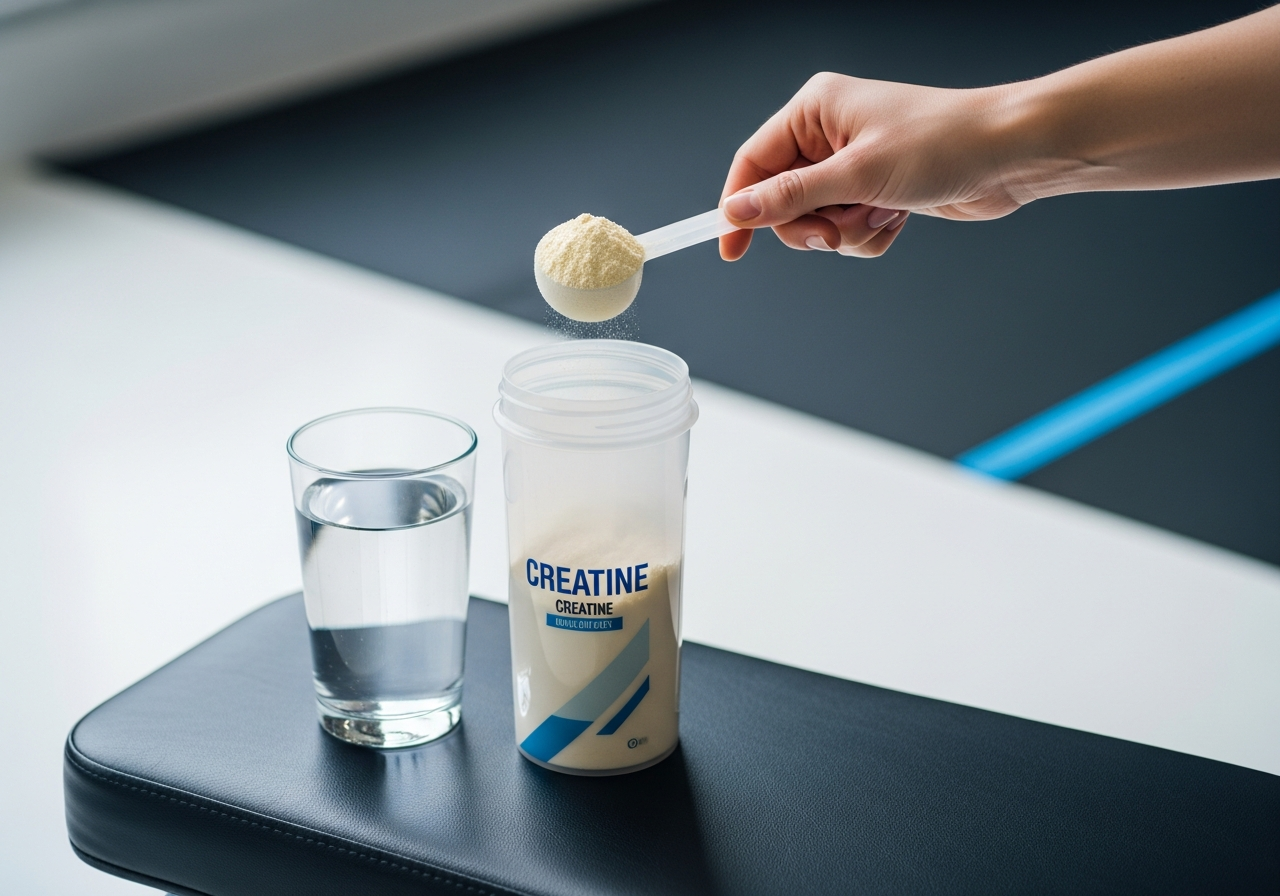
If you already have creatine ethyl ester, the practical move is to use it consistently rather than panic, then switch to monohydrate when you reorder if results are underwhelming. The biggest mistake now would be randomly underdosing it, changing protocols every few days, and concluding all creatine 'does not work'.
Here is the simplest step-by-step approach:
- Check the label for actual creatine ethyl ester amount per serving. Many products hide behind proprietary blends or multiple-scoop servings.
- Take the product daily. Creatine works by building and maintaining saturated muscle stores over time, not by acting like a stimulant you feel right away.
- Use it at the same time each day if that helps adherence. Timing is less important than consistency, as discussed in when to take creatine.
- Mix it with enough fluid to tolerate it comfortably. If it causes stomach upset, take it with food and spread the dose.
- Track three things for 2-4 weeks: body weight, gym performance, and subjective muscle fullness or recovery.
- Do not keep changing brands, doses, and workout plans simultaneously. You need a stable routine to judge whether a supplement is doing anything.
What should you expect? If any creatine form is working well, typical signs are subtle at first: body weight may rise slightly from increased intracellular water, you may squeeze out one or two extra reps on later sets, and repeated efforts can feel a bit more sustainable. The change is usually most obvious over several weeks of training, not in one dramatic workout.
If you do not notice anything after a fair trial, switching to monohydrate is the rational next step. You can use how to take creatine and creatine loading phase guides to set up a proven protocol. In other words, if you already own CEE, use it sensibly; if you are deciding what to buy next, do not treat CEE as an upgrade that needs to be chased.
Dosing specifics by body weight and goal: what to do in the real world
For real-world dosing, use the same evidence-based creatine framework you would use for monohydrate, because CEE has not earned a special superior protocol. The goal is still muscle creatine saturation, and the most defensible approach remains either a standard maintenance dose or a short loading phase followed by maintenance.
The mainstream creatine protocol is:
- Maintenance only: 3-5 g daily.
- Optional loading phase: about 20 g daily, split into 4 doses, for 5-7 days, then 3-5 g daily.
Body size matters somewhat because larger people generally have more muscle mass and potentially larger creatine storage capacity. A practical way to think about it is this:
| Body weight | Conservative daily maintenance | Who this often fits |
|---|---|---|
| Under 60 kg | 3 g/day | Smaller beginners, lighter women, some endurance athletes |
| 60-90 kg | 3-5 g/day | Most recreational lifters and field-sport athletes |
| Over 90 kg | 5 g/day | Larger lifters, rugby players, heavyweight strength athletes |
By goal, here is the practical breakdown:
- Strength and muscle gain: Use 3-5 g/day and train progressively. Loading is optional if you want faster saturation.
- Team sports, sprinting, HIIT: Same daily dose. Loading can help if you want quicker performance readiness.
- Older adults: 3-5 g/day is commonly used, especially alongside resistance training.
- General health or beginners: Keep it simple with 3 g/day if smaller, 5 g/day if average-to-large.
If you want the number tailored more precisely, use our creatine dosage calculator or read creatine maintenance dose. Also remember that if you skip days often, the form is not the problem; the inconsistency is. A mediocre protocol done every day beats a perfect protocol done sporadically.
One more point for CEE users: do not assume smaller label doses automatically mean it is more potent. Without stronger comparative evidence, lower dose marketing should be treated cautiously. Dose enough, take it daily, and judge by outcomes rather than by how futuristic the tub looks.
Timing, results, and how to tell if your creatine is actually doing anything
Creatine timing matters far less than total daily intake, and the clearest sign that creatine is working is gradual improvement in training quality over days to weeks, not an immediate buzz. That applies to CEE and monohydrate alike.
Because creatine works through saturation, the timeline depends on whether you load. With a loading phase, many people begin to notice changes within about one week. Without loading, noticeable effects often emerge over roughly 2-4 weeks of daily use. The exact timing varies with baseline diet, muscle mass, training quality, and how consistently you supplement.
Here is what an honest week-by-week expectation looks like:
- Days 1-7 with loading: possible slight scale increase, usually from more water being drawn into muscle cells; some people notice better repeated effort capacity.
- Weeks 2-3 without loading, or week 2 after loading: gym performance may improve subtly, especially on later sets or repeated sprints.
- Weeks 3-6: the bigger payoff usually comes from training adaptations, such as more total volume handled and better long-term strength or size progress.
How do you tell whether it is working? Track objective markers:
- Body weight first thing in the morning, 3-4 times weekly.
- Performance on repeatable lifts such as squat, bench, row, or deadlift accessory work.
- Number of reps completed at a fixed load.
- Repeated sprint or interval quality if you are a field or court athlete.
What should not be your main marker? Feeling 'amped'. Creatine is not caffeine and should not feel like pre-workout. If you want detail on timing and adherence, see creatine on rest days, what happens if you miss a day, and how long creatine takes to work.
If you are using CEE and performance does not move despite solid training, enough protein, and consistent intake, that is one more reason to stop paying a premium for uncertainty and move to monohydrate.
Who creatine ethyl ester is for — and why most groups are still better served by monohydrate
Creatine ethyl ester is not clearly the best choice for any major user group, because the benefits people seek from creatine are already well supported with monohydrate. That includes beginners, women, older adults, strength athletes, and many team-sport athletes.
Beginners: Beginners should almost always start with monohydrate, not CEE, because they need proven results and simple dosing more than novelty. A basic daily protocol is easier to follow and easier to troubleshoot. Our creatine for beginners guide covers the setup.
Women: Women respond to creatine too, and there is no compelling reason to believe CEE offers a female-specific advantage. The common fear of 'bulking' is usually misplaced; any early weight increase is typically water in muscle, not fat gain. See creatine for women for detail.
Older adults: Older adults interested in strength, preserving lean mass, or supporting training capacity benefit from the same evidence-based logic: choose the form with the best track record. Monohydrate is the better-supported option here as well, especially when paired with resistance training.
Athletes: Competitive athletes should be especially conservative about supplement choices because evidence quality and product quality both matter. The International Olympic Committee consensus stresses that supplements should be chosen carefully and only when a clear evidence-backed benefit exists. Monohydrate meets that threshold much better than CEE.
Vegetarians and vegans: People who eat little or no meat often have lower baseline creatine stores and may respond especially well to creatine supplementation. Again, there is no good reason to pay extra for CEE here.
Who should be cautious with any creatine form? People with relevant medical conditions, especially pre-existing kidney disease or those under physician care for complex health issues, should speak with a qualified healthcare professional before supplementing. That is a general creatine caution, not something unique to CEE.
Bottom line: there is no obvious population in which creatine ethyl ester has a strong, evidence-based edge. If your goal is reliability, monohydrate remains the default recommendation across nearly every major use case.
Safety, side effects, and what Canadians should look for on the label
Creatine ethyl ester is not known for unique headline benefits, and its safety discussion mostly comes back to the broader creatine literature, where monohydrate has the strongest long-term reassurance. If you want the safest evidence-based route, the most-studied form is usually the best bet.
According to the 2017 ISSN position stand and the 2021 JISSN review on common misconceptions, creatine monohydrate is well supported as safe for healthy individuals when used appropriately. Typical side effects with creatine products are not exotic; they are usually practical issues such as stomach upset, loose stools from taking too much at once, or minor transient water-weight changes. These issues are often dose-related rather than proof that someone 'cannot tolerate creatine'.
Common side effects and fixes include:
- Stomach upset: split the dose and take it with food.
- Loose stools: avoid large single doses if you are loading.
- Scale increase: understand that intracellular water gain is common and not the same as fat gain.
- Perceived bloating: often improves with consistent dosing, better mixing, and realistic expectations.
If you want a deeper dive, see is creatine safe, creatine digestive side effects, and does creatine cause bloating.
For Canadians, buying quality matters. Look for:
- A clear Supplement Facts or product panel with exact grams per serving.
- An NPN, or Natural Product Number, when applicable under Health Canada rules, which indicates the product has been licensed as a natural health product.
- Third-party testing or transparent quality-control statements.
- A short, simple ingredient list rather than proprietary blends built around buzzwords.
If you are shopping locally or online, compare reputable products in our creatine product catalog, browse creatine brand reviews, and use our guide to best creatine monohydrate in Canada before spending extra on exotic forms. In Canada especially, a boring label backed by good manufacturing and a proper dose is often a much better sign than a flashy formula built around CEE claims.
The biggest CEE myths debunked: absorption, bloating, water retention, and 'advanced' chemistry
Most creatine ethyl ester marketing claims sound stronger than the actual evidence behind them. If a brand says CEE is better absorbed, causes less bloating, needs smaller doses, or avoids water retention, treat those claims as unproven unless the company can show strong human data against monohydrate.
Myth 1: 'CEE is better absorbed.' Better absorbed is only meaningful if it leads to better muscle creatine status and better performance outcomes. A digestion or transport theory alone is not enough.
Myth 2: 'CEE does not cause water weight.' Effective creatine often increases water inside muscle cells, which is part of how saturation shows up early on. Avoiding all water shift is not automatically a benefit if it also means less useful creatine in muscle.
Myth 3: 'Monohydrate causes bloating, but CEE does not.' Many people tolerate monohydrate perfectly well, especially at sensible doses. When digestive issues happen, they are often solved by splitting doses, taking creatine with food, or using a micronized powder rather than switching to a less-supported form.
Myth 4: 'CEE is more advanced, so it must be better.' In sports nutrition, newer and more complex do not automatically mean more effective. Monohydrate continues to win because it repeatedly delivers where it counts.
Myth 5: 'If you feel nothing, creatine is not working.' Creatine is not supposed to feel like a stimulant. The proper signs are better training output, gradual strength progress, and sometimes slight body-mass increase.
Antonio et al. (2021) specifically addressed widespread misconceptions around creatine, reinforcing an evidence-first view rather than a marketing-first one. If you want more myth cleanup, see creatine myths debunked and creatine myths vs. facts.
The broader lesson is useful beyond CEE: when comparing supplement forms, ask one question first. Does this form produce better human outcomes than monohydrate at a fair cost? If the answer is not clearly yes, the burden of proof has not been met.
Bottom line: should you buy creatine ethyl ester or skip it?
You should usually skip creatine ethyl ester and buy creatine monohydrate instead. That is the cleanest evidence-based answer for almost everyone asking whether creatine ethyl ester works better than monohydrate.
CEE is not nonsense because it still relates to creatine supplementation, but it has not earned first-choice status. The problem is not that CEE is mysterious or dangerous; the problem is that it does not have a compelling advantage where it matters most. You want higher muscle creatine stores, better repeated high-intensity performance, better support for strength and lean-mass gains over time, predictable dosing, and good value. Monohydrate checks all of those boxes more convincingly.
If you are a beginner, the decision is even easier: choose monohydrate, take 3-5 g daily, and train hard enough to give creatine something to amplify. If you want faster saturation, use a loading phase of about 20 g/day split into 4 doses for 5-7 days, then drop to maintenance. If you are a larger athlete, stay near the top of the maintenance range. If you are smaller, 3 g/day is often adequate.
If you already bought CEE, finish it if you tolerate it and want to avoid waste, but compare your results honestly and switch to monohydrate next time unless there is a very specific reason not to. Most of the time, there is not.
The best buying principle is simple: pick the form with the most consistent human evidence, then pick a reputable product with clear dosing and quality controls. In 2026, that still means monohydrate. For next steps, compare options in our best creatine rankings, browse the product catalog, or read why monohydrate still wins for the broader form debate.
Creatine Ethyl Ester vs. Monohydrate at a Glance
- 3-5 g/day Standard creatine maintenance dose — Mainstream evidence-based daily amount for most adults using monohydrate
- 20 g/day Typical loading dose — Usually split into 4 doses for 5-7 days to saturate faster
- 5-7 days Loading phase timeline — Often enough to raise muscle creatine more quickly than maintenance alone
- 2-4 weeks Common no-loading timeline — Typical window to notice effects when taking creatine daily without loading
Frequently Asked Questions
What is creatine ethyl ester?
Creatine ethyl ester is a modified form of creatine in which creatine is attached to an ethyl ester group. It was designed to improve absorption and reduce side effects, but it has not shown a clear advantage over creatine monohydrate in the outcomes that matter most, such as muscle creatine saturation, strength, and training performance.
Does creatine ethyl ester work better than monohydrate?
No, creatine ethyl ester has not been shown to work better than creatine monohydrate. Monohydrate remains the most studied and most consistently effective form for improving high-intensity exercise capacity and supporting lean mass gains during training.
Does creatine ethyl ester work at all?
Yes, creatine ethyl ester may still work to some degree because it still provides creatine, but that is not the same as being the best option. The stronger evidence still supports monohydrate as the more reliable and better-validated choice.
What are the benefits of creatine ethyl ester?
The expected benefits of creatine ethyl ester are basically the same benefits people seek from any creatine form: better repeated high-intensity performance, support for strength, and potentially more lean mass over time. The issue is not whether these benefits are desirable, but that CEE has not shown superior delivery of them compared with monohydrate.
Is CEE creatine easier to absorb?
CEE creatine is often marketed as easier to absorb, but better absorption claims are only meaningful if they lead to better muscle creatine levels and better performance outcomes. So far, the evidence has not established that CEE outperforms monohydrate on those practical endpoints.
Does creatine ethyl ester cause less bloating?
Not necessarily, and the claim that creatine ethyl ester causes less bloating is not strongly supported. Many people tolerate monohydrate well, and when bloating or stomach discomfort happens, it is often improved by splitting doses, taking it with food, or using a micronized powder.
How much creatine ethyl ester should you take?
There is no clearly superior CEE-specific dosing protocol supported well enough to replace standard creatine guidance. In practice, most people should think in terms of the standard creatine framework: 3-5 g daily for maintenance, or a loading phase of about 20 g/day split into 4 doses for 5-7 days, followed by maintenance.
Should beginners buy creatine ethyl ester?
No, beginners should usually buy creatine monohydrate instead of creatine ethyl ester. Monohydrate is simpler, cheaper, much better studied, and easier to recommend confidently because the dose, timing, and expected results are far clearer.
Is creatine ethyl ester safe?
Creatine ethyl ester does not appear to have a unique safety advantage, and most safety reassurance in the literature comes from monohydrate rather than CEE. For healthy adults, creatine is generally considered safe when used appropriately, but anyone with relevant medical conditions should speak with a healthcare professional first.
What is the best type of creatine to buy in Canada?
For most Canadians, the best type of creatine to buy is creatine monohydrate from a reputable brand with clear dosing, preferably third-party testing, and an NPN on the label when applicable. Fancy form claims are less important than strong evidence, product transparency, and value per effective dose.