Creatine for Bodybuilding: Size, Fullness, and Contest Prep
By The Creatine Canada Research Team — Evidence-based supplement analysts
Creatine for bodybuilding works, and for most lifters it is the single most reliable supplement for adding training volume, fuller-looking muscles, and more long-term lean mass. In practice, creatine monohydrate helps bodybuilders by increasing intramuscular phosphocreatine stores, which supports repeated hard sets, better performance over time, and a noticeable increase in muscle water content that many people describe as more size and pump.
Evidence-based · Cites 4 sources · Editorial standards
Key Takeaways
- Creatine monohydrate is the best-studied and most cost-effective form for bodybuilding.
- A standard maintenance dose is 3-5 g daily; loading is optional but fills stores faster.
- Expect quicker muscle fullness within 1-2 weeks with loading, and performance or size benefits over several weeks of training.
- Creatine can improve the pump indirectly by increasing muscle cell hydration and letting you sustain more quality volume.
- Most bodybuilders, including many natural bodybuilders, use creatine year-round rather than cycling it.
- Contest-prep use is individual: some keep creatine in, while some remove it briefly if they feel it changes their look.
- Healthy adults generally tolerate creatine well, but taking too much at once is a common cause of stomach upset.
What creatine does for bodybuilding, in one direct answer
Creatine for bodybuilding helps you train harder, recover between sets faster, and maintain a fuller muscle look by increasing the amount of phosphocreatine stored inside muscle. Phosphocreatine is the rapidly available form of stored energy your body uses to help regenerate ATP, the immediate fuel for high-intensity efforts such as heavy sets of squats, rows, presses, and repeated sprint-style bursts in the gym.
For bodybuilding, that matters because hypertrophy is built from repeated high-quality training over months, not from one magical scoop. Creatine does not build muscle like an anabolic drug, and it is not a steroid. Instead, it improves the energy system that powers short, hard efforts, which can translate into an extra rep here, a little more load there, and better total training volume over time. The 2017 ISSN position stand concluded that creatine monohydrate is the most effective nutritional supplement currently available for increasing high-intensity exercise capacity and lean body mass when paired with training. See Kreider et al. (2017), ISSN Position Stand: Safety and Efficacy of Creatine — JISSN.
If your question is whether bodybuilders take creatine, the answer is yes, many do. That includes recreational lifters, natural bodybuilders, and many competitive physique athletes because the evidence base is strong, the cost per serving is low, and the downside profile in healthy adults is generally mild. It is common enough that many beginners first encounter it in basic stacks alongside whey protein and caffeine.
If your question is whether all bodybuilders take creatine, the answer is no. Some avoid it because they dislike the small scale-weight increase from intracellular water, some have digestive issues with poor dosing habits, and some competitors remove it before a show if they personally think it affects how they look. But from a pure evidence perspective, creatine monohydrate is one of the few supplements that genuinely earns a place in a bodybuilding plan.
If you are completely new, start with our creatine dosage calculator or read what creatine is in more depth. For most people, the short version is simple: 3-5 g of creatine monohydrate every day, consistently, while you keep training hard.
How creatine actually helps size, fullness, and better workouts
Creatine helps bodybuilding through three main mechanisms: faster ATP regeneration during hard efforts, greater intramuscular water retention, and better long-term training quality. Those three effects explain why lifters often notice both a visible change in muscle fullness and a slower, more meaningful change in strength and lean mass.
The first mechanism is energy. During a hard set lasting roughly a few seconds to about half a minute, your body relies heavily on phosphocreatine to help restore ATP. When muscle creatine stores are higher, you can often maintain force output a little better across repeated bouts. In bodybuilding terms, that can mean squeezing out another rep, preserving bar speed, or keeping later sets from falling off as sharply. One extra quality rep across many exercises and weeks is not trivial; it is exactly the kind of small performance edge that accumulates into more hypertrophy stimulus.
The second mechanism is cell hydration. Creatine draws more water into muscle cells, which is why many users look fuller within days to a couple of weeks. This is not subcutaneous water sitting under the skin in the way bodybuilders usually fear. It is primarily increased intracellular water, meaning water stored inside muscle tissue. That is why people often say creatine makes their muscles look rounder or denser. If you want the evidence-based explanation behind scale changes, see does creatine make you gain weight.
The third mechanism is long-term adaptation. Creatine does not replace progressive overload, good programming, or sufficient protein, but it can support them. Better repeated performance lets you accumulate more useful work, and that repeated work is what drives growth. The IOC supplement consensus recognises creatine as one of the few supplements with strong evidence for performance benefits in high-intensity exercise. See International Olympic Committee consensus on dietary supplements (2018).
Does creatine give you a pump? Yes, often indirectly. Creatine is not a nitric oxide booster, but it can increase muscle cell hydration and help you sustain more training volume, both of which can make a pump feel and look better. If you want more on the broader effect profile, our creatine benefits guide and does creatine build muscle article go deeper.
What results to expect, and how fast bodybuilding changes show up
Most bodybuilders notice creatine in phases: fullness first, gym performance next, and measurable physique progress later. That timeline is important because many people quit too early after expecting instant muscle gain from a supplement that mainly works by supporting training quality.
If you use a loading phase of about 20 g per day split into 4 doses for 5-7 days, you can usually saturate muscle stores faster and notice body-weight and fullness changes within the first week. If you skip loading and take 3-5 g daily, the same endpoint is usually reached more gradually over roughly 3-4 weeks. The fast visible effect is typically a small increase in intracellular water rather than new contractile tissue appearing overnight.
In week 1, many lifters notice a fuller look, slightly better pumps, or a small bump on the scale. In weeks 2-4, workouts may feel more repeatable, especially on volume-heavy training blocks with multiple hard sets. By weeks 4-8, some lifters notice clearer progress in rep performance or set quality. Over months, the payoff is the ability to string together more productive training.
How do you tell it is working? The best markers are practical and boring: more reps at a given load, less drop-off from your first working set to your last, improved ability to repeat sprint-like efforts, and a slightly fuller look in the mirror. Creatine is not working if you expect an acute stimulant feeling; it does not hit like pre-workout and it does not need to.
There is also individual variation. People with lower baseline muscle creatine stores, including some vegetarians and some newer lifters, may notice a stronger response. Others respond more subtly. If you think you are not seeing anything, first ask whether you are taking it daily, whether your dose is adequate, and whether your training is actually challenging enough to create a benefit from improved high-intensity energy availability.
For a more detailed timeline, read how long creatine takes to work. For people worried they are non-responders, remember that a modest response is still a response, and the visible effect often lags behind the performance effect.
How to take creatine for bodybuilding: the exact step-by-step plan
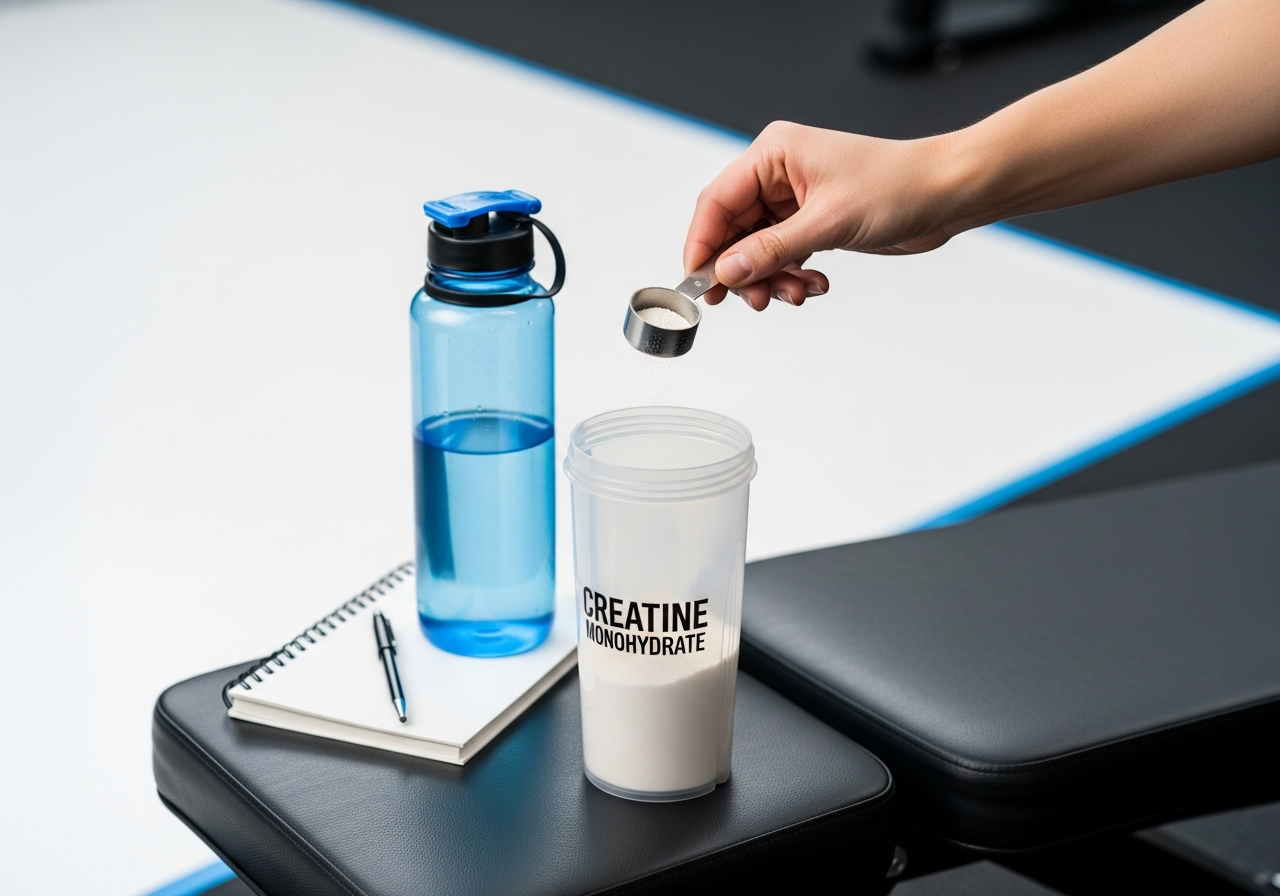
The simplest effective bodybuilding protocol is 3-5 g of creatine monohydrate every day, including rest days. You do not need a fancy stack, and you do not need to cycle on and off if you are a healthy adult using standard doses.
- Choose creatine monohydrate. Monohydrate is the most studied form and remains the reference standard for efficacy, safety, and value. If you want help comparing products, start with our best creatine rankings and creatine brand reviews.
- Pick your dosing approach. Option A is maintenance only: take 3-5 g daily. Option B is loading: take 20 g per day split into 4 doses of 5 g for 5-7 days, then continue with 3-5 g daily.
- Take it consistently. Daily consistency matters far more than exact clock timing. On training days, many bodybuilders take it with a post-workout shake simply because that is easy to remember. On rest days, take it with any meal or beverage.
- Mix it properly. Stir the powder into water, juice, or a protein shake. Warm liquid can help it dissolve, though full dissolution is not required for effectiveness. If you need mixing tips, see how to mix creatine.
- Use enough fluid. Creatine does not dehydrate you, but taking it with a decent amount of water is a good habit, especially if you train hard and sweat a lot. Our guide on how much water to drink with creatine explains the practical side.
- Give it time. Commit to at least 4-8 weeks of consistent use while tracking workouts before judging results.
One common beginner mistake is taking one huge scoop whenever you remember. That is the fastest route to stomach upset and the slowest route to stable saturation. Another is only taking creatine on workout days. Creatine works by keeping muscle stores elevated over time, so off-day dosing still counts.
If you already use whey protein, it is fine to combine the two in one shaker. If you drink coffee, it is also fine to take creatine in the same general part of the day. For more depth, read how to take creatine and when to take creatine.
Dosing by body weight, goal, and season of training
For most bodybuilders, 3-5 g of creatine monohydrate per day is enough to maintain saturation, while a 5-7 day loading phase of 20 g per day split into 4 doses gets you there faster. Larger athletes often choose the high end of the maintenance range, while smaller athletes and beginners often do fine at the low end.
| Body weight / goal | Fast-start option | Standard daily option | Best use case |
|---|---|---|---|
| Under 60 kg | 20 g/day for 5-7 days in 4 x 5 g doses, then 3 g/day | 3 g/day | Smaller lifters who want either rapid saturation or a gentle start |
| 60-90 kg | 20 g/day for 5-7 days in 4 x 5 g doses, then 3-5 g/day | 3-5 g/day | Most bodybuilders and general physique athletes |
| Over 90 kg | 20 g/day for 5-7 days in 4 x 5 g doses, then 5 g/day | 5 g/day | Larger, heavily muscled athletes seeking a simple maintenance target |
| Bulking phase | Loading is optional | 3-5 g/day | Supports fuller look and more productive training |
| Cutting phase | Usually not necessary | 3-5 g/day | Helps preserve training quality while calories are lower |
| Peaking / show week | Not typically introduced here | Individual decision | Keep routine stable unless coach and athlete know how you respond |
Should you scale creatine precisely to body weight? You can, but most people do not need to. The practical bodybuilding answer is that standard daily dosing works well for nearly everyone. If you want a more tailored estimate, use our creatine dosage calculator or read how much creatine per day.
Natural bodybuilders often keep creatine in during both off-season and contest prep because it supports training performance without violating natural federation rules. During a cut, some people worry creatine will make them look soft. In reality, most of the water retention is intramuscular, which often helps muscles look fuller rather than washed out. Still, physique sports are visual and individual, so contest-specific decisions should be tested before they matter.
The most important rule is consistency. The perfect dose taken sporadically loses to the boring dose taken daily.
Best timing for bodybuilders: pre-workout, post-workout, or whenever?
For bodybuilding, the best time to take creatine is the time you will remember every day, because daily saturation matters more than acute timing. Creatine is not a stimulant, so it does not need to be taken pre-workout to "kick in" during the session.
That said, bodybuilders often prefer one of three timing habits. First is post-workout with a shake, because it is convenient and easy to keep consistent. Second is pre-workout, often because it is already part of a supplement routine. Third is with a meal on rest days to keep the habit automatic. All three work if the daily dose is there.
If your goal is pure compliance, attach creatine to an anchor behaviour you never miss: your morning coffee, lunch, post-workout protein, or evening meal. The question is not whether 2:17 p.m. beats 6:42 p.m.; the question is whether you will still be taking it eight weeks from now.
Does taking creatine with carbs or protein help? It can be a reasonable practical choice, but it is not required for bodybuilding results. If mixing with protein makes your routine simpler, do that. If plain water is easier, do that instead. The main performance effect comes from elevated muscle creatine stores over time.
Should you take creatine on rest days? Yes. Rest-day use helps maintain saturation. Missing a single day is not catastrophic, but routinely skipping non-training days is a common reason people take longer to see benefits.
There is no strong reason to reserve creatine only for workouts, and there is no evidence-based need to cycle it on and off for most healthy adults. If you want the deep dive, read creatine on rest days, creatine maintenance dose, and do you need to cycle creatine.
Bottom line: timing is a minor detail; regular intake is the major one.
Who should use creatine for bodybuilding: beginners, women, older adults, naturals, and pros
Creatine is appropriate for many bodybuilding populations, including beginners, women, older adults who lift, natural competitors, and many higher-level physique athletes. The dose is usually similar across groups, but expectations and context can differ.
Beginners: Yes, beginners can take creatine. In fact, the earlier lesson is not about supplements but about consistency: train with progressive overload, eat enough protein, sleep well, and use creatine as a supportive tool. Beginners often respond well because they are building habits and adapting quickly to training in general. If you are starting from zero, our creatine for beginners guide is a good next read.
Women: Women can absolutely use creatine for bodybuilding or general physique goals. Creatine does not "bulk women up" on its own; it supports performance and muscle retention just as it does in men. The scale may rise slightly from intracellular water, but that is not body fat. See creatine for women for the practical details.
Older adults: Adults over 50 who resistance train can also benefit, especially when the goal is maintaining muscle and performance with age. The mechanism is the same: improved phosphocreatine availability can support better training quality and, in some contexts, lean mass retention.
Natural bodybuilders: Yes, natural bodybuilders commonly take creatine because it is legal, well researched, and useful during both gaining and cutting phases. If someone asks, "Do natural bodybuilders take creatine?" the direct answer is yes, many do, precisely because it offers a legal edge in repeated high-intensity training.
Pro bodybuilders: Many pro bodybuilders and serious physique athletes also use creatine, but not literally all of them. Individual supplement philosophies, digestive tolerance, and show-week aesthetics vary. If someone asks, "Do pro bodybuilders take creatine?" the honest answer is that many do, but some avoid or manipulate it around competition based on personal response.
Vegetarians and vegans may notice especially meaningful benefits because dietary creatine intake is typically lower. If that applies to you, the supplement becomes even more relevant to a bodybuilding setup.
Contest prep, show week, and whether creatine helps or hurts stage look
Bodybuilders can take creatine before a show, but whether they should keep it in during peak week depends on individual response and how much uncertainty they want to remove. The evidence-based default is that creatine increases intramuscular water, which often supports fullness, but physique sports are judged visually and tiny look changes matter.
If your question is "Do bodybuilders take creatine before a show?" the correct answer is: many do, some do not, and the deciding factor is usually personal trial rather than a universal rule. Some competitors keep creatine in all the way through prep because stable routines reduce variables and fuller muscles can improve stage appearance. Others pull it several days out because they feel flatter, heavier, or simply more confident without it. Confidence and predictability matter in peaking.
What creatine is not likely to do is spill water under the skin in a dramatic, guaranteed way. The common fear that creatine automatically ruins conditioning is overstated. The 2021 JISSN review on common creatine misconceptions notes that several widespread worries about water retention and side effects are exaggerated or poorly understood. See Antonio et al. (2021), Common questions and misconceptions about creatine supplementation — JISSN.
Does creatine give you a better pump? Often yes, especially when you are glycogen-replete and training with moderate to high volume. Creatine can improve pump indirectly by increasing intracellular water and supporting more sustained output across sets. It is not a direct vasodilator, so it does not replace carbohydrate intake, sodium, hydration, or nitric oxide-focused ingredients, but it can make an already good pump better.
The safe practical rule for competitors is simple: never experiment in show week. If you plan to keep creatine in, test that strategy in advance during mock peaks or check-in phases. If you plan to remove it, test that too. Bodybuilding is one of the few contexts where the right answer depends as much on mirror feedback as on physiology.
Safety, side effects, and when bodybuilders should be cautious
Creatine monohydrate is generally safe for healthy adults at standard doses, and the strongest evidence supports long-term use without a need to cycle. The biggest real-world side effect is gastrointestinal upset from taking too much at once, not kidney damage in healthy users following normal protocols.
The 2017 ISSN position stand and the 2021 JISSN misconceptions review both support creatine's strong safety profile in healthy populations. One point that causes confusion is bloodwork: creatine supplementation can increase creatinine, which is a breakdown marker commonly used in kidney panels, without meaning creatine is harming the kidneys. That is why context matters. If you want the full explanation, read is creatine bad for your kidneys and creatine vs creatinine.
Common side effects and fixes:
- Stomach upset or loose stool: Usually caused by large single doses. Split doses, take with food, or reduce from loading to maintenance.
- Temporary scale-weight increase: Usually from increased intracellular water, not fat gain.
- Bloating complaints: More often reported when people load aggressively or use poor mixing habits. See does creatine cause bloating.
Common myths that are not well supported include the claims that creatine dehydrates you, causes muscle cramps, damages kidneys in healthy adults, or is a steroid. For evidence-based myth cleanup, see creatine myths debunked and creatine myths vs facts.
Who should be cautious? People with pre-existing kidney disease, complex medical conditions, or medication concerns should speak with a qualified clinician before supplementing. Pregnant or breastfeeding individuals should use clinician guidance. Teen athletes are a separate discussion and should ideally involve parents, coaches, and informed medical oversight.
From a bodybuilding perspective, the practical safety lesson is simple: use plain monohydrate, respect the dose, drink normally for your training environment, and avoid turning a straightforward supplement into an extreme protocol.
The biggest mistakes, myths, and reasons creatine seems not to work
When bodybuilders think creatine is not working, the cause is usually poor expectations, inconsistent dosing, or a training problem rather than a failure of the supplement itself. Creatine supports high-intensity performance; it does not replace effort, food, or time.
Mistake 1: Taking it only on training days. Creatine works by saturating muscle stores, so skipping rest days slows progress. Daily intake wins.
Mistake 2: Expecting a stimulant effect. Creatine does not feel like caffeine. If you judge it by a rush or buzz, you will think it failed even when it is helping.
Mistake 3: Mega-dosing in one shot. More is not better once stores are full, and very large doses are more likely to upset your stomach.
Mistake 4: Blaming creatine for fat gain. A scale increase in the first days or weeks is usually water inside the muscle, not body fat. If calories are controlled, creatine itself is not making you fatter.
Mistake 5: Switching to exotic forms because the marketing sounds better. Monohydrate remains the evidence leader. Fancy forms often cost more without proving better bodybuilding outcomes.
Myth: Creatine only matters for powerlifters, not bodybuilders. False. Bodybuilding still relies on repeated high-intensity sets, local fatigue management, and total volume. Creatine helps that exact environment.
Myth: You need to cycle off or your body will stop responding. False for most healthy adults. There is no standard evidence-based requirement to cycle creatine.
Myth: Creatine ruins conditioning before a show. Not universally true. Some competitors keep it in successfully; others prefer not to. The answer is individual, not absolute.
If you suspect poor response, audit the basics: are you taking 3-5 g every day, have you done so for at least 3-4 weeks, are you training hard enough to benefit, and are you sleeping and eating in a way that allows adaptation? If those boxes are checked and results are subtle, you may still be getting a modest but real benefit. The difference between a decent mesocycle and a great mesocycle often looks small day to day.
How to buy creatine in Canada without overpaying for marketing
In Canada, the best creatine for bodybuilding is usually a simple creatine monohydrate powder from a reputable brand with clear labelling, an NPN, and ideally third-party quality testing. NPN stands for Natural Product Number, which indicates a licensed natural health product under Health Canada rules.
Here is what to look for when comparing products:
- Ingredient simplicity: Plain creatine monohydrate is usually the best value.
- Dose transparency: A serving should clearly tell you how many grams of creatine you get.
- Third-party testing: This adds confidence around purity and label accuracy.
- Price per 5 g serving: Compare cost by effective daily dose, not by flashy container size.
- Form factor: Powder is usually cheapest, while capsules and gummies trade convenience for higher cost.
| Form | Pros | Cons | Best for |
|---|---|---|---|
| Monohydrate powder | Best evidence, best value, easy to dose 3-5 g | Needs mixing | Most bodybuilders |
| Micronized powder | Mixes a bit easier, same core ingredient | Often slightly pricier | People who dislike grit |
| Capsules | Portable and tidy | More expensive, many capsules needed for full dose | Travel or convenience users |
| Gummies | Easy to take | Usually expensive per effective dose, sometimes added sugar | People who refuse powders |
| HCL or other specialty forms | Aggressive marketing, sometimes smaller scoop size | Usually costlier, not better proven than monohydrate | Rarely necessary |
If you want a starting point, browse our creatine product catalog, best creatine rankings, and creatine brand reviews. Canadian buyers should also understand what labels and regulations mean; when in doubt, simple and transparent usually beats flashy.
For bodybuilding, your money should go first to consistent training, adequate protein, enough food for your goal, and a plain creatine monohydrate product you will actually use every day.
Bottom line: the smartest way to use creatine for bodybuilding
Creatine for bodybuilding is worth using for most lifters because it reliably supports harder training, fuller muscles, and better long-term lean mass progress when combined with proper lifting and nutrition. If you want the shortest possible recommendation, take 3-5 g of creatine monohydrate daily, every day, and judge it over weeks and months rather than one workout.
If you want faster saturation, use a loading phase of 20 g per day split into 4 doses for 5-7 days, then drop to 3-5 g daily. If you prefer the gentler route, skip loading and simply stay consistent. Both approaches can work; one is faster, the other is simpler.
Do bodybuilders take creatine? Yes, many do. Do all bodybuilders take creatine? No. Do natural bodybuilders take creatine? Very often, yes. Do pro bodybuilders take creatine? Many do, though not universally. Do bodybuilders take creatine before a show? Some keep it in for fullness and stable routine, while others remove it based on personal response. Those are all true because creatine is both strongly evidence-based and still subject to the visual preferences of physique sport.
Does creatine give you a pump? Usually yes, indirectly. It helps create fuller muscle cells and can support more sustained training volume, both of which can make a pump look and feel better. But its biggest bodybuilding value is not the mirror pop from one session; it is the accumulation of slightly better training over many sessions.
If you are buying in Canada, keep it boring: plain monohydrate, clear label, reputable brand, and a sensible price per serving. If you are using it, keep it boring too: daily dose, enough water, and no drama. In supplements, boring is often where the real results are.
Creatine for Bodybuilding: the numbers that matter
- 3-5 g/day Standard maintenance dose — Enough for most bodybuilders to maintain elevated muscle creatine stores.
- 20 g/day Typical loading dose — Usually split into 4 doses for 5-7 days to saturate faster.
- 5-7 days Fast saturation timeline — Common timeframe when using a loading phase.
- 3-4 weeks Gradual saturation timeline — Typical timeframe when taking only 3-5 g per day without loading.
Frequently Asked Questions
Do bodybuilders take creatine?
Yes, many bodybuilders take creatine because it is one of the best-supported supplements for high-intensity training performance and lean mass gains over time. It is especially popular in bodybuilding because it can improve training quality, increase muscle fullness through intracellular water, and costs far less than many less-proven supplements.
Do all bodybuilders take creatine?
No, not all bodybuilders take creatine. Some skip it because they dislike even a small body-weight increase, some do not tolerate large doses well, and some simply prefer fewer supplements, but from an evidence standpoint creatine monohydrate is still one of the strongest choices available.
Do natural bodybuilders take creatine?
Yes, natural bodybuilders commonly take creatine because it is legal, non-hormonal, and effective for supporting repeated hard training. Natural competitors often value creatine precisely because it can provide a legitimate performance and physique benefit without conflicting with natural bodybuilding rules.
Do pro bodybuilders take creatine?
Yes, many pro bodybuilders take creatine, but not every single one does. At the high end of physique sport, supplement use becomes very individual, and some athletes keep creatine in year-round while others adjust it during prep based on digestion, body weight, and how they feel it affects their look.
Does creatine give you a pump?
Yes, creatine can help give you a better pump, mainly indirectly rather than by acting like a nitric oxide booster. It increases water stored inside muscle cells and can help you sustain more productive volume, which together often make muscles feel and look fuller during training.
Does creatine increase pump or just water weight?
Creatine can do both, but the important distinction is that most of the early water gain is inside the muscle rather than under the skin. That intracellular water can improve the appearance of fullness and contribute to a better pump, while the long-term bodybuilding value comes from improved training performance over time.
Do bodybuilders take creatine before a show?
Some bodybuilders take creatine before a show and some do not, because this is one of the most individual parts of creatine use. Many athletes keep it in to preserve fullness and routine, while others remove it if they personally feel they look better without it, so the best approach is to test your own response well before peak week.
What is the best creatine for bodybuilding?
Creatine monohydrate is the best creatine for bodybuilding because it has the strongest evidence base, the lowest cost per effective dose, and a long safety record in healthy adults. Most lifters do not need specialty forms like HCL, buffered creatine, or creatine gummies unless convenience is worth the added cost.
How much creatine should a bodybuilder take per day?
Most bodybuilders should take 3-5 g of creatine monohydrate per day. A loading phase of 20 g per day split into 4 doses for 5-7 days is optional if you want faster saturation, but it is not required to get results.
How long does creatine take to work for bodybuilding?
Creatine can start affecting muscle fullness within about a week if you load, or within roughly 3-4 weeks if you use only a daily maintenance dose. Performance and physique benefits build more gradually, because creatine works best by supporting better training over repeated weeks and months.