Creatine Muscle Saturation: How Long It Takes and How to Know When You're Full
By The Creatine Canada Research Team — Evidence-based supplement analysts
Creatine muscle saturation means your muscles have topped up their creatine and phosphocreatine stores enough to deliver the full practical benefit of supplementation. With a loading phase of about 20 g/day split into 4 doses, most people saturate in 5-7 days; with 3-5 g/day, most reach near-full saturation in roughly 3-4 weeks.
Evidence-based · Cites 4 sources · Editorial standards
Key Takeaways
- Most people fully saturate faster with 20 g/day for 5-7 days, then maintain with 3-5 g/day.
- If you skip loading, 3-5 g/day still works; it just usually takes about 3-4 weeks.
- Creatine works by increasing intramuscular phosphocreatine, which helps regenerate ATP during hard, short efforts.
- You cannot feel a precise saturation point, but better training performance, fuller muscles, and small scale increases are common clues.
- Monohydrate is still the best-studied, most cost-effective form for saturating muscle stores.
- Take creatine every day, including rest days, because saturation depends on consistency more than timing.
- Stomach upset during loading is usually solved by smaller split doses, taking it with food, or skipping loading entirely.
Creatine muscle saturation, defined plainly: what ‘full stores’ actually means
Creatine muscle saturation means your muscles have stored as much extra creatine as they can realistically hold from supplementation, so additional daily doses mainly maintain those elevated stores rather than raising them much further. In practice, people asking about the creatine saturation point are asking when their muscles are “full enough” to get the main performance and training benefits.
Your body already stores creatine naturally, mostly in skeletal muscle, where it exists as free creatine and phosphocreatine, the high-energy form that helps rapidly regenerate ATP, the cell’s immediate energy currency. Supplementation raises those muscle stores above baseline. Once those stores are elevated to a near-maximal level for you, you are considered creatine fully saturated.
This matters because creatine is not a stimulant you “feel” right after a scoop. It is a storage-based supplement. The benefit comes from building up muscle creatine over days and weeks, not from a one-off acute effect. That is why a person who takes 5 g once before a workout will not usually notice much, while a person who takes 3-5 g daily for several weeks often will.
The 2017 ISSN position stand concluded that creatine monohydrate is the most effective ergogenic nutritional supplement currently available for increasing high-intensity exercise capacity and lean mass during training, and that conclusion rests on raising muscle creatine stores consistently over time. For a broader primer, see our what is creatine guide.
The most useful way to think about saturation is this:
- Below saturation: your muscle stores are still climbing.
- At or near saturation: your muscle stores are topped up enough to produce the main benefits.
- After saturation: you keep taking a smaller maintenance dose so those stores do not drift back down.
Not everyone starts from the same baseline. People who eat little or no meat often begin with lower creatine stores and can sometimes notice a bigger response. People with naturally higher baseline stores may see a smaller visible change, even though the supplement is still working. That is one reason “creatine and muscle stores” is a better framework than asking whether creatine feels dramatic on day one.
If you want the shortest answer: creatine saturation loading gets you there fast, while a standard low daily dose gets you there more slowly but just as reliably.
How long it takes to saturate with creatine: the realistic timeline most people can expect
Most people reach creatine muscle saturation in 5-7 days with a loading phase, or in about 3-4 weeks with 3-5 g/day and no loading phase. That is the clearest evidence-based answer to “how long to saturate with creatine”.
The standard loading protocol is about 20 g/day, usually split into four 5 g doses, for 5-7 days. After that, a maintenance intake of 3-5 g/day is typically enough to keep stores elevated. The slower protocol is simpler: take 3-5 g/day every day from the start, and let muscle stores rise gradually until they approach the same endpoint a few weeks later.
Why the range? Because the creatine saturation point is not identical for everyone. Your timeline depends on:
- Body size and lean mass: more muscle usually means more total storage capacity.
- Baseline dietary intake: vegetarians and vegans often start lower and may respond more noticeably.
- Adherence: missing doses slows the climb toward saturation.
- Dose size: 3 g/day can work, but it is slower than 5 g/day for many people.
What should you expect week by week?
- Days 1-7 with loading: muscle stores rise quickly; some people notice fuller muscles, small body-weight increases, and better repeated-effort performance by the end of the week.
- Weeks 2-4 after loading: training quality and volume benefits often become easier to notice, especially in strength and sprint-style work.
- Weeks 1-2 without loading: little obvious change for many users, even though stores are building.
- Weeks 3-4 without loading: this is when more people start saying creatine is “working”.
The important practical point is that loading changes the speed of saturation, not the ultimate value of creatine monohydrate. If you dislike taking multiple doses or you tend to get GI upset, skipping the loading phase is completely reasonable.
For a dedicated timeline breakdown, read how long creatine takes to work. If you want a loading-only walkthrough, our creatine loading phase guide goes deeper.
The evidence overview from Kreider et al. (2017), ISSN Position Stand: Safety and Efficacy of Creatine — JISSN supports both approaches, with loading simply producing a faster rise in muscle creatine content.
Why saturation works: how creatine is stored in muscle and why performance improves
Creatine supplementation works because it increases muscle phosphocreatine stores, and those extra stores help you regenerate ATP faster during short, intense exercise. This is the core mechanism behind creatine muscle saturation.
During hard efforts like a heavy set of squats, a 10-second sprint, repeated jumps, or a hockey shift, ATP is used extremely quickly. Your body can only store a small amount of ATP directly, so it relies on phosphocreatine to donate a phosphate group and rapidly remake ATP. More phosphocreatine availability means you can better sustain high power output, recover between repeated bursts, and often complete slightly more quality work across a training session.
That sounds subtle, but over weeks it compounds. One more rep here, slightly better sprint repeatability there, a bit more total volume over months — that is how creatine supports muscle and strength gains. Creatine does not directly build muscle like an anabolic drug. Instead, it improves the energetic environment that lets you train harder and recover better.
Creatine also draws water into muscle cells. This is intracellular water, meaning inside the muscle, not necessarily “puffy under-the-skin water”. That cell hydration may contribute to the fuller look many users report and may support training adaptations, though the best-established performance mechanism is still ATP regeneration via phosphocreatine.
Several practical implications follow from this mechanism:
- Creatine is best for repeated high-intensity efforts, not as a pure endurance booster.
- Saturation matters more than exact clock timing. If stores are full, today’s workout benefits from yesterday’s consistency.
- Training magnifies the benefit. Supplementation without resistance or intense training can still raise stores, but the most obvious payoff is usually seen in the gym or sport.
The 2018 International Olympic Committee consensus on dietary supplements identifies creatine as one of the few supplements with strong evidence for performance in high-intensity exercise settings. Antonio et al. also review common misconceptions in their 2021 JISSN paper, noting that many fears about water retention, cramps, or kidney harm are overstated or misunderstood in healthy users.
If you want the physiology in more detail, see our related guides on creatine and ATP and the creatine phosphate energy system.
Exactly how to saturate your muscles with creatine: a beginner-friendly step-by-step plan
The easiest way to saturate your muscles with creatine is to choose either a fast loading protocol or a slower no-loading protocol, then take it every day without missing doses. Most people overcomplicate this.
- Pick creatine monohydrate. Monohydrate is the most studied and most cost-effective form for increasing muscle stores. Fancy forms have not consistently beaten it.
- Choose your speed. Use loading if you want faster saturation; skip it if you prefer simplicity or have a sensitive stomach.
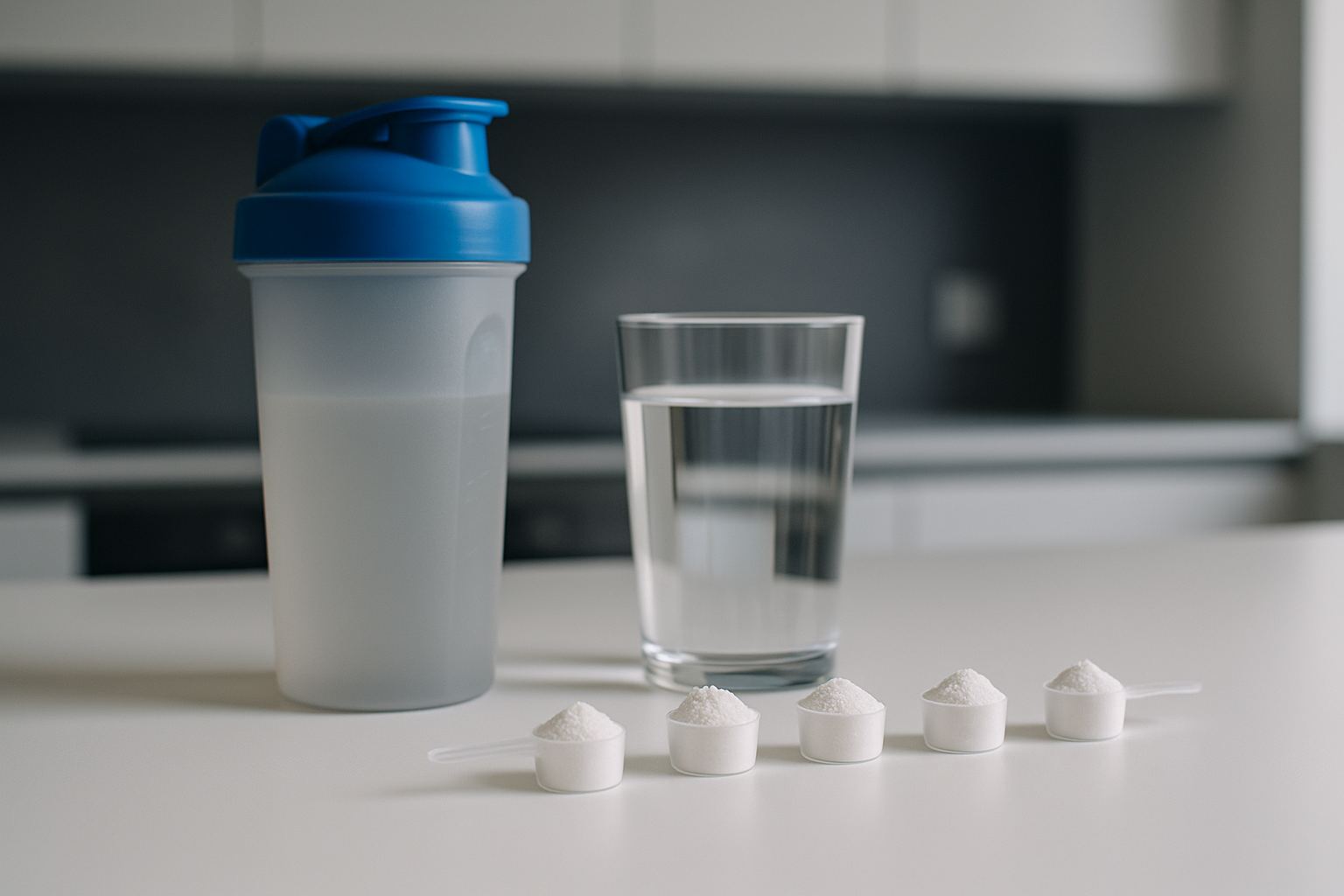
- Fast option: take 20 g/day for 5-7 days, split into four 5 g doses spaced across the day.
- Slow option: take 3-5 g/day once daily for about 3-4 weeks.
- After saturation, maintain. Use 3-5 g/day every day, including rest days.
- Mix and take it consistently. Water, juice, or a protein shake are all fine. Consistency beats perfection.
- Track signs of progress. Look for improved training volume, more reps at a fixed weight, slightly better repeat sprint power, or a modest bump in body weight from intracellular water.
A practical fast-start example:
- Morning: 5 g with breakfast
- Midday: 5 g with lunch
- Pre- or post-workout: 5 g
- Evening: 5 g with dinner
A practical simple-start example:
- Every day: 5 g at the same time, such as after training or with breakfast on rest days
For most beginners, the best adherence strategy is pairing creatine with an existing habit. Put the tub beside your coffee setup, shaker bottle, or protein powder so you do not forget. If you miss a day, do not panic and do not “double up” aggressively the next day unless you are in a planned loading phase. Just resume your normal schedule.
If you want the most precise dose for your body size, use our creatine dosage calculator. If you are new to supplementation entirely, our creatine for beginners guide gives a wider day-one framework.
Bottom line: the best saturation protocol is the one you will actually follow daily for weeks and months.
How much creatine to saturate muscle stores: doses by body weight, training goal, and urgency
Most adults can saturate muscle stores with either 20 g/day for 5-7 days followed by 3-5 g/day, or with a straight 3-5 g/day approach; larger and more muscular people often do better nearer the top of that range.
The textbook loading approach is often expressed relative to body weight at roughly 0.3 g/kg/day for 5-7 days, followed by maintenance around 0.03 g/kg/day. In the real world, many people simply use 20 g/day loading and 3-5 g/day maintenance because it is easier. Here is a practical version:
| Body weight | Fast saturation loading | Maintenance after loading | Simple no-loading option |
|---|---|---|---|
| Under 60 kg | 15-20 g/day split in 3-4 doses for 5-7 days | 3 g/day | 3 g/day for 3-4 weeks |
| 60-90 kg | 20 g/day split in 4 doses for 5-7 days | 3-5 g/day | 5 g/day for 3-4 weeks |
| Over 90 kg | 20-25 g/day split in 4-5 doses for 5-7 days | 5 g/day | 5 g/day, sometimes slightly more if advised by a qualified professional |
Goal also matters:
- You want results fast for training or a competition block: loading is worth considering.
- You care most about convenience: 3-5 g/day is the better plan.
- You have a sensitive stomach: skip loading or use smaller divided doses.
- You are cutting weight for a weigh-in sport: loading-related water gain may be inconvenient.
Women, men, beginners, and older adults generally use the same broad evidence-based dosing ranges. The differences are mostly body size, training demands, and tolerance. Older adults may especially benefit when creatine is paired with resistance training. Vegetarians and vegans often respond well because they can start with lower baseline muscle creatine stores.
If you want a dedicated body-weight article, see how much creatine per day. For women specifically, our creatine for women guide covers common concerns like weight gain, “bulkiness”, and hormone myths.
One caution: more is not better once stores are saturated. Taking much more than needed after saturation mostly increases cost and, for some people, digestive side effects without meaningfully improving muscle creatine storage.
How to know when creatine is working: the real signs of full or near-full saturation
You cannot directly feel your muscles hit an exact creatine saturation point, but you can look for a cluster of signs that strongly suggest your stores are elevated. This is the most honest answer to “how to know creatine is working”.
The most common practical signs are:
- Slight body-weight increase: often from more water stored inside muscle cells, especially in the first 1-3 weeks.
- Better repeated-effort performance: for example, an extra rep at the same weight, stronger sprint repeatability, or less drop-off across sets.
- More muscular fullness: some people notice muscles look or feel a bit “rounder”.
- Improved training volume: you may handle slightly more total work before fatiguing.
What creatine does not usually do is create a dramatic stimulant-like sensation. No buzz, no instant pump that proves absorption, and no clear “switch flipped” moment for most users. That is why people who expect to feel creatine on day one often conclude it is not working, even when their muscle stores are climbing exactly as expected.
A better test is performance tracking. Choose one or two lifts or repeated-effort tasks and compare them across 3-4 weeks:
- Bench press or squat reps at a fixed load
- Total volume completed in a session
- Repeated sprints, rows, or bike intervals
- Recovery between hard sets
If you loaded for 5-7 days, signs may appear sooner. If you used 3-5 g/day from the start, wait at least 3-4 weeks before judging. That longer runway is essential when deciding whether you are a so-called non-responder. Many people are not non-responders at all; they are just underdosed, inconsistent, or expecting the wrong sensations. See creatine non-responders and creatine not working for troubleshooting.
Also remember that saturation is only part of the story. If training, sleep, or protein intake are poor, creatine cannot rescue a weak program. It helps a solid system work better; it does not replace one.
The simplest self-check: if you have taken an evidence-based dose consistently for long enough and your high-intensity training performance is gradually improving, your muscle creatine stores are very likely elevated.
Does timing matter once you are saturated? Less than most people think
Once your muscles are saturated, the exact time of day you take creatine matters far less than taking it consistently every single day. Saturation is a storage issue, not a pre-workout timing trick.
This is where many supplement routines go wrong. People obsess over whether creatine should be taken before or after a workout, yet the bigger determinant of results is whether they remembered their dose at all this week. Because creatine accumulates in muscle, yesterday’s and last week’s intake matter more than whether today’s scoop was 45 minutes before training.
That said, practical timing can still help adherence and tolerance:
- With a meal: often easier on the stomach, especially during loading.
- Post-workout: convenient because many people already use a shake then.
- Any fixed daily habit: breakfast, lunch, or evening all work if you stick to it.
What about taking creatine with carbs or protein? Insulin can help creatine uptake into muscle, but for most everyday users this is a secondary optimisation, not a requirement. You do not need sugary juice for creatine to work. Water is fine. A protein shake is fine. A mixed meal is fine.
Rest days matter just as much as training days because muscle creatine stores decline gradually if intake stops. Think of maintenance as keeping the tank topped up. This is why creatine on rest days is still important.
Good simple routines include:
- Gym-goer: 5 g after workouts, 5 g with breakfast on rest days
- Early-morning trainer: 5 g with breakfast after training
- Busy professional: 3-5 g with lunch daily
- Sensitive stomach: 2-3 smaller servings across the day during loading
If you want a deeper timing breakdown, read when to take creatine and with or without food. For mixing and solubility help, see how to mix creatine.
The practical rule: take creatine at the time you are least likely to forget it.
Who benefits most from saturated muscle creatine stores: beginners, women, older adults, and athletes
Anyone doing repeated high-intensity training can benefit from saturated muscle creatine stores, but some groups often notice especially meaningful results: beginners, vegetarians or vegans, women, older adults, and power- or sprint-oriented athletes.
Beginners often do very well with creatine because their training response is already strong, and improved phosphocreatine availability can help them tolerate more quality work. The biggest mistake beginners make is assuming they must wait until they are “advanced” to use a basic evidence-based supplement. They do not.
Women benefit just as legitimately as men. Creatine does not work only for bodybuilders, and it does not automatically make women bulky. Women may use the same broad dosing protocols as men, adjusted mainly for body size and preference. Our women’s guide covers this in more detail.
Older adults are an especially important group. When paired with resistance training, creatine can support strength and lean mass gains that matter for function, independence, and healthy ageing. Our creatine for older adults guide goes deeper on this use case.
Vegetarians and vegans may see a larger response because dietary creatine intake is often lower, leaving more room to raise muscle stores with supplementation. If that sounds like you, see is creatine vegan and creatine for vegetarians.
Athletes in explosive or repeated-burst sports often benefit the most directly. Think hockey, football, sprinting, CrossFit, powerlifting, weightlifting, rugby, and many court sports where short maximal efforts repeat with incomplete recovery.
Who may notice less? Pure endurance athletes doing long steady-state work may see a smaller direct performance effect, and some may be cautious about transient body-mass increases. But even then, there can still be value during gym work, sprint finishes, or high-intensity training blocks.
The IOC consensus and ISSN position stand both support creatine as one of the better-established sports supplements. That does not mean it is magic. It means that when the activity demands rapid ATP turnover, saturating muscle creatine stores is a sensible and evidence-based move.
Safety, side effects, and buying in Canada: what matters more than marketing
Creatine monohydrate is well supported as safe for healthy people at standard evidence-based doses, and the main short-term side effects are usually mild digestive upset or temporary body-water increases, especially during loading.
The safety question deserves a plain answer because myths linger. The 2017 ISSN position stand and the 2021 JISSN review by Antonio et al. both reinforce that creatine is one of the most studied sports supplements, and common fears about kidney damage, dehydration, or cramps in healthy users are often overstated. That said, people with kidney disease, significant medical conditions, or medication concerns should speak with a qualified clinician before using it. Our is creatine safe and kidneys guide cover those nuances.
The most common side effects and fixes:
- Stomach upset or loose stools: usually from taking too much at once; split doses smaller or skip loading.
- Scale weight increase: often intracellular water, not fat gain.
- Bloating sensation: more likely with aggressive loading; a slower protocol often solves it.
In Canada, product quality matters. Look for:
- Creatine monohydrate as the sole active ingredient if you want the cleanest evidence base.
- An NPN, meaning a Natural Product Number issued for licensed natural health products in Canada.
- Third-party testing or sport certification if you are a tested athlete or simply want stronger quality assurance.
Buying tips for Canadians:
| What to check | Why it matters | Best choice for most people |
|---|---|---|
| Form | Evidence and value | Plain creatine monohydrate |
| Ingredient list | Avoid paying for filler blends | One active ingredient |
| NPN | Canadian regulatory compliance | Yes, where applicable |
| Third-party testing | Purity and contamination screening | Useful, especially for athletes |
| Price | Creatine is a long-term supplement | Compare cost per gram, not hype |
To compare options, browse our best creatine rankings, creatine brand reviews, and product catalog. If you want label literacy, see our guide to Canadian supplement rules and NPNs.
The biggest mistakes and myths that stop people from ever reaching full saturation
The most common reasons people fail to reach or maintain creatine muscle saturation are inconsistency, underdosing, quitting too early, and believing myths that are not supported by the evidence.
Here are the biggest practical mistakes:
- Taking creatine only on workout days. Saturation depends on daily intake, not just training-day intake.
- Using a tiny dose and expecting fast results. A very small daily amount may eventually help, but it will take longer.
- Stopping after a week because nothing dramatic happened. Without loading, many people need 3-4 weeks before results become obvious.
- Buying exotic forms instead of monohydrate. The marketing is often stronger than the evidence.
- Assuming water weight equals fat gain. Early scale increases are usually from water inside muscle, not added body fat.
Now the myths:
Myth: You must load or creatine will not work.
False. Loading only speeds saturation. It is optional.
Myth: You need to cycle off creatine.
False for most healthy users. There is no good evidence that routine cycling is necessary simply because you reached saturation.
Myth: More creatine after saturation means more gains.
False. Once muscle stores are topped up, a standard maintenance dose is generally enough.
Myth: Creatine is a steroid.
False. Creatine is a naturally occurring compound involved in energy metabolism, not an anabolic steroid.
Myth: Creatine automatically causes cramps, dehydration, or kidney damage.
The evidence does not support those blanket claims in healthy people using standard doses.
Antonio et al. (2021) specifically addressed many of these misconceptions in their JISSN review. If you want a myth-focused read, see our creatine myths debunked hub and do you need to cycle creatine.
The practical mindset shift is simple: creatine is not about chasing a feeling; it is about steadily filling and maintaining muscle stores. If you treat it like a daily habit instead of a pre-workout stimulant, you will avoid most of the common errors.
Bottom line: the simplest way to reach and keep full creatine muscle saturation
If your goal is full creatine muscle saturation, the simplest winning plan is creatine monohydrate at 20 g/day split into 4 doses for 5-7 days, then 3-5 g/day daily, or just 3-5 g/day daily for about 3-4 weeks if you prefer a slower route.
That is the answer most readers actually need. Everything else is refinement.
Here is the whole strategy in one short checklist:
- Buy plain creatine monohydrate from a reputable brand.
- Use loading only if you want faster results.
- Take it every day, including rest days.
- Maintain with 3-5 g/day once stores are elevated.
- Judge success by training performance over weeks, not by day-one sensations.
If you want the broadest evidence-backed option for strength, sprint performance, training capacity, and lean-mass support, monohydrate remains the standard. The ISSN position stand still anchors that conclusion, and newer reviews continue to support it. As of 2026, the mainstream guidance has not changed in any important way: the gold-standard form is still creatine monohydrate, the gold-standard concept is still muscle saturation, and the gold-standard habit is still daily consistency.
For next steps, the most useful companion guides are how much creatine per day, how to take creatine, creatine maintenance dose, and the complete creatine guide.
Creatine does not need to feel dramatic to work well; it needs to be taken consistently long enough for your muscle stores to fill.
If you remember only one thing from this page, make it this: muscle saturation is the goal, and daily adherence is how you get there.
Creatine Muscle Saturation at a Glance
- 20 g/day Standard loading dose — Usually split into 4 x 5 g servings for 5-7 days
- 5-7 days Typical time to saturate with loading — Most people reach near-full stores in about a week
- 3-5 g/day Standard maintenance dose — Also the common no-loading daily protocol
- 3-4 weeks Typical time to saturate without loading — Consistency matters more than exact timing
Frequently Asked Questions
How long does it take to saturate with creatine?
It usually takes 5-7 days to saturate with creatine if you use a loading phase of about 20 g/day split into several doses. If you skip loading and take 3-5 g/day, most people reach near-full muscle saturation in roughly 3-4 weeks.
What is the creatine saturation point?
The creatine saturation point is the point where your muscles have stored as much extra creatine as they can realistically hold from supplementation. After that, additional creatine mainly maintains those higher stores instead of increasing them much further.
Can you fully saturate muscles without a loading phase?
Yes, you can fully saturate muscles without a loading phase by taking 3-5 g of creatine monohydrate daily. Loading only speeds up the process; it is not required for creatine to work.
How much creatine do I need to saturate my muscles?
Most people need either about 20 g/day for 5-7 days followed by 3-5 g/day, or a straight 3-5 g/day for several weeks, to saturate muscle stores. Larger individuals often do better nearer 5 g/day for maintenance.
How do I know when creatine is fully saturated?
You cannot precisely feel when creatine is fully saturated, but consistent dosing for the expected time window plus better repeated-effort performance are strong clues. Mild body-weight gain, fuller muscles, and improved training volume are also common signs.
Does creatine timing matter for saturation?
Timing matters much less than daily consistency for creatine saturation. Once you are taking enough creatine every day, the best time is simply the time you are most likely to remember it.
Do I need to keep taking creatine after my muscles are saturated?
Yes, you should keep taking creatine after saturation if you want to stay saturated. A maintenance dose of 3-5 g/day is typically enough to keep muscle stores elevated.
Can I take creatine only on workout days and still stay saturated?
No, taking creatine only on workout days is a poor way to reach or maintain full saturation. Muscle stores are best supported by daily intake, including rest days.
Is creatine monohydrate the best form for saturating muscle stores?
Yes, creatine monohydrate is still the best-supported form for saturating muscle stores because it has the strongest evidence base and the best cost-to-benefit ratio. Other forms are usually marketed more aggressively than they are supported by evidence.
Why does creatine make the scale go up during saturation?
Creatine can make the scale go up because it increases water stored inside muscle cells as muscle creatine levels rise. That early weight gain is usually water within muscle, not fat gain.