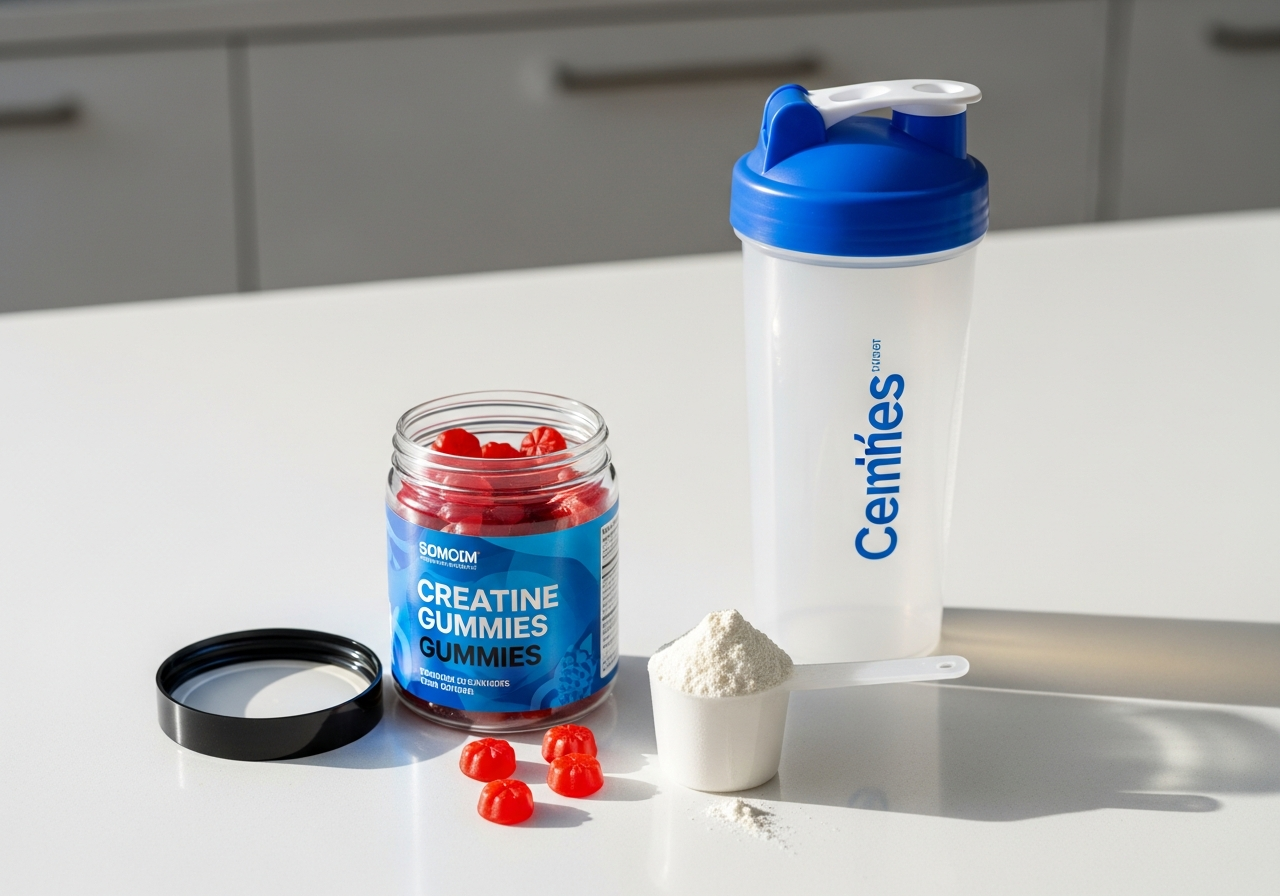
Creatine Gummies in 2026: The No-Mixing Format Growing Six-Fold
By The Creatine Canada Research Team — Evidence-based supplement analysts
The creatine gummies trend is real in 2026: gummies do work if they provide enough creatine, but the format is growing faster because it is easier and more pleasant to take than powder, not because it is more effective. For most people, creatine gummies are worth it only if the label gives a true 3–5 g daily dose, the brand is third-party tested, and you accept the higher cost per gram.
Evidence-based · Cites 4 sources · Editorial standards
Key Takeaways
- Creatine gummies can work as well as powder if they deliver the same daily creatine dose.
- The trend is being driven by convenience, taste, and appeal to newer supplement users, not superior science.
- Most adults need 3–5 g of creatine per day, which often means several gummies rather than one serving.
- Creatine monohydrate remains the most studied, most reliable, and usually most cost-effective form inside any format.
- Gummies often cost more per gram and raise bigger questions about label accuracy and creatine stability than plain powder.
- In Canada, look for a Natural Product Number, full gram dosing on the label, and independent third-party testing.
- If your goal is value and easy accurate dosing, powder still wins; if your goal is compliance and convenience, gummies can be a good fit.
What the creatine gummies trend actually means in 2026
The creatine gummies trend refers to the fast rise of chewable creatine products as a convenience-first alternative to powder, and the trend is real even though gummies are still a small slice of the overall creatine market. Market-research estimates put the global creatine gummies market at about USD $44.95 million in 2024 and roughly USD $52.8 million in 2025, with projections reaching around USD $176.2 million by 2034 and roughly USD $285.5 million by 2035, which implies about a six-fold increase by the mid-2030s.
That sounds dramatic because it is, but context matters. The broader creatine supplement market is estimated near USD $1.85 billion in 2026, so gummies are growing from a small base rather than replacing traditional formats overnight. In plain English, creatine gummies are trending because many people prefer a no-mixing, no-chalky-taste experience, especially beginners, younger buyers, frequent travellers, and people who have never liked scooping powder into water.
The key point is simple: gummies are a delivery format, not a better form of creatine. If a gummy supplies enough creatine, usually as creatine monohydrate, it can help saturate muscle creatine stores just like powder. If it underdoses creatine, hides the actual grams behind a “blend”, or degrades over time, the format becomes the problem.
This is why the creatine gummies trend deserves both attention and skepticism. It is a real consumer shift toward convenience and adherence, but it also creates new quality-control questions. A gummy has to carry a meaningful dose, remain stable in a moist, flavoured matrix, and still taste good enough that people take it every day. Those are tougher formulation demands than a plain tub of monohydrate powder.
If you want the short answer, here it is again: the creatine gummies trend is growing because gummies are easier to use, not because they outperform powder. For practical buying advice, compare formats with our creatine gummies vs. powder guide, explore current best creatine rankings, or browse the creatine product catalog to see how doses differ by brand.
Do creatine gummies work? Yes—if you take enough to saturate muscle stores
Creatine gummies work when they provide enough creatine to raise and maintain intramuscular creatine stores, a process called saturation. Saturation means your muscles have built up a larger reserve of creatine and phosphocreatine, the rapidly available stored form used to regenerate ATP, the cell’s immediate energy currency, during short, hard efforts.
The mechanism does not change because the format changes. Once you swallow creatine and absorb it, your body does not care whether it came from powder, capsules, or gummies. What matters most is the total dose reaching your muscles over time. The 2017 ISSN position stand concluded that creatine monohydrate is the most effective nutritional supplement for increasing high-intensity exercise capacity and lean body mass during training. That conclusion is about creatine itself, not about gummy marketing.
So why do some people say gummies do not work? Usually for one of three reasons:
- The product underdoses creatine. Many gummies provide a modest amount per serving, so users may think they are taking a full dose when they are not.
- The person expects an immediate stimulant-like feeling. Creatine is not caffeine; you do not “feel” it acutely in the same way.
- The product quality is questionable. Gummies introduce more formulation complexity, so label accuracy and stability matter more.
What should you realistically expect if your dose is correct? Most people notice benefits as improved training performance over repeated sessions, not a dramatic first-day sensation. You may get an extra rep in hard sets, slightly better sprint repeatability, or a gradual increase in training volume. Over weeks, that performance edge can contribute to better strength and muscle gains. If you are new to creatine, our complete beginner’s guide to what creatine is and realistic creatine timeline guide explain what changes to watch for.
The practical takeaway is blunt: creatine gummies are only as effective as their actual daily creatine dose and product quality. If the label can get you to a true 3–5 g per day and the brand has credible testing, gummies can absolutely work.
Why creatine helps performance and muscle, regardless of format
Creatine helps because it increases the muscle’s phosphocreatine pool, which improves the ability to rapidly regenerate ATP during short, intense exercise. That is why creatine is most useful for lifting, sprinting, jumping, repeated high-intensity intervals, and any training where the quality of hard efforts matters.
Here is the mechanism in practical terms. During a heavy set of squats or a 10-second sprint, ATP gets used quickly. Phosphocreatine donates a phosphate group to help remake ATP fast enough to keep force output higher for a little longer. That small edge can mean one more rep, slightly better bar speed, or less drop-off across multiple sprints. Over time, those marginal gains compound into more quality training and, for many people, better increases in lean mass and strength.
Creatine may also support training adaptation through indirect effects. Better workout quality can raise total training volume, and higher training volume is one pathway to more muscle gain. Some research also suggests creatine can improve cellular hydration inside muscle tissue, which may create a more favourable environment for training adaptation, though the best-established benefit remains high-intensity performance support.
The evidence base is strongest for creatine monohydrate. The 2021 JISSN review on common questions and misconceptions about creatine reinforced that monohydrate is the reference form because it is effective, well studied, and consistently supported by the literature. In other words, if a gummy contains creatine monohydrate at a real dose, the physiology is on its side.
What the evidence does not support is the idea that gummies themselves improve absorption or results beyond powder. There is no established reason to expect a gummy to outperform an equal dose of monohydrate powder. The benefit of gummies is behavioural: people often take them more consistently because they are portable, palatable, and simple. Compliance matters in creatine because daily intake is what keeps muscle stores elevated.
If you want a deeper look at benefits beyond the sales claims, see our guides on evidence-based creatine benefits and why monohydrate still wins in 2026.
Creatine gummies vs. powder: which format is actually better for most people?
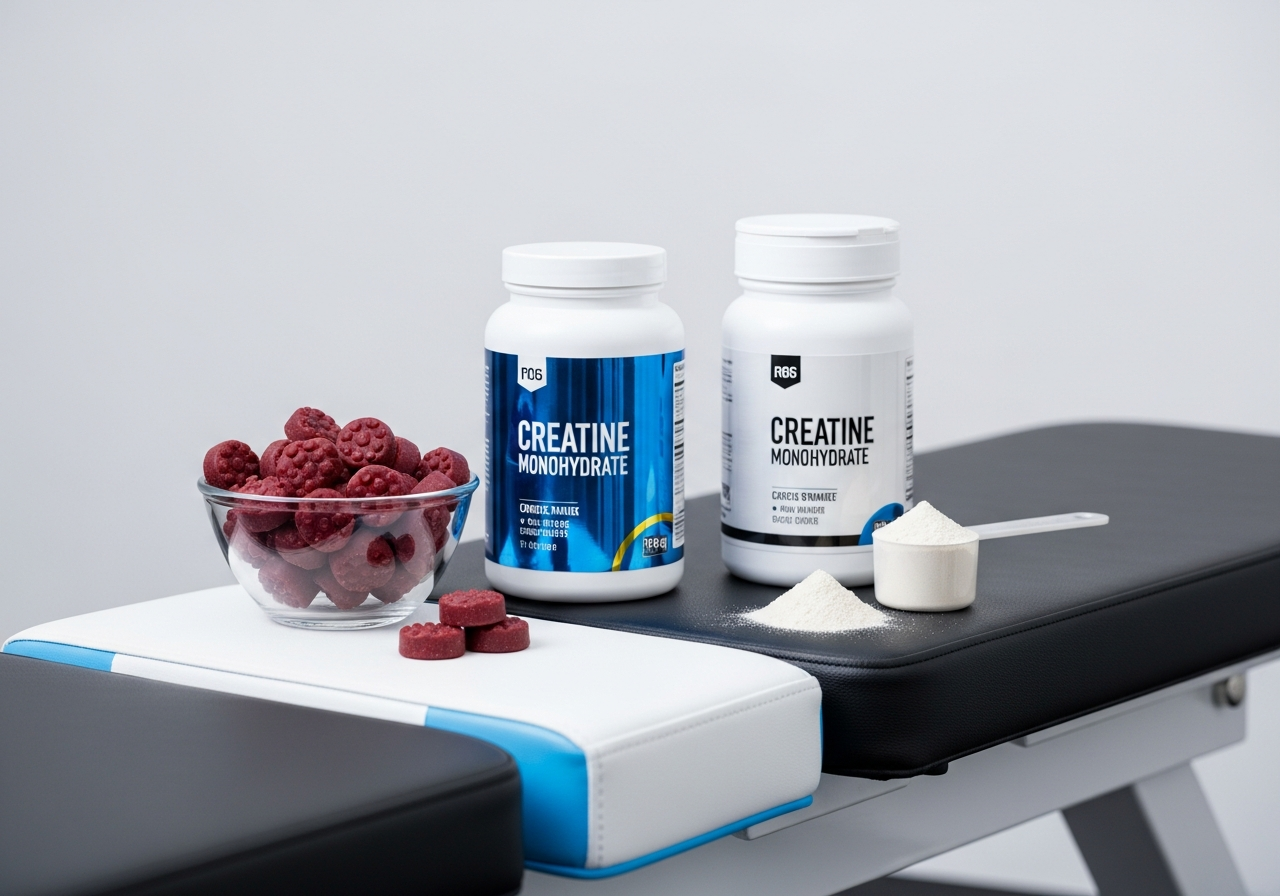
Powder is still the better all-around creatine format for most people because it is usually easier to dose accurately, cheaper per gram, and less complicated from a stability standpoint. Gummies are better when convenience and compliance matter more than cost efficiency.
The biggest advantage of powder is simple math. A standard daily maintenance dose is 3–5 g, and a single scoop of powder often gets you there cleanly. With gummies, you may need several pieces to reach the same dose. That is not automatically bad, but it can be less efficient, easier to underdose, and more expensive over time.
The biggest advantage of gummies is friction reduction. A gummy is fast, portable, travel-friendly, and requires no shaker, spoon, or water. For a beginner who hates the idea of mixing supplements, that lower barrier can be the difference between taking creatine every day and forgetting it half the week.
| Factor | Creatine Gummies | Creatine Powder |
|---|---|---|
| Effectiveness | Works if the daily dose reaches 3–5 g | Works if the daily dose reaches 3–5 g |
| Convenience | Very high; no mixing | Moderate; requires scooping and liquid |
| Dose accuracy | Can be good, but check grams per serving carefully | Usually straightforward with a measured scoop |
| Cost per gram | Often higher | Usually lower |
| Stability concerns | Higher; matrix and storage matter more | Lower in dry monohydrate powder |
| Travel use | Excellent | Good, but messier |
| Best for | Beginners, travellers, people who dislike powders | Value seekers, experienced users, precise dosing |
So, are creatine gummies worth it? They are worth it if the easier format makes you consistently hit your full daily dose. They are not worth it if you are paying a premium for a low-dose product that cannot realistically get you to 3–5 g without eating a pile of gummies.
For a deeper head-to-head breakdown, see creatine gummies vs. powder, compare current creatine brand reviews, and use the creatine dosage calculator to check how many grams you actually need.
Creatine gummies dosage: how much to take by body size and goal
Most adults should aim for 3–5 g of creatine per day from gummies, exactly as they would from powder, and the label should tell you how many gummies it takes to reach that amount. The important number is grams of creatine, not the number of pieces.
There are two mainstream dosing approaches. First, the maintenance-only approach: take 3–5 g daily and allow muscle stores to build gradually over about 3–4 weeks. Second, the loading approach: take about 20 g per day split into 4 doses for 5–7 days, then continue with 3–5 g per day. Loading works faster, but it is often impractical with gummies because it may require a large number of pieces each day.
For most gummy users, maintenance dosing is the sensible choice. It is cheaper, simpler, and easier on the stomach. If you want faster saturation, read our creatine loading phase guide before trying to load with gummies.
Practical examples:
- Smaller adult, general fitness: 3 g daily is often enough if you are lighter, train recreationally, and want simplicity.
- Average adult lifter: 5 g daily is the standard, practical target.
- Larger athlete or hard trainer: 5 g daily is still a common ceiling for maintenance, though some athletes use body-weight-based approaches under coaching.
If you prefer body-weight framing, a common loading guideline is about 0.3 g/kg/day for 5–7 days, followed by roughly 0.03 g/kg/day for maintenance. In real life, most adults can ignore the fine math and just use 3–5 g daily unless they have a specific reason to load.
Week-by-week expectations with maintenance dosing are straightforward:
- Week 1: You may notice little subjectively; consistency matters more than sensation.
- Week 2: Some people begin to feel better repeat performance in training.
- Weeks 3–4: Muscle creatine stores are typically more fully elevated, and training benefits are easier to notice.
To avoid underdosing, count backwards from your goal. If a serving of gummies provides less than 3 g, ask whether you are realistically willing to take enough pieces every day. Our how much creatine per day guide and step-by-step how to take creatine guide can help you build a routine that actually sticks.
The best way to take creatine gummies so they actually work
The best way to take creatine gummies is to choose a product with a clear gram dose, take enough to reach your daily target, and repeat that daily for weeks, including rest days. Creatine works through saturation, so consistency beats perfect timing.
- Read the Supplement Facts carefully. Find the actual grams of creatine per serving and how many gummies make up that serving.
- Set a daily target. Most adults should choose 3–5 g daily unless following a planned loading phase.
- Decide on a routine you will not forget. Common options are with breakfast, after training, or with another daily habit such as brushing your teeth or packing a gym bag.
- Take them daily, not just on workout days. Rest-day use matters because you are maintaining saturation, not chasing an acute workout buzz.
- Store them properly. Heat, humidity, and poor sealing can make gummy products more vulnerable than powder.
- Track results for at least 3–4 weeks. Look for better repeat performance, small strength improvements, or slightly higher training volume.
Timing matters less than people think. The evidence supports total daily intake far more strongly than a magic pre-workout or post-workout window. If taking gummies after training helps you remember them, that is a good choice. If mornings are easier, mornings are fine. Our when to take creatine guide covers the timing question in detail.
What should you take them with? Water is fine, and food is fine. There is no requirement to pair gummies with a sugary drink for them to work. If your stomach is sensitive, taking creatine with food can be more comfortable. If hydration is a concern, see how much water to drink with creatine.
How do you know it is working? Do not expect a jolt. Instead, watch for subtle but meaningful training changes: less drop-off across sets, an extra rep at the same weight, better sprint repeatability, or the ability to handle a little more work before fatigue sets in.
The simplest rule is this: pick the format you will actually use every day. If gummies remove the friction that made you inconsistent with powder, they can be the better choice for you even if they are not the better value on paper.
Creatine gummies stability and label accuracy: the part buyers should worry about most
Creatine stability and label accuracy are the biggest technical concerns with creatine gummies, and they matter more here than with dry monohydrate powder. A gummy is a moist, flavoured matrix with multiple ingredients, which creates more opportunities for degradation, formulation shortcuts, or simple dosing confusion.
In supplement terms, stability asks whether the listed amount of creatine remains meaningfully intact through manufacturing, shipping, shelf life, and normal storage. Dry creatine monohydrate powder has a long track record and is comparatively simple. Gummies have more moving parts: water activity, acids, flavour systems, sweeteners, texture agents, and temperature exposure during transport and warehousing.
For buyers, the practical implication is not panic but selectivity. You want a brand that treats testing seriously. Look for:
- Exact gram amounts of creatine on the label. Avoid vague proprietary blends.
- The form identified as creatine monohydrate. That is the most studied benchmark.
- Third-party testing. Independent testing is your best defence against label mismatch.
- Clear lot numbers and expiry dates. Traceability matters.
- Storage directions. If the product says keep cool and dry, follow that.
In Canada, also look for a Natural Product Number, or NPN, which is the Health Canada product licence identifier used on natural health products. An NPN does not guarantee perfect product quality, but it is a meaningful basic checkpoint for legal market presence and label review. If you are shopping domestically, our guides on where to buy creatine in Canada and Canadian supplement regulations can help.
This quality issue is one reason powder still has an edge. A tub of plain monohydrate is easier to formulate, easier to test, and easier to dose precisely. Gummies can be excellent, but they have to earn that trust more actively.
If a brand markets convenience but hides the actual creatine grams, offers no testing transparency, or relies on influencer hype instead of verifiable details, treat that as a red flag. The format is trendy, but the quality bar should stay old-school strict.
Who creatine gummies are best for—and who should probably skip them
Creatine gummies are best for people who value ease of use enough that it improves daily compliance, and they are a weaker fit for people who want the cheapest cost per gram or need high-dose precision. The right format depends more on behaviour and budget than on physiology.
Gummies are a strong fit for:
- Beginners. If powder feels messy or intimidating, gummies lower the barrier to starting. See creatine for beginners.
- Women. Women respond to creatine too, and gummies may feel more approachable for daily use; the dose principles are the same. See creatine for women.
- Older adults. A chewable format may be simpler than mixing powders, especially when routines and adherence matter. See creatine for older adults.
- Travellers and commuters. Gummies are easy to pack and use discreetly.
- Athletes who already know the dose math. Gummies can be fine when convenience is useful and the product is properly dosed.
Gummies are often a poor fit for:
- Budget-focused users. Powder usually gives more creatine for the money.
- People planning to load. Gummies can make a loading phase cumbersome.
- Anyone who tends to snack on gummy supplements. If the candy-like format makes you lose track of dose, powder may be safer and clearer.
- Users with sensitive digestion to sugar alcohols or certain gummy bases. Check the non-creatine ingredients.
Competitive athletes should also think about supplement risk management. The International Olympic Committee consensus on dietary supplements emphasized the importance of product quality assurance because contamination risk varies across supplements and brands. That is another reason to prioritise third-party-tested products over trendy packaging.
The bottom line is practical. If gummies help you consistently take a full dose every day, they can be an excellent entry point. If you are experienced, price-sensitive, or want the simplest evidence-based option, creatine monohydrate powder still makes the most sense.
Safety, side effects, and the biggest myths about creatine gummies
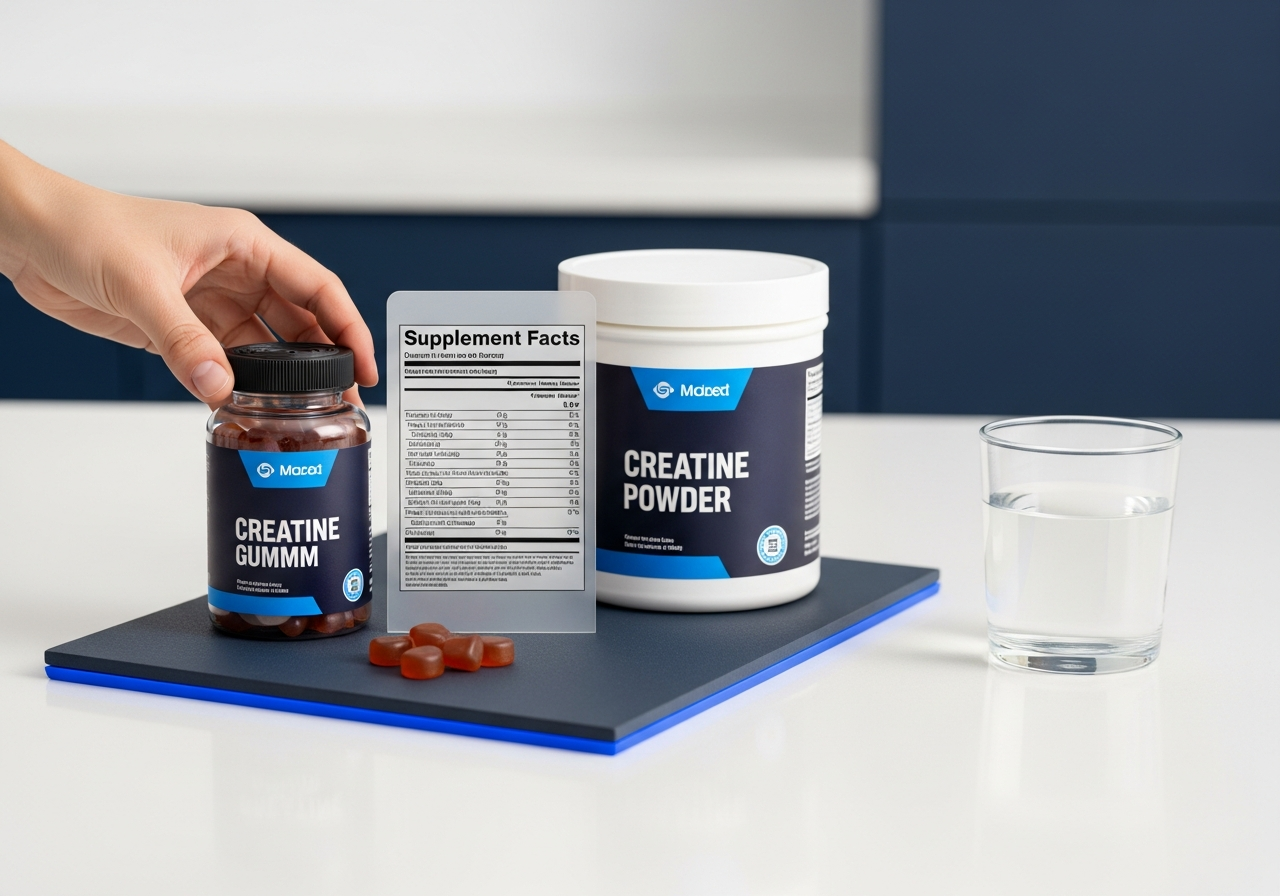
Creatine gummies are generally as safe as other creatine formats when used at standard doses, but the gummy ingredients can add separate tolerance issues that plain powder may not. The creatine itself has one of the stronger safety records in sports nutrition, especially as creatine monohydrate.
The ISSN position stand and the 2021 JISSN review both support creatine monohydrate as safe and effective for healthy individuals when used appropriately. Common side effects, when they happen, are usually mild and often dose-related:
- Temporary water-weight gain. This is typically water pulled into muscle, not fat gain.
- Stomach upset. More likely with large single doses or certain gummy ingredients.
- Bloating or GI discomfort. Often reduced by smaller doses and taking with food.
Important caveat: people with pre-existing kidney disease, or those told by a clinician to restrict certain supplements, should speak with a healthcare professional before starting creatine. That is a sensible medical precaution, not a sign that creatine is inherently dangerous for healthy users. If kidney concerns are on your mind, our guide on creatine and kidney myths explains the creatinine confusion.
Common myths worth debunking:
- “Gummies work faster.” No established evidence shows gummies beat an equivalent dose of powder.
- “If it tastes like candy, it must be weak.” Taste tells you nothing about efficacy; dose and testing do.
- “Creatine causes fat gain.” Creatine may increase water content in muscle, but it does not inherently add body fat.
- “You need to cycle creatine.” Routine daily use is standard; cycling is not required. See do you need to cycle creatine.
One gummy-specific caution is accidental underdosing. People often assume a serving is “enough” without checking whether that serving actually reaches 3–5 g. That is not a safety issue so much as a results issue. Another is overconsumption of added sweeteners or extra ingredients if you treat the product like candy.
In short, the main safety profile comes from creatine, and that profile is well established. The main extra risk with gummies is not creatine itself but poor formulation, poor labelling, or poor purchasing decisions.
How to buy the best creatine gummies in Canada without getting fooled by the trend
The best creatine gummies in Canada are the ones that clearly deliver a full daily creatine dose, use creatine monohydrate, disclose testing, and carry compliant Canadian labelling. Buying the best product is less about flashy branding and more about verifying boring details.
Use this quick checklist before you buy:
- Check the grams of creatine per serving. If the serving gives less than 3 g, ask whether you will realistically take enough every day.
- Prefer creatine monohydrate. It is the most studied and usually the safest evidence-based bet.
- Look for third-party testing. This is especially important for a gummy matrix.
- Check for a Natural Product Number. In Canada, an NPN is a useful sign the product is licensed as a natural health product.
- Read the non-medicinal ingredients. Sugar, sugar alcohols, acids, and gelling agents can affect tolerance and preferences.
- Compare cost per gram, not just cost per bottle. A cheap-looking gummy can be expensive once you calculate effective daily dosing.
- Buy from a reputable retailer. That improves freshness, storage conditions, and after-sale support.
If you are wondering whether “best creatine gummies” can beat the best powder, the honest answer is usually no on value and simplicity. But they can beat powder on adherence for the right user, and adherence is not trivial. A supplement only works when you actually take it.
Canadian shoppers should be especially careful with imported products that look trendy online but provide limited regulatory or testing information. Domestic buying often makes it easier to verify the NPN, shipping conditions, and seller reputation. Compare options through our best creatine monohydrate in Canada guide, our buying creatine online in Canada guide, and the current creatine brand reviews.
If a brand hides the exact dose, does not identify the creatine form, or dodges testing questions, move on. The best creatine gummy is not the prettiest one; it is the one that proves what is inside.
The common mistakes that make creatine gummies seem useless
Most complaints that creatine gummies do not work come down to user error or product selection, not a failure of creatine itself. When gummies disappoint, the problem is usually underdosing, inconsistency, unrealistic expectations, or buying a low-transparency product.
These are the most common mistakes:
- Taking too little creatine. If your daily intake never reaches a true maintenance dose, results will be weaker or absent.
- Using them only on workout days. Creatine is a saturation supplement, so rest days count.
- Expecting a pre-workout buzz. Creatine supports energy regeneration in muscle over time; it is not a stimulant.
- Stopping after one week. Without loading, most people need a few weeks of consistent use to meaningfully saturate muscle stores.
- Ignoring storage. Leaving gummies in a hot car or humid gym bag is not ideal for product quality.
- Buying based on flavour alone. Great taste does not rescue a weak formula.
Troubleshooting is simple:
- Confirm how many grams of creatine you are actually taking per day.
- Take that amount every day for at least 3–4 weeks.
- Track gym performance, not just body weight.
- If you still cannot hit the dose conveniently, switch to powder.
If you suspect you are a weak responder, remember that baseline diet, muscle mass, and training style all influence how noticeable the effects feel. Some people start with higher creatine stores and notice less dramatic changes. That does not mean the supplement is fake; it may mean the marginal gain is smaller. Our guides on creatine non-responders, does creatine build muscle, and creatine for strength can help set realistic expectations.
The fastest way to make gummies “work” is not a hack. It is the boring formula: enough grams, every day, for long enough, from a brand you trust.
Bottom line: should you buy creatine gummies or stick with powder?
Creatine gummies are a legitimate and fast-growing format in 2026, but they are not automatically the smartest buy. You should buy creatine gummies if they help you consistently take a full 3–5 g daily dose from a tested, transparent product and you are comfortable paying more per gram for that convenience.
You should probably stick with powder if you want the strongest combination of evidence, dose precision, stability confidence, and value. Plain creatine monohydrate powder still sets the standard because it is easy to formulate, easy to measure, and backed by the deepest body of research.
Here is the clearest decision rule:
- Choose gummies if no-mixing convenience will clearly improve your adherence.
- Choose powder if you care most about value, simplicity, and accurate dosing.
The creatine gummies trend is worth watching because it reflects a real shift in how consumers want supplements delivered. Convenience now sells, especially to people who do not identify as traditional supplement users. But the physiology has not changed. Creatine still works by saturating muscle stores, and that still depends on enough grams taken consistently.
If you are deciding today, start by comparing the label against three questions: Does it provide a full effective dose? Does it use creatine monohydrate? Does it provide credible third-party testing and, in Canada, appropriate labelling such as an NPN? If the answer to any of those is no, the trend is not your friend.
For next steps, compare formats in our full creatine gummies guide, check the latest best creatine rankings, or use the creatine dosage calculator to figure out the amount that fits your size and goal. The best creatine is the one you can trust and will actually take every day.
Creatine Gummies by the Numbers in 2026
- USD $44.95M Estimated global creatine gummies market in 2024 — Market-research estimate, not a clinical figure.
- USD $52.8M Estimated global creatine gummies market in 2025 — Shows the format is still small but growing quickly.
- USD $176.2M Projected global creatine gummies market by 2034 — One set of market-research estimates; other projections extend to about USD $285.5M by 2035.
- 3–5 g/day Standard effective daily creatine target for most adults — Applies whether creatine comes from gummies, powder, or capsules.
Frequently Asked Questions
Are creatine gummies worth it?
Creatine gummies are worth it if they help you reliably take a full effective dose every day and the brand is transparent about testing. They are usually less worth it for budget-conscious users because gummies often cost more per gram than powder and may require several pieces to reach 3–5 g daily.
Do creatine gummies work the same as powder?
Creatine gummies can work the same as powder if they provide the same total amount of creatine per day. The body responds to the absorbed creatine dose, not to the format, so the main differences are convenience, price per gram, and product-quality concerns.
How many creatine gummies should I take per day?
You should take enough creatine gummies to reach about 3–5 g of creatine per day unless you are following a loading protocol. The exact number of gummies depends entirely on how many grams of creatine the label provides per serving, which is why you should always calculate by grams rather than by pieces.
Are creatine gummies better than powder?
Creatine gummies are not better than powder for effectiveness when the dose is matched. They are better only in convenience for people who dislike mixing supplements, while powder is usually better for cost, dosing accuracy, and confidence in long-term stability.
What is the best creatine in gummy form?
The best creatine gummy is a product that clearly states the grams of creatine per serving, preferably uses creatine monohydrate, and provides credible third-party testing. In Canada, it should also have compliant labelling and ideally an NPN so you are not relying on marketing alone.
Do creatine gummies need to be taken before or after a workout?
Creatine gummies do not need to be taken at a specific workout time to work well. Daily consistency matters more than exact timing, so take them whenever you are most likely to remember them, including on rest days.
Are creatine gummies stable?
Creatine gummies can be stable, but stability is a more legitimate concern than it is with dry creatine powder. Because gummies are a more complex, moisture-containing format, buyers should prioritise third-party-tested brands, follow storage instructions, and avoid products with vague labelling.
Can women take creatine gummies?
Yes, women can take creatine gummies, and the same evidence-based creatine principles apply. The key is choosing a product that provides enough creatine to reach an effective daily dose rather than assuming the gummy format changes how creatine works in the body.
Can older adults use creatine gummies?
Yes, older adults can use creatine gummies if the dose is appropriate and a healthcare professional has no reason to object. The gummy format may be more convenient for routine use, but the same quality checks still matter: clear grams, monohydrate, and trustworthy testing.
What should Canadians look for when buying creatine gummies?
Canadians should look for the actual grams of creatine per serving, the creatine form, third-party testing, and a Natural Product Number where applicable. Buying from reputable Canadian retailers can also make it easier to verify freshness, labelling compliance, and customer support.