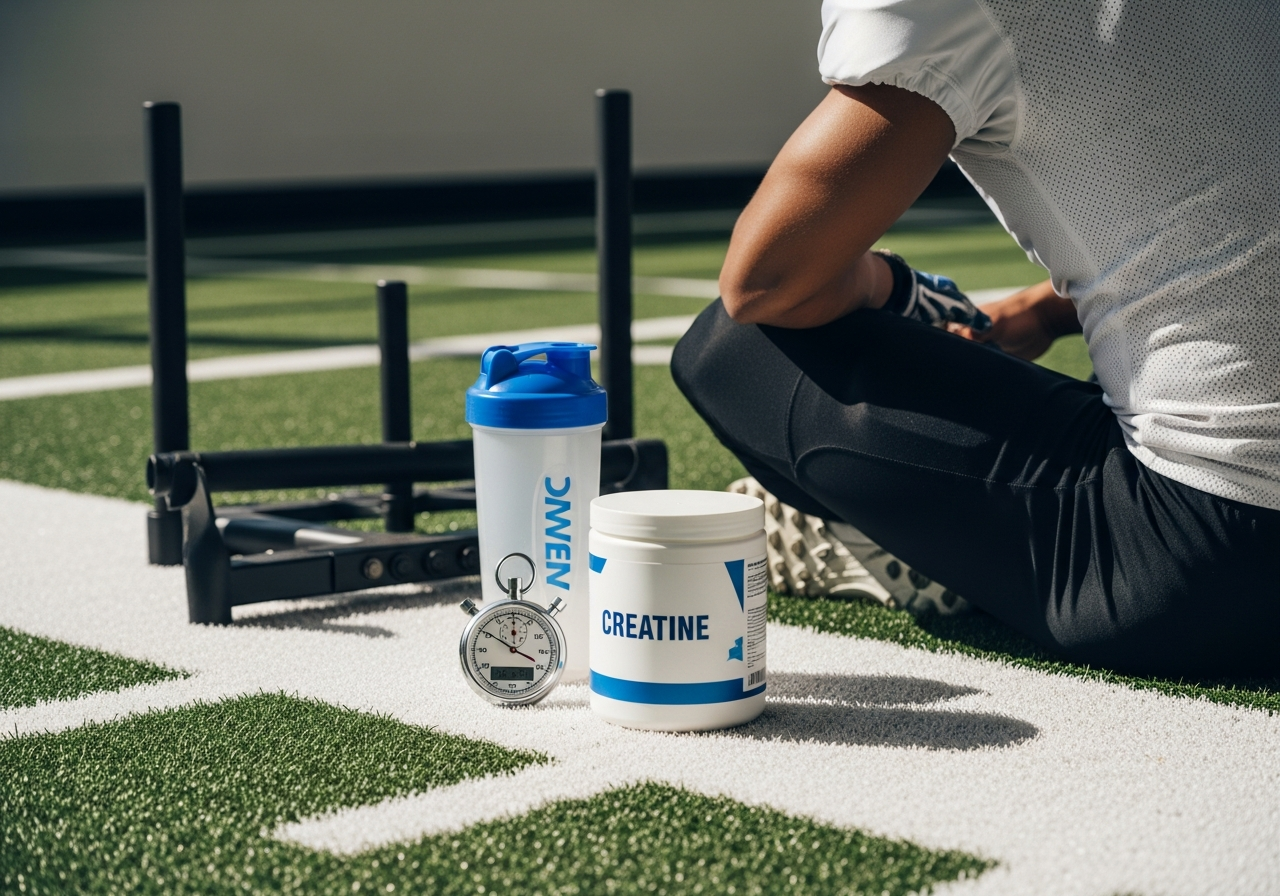
Creatine for Football: Explosive Power, Sprint Speed, and Recovery
By The Creatine Canada Research Team — Evidence-based supplement analysts
Yes—creatine helps football players by improving repeated sprint ability, explosive power, strength training output, and recovery between hard efforts, which directly matches the stop-start demands of football. For most players, the best choice is plain creatine monohydrate at 3–5 g per day, with effects showing up faster if you use a short loading phase.
Evidence-based · Cites 4 sources · Editorial standards
Key Takeaways
- Creatine monohydrate is the best creatine for football because it is the most studied, most effective, and usually the most affordable form.
- Football players typically take 3–5 g of creatine daily, or load with 20 g per day split into 4 doses for 5–7 days before switching to maintenance.
- Creatine works best for repeated sprints, explosive efforts, heavy lifting, and training quality—not as a stimulant you feel immediately.
- A small increase in body mass from intracellular water is common in the first 1–2 weeks and is not the same as gaining fat.
- Timing matters less than consistency; taking creatine every day is more important than taking it pre-workout versus post-workout.
- Creatine is well supported for healthy athletes, but players with kidney disease or relevant medical conditions should speak with a clinician first.
- In Canada, choose a product with a Health Canada NPN and ideally third-party testing for purity and label accuracy.
Does creatine help football players? Yes—especially for power, repeated sprints, and hard training
Yes, creatine helps football players because football is built on short, explosive, repeated efforts, and creatine directly supports the energy system that powers those efforts. If you are asking whether creatine for football is worth it, the practical answer for most healthy players is yes: it is one of the few supplements with decades of evidence for improving high-intensity performance and training quality.
Football performance depends heavily on the phosphagen system, which is your body’s fastest energy pathway for very short bursts like a first-step acceleration, a block, a tackle, a jump, or a 10–40 yard sprint. Creatine increases muscle stores of phosphocreatine, the stored form of creatine that helps regenerate ATP, your cells’ immediate energy currency. More phosphocreatine means faster ATP resynthesis between repeated maximal efforts, which can help you produce high power more often during both training and games.
In practice, football players usually care about four outcomes:
- Explosive power: better support for jumps, accelerations, and collision-based actions.
- Repeated sprint ability: more consistency across multiple short sprints with incomplete rest.
- Strength training output: more high-quality reps and better long-term gains from resistance training.
- Recovery between bouts: improved readiness for the next set, drill, series, or practice segment.
The 2017 ISSN position stand concluded that creatine monohydrate is the most effective nutritional supplement available for increasing high-intensity exercise capacity and lean body mass during training. That does not mean it turns every athlete into a star, and it does not guarantee faster straight-line speed in every study. It means the overall evidence strongly supports creatine when the sport relies on repeated high-power output—which football clearly does.
This applies across levels: youth players training seriously, high school athletes, university players, semi-pro, and pro athletes including those in Canadian football environments. If you play skill positions, line, linebacker, special teams, or train for combines, creatine is relevant because every position benefits from strength and repeated explosive effort, even if the trade-offs around body mass differ slightly by role.
If you want the simplest starting point, use plain monohydrate daily and combine it with hard training, enough protein, sleep, and hydration. For the fundamentals, see our creatine dosage calculator and how to take creatine guide.
How creatine improves football performance: the actual mechanism behind sprint speed, force, and recovery
Creatine improves football performance by raising intramuscular phosphocreatine stores, which helps your muscles recycle ATP faster during maximal efforts and recover faster between them. That mechanism is why creatine tends to help the exact kinds of actions football players repeat all game and all week in training.
Here is the simple physiology. Your body stores a limited amount of ATP inside muscle cells, and ATP is spent rapidly when you explode off the line, change direction, jump, or drive through contact. During very short efforts, phosphocreatine donates a phosphate group to help regenerate ATP almost instantly. Supplementing with creatine increases those phosphocreatine reserves, so your muscles can maintain power output a little better and restore high-energy capacity a little faster between efforts.
That matters in football because the sport is rarely one all-out effort in isolation. It is repeated all-out efforts with incomplete rest:
- Multiple sprints during practice drills
- Repeated plays in a series
- Successive heavy sets in the weight room
- Acceleration work, sled pushes, jumps, and contact sessions
Creatine also helps indirectly. Better training quality often means more total volume at useful intensities over weeks and months. If you squeeze out an extra rep here, maintain bar speed better there, or drop off less across sprint sets, the long-term adaptation can be meaningful. That is one reason creatine’s biggest value may show up not only on game day, but in the cumulative quality of your off-season and in-season work.
The 2018 International Olympic Committee consensus on dietary supplements lists creatine among the small number of supplements with strong evidence for certain performance uses. The evidence is strongest for short-duration, high-intensity work and gains in lean mass and strength when combined with training.
What creatine does not do is act like caffeine. You do not take it and suddenly feel wired before kick-off. Creatine is a saturation supplement, meaning it works by building up muscle stores over days to weeks. Once your muscles are saturated, you are simply better equipped to repeat explosive work.
For football players, that distinction matters. Creatine is not a magic speed powder and it is not a replacement for sprint mechanics, strength work, or conditioning. It is an evidence-based tool that supports the energy system most responsible for first-step power, repeated efforts, and high-quality training adaptations. If you want the broader background, read what creatine is and creatine for strength.
Best creatine for football: why monohydrate still beats fancy forms
The best creatine for football is creatine monohydrate because it is the most studied form, the form used in most performance research, and usually the best value per effective gram. If a football player wants a simple answer, buy monohydrate first and ignore most marketing around premium alternatives.
The biggest mistake athletes make is assuming newer or more expensive forms must work better. Right now, the evidence does not support that assumption. According to the 2021 JISSN review on common creatine questions and misconceptions, creatine monohydrate remains the reference form against which others are compared, and alternative forms have not consistently shown superior performance outcomes.
| Form | Best use case | Evidence for football performance | Bottom line |
|---|---|---|---|
| Creatine monohydrate | Almost everyone | Strongest evidence for strength, power, lean mass, repeated efforts | Best overall choice |
| Micronized monohydrate | Players who want easier mixing | Same active ingredient as monohydrate | Fine if the price is reasonable |
| Creatine HCl | Convenience/marketing preference | Less robust evidence than monohydrate | Usually not worth paying more |
| Buffered or branded specialty forms | Brand-driven purchases | No consistent advantage over monohydrate | Skip unless cost is similar |
| Gummies/capsules | Travel or convenience | Can work if the dose is real | Often more expensive per gram |
For football players, powder is usually the most practical format because effective doses are measured in grams, not milligrams, and powder keeps cost per serving low. Micronized monohydrate can help if you dislike grittiness, but it is not meaningfully more effective than standard monohydrate.
When buying in Canada, check for:
- NPN: a Natural Product Number, which indicates the product is licensed by Health Canada.
- Third-party testing: useful for purity and label accuracy, especially for competitive athletes.
- Single-ingredient formulas: easier to dose and audit than flashy blends.
- Transparent serving size: ideally listing grams of creatine monohydrate clearly.
If you are comparing brands, start with our best creatine rankings, browse creatine brand reviews, or see the full creatine product catalog. If you want a deeper form comparison, read creatine monohydrate vs HCL and best type of creatine.
How to take creatine for football: a simple step-by-step plan that actually works
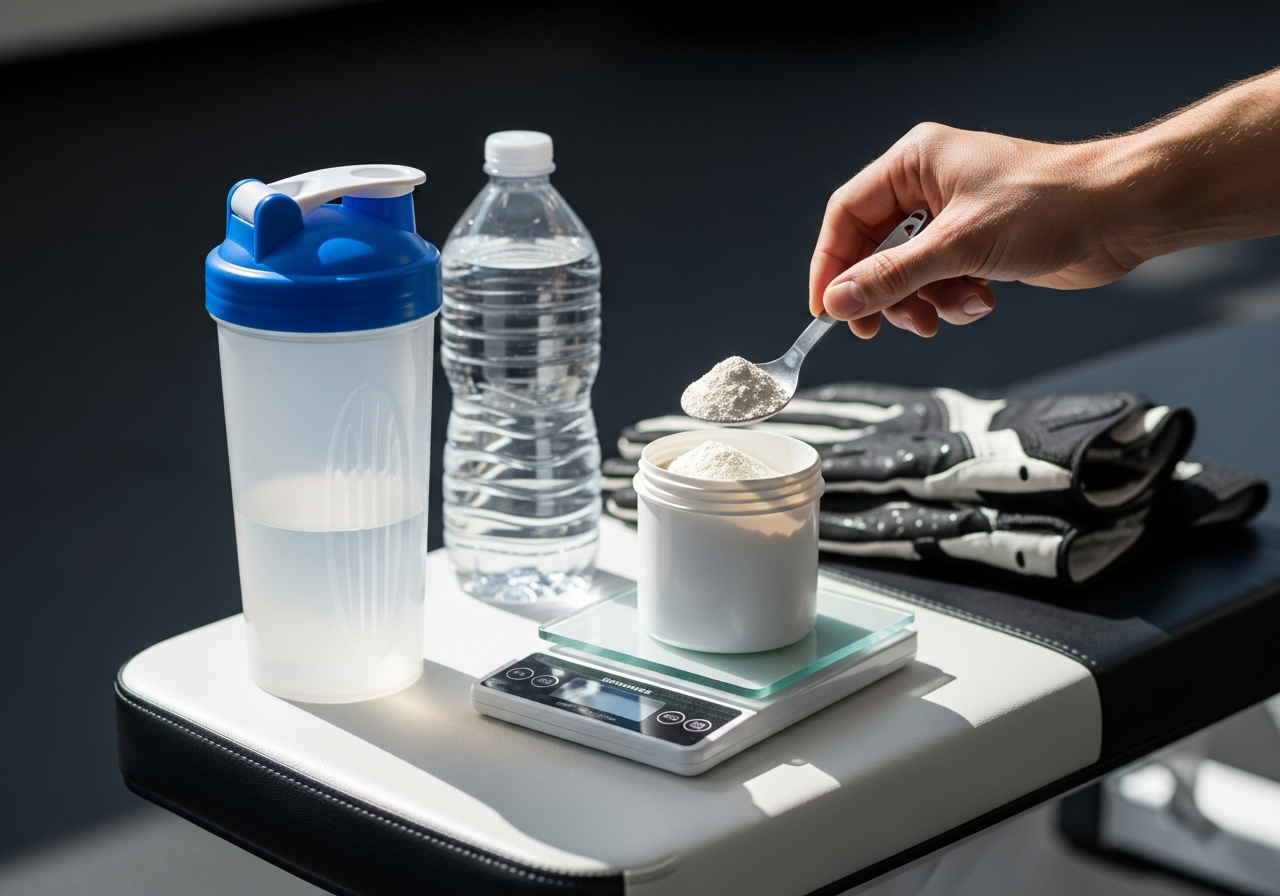
The best way to take creatine for football is to use creatine monohydrate every day, either with a short loading phase for faster results or a steady maintenance dose for simplicity. The method is straightforward, but consistency matters more than hacks.
- Choose plain creatine monohydrate. A single-ingredient powder is the default recommendation for almost every football player.
- Decide whether to load. If you want faster saturation, take 20 g per day split into 4 doses of 5 g for 5–7 days. If you prefer the slow route, skip loading and take 3–5 g per day from day one.
- Move to maintenance. After loading, take 3–5 g daily to maintain muscle saturation.
- Take it every day. Training day, game day, rest day, travel day—it still counts.
- Mix it in a drink you will actually finish. Water, juice, or a protein shake all work.
- Keep hydration normal and sensible. You do not need to force extreme amounts of water, but do meet your baseline fluid needs as an athlete.
- Stick with it for at least 4 weeks. Evaluate performance trends in training, not just how you feel after one scoop.
Loading is useful if you are entering camp, starting an off-season block, or want results sooner. Without loading, saturation usually takes roughly 3–4 weeks. With loading, it happens in about a week. Our guides on the creatine loading phase and how long creatine takes to work explain this in more detail.
For football players, pair creatine with:
- Regular resistance training
- Sprint and power work
- Adequate daily protein
- Enough total calories for your goal
- Sleep and hydration
How do you know it is working? You usually will not “feel” creatine like a stimulant. Instead, look for subtle but useful signs: less performance drop-off across sprint reps, slightly better repeat efforts, improved gym output, and sometimes a quick increase in body mass from water stored inside muscle. That early weight increase is expected and often useful in football, especially for players trying to improve size and force production.
If you want exact body-weight-based dosing, use the creatine dosage calculator or read how much creatine per day.
Creatine dosing for football players by body weight, position, and goal
Most football players do well on 3–5 g of creatine daily, but body weight and goal can help you choose the most practical end of that range. Bigger athletes, players in hard off-season training, and those seeking the fastest saturation often lean toward the higher end.
The evidence-based standards remain simple: a loading phase of about 20 g per day split into 4 doses for 5–7 days, followed by 3–5 g per day for maintenance, or a no-loading approach of 3–5 g daily from the start. Some practitioners also use approximately 0.3 g/kg/day for loading and around 0.03 g/kg/day for maintenance, which aligns with standard sport nutrition guidance.
| Player body weight | Simple maintenance dose | Loading option | Best fit |
|---|---|---|---|
| Under 68 kg (150 lb) | 3 g/day | 20 g/day split for 5–7 days, then 3 g/day | Smaller skill players, youth, some women |
| 68–91 kg (150–200 lb) | 3–5 g/day | 20 g/day split for 5–7 days, then 3–5 g/day | Most high school, university, and adult players |
| Over 91 kg (200 lb) | 5 g/day | 20 g/day split for 5–7 days, then 5 g/day | Larger players, linemen, higher-volume trainees |
Goal also matters:
- Off-season size and strength: load if you want faster uptake, then maintain at 5 g/day if you are a larger athlete.
- In-season maintenance: 3–5 g/day is usually enough.
- Combine prep or speed block: loading can be useful if the timeline is short.
- Players managing body mass carefully: consider starting without loading if you want a slower, smaller early scale change.
Position-specific nuance is real but not complicated. Linemen often welcome the slight early increase in intracellular water and the support for heavy strength work. Receivers, DBs, and other speed-focused skill players may worry more about scale weight, but the typical weight increase is not fat gain, and many still benefit if sprint training and body composition are managed properly. Canadian football players in larger-field, faster-tempo contexts can still benefit because repeated acceleration and high-output practices remain central demands.
If you are a beginner, do not overcomplicate this. Start at 3–5 g/day and stay consistent. If you want personalised numbers or need help converting teaspoons to grams, see how to measure creatine and creatine maintenance dose.
Best time to take creatine for football: daily consistency beats perfect timing
The best time to take creatine for football is the time you will remember every day, because consistency matters far more than precise timing. Most evidence suggests total daily intake and long-term muscle saturation are the main drivers of benefit, not whether you take it exactly before practice or after lifting.
That said, there are practical timing approaches that make sense:
- After training: easy to pair with your post-workout shake or meal, which helps adherence.
- Before training: fine if that is already part of your routine.
- With a meal: often easier on the stomach and easier to remember.
- Split doses during loading: reduces the chance of stomach upset versus taking a large amount at once.
On game days, creatine is not an acute performance booster in the same way caffeine can be. If your stores are already saturated, a single game-day dose is simply part of maintaining that saturation. So the best game-day strategy is to keep your normal routine and avoid inventing anything new.
For football schedules, here is a practical setup:
- Morning lifter: take 3–5 g with breakfast or in your post-lift shake.
- After-school athlete: take it with your post-practice meal.
- Two-a-day camp schedule: take one of your loading doses with meals and one after each training block if loading.
- Rest day: take the same maintenance dose with any regular meal.
Creatine mixes well with water, juice, or protein powder. It can also be taken with coffee if your stomach tolerates it, though many players prefer not to combine hot drinks and gritty powder for comfort and taste reasons. The larger point is that absorption is not the limiting factor in normal use. Reaching full muscle saturation is.
If you miss one day, do not panic and do not double up aggressively the next day. Just resume your normal dose. Missing a single day will not empty your muscle stores. For more timing-specific detail, read when to take creatine, creatine on rest days, and what happens if you miss a day.
Who should use creatine in football, and who should be more cautious
Creatine is a strong fit for most healthy football players who want better training quality, more strength and power, or support for repeated sprint efforts. It is especially relevant for athletes whose programmes include lifting, acceleration work, plyometrics, and repeated high-intensity practice.
Good candidates include:
- Beginners: creatine is simple, affordable, and evidence-based, making it one of the few supplements worth considering early.
- High school and university players: useful when training frequency and intensity are high and recovery matters.
- Women football players: creatine works for women too; the physiology of phosphocreatine and ATP resynthesis is not a male-only benefit.
- Vegetarian or vegan athletes: they may respond especially well because dietary creatine intake is typically lower.
- Older adults playing or coaching-trainining seriously: creatine can support resistance training adaptations and muscle function.
For women, the dosing is usually the same as for men relative to size and goal. The common fear of “bulking” from creatine is misplaced. Creatine can increase water inside muscle and support lean mass gains over time, but it is not a steroid and does not automatically create a bulky look. Our creatine for women guide covers this in detail.
For teenage athletes, nuance matters. Creatine is widely used in youth sport, and the available evidence is generally reassuring when used appropriately by healthy adolescents in serious training environments, but supplementation should ideally involve informed parental support, quality products, and supervision from a qualified coach, dietitian, athletic therapist, or physician where appropriate. See creatine for teenagers and what age can you take creatine.
Who should be more cautious? Athletes with known kidney disease, those under medical investigation for kidney issues, and anyone with a relevant chronic medical condition or medication concern should speak with a clinician first. The concern is not that creatine has been shown to damage healthy kidneys in standard doses; the concern is that pre-existing medical situations deserve individual guidance. The 2021 JISSN paper and other mainstream reviews also note that creatinine blood tests can confuse people, because creatinine is a breakdown product and can rise without indicating kidney injury.
If you are unsure whether you are a good candidate, start with is creatine safe and who should not take creatine.
Creatine safety for football players: side effects, hydration, kidneys, and weight gain explained honestly
Creatine is considered safe for healthy athletes when used at evidence-based doses, and the most common side effects are mild and manageable rather than dangerous. For football players, the real issues are usually stomach comfort, scale weight, and misunderstanding lab tests—not hidden toxicity.
The 2017 ISSN position stand and the 2021 JISSN misconceptions paper both support the safety of creatine monohydrate in healthy people when used appropriately. The major myths tend to outlive the evidence.
Here is what football players should realistically expect:
- Early weight gain: often shows up in the first 1–2 weeks, especially with loading, because creatine pulls more water into muscle cells. This is not fat gain.
- Stomach upset: more likely if you take too much at once. Splitting doses and taking creatine with food often helps.
- Bloating: some people describe this, but it is usually manageable and often confused with normal water retention or taking oversized doses.
- No proven dehydration effect: creatine does not appear to dehydrate healthy athletes when fluid intake is normal.
- No strong evidence it causes cramps: this is a long-running myth, not a well-supported conclusion.
The kidney question deserves direct clarity. Creatine supplementation can increase creatinine, a breakdown product often measured on bloodwork, but that does not automatically mean kidney damage. Creatinine is a marker that must be interpreted in context, especially in muscular athletes and supplement users. Mayo Clinic notes creatine may be safe when used for up to several years in healthy people, while also advising caution in those with kidney disease or who are at risk. See Mayo Clinic’s creatine overview for a conservative clinical summary.
For football specifically, body-mass changes can be a feature or a drawback depending on your role. A lineman adding a bit of intracellular water and training better is often happy. A player trying to stay in a very tight speed-weight window may prefer no loading and closer tracking of body mass and sprint feel.
If you have side effects, the first fixes are simple: reduce the single dose size, switch to micronized monohydrate, take it with meals, and ensure your scoop is actually measured correctly. For more myth-busting, visit creatine myths debunked, does creatine cause bloating, and is creatine bad for your kidneys.
Common creatine mistakes football players make—and how to fix them fast
The most common creatine mistakes in football are inconsistent use, underdosing, overdosing, and buying flashy products instead of effective ones. The good news is that nearly all of these errors are easy to correct within a day.
Mistake 1: Taking it only on workout days.
Fix: Take creatine every day. Saturation matters, so rest days count.
Mistake 2: Expecting a stimulant-like feeling.
Fix: Judge creatine by training trends over weeks, not by a “buzz” after one serving.
Mistake 3: Using too little.
Fix: If your product gives tiny proprietary servings, check the label. Effective daily maintenance is usually 3–5 g of actual creatine.
Mistake 4: Taking too much at once.
Fix: More is not better. Large single doses increase the chance of stomach issues without improving results. During loading, split into 4 doses.
Mistake 5: Blaming normal water gain on getting fat.
Fix: Early scale changes are often intracellular water in muscle, not body fat.
Mistake 6: Choosing expensive “advanced” forms first.
Fix: Start with monohydrate unless there is a clear reason not to.
Mistake 7: Not measuring properly.
Fix: Use a scoop you trust or a digital scale. Guessing by eye leads to dosing errors.
Mistake 8: Changing everything at once before camp or a game.
Fix: Test creatine during normal training first so you know how your body responds.
Mistake 9: Ignoring the rest of the performance equation.
Fix: Creatine cannot compensate for poor sleep, low calories, low protein, or weak programming.
Mistake 10: Assuming no immediate result means you are a non-responder.
Fix: Give it enough time, verify the dose, and consider that athletes with higher baseline creatine intake may notice smaller changes.
If you are troubleshooting, keep a short log for 3–4 weeks: body weight, sprint times if available, rep quality in key lifts, and your perception of drop-off across repeated efforts. That is a better way to assess whether creatine and football performance are connecting for you than relying on vague gym chatter.
Need a deeper troubleshooting guide? Read creatine non-responders, how to mix creatine, and creatine digestive side effects.
Buying creatine in Canada for football: what CFL hopefuls, students, and parents should check
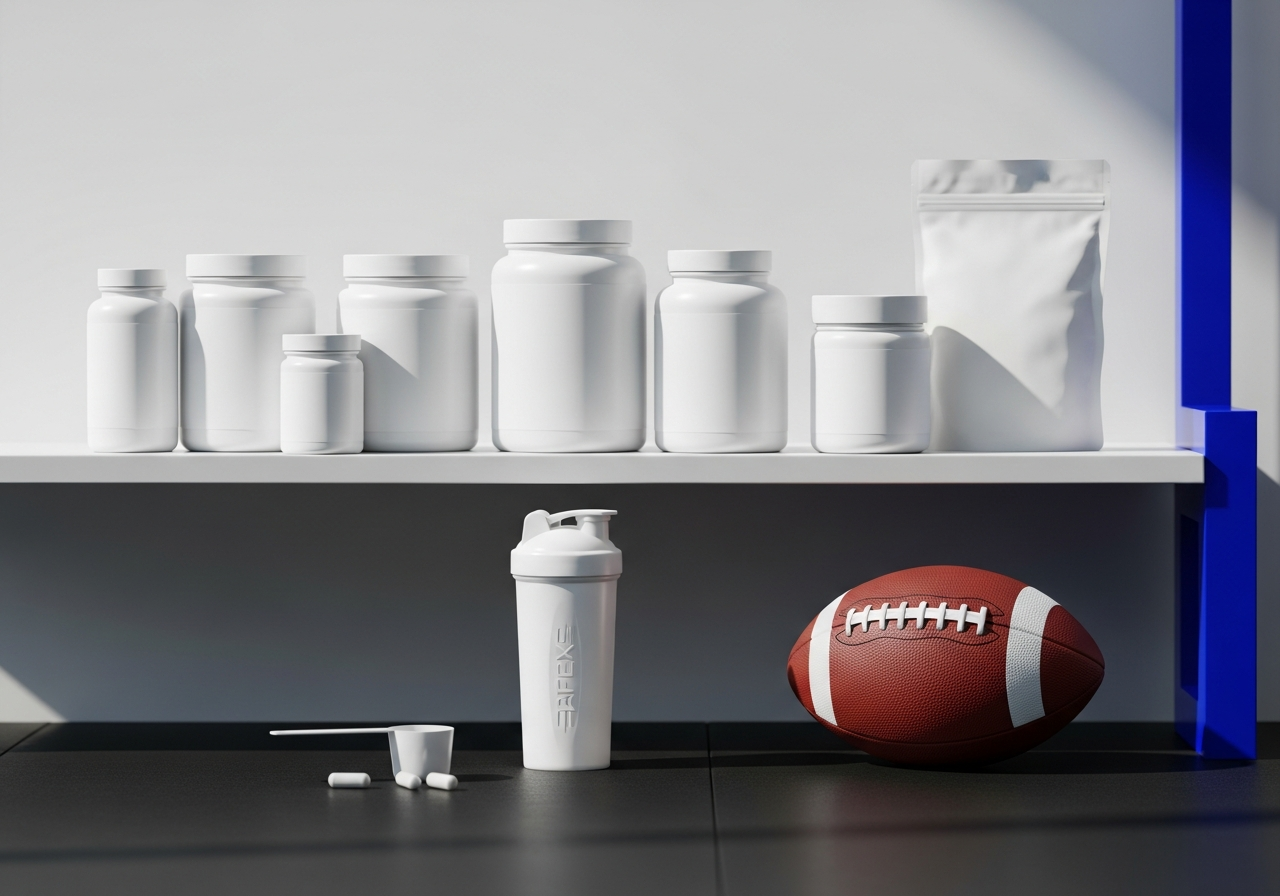
If you are buying creatine in Canada for football, the smartest move is to prioritise monohydrate, a valid NPN, and reputable quality controls rather than flashy branding. That advice applies whether you are a high school player, university athlete, or someone searching “creatine CFL” because you want a more professional standard.
In Canada, many sports supplements are sold as Natural Health Products and carry an NPN, or Natural Product Number, on the label. An NPN indicates the product is licensed by Health Canada for sale under that framework. For everyday buyers, this is a useful baseline check that the product has gone through the required regulatory process.
Competitive athletes should also care about:
- Third-party testing: helps reduce risk around contamination and label inaccuracies.
- Single-ingredient purity: easier to verify than “performance matrix” blends.
- Serving transparency: the label should clearly state grams of creatine monohydrate.
- Cost per 5 g serving: this is the fairest way to compare value.
For football players, unflavoured powder is usually the best buy. It is easier to dose accurately, tends to be cheaper, and avoids unnecessary extras. Flavoured versions can improve compliance if taste is a major barrier, but check that the actual creatine dose per serving is still meaningful.
Parents shopping for teen athletes should pay extra attention to product simplicity. A clean monohydrate powder is generally easier to evaluate than a pre-workout, “mass gainer,” or proprietary blend that also contains stimulants. That matters because the question is not just “does creatine help football players?” but “can I buy a football-appropriate product that does exactly what the label says?”
For serious athletes aiming at university, U Sports, junior football, or pro pathways, conservative supplement purchasing is wise. Use established sellers, keep receipts and lot numbers, and avoid dubious cross-border products with vague labelling. If you want help comparing options, check our best creatine rankings, brand reviews, and product catalog. You can also read Canadian supplement regulations and best creatine monohydrate in Canada.
What football players can expect week by week after starting creatine
Football players usually notice creatine through training performance and body-weight trends over days to weeks, not through an instant dramatic sensation. Your timeline depends mainly on whether you load and how hard you are training.
Days 1–7 with loading: muscle creatine stores rise quickly. Some players notice a small body-weight increase, fuller muscles, or less drop-off across hard sets and repeated sprints by the end of the first week.
Week 1–2 without loading: less obvious early change, but saturation is building steadily if you take 3–5 g daily.
Weeks 2–4: many players begin noticing improved gym performance, especially better repeat quality on heavy sets, jumps, sprint drills, or short conditioning intervals. Without loading, this is often when benefits become clearer.
Weeks 4–8: creatine’s value often becomes more obvious through accumulated training adaptations. You may see better progress in strength numbers, more stable output during repeated explosive work, and improved ability to tolerate high-quality volume.
Beyond 8 weeks: creatine is now more of a performance foundation than a “cycle.” The benefit is in sustained saturation supporting weeks and months of football-specific training.
What should you track?
- Body weight first thing in the morning
- Key lift performance such as squat, bench, trap-bar deadlift, or clean variations
- Broad jump or vertical jump if you test regularly
- Short sprint times
- How much your performance falls off across repeated reps or sets
If nothing seems to happen, ask four questions: Are you taking enough? Are you taking it daily? Have you used it long enough? Is your training specific and hard enough for creatine’s benefits to show up? A player doing random workouts and skipping doses will often conclude creatine “doesn’t work,” when the real issue is poor execution.
Also remember that not every gain is visible on a stopwatch immediately. Some benefits are indirect and cumulative: more quality work in the gym, better repeatability in speed sessions, and stronger long-term adaptation. That matters hugely in football, where off-season development often decides in-season performance. For a deeper timeline, see how long creatine takes to work and does creatine build muscle.
Bottom line: should football players take creatine?
Yes, most healthy football players should seriously consider creatine monohydrate because it is one of the best-supported supplements for explosive training, repeated sprint efforts, strength development, and lean-mass gains during training. If your sport demands fast bursts, collisions, accelerations, and repeated maximal efforts, creatine fits the job description unusually well.
The simplest evidence-based plan is this:
- Buy plain creatine monohydrate from a reputable Canadian seller.
- Optionally load with 20 g per day split into 4 doses for 5–7 days.
- Then take 3–5 g daily, including rest days.
- Track body weight, sprint repeatability, and gym performance over 4–8 weeks.
- Adjust only if you have comfort issues or a very specific body-mass concern.
If you want the shortest possible answer to “does creatine help football players?”, it is this: creatine helps most football players train and perform better in the exact qualities football relies on most. The strongest evidence is for strength, power, repeated high-intensity efforts, and lean-mass support during training. The evidence is weaker for dramatic one-off speed transformations, and creatine should never be sold as a substitute for great coaching, smart programming, nutrition, and sleep.
For players chasing the “best creatine for football,” do not get distracted by expensive alternatives before you have mastered the basics. Monohydrate remains the standard because the research keeps coming back to the same conclusion: it works, it is safe for healthy users at recommended doses, and it delivers excellent value.
If you want to start today, use our creatine dosage calculator, then read creatine for athletes, creatine for sprinting, and is creatine safe. Keep it simple, keep it daily, and let the evidence—not marketing—drive your plan.
Creatine for Football: the numbers that matter
- 3–5 g/day Standard maintenance dose — Works for most football players after saturation.
- 20 g/day Typical loading dose — Usually split into 4 doses for 5–7 days.
- 5–7 days Time to saturate with loading — Without loading, saturation usually takes about 3–4 weeks.
- 4 doses of 5 g Best way to split a loading phase — Helps improve tolerance versus taking large single doses.
Frequently Asked Questions
Does creatine help football players get faster?
Creatine can help football players get faster indirectly by improving repeated sprint ability, training quality, and explosive output. It is not a magic speed booster on its own, but by supporting phosphocreatine stores and helping you maintain power across repeated efforts, it can contribute to better acceleration and speed development when paired with proper sprint training.
What is the best creatine for football players?
The best creatine for football players is creatine monohydrate. It has the strongest research support, is the form used in most studies on strength and power, and is usually the most cost-effective option compared with HCl, buffered creatine, or other premium-branded forms.
How much creatine should a football player take?
Most football players should take 3–5 g of creatine monohydrate per day. If faster results are the goal, a typical loading phase is 20 g per day split into 4 doses for 5–7 days, followed by 3–5 g daily for maintenance.
Should football players load creatine?
Football players do not have to load creatine, but loading is useful if they want faster saturation. A loading phase can fill muscle stores in about a week, while taking 3–5 g daily without loading usually takes around 3–4 weeks to reach the same place.
When should football players take creatine?
Football players should take creatine whenever they are most likely to remember it consistently. Taking it after training or with a daily meal is practical, but total daily intake matters more than exact timing because creatine works through muscle saturation over time.
Does creatine make football players gain weight?
Yes, creatine can make football players gain a small amount of weight early on, but this is usually water stored inside muscle rather than fat gain. For many players, especially those seeking more size and force production, that effect is useful rather than harmful.
Is creatine safe for high school football players?
Creatine appears to be safe for healthy young athletes when used appropriately, but high school players should ideally use it with informed parental support and guidance from a qualified professional. Product quality, correct dosing, and a serious training environment matter more than simply copying what teammates are doing.
Is creatine allowed in football and pro pathways like the CFL?
Creatine is generally allowed in sport and is not a banned performance-enhancing drug under standard anti-doping frameworks. Players aiming for university, junior, or pro levels such as CFL pathways should still choose reputable products with strong quality controls to reduce contamination risk.
Can skill position players use creatine without getting too heavy?
Yes, skill position players can use creatine without automatically becoming too heavy. If body-mass sensitivity is a concern, they can skip loading and use 3–5 g daily to allow a slower uptake while tracking body weight, sprint feel, and performance.
How long does creatine take to work for football?
Creatine can start working within about 5–7 days if you use a loading phase, and usually within about 3–4 weeks if you do not load. Football players often notice it first through better gym output or less drop-off across repeated sprints rather than a dramatic immediate feeling.