
Creatine for Your 40s: Why Your Body Needs It More Than Ever
By The Creatine Canada Research Team — Evidence-based supplement analysts
Yes—creatine for men in their 40s is one of the most evidence-backed, practical supplements for preserving strength, training performance, lean mass, and recovery, especially as age-related muscle loss and lower high-intensity capacity start to become more noticeable. For most healthy adults in their 40s, 3 to 5 grams of creatine monohydrate daily is the simplest effective dose.
Evidence-based · Cites 4 sources · Editorial standards
Key Takeaways
- Creatine monohydrate is the best-studied form and the smart default for adults in their 40s.
- Most men in their 40s do well with 3 to 5 g daily; loading is optional, not required.
- Expect faster gym performance changes in 1 to 3 weeks with loading, or 3 to 4 weeks without it.
- Creatine helps most when paired with resistance training, adequate protein, and consistent sleep.
- A small early scale increase is usually water inside muscle, not body fat.
- Healthy adults can generally take creatine long term, but kidney disease or relevant medical conditions warrant a doctor’s advice first.
- In Canada, look for a Natural Product Number and ideally third-party testing when buying.
Creatine in your 40s: yes, it makes sense for most healthy men
Yes, creatine for men in their 40s is usually worth considering because it directly supports the exact capacities that often begin to decline in middle age: high-intensity energy production, training quality, lean mass retention, and recovery between repeated efforts. If you are a healthy 40-year-old man who lifts weights, plays hockey, does CrossFit, sprints, golfs, or simply wants to stay strong and capable, creatine monohydrate is the evidence-based place to start.
Creatine is a compound your body stores mostly in muscle, where it helps regenerate ATP, or adenosine triphosphate, the immediate energy currency used for short, hard efforts. That matters more in your 40s because muscle mass, power output, and the ability to recover from heavy training do not usually improve automatically with age. Even active men often notice they do not bounce back like they did at 25. Creatine does not stop aging, but it can improve the quality of the training stimulus that helps offset it.
The practical answer is simple: most men over 40 can take 3 to 5 grams of creatine monohydrate every day, including rest days. You can either load with 20 grams per day split into 4 doses for 5 to 7 days to saturate muscle faster, or skip loading and reach the same endpoint more gradually over roughly 3 to 4 weeks. If you are new to supplementation, our creatine dosage calculator and how to take creatine guide can help you set it up correctly.
What creatine is not: it is not a steroid, it does not directly raise testosterone in any reliable way, and it is not a magic muscle-builder if your training is poor. The 2017 ISSN position stand concluded that creatine monohydrate is the most effective ergogenic nutritional supplement currently available for increasing high-intensity exercise capacity and lean body mass during training. That is the core reason creatine for 40s, creatine over 40, and creatine and middle age have become such common questions.
For context, the best evidence supports creatine most strongly for strength training, sprint-style activity, repeated bursts of effort, and lean-mass support. Evidence for cognition and healthy aging is promising but still more nuanced than the performance case. If your goal is to age more athletically, stay stronger, and train with more quality, creatine belongs near the top of the list.
Why your 40s are a sweet spot for creatine, not “too late” for it
Your 40s are not too late for creatine; they are arguably the age when its benefits become easier to notice. Men in their 40s often face the first meaningful friction from middle age: slightly less explosive power, slower recovery, more work and family stress, and a gradual drift toward lower muscle mass if training is inconsistent.
From a physiology standpoint, you do not suddenly stop responding to creatine at 40. What changes is your baseline. If you are training less hard than you once did because recovery feels worse, joints are crankier, or life is busier, anything that helps you maintain training quality becomes more valuable. Creatine helps by increasing phosphocreatine stores, which are the stored high-energy phosphates muscles use to rapidly regenerate ATP during efforts like a heavy set of squats, a sled push, a hill sprint, or the last hard reps on a machine.
There is also the age-related muscle issue. Adults start to face a slow long-term risk of sarcopenia, meaning age-related loss of muscle mass and function. That process usually becomes a bigger conversation later, but the best time to protect muscle is before major decline sets in. Creatine is not a substitute for resistance training, yet it can amplify the results of well-designed training by helping you do a bit more total quality work over time.
Here is the practical translation for a 40-year-old man:
- If you are lifting: creatine can help you squeeze out extra reps or maintain bar speed better.
- If you play rec sport: creatine can help with repeated bursts, changes of direction, and later-game fatigue resistance.
- If you are dieting: creatine can help preserve training performance while calories are lower.
- If you are returning to fitness: creatine can support the rebuilding phase, though consistency matters far more than any supplement.
This is why queries like creatine for 40 year olds, creatine 40 year old man, and creatine for adults in their 40s are really asking the same thing: can this help me stay more athletic as aging begins to show up? In most healthy adults, the answer is yes—especially if your goal is strength, lean mass, performance, or body recomposition rather than just chasing scale weight.
If you want broader context on the aging angle, see creatine and aging and creatine for masters athletes.
How creatine works in middle age: ATP, phosphocreatine, and better training quality
Creatine works by increasing your muscle phosphocreatine stores, which helps you regenerate ATP faster during short, intense efforts. That mechanism is the same whether you are 24 or 44, but it becomes especially useful in middle age because training quality is often the first thing to slip when recovery, stress, and work capacity start to change.
ATP is the direct fuel for muscle contraction, but muscles only store a tiny amount at any given time. Phosphocreatine acts like a rapid backup battery. During heavy or explosive work, it donates a phosphate group to help restore ATP so you can sustain force output a little longer. In real life, that can mean one more good rep, slightly better sprint repeatability, or less drop-off across multiple sets.
That small edge compounds. More quality reps at a given load, or more total training volume over weeks, can contribute to better strength and lean-mass gains. Creatine also draws water into muscle cells, which is why many people notice fuller muscles and a small bodyweight increase early on. That intracellular water shift is not body fat; it is part of the normal saturation process. For more on that, see does creatine make you gain weight.
The 2017 ISSN position stand and the 2021 JISSN review on misconceptions both reinforce the same core point: creatine monohydrate is highly studied, effective, and safe for healthy individuals when used appropriately. The performance benefits are strongest for resistance training and repeated high-intensity exercise, while evidence for direct endurance performance is less impressive unless endurance includes hard surges or sprint finishes. You can read those reviews here: ISSN Position Stand and common questions and misconceptions about creatine.
One more 40s-specific point: creatine does not replace the boring fundamentals that now matter more than ever. If your sleep is inconsistent, protein is low, and you only train hard once every ten days, creatine will not rescue the plan. But if you are already doing the basics reasonably well, it can make the work more productive. Think of creatine less as a stimulant and more as an energy-system support tool that improves the return on your training.
If you want the deeper physiology, our guides on what creatine is and creatine and ATP go further.
Exactly how to start creatine in your 40s: the simple 5-step plan
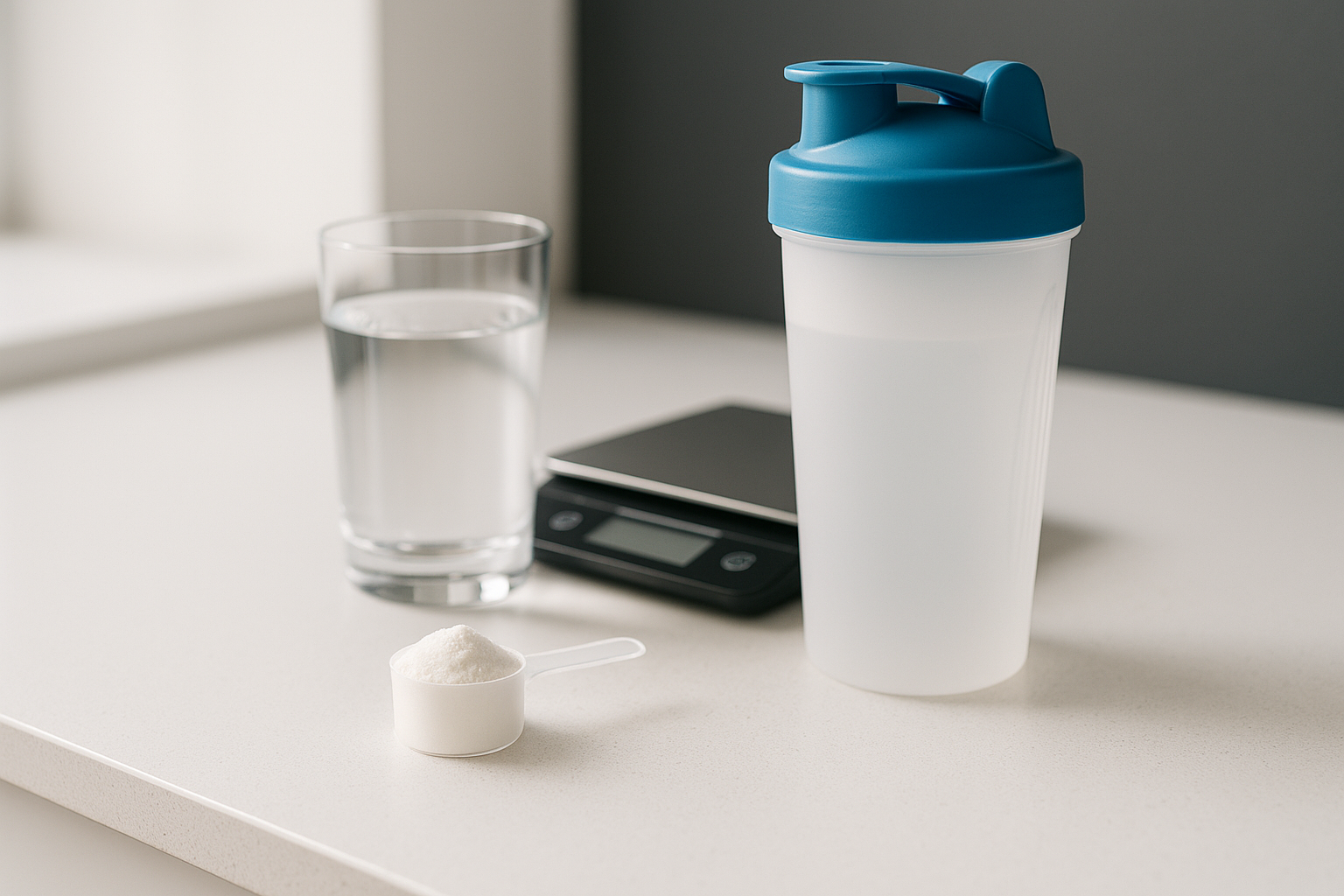
The easiest way to start creatine in your 40s is to pick plain creatine monohydrate, take the right dose every day, and stay consistent for at least a month before judging results. Most problems happen because people under-dose, skip days, or expect a pre-workout-like feeling.
- Choose creatine monohydrate. It is the most studied, most reliable, and usually the most cost-effective form. Fancy alternatives often cost more without beating monohydrate in real-world evidence.
- Pick your saturation strategy. Either take 3 to 5 g daily and wait about 3 to 4 weeks for full effect, or load with 20 g daily split into 4 doses for 5 to 7 days, then continue with 3 to 5 g daily.
- Take it every day. Training day, rest day, travel day—consistency matters more than timing.
- Mix it in a way you will actually stick to. Water, a protein shake, yoghurt, or a post-workout drink all work. If grittiness bothers you, warm liquid can help dissolve it better. See how to mix creatine.
- Track useful signs, not just scale weight. Watch for better performance on repeated sets, improved gym stamina, slightly fuller muscles, and easier maintenance of strength while dieting.
What should you expect week by week?
- Days 1 to 7 with loading: some people notice a small bodyweight increase and better set-to-set performance by the end of the week.
- Weeks 2 to 3: training quality usually becomes more noticeable, especially in the last reps of hard sets.
- Weeks 3 to 4 without loading: this is when daily low-dose users often begin to feel the difference.
- Weeks 4 to 12: the real payoff is usually better progression in strength, volume, and lean mass over time.
A good beginner benchmark is this: if you are lifting and your later sets stop falling off as hard, or you can maintain reps better at a given load, creatine is likely doing its job. If you want a tighter protocol, use the creatine dosage calculator and compare it with how much creatine per day.
For men in their 40s coming back after a layoff, the key is not to overcomplicate it. Start with daily monohydrate, pair it with 2 to 4 weekly strength sessions, and give it enough time to work.
Best creatine dose for a 40-year-old man: by body weight and goal
For most men in their 40s, 3 to 5 grams of creatine monohydrate per day is the right maintenance dose, while a loading phase of 20 grams per day split into 4 doses for 5 to 7 days saturates muscle faster. Heavier or more muscular individuals often choose the upper end of the maintenance range, but you do not need a complicated formula to get good results.
| Body weight | Goal | Practical daily dose | Loading option |
|---|---|---|---|
| Under 70 kg | General fitness, lean mass, strength | 3 g/day | 20 g/day split into 4 doses for 5-7 days, then 3 g/day |
| 70-90 kg | Most active men in their 40s | 3-5 g/day | 20 g/day split into 4 doses for 5-7 days, then 3-5 g/day |
| Over 90 kg | Strength, power, higher lean mass | 5 g/day | 20 g/day split into 4 doses for 5-7 days, then 5 g/day |
| Any body weight | Sensitive stomach | 3 g/day to start, then increase if desired | Skip loading; use steady daily dosing |
How should goal change your decision?
- Strength and muscle: 3 to 5 g/day is the default, with loading if you want faster saturation.
- Fat loss or body recomposition: use the same dose. Creatine is still useful during a cut because it helps preserve training quality and lean mass.
- Rec sport and sprint-based performance: the same daily dose works. Loading can help if you want benefits sooner.
- Healthy aging support: the same 3 to 5 g/day still applies, especially if paired with resistance training.
More is not better once your muscles are saturated. Taking 10 grams every day long term is usually unnecessary for the average 40-year-old lifter. Creatine works by maintaining full muscle stores, not by delivering an acute buzz from a giant dose. If you are not sure where to land, our maintenance dose guide and dosage calculator make it easy.
If you have digestive discomfort, splitting the dose is often enough. For example, take 2 grams with breakfast and 2 or 3 grams later in the day. That is usually smarter than abandoning the supplement or paying extra for a flashy alternative form.
When to take creatine in your 40s, on rest days, and how to tell it’s working
The best time to take creatine is the time you will remember every day, because daily consistency matters more than exact timing. For most adults in their 40s, taking creatine with a meal or after training is a simple, sustainable habit—but the difference between morning, pre-workout, and post-workout is small compared with simply not missing doses.
On rest days, still take it. Creatine works through saturation of muscle stores, not just acute workout timing. Skipping weekends or only using it on training days slows or reduces saturation. If you travel often for work, keep a few single servings in a small container or baggie so routine does not break.
Good timing options include:
- With breakfast if you want a fixed daily habit.
- Post-workout with your protein shake if you already use one.
- With lunch or dinner if that is when your digestion is best.
How do you know creatine is working?
- Performance signs: more reps at the same load, slightly better bar speed, or less drop-off in later sets.
- Recovery signs: you may feel more able to train hard again after a day or two, though this is less dramatic than the performance effect.
- Visual signs: some people look a little fuller due to increased intracellular water in muscle.
- Scale signs: a modest increase early on is common, especially with loading.
How do you know it is not working yet? Usually because muscle saturation is incomplete, your dose is inconsistent, or your training does not involve the kind of hard repeated efforts creatine helps most. Endurance-only exercisers doing easy steady-state cardio often notice less than people who lift or sprint.
If you are the type who wants precise scheduling, read when to take creatine and creatine on rest days. If you want realistic timelines, how long creatine takes to work covers it in detail.
For busy men in their 40s, the best timing plan is usually the boring one: keep the tub near the habit you already never skip.
Who creatine is for in their 40s: beginners, athletes, women, and adults focused on healthy aging
Creatine is not only for bodybuilders; it is useful for many adults in their 40s, including beginners, recreational lifters, masters athletes, women, and people mainly focused on preserving muscle and function with age. The same supplement can serve different goals because the core mechanism—supporting rapid ATP regeneration—shows up in many forms of training.
Beginners: yes, beginners can take creatine right away. In fact, new trainees often benefit because creatine can support better early training quality while they are learning movement patterns and building consistency. It is not necessary before you start training, but it is perfectly reasonable once you begin. See creatine for beginners.
Recreational lifters and busy professionals: if you train 2 to 4 days a week and want strength, muscle retention, or body recomposition, creatine is highly relevant. This is probably the most typical “creatine men 40s” use case.
Masters and competitive athletes: creatine remains useful for hockey, sprinting, CrossFit, football, powerlifting, racquet sports, and any sport with repeated explosive efforts. The International Olympic Committee consensus on dietary supplements includes creatine among the few supplements with strong evidence for specific performance uses.
Women in their 40s: women can use the same basic monohydrate protocol. Creatine is not a male-only supplement, and it does not inherently make women “bulky.” If this applies to your household, see creatine for women.
Vegetarians and vegans: these groups may notice stronger responses because dietary creatine intake is often lower. That does not mean meat-eaters do not benefit; it means baseline muscle creatine stores may start lower in plant-based eaters.
Older adults broadly: adults in their late 40s and beyond may be especially interested in creatine as part of a healthy aging plan centred on resistance training. The evidence is strongest for muscle and performance; interest in cognition and resilience is growing but still more emerging than settled. For the next age bracket, see creatine for older adults.
If you are a healthy adult asking about creatine over 40 or creatine for people in their 40s, the answer is less about age alone and more about whether your goals involve strength, muscle, power, recovery, or staying physically capable.
Is creatine safe for men over 40? What side effects, kidney myths, and blood tests actually mean

For healthy adults, creatine monohydrate is generally considered safe when taken at recommended doses, including by men over 40. The strongest long-term concern people raise is kidney health, but in healthy individuals the research does not support the claim that creatine damages kidneys at standard doses.
The most important nuance is this: creatine can increase creatinine, a breakdown product measured on bloodwork, without harming your kidneys. That matters because creatinine is commonly used as a kidney marker, and supplementation can make the number look higher even when kidney function is normal. This is one reason adults in their 40s should tell their doctor if they take creatine before interpreting lab results. For a deep dive, see creatine vs creatinine and is creatine bad for your kidneys.
Common side effects are usually manageable and dose-related:
- Water weight: often a small early increase from more water inside muscle.
- Stomach upset or loose stool: more likely with large single doses, especially during loading.
- Bloating: often overstated, but some people feel it if dosing is too aggressive.
Simple fixes include splitting the dose, taking it with food, and avoiding dry scooping. If digestion is an issue, read creatine digestive side effects.
Who should be more cautious? Anyone with known kidney disease, significant renal impairment, or a medical condition requiring fluid or electrolyte management should talk to a physician first. The same applies if you take medications that affect kidney function or you have a complex medical history. Creatine is safe for many people, but “safe for healthy adults” is not the same as “appropriate for every medical situation.”
The 2021 JISSN review also addresses several persistent myths, including dehydration, cramping, and hair loss claims, and concludes that many common fears are not supported by the totality of evidence. For a consumer-friendly overview, Mayo Clinic’s creatine page is also useful: Mayo Clinic — Creatine.
Bottom line: for a healthy 40-year-old man, standard-dose creatine monohydrate is one of the better-studied and safer sports supplements available. The smart move is not fear—it is informed use.
The biggest creatine mistakes men in their 40s make, and the myths still wasting money
The biggest creatine mistakes men in their 40s make are buying the wrong form, taking it inconsistently, judging it too quickly, and blaming normal water retention on “getting fat.” Most creatine frustration comes from poor execution, not from creatine failing.
Mistake 1: paying extra for trendy forms. Monohydrate remains the evidence-based standard. Claims that HCL, buffered creatine, liquid creatine, or proprietary blends are clearly superior are not supported by stronger real-world evidence. If you want the best default, see best type of creatine and monohydrate vs HCL.
Mistake 2: only taking it on workout days. Creatine is not like caffeine. Muscle saturation depends on total regular intake over time.
Mistake 3: expecting a stimulant feeling. Creatine does not usually feel like a pre-workout. The effect is more subtle and performance-based.
Mistake 4: stopping because the scale went up. Early weight gain is usually water inside muscle, not fat mass. If your waist is stable and performance is improving, this is usually a positive sign.
Mistake 5: loading with huge single servings. Taking 20 grams in one shot is a great way to create stomach problems. Split loading doses across the day.
Now the myths:
- “Creatine is a steroid.” False. Creatine is a naturally occurring compound involved in energy metabolism.
- “Creatine ruins your kidneys.” Not supported in healthy individuals at recommended doses.
- “Creatine causes dehydration and cramps.” This is a persistent myth not supported by the best evidence reviews.
- “You need to cycle it.” No. Daily use is fine; cycling is not required.
- “Creatine only matters if you are bodybuilding.” False. It also helps repeated high-intensity efforts in many sports and can support healthy aging goals.
If you want a full myth breakdown, visit creatine myths debunked and creatine myths vs facts. If you think you might be a non-responder, that is usually premature. More often the issue is low adherence, under-dosing, or training that does not challenge the phosphocreatine system enough. Our guide on creatine not working can help troubleshoot.
How to buy creatine in Canada without getting fooled by marketing
The best creatine to buy in Canada is usually a plain creatine monohydrate product with clear dosing, a Natural Product Number, and ideally third-party testing or a strong reputation for quality control. You do not need a flashy label; you need a product that reliably delivers the stated grams of monohydrate.
In Canada, creatine products are commonly sold as natural health products. A Natural Product Number, or NPN, indicates that the product has been licensed by Health Canada within the natural health products framework. An NPN does not mean every product is identical in quality, but it is a useful legitimacy check. If you are buying online, especially from large marketplaces, verify that the seller and label information are consistent and that the product arrives sealed.
Use this buying framework:
- Form: plain creatine monohydrate first.
- Dose transparency: serving size should clearly state grams of creatine monohydrate.
- Additives: fewer extras are usually better if you just want creatine.
- Testing: third-party testing, NSF, Informed Sport, or equivalent quality signals are helpful, especially for tested athletes.
- Value: compare cost per gram, not just tub price.
| What to compare | What good looks like | Red flag |
|---|---|---|
| Form | Creatine monohydrate | Proprietary blend with unclear dose |
| Label clarity | 3 g or 5 g clearly stated per serving | Vague “performance matrix” language |
| Regulatory fit | NPN shown for Canadian sale | No clear Canadian label details |
| Quality assurance | Third-party tested or reputable brand | No testing information at all |
| Price logic | Reasonable cost per gram | Expensive niche form with weak evidence |
If you want help comparing options, start with our best creatine rankings, creatine brand reviews, and creatine product catalog. For Canada-specific buying considerations, see is creatine approved in Canada and third-party tested creatine in Canada.
For most men in their 40s, the highest-value purchase is boring in the best way: unflavoured monohydrate, clean label, correct dose, fair price, and trustworthy sourcing.
Bottom line: the smartest way to use creatine for your 40s
Creatine for men in their 40s is not a fad; it is one of the most practical, evidence-based tools for supporting strength, lean mass, training quality, and athletic capacity during middle age. If you are healthy, active, and want to keep more of your muscle and performance as you age, creatine monohydrate deserves serious consideration.
The smartest protocol is simple:
- Buy plain creatine monohydrate from a reputable Canadian seller.
- Take 3 to 5 grams every day.
- Use a loading phase only if you want faster saturation.
- Keep taking it on rest days.
- Pair it with resistance training, adequate protein, hydration, and sleep.
What should a 40-year-old man realistically expect? Not a stimulant hit, not instant fat loss, and not miracle muscle growth without effort. Instead, expect a modest but meaningful improvement in your ability to train hard, repeat hard efforts, and accumulate the kind of quality work that drives long-term results. Over months, that can translate into better strength, more lean mass retention, and better physical resilience.
If your goals are broader healthy aging, creatine is still promising—but the most established evidence remains in muscle and performance. That is not a limitation so much as a strength: few supplements have such a clear, well-supported use case.
So, is creatine over 40 worth it? For most healthy adults, yes. It is especially worth it if you lift, play sport, want to preserve muscle while dieting, or simply do not want to give away athletic capacity any earlier than necessary.
Next steps: calculate your dose with our creatine dosage calculator, compare options in the best creatine rankings, and read is creatine safe if you want a deeper safety review before you start.
Creatine for Men in Their 40s: The Numbers That Matter
- 3-5 g/day Standard maintenance dose — Appropriate for most healthy adults using creatine monohydrate.
- 20 g/day Typical loading dose — Usually split into 4 doses daily for 5-7 days.
- 5-7 days Time to saturate with loading — Benefits are often noticed sooner with a proper loading phase.
- 3-4 weeks Time to saturate without loading — Daily low-dose use reaches the same endpoint more gradually.
Frequently Asked Questions
Is creatine good for a 40-year-old man?
Yes, creatine is a good option for many healthy 40-year-old men because it supports strength, repeated high-intensity performance, and lean mass retention. It is especially useful if you lift weights, play sport, or want to stay more athletic as middle age starts to affect recovery and muscle maintenance.
Should men over 40 take creatine every day?
Yes, men over 40 should usually take creatine every day if they choose to use it. Daily intake matters because creatine works by saturating muscle stores over time, so taking it only on workout days is less effective than steady daily use.
How much creatine should a man in his 40s take?
Most men in their 40s do well with 3 to 5 grams of creatine monohydrate per day. A loading phase of 20 grams per day split into 4 doses for 5 to 7 days is optional if you want faster muscle saturation.
Does creatine help with age-related muscle loss in your 40s?
Yes, creatine can help support muscle retention in your 40s, especially when combined with resistance training. It does not stop age-related muscle loss by itself, but it can improve training quality and help preserve or build lean mass more effectively.
Is creatine safe for men over 40 with normal kidneys?
Yes, creatine is generally considered safe for healthy men over 40 with normal kidney function when taken at recommended doses. The main caution is for people with kidney disease or complex medical conditions, who should speak with a physician before starting.
Will creatine make a man in his 40s gain fat?
No, creatine does not inherently make you gain fat. Early weight gain from creatine is usually due to more water being stored inside muscle, not an increase in body fat.
What is the best creatine for men in their 40s?
The best creatine for men in their 40s is usually plain creatine monohydrate. It is the most studied form, the most consistently effective, and usually the best value compared with newer forms that are marketed as superior.
Can you take creatine in your 40s if you are a beginner?
Yes, you can take creatine in your 40s even if you are a beginner. It is not required to start training, but it can support better gym performance and make it easier to get more productive work from each session.
How long does creatine take to work for people in their 40s?
Creatine usually takes about 5 to 7 days to have fuller effects if you use a loading phase, or about 3 to 4 weeks if you start with a standard daily dose only. Age does not change the basic saturation timeline nearly as much as dosing consistency does.
Do men in their 40s need to cycle creatine?
No, men in their 40s do not need to cycle creatine. Long-term daily use at standard doses is common, and cycling is not required to maintain effectiveness or safety in healthy adults.