Creatine and Diabetes: Blood Sugar, Insulin, and Safety
By The Creatine Canada Research Team — Evidence-based supplement analysts
Creatine is not a diabetes treatment, but current evidence suggests creatine monohydrate does not raise blood sugar in healthy people and may modestly support glucose control when paired with exercise in some adults with type 2 diabetes. For most people with diabetes, the key question is not whether creatine is inherently “bad for blood sugar”, but whether it fits safely with their kidney status, medications, training plan, and clinician’s advice.
Evidence-based · Cites 4 sources · Editorial standards
Key Takeaways
- Creatine monohydrate is the best-studied form, and 3–5 g/day is the standard maintenance dose.
- Creatine does not contain sugar and does not directly spike blood glucose on its own.
- The strongest evidence for glucose benefits is in combination with exercise, not creatine by itself.
- People with diabetes should be more cautious if they have kidney disease, abnormal renal labs, or are being monitored with creatinine-based tests.
- A loading phase of 20 g/day for 5–7 days is optional; it speeds saturation but is not required.
- If you have type 1 or type 2 diabetes, talk to your clinician before starting creatine, especially if you use insulin or glucose-lowering medication.
- Choose a simple Canadian product with an NPN and preferably third-party testing rather than flashy blends or sugary formulas.
Creatine and diabetes: the short answer most people actually need
Creatine is not known to worsen blood sugar in most people, and it may modestly improve glucose handling in some adults with type 2 diabetes when combined with regular exercise. That is the practical answer to the question “is creatine safe for diabetics?”—but it comes with important caveats about kidney health, lab interpretation, and medical supervision.
Creatine is a naturally occurring compound stored mainly in muscle, where it helps recycle ATP, the cell’s immediate energy currency, during short, intense efforts. Supplemental creatine monohydrate raises muscle phosphocreatine stores, which can improve strength, repeated high-intensity performance, and training quality. The 2017 ISSN position stand concluded that creatine monohydrate is the most effective ergogenic nutritional supplement currently available for increasing high-intensity exercise capacity and lean mass during training.
What creatine does not do is act like a carbohydrate. Pure creatine monohydrate contains no sugar and no meaningful calories, so taking 3–5 g of creatine in water does not inherently cause a glucose spike. That matters for search queries like “creatine blood sugar” and “creatine glucose”, because the concern is often based on confusion between creatine and sugary pre-workouts or sports drinks.
The nuance is this: diabetes changes the risk-management conversation. If you have type 1 or type 2 diabetes, especially with kidney impairment, albuminuria, long-standing disease, or medications that can alter hydration or renal function, creatine should be treated as a supplement worth discussing with your clinician first. Creatine can also increase serum creatinine, which is a breakdown product measured on bloodwork, and that can muddy the interpretation of kidney labs even when kidney function itself is unchanged. If that topic worries you, read our guide to creatine and kidney concerns and creatine vs creatinine.
For a generally healthy lifter with well-managed diabetes and normal kidney function, creatine is often a reasonable option. For someone with diabetic kidney disease, unstable blood sugars, or complex medication changes, the safest approach is individual assessment rather than blanket internet advice.
Bottom line: creatine and diabetes can coexist, but the goal should be informed, monitored use—not assuming creatine is either a miracle for glucose control or automatically unsafe.
How creatine may affect blood sugar and insulin in the real world
Creatine may influence glucose control indirectly by helping muscle use and store glucose better, especially when it is paired with exercise. That is the core mechanism behind the most credible interest in “creatine and insulin” and “creatine glucose” research.
Here is the physiology in plain English. Skeletal muscle is the body’s largest site for glucose disposal after meals. When you train, muscle contractions stimulate glucose uptake through pathways that are partly separate from insulin. Creatine can improve training performance by increasing phosphocreatine availability, which helps you do more high-quality work, recover faster between efforts, and potentially build or preserve more lean mass over time. More and better-functioning muscle usually means a larger “sink” for glucose.
Some researchers have also proposed that creatine may support the movement or activity of GLUT-4, the main glucose transporter in muscle cells, particularly in response to exercise. GLUT-4 is the protein that helps shuttle glucose out of the blood and into muscle. The evidence here is promising but not as settled as creatine’s effect on strength and power.
In practical terms, creatine is more likely to help blood sugar management as an exercise-support supplement than as a stand-alone glucose supplement. That distinction matters. If a sedentary person with diabetes takes creatine and changes nothing else, you should not expect a dramatic drop in fasting glucose or A1C. If that same person begins a structured resistance-training or mixed exercise plan and uses creatine consistently, there is a more plausible route to benefit.
The 2021 JISSN review on common creatine questions and misconceptions reinforces a broader point that helps here: creatine’s best-established role is performance and training support, while many health applications outside sport remain promising but more context-dependent.
So does creatine increase insulin? Not in the way people often imagine. Creatine is not an insulin secretagogue, meaning it is not known as a supplement that directly forces the pancreas to release insulin. It also does not need a huge insulin spike to “work”. You can take creatine with water, with a meal, or mixed into a protein shake. If you want the fundamentals of how saturation works, see what creatine is and how to take creatine.
The best current summary is simple: creatine does not appear to be a blood-sugar spiker, and any glucose-related upside is most likely mediated through muscle, training, and body-composition changes rather than a direct drug-like effect on diabetes itself.
What the research actually shows for type 1 diabetes, type 2 diabetes, and healthy adults

The evidence for creatine and diabetes is cautiously encouraging in type 2 diabetes, sparse in type 1 diabetes, and not strong enough to call creatine a glucose-control supplement on its own. That is the evidence-based middle ground.
In healthy adults, the main finding is that creatine is generally neutral with respect to blood glucose when used at standard doses. Most people taking creatine monohydrate for performance do not report it causing obvious high blood sugar, and this fits the fact that creatine itself contains no carbohydrate.
In adults with type 2 diabetes, some studies have suggested that creatine combined with exercise may improve measures of glycaemic control or glucose handling. The key phrase is combined with exercise. The literature is not large, and study designs vary, so the signal is interesting rather than definitive. You should think of this as “potentially useful in the right context”, not “proven standard of care”.
For type 1 diabetes, the evidence is much thinner. That does not automatically mean creatine is unsafe, but it does mean there is less direct research to lean on. People with type 1 diabetes also have a more immediate risk of training-related hypo- or hyperglycaemia depending on insulin dosing, meal timing, and workout type. Creatine does not replace that planning.
Major sports-nutrition guidance remains focused on creatine’s safety and performance profile rather than endorsing it as a diabetes intervention. The International Olympic Committee consensus on dietary supplements includes creatine among supplements with strong evidence for specific performance uses, but that is not the same as endorsing it for disease management. Likewise, Examine’s creatine evidence summary consistently notes that creatine’s strongest support is for exercise performance and lean mass, while metabolic applications are still more nuanced.
What should a practical reader conclude from this? First, creatine is not a replacement for medication, diet, or exercise programming. Second, if you have type 2 diabetes and are starting resistance training, creatine is a rational supplement to discuss with your clinician because it may support the training adaptations that help glucose control. Third, if you have type 1 diabetes, consider creatine mainly through a sports-performance lens and manage glucose around training exactly as carefully as you normally would.
The honest scientific answer is that creatine for diabetics is promising in some contexts, but the evidence is not yet strong enough to make universal claims about lowering A1C or improving insulin sensitivity in every person with diabetes.
Who creatine may make sense for if you have diabetes
Creatine makes the most sense for people with diabetes who want to improve strength, preserve muscle, or train harder and more consistently. It is usually a performance-and-body-composition decision first, with possible glucose benefits as a secondary bonus.
Beginners can use creatine. In fact, beginners often benefit because they respond well to resistance training, and creatine can support training volume and recovery between hard sets. If you are newly diagnosed with type 2 diabetes and beginning a supervised exercise plan, creatine may be worth considering after you have your basics in place: regular training, enough protein, sensible hydration, and stable medication routines.
Women with diabetes can use creatine just as men can. There is no evidence-based reason women need a special “female creatine” formula. Standard creatine monohydrate is the default choice. If this is relevant to you, see our creatine for women guide.
Older adults are another group worth highlighting. Ageing is associated with lower muscle mass, lower power, and often poorer glucose disposal. Resistance training is one of the best tools for maintaining function and metabolic health, and creatine may help older adults train more effectively. For this reason, creatine can be especially reasonable for adults over 50 with type 2 diabetes who are focused on muscle retention, independence, and strength.
Athletes with diabetes may also benefit because creatine is particularly useful for repeated high-intensity efforts such as sprinting, lifting, hockey, football, CrossFit, and many team sports. If your sport involves explosive repeated efforts, creatine is much more likely to help performance than if your only goal is lowering blood sugar without training.
Who should pause before using it? Anyone with known kidney disease, reduced eGFR, persistent abnormal renal labs, uncontrolled hypertension under active workup, recurrent dehydration, or a history of medical advice to restrict supplements should not start casually. People using multiple medications that affect fluid balance or kidney function should also check first.
If you are unsure whether your goal really matches what creatine does, start here: evidence-based creatine benefits and creatine for beginners. Creatine is for improving the muscle side of the metabolic equation; it is not a shortcut around the core diabetes habits that matter most.
How to start creatine safely when you have diabetes: a simple step-by-step plan
If you have diabetes and want to try creatine, the safest approach is to start low, keep everything else stable, and monitor how you respond over the first 2–4 weeks. This reduces confusion about what creatine is actually doing versus what your training, meals, or medications are doing.
- Get medical clearance if you have any kidney or medication concerns. This is especially important if you have diabetic kidney disease, abnormal creatinine or eGFR, or use medications where dehydration or renal monitoring matters.
- Choose plain creatine monohydrate. Avoid proprietary blends, mega-dosed pre-workouts, and products with added sugar if your goal is to keep variables simple. In Canada, look for a product with an NPN, which stands for Natural Product Number, and ideally third-party testing. You can compare options in our best creatine rankings, creatine brand reviews, and product catalog.
- Start with 3 g/day for the first week if you want to be conservative. Then move to 3–5 g/day. This is gentler on digestion than jumping into a loading phase.
- Take it once daily, at roughly the same time. With a meal, after training, or in a shake are all fine. Consistency matters more than timing perfection. For more on this, see when to take creatine.
- Keep hydration normal. You do not need to force litres of extra water, but do not under-drink either. A separate guide on how much water to drink with creatine can help.
- Track training and glucose. Note your fasting glucose, workout performance, body weight, and any digestive symptoms for 2–4 weeks. If you use a CGM, pay attention to trends rather than one-off readings.
- Do not change five variables at once. If you begin creatine, a new lifting plan, and a different medication schedule in the same week, you will not know what caused any change.
What should you expect? Week 1 may feel like nothing, especially without loading. By weeks 2–4, many people notice better reps, better repeat sprint output, or a small increase in body weight from increased intracellular water in muscle. That is not fat gain. If your goal is performance, those are normal signs creatine saturation is progressing. For a full timeline, see how long creatine takes to work.
If stomach upset appears, split the dose into two smaller servings or use micronized monohydrate. If glucose becomes harder to interpret around training, do not assume creatine is the culprit; review food, insulin, workout intensity, and hydration first.
Best creatine dose for diabetics: by body weight, goal, and whether you want to load
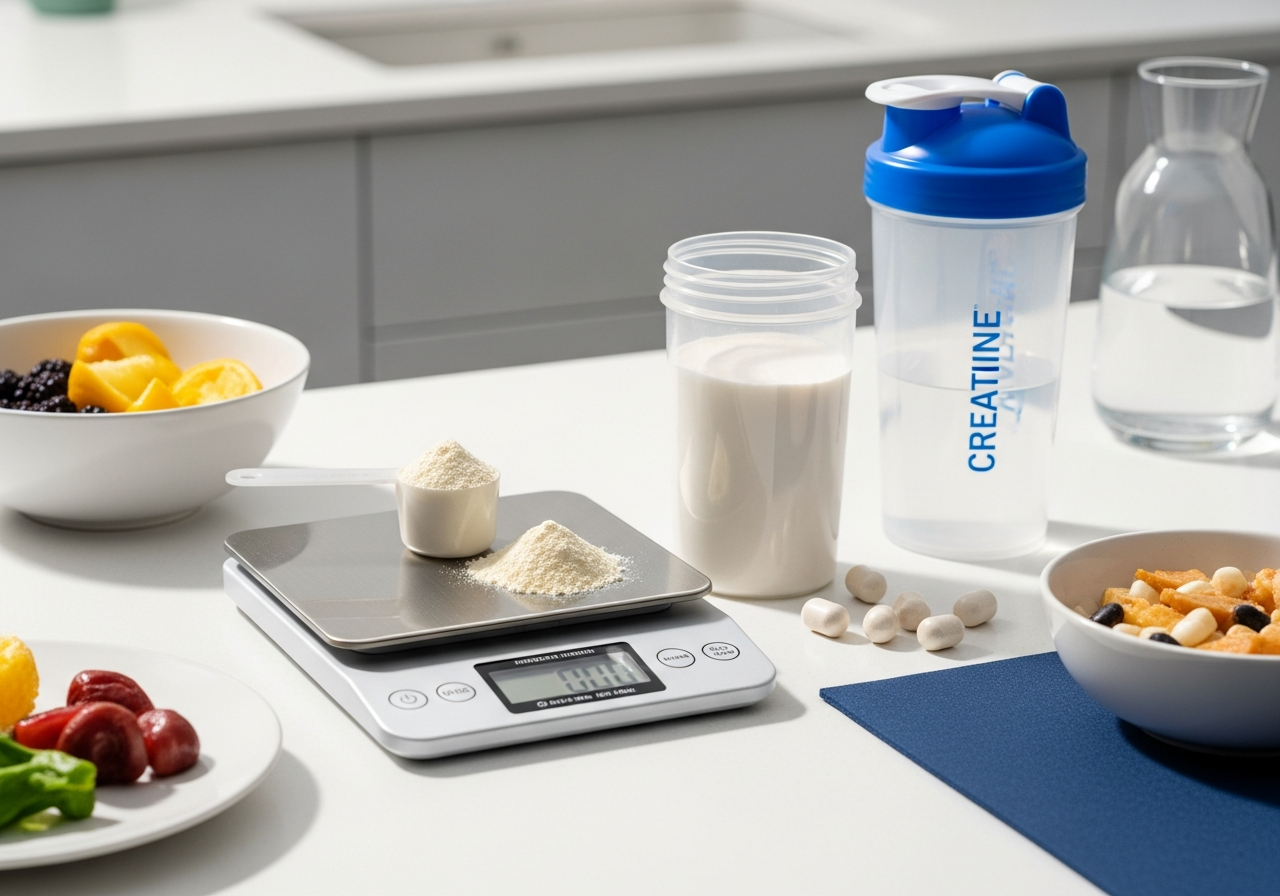
For most adults with diabetes, the best creatine dose is still the standard evidence-based dose used in sports nutrition: 3–5 g/day of creatine monohydrate. Diabetes does not usually require a special creatine dose, but your body size, goals, and tolerance can influence how you start.
The two accepted dosing strategies are straightforward. A loading phase uses 20 g/day split into 4 doses of 5 g for 5–7 days, followed by 3–5 g/day. A no-loading approach uses 3–5 g/day from day one and reaches full muscle saturation more gradually over roughly 3–4 weeks. The loading phase works faster, but it is more likely to cause temporary stomach upset or a quick jump in scale weight from water moving into muscle cells.
| Body weight | Conservative start | Standard maintenance | Optional loading phase |
|---|---|---|---|
| Under 60 kg | 3 g/day | 3 g/day | 20 g/day split into 4 x 5 g for 5–7 days, then 3 g/day |
| 60–90 kg | 3 g/day | 3–5 g/day | 20 g/day split into 4 x 5 g for 5–7 days, then 3–5 g/day |
| Over 90 kg | 3–5 g/day | 5 g/day | 20 g/day split into 4 x 5 g for 5–7 days, then 5 g/day |
If your goal is glucose support through better training, there is usually no need to load. A steady 3–5 g/day is simpler, gentler, and easier to stick with. If your goal is faster performance benefit for a training block or sport season, loading is reasonable if you tolerate it well.
People sometimes ask whether they need to take creatine with sugar for absorption. No. While carbohydrate and insulin can influence creatine uptake, normal daily dosing still works well without a sugar bolus. That is useful for people who are specifically trying to manage post-meal glucose excursions.
If you want the simplest recommendation, use this: 5 g/day if you are an average-sized adult who trains regularly, 3 g/day if you are smaller or want to start cautiously, and skip loading unless you want faster saturation. You can fine-tune your intake with our creatine dosage calculator and read more in how much creatine per day and our loading phase guide.
Consistency beats precision. Missing the “perfect” dose by a gram matters less than taking the right form every day for weeks.
When to take creatine if you have diabetes: with meals, with insulin, or around workouts?
The best time to take creatine if you have diabetes is the time you will remember to take it every day, because saturation matters more than clock timing. If you prefer structure, taking it with a meal or after training is a sensible default.
Creatine does not have to be taken with sugar to work. That point is especially helpful for people searching “creatine and insulin” because they have heard insulin is required for uptake. In reality, insulin can support nutrient transport, but routine daily creatine dosing still raises muscle creatine stores effectively without forcing a high-sugar drink.
With meals can be a good option for three reasons. First, it helps adherence. Second, many people find it easier on the stomach. Third, it keeps creatine attached to an existing routine, which is useful if you already track medication and meal timing carefully.
After workouts is also common. Some people like putting 3–5 g into a post-workout protein shake, which is perfectly fine. If you already use whey, the pairing is practical; see mixing creatine with protein powder. Morning versus evening is largely a preference issue unless your clinician wants all supplements scheduled around testing or GI tolerance.
If you use insulin, the key is not that creatine has a dangerous insulin interaction; the key is that exercise itself changes glucose dynamics. A hard lifting session or interval workout may affect your blood sugar far more than the creatine does. That is why it is smart to introduce creatine during a stable training period rather than on the same week you start a new high-volume program.
On rest days, keep taking it. Creatine works by maintaining muscle saturation over time, not by giving an immediate pre-workout stimulant effect. Stopping on off days slows that process. For more detail, read creatine on rest days and with or without food.
Practical rule: take your creatine once daily at a time that fits your diabetes routine, training schedule, and digestion. A boring routine beats a complicated “optimal” protocol you cannot follow consistently.
Safety, side effects, kidney concerns, and why creatinine can confuse diabetes care
For most healthy adults, creatine monohydrate has a strong safety record, but diabetes adds one important wrinkle: kidney monitoring deserves extra attention. That does not mean creatine is inherently kidney-damaging; it means the context matters more.
The ISSN position stand and the Mayo Clinic overview both support the general view that creatine is safe for many people when used appropriately. Typical side effects are mild and usually include stomach upset, loose stools, or temporary water-weight gain, especially during loading or when people take large single doses.
The kidney issue is subtler. Creatine supplementation can raise serum creatinine because creatinine is a normal breakdown product of creatine. A higher creatinine blood test does not automatically mean kidney damage. However, in diabetes care, kidney function is often monitored closely using creatinine-based estimates such as eGFR. That means creatine can complicate interpretation, particularly if your clinician does not know you are taking it.
This is why disclosure matters. Tell your clinician and, if relevant, your pharmacist that you are supplementing with creatine before renal labs are interpreted. If you already have chronic kidney disease, diabetic nephropathy, or unexplained renal abnormalities, do not self-prescribe creatine based on general fitness advice. Start only with clinician approval.
Other safety points matter too. Creatine does not dehydrate you by default, but poor hydration habits plus hard training plus certain diabetes medications can be a bad combination. Creatine does not appear to cause muscle cramps in the way old gym myths suggested, and it is not a steroid. For myth cleanup, see our myths hub and creatine myths vs facts.
Stop and reassess if you develop persistent GI distress, unusual swelling, unexplained shortness of breath, severe headaches, or any significant change in medical status. Those are not classic creatine reactions, but they are reasons not to push through blindly.
The practical safety summary is this: creatine is often compatible with diabetes, but anyone with kidney disease, renal monitoring, or complex medication management should treat it as a supplement that requires medical context, not just internet reassurance.
Common mistakes and myths about creatine, blood sugar, and insulin
Most confusion about creatine and diabetes comes from mixing up pure creatine with sugary supplement products, misunderstanding insulin’s role in uptake, or overreacting to creatinine blood tests. Clearing those up makes the whole topic much easier.
- Myth: Creatine raises blood sugar because supplements are full of sugar.
Pure creatine monohydrate contains no sugar. If a product spikes your glucose, the likely cause is added carbohydrate in the formula, not the creatine molecule itself. - Myth: You must take creatine with a high-sugar drink for it to work.
No. Daily creatine still works without a sugar load. Pairing it with a meal can be convenient, but “insulin spiking” is not required for standard supplementation. - Myth: Creatine is unsafe for all diabetics.
Too broad. The more accurate statement is that creatine may be reasonable for some people with diabetes, but those with kidney disease or complex medical issues need clinician oversight. - Myth: If creatinine goes up, creatine damaged your kidneys.
Not necessarily. Serum creatinine can rise because you are taking creatine, which can complicate lab interpretation without proving kidney injury. - Myth: Creatine is only for bodybuilders.
False. Older adults, women, team-sport athletes, vegetarians, and beginners can all use creatine, and in diabetes the muscle-preservation angle can be particularly relevant. - Myth: You need an expensive form like HCL for better safety or glucose control.
There is no strong evidence that HCL, buffered creatine, or other premium forms outperform monohydrate for the typical user. Monohydrate remains the evidence-based default.
The biggest beginner mistake is changing too much at once. Someone starts creatine, doubles training volume, adds a pre-workout, switches to a flavoured product with sugar, and then blames creatine for every lab or glucose change. Keep the experiment clean.
The second big mistake is under-dosing or inconsistent dosing. If you take creatine only on workout days, or only when you remember, you may never reach or maintain full saturation. That can lead people to wrongly assume “creatine doesn’t work for me.” If that sounds familiar, see why creatine may not seem to work and maintenance dosing.
The final mistake is buying flashy blends instead of plain basics. For this topic, simplicity is a feature. If blood sugar management matters to you, the fewer unnecessary ingredients, the better.
How to choose a creatine product in Canada if blood sugar and safety are priorities
If you have diabetes, the best creatine product to buy in Canada is usually a plain creatine monohydrate powder with an NPN and minimal added ingredients. The goal is not a “diabetic creatine” formula; the goal is a simple, transparent one.
In Canada, an NPN, or Natural Product Number, indicates that a natural health product has been licensed by Health Canada for sale under that framework. An NPN is not a magic proof of superiority, but it is a useful baseline sign that the product is being sold through the proper Canadian channel. Third-party testing is another plus because it gives extra confidence around identity and contamination control.
| What to look for | Why it matters for diabetes | Best choice |
|---|---|---|
| Creatine form | Most evidence, simplest ingredient profile | Creatine monohydrate |
| Added sugars | Can affect blood glucose independent of creatine | Zero-sugar or unflavoured |
| NPN | Canadian regulatory baseline | Yes, if buying in Canada |
| Third-party testing | Extra quality assurance | Preferred |
| Proprietary blends | Hide ingredient amounts, add unnecessary stimulants | Avoid |
| Format | Powder is easiest to dose accurately | Powder over gummies for most users |
Unflavoured powder is usually the easiest recommendation because it avoids sugars, sweeteners, and unnecessary extras. Flavoured sugar-free products can also work if you tolerate them well and prefer the taste. Gummies are less ideal for many people with diabetes because they can include added sugars and often require multiple pieces to reach a full daily dose.
If you are comparison shopping, start with our best creatine monohydrate in Canada, where to buy creatine in Canada, and Canadian supplement regulations guide. Those can help you separate genuinely solid products from marketing noise.
Smart buying rule: pay for purity, transparent labelling, and dosing accuracy—not exotic forms, blood-sugar claims, or “insulin matrix” marketing. For this topic, boring is usually better.
Bottom line: should people with diabetes take creatine?
People with diabetes can often take creatine safely, but creatine should be viewed as a training-support supplement, not a diabetes treatment. That one sentence captures the most evidence-based answer.
If you have well-managed diabetes, normal kidney function, and a clear goal such as improving strength, preserving muscle, or training harder, creatine monohydrate at 3–5 g/day is a reasonable option to discuss with your clinician. It does not contain sugar, it does not inherently spike blood glucose, and any metabolic benefit is most likely to show up when creatine is paired with regular exercise.
If you have diabetic kidney disease, unexplained abnormal renal labs, or a medical team that is actively monitoring creatinine and eGFR, be much more careful. Creatine can complicate lab interpretation, and that is a legitimate reason to get personalised advice before starting.
For most readers, the best decision framework is simple:
- Use creatine only if you have a performance, muscle, or training goal.
- Choose plain creatine monohydrate, ideally with an NPN and third-party testing in Canada.
- Take 3–5 g/day consistently; loading is optional.
- Keep meals, medications, and training stable while you assess your response.
- Tell your clinician you are using it, especially before kidney-related bloodwork.
If that approach sounds practical, continue with our full creatine safety guide, how to take creatine, and what results to expect and when.
The final verdict on creatine and diabetes is nuanced but reassuring: it is not a cure, not a blood-sugar bomb, and not automatically off-limits. Used correctly, creatine can be a sensible tool for some people with diabetes—especially those using exercise to improve strength, body composition, and long-term metabolic health.
Creatine and Diabetes: the numbers that matter
- 3–5 g/day Standard daily creatine dose — Typical maintenance dose for creatine monohydrate.
- 20 g/day Optional loading dose — Usually split into 4 doses for 5–7 days to saturate muscle faster.
- 3–4 weeks Time to full saturation without loading — Daily 3–5 g dosing works more gradually than loading.
- 0 g sugar Pure creatine monohydrate — Plain creatine powder does not contain carbohydrate or sugar.
Frequently Asked Questions
Can people with diabetes take creatine?
Yes, many people with diabetes can take creatine, but it should be considered case by case. Creatine monohydrate is generally not known to raise blood sugar on its own, yet people with kidney disease, abnormal renal labs, or complex medication regimens should get clinician advice before starting.
Does creatine raise blood sugar?
No, pure creatine monohydrate does not directly raise blood sugar because it contains no sugar or carbohydrate. If someone sees higher glucose after a supplement, the cause is often added sugars in the product, training stress, meal changes, or medication timing rather than creatine itself.
Does creatine affect insulin?
Creatine does not appear to directly increase insulin in the way many people fear or hope. Its possible metabolic benefit is more indirect, through better training quality, muscle retention, and potentially improved muscle glucose handling, especially when combined with exercise.
Is creatine safe for type 2 diabetes?
Creatine may be safe for many adults with type 2 diabetes, particularly those with normal kidney function who are using exercise to improve strength and body composition. The evidence is most encouraging when creatine is paired with exercise, but it is still not a substitute for diabetes treatment.
Is creatine safe for type 1 diabetes?
Creatine may be an option for some people with type 1 diabetes, but the direct research base is smaller than it is for type 2 diabetes. Because training can significantly change glucose needs in type 1 diabetes, creatine should be introduced carefully and preferably with clinician awareness.
What is the best creatine dose for diabetics?
The best creatine dose for most diabetics is the same as for most other adults: 3–5 g/day of creatine monohydrate. A loading phase of 20 g/day for 5–7 days is optional, but many people with diabetes prefer steady daily dosing to keep things simpler and easier to tolerate.
Should you take creatine with sugar if you have diabetes?
No, you do not need to take creatine with sugar for it to work. Standard daily dosing still increases muscle creatine stores effectively, so people with diabetes can usually take creatine with water, with a meal, or in a protein shake without adding a sugary drink.
Can creatine affect kidney blood tests in diabetics?
Yes, creatine can affect kidney-related blood tests by increasing serum creatinine, which may complicate interpretation. That does not automatically mean kidney damage, but it does mean people with diabetes should tell their clinician they are taking creatine before renal labs are assessed.
Can creatine help glucose control?
Creatine may modestly help glucose control in some adults, but the most plausible benefit appears when it is combined with regular exercise. It should be thought of as a supplement that supports muscle and training, not as a stand-alone glucose-lowering strategy.
What type of creatine is best if you have diabetes?
Plain creatine monohydrate is the best type for most people with diabetes because it is the most studied, usually the most affordable, and easiest to buy without added sugar. A simple Canadian product with an NPN and transparent testing is usually the smartest choice.