Creatine and Aging: How It Protects Muscle, Brain, and Bone After 40
By The Creatine Canada Research Team — Evidence-based supplement analysts
Creatine can support healthy aging by helping preserve muscle strength, training capacity, and possibly aspects of brain energy metabolism as you get older, but it is not a proven anti-aging or lifespan-extending supplement. The strongest evidence is for creatine monohydrate at 3 to 5 g per day, especially when paired with resistance training, where it helps counter age-related decline in muscle and physical function after 40.
Evidence-based · Cites 4 sources · Editorial standards
Key Takeaways
- Creatine and aging is mainly about healthier function, not extending lifespan.
- The best-supported protocol is creatine monohydrate, 3 to 5 g daily, every day.
- For older adults, creatine works best when combined with resistance training 2 to 4 times per week.
- A loading phase of 20 g per day for 5 to 7 days can speed up results, but is optional.
- Expect early body-weight gain from water in muscle, not body fat.
- Muscle and performance benefits are well-supported; brain, bone, and mood benefits are promising but more variable.
- In Canada, choose products with an NPN and preferably third-party testing or strong brand transparency.
Creatine and aging: the direct answer in plain English
Creatine and aging means using creatine supplementation to help reduce age-related declines in muscle performance, strength, and possibly brain energy support, not to literally stop aging or extend lifespan. If you are over 40, creatine is one of the most evidence-based supplements for maintaining training quality and lean mass, but its anti-aging benefits are mostly functional rather than cosmetic or life-extending.
Creatine is a naturally occurring compound made from amino acids and stored mostly in muscle, with smaller but important amounts in the brain and other tissues. Its core job is to help regenerate ATP, or adenosine triphosphate, which is the cell's immediate energy currency. It does this through phosphocreatine, a stored high-energy phosphate that rapidly helps rebuild ATP during short, demanding efforts such as lifting weights, climbing stairs quickly, getting up from a chair, or sprinting.
That matters more with age because muscle mass, power, and training tolerance often decline over time. Beginning in midlife, many adults gradually lose muscle and strength if they do not actively train. Creatine does not replace exercise, but it can make good training more productive by improving repeated-effort performance and helping you do slightly more quality work over months. That small edge can compound into better strength retention and better odds of preserving independence later in life.
The 2017 ISSN position stand concluded that creatine monohydrate is the most effective ergogenic nutritional supplement currently available for increasing high-intensity exercise capacity and lean body mass during training. For aging, that conclusion matters because high-intensity here does not just mean elite sport; it also includes the strength and power demands of normal life.
So if you are searching for creatine for aging, creatine older adults aging, or creatine and healthy aging, the short answer is this: creatine is best used as a practical tool to support muscle, training, and daily function, with emerging but less definitive evidence for cognition, bone, and broader longevity-related outcomes.
If you want the fundamentals first, see our guide on what creatine is and the complete creatine for beginners walkthrough.
How creatine works after 40: muscle energy, cellular resilience, and why older adults respond well
Creatine helps an aging body primarily by increasing phosphocreatine stores, which improves rapid ATP regeneration and supports better muscle performance during hard efforts. In practical terms, that means a given workout can feel more productive, which helps preserve or build lean mass over time.
The first mechanism is energy buffering. During a hard set of squats, a hill sprint, or a loaded carry, ATP gets used quickly. Phosphocreatine donates a phosphate group to help regenerate ATP fast, especially in the first seconds of intense effort. When muscle creatine stores are higher, your muscles can better sustain force output across repeated efforts. That is why creatine consistently shows benefits for strength, power, and training volume.
The second mechanism is indirect but crucial for creatine aging muscle benefits: better training quality leads to better adaptation. If creatine lets you complete an extra rep, use a slightly heavier load, or recover a bit better between sets, the long-term result can be more lean mass and stronger muscles. For adults facing sarcopenia, which is age-related loss of muscle mass and function, that is highly relevant.
There are also cell-level effects often discussed in healthy aging. Creatine appears to influence cell hydration, which can act as an anabolic signal, and may support glycogen storage and recovery from training. Some researchers also examine creatine's role in brain energy metabolism, oxidative stress, and mitochondrial function, but these areas are less settled than its exercise effects. Emerging evidence suggests brain-related benefits may be more noticeable under stress, sleep deprivation, low dietary creatine intake, or in older adults, but the effect is not universal.
The 2021 review on common questions and misconceptions about creatine noted that creatine is one of the most studied supplements and that many safety fears are not supported by the evidence. The evidence for muscle and performance is strong; the evidence for anti-aging outcomes like cognition, mood, and bone is promising but mixed and more context-dependent.
One practical point: older adults, vegetarians, and people with lower baseline muscle creatine stores may sometimes notice more obvious benefits. If you eat little red meat or fish, or you have been detrained for a while, creatine may provide a bigger bump once your stores rise. For a deeper dive into mechanisms, our guides on creatine and ATP and the creatine phosphate system break down the physiology in more detail.
What the research actually says about muscle, brain, bone, and lifespan
The research on creatine and aging strongly supports benefits for muscle and physical performance, offers plausible but less consistent support for cognition and bone, and does not currently prove that creatine extends lifespan. That distinction matters because creatine longevity claims are often broader than the evidence justifies.
Muscle is the clearest win. In older adults, creatine supplementation paired with resistance training is consistently more effective than training alone for improving lean mass and strength-related outcomes. The effect is not magic, but it is meaningful over months. Better training quality, slightly greater work capacity, and improved adaptation can help offset age-related decline in muscle and function.
Brain effects are promising but variable. The brain also uses creatine and phosphocreatine to manage energy demands, so the mechanism makes sense. Some studies suggest creatine may help certain aspects of memory, mental fatigue, or cognitive performance, especially in people with lower baseline intake, during sleep deprivation, or under high-demand conditions. But the evidence is not yet strong enough to promise broad cognitive enhancement to every healthy adult over 40. If brain support is your main interest, our guide on creatine and the brain goes deeper.
Bone is more nuanced. Creatine does not appear to be a stand-alone bone supplement in the way calcium or vitamin D are positioned. Any bone-related benefit may be indirect, through helping people maintain stronger muscles, train more effectively, and apply more mechanical loading to the skeleton. Some studies suggest possible support when paired with resistance training, but creatine is not a proven osteoporosis treatment.
Lifespan is the weakest claim. There is no high-quality human evidence showing that creatine supplementation increases lifespan. If you see creatine anti aging or creatine lifespan claims stated as settled fact, be cautious. A more defensible statement is that creatine may support healthy aging by preserving physical function and possibly some aspects of cognitive energy metabolism, which are both relevant to quality of life as we age.
The Examine creatine evidence summary is useful here because it separates robust findings from tentative ones. The most reliable takeaway remains simple: creatine monohydrate works best as a long-term support tool for training, lean mass, and function, not as a shortcut to immortality.
The best creatine protocol for healthy aging, step by step
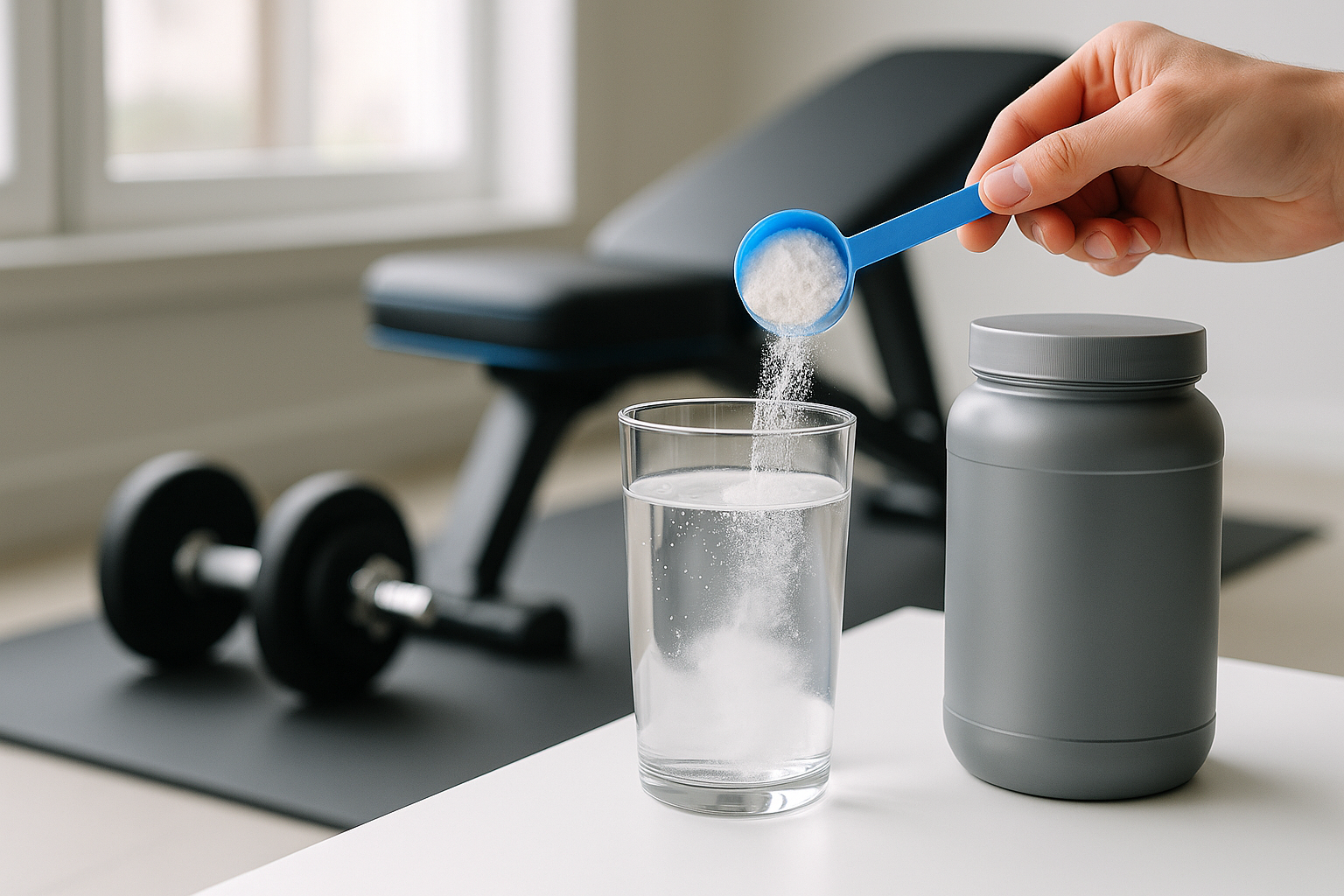
The best creatine protocol for healthy aging is simple: take creatine monohydrate every day, train with resistance regularly, and stay consistent for months rather than judging it after a few days. Consistency matters more than complicated timing tricks.
- Choose creatine monohydrate. Monohydrate is the most studied, most effective, and most cost-effective form. Fancy alternatives have not reliably outperformed it.
- Pick your dose. Most adults do well with 3 to 5 g per day. Larger bodies, more lean mass, or people training hard often use the top of that range.
- Decide whether to load. A loading phase of 20 g per day split into 4 doses for 5 to 7 days saturates muscle faster. If you skip loading and just take 3 to 5 g daily, full saturation usually takes several weeks instead.
- Take it every day. Creatine works by building up tissue stores, so rest days count too. Missing one day is not a disaster, but daily use is ideal.
- Pair it with resistance training. Two to four sessions per week of progressive strength training gives creatine the best chance to shine for aging muscle.
- Use a realistic timeline. With loading, some people notice body-weight changes and workout improvements within 1 to 2 weeks. Without loading, clear training benefits often become more obvious after 2 to 4 weeks, then compound over 8 to 12 weeks.
For a beginner over 50, a practical plan could look like this: 5 g creatine monohydrate once daily with breakfast, full-body resistance training three times weekly, and a simple habit tracker so you do not miss doses. If you are sensitive to stomach upset, take smaller divided doses or use 3 g daily and build from there.
How do you know it is working? The best signs are not dramatic. Look for one or more of these: extra reps at the same weight, less drop-off between sets, slightly faster strength progress, a modest early increase in scale weight from intramuscular water, and better long-term lean-mass retention. If you want a precise dose estimate, use our creatine dosage calculator or read how much creatine per day and how to take creatine.
Dose by body weight, goal, and training status
For most adults using creatine for aging, a maintenance dose of 3 to 5 g daily is enough, but body size, diet, and training goals can help you decide where to land in that range. The bigger question is usually not whether you need a special age-based dose, but whether you want faster saturation or simpler adherence.
Older age alone does not automatically require a higher dose. What matters more is muscle mass, habitual dietary creatine intake, and whether you are trying to support serious training or simply maintain baseline function. Larger adults and people carrying more lean mass often choose 5 g daily. Smaller adults with lighter training loads may do well with 3 g daily.
| Body weight / goal | Suggested daily dose | When it makes sense |
|---|---|---|
| Smaller adult under about 60 kg, general healthy aging | 3 g/day | Good for maintenance, simplicity, and minimising GI issues |
| Most adults 60 to 90 kg, training 2 to 4 times weekly | 3 to 5 g/day | Best all-purpose range for muscle and function |
| Larger adult over about 90 kg or higher lean mass | 5 g/day | Common practical ceiling for maintenance in real-world use |
| Anyone wanting faster saturation | 20 g/day for 5 to 7 days, split into 4 doses, then 3 to 5 g/day | Useful if you want quicker training effects |
If you are a vegetarian or vegan, you may be more likely to start with lower baseline stores because food sources of creatine are mainly animal-based. That does not change the standard dosing much, but it may affect how noticeable your response is. See is creatine vegan and creatine for vegetarians if that applies to you.
A few practical examples: a 55 kg woman starting basic strength training could begin with 3 g daily; a 78 kg man lifting three days a week could use 5 g daily; a 95 kg masters athlete preparing for a training block could use a loading phase, then settle at 5 g daily. If you want loading details, see our loading phase guide.
The key is not to overcomplicate creatine for age related decline. Most people do very well by taking one plain dose every day for the long term.
When to take creatine, how long it takes to work, and what to expect week by week
The best time to take creatine for healthy aging is the time you will remember every day, because total daily intake and long-term saturation matter more than exact timing. Whether you take it with breakfast, after training, or on a rest day at lunch is less important than doing it consistently.
That said, many people find it easiest to attach creatine to an existing routine, such as morning coffee, a protein shake, or a post-workout meal. Taking it with food can be gentler on the stomach for some users. If timing interests you, read when to take creatine and with or without food.
Here is a realistic timeline for creatine and aging:
- Days 1 to 7 with loading: Muscle stores rise quickly. You may notice a small increase in body weight from water being pulled into muscle, not fat gain.
- Weeks 2 to 4: Workouts may feel a bit stronger or less fatiguing, especially on repeated sets or higher-effort sessions.
- Weeks 4 to 8: Strength progress and training volume may improve more clearly if your program is solid.
- Weeks 8 to 12 and beyond: The main value shows up as accumulated better training, better lean-mass retention, and more resilience against age-related decline.
If you do not load, shift that timeline later by a few weeks. You are not losing the benefit; you are just arriving at saturation more slowly.
How can you tell creatine is working? The best markers are objective. Track the following: weights lifted, reps completed, walking or stair tolerance if you are using it for function, recovery between hard efforts, and changes in body composition over time. Creatine is not usually something you feel like caffeine. It is something you verify through better output and better adaptation.
If nothing seems to happen after 6 to 8 weeks, check the basics: Are you taking it daily? Are you using enough? Are you resistance training hard enough to create adaptation? Are you expecting a mental buzz rather than improved performance? Our guides on how long creatine takes to work and why creatine may not seem to be working can help troubleshoot.
Who should consider creatine after 40, 50, and 60
Creatine is worth considering for many adults after 40, but it is especially relevant for people trying to preserve muscle, train for strength, recover from inactivity, or maintain physical function as they age. It is not just for bodybuilders.
Beginners: Creatine can make sense right away if you are starting resistance training. You do not need to "earn" creatine by training for years first. If your goal is to build strength and protect muscle as you age, starting early is reasonable. See creatine for beginner strength trainers.
Older adults: Adults over 50 or 60 may benefit most when creatine is combined with a structured strength program. This is where creatine older adults aging searches usually lead: preserving lean mass, improving training quality, and helping daily function such as stair climbing, carrying groceries, and rising from a chair. Our dedicated creatine for older adults guide expands on this.
Women in perimenopause and menopause: Creatine may be especially useful when hormonal shifts make muscle retention, recovery, and body composition more challenging. It will not "bulk" women up by itself, but it can support better training outcomes. Relevant reads include creatine for women and creatine and menopause.
Masters athletes: Recreational and competitive athletes over 35 often use creatine to maintain power, repeated sprint ability, gym performance, and recovery quality. The older you get, the more valuable preserved explosiveness can become.
Vegetarians and vegans: Because dietary creatine comes mainly from meat and fish, plant-based adults may have lower baseline stores and potentially more room to benefit from supplementation.
People dieting or losing weight: During a caloric deficit, creatine can help preserve training quality and lean mass, which matters because age-related decline accelerates when people lose muscle during weight loss phases.
Who should be more cautious? People with pre-existing kidney disease, those under medical care for complex conditions, or anyone taking medications that affect kidney function should speak with a qualified clinician before supplementing. For most healthy adults, though, creatine is one of the more practical and evidence-based additions to an aging-support plan built around strength training, protein intake, sleep, and movement.
Safety, side effects, and the kidney question older adults always ask
Creatine monohydrate is generally considered safe for healthy adults at recommended doses, including long-term use, but side effects and medical context still matter. The biggest misunderstanding is that creatine automatically harms the kidneys; in healthy people, that claim is not supported by the best available evidence.
The ISSN position stand and later reviews have consistently reported that creatine monohydrate is safe when used appropriately in healthy populations. The 2021 JISSN review specifically addressed common misconceptions, including kidney fears, dehydration myths, and the mistaken belief that creatine is a steroid.
Here are the main side effects to actually watch for:
- Water-weight gain: Common, especially during loading. This is usually intramuscular water, not fat.
- Stomach upset or loose stools: More likely if you take too much at once. Splitting doses helps.
- Temporary bloated feeling: More common with large loading doses than with steady daily maintenance.
One point older adults should know: creatine can increase blood creatinine, which is a breakdown product often used in kidney-function blood tests. That does not automatically mean kidney damage. It can simply reflect greater creatine turnover. This is where confusion between creatine and creatinine causes unnecessary alarm. If you are having lab work, tell your clinician you are supplementing. Our guide on creatine vs. creatinine explains this clearly.
Who should talk to a clinician first? Anyone with diagnosed kidney disease, significantly reduced kidney function, a history of serious renal issues, or use of medications that may stress the kidneys should get personalised advice. The same applies if you are pregnant or breastfeeding, because the evidence base there is still limited.
Creatine does not need to be cycled, is not a steroid, and does not inherently dehydrate you. The International Olympic Committee's consensus on supplements also recognises creatine as one of the few supplements with strong evidence for performance-related use in sport. For a deeper review, read is creatine safe and the kidney guide.
Creatine anti-aging myths, debunked without the marketing
Most creatine anti-aging claims fail because they exaggerate what is proven, not because creatine is ineffective. Creatine is useful, but the honest version is better than the hype.
Myth 1: Creatine extends lifespan. There is currently no good human evidence proving creatine increases lifespan. Creatine and lifespan should be framed as an open question, not a solved one.
Myth 2: Creatine only helps young male lifters. False. Women, older adults, beginners, and masters athletes can all benefit. In fact, creatine may be especially relevant when age-related muscle decline becomes a concern.
Myth 3: Creatine is just water weight, so it does not really work. False. Early weight gain is often water inside muscle, but that does not cancel the performance and training benefits. Increased cell hydration is part of the physiological picture, not proof the supplement is fake.
Myth 4: Creatine damages kidneys in everyone. False. In healthy adults at recommended doses, this is not supported by the evidence. The confusion often comes from creatinine lab values, not clinical kidney injury.
Myth 5: Creatine makes you bulky or puffy in a bad way. Usually false. Some people gain a bit of scale weight from intramuscular water, but creatine does not force unwanted fat gain. If anything, it often supports better body composition when paired with training.
Myth 6: Older adults should avoid creatine because they are not athletes. False. Healthy aging is exactly where preserving strength, power, and functional capacity matters most.
Myth 7: You need exotic forms for brain or longevity benefits. False for now. Monohydrate remains the research standard. Specialty forms are often marketed harder than they are proven.
The most accurate framing is this: creatine for age related decline is a practical performance-and-function supplement with some intriguing broader health research, not a miracle longevity molecule. That is still a very good deal. For more myth-busting, visit creatine myths debunked and myths vs. facts.
How to choose the right creatine in Canada: form, quality, and label checks
The best creatine for aging in Canada is usually a plain creatine monohydrate powder with a clean ingredient list, an NPN on the label, and strong quality assurance. You do not need a special "senior" formula if the core ingredient and dose are right.
In Canada, many supplements are sold as Natural Health Products and carry an NPN, or Natural Product Number, which indicates the product has been licensed by Health Canada. An NPN is not a guarantee of perfection, but it is a useful compliance signal. Beyond that, look for third-party testing, lot transparency, or established brands with a track record for purity.
| What to check | Best choice | Why it matters |
|---|---|---|
| Form | Creatine monohydrate | Most studied and most cost-effective |
| Dose per serving | Clear grams listed, ideally 3 to 5 g | Makes accurate daily dosing easier |
| Ingredients | Unflavoured, minimal extras | Reduces fillers and digestive surprises |
| Regulatory label | NPN if sold as an NHP in Canada | Shows Health Canada product licensing pathway |
| Quality assurance | Third-party tested or brand transparency | Useful for purity and contamination confidence |
| Value | Compare cost per gram, not just tub price | Best way to compare real value |
If you are comparing monohydrate to HCl, buffered creatine, gummies, or capsules, keep the burden of proof in mind. Monohydrate still wins on evidence, price, and reliability. Capsules can be convenient but often cost more per gram. Gummies are easy to take but may be underdosed or expensive for the amount of creatine delivered.
For Canadian shoppers, our best creatine rankings, creatine brand reviews, and creatine product catalog can help you compare real options. If you want form-specific guidance, see best type of creatine and best creatine monohydrate in Canada.
The most common mistakes that make creatine seem useless
The most common reason creatine seems ineffective is not that creatine failed, but that the protocol, expectations, or training plan failed. A few avoidable mistakes account for most disappointing experiences.
- Taking it inconsistently: Creatine depends on saturation, so random use undermines results.
- Using too little: Tiny underdosed servings often do not maintain full stores, especially in larger adults.
- Stopping on rest days: Rest-day dosing still matters because muscle stores need to stay elevated.
- Expecting a stimulant effect: Creatine is not caffeine. You track it through performance and adaptation, not a buzz.
- Blaming normal water gain: Early scale changes are usually muscle water, not fat or "bad weight."
- Ignoring resistance training: Creatine helps most when there is a training signal to amplify.
- Buying based on marketing rather than evidence: Fancy forms often add cost, not results.
- Taking huge single doses: This raises the chance of GI distress without extra benefit.
Here is a quick troubleshooting sequence if your creatine for aging plan feels flat:
- Confirm you are using creatine monohydrate.
- Take 3 to 5 g every day for at least 4 to 8 weeks.
- If you want faster saturation, use a loading phase correctly.
- Train with progressive resistance at least twice weekly.
- Eat enough protein and total calories to support adaptation.
- Track objective outcomes like reps, loads, body weight, and circumference measures.
It is also worth remembering that baseline matters. Someone who already eats a lot of meat, trains well, and has high natural stores may notice subtler changes than a beginner, older adult, or vegetarian. That does not mean creatine is not helping; it may just be harder to perceive without data.
If you suspect you are a weak responder, see creatine non-responders, common creatine mistakes, and realistic creatine results.
Bottom line: is creatine worth taking for healthy aging?
Yes, creatine is worth considering for healthy aging if your goal is to preserve muscle, support strength training, and maintain physical function, but it should be viewed as a support tool rather than a standalone anti-aging cure. The strongest case for creatine and aging is improved muscle-related outcomes, especially when combined with resistance training.
If you are over 40 and want the simplest evidence-based plan, it is this: take creatine monohydrate daily, lift weights or do other resistance exercise several times per week, eat enough protein, and evaluate progress over months. That combination is far more meaningful than chasing miracle longevity claims.
For brain health, mood, bone, and broader creatine longevity discussions, the research is intriguing and worth watching, but it is still less definitive than the muscle data. Creatine may help support healthy aging through better energy availability and better training outcomes, and those effects matter in the real world even if they do not translate into a proven lifespan increase.
The practical verdict is straightforward:
- If you want a supplement with one of the best evidence bases in sports nutrition, creatine qualifies.
- If you want something specifically useful against age-related muscle decline, creatine is one of the top options.
- If you want a guaranteed anti-aging or lifespan supplement, the evidence is not there.
That balance is exactly why creatine has become so relevant beyond the gym. It is not exciting because it promises the impossible; it is valuable because it reliably helps with something aging adults actually need: preserving the capacity to move, train, and stay strong.
If you are ready to start, use our creatine dosage calculator and browse the product catalog for straightforward monohydrate options.
Creatine and Healthy Aging: The Numbers That Matter
- 3–5 g/day Standard maintenance dose — The most common evidence-based daily dose for long-term use.
- 20 g/day Typical loading dose — Usually split into 4 doses for 5–7 days to saturate faster.
- 5–7 days Time to load muscle stores — A loading phase speeds up saturation compared with daily low-dose use.
- 2–4 weeks Common window to notice training benefits without loading — Fuller effects often become clearer over 8–12 weeks with resistance training.
Frequently Asked Questions
Is creatine good for aging?
Yes, creatine can be good for aging because it helps support muscle strength, training capacity, and lean-mass retention, especially when paired with resistance exercise. The strongest evidence is for physical-function benefits rather than true anti-aging in the sense of slowing biological age or extending lifespan.
Does creatine help older adults build or keep muscle?
Yes, creatine helps older adults build or keep muscle best when combined with resistance training. On its own, the effect is more modest, but with lifting or other progressive strength work, creatine can improve training quality and help offset age-related muscle loss over time.
Can creatine improve brain function as you age?
Possibly, but the evidence is less consistent than it is for muscle. Creatine may support brain energy metabolism and could help certain cognitive tasks or mental fatigue in some people, especially under stress, low dietary creatine intake, or older age, but it is not a guaranteed brain booster.
Is creatine anti-aging or does it increase lifespan?
Creatine is not proven to be an anti-aging or lifespan-extending supplement in humans. A more accurate statement is that creatine may support healthy aging by preserving physical function and possibly some aspects of cognitive energy support, which can improve quality of life as you get older.
How much creatine should a person over 50 take?
Most people over 50 do well with 3 to 5 g of creatine monohydrate per day. A loading phase of 20 g per day split into 4 doses for 5 to 7 days is optional if you want faster saturation, but daily maintenance dosing is perfectly effective if used consistently.
Is creatine safe for seniors?
Creatine is generally safe for healthy seniors at recommended doses, but individual medical context matters. Seniors with kidney disease, reduced renal function, or medications that affect kidney health should talk with a clinician before starting, because lab interpretation and clinical risk need personalised review.
Does creatine help with sarcopenia?
Yes, creatine can help as part of a sarcopenia strategy because it supports the muscle and strength gains produced by resistance training. It is not a stand-alone cure for sarcopenia, but it is one of the more evidence-based supplements for improving the results of strength-focused exercise in older adults.
Will creatine make older adults gain weight?
Creatine can make older adults gain a small amount of body weight early on, but this is usually water stored inside muscle rather than fat gain. That effect is often more noticeable during a loading phase and is generally part of how creatine increases intramuscular stores.
Should older adults take creatine every day or only on workout days?
Older adults should take creatine every day, not just on workout days, because creatine works by keeping tissue stores elevated over time. Rest-day use helps maintain saturation, and daily consistency is more important than exact workout timing.
What is the best type of creatine for healthy aging?
Creatine monohydrate is the best type of creatine for healthy aging because it is the most studied, the most consistently effective, and usually the best value. Other forms may be marketed as superior, but they have not reliably outperformed monohydrate in the evidence.