Revolution Nutrition Creatine Review: Canadian Brand Worth It?
By The Creatine Canada Research Team — Evidence-based supplement analysts
Yes—Revolution Nutrition creatine can be a perfectly good buy in Canada if the product is plain creatine monohydrate, properly labelled, and competitively priced, but it is not automatically better than other monohydrate powders. The real question is not the logo on the tub; it is whether you are getting enough pure creatine monohydrate per dollar, with clear dosing, Canadian-compliant labelling, and quality signals you can verify.
Evidence-based · Cites 4 sources · Editorial standards
Key Takeaways
- Revolution Nutrition creatine is worth considering if it is simple creatine monohydrate with no underdosing or unnecessary add-ons.
- Creatine monohydrate remains the gold-standard form; most alternative forms do not outperform it in real-world results.
- The evidence-based daily dose for most adults is 3-5 g per day, every day, not just on training days.
- A loading phase of 20 g per day split into 4 doses for 5-7 days works faster, but it is optional.
- For Canadian buyers, check for an NPN, a transparent ingredient panel, and ideally third-party testing or clear purity claims.
- If a Revolution Nutrition tub costs materially more than comparable monohydrate without better testing or certification, the premium is hard to justify.
- If you get stomach upset, smaller doses, better mixing, and taking creatine with food usually solve the problem.
Revolution Nutrition creatine review: the short answer for Canadian buyers
Revolution Nutrition creatine is good if it is standard creatine monohydrate at a fair price, but the brand alone does not make it superior. For most people searching revolution nutrition creatine review, the practical answer is simple: if the tub provides a full evidence-based serving of creatine monohydrate, has clear Canadian labelling, and is priced competitively against other monohydrate products, it should work just as well as any other properly made monohydrate.
That matters because creatine is not like a pre-workout where formula design can vary wildly. Once you are buying plain creatine monohydrate, the main differences are usually:
- price per gram
- purity and testing transparency
- mixability and texture
- whether it is flavoured, micronized, or plain
- whether the label is clear and compliant for sale in Canada
In other words, the question is Revolution Nutrition creatine good? should really be broken into smaller questions:
- Is it actually creatine monohydrate?
- Does one serving deliver a meaningful dose, usually 3-5 g?
- Is the ingredient list clean and easy to understand?
- Can you verify quality through an NPN, batch information, or third-party testing?
- How does its cost compare with the options in our best creatine rankings and broader creatine brand reviews?
If the answer to those is yes, then Revolution creatine in Canada can be a solid, convenient choice. If the product is flavoured, blended, or padded with extras that raise the cost without improving outcomes, then it may be less attractive than a simpler monohydrate powder.
The big point is that creatine results come from muscle saturation, not branding. Saturation means building up enough creatine inside muscle to support faster ATP recycling during short, hard efforts. As the 2017 ISSN position stand concluded, creatine monohydrate is the most effective ergogenic nutritional supplement currently available for increasing high-intensity exercise capacity and lean mass during training.
So our verdict is measured, not dramatic: Revolution Nutrition creatine monohydrate is likely worth it if the label, dose, and value check out. If you want a broader benchmark before buying, compare it with our creatine product catalog and use the creatine dosage calculator to make sure the serving size matches your actual needs.
What Revolution Nutrition creatine monohydrate should be doing in your body
Revolution Nutrition creatine monohydrate works for the same reason any quality creatine monohydrate works: it increases muscle phosphocreatine stores, which helps your body regenerate ATP faster during short, intense exercise. ATP, or adenosine triphosphate, is the immediate energy currency your muscles use for explosive work like sprinting, jumping, and heavy sets of 3-10 reps. Phosphocreatine is the stored form of creatine in muscle that donates a phosphate group to help rebuild ATP quickly.
That mechanism is why creatine is most useful for:
- strength training
- power sports
- repeated sprint efforts
- high-intensity interval work
- preserving training quality during hard blocks
If your Revolution Nutrition product is plain monohydrate, it is not relying on a novel or proprietary pathway. It is using the same well-established mechanism that has made monohydrate the reference standard for decades. According to the ISSN position stand and the IOC consensus on supplements, creatine is one of the best-supported supplements for improving high-intensity performance when paired with training.
What does that look like in the gym? Once muscle stores are saturated, many users notice:
- slightly more reps before fatigue
- better repeat effort across sets
- small increases in strength over time
- faster progress from training because quality and volume improve
- a fuller muscle look from increased intracellular water
The phrase revolution creatine quality therefore should not be judged by hype claims like “explosive pumps” or “instant gains.” It should be judged by whether the product reliably helps you reach the proven biological target: muscle creatine saturation.
Creatine monohydrate does not work like caffeine. It is not a stimulant, and you should not expect a same-day buzz. It is more like topping up a fuel reserve. Daily use gradually raises muscle stores, and the benefit shows up in training output over days to weeks.
There is also nuance. Creatine helps most with repeated high-power efforts, but it is not magic for purely steady-state endurance. It can still help some endurance athletes during surges, sprints, or heavy gym work, but the benefit is more context-dependent. If you want the broad beginner foundation before choosing any brand, see what creatine is and what it does and our guide to creatine benefits.
Bottom line: if Revolution Nutrition creatine contains real creatine monohydrate in a meaningful dose, the science behind how it works is strong. The remaining question is whether the product is well-executed and fairly priced.
How to judge Revolution creatine quality in Canada before you click buy
The best way to evaluate Revolution Nutrition creatine in Canada is to read the label like a buyer, not like a fan. Brand reputation can help, but the tub itself should answer the most important quality questions. For Canadian shoppers, that means checking product form, dose clarity, label compliance, and testing transparency.
- Confirm the form. The front or supplement facts should say creatine monohydrate. If it is a “blend,” ask what each ingredient is adding beyond monohydrate, because most alternatives do not have stronger evidence.
- Check the dose per serving. A useful maintenance serving is usually 3-5 g daily. If a scoop is much smaller, you may need multiple scoops. If it is a flavoured product, verify that flavouring has not displaced too much active creatine.
- Scan the ingredient list. Plain unflavoured creatine should ideally contain only creatine monohydrate. Flavoured versions may contain sweeteners, acids, or anti-caking agents, which is not automatically bad, but it changes value and simplicity.
- Look for Canadian compliance. In Canada, many natural health products carry an NPN, or Natural Product Number, indicating authorization under Health Canada rules. An NPN does not prove superiority, but it is a useful legitimacy signal.
- Look for testing claims you can verify. Third-party testing, banned-substance screening, or raw material purity claims matter more for competitive athletes than marketing slogans do.
- Compare cost per gram, not tub size. A larger tub can still be a worse deal if servings are small or the formula is diluted.
Here is a practical buyer’s lens for revolution nutrition creatine monohydrate in Canada:
| Checkpoint | What you want to see | Why it matters |
|---|---|---|
| Form | Creatine monohydrate | Most studied and most cost-effective form |
| Dose | 3-5 g per daily serving, or clearly scalable | Matches evidence-based maintenance intake |
| Ingredient list | Minimal extras, especially in unflavoured tubs | Cleaner formula and easier value comparison |
| NPN | Present where applicable | Useful Canadian compliance signal |
| Testing | Third-party or raw-material purity disclosure | Helps reduce contamination concerns |
| Price | Competitive cost per gram | Monohydrate should not command a huge premium |
If you are an athlete in a tested sport, certification or stronger contamination controls deserve extra weight. The IOC consensus on dietary supplements specifically emphasizes product quality assurance because contamination risk is a real issue in sport.
If Revolution Nutrition checks these boxes, it can absolutely be a smart buy. If not, compare against best creatine rankings, creatine brand reviews, and our guides on third-party tested creatine in Canada and how to choose creatine.
How to take Revolution Nutrition creatine properly for results you can actually notice
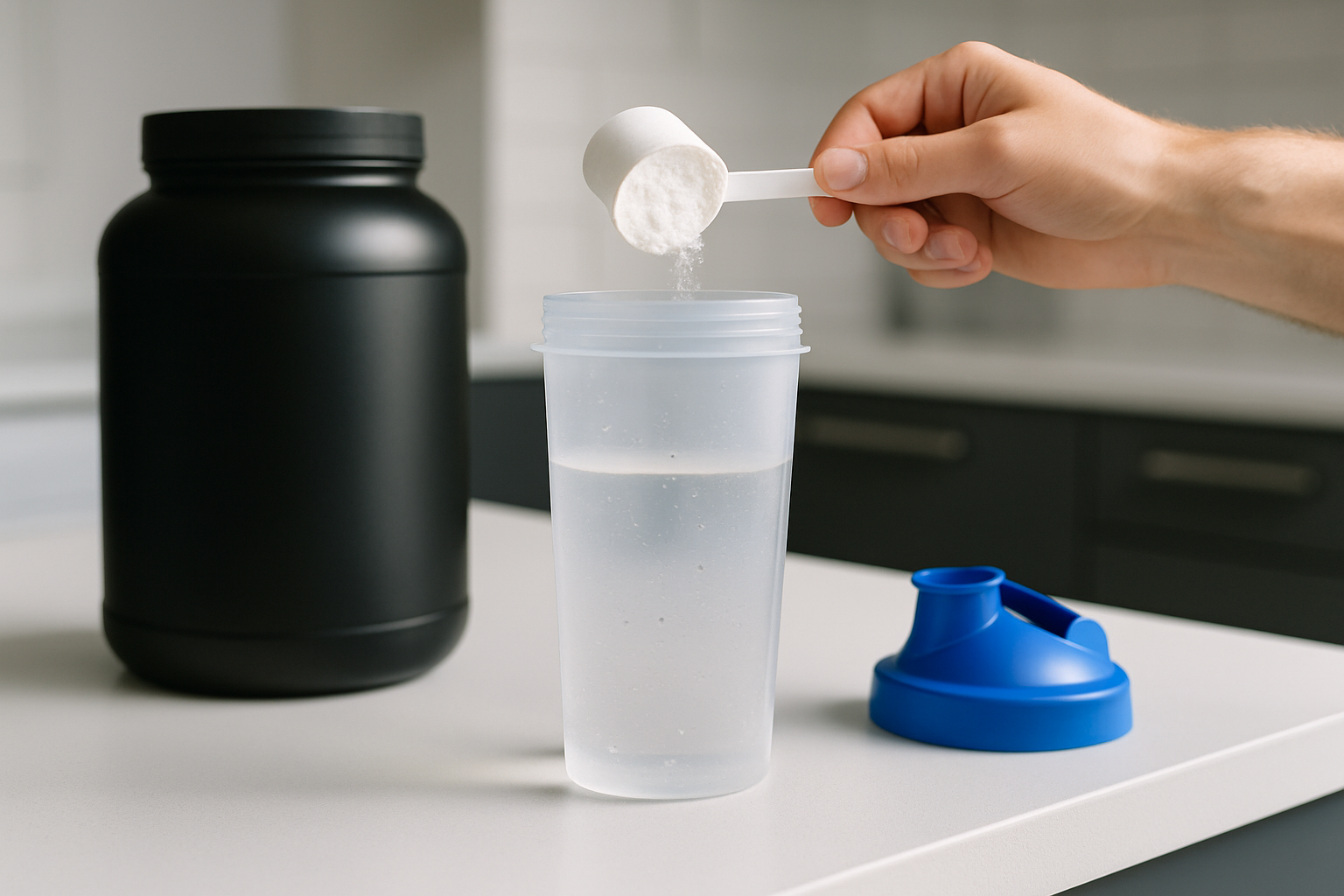
The best way to take Revolution Nutrition creatine is 3-5 g daily, every day, mixed in water or another drink, with or without food. Consistency matters more than timing. Many disappointing creatine reviews are really dosing or compliance problems, not product failures.
Use this simple step-by-step protocol:
- Pick your dose. Most adults do well with 3-5 g per day. Larger athletes and hard trainers often prefer 5 g daily.
- Decide whether to load. If you want faster saturation, take 20 g per day split into 4 doses of 5 g for 5-7 days, then drop to 3-5 g daily. If you do not load, daily saturation typically takes a few weeks longer.
- Take it daily. Use it on workout days and rest days. Skipping non-training days slows saturation maintenance.
- Mix it well. Stir into water, juice, or a shake. Warm liquid can improve dissolving if the powder is gritty.
- Take it with a meal if your stomach is sensitive. This often reduces bloating or GI discomfort.
- Track training, not just body weight. Look for more reps, steadier performance across sets, and gradual strength progress.
A realistic week-by-week expectation looks like this:
- Days 1-7 with loading: possible 0.5-1.5 kg increase in body weight from intracellular water, plus an early “fuller” muscle feel.
- Weeks 2-4: better repeat effort and subtle strength improvements become easier to notice in training logs.
- Weeks 4-8 without loading: similar benefits emerge more gradually once saturation catches up.
- Months 2-3: the biggest payoff is often cumulative, because higher training quality supports better long-term adaptation.
Timing is a smaller issue than many people think. Taking creatine after training, before training, or at another consistent time of day is fine. If a schedule helps you remember it, that schedule is the right one. For a deeper dive, see how to take creatine, when to take creatine, and creatine on rest days.
If you bought Revolution Nutrition creatine and want to know whether it is “working,” do not wait for a dramatic feeling. Creatine is doing its job if your training volume, repeated effort, or strength trend improves over time. That is especially true if your sleep, protein intake, and program are already in reasonable shape.
One last practical tip: use an actual gram scoop when possible. Label scoops vary, and powder density can shift with clumping. Our creatine dosage calculator and how to measure creatine guide can help you get the dose right.
The right dose by body weight, training goal, and whether you want to load
For most people using Revolution Nutrition creatine monohydrate, 3-5 g daily is the correct maintenance dose, while a loading phase is optional and only speeds up saturation. You do not need a complicated brand-specific protocol. You need a reliable, evidence-based dose.
The ISSN position stand supports two standard approaches:
- Loading protocol: 20 g per day, usually as 4 doses of 5 g, for 5-7 days; then 3-5 g per day.
- No-loading protocol: 3-5 g per day from the start; this reaches saturation more slowly, typically over about 3-4 weeks.
Body size can influence where you sit inside that range. Here is a practical framework:
| Body weight | General daily maintenance | Optional loading phase | Best fit |
|---|---|---|---|
| Under 60 kg | 3 g/day | 20 g/day split doses for 5-7 days if faster results desired | Beginners, lighter athletes, general fitness |
| 60-90 kg | 3-5 g/day | 20 g/day split doses for 5-7 days | Most gym-goers |
| Over 90 kg | 5 g/day | 20 g/day split doses for 5-7 days | Larger lifters, strength athletes |
Now match the dose to your goal:
- Muscle and strength: 5 g/day is a simple default if you are training hard 3-6 days per week.
- General fitness or beginner use: 3 g/day is often enough, especially for smaller individuals.
- Older adults: 3-5 g/day is commonly used, ideally paired with resistance training.
- Vegetarians or vegans: 3-5 g/day is still the rule, though response can be especially noticeable because baseline stores may be lower.
- Athletes needing rapid saturation: use the loading phase if a competition block or training camp is near.
What about women? The dose is not “female-specific” so much as size- and goal-specific. Many women do very well with 3-5 g/day. If body size is smaller and the goal is general wellness plus training support, 3 g/day can be a perfectly sensible place to start. See creatine for women and creatine for older adults for more context.
The most common error is underdosing. If a flavoured Revolution creatine product provides less than 3 g per scoop, one scoop may not be enough. The second common error is inconsistency. A perfect dose taken three days a week is less effective than a decent dose taken daily.
If you want a personalised estimate, use our creatine dosage calculator or read how much creatine per day and creatine loading phase.
Who should buy Revolution Nutrition creatine—and who should look harder at testing
Revolution Nutrition creatine can suit beginners, women, older adults, and recreational lifters well, but competitive athletes should scrutinize testing standards more closely. The product category itself is broadly useful; the question is whether this specific brand matches your risk tolerance and buying priorities.
It is likely a sensible option for:
- Beginners: plain monohydrate is the easiest, cheapest, and most evidence-based place to start.
- Recreational lifters: if you want better gym performance without complicated stacks, monohydrate covers the basics.
- Women: creatine is not a “male” supplement, and daily monohydrate can support strength, training quality, and lean mass goals without being a hormone product.
- Older adults: when paired with resistance training, creatine may help support muscle function and training adaptations across ageing.
- Vegetarians and vegans: supplemental creatine is often especially worthwhile because dietary intake is typically lower.
Canadian shoppers often search revolution creatine Canada because they want a familiar domestic retail option. That convenience can be valuable. Shipping speed, easier returns, and local availability are legitimate reasons to choose one decent monohydrate over another.
However, some groups should be stricter:
- Drug-tested athletes: if you play varsity, elite amateur, or professional sport, third-party certification or stronger contamination controls may matter more than saving a few dollars.
- People with sensitive digestion: micronized or very fine monohydrate may be easier to mix and tolerate, though the active ingredient is still the same.
- People with medical conditions or on medication: creatine is widely considered safe for healthy people, but you should still check with a healthcare professional if you have kidney disease, are pregnant, breastfeeding, or take relevant medications. We cover that in is creatine safe and who should not take creatine.
The 2021 JISSN paper on common questions and misconceptions about creatine notes that many fears around creatine are overstated, including misconceptions about dehydration, cramping, and kidney harm in healthy users. You can read it here: Antonio et al. (2021), Common questions and misconceptions about creatine supplementation.
So, is Revolution Nutrition creatine good for you personally? Probably yes if you are a general fitness user who wants a straightforward monohydrate in Canada. Maybe not your best match if you are a tested athlete and the product does not provide the strongest certification or purity assurances available.
Safety, water weight, bloating, and kidney myths: what this creatine review needs to say clearly
Creatine monohydrate is well-supported as safe for healthy people at standard doses, and the most common side effects are mild water-weight gain or stomach upset from poor dosing habits. That applies to Revolution Nutrition creatine if it is standard monohydrate used appropriately.
The strongest evidence-based points are straightforward:
- Water weight is common. Early scale increases usually reflect more water inside muscle cells, not body fat.
- GI upset is usually dose-related. Large single servings, especially during loading, are the usual trigger for diarrhea, cramping, or stomach discomfort.
- Creatine is not a steroid. It is a naturally occurring compound involved in energy metabolism.
- Healthy kidneys are not the same as elevated creatinine on a lab test. Creatinine is a breakdown product and can rise slightly with creatine use, which can confuse bloodwork interpretation without indicating damage.
The ISSN position stand concluded that creatine monohydrate is not only effective but also safe when used as directed in healthy populations. The 2021 JISSN review similarly addressed frequent misconceptions, noting that evidence does not support many popular internet fears.
What should you expect in practice?
- First week: possible bodyweight increase from water retention in muscle.
- If you load: higher chance of temporary stomach upset unless you split the dose.
- If you take it dry or in one giant scoop: more chance of discomfort than if you dissolve it and take normal servings.
Best troubleshooting steps:
- Drop to 3-5 g once daily if loading bothers your stomach.
- Take it with food.
- Use more water and mix more thoroughly.
- Avoid “hero dosing.” More is not better once daily needs are met.
What about specific myths?
- Hair loss: evidence is limited and does not justify claiming creatine causes hair loss in typical users.
- Dehydration and cramps: research does not support the idea that creatine inherently dehydrates you when used normally.
- Kidney damage in healthy users: this is one of the most persistent myths, but current evidence does not support it in healthy individuals at recommended doses.
For a deeper look, read creatine myths debunked, is creatine bad for your kidneys, does creatine cause bloating, and creatine digestive side effects.
If you have kidney disease, are pregnant or breastfeeding, or have a medical reason to monitor renal markers closely, speak with a qualified healthcare professional before use. That is not alarmism; it is basic good practice.
Why some people think Revolution Nutrition creatine is not working

When people say a creatine product is not working, the most common causes are underdosing, inconsistency, unrealistic expectations, or judging the product by feel instead of performance. This is true for Revolution Nutrition creatine reviews just as much as any other brand.
Here are the biggest mistakes:
- Taking it only on workout days. Creatine works by maintaining saturation, so rest-day use matters.
- Using too little. If one flavoured scoop provides less than 3 g, you may be underdosing.
- Expecting a stimulant effect. Creatine does not give a caffeine-like surge.
- Quitting after one week without loading. Without a loading phase, meaningful saturation takes longer.
- Ignoring training quality. Creatine supports hard training; it does not replace it.
- Dry scooping or mega-dosing. These habits increase discomfort without improving outcomes.
A few myths also distort brand reviews:
- “This form is more advanced than monohydrate.” In most cases, evidence still favours monohydrate for efficacy, cost, and depth of research.
- “You must cycle creatine.” There is no evidence-based requirement to cycle on and off.
- “Creatine makes you puffy with bad weight.” It usually increases intracellular water, which is not the same as gaining fat.
- “If it clumps, it is fake.” Mild clumping can simply reflect moisture exposure; storage matters.
So how do you tell if your Revolution Nutrition creatine is actually helping?
- your body weight may rise modestly early on
- you recover slightly better between hard sets
- your final reps stay stronger
- your training log trends upward over several weeks
If none of those are happening after 4-6 weeks of consistent use, re-check the basics:
- Are you taking 3-5 g every day?
- Are you resistance training hard enough to reveal a benefit?
- Are you sleeping enough and eating enough protein?
- Is the scoop size actually what the label says?
Some people do appear to respond less dramatically than others, often because their baseline muscle creatine stores were already relatively high, but true “non-response” is frequently overstated. For more help, see creatine not working, creatine non-responders, and common creatine mistakes.
That is why a fair revolution nutrition creatine review has to separate product quality from user error. If the label is sound and your protocol is wrong, the tub is not the problem.
Revolution Nutrition vs other creatine options in Canada: where it wins and where it does not
Revolution Nutrition creatine is most compelling when it matches other Canadian monohydrate products on purity and dose while offering better convenience or price, but it is less compelling if you pay a premium without getting stronger quality assurances. Because creatine monohydrate is a mature category, product comparison is mostly a value and trust exercise.
Here is the fairest way to compare Revolution creatine in Canada:
| Buying factor | When Revolution Nutrition is a good pick | When another brand may be better |
|---|---|---|
| Ingredient simplicity | It is plain monohydrate with minimal extras | You want a cleaner or more transparent unflavoured formula |
| Price per gram | It is equal to or cheaper than comparable monohydrate tubs | Another brand offers meaningfully lower cost per gram |
| Testing confidence | The product provides credible purity or testing information | You need NSF, Informed Sport, or stronger athlete-focused certification |
| Canadian availability | It is easy to buy locally or ships quickly in Canada | You are willing to order elsewhere for better value |
| Mixability | The powder is micronized or dissolves well enough for daily use | You strongly prefer ultra-fine texture or capsule convenience |
For the average gym-goer, the hierarchy usually looks like this:
- plain monohydrate first
- fair cost per gram second
- testing and transparency third
- flavour or texture last
For competitive athletes, move testing and certification much higher. Convenience is nice, but contamination control is more important than saving a few dollars.
This is also where many branded creatines lose their edge. If Revolution Nutrition creatine monohydrate costs more than comparable monohydrate because of flavouring, influencer branding, or oversized packaging, that premium may not buy you any extra physiological benefit. Creatine monohydrate does not become more effective because the label is louder.
On the other hand, Canadian buyers may reasonably choose Revolution if:
- you want domestic availability
- you can buy it without cross-border shipping issues
- the company provides solid customer service
- the product is often discounted locally
If you want side-by-side alternatives, browse our best creatine rankings, brand reviews, and comparison guides like best creatine monohydrate in Canada, cheapest creatine in Canada, and creatine cost per gram.
The simplest buying rule is this: choose the cheapest trustworthy monohydrate that meets your quality bar. If Revolution Nutrition meets that bar for you, it is absolutely defensible. If not, there are plenty of equally effective monohydrate options.
A Canadian buyer’s checklist for Revolution creatine: NPNs, retailers, and what to verify
In Canada, the smartest way to buy Revolution Nutrition creatine is to verify the label, confirm the seller, and avoid treating marketplace listings as equal to direct or established retail listings. This matters because the supplement itself may be simple, but where and how you buy it still affects confidence.
Use this checklist before purchasing:
- Check for an NPN where applicable. An NPN, or Natural Product Number, is a Health Canada identifier for authorized natural health products. It is not the only quality signal, but it is a meaningful one for Canadian consumers.
- Buy from a reputable retailer. Direct brand stores and established Canadian supplement retailers generally provide better lot control and return policies than anonymous marketplace sellers.
- Review serving size carefully. Some listings emphasize tub weight more than actual grams of creatine per scoop.
- Inspect flavour variants closely. Flavoured creatine can be fine, but you should verify how much active creatine each serving actually contains.
- Look for lot numbers, expiry dates, and sealed packaging. These are basic but important trust markers.
- Compare shipping costs. A cheap tub with expensive shipping may not be a cheap tub.
Canadian context matters for another reason: importing supplements can add hassles, extra cost, or customs uncertainty. If Revolution creatine Canada availability is strong and the price is reasonable, local supply can be a meaningful advantage over international brands.
That said, do not confuse easy availability with elite quality. Availability is a convenience factor, not a performance factor. Quality still comes back to:
- the exact ingredient
- dose accuracy
- purity confidence
- seller legitimacy
If you are new to reading labels, our guides on how to read a creatine label, Canadian supplement regulations, and buying creatine online in Canada will help. You can also compare local options using creatine product catalog and where to buy creatine in Canada.
One final rule: if a listing is vague about ingredients, dosage, or seller identity, skip it. Creatine monohydrate is too common and too well understood to justify buying from a page that does not answer basic questions clearly.
For most Canadians, the best purchase is not the most exciting one. It is the cleanest monohydrate from the most trustworthy seller at the best usable price.
Bottom line: is Revolution Nutrition creatine worth it?
Yes, Revolution Nutrition creatine is worth it if you are buying plain creatine monohydrate with a clear 3-5 g serving, solid Canadian labelling, and a competitive price—but it is not inherently better than other good monohydrate products. That is the honest conclusion from both the science and the buyer’s perspective.
If you came here wanting a simple answer to is Revolution Nutrition creatine good, here it is: it should work well if it is real monohydrate and you take it properly. The mechanism, benefits, and safety profile come from creatine monohydrate itself, not from a special brand effect.
Choose it if:
- you want a familiar Canadian option
- the ingredient list is simple
- the dose is evidence-based
- the price per gram is competitive
- you are comfortable with the brand’s testing transparency for your needs
Look harder at alternatives if:
- it is more expensive than comparable monohydrate for no clear reason
- the flavoured version delivers less active creatine per scoop
- you are a tested athlete who wants stronger certification
- the product listing is vague on dosage, lot info, or quality controls
For actual results, keep the protocol boring and consistent:
- take 3-5 g daily
- load only if you want faster saturation
- use it on rest days too
- judge success by training output over weeks, not by an immediate sensation
If you want the next step, compare Revolution against our best creatine rankings, use the creatine dosage calculator, and read creatine for beginners or the complete creatine guide before buying.
Revolution Nutrition creatine can be a good buy in Canada, but only if the fundamentals are right: monohydrate, correct dose, trustworthy labelling, and fair value.
That is ultimately how every serious creatine review should end—not with hype, but with a clear standard you can use on any tub you pick up.
Revolution Nutrition Creatine Review: The Numbers That Actually Matter
- 3-5 g/day Standard maintenance dose — Appropriate for most adults using creatine monohydrate.
- 20 g/day Optional loading dose — Typically split into 4 doses for 5-7 days to saturate faster.
- 5-7 days Time to load quickly — Fastest standard route to near-full muscle saturation.
- 3-4 weeks Time without loading — Typical timeline to reach similar saturation using daily maintenance only.
Frequently Asked Questions
Is Revolution Nutrition creatine good?
Yes, Revolution Nutrition creatine can be good if the product is straightforward creatine monohydrate with a full 3-5 g serving and fair pricing. The key is not the brand name alone but whether the formula is plain monohydrate, clearly labelled, and sold by a trustworthy Canadian retailer.
What type of creatine is Revolution Nutrition creatine?
The best Revolution Nutrition creatine option to buy is creatine monohydrate, because monohydrate is the most studied and most cost-effective form. If a specific product is a flavoured or blended version, read the label carefully to confirm how many grams of actual creatine monohydrate you get per serving.
How much Revolution Nutrition creatine should I take per day?
Most adults should take 3-5 g of Revolution Nutrition creatine per day. A larger athlete or someone training hard may prefer 5 g daily, while smaller individuals often do well at 3 g, as long as the dose is taken consistently every day.
Do I need to load Revolution Nutrition creatine?
No, you do not need to load Revolution Nutrition creatine, but loading works faster. A standard loading phase is 20 g per day split into 4 doses for 5-7 days, after which you continue with 3-5 g daily; otherwise, taking 3-5 g daily from the start usually reaches saturation in about 3-4 weeks.
Is Revolution creatine safe?
Yes, creatine monohydrate is generally considered safe for healthy people at recommended doses, and that applies to Revolution creatine if it is standard monohydrate. The most common issues are mild water-weight gain or stomach upset from taking too much at once, while people with medical conditions should check with a healthcare professional.
Does Revolution Nutrition creatine cause bloating?
Revolution Nutrition creatine may cause some people to feel bloated, especially if they load aggressively or take large single doses, but this is usually manageable. Most early weight gain from creatine reflects more water stored inside muscle cells rather than fat gain, and smaller servings with food often reduce discomfort.
How long does Revolution Nutrition creatine take to work?
Revolution Nutrition creatine usually starts working once muscle creatine stores rise enough to improve repeated high-intensity effort, which often takes 5-7 days with loading or about 3-4 weeks without loading. You are more likely to notice better performance in the gym than an immediate physical sensation.
Is Revolution creatine better than other brands in Canada?
Revolution creatine is not automatically better than other brands in Canada if all are selling plain creatine monohydrate. The deciding factors are usually price per gram, testing transparency, mixability, retailer trust, and whether the label provides a full evidence-based dose.
Can beginners use Revolution Nutrition creatine?
Yes, beginners can absolutely use Revolution Nutrition creatine, and plain creatine monohydrate is often the best first supplement to try. A simple daily dose of 3-5 g is usually enough, and beginners should focus on consistency, hydration, and tracking training progress rather than searching for an immediate feeling.
What should I look for when buying Revolution creatine in Canada?
When buying Revolution creatine in Canada, look for creatine monohydrate, a clear 3-5 g serving, a legitimate seller, and Canadian-compliant labelling such as an NPN where applicable. Also compare cost per gram and check whether the product offers any verifiable testing or purity information.