How to Store Creatine: Fridge, Pantry, Silica Gel, and Containers Explained
By The Creatine Canada Research Team — Evidence-based supplement analysts
How to store creatine properly is simple: keep creatine powder tightly sealed in a cool, dry, dark place, and do not leave it sitting mixed in liquid for long periods. Heat, moisture, and time in water can gradually reduce quality, while good storage habits help keep creatine fresh, stable, and as potent as the label intends.
Evidence-based · Cites 4 sources · Editorial standards
Key Takeaways
- Store creatine powder in its original, tightly sealed container in a cool, dry cupboard away from sunlight and steam.
- Moisture is the main enemy of stored creatine powder because it causes clumping and can speed degradation over time.
- Mixed creatine is best consumed soon after preparation rather than left in water for hours or days.
- Do not store creatine beside kettles, stoves, dishwashers, or in a humid bathroom cabinet.
- A hard clump does not always mean the creatine is unsafe, but it often means moisture got in and storage needs improving.
- Creatine monohydrate is the most studied form, and the same basic storage rules apply to micronized powder, capsules, and gummies.
- If you want the easiest routine, scoop with a dry utensil, reseal immediately, and finish mixed drinks the same day.
The direct answer: the best way to store creatine at home
The best way to store creatine is to keep it cool, dry, dark, and tightly sealed between uses. If you only remember one rule, remember this: storing creatine powder properly means protecting it from moisture first, heat second, and light third.
For most people, the ideal storage spot is a kitchen cupboard, pantry shelf, or drawer that stays at normal room temperature and is far from steam, direct sun, and frequent temperature swings. A bedroom drawer or home office cabinet can also work well if it stays dry. The worst common spots are right beside the kettle, above the stove, on a sunny windowsill, in a hot car, or in a bathroom medicine cabinet where repeated humidity exposure can seep into the container.
Creatine monohydrate is fairly stable in dry powder form, which is one reason it remains the most practical and cost-effective choice. The storage issue is not that dry creatine is unusually fragile; the issue is that once powder repeatedly contacts humidity or sits dissolved in liquid, it has more opportunity to slowly convert into creatinine, a breakdown product. That is why day-to-day handling matters almost as much as where you keep the tub.
Use these basic storage rules every time:
- Keep the lid screwed on firmly right after scooping.
- Use a completely dry scoop or spoon.
- Do not shake condensation from a wet bottle or wet hands near the open tub.
- Leave the silica or desiccant packet in the container if the product includes one, unless the label says otherwise.
- Store the package in the original container or another airtight food-safe container.
If you are new to supplementation, good storage is only one part of getting creatine right. Your daily amount still matters more than the exact shelf location, so pair this guide with our creatine dosage calculator and step-by-step guide on how to take creatine.
In plain terms, keep creatine fresh by keeping it dry, sealed, and out of heat. That simple routine is enough for the vast majority of Canadian lifters, athletes, and beginners using creatine at home.
Why creatine storage matters: what heat, water, and humidity actually do
Creatine storage matters because creatine is most stable as a dry powder and less stable once dissolved in liquid for extended periods. The core chemistry is simple: creatine can gradually break down into creatinine, and that conversion happens more readily in solution than in a dry, sealed powder.
According to the 2017 ISSN position stand, creatine monohydrate is the most studied form of creatine and is effective and generally safe when used appropriately. That body of research is one reason storage guidance usually focuses on preserving the powder you bought rather than worrying that the ingredient is inherently unstable under normal household conditions.
Here is the practical mechanism. Humidity introduces water to the powder before you even drink it. If enough moisture gets inside a tub, the powder may clump, harden, or dissolve in tiny patches. Once that happens, the product has been exposed to the very condition that encourages breakdown over time. Heat can speed chemical reactions, so storing creatine in a hot environment is less ideal than storing it at ordinary room temperature. Light matters less than moisture for most users, but keeping the tub out of direct sun still makes sense for overall product quality.
What about pH, acidity, and mixed drinks? When creatine sits in water, juice, or another beverage for a long time, it is no longer protected by its dry state. Acidic liquids and warmer temperatures can make that situation less favourable still. That does not mean your creatine becomes useless the moment it touches water. It means that mix now, drink soon is better than mix today, sip tomorrow.
The 2021 JISSN review on common creatine questions and misconceptions also reinforces that creatine monohydrate remains the reference standard for evidence and practical use. Products that promise special “stability” advantages over monohydrate often overstate how much of a real-world problem this is for people simply using a fresh tub correctly.
Bottom line: dry powder stored well is stable enough for normal use, while repeated moisture exposure and long storage in liquid are the conditions most worth avoiding. That is the science behind nearly every sensible creatine storage tip you will hear.
A foolproof step-by-step routine for storing creatine powder properly
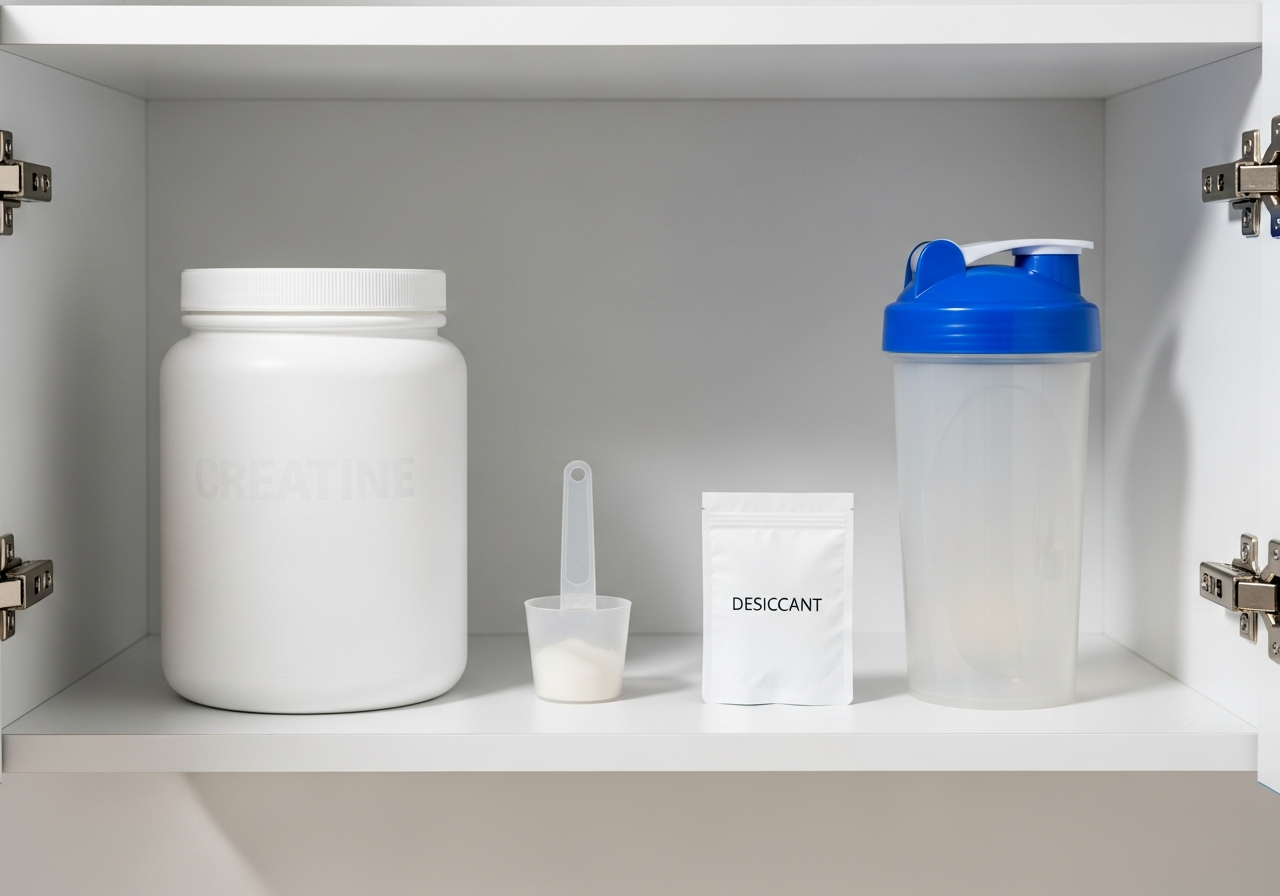
The easiest way to store creatine powder properly is to build a repeatable 30-second routine around each scoop. If you follow the same sequence every day, you remove almost every common storage mistake.
- Choose one permanent storage location. Pick a cupboard, pantry shelf, or drawer away from the stove, sink, kettle, dishwasher, and direct sun.
- Open the tub only when your drink is ready. Do not leave the container open while you look for your shaker or fill your bottle.
- Use a dry scoop. Even a few drops of water on the scoop can introduce moisture into the powder.
- Scoop quickly and level if needed. If your product is unflavoured monohydrate, measure your usual amount and close the lid right away. If you are unsure on dose, see how much creatine per day.
- Reseal firmly. Screw the cap down fully or press the seal shut immediately after use.
- Return it to storage at once. Do not leave the tub sitting on the counter through a shower, workout, or breakfast prep.
- Drink the mixed serving soon. Mix, shake, and consume instead of storing the prepared drink for extended periods.
This routine works for beginners, advanced lifters, and anyone who wants low-effort consistency. It also matters for people who buy larger tubs to save money. The bigger the container, the longer it will sit in your home, which means repeated handling can matter more over time.
If you live in a humid region or your home gets muggy in summer, take extra care with the lid and scoop. Some Canadians also keep supplements in basements; that is fine if the basement is climate-controlled and dry, but not ideal if it feels damp. You do not need to refrigerate creatine, and refrigeration can actually create condensation if the container moves in and out of colder conditions.
For added protection, keep the original desiccant packet inside. That small packet absorbs stray moisture and helps the product stay free-flowing. If the powder does begin clumping lightly, storage likely slipped, but mild clumping does not automatically mean the product is ruined.
Want the easiest all-in-one beginner setup? Pair a dry scoop, a dedicated supplement drawer, and a fixed daily dose. Our creatine for beginners guide and creatine dosage calculator can help you turn that into a long-term habit.
Does creatine go bad in water? Yes, mixed creatine is less stable than dry powder
Yes, creatine can gradually degrade when left in water, which is why mixed creatine is best consumed soon after you prepare it. This is one of the most common questions around how to store creatine, and the short answer is clear: do not treat a mixed creatine drink like a shelf-stable beverage.
The reason is chemical, not microbial alone. Dry creatine monohydrate is relatively stable. Once dissolved, it becomes more vulnerable to breakdown into creatinine over time, especially if the liquid is warm or acidic. That means a shaker left in a gym bag, a car, or on a desk all day is not the ideal way to use creatine. It may still contain some active creatine later, but it is no longer the best-practice approach if your goal is maximum potency and consistency.
Here is the practical rule set:
- Best practice: mix and drink right away or within a short period.
- Reasonable backup: if you pre-mix for convenience, keep it cool and drink it the same day.
- Not recommended: leaving creatine in water overnight regularly, especially in a warm room or car.
- Worst case: storing mixed creatine for days.
This applies whether you mix creatine in plain water, juice, a sports drink, or a protein shake. A cold bottle is generally better than a warm one, but immediate use is still the simplest answer. If you often prepare supplements in advance, a smarter option is to carry the powder dry in a pill organizer, mini container, or pre-portioned bag and add it to liquid only when ready to drink. For more on practical preparation, see how to mix creatine and mixing creatine with protein powder safely.
A related myth is that creatine “goes bad instantly” in water. That overstates the issue. The better statement is this: creatine in water becomes progressively less ideal the longer it sits. If you mixed it 20 minutes ago, that is not a problem. If you mixed it yesterday, that is avoidable and not best practice.
So if you are asking, “Does creatine go bad in water?” the useful real-world answer is: it does not become useless immediately, but it is less stable in liquid, so mix it close to the time you plan to drink it.
The worst places to keep creatine fresh, and why people ruin it by accident
The worst places to store creatine are hot, humid, bright, or frequently changing environments, because those conditions increase moisture exposure and reduce storage quality. Most creatine is not ruined by dramatic mistakes; it is slowly compromised by ordinary bad habits repeated every day.
Common bad storage locations include:
- Bathroom cabinets: showers create repeated humidity spikes.
- Above the stove: heat and steam are a poor combination for powders.
- Beside a kettle or coffee machine: frequent steam exposure can sneak into the tub.
- Sunny windowsills: direct light and heat swings are unnecessary stressors.
- Cars and garages: temperatures can fluctuate far beyond normal indoor conditions.
- Gym bags: they often stay warm, cramped, and moisture-prone.
One underrated mistake is storing creatine near your shaker-washing area. People often open the tub with damp hands or while a freshly rinsed bottle is dripping nearby. Another is tossing the scoop back in while it is still slightly wet. Those small errors matter more than whether the room is 20 or 23 degrees.
If you buy creatine in bulk from a large bag, consider transferring a smaller working amount into a clean, airtight container while keeping the rest sealed and undisturbed. That reduces the number of times the main supply is opened. Just make sure the secondary container is dry, food-safe, and seals properly.
Travelling? Short trips are easy. Keep the powder in a sealed travel container and avoid leaving it in a hot vehicle. If you fly, dry powder is more convenient than a pre-mixed bottle. We cover logistics in bringing creatine on a plane.
In Canadian homes, winter dryness is rarely the issue. Summer humidity, cottage travel, and warm condos with limited ventilation are more likely to create storage problems. If your creatine clumps every July, your environment may simply be too humid for a loosely closed tub.
The simple fix is not complicated: move creatine away from steam, keep the scoop dry, and close the container immediately after use. Those three changes solve the majority of real-world storage problems.
How long creatine lasts, what expiry dates mean, and how to tell if storage went wrong
Creatine usually lasts a long time when kept dry and sealed, but the printed expiry date still matters because it reflects the manufacturer’s tested quality window. If you are wondering whether your tub is still good, start with the date, then inspect the powder, then think about how it has been stored.
Dry creatine monohydrate is generally stable enough for normal consumer use, especially when unopened or lightly handled. The bigger issue is not that creatine suddenly “expires” on a single day; it is that storage conditions can chip away at ideal quality over time. That is why an unopened tub stored well is very different from a half-used tub that has lived in a humid kitchen for months.
Signs that storage may have gone wrong include:
- Clumping or hardening: usually a sign moisture got in.
- Unusual smell: plain creatine should have little to no strong odour.
- Discolouration: any obvious colour change is a warning sign.
- Damaged seal or cracked container: exposure risk goes up sharply.
Clumping alone does not prove the creatine is unsafe or ineffective. Sometimes creatine simply absorbs humidity and cakes together. But clumping is still useful feedback that your storage setup needs improvement. If the product smells normal, looks otherwise normal, and is within date, mild clumping may not be catastrophic. If it is badly hardened, exposed to water, or long past expiry, replacing it is the more sensible call.
For a deeper shelf-life discussion, see does creatine expire?. If you are shopping for a replacement, our best creatine rankings, creatine brand reviews, and creatine product catalog can help you compare options.
Canadian shoppers should also check for an NPN, which stands for Natural Product Number, on products sold as licensed natural health products in Canada. An NPN does not guarantee perfect storage after purchase, but it does indicate the product has gone through Health Canada’s licensing framework and should carry standardized label information.
The practical takeaway is straightforward: expiry dates matter, but storage history matters too. A fresh, tightly sealed tub kept dry is usually in far better shape than a technically in-date tub that has spent months absorbing steam from your kitchen.
Which container and format stores best? Powder, capsules, gummies, and liquid compared
Dry creatine powder usually offers the best mix of stability, value, and flexibility, but storage quality also depends on the format and packaging you choose. If you are deciding what to buy in Canada, compare both the form of creatine and how well the package protects it from moisture.
| Format | Storage stability | Main risk | Best practice |
|---|---|---|---|
| Creatine monohydrate powder | High when kept dry and sealed | Humidity and wet scoops | Store in original airtight tub in a cool, dry cupboard |
| Micronized powder | High when kept dry and sealed | Same as regular powder | Treat the same as monohydrate powder |
| Capsules | Generally high | Heat, humidity, bottle left open | Keep bottle sealed and away from moisture |
| Gummies or chewables | Moderate | Heat can affect texture; packaging matters | Store cool and reseal carefully after opening |
| Liquid creatine products | Less ideal for long-term stability claims | Time in solution | Use only from reputable brands and follow label directions closely |
For most people, plain creatine monohydrate powder remains the best option because it is the most studied form, usually the most cost-effective, and easy to store well. The 2021 JISSN review and the broader evidence base continue to support monohydrate as the standard against which other forms are judged.
Container design matters too. A sturdy, opaque tub with a tight screw top is usually better than a flimsy zipper pouch that gets opened wide every day in a humid room. If you prefer bags for price or portability, use clean hands, reseal fully, and consider storing the pouch inside another airtight container.
When buying in Canada, look for clear lot coding, expiry dates, an NPN where applicable, and ideally third-party testing or strong manufacturing transparency. Those quality markers matter more than flashy claims about “enhanced stability.” If you want help choosing, see the best type of creatine and best creatine monohydrate in Canada.
The simple answer is that the best-storing creatine is the one sold as a dry product in good packaging and handled carefully after opening.
Storage tips by routine: beginners, athletes, women, older adults, and bulk buyers
The best creatine storage strategy depends less on your sex or age and more on your daily routine, travel habits, and how quickly you go through a tub. The core rules are the same for everyone, but the friction points differ.
Beginners usually do best with a simple habit loop: keep the tub in one dry location, take the same daily dose, and avoid pre-mixing unless necessary. If consistency is your challenge, the storage solution is convenience. Put the tub where you already make breakfast or your post-workout drink, but away from steam.
Women using creatine do not need special storage rules. The same cool, dry, sealed approach applies. If you share supplements in a household, labelling your container and keeping a dedicated dry scoop can prevent accidental moisture contamination or dose confusion. Our creatine for women guide covers practical use in more detail.
Older adults often prefer capsules for convenience, but powder is still perfectly fine if scooping is easy. For this group, accessibility matters: a lower shelf or easy-open container can improve adherence without sacrificing storage quality. Our creatine for older adults guide explains broader use cases.
Competitive athletes and frequent travellers should prioritize portability without resorting to pre-mixed bottles sitting for hours. Pre-portion dry servings into sealed mini containers or single-serve baggies, then mix only when needed. This is more storage-safe than carrying a warm shaker all day. The IOC consensus on dietary supplements also emphasizes product quality and contamination awareness for athletes, which makes reputable sourcing important alongside storage.
Bulk buyers need the most disciplined storage. If you buy a large bag or multi-month supply, open the main package as little as possible. Consider a two-container system: one smaller daily-use tub and one larger backup kept tightly sealed in a cool, dry place.
Very humid homes may benefit from extra caution such as storing creatine in a better-sealed secondary container, but refrigeration is still not usually necessary or helpful because of condensation risk.
No matter who you are, the same truth holds: creatine works through consistent daily intake, and smart storage supports that consistency by keeping the product easy to use and well protected.
Dose, timing, and storage: what actually matters most for results
Storage matters, but your daily dose matters more for performance results. In practical terms, a well-stored tub does not help much if you rarely take creatine, and a slightly imperfect storage setup does not erase the benefit of consistent dosing if the product is otherwise normal.
Mainstream creatine science supports two standard dosing approaches:
- Maintenance-only approach: 3 to 5 g per day.
- Loading approach: about 20 g per day split into 4 doses for 5 to 7 days, then 3 to 5 g per day.
A body-weight method sometimes used in research is about 0.3 g/kg/day for loading for 5 to 7 days and roughly 0.03 g/kg/day for maintenance. That means a 60 kg person might maintain around 2 to 3 g daily, an 80 kg person around 3 to 5 g, and a 100 kg person around 3 to 5 g, with many lifters simply using 5 g daily for convenience. If you want exact calculations, use our creatine dosage calculator or read creatine maintenance dose.
Timing is flexible because creatine works by gradually increasing muscle creatine and phosphocreatine stores rather than by creating a sharp stimulant-like effect. Phosphocreatine is the stored form that helps rapidly regenerate ATP, the cell’s immediate energy currency, during short, high-intensity efforts. That is why daily consistency matters more than taking creatine at the perfect minute. For timing specifics, see when to take creatine.
How does storage connect to dose and timing? Mainly in one way: good storage makes regular use easier and reduces waste. If your powder clumps badly, lives in an inconvenient spot, or is always left pre-mixed in forgotten bottles, adherence tends to fall. The best creatine protocol is the one you can repeat for months.
If you are wondering what to expect, most users notice no dramatic “feeling” on day one. With loading, muscle stores can rise within about a week. Without loading, saturation usually takes a few weeks of daily use. We cover the realistic timeline in how long creatine takes to work.
In short, store creatine well, but focus first on taking an evidence-based dose consistently. That is what actually drives results.
Common storage mistakes and myths: clumps, fridges, freezers, and 'ruined' creatine
Most creatine storage myths come from confusing “less ideal” with “useless” or “dangerous.” The evidence-based view is more balanced: creatine monohydrate is robust enough for normal household use, but moisture and long time in liquid still deserve respect.
Myth 1: Creatine must be refrigerated. Usually false. Refrigeration is not required for dry creatine powder, and moving a cold container in and out of room air can create condensation. A cool, dry cupboard is typically better.
Myth 2: Any clumping means the creatine is bad. Not necessarily. Clumping often means moisture got in, but mild caking alone does not prove the powder is ruined. Inspect smell, colour, seal integrity, and expiry date too.
Myth 3: Creatine in water is instantly destroyed. False. Mixed creatine is less stable over time, but not instantly useless. The sensible rule is to drink it soon rather than store it long.
Myth 4: Fancy creatine forms are needed because monohydrate is unstable. Overblown. Monohydrate remains the best-supported form in the literature and stores well when handled properly.
Myth 5: A warm room ruins creatine immediately. False. Normal room temperature is fine. The problem is prolonged heat exposure, especially combined with humidity.
Here is a quick troubleshooting guide:
- Powder slightly clumpy? Improve storage and keep using if within date and otherwise normal.
- Powder rock-hard, damp, or oddly coloured? Replace it.
- You keep forgetting to reseal it? Move it to a lower-friction location and build a fixed scoop routine.
- You pre-mix for work? Carry dry portions instead.
- Your bag packaging is annoying? Transfer to a dry airtight container.
If you want a broader myth breakdown, visit creatine myths debunked or creatine myths vs. facts. For safety concerns unrelated to storage, see is creatine safe?.
The truth is reassuring: creatine is not delicate, but it does reward basic good storage habits. Most “ruined creatine” stories are really stories about wet scoops, open lids, hot cars, and forgotten shaker bottles.
Bottom line: how to keep creatine fresh, stable, and worth taking every day
To keep creatine fresh, store the powder in a tightly sealed container in a cool, dry, dark place and avoid leaving it mixed in water for long periods. If you follow that one-sentence rule, you will get almost everything right.
The practical checklist is short:
- Keep creatine in its original container or another airtight dry container.
- Store it in a cupboard, pantry, or drawer away from steam and sunlight.
- Use only a dry scoop.
- Reseal immediately after each use.
- Leave desiccant packets in place if included.
- Mix close to the time you plan to drink it.
- Replace the product if it is badly damaged, suspiciously discoloured, or clearly moisture-compromised.
For most people, storing creatine powder is not complicated. You do not need a special fridge, a vacuum chamber, or a premium “stable” formula. You need dry handling, sensible placement, and a consistent daily routine. Creatine monohydrate remains the evidence-based standard because it works, it is practical, and it stores well under normal conditions.
If you are buying in Canada, look for clear labels, expiry dates, an NPN where appropriate, and a reputable brand with transparent manufacturing or third-party testing. That gives you a stronger starting point before storage habits even come into play.
And remember the bigger picture: storage protects product quality, but results still come from regular intake, adequate hydration, and training consistency. If you are building a full routine, the most useful next reads are what creatine is, how to take creatine, how much water to drink with creatine, and whether creatine expires.
Final answer: keep creatine dry, sealed, and out of heat; drink mixed creatine promptly; and if you do those things, your creatine should stay fresh and potent for normal day-to-day use.
Creatine Storage: The Numbers That Matter
- 3-5 g/day Standard maintenance dose — Consistent daily intake matters more for results than exact timing.
- 20 g/day Typical loading dose — Usually split into 4 doses for 5-7 days.
- 5-7 days Typical loading phase length — Helps raise muscle creatine stores faster than maintenance-only dosing.
- 0.03 g/kg/day Body-weight maintenance guideline — A research-based maintenance estimate after loading.
Frequently Asked Questions
How should you store creatine powder?
You should store creatine powder in a tightly sealed container in a cool, dry, dark place. A pantry, cupboard, or drawer away from heat, sunlight, and steam is ideal. The most important detail is keeping moisture out by using a dry scoop and resealing the container immediately after each use.
Does creatine go bad in water?
Yes, creatine is less stable in water than in dry powder form. It does not become useless instantly, but it can gradually degrade the longer it sits mixed, especially if the drink is warm or acidic. For best potency, mix creatine close to the time you plan to drink it.
Can you store creatine in the fridge?
You usually do not need to store creatine in the fridge. Dry creatine keeps well at normal room temperature, and refrigeration can create condensation when the container is taken in and out. A cool, dry cupboard is generally the better storage choice.
Can you leave creatine in a shaker overnight?
You can, but it is not best practice. Creatine left in a shaker overnight is less stable than dry powder and may lose some quality over time, especially if the bottle sits warm. It is better to carry the powder dry and mix it when you are ready to drink it.
Does clumpy creatine mean it has gone bad?
No, clumpy creatine does not automatically mean it has gone bad. Clumping usually means moisture entered the container, which is a storage issue more than an immediate safety problem. If the product is still within date, smells normal, and has no odd colour changes, mild clumping alone is not definitive proof it is unusable.
What is the best container for storing creatine?
The best container for storing creatine is an airtight, dry, food-safe container with a strong seal. The original tub is often the best option because it is designed for the product and may include a desiccant packet. Opaque containers are also helpful because they reduce light exposure.
Can heat ruin creatine?
Heat can reduce storage quality over time, especially when combined with humidity, but normal room temperature is generally fine. The real concern is prolonged exposure to hot environments like cars, garages, windowsills, or shelves above stoves. A stable indoor cupboard is far safer.
Should you keep the desiccant packet in your creatine tub?
Yes, you should usually keep the desiccant packet in the tub unless the product label says otherwise. Its job is to absorb stray moisture and help the powder stay dry and free-flowing. Just do not open the packet or let children access it.
How long can creatine sit mixed in water?
Creatine is best consumed soon after mixing rather than left sitting for long periods. If convenience forces you to pre-mix, keeping it cool and drinking it the same day is more sensible than leaving it overnight or for multiple days. The longer it sits, the less ideal the stability becomes.
What is the biggest mistake when storing creatine?
The biggest mistake when storing creatine is letting moisture into the container. That usually happens through wet scoops, damp hands, steam from kitchens or bathrooms, or lids left open too long. Most other storage problems trace back to that one issue.