Creatine with Juice: Does Sugar Boost Absorption or Is It Just Marketing?
By The Creatine Canada Research Team — Evidence-based supplement analysts
Yes—mixing creatine with juice is perfectly fine, but juice is optional, not magical. Sugar and other carbohydrates can modestly support creatine uptake by raising insulin, yet for most people the difference is small enough that the best liquid is simply the one that helps you take 3–5 g of creatine monohydrate consistently every day.
Evidence-based · Cites 4 sources · Editorial standards
Key Takeaways
- Creatine with juice works, but it is not meaningfully better than water for most lifters taking a proper daily dose.
- A standard maintenance intake is 3–5 g/day of creatine monohydrate; a loading phase is 20 g/day split into 4 doses for 5–7 days.
- Juice may slightly increase creatine uptake because carbohydrates raise insulin, but daily consistency matters far more than the drink choice.
- Orange juice, grape juice, and apple juice are all acceptable mixing options if they help taste and routine.
- If creatine upsets your stomach, split the dose, mix thoroughly, and take it with food rather than dry scooping.
- Micronized or plain monohydrate is still the best-value form; fancy 'transport' blends are usually unnecessary.
- In Canada, look for a product with clear dosing, an NPN when applicable, and preferably third-party testing or a strong quality track record.
Creatine with juice: the short answer most people need
Yes, you can absolutely take creatine with juice, and it works well. The important point is that juice is a convenience choice, not a requirement for results.
Creatine works by increasing your muscles' stored phosphocreatine, the high-energy compound that helps regenerate ATP, the immediate fuel used during short, intense efforts like lifting, sprinting, and repeated explosive work. What determines results is not whether you mixed it with orange juice, grape juice, apple juice, or water on any one day; it is whether your muscles become and stay saturated over time.
The evidence-based default remains creatine monohydrate. The 2017 International Society of Sports Nutrition position stand concluded that creatine monohydrate is the most effective ergogenic nutritional supplement currently available for increasing high-intensity exercise capacity and lean mass gains during training. You can read that position stand here: Kreider et al. (2017), ISSN Position Stand.
Why do people talk about creatine and juice absorption? Because carbohydrates in juice can raise insulin, and insulin can help move creatine into muscle cells. That mechanism is real, but the practical importance is often overstated online. If you already take enough creatine every day, muscle creatine stores rise regardless of whether your powder went into juice or water. For a beginner, that means you should prioritise:
- 3–5 g daily of creatine monohydrate
- Taking it consistently
- Using a liquid you will actually drink every day
- Minimising stomach upset so you stay adherent
If juice helps the powder go down more easily, use it. If you are trying to minimise sugar or calories, water is also completely fine. For a deeper beginner primer, see what creatine is and our creatine dosage calculator.
The practical verdict is simple: juice can help palatability and may slightly help uptake, but it does not rescue a bad dosing plan and it does not outperform consistent daily creatine use.
Does sugar boost creatine absorption, or is that mostly supplement marketing?
Sugar can support creatine uptake and carbohydrates-driven transport, but for most users the real-world advantage is modest rather than dramatic. That is the nuanced answer missing from a lot of marketing.
Creatine enters muscle through a transporter called SLC6A8, often referred to as the creatine transporter. Insulin does not turn creatine into a different compound, but it can create a more favourable environment for nutrients to move into tissues. Because fruit juice contains carbohydrates, drinking creatine with juice can produce a small insulin response that may help shuttle creatine into muscle.
That mechanism is why you still hear claims about creatine and sugar absorption. The problem is that many people take a true concept and exaggerate it into a sales pitch for high-sugar "transport systems". The bigger determinant of muscle creatine content is still whether you consume enough creatine over days and weeks to reach saturation. According to Antonio et al. (2021), Common questions and misconceptions about creatine supplementation, many common concerns and claims around creatine are overstated, while the basic dosing principles remain very robust.
Here is the practical interpretation:
- If you take 3–5 g/day, you can saturate muscle stores without juice.
- If you load at 20 g/day for 5–7 days, you can saturate faster without juice.
- If you take creatine with a carb-containing meal or drink, uptake may be somewhat enhanced, but not enough to matter more than consistency.
So does juice help creatine? Yes, a bit, in theory and likely in practice. Does it transform creatine from ineffective to effective? No. Creatine monohydrate already works exceptionally well when taken correctly.
A useful way to think about it is this: juice is a minor optimiser, not a primary driver. For someone who already eats mixed meals and trains regularly, the extra benefit of adding juice instead of water is usually small. For someone who struggles to remember supplements, the best absorption strategy is the boring one: build a repeatable daily habit. If you want more on timing and absorption context, see when to take creatine and how to maximize creatine absorption.
Orange juice, grape juice, apple juice: which juices are actually good for mixing creatine?
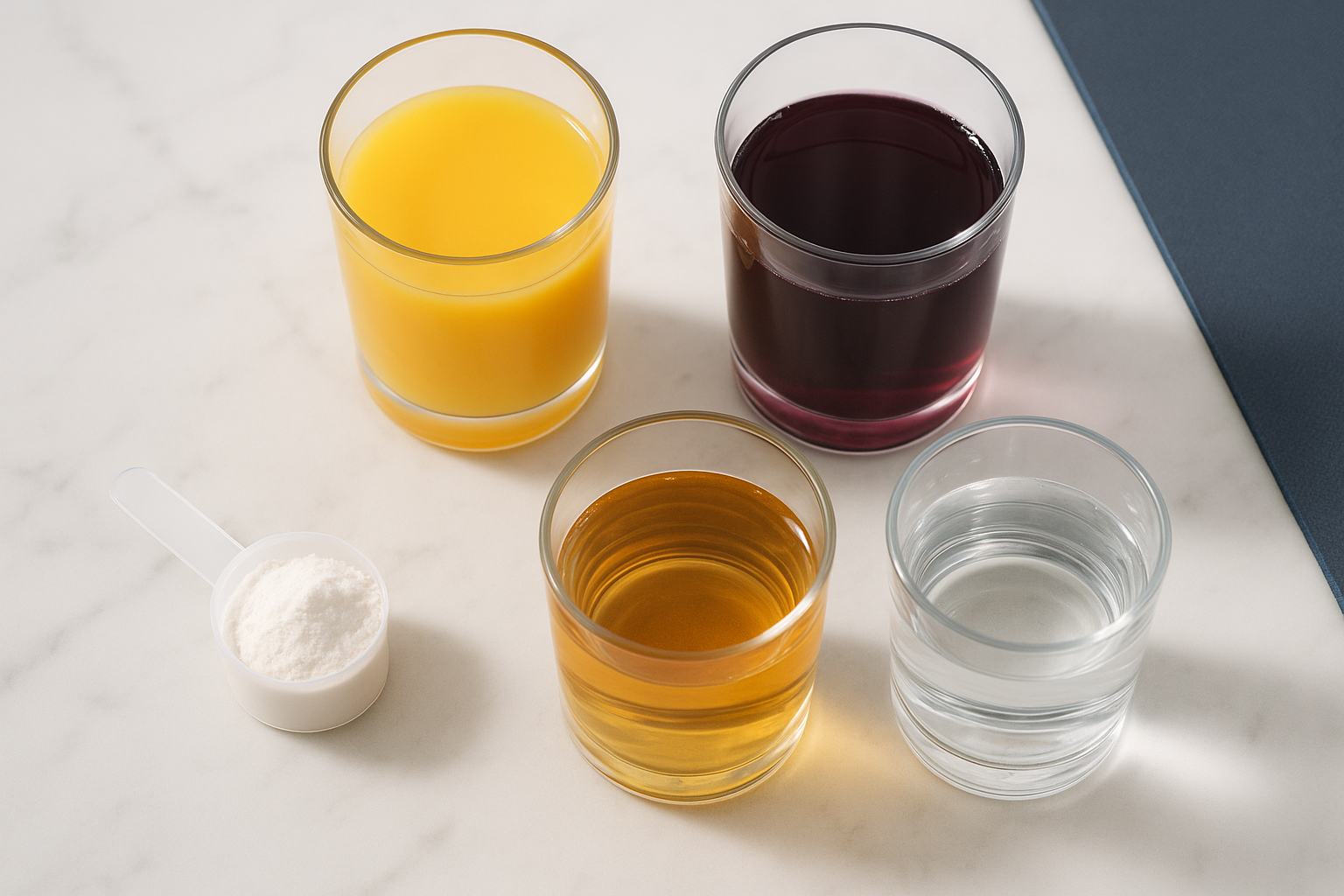
Creatine and orange juice, creatine and grape juice, and creatine with apple juice are all acceptable combinations. The best juice is the one you tolerate well, enjoy drinking, and can use consistently.
There is no strong evidence that one common fruit juice is dramatically superior to another for creatine uptake. Most of the practical differences are about taste, acidity, sweetness, and how well the powder disperses. Unflavoured creatine monohydrate has a mild, slightly chalky taste, so juice can mask that texture better than plain water.
Here is a practical comparison:
| Mixing option | Best for | Potential downside | Practical note |
|---|---|---|---|
| Orange juice | Masking taste well | Acidic taste may bother sensitive stomachs | Very popular and easy to find |
| Grape juice | Sweeter flavour and easy mixing | Higher sweetness may not suit cutting phases | Common choice in old-school bodybuilding circles |
| Apple juice | Lighter taste | Can still add unnecessary liquid calories | Good option if orange juice feels too sharp |
| Water | Zero calories, simplest routine | Less flavour masking | Works perfectly well for absorption |
| Protein shake or smoothie | Convenience with a meal | Thicker texture if poorly mixed | Good if you already use post-workout shakes |
One myth worth addressing: acidic juice does not instantly ruin creatine. Creatine can gradually degrade to creatinine in liquid over time, especially if left mixed for long periods, but that does not mean you cannot stir it into juice and drink it normally. The simple fix is to mix and drink it soon after preparing it rather than leaving it in a bottle all day.
If you are deciding between juice and other liquids, think in this order:
- Will I take this every day?
- Does it cause stomach upset?
- Does it fit my calories and macros?
- Can I prepare it quickly?
If the answer points to juice, use juice. If it points to water, use water. If your bigger challenge is dissolving the powder well, see how to mix creatine and tips for a grit-free shake.
Exactly how to mix creatine with fruit juice without clumps, waste, or stomach upset
The easiest way to mix creatine with juice is to add 3–5 g of creatine monohydrate to a small glass of juice, stir thoroughly, and drink it right away. That simple method is enough for nearly everyone.
Here is a beginner-friendly step-by-step process that works:
- Measure the dose accurately. Use a scale if possible, or a product scoop that clearly states the grams per scoop. If you are unsure, use our creatine dosage calculator and read how to measure creatine.
- Pour a moderate amount of juice first. A smaller volume is easier to finish quickly than a giant glass.
- Add the creatine slowly. Dumping the whole scoop at once can create floating clumps.
- Stir or shake for 15–30 seconds. Micronized creatine usually disperses more easily than regular powder.
- Drink it soon after mixing. Do not leave it sitting for hours if you can avoid it.
- Add a splash of water and swirl the glass. This helps you finish any powder left at the bottom.
If you get digestive discomfort, the most common fixes are mechanical rather than medical:
- Take smaller divided doses instead of one larger serving.
- Use 3 g instead of 5 g if you are smaller-bodied and already near saturation.
- Mix it with a meal or snack rather than on an empty stomach.
- Choose micronized creatine monohydrate if regular powder feels gritty.
- Avoid dry scooping, which adds choking risk and often worsens stomach complaints.
If you are loading, the same principle applies. Instead of trying to slam 20 g in one sweet drink, split it into 4 servings of 5 g across the day. That is gentler on the gut and aligns with established loading practice.
One practical note for athletes: if you already drink a pre-, intra-, or post-workout carb beverage, adding creatine there is often easier than creating a separate ritual. If you do not already use juice, there is no need to force it.
For troubleshooting clumps, grittiness, and routine design, our guides on common creatine mistakes and digestive side effects go deeper. The key is that perfect mixing is not required for creatine to work, but good mixing makes adherence easier.
The right creatine dose by body weight, goal, and whether you use juice or not
Your creatine dose does not change just because you mix it with juice. The evidence-based targets remain the same whether your powder goes into water, orange juice, grape juice, or a shake.
The most practical default is 3–5 g/day of creatine monohydrate for maintenance. A loading phase is optional and usually means 20 g/day split into 4 doses for 5–7 days, followed by 3–5 g/day.
| Body weight / goal | Simple daily plan | Faster-loading option | Best use case |
|---|---|---|---|
| Smaller adults under ~60 kg | 3 g/day | 20 g/day split for 5–7 days, then 3 g/day | General fitness, beginners, lighter women |
| Most adults ~60–100 kg | 5 g/day | 20 g/day split for 5–7 days, then 5 g/day | Muscle, strength, team sport, mixed training |
| Larger athletes over ~100 kg | 5 g/day is still reasonable; some prefer slightly more based on size | 20 g/day split for 5–7 days, then 5 g/day | Heavier lifters and field athletes |
| Weight-conscious or sensitive stomach users | 3–5 g/day with food | Skip loading | Cutting phases, gut sensitivity, cautious starters |
If you use juice, use it as a delivery vehicle, not as a reason to overcomplicate dose math. More sugar does not mean you need less creatine, and less sugar does not mean you need more creatine.
Here are sensible examples:
- 55 kg beginner woman: 3 g/day in water or juice is a practical starting point.
- 78 kg recreational lifter: 5 g/day is the standard easy answer.
- 92 kg hockey or rugby athlete: 5 g/day is still the normal maintenance target; loading may make sense during pre-season.
- Older adult focused on strength and function: 3–5 g/day alongside resistance training is usually the practical range.
The 2021 JISSN review emphasised that creatine is one of the most studied sports supplements and that many misconceptions persist despite decades of data. One of those misconceptions is that there must be a fancy dose matched to your beverage. There does not. Juice changes convenience and calories more than it changes the core dose.
If you want more precise planning, see how much creatine per day, maintenance dosing, and the loading phase guide.
When to take creatine with juice, and how fast you should notice anything
You can take creatine with juice before or after training, with a meal, or on rest days; timing matters far less than taking it daily. That is the answer most people need.
Creatine is not a stimulant, so you usually do not feel an immediate boost the day you start it. It works by gradually increasing intramuscular creatine stores until you reach a more saturated state. Once those stores rise, you may notice improved performance in short, repeated, high-intensity efforts, slightly better training volume, and over time, better strength and lean mass gains.
Here is a realistic timeline:
- With loading: you may reach near-saturation in roughly 5–7 days.
- Without loading: it often takes about 3–4 weeks of daily use to approach saturation.
- In the gym: benefits often show up as an extra rep, slightly better repeated sprint output, or less drop-off across hard sets.
- On the scale: some people notice a modest early increase in body weight from greater intracellular water, not fat gain.
So when should you take creatine and orange juice or another juice? The best timing is the timing you will stick to. Good anchor habits include:
- With breakfast every day
- After training with your post-workout meal
- At the same time on rest days
If you are especially interested in the carbohydrate angle, taking creatine with a meal that includes carbs and protein is perfectly reasonable. But there is no need to chase a narrow anabolic window or to drink sugary juice immediately after a workout if that does not fit your nutrition plan.
The Examine.com creatine evidence summary is useful here because it consistently reflects the main conclusion seen across the literature: creatine works best as a chronic daily supplement, not as a one-off acute performance drink.
If you want a detailed timeline, read how long creatine takes to work and when to take creatine. The key expectation to set is simple: do not judge creatine by whether you feel a buzz; judge it by better training output over weeks.
Who should mix creatine with juice, and who may be better off with water or food
Creatine with juice is best for people who want a tastier, easier routine, while water or food-based dosing may be better for those watching sugar, calories, or blood-glucose control. The supplement itself is the star; the liquid is just the delivery system.
Beginners often do well with juice because it masks the taste and makes daily use easier. If your main barrier is remembering to take creatine, pairing it with your usual morning juice or post-workout drink can be genuinely useful.
Women can use the exact same creatine forms and general dose ranges as men, usually adjusted only by body size and tolerance. Juice is not uniquely beneficial for women, but if it improves adherence, it is a smart option. If you want more detail, see creatine for women.
Older adults may prefer taking creatine with a meal or smoothie instead of a sharp, acidic juice if digestion is more sensitive. The goal here is easy daily compliance and minimal GI discomfort, not chasing an absorption trick.
Athletes in explosive sports can use juice if it fits their fuelling plan, especially around hard training blocks. For endurance athletes or weight-class athletes, however, adding unnecessary liquid calories from juice may not be ideal when plain water would do the job just as well.
People cutting fat often prefer water, a low-calorie flavoured drink, or a protein shake because these options avoid extra sugar. The caloric cost of juice matters more than any theoretical absorption edge if you are trying to control intake tightly.
People with diabetes, insulin resistance, or glucose-management concerns should not assume juice is required for creatine to work. In these cases, it is usually more sensible to take creatine with a balanced meal or plain water and follow individual medical advice.
People with sensitive stomachs may do better with food than with fruit juice, especially acidic juices. If orange juice makes your stomach feel sour, try water, milk, a smoothie, or a meal instead.
The IOC consensus on dietary supplements recognises creatine as one of the evidence-supported options for certain performance contexts, but it does not suggest that athletes need a specific sugar-loading drink for routine use: International Olympic Committee consensus on dietary supplements (2018).
The practical takeaway is straightforward: use juice if it makes creatine easier, skip juice if it complicates calories, digestion, or health management.
Safety, side effects, and whether juice changes any real creatine risks
Mixing creatine with juice does not create new major risks for healthy adults; the main side effects to watch are the same ones seen with creatine in general, especially stomach upset and temporary water-weight changes. Juice mostly changes taste, calories, and tolerance.
According to the ISSN position stand and the 2021 JISSN review, creatine monohydrate is well studied and is generally considered safe for healthy individuals when used at established doses. Common issues are usually mild and manageable:
- Stomach discomfort: more likely with large single doses, poor mixing, or taking it on an empty stomach.
- Loose stools: often a sign the dose is too large at once, especially during loading.
- Early weight increase: commonly reflects more water stored inside muscle, not body-fat gain.
- Grittiness: a texture issue, not a safety issue.
Juice can change side-effect experience in both directions. For some people, juice makes creatine easier on the stomach because it is taken with carbs. For others, acidic or very sweet juice makes GI symptoms worse. That is why personal tolerance matters more than internet folklore.
There are also a few practical safety notes:
- Do not premix and leave it for long periods if you can avoid it; mix and drink relatively soon.
- Stay normally hydrated; you do not need absurd amounts of water, but you should not be chronically underhydrated either.
- Avoid dry scooping, which adds unnecessary choking and coughing risk.
- Use reputable products so purity is not a question mark.
If you have kidney disease, take medications that affect kidney function, or have a relevant medical condition, use extra caution and speak to a qualified clinician before supplementing. For healthy people, routine creatine use is far less controversial in the research than many headlines suggest, but individual medical context still matters. Our guides on creatine safety and kidney concerns and creatinine confusion cover this in more depth.
Finally, storing your creatine matters more than the juice debate. Keep the powder dry, sealed, and away from excess moisture. For storage details, see whether creatine expires and how to store creatine.
The biggest myths about creatine and juice, debunked clearly
Most claims about creatine juice absorption are built on a grain of truth and then stretched too far. Here are the myths that cause the most confusion.
Myth 1: You must take creatine with grape juice or it will not absorb.
False. Creatine absorbs and works without grape juice. Carbohydrates may modestly enhance uptake, but adequate daily dosing is the dominant factor.
Myth 2: More sugar always means better results.
False. There is no practical reason for most people to chase large sugar loads just to take 3–5 g of creatine. Extra calories can easily outweigh any tiny uptake benefit, especially during a cut.
Myth 3: Acidic juices destroy creatine instantly.
False. Creatine does not become useless the moment it touches orange juice. The sensible rule is simply not to leave it mixed for long periods before drinking.
Myth 4: Juice makes creatine hit like a pre-workout.
False. Creatine is not an acute stimulant. It improves the phosphocreatine system over time, not through a quick buzz.
Myth 5: If you are not gaining weight fast, the creatine is not working.
False. Some people notice scale changes early, others do not. Better gym performance over time is a better sign than day-to-day body weight.
Myth 6: Fancy creatine transport formulas are better than monohydrate plus juice.
Usually false. Plain creatine monohydrate remains the benchmark for evidence, value, and reliability. If you want help evaluating products, compare our best creatine rankings, creatine brand reviews, and product catalog.
The most common real-world mistakes are not biochemical at all:
- Skipping doses repeatedly
- Using too much at once and blaming creatine for GI distress
- Buying overpriced blends with tiny creatine amounts
- Confusing water retention in muscle with getting fatter
- Expecting immediate energy like caffeine
If you want a broader myth roundup, visit creatine myths debunked. The biggest truth to remember is this: the basics win with creatine, and marketing usually tries to make the basics sound insufficient.
What to buy in Canada if you plan to mix creatine with juice every day
If you plan to mix creatine with juice daily, the best buy in Canada is usually a plain, well-sourced creatine monohydrate powder with clear dosing and strong quality signals. You do not need a sugary proprietary formula just because the label talks about absorption.
For most Canadians, the shopping checklist should look like this:
- Form: creatine monohydrate first
- Dose transparency: clearly labelled grams per scoop
- Minimal ingredients: especially if you are adding it to your own juice
- Quality assurance: third-party testing, NSF/Informed Sport where relevant, or a reputable manufacturer
- Canadian compliance: appropriate Natural Product Number (NPN) labelling where applicable and a legitimate seller
Why plain powder? Because when you are already mixing creatine with fruit juice, you do not need a pre-flavoured, sweetened, more expensive formula trying to solve a problem your orange juice already solved. In practical terms, plain monohydrate gives you:
- The strongest evidence base
- The lowest cost per effective dose
- The easiest stacking with your existing nutrition
- The least risk of paying for filler ingredients
Canadian buyers should also be cautious with marketplace listings that make extreme absorption claims but provide little manufacturing detail. A reputable product page should make the creatine form and serving size obvious. If you are in a tested sport, certification becomes even more important than flavour or mixability.
For brand comparisons and product picking, start with best creatine rankings, creatine brand reviews, and best creatine monohydrate in Canada. If you want to understand the label side, see Canadian supplement regulations and how to read a creatine label.
The smart-buy principle is simple: spend your money on purity and proven form, not on the promise that added sugar technology will somehow make basic monohydrate finally work.
Bottom line: should you mix creatine with juice?
Yes, you can mix creatine with juice, and for some people it is a smart, easy habit. But no, you do not need juice for creatine to work well.
If you want the one-sentence verdict: juice may offer a small absorption advantage through carbohydrates and insulin, but daily creatine monohydrate intake of 3–5 g matters far more than the specific liquid you choose.
That leads to a very practical decision tree:
- If juice helps you take creatine every day, use juice.
- If you want fewer calories or less sugar, use water.
- If your stomach is sensitive, take creatine with food or split the dose.
- If you want faster results, consider loading at 20 g/day split into 4 doses for 5–7 days.
- If you want the best value, buy plain creatine monohydrate.
The people who get the best results from creatine are rarely the ones chasing tiny optimisation tricks. They are the ones who take the right dose, keep taking it, train hard, and give it enough time to work.
If you are just getting started, your next best reads are how to take creatine, creatine for beginners, with or without food, and how long creatine takes to work.
So is mixing creatine with juice useful? Yes. Is it necessary? No. Is it worth doing if it improves taste and consistency? Absolutely.
Creatine With Juice: The Numbers That Actually Matter
- 3–5 g/day Standard maintenance dose — The core daily dose works whether you mix creatine with juice or water.
- 20 g/day Typical loading protocol — Usually split into 4 doses for 5–7 days to saturate faster.
- 5–7 days Time to near-saturation with loading — A loading phase speeds the rise in muscle creatine stores.
- 3–4 weeks Time to near-saturation without loading — Consistent daily use gets you there even without juice.
Frequently Asked Questions
Can you mix creatine with orange juice?
Yes, you can mix creatine with orange juice, and it is a common, perfectly acceptable way to take it. Orange juice may modestly support uptake because it contains carbohydrates, but its bigger advantage is simply making unflavoured creatine easier to drink consistently.
Does grape juice help creatine absorption more than water?
Grape juice may help creatine absorption slightly more than water because its carbohydrates can increase insulin, which can support creatine transport into muscle. In practice, though, the difference is usually small compared with the much bigger effect of taking the right dose every day.
Is mixing creatine with fruit juice better than mixing it with water?
Mixing creatine with fruit juice is not necessarily better than water; it is mostly a preference and routine question. Juice can improve taste and may slightly assist uptake, while water is simpler, cheaper, and avoids extra sugar and calories.
Does sugar make creatine work better?
Sugar can modestly support creatine uptake because carbohydrates raise insulin, and insulin can help move creatine into muscle. That said, sugar does not make creatine fundamentally start working; creatine monohydrate already works very well when taken consistently at evidence-based doses.
Can I take creatine with apple juice?
Yes, creatine with apple juice is fine. Apple juice is simply another carb-containing liquid that can mask creatine's mild chalky taste, and there is no strong evidence that it is meaningfully better or worse than orange or grape juice for most users.
Should I drink creatine with juice before or after a workout?
You can drink creatine with juice before or after a workout, but the timing matters less than daily consistency. Creatine is a saturation supplement, so your results depend more on maintaining muscle creatine stores over time than on a narrow pre- or post-workout window.
Can juice ruin creatine or turn it into creatinine?
Juice does not instantly ruin creatine, but creatine can gradually degrade in liquid over time if left mixed for too long. The practical solution is easy: stir it into the juice and drink it relatively soon rather than leaving it sitting for hours.
Do I need carbs to absorb creatine properly?
No, you do not need carbs to absorb creatine properly. Carbohydrates can modestly enhance uptake, but creatine still raises muscle stores effectively when taken daily with water, food, or other non-carb beverages.
What is the best juice for creatine?
The best juice for creatine is whichever one you enjoy and tolerate well enough to use every day. Orange juice, grape juice, and apple juice all work, and the differences between them are mainly about taste, acidity, sweetness, and calories rather than major absorption changes.
Is creatine with juice a good idea during a cut?
Creatine with juice can still work during a cut, but it may not be the best fit if you are tightly controlling calories or sugar. In that case, many people simply switch to water or take creatine with a regular meal to keep the benefits without adding liquid calories.