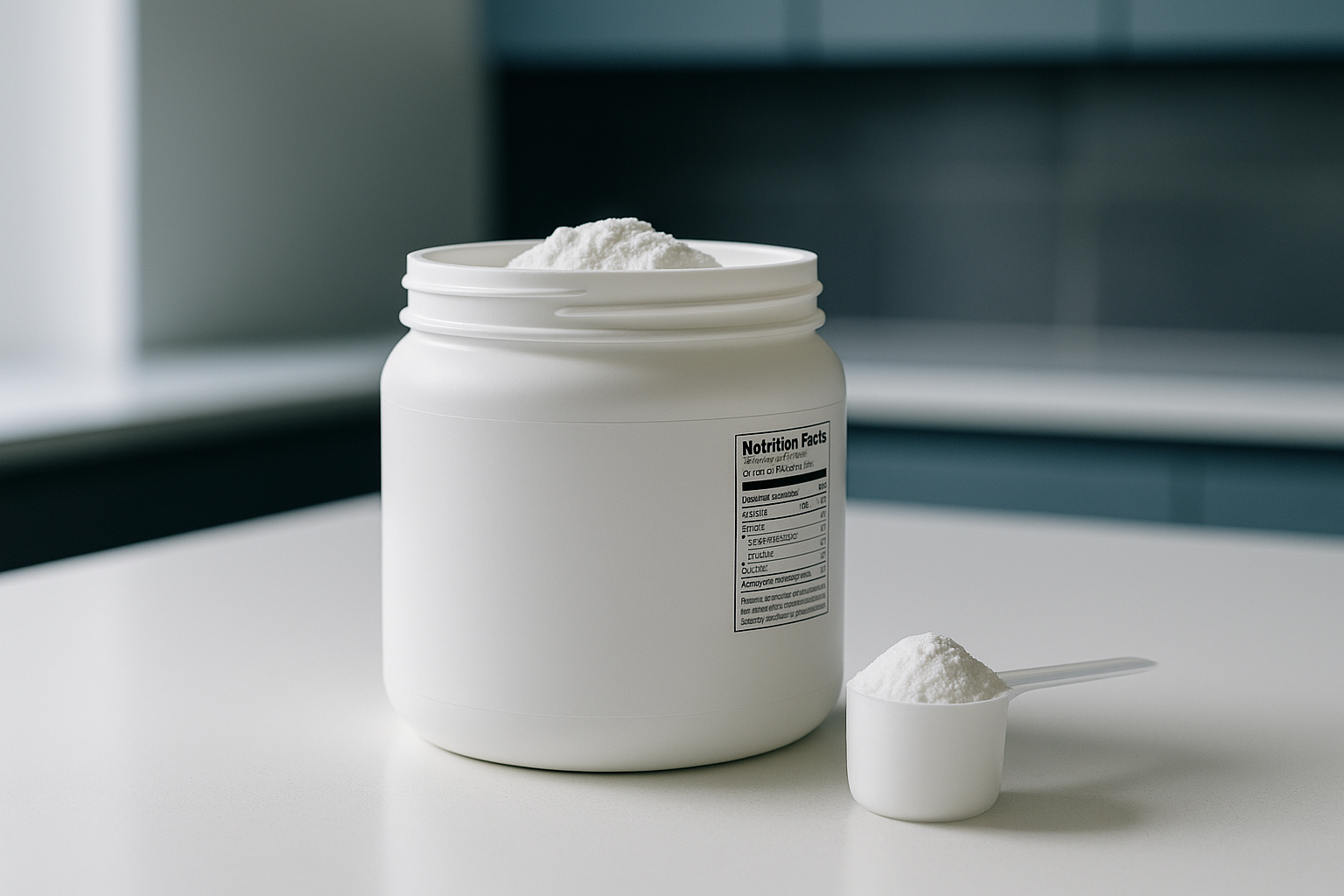
Creatine Nutrition Facts: Calories, Carbs, and What's Really in the Scoop
By The Creatine Canada Research Team — Evidence-based supplement analysts
Creatine monohydrate itself has essentially no meaningful calories, carbs, sugar, fat, or protein per serving, because it is not a macronutrient food ingredient. When a creatine label shows calories, carbs, or sweeteners, those usually come from added flavouring ingredients, gummies, drink mixes, or blend formulas rather than the creatine itself.
Evidence-based · Cites 4 sources · Editorial standards
Key Takeaways
- Pure creatine monohydrate powder is typically a zero-macro supplement: effectively no calories, carbs, sugar, fat, or protein per 3-5 g serving.
- If your creatine label lists calories or carbs, they are almost always coming from added ingredients, not from creatine itself.
- The evidence-backed dose for most adults is 3-5 g daily, with an optional loading phase of 20 g per day split into 4 doses for 5-7 days.
- Creatine works by increasing muscle phosphocreatine stores, which helps regenerate ATP faster during short, hard efforts.
- Timing matters far less than consistency; taking creatine every day is more important than taking it at a perfect hour.
- The best value and best-studied option remains plain creatine monohydrate with a short ingredient list and clear third-party testing.
- In Canada, check the label for an NPN and ideally third-party certification if you are a tested athlete.
Creatine nutrition facts, directly answered: what is actually in a scoop?
Pure creatine monohydrate contains creatine and very little else, so its nutrition facts are effectively zero calories, zero carbs, zero sugar, zero fat, and zero protein per typical serving. That is the short answer most people want when they search creatine nutrition facts, creatine calories, or creatine macros.
Why is that true? Creatine is not a carbohydrate, fat, or protein in the way food labels usually track. It is a naturally occurring nitrogen-containing compound made in the body from amino acids and stored largely in muscle tissue. Supplement labels still sometimes include a Nutrition Facts-style panel or supplement facts panel, but for plain creatine powder, there is usually no meaningful energy contribution to report.
A standard serving is commonly 3 g, 5 g, or 1 scoop, depending on the brand. On a pure product, the ingredients line should read something very close to “100% creatine monohydrate”. If the label is longer than that, then you are not looking at a plain creatine-only product. You may be looking at:
- a flavoured creatine powder
- a pre-workout with creatine added
- creatine gummies
- a carbohydrate transport blend
- capsules with fillers or shell ingredients
Those added ingredients can change the nutrition profile. For example, a flavoured creatine drink may include citric acid, natural flavours, sweeteners, or small amounts of carbohydrate. A gummy format may include sugar, glucose syrup, pectin, or other calorie-containing ingredients. In those cases, the label reflects the delivery format, not just the creatine.
The practical takeaway is simple: if you want creatine with essentially no calories or carbs, buy plain unflavoured creatine monohydrate. If your goal is convenience or taste, a flavoured powder or gummy can still work, but the nutrition facts may no longer be zero.
If you are brand-comparing, start with the ingredient list before you even look at the front label claims. Our creatine product catalog, creatine brand reviews, and best creatine rankings can help you spot the difference between a pure creatine supplement and a more heavily formulated product.
Does creatine have calories, carbs, sugar, or protein? Here is the label reality
Pure creatine monohydrate has no meaningful calories, carbs, sugar, fat, or protein per serving, so for most practical nutrition tracking it counts as zero. That is why plain creatine usually does not affect your macros in any meaningful way.
This point confuses people because creatine comes as a powder, and many powders in sports nutrition are foods with calories, like whey protein or carbohydrate drink mixes. Creatine is different. A 5 g scoop of pure creatine is not 5 g of carbohydrate and not 5 g of protein. It is 5 g of creatine compound.
Here is the key distinction:
- Pure creatine powder: effectively zero calories and zero macros.
- Flavoured creatine powder: still often very low calorie, but may include sweeteners, acids, colours, and sometimes a small amount of carbs.
- Creatine gummies or chewables: often contain sugar or syrup, so they can add calories and carbs.
- Pre-workouts with creatine: may include carbs or other active ingredients; the label is not telling you about creatine alone.
If you are counting macros during a cut, fast, or physique phase, this matters. Plain creatine is generally easy to fit into any nutrition plan because it contributes performance support without materially changing your calorie intake. For a deeper dive, see does creatine have calories, carbs, or sugar?.
According to the 2021 JISSN review on common questions and misconceptions about creatine, creatine monohydrate remains the most studied form and the standard reference point for efficacy and safety. That same evidence base is one reason simple, plain monohydrate is usually the smart baseline product.
One more nuance: some labels round tiny amounts down to zero under labelling rules, especially if an added ingredient contributes only a trace amount. That is normal and usually not important. What matters is whether the ingredient list stays lean and whether the product gives you the full clinically useful dose of creatine per serving.
If a product markets itself as sugar-free, keto-friendly, or fasting-friendly, verify that on the actual label. Front-of-pack claims are marketing; the ingredient list and nutrition panel are the facts.
Why creatine works even without calories: the phosphocreatine and ATP mechanism
Creatine works without supplying calories because its main job is to help your body recycle energy faster inside muscle cells, not to act as a fuel source like carbohydrate or fat. That is the most important mechanism to understand.
Inside muscle, some creatine is stored as phosphocreatine, which is creatine bound to a phosphate group. During short, explosive efforts such as sprinting, jumping, heavy lifting, or repeated hard intervals, your muscles rapidly use ATP, or adenosine triphosphate, the cell’s immediate energy currency. ATP runs out quickly under high demand. Phosphocreatine helps regenerate ATP by donating that phosphate back, allowing you to maintain force output for a little longer and recover a little faster between repeated bouts.
That is why creatine tends to help most with:
- strength and power output
- repeated sprint ability
- training volume across sets
- longer-term gains in lean mass when paired with resistance training
The 2017 ISSN position stand concluded that creatine monohydrate is the most effective nutritional supplement currently available for increasing high-intensity exercise capacity and lean body mass during training. That sentence matters because it explains the real value of creatine: not calories, not stimulation, and not a hormone effect, but improved capacity to do more high-quality work.
Creatine also draws water into muscle cells as intramuscular water, which is one reason some people notice a slightly fuller look or a small body-weight increase early on. That water shift is not the same as gaining body fat. Over time, the bigger payoff is that better training quality can support better adaptation.
If you are brand new to the topic, read what is creatine and what does it do? and creatine and ATP for a deeper primer. If you care about gym outcomes more than label trivia, the main question is not whether creatine has carbs; it is whether you are taking enough consistently to saturate muscle stores.
That is also why creatine can benefit more than bodybuilders. Recreational lifters, team-sport athletes, some older adults, and some vegetarians or vegans may all benefit because the mechanism is universal human energy metabolism, not a niche bodybuilding trick.
How to read a creatine label without getting fooled by fluff
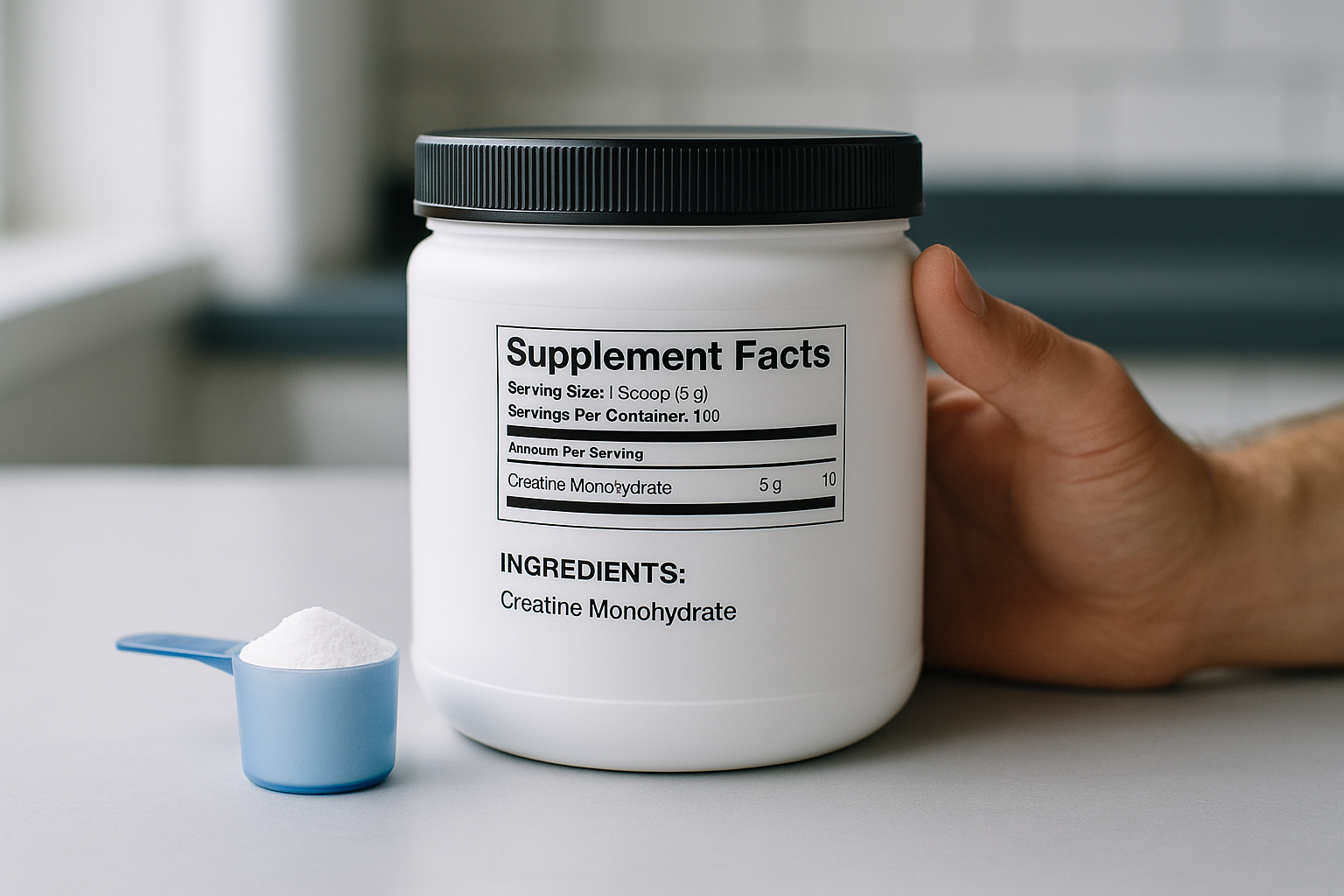
The fastest way to judge a creatine supplement is to read the ingredient list, dose per serving, and form of creatine before you care about flavour names or front-label promises. For most buyers, a good creatine label is boring in the best possible way.
- Check the form: look for creatine monohydrate first. It is the best-studied and usually the most cost-effective form.
- Check the dose: a serving should deliver a useful amount, commonly 3 g to 5 g of creatine monohydrate.
- Check the ingredients: plain unflavoured powder should ideally list only creatine monohydrate.
- Check the nutrition panel: calories and carbs should be essentially zero on a pure product.
- Check serving math: divide the tub size by grams per serving to see how many true servings you are getting.
- Check quality signals: in Canada, look for an NPN, or Natural Product Number, which indicates the product is licensed by Health Canada for sale as a natural health product.
- Check athlete testing needs: if you are drug-tested, look for third-party certification such as NSF Certified for Sport or Informed Sport where relevant.
The biggest label trap is the word “blend”. A proprietary blend can hide how much creatine you are actually getting. Another trap is flashy forms marketed as superior without evidence to justify the price. Monohydrate remains the benchmark against which newer forms are judged, and most do not clearly outperform it.
In Canada, label quality matters because cross-border listings and marketplace sellers are not all equal. A Canadian-compliant product with clear bilingual labelling, an NPN where applicable, and transparent testing is usually the safer, more trustworthy buy. If you want help sorting real options, see best creatine rankings, creatine brand reviews, and creatine product catalog.
For a more detailed walkthrough, our guide on how to read a creatine label breaks down serving size, purity claims, and the fine print that actually matters.
What is in a creatine supplement? Pure powder vs gummies vs flavoured blends
What is in a creatine supplement depends entirely on the format, and that is why two products both called “creatine” can have very different nutrition facts. The creatine itself may be the same active ingredient, but the delivery system can change calories, carbs, sweeteners, and price.
| Product type | Typical main ingredients | Calories/carbs | Best for |
|---|---|---|---|
| Unflavoured monohydrate powder | Creatine monohydrate only | Effectively zero | Best value, purest label, easiest dosing |
| Flavoured creatine powder | Creatine monohydrate plus flavours, acids, sweeteners, colours | Usually very low, sometimes small carbs | Taste and easier daily compliance |
| Creatine gummies | Creatine plus sugar or syrup, gelling agents, flavours | Usually higher than powder | Convenience, no mixing |
| Capsules | Creatine plus capsule shell and sometimes fillers | Usually negligible | Portability, exact dose, no taste |
| Pre-workout with creatine | Creatine plus caffeine, pump ingredients, sweeteners, flavours | Varies by formula | People who want an all-in-one product |
If your search is really “creatine ingredients” or “creatine per serving nutrition,” the safest interpretation is this: you must judge the product type, not just the word creatine on the label.
There is also a quality point hidden here. The more ingredients a product has, the more places there are for underdosing, poor flavouring, digestive irritation, or unnecessary cost. That does not mean flavoured or capsule products are bad. It means you should know what trade-off you are making.
For many people, the most rational choice is simple: buy plain monohydrate, measure 3-5 g, and mix it into water, juice, or a protein shake. If convenience is your top priority, capsules or gummies may still be worth it, but calculate the real dose and cost per gram of creatine, not just the price per container.
If you are comparing forms, you may also want creatine gummies vs. powder, creatine powder vs capsules, and best type of creatine.
How much creatine to take: exact doses by goal, body size, and urgency
Most adults do well with 3-5 g of creatine monohydrate per day, and that dose is enough for nearly everyone to maintain high muscle creatine stores over time. If you want faster saturation, use a loading phase of 20 g per day split into 4 doses for 5-7 days, then drop to 3-5 g daily.
Those numbers come directly from mainstream creatine research and remain the practical standard. You do not need a bodybuilder-sized dose if you are a beginner. What changes with body size is not that smaller people need none or larger people need extreme amounts, but that people at the lighter end often do fine at 3 g daily while larger athletes often prefer 5 g daily for convenience.
Simple examples:
- 60 kg beginner: 3 g daily is a sensible starting dose.
- 75 kg recreational lifter: 3-5 g daily works well.
- 90+ kg strength athlete: 5 g daily is a practical maintenance dose.
Goal-based guidance:
- Fastest results: load at 20 g daily in 4 x 5 g doses for 5-7 days, then 3-5 g daily.
- Simplest routine: skip loading and take 3-5 g daily; expect full saturation in roughly 3-4 weeks.
- Sensitive stomach: use 3 g daily or split 5 g into smaller doses.
- Weight-class athlete: skip loading close to weigh-ins if you want to avoid an early water-weight bump.
If you want precision, use a digital scale or our creatine dosage calculator. If you want the full framework, read how much creatine per day and creatine loading phase.
One common mistake is underdosing because a scoop is heaped, half full, or inconsistently measured. Another is assuming more must be better. It is not. Once muscle stores are saturated, taking much more than needed does not create proportionally better results and may simply raise the chance of stomach upset.
The evidence-based approach is straightforward: take enough to saturate stores, then keep them topped up consistently. That is the entire dosing game for most people.
A beginner-friendly step-by-step plan: how to take creatine starting today
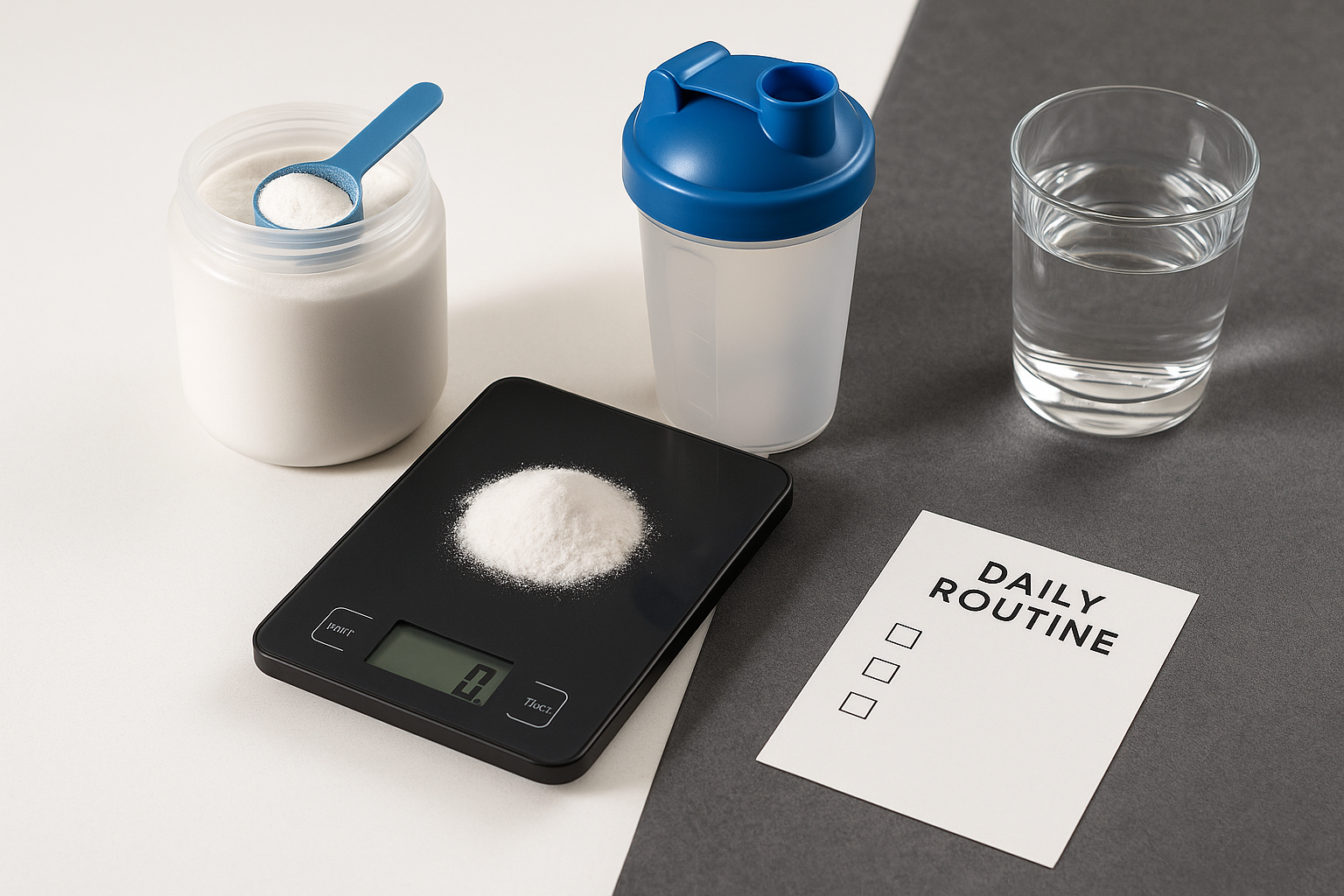
The best way to start creatine is to pick a plain monohydrate product, take 3-5 g every day, and keep going long enough for muscle stores to rise. Consistency beats complexity.
- Choose your product. Pick a creatine monohydrate powder with a short ingredient list. If you are in Canada, an NPN and reputable testing are good quality signals.
- Measure your dose. Use 3 g daily if you are smaller-bodied or want the gentlest start; use 5 g daily if you are larger or want the common standard dose.
- Mix it in a liquid you already tolerate. Water works. Juice works. A protein shake works. The best liquid is the one that makes you remember to take it.
- Take it daily, including rest days. Creatine works by saturating muscle stores over time, so skipping weekends is a classic beginner mistake.
- Decide whether you want to load. If you want faster saturation, take 5 g four times daily for 5-7 days, then return to 3-5 g daily.
- Track the right outcomes. Look for better performance on repeated hard sets, slightly improved training volume, fuller muscles, and gradual strength progress over weeks.
- Troubleshoot if needed. If your stomach feels off, split the dose, take it with food, or switch to micronized monohydrate.
What to expect week by week without loading:
- Week 1: usually nothing dramatic; routine matters more than sensation.
- Weeks 2-3: some people notice slightly better repeat performance or a small increase in body weight from intracellular water.
- Weeks 3-4: muscle stores are approaching saturation; gym performance changes become easier to notice.
- Weeks 4-8+: the main payoff is better training quality translating into strength and muscle gains over time.
This is why creatine often feels subtle. It is not a stimulant. If you want more detailed walkthroughs, see how to take creatine, how long creatine takes to work, and creatine for beginners.
The best sign it is working is not a buzz. It is that a weight you used to get for eight reps becomes nine, or that your later sets hold up better than before.
When to take creatine, and whether food, carbs, coffee, or protein matter
The best time to take creatine is whenever you will reliably remember it every day, because consistency matters far more than clock timing. For most people, taking creatine with a meal, in a shake, or after training is simply a practical adherence strategy.
There is no strong evidence that a perfect minute-by-minute timing window is required for creatine to work. Muscle saturation drives the outcome. If you take 3-5 g daily and keep taking it, you will build and maintain stores whether that scoop happens in the morning, before a workout, after a workout, or at dinner.
What about taking creatine with carbs? Carbohydrate and insulin can support creatine uptake, but in the real world this is usually not a make-or-break issue for someone already taking a full daily dose. You do not need a sugary drink for creatine to work. This is especially relevant if you searched creatine carbs and worried you need carbs built into the supplement itself. You do not.
Useful practical rules:
- With food: often easier on the stomach for sensitive users.
- With protein: completely fine and convenient.
- With coffee: generally fine for most people if you tolerate both well.
- On an empty stomach: also fine for many, but some get mild GI discomfort.
- On rest days: yes, still take it.
If you train early, adding creatine to your post-workout shake is an easy habit. If you do not train consistently, pairing it with breakfast is often better. The best schedule is the one you can repeat for months.
For more on specific timing questions, see when to take creatine, with or without food, and can you mix creatine with coffee?.
Creatine also does not need a special “absorption hack” to be effective. Most people get better results by focusing on daily compliance, good training, enough protein, and adequate hydration rather than obsessing over exotic stacking tricks.
Who these label details matter most for: beginners, women, older adults, athletes, and dieters
Creatine nutrition facts matter most when you need to know whether a product fits your goals, diet, or competition context, and the answer depends on who you are. The active ingredient is broadly useful, but the label details matter for different reasons in different groups.
Beginners should care because the simplest product is often the best first choice. A plain monohydrate with effectively zero calories and zero carbs removes confusion. It also makes it easier to learn whether creatine itself agrees with your stomach before you add flavours or blends.
Women often want to know whether creatine will make them bulky or affect macros. Pure creatine does not add meaningful calories, and any small early scale increase is usually water held inside muscle, not fat gain. For many active women, that makes creatine easy to fit into a strength, recomposition, or performance plan. See creatine for women for specifics.
Older adults may benefit because creatine can support resistance-training adaptations and help maintain muscle function with aging. Here, label simplicity matters because older users are often managing multiple supplements or medications and benefit from fewer unnecessary additives. More on that in creatine for older adults.
Athletes, especially tested athletes, should care about what else is in the tub. Pure creatine itself is not the problem; contamination risk or hidden actives in blends can be. The International Olympic Committee consensus on dietary supplements stresses product quality assurance and contamination risk management as a major issue in sport.
Dieters, fasters, and physique athletes care because plain creatine is effectively macro-free and easy to include during a cut. If you are using gummies or a flavoured product, check whether the added sugars or calories still fit your plan.
Vegetarians and vegans may be especially interested because dietary creatine intake is typically lower when you do not eat meat or fish. That does not change the label facts, but it may increase the practical benefit of supplementation. For more, see is creatine vegan? and creatine for vegetarians.
So the product does not need to be different for every population. The main difference is which label details matter most to each person.
Safety, side effects, and myths: what the evidence supports and what it does not
Creatine monohydrate is generally considered safe for healthy people at standard doses, and the most common side effects are mild digestive upset or a small early increase in body weight from water retained inside muscle. The bigger myths around creatine are much more dramatic than the evidence actually supports.
The 2017 ISSN position stand and the 2021 JISSN review both support creatine monohydrate as effective and well-studied when used appropriately. That does not mean every rumour is true, or every person should use it without context.
What is well established:
- Water weight can increase early. This is usually intracellular water, not fat.
- GI upset can happen. Large single doses are more likely to cause bloating or loose stools.
- Daily use is fine for most healthy adults. Cycling is generally unnecessary.
What is often misunderstood:
- “Creatine has calories.” Pure creatine effectively does not contribute meaningful calories.
- “Creatine is a steroid.” It is not; it works through energy metabolism, not anabolic steroid pathways.
- “Creatine damages kidneys in healthy people.” This is not supported in healthy users at recommended intakes, though existing kidney disease warrants medical guidance.
- “Creatine dehydrates you or causes cramps.” The old myth is not well supported by the overall evidence.
Who should pause and ask a clinician first? People with known kidney disease, those under specialist care for major medical conditions, pregnant or breastfeeding individuals where evidence is still limited for routine supplementation decisions, and anyone taking medications where supplement review is prudent.
Practical fixes for side effects:
- split the dose into smaller servings
- take it with a meal
- choose monohydrate instead of a flashy blend
- avoid dry scooping
- use a measured dose rather than a heaped scoop
For deeper myth-by-myth breakdowns, visit creatine myths debunked, is creatine safe?, and creatine digestive side effects.
The most common creatine label mistakes people make, and how to avoid them
The most common mistake is assuming every creatine product has the same nutrition facts just because the front label says “creatine.” That shortcut causes people to miss added sugars, underdosed formulas, overpriced formats, or unnecessary ingredients.
Here are the big mistakes to avoid:
- Mistaking product format for ingredient purity. A gummy or flavoured mix may still contain effective creatine, but it is not nutritionally the same as plain monohydrate powder.
- Looking at front claims before the ingredient list. “Zero sugar,” “ultra-absorption,” and “premium” tell you less than one line that says “100% creatine monohydrate.”
- Ignoring actual grams of creatine per serving. Some products require multiple gummies, capsules, or scoops to reach a proper daily dose.
- Overpaying for exotic forms. Monohydrate remains the form with the strongest evidence and usually the best price per effective dose.
- Underdosing because of poor measuring. If the scoop is inconsistent, your “daily creatine” may actually be half a dose.
- Taking it only on workout days. That slows or disrupts saturation.
- Expecting a stimulant-like feeling. Creatine is usually subtle and cumulative.
A good troubleshooting question is: “Am I buying creatine for what it does, or for how the marketing makes it feel?” If your main goal is performance, recovery between repeated efforts, strength, and lean mass support, plain monohydrate is still the reference standard in 2026.
If you think creatine is not working, the problem is usually one of four things: not enough daily dose, not enough consistency, unrealistic expectations, or poor training and recovery around it. Our guides on creatine not working, creatine non-responders, and common creatine mistakes go deeper.
The simplest buying rule remains excellent: if you want clean creatine nutrition facts, choose the cleanest possible formula. If you choose convenience formats, do the math carefully and make sure they still deliver a real daily dose.
Bottom line: what creatine nutrition facts actually mean for your buying decision
The bottom line is that pure creatine monohydrate is essentially a zero-calorie, zero-carb, zero-sugar supplement, and any calories or carbs on a creatine label usually come from added ingredients rather than the creatine itself. If you want the cleanest creatine nutritional information, buy unflavoured monohydrate with a short ingredient list.
That makes the decision easier than the supplement industry often suggests. You do not need a sugar-loaded transport system, a proprietary blend, or a trendy alternative form to get creatine’s benefits. You need an evidence-based dose taken consistently enough to raise and maintain muscle creatine stores.
If you want the shortest possible checklist, use this:
- Choose creatine monohydrate.
- Aim for 3-5 g daily.
- Use a loading phase only if you want faster saturation.
- Take it every day, not just on training days.
- Check the ingredient list for extras if calories or carbs matter to you.
- In Canada, prefer products with an NPN and strong quality signals.
For most readers, the best answer to “what is in creatine supplement?” is pleasantly boring: ideally just creatine monohydrate. That boring answer is also the smartest one.
If you want to take the next step, use our creatine dosage calculator, compare options in the creatine product catalog, or browse the best creatine rankings for practical buying help in Canada.
And if you only remember one sentence from this entire guide, make it this one: creatine itself is not a meaningful source of calories or carbs, but creatine products can contain calorie- or carb-containing extras, so always judge the full label, not just the word creatine on the front.
Creatine Nutrition Facts at a Glance
- 0 meaningful calories in pure creatine — Plain creatine monohydrate is effectively calorie-free in practical nutrition tracking.
- 3-5 g/day standard maintenance dose — The mainstream evidence-based daily dose for most adults.
- 20 g/day optional loading dose — Usually split into 4 doses for 5-7 days to saturate faster.
- 5-7 days typical loading phase length — Without loading, full saturation usually takes closer to 3-4 weeks.
Frequently Asked Questions
How many calories are in creatine?
Pure creatine monohydrate has essentially no meaningful calories per serving. If a creatine product lists calories, they usually come from added sugars, flavours, gummy ingredients, or blend components rather than from the creatine itself.
Does creatine have carbs?
Pure creatine does not contain meaningful carbs. Carbohydrates only show up when the product includes added ingredients such as sugars, drink-mix powders, or gummy bases.
Does creatine count toward macros?
Plain creatine generally does not count toward your daily macros in any meaningful way. For practical tracking, it is usually treated as zero calories, zero carbs, zero fat, and zero protein unless the formula contains other nutrition ingredients.
What is in creatine supplement besides creatine?
That depends on the product format. Unflavoured powders may contain only creatine monohydrate, while flavoured powders, capsules, gummies, and pre-workouts can include sweeteners, flavours, acids, capsule shells, fillers, sugars, or stimulants.
Why does my creatine label show carbs or sugar?
Your creatine label shows carbs or sugar because the product contains other ingredients beyond creatine. This is common in gummies, flavoured powders, and all-in-one pre-workouts, where the added delivery ingredients change the nutrition facts.
Does creatine break a fast?
Plain creatine monohydrate is generally considered unlikely to meaningfully affect calories or macros during a fast because it contains essentially no meaningful energy. However, flavoured creatine products or gummies may break a fast if they include sugars or calorie-containing additives.
Is creatine a protein or amino acid?
Creatine is neither a protein nor an amino acid. It is a separate nitrogen-containing compound made in the body from amino acids and used mainly to help regenerate ATP during short, intense muscular effort.
Do I need to take creatine with carbs for it to work?
No, you do not need to take creatine with carbs for it to work. Taking it with carbs can support uptake, but the far bigger factor is taking a full daily dose consistently enough to saturate muscle stores.
What is the best creatine if I want zero calories and zero carbs?
The best choice is plain unflavoured creatine monohydrate with a one-ingredient label. That gives you the most predictable creatine nutrition facts, the strongest evidence base, and usually the best cost per effective dose.
How do I know if my creatine is pure?
You can estimate purity by checking that the ingredient list says only creatine monohydrate and that the label provides a clear dose per serving. In Canada, an NPN and reputable third-party testing add extra confidence in product quality and compliance.