Creatine for Swimmers: Sprint Speed and Recovery in the Pool
By The Creatine Canada Research Team — Evidence-based supplement analysts
Yes—creatine can help swimmers, especially for sprint speed, repeated high-intensity efforts, strength training that supports swimming, and recovery between hard sets. It is most useful for sprinters, IM swimmers, water-polo style repeated bursts, and athletes doing heavy dryland work, while pure long-distance swimmers need to weigh the small performance upside against possible body-mass gain.
Evidence-based · Cites 4 sources · Editorial standards
Key Takeaways
- Creatine monohydrate is the best-studied form for swimming performance and is usually the smartest first choice.
- A standard maintenance dose is 3–5 g daily; a faster loading option is 20 g daily split into 4 doses for 5–7 days.
- Creatine helps most in short, explosive swimming efforts by increasing phosphocreatine, your muscle’s rapid ATP backup system.
- Some swimmers gain 0.5–2.0 kg of water weight early on, which can matter more in distance events than in sprint events.
- Timing matters less than consistency; taking creatine every day is more important than taking it right before a swim.
- If stomach upset occurs, reduce the dose per serving, take it with food, and switch to plain micronized monohydrate.
- In Canada, look for a Natural Product Number and ideally third-party testing when buying creatine.
Does creatine help swimming? Yes—for sprinting, repeated efforts, and dryland power
Yes, creatine helps swimming performance most clearly in events and training that rely on short, high-power efforts rather than steady aerobic pacing. For swimmers, that usually means better support for starts, turns, underwater dolphin kicks, 25–100 m sprint work, repeated race-pace sets, and the gym sessions that build force production behind those skills.
Creatine is a compound stored in muscle as phosphocreatine, which is the fast energy reserve used to regenerate ATP, the direct fuel your muscles spend during explosive work. In swimming, that matters whenever you need a fast burst of force: pushing off the wall, accelerating into clean water, holding speed at the end of a sprint, or repeating hard efforts with short rest.
The strongest evidence base overall supports creatine for strength, power, repeated sprint performance, and lean-mass gains during training, not for dramatic improvements in long-duration endurance performance. The 2017 ISSN position stand concluded that creatine monohydrate is the most effective nutritional supplement currently available for increasing high-intensity exercise capacity and lean body mass during training. The International Olympic Committee consensus on dietary supplements also recognises creatine as one of the few supplements with strong evidence for certain performance uses.
What this means in practice is simple:
- Likely useful: sprint swimmers, middle-distance swimmers with repeated race-pace sets, swimmers doing hard resistance training, triathletes or masters swimmers who need more gym power, and athletes returning to training blocks.
- Potentially useful but less clear: 200–400 m swimmers where repeated power and fatigue resistance matter.
- More of a trade-off: distance specialists for whom even small increases in body mass may offset part of the benefit.
If you are asking, “does creatine help swimming?”, the fairest evidence-based answer is that it can help swimming when the event or training demands repeated high-intensity energy. It is not a magic supplement for technique, pacing, or aerobic base, but it can make the engine behind your fastest efforts more repeatable.
If you are new to supplementation, start with plain monohydrate and pair it with the fundamentals: quality swim volume, smart dryland strength, sleep, and enough carbohydrate around hard sessions. If you want a broader beginner primer first, see what creatine is and creatine for beginners.
How creatine works in the pool: phosphocreatine, ATP, and why sprint sets feel different
Creatine works for swimmers by increasing intramuscular phosphocreatine stores, which helps your muscles resynthesise ATP faster during brief, intense efforts. That mechanism is exactly why creatine tends to help more in swim sprint performance, turns, starts, and repeated hard intervals than in easy aerobic laps.
During an all-out 15–30 second effort, your body cannot rely mainly on oxygen-based energy production because it is too slow to meet the immediate demand. Instead, the phosphocreatine system steps in to rapidly donate a phosphate group and rebuild ATP. More stored phosphocreatine means you can usually maintain power output a little longer, recover a little faster between repeated bursts, and preserve training quality across a session.
For swimmers, the most relevant performance links are:
- Starts and breakouts: more explosive force from the block and more pop into the first metres.
- Turns and underwaters: stronger push-offs and repeated dolphin kicks under fatigue.
- Sprint maintenance: a better chance of holding velocity in the final part of a 50 or 100.
- Repeatability: less drop-off across sets like 12 x 50 race pace on tight rest.
- Dryland transfer: improved strength and power training quality in the gym, which can support stroke force over time.
Creatine may also support recovery indirectly by helping maintain training intensity and, in some contexts, reducing the decline in performance across repeated efforts. It is not a replacement for carbohydrate, protein, hydration, or sleep, but it can strengthen the short-burst energy system swimmers rely on repeatedly in training and racing.
Another reason creatine matters in swimming is that pool performance is highly technical, so small physical gains can show up in useful places even if total race time changes are modest. If a supplement lets you hit one more quality rep at target pace, maintain cleaner underwaters late in a set, or produce more force in the weight room for several weeks, that can matter during a competition block.
The clearest summary is this: creatine does not make water feel lighter or instantly improve technique, but it can improve the muscle energetics behind explosive swimming. For a deeper explanation of this energy system, see how creatine gives you energy and creatine for sprinting.
Which swimmers benefit most—and who should think twice before loading
Creatine is most worthwhile for swimmers whose training and races involve repeated high-intensity efforts, and it is less clearly beneficial for pure distance specialists. The benefit-to-trade-off ratio depends on your event, your training style, and how sensitive your performance is to a small rise in body mass.
Best-fit swimmers usually include:
- 50 m and 100 m sprinters: these events depend heavily on starts, turns, power, and top-end speed maintenance.
- 200 m swimmers: many 200 m races blend speed and fatigue resistance, making repeated high-intensity support useful.
- IM swimmers: repeated power demands, strong turns, and high training variety often make creatine a sensible option.
- Swimmers in heavy dryland phases: if your programme includes lifting, jumping, pulling, or resisted power work, creatine can improve the quality of that training.
- Vegetarian or vegan athletes: people who eat little or no meat often start with lower muscle creatine stores and may respond especially well.
Swimmers who should think more carefully include:
- Distance specialists: if you race longer events and every small body-mass increase affects feel and efficiency, trial creatine well away from a key meet.
- Highly weight-sensitive athletes: some swimmers dislike the early scale increase, even when it is mostly water stored inside muscle.
- Athletes with a history of GI issues: creatine is still possible, but dosing method matters more.
Women can absolutely use creatine, and there is no evidence-based reason to avoid it simply because you are female. Older masters swimmers may also benefit, especially if they are using resistance training to preserve power and muscle. Beginners can use creatine too, but it should come after the basics of regular training, protein intake, and recovery are in place.
If you are unsure whether your event profile suits creatine, use this rule of thumb: the more your performance depends on explosive output and repeating hard efforts with limited rest, the more logical creatine becomes. The more your performance depends almost entirely on steady-state efficiency and minimal body mass, the more individual the decision becomes.
For more athlete-specific nuance, see creatine for athletes, creatine for women, and creatine for older adults.
Exactly how to take creatine for swimmers: the simplest step-by-step plan
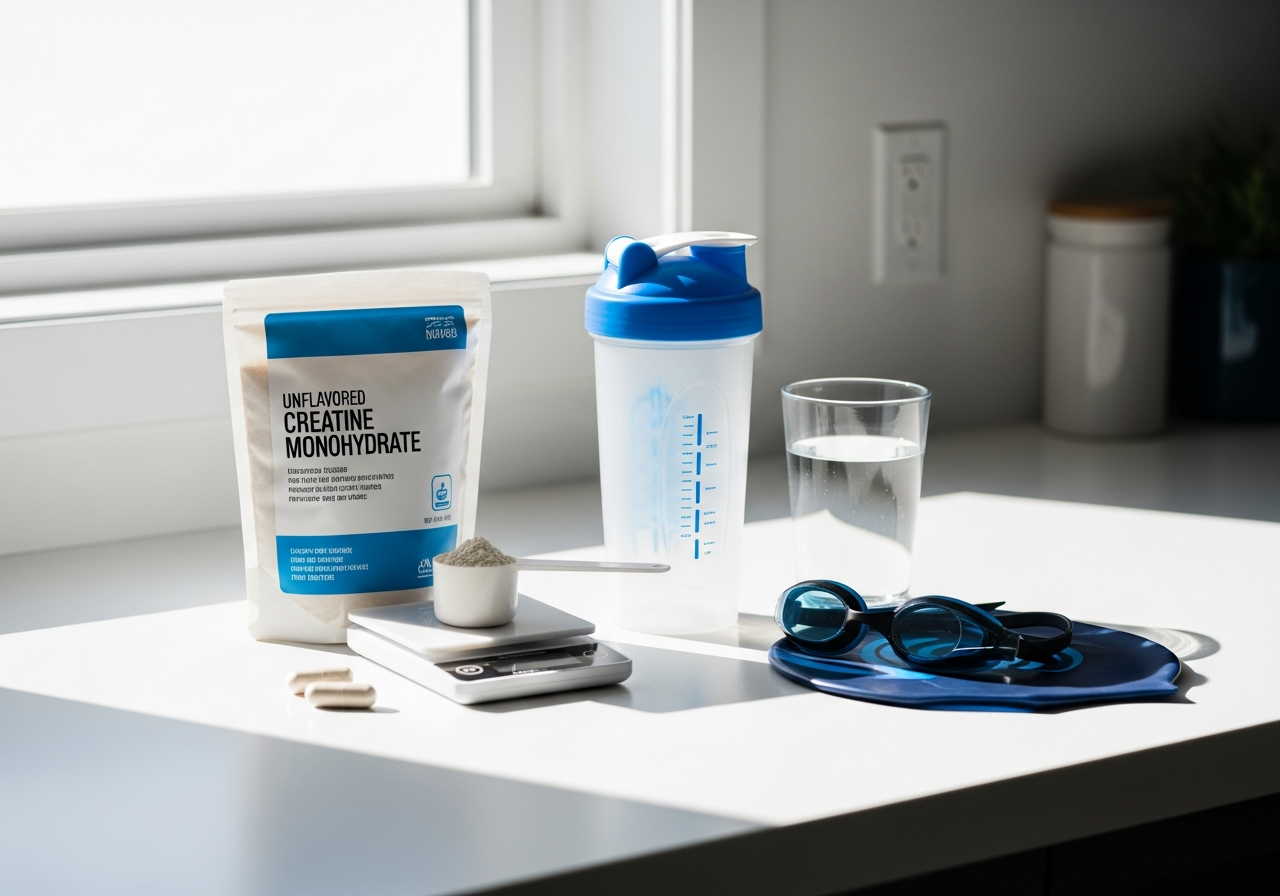
The best way for swimmers to take creatine is to use 3–5 g of creatine monohydrate every day, or load with 20 g daily split into 4 doses for 5–7 days if you want faster saturation. Daily consistency matters more than taking it at a perfect time.
- Choose the right form. Buy plain creatine monohydrate, ideally micronized for easier mixing. It is the most studied, most cost-effective form and the benchmark against which fancy versions are judged.
- Pick your dosing strategy. Use either a no-loading approach of 3–5 g daily, or a loading phase of 20 g daily split into four 5 g servings for 5–7 days, then drop to 3–5 g daily.
- Take it every day. Training days and rest days both count because creatine works by saturating muscle stores over time. Missing the occasional day is not a disaster, but regular intake works best.
- Mix it in something you will actually drink. Water, juice, a protein shake, or your post-swim recovery drink are all fine. If you need help with dissolving, see how to mix creatine.
- Pair it with your routine. The easiest habit is after morning practice, after lifting, or with breakfast on rest days. If you want more on timing, read when to take creatine.
- Track outcomes for 3–4 weeks. Monitor body weight, how your sprint sets feel, gym performance, and whether your repeat times hold up better late in sets.
Here is a realistic beginner plan for a swimmer:
- Week 1 without loading: start 3 g daily with a meal.
- Week 2: continue 3–5 g daily and note any scale change or GI issues.
- Week 3–4: expect fuller muscles, better support on power sets, and possibly improved gym numbers.
If you need a more exact amount based on your size and goals, use our creatine dosage calculator and read how much creatine per day. If you prefer the rapid route, see creatine loading phase.
Most swimmers do not need to overcomplicate this. The practical winning formula is plain monohydrate, a measured dose, every day, for long enough to saturate muscle.
Creatine dosage for swimmers by body weight, event, and goal
Most swimmers do well with 3–5 g of creatine monohydrate daily, but heavier athletes and those who want faster saturation may benefit from a body-weight-based approach. The common evidence-based loading method is 0.3 g/kg/day for 5–7 days, followed by a maintenance intake around 3–5 g/day.
For practical use, event demands matter as much as body weight. Sprinters often value faster saturation and may accept early water-weight gain, while distance swimmers often prefer a slower build with no loading.
| Swimmer profile | Body weight | Best starting plan | Why this works |
|---|---|---|---|
| Teen or smaller adult beginner | Under 60 kg | 3 g/day | Usually enough to raise stores steadily with lower GI risk |
| Average adult swimmer | 60–90 kg | 3–5 g/day | Standard maintenance range supported by mainstream practice |
| Larger swimmer or strength-focused athlete | Over 90 kg | 5 g/day | Simple dose that better matches larger muscle mass |
| Sprinter needing faster saturation | Any | 20 g/day in 4 x 5 g for 5–7 days, then 3–5 g/day | Raises muscle stores more quickly before hard training blocks |
| Distance swimmer worried about mass gain | Any | 3 g/day, no loading | Slower saturation may reduce abrupt early weight change |
Examples:
- 55 kg female 200 m swimmer: start with 3 g/day for 4 weeks, then evaluate training response.
- 76 kg male 100 m freestyle swimmer: 5 g/day, or load for 5–7 days before a power-focused training block.
- 94 kg masters swimmer doing 3 lifts per week: 5 g/day is a reasonable default.
Do not confuse “more” with “better.” Once muscle creatine stores are saturated, taking large extra doses does not keep boosting performance and is more likely to cause stomach upset. The goal is saturation, not megadosing.
One more practical point for swimmers: if an important meet is approaching and you have never used creatine before, do not experiment during race week. Trial it in training first so you know whether you gain body mass, how your stomach handles it, and whether your stroke feel changes. That is especially important for long-course swimmers sensitive to body position and rhythm.
Timing, loading, and what swimmers should expect week by week
Creatine timing is a minor detail compared with total daily intake, but loading changes how quickly swimmers notice effects. If you load, you may feel the training benefits within about a week; if you do not load, it often takes roughly 3–4 weeks of daily use to meaningfully saturate muscle stores.
Here is the realistic timeline:
- Days 1–7 with loading: muscle creatine stores rise quickly. Some swimmers notice a small increase in body weight and fuller muscles. Power-set quality may start improving near the end of the week.
- Weeks 1–2 without loading: no dramatic sensation is required. You are gradually building stores even if you feel nothing obvious yet.
- Weeks 3–4: this is when many swimmers notice better repeatability in sprint sets, slightly stronger gym sessions, or less drop-off late in power work.
- Weeks 4–8: the biggest practical payoff often appears through training quality, not through an instant miracle race. Better dryland numbers and more consistent hard reps can compound.
When should you take it? In real life, take creatine whenever you are most likely to remember it. Post-workout, with a meal, or in a recovery shake are all reasonable. There is no compelling need to take creatine immediately before you swim. If you want a fuller timing breakdown, see when to take creatine and creatine on rest days.
Swimmers often ask how to tell if it is working. Look for these signs:
- Less pace drop-off across repeated 25s or 50s
- Stronger push-offs and cleaner underwaters late in sets
- Better gym performance in low-rep or explosive work
- A small early scale increase without a change in body fat
It is also normal not to feel a stimulant-like effect. Creatine is not a pre-workout buzz supplement. It works silently by raising muscle stores over time.
If nothing changes after 4–6 weeks, revisit the basics: are you actually taking 3–5 g daily, using monohydrate, and training in a way that stresses the energy systems creatine supports? You may also be a lower responder if your baseline muscle creatine stores were already relatively high. For that scenario, read why creatine may not seem to work.
The big swimming trade-off: performance upside versus early water-weight gain
The main downside of creatine for swimmers is not fat gain but a possible early increase in body mass from extra water stored inside muscle. For many sprinters that is an acceptable trade for more power, but for some distance swimmers it can be a real performance consideration.
Creatine pulls water into muscle cells as intramuscular stores rise, which is one reason muscles often look and feel fuller after starting it. That water is not the same thing as subcutaneous “puffiness,” and it is not body fat. Many users gain roughly 0.5–2.0 kg early on, especially with loading, though individual responses vary.
In swimming, body mass affects more than the scale:
- Sprint upside: more force and repeated-effort support can outweigh the extra mass.
- Distance caution: any change in feel, line, or efficiency may matter more over longer events.
- Technique interaction: some swimmers love the added muscular fullness; others feel “heavier” until they adapt.
This is why testing creatine in a normal training block is smarter than starting it right before a championship meet. You need time to learn whether the net effect is positive for your stroke feel and event profile.
How to minimise the trade-off:
- Use 3 g/day with no loading if you are mass-sensitive.
- Start in the off-season or early in a build block.
- Track morning body weight for 2–3 weeks, not day to day.
- Judge by performance markers, not just scale weight.
If you are a 50 or 100 specialist doing high-force training, a small rise in body mass often matters less than better power production. If you are a 1500 swimmer or open-water athlete, the equation may tilt the other way. That does not mean creatine is “bad” for endurance swimmers; it means the decision is more individual and should be tested, not assumed.
For more on this issue, see does creatine make you gain weight and creatine for endurance athletes.
Safety for swimmers: side effects, hydration, kidneys, and common concerns
Creatine monohydrate is generally considered safe for healthy people when used at recommended doses, and the most common side effects are mild digestive issues or early water-weight gain rather than anything dramatic. The 2017 ISSN position stand and the 2021 JISSN review on misconceptions both support the overall safety profile of creatine in healthy populations.
The biggest practical side effects for swimmers are:
- Stomach upset or loose stools: usually caused by taking too much at once.
- Temporary scale increase: commonly due to intramuscular water retention.
- Mild bloating sensation: more common during aggressive loading.
What about dehydration and cramps? Current evidence does not support the old myth that creatine inherently dehydrates you or causes cramps. In fact, the 2021 JISSN misconceptions review specifically addressed several of these claims and found they are not well supported. Swimmers should still hydrate properly, of course, but that is because hard pool training demands it, not because creatine is uniquely drying.
What about kidneys? In healthy individuals, creatine at recommended doses is not the same as kidney damage. Confusion often arises because creatine can increase creatinine, a breakdown product that appears on blood tests, without necessarily indicating harm. If you have known kidney disease, are under medical supervision for renal issues, or take medications that affect kidney function, speak with a qualified healthcare professional before using it.
Use caution or medical guidance if you:
- Have diagnosed kidney disease
- Are pregnant or breastfeeding
- Have a complex medical condition or multiple medications
- Are buying from unverified sources with questionable ingredient quality
For healthy swimmers, the safest approach is boring and effective: buy a reputable monohydrate product, measure your dose, take it consistently, and avoid giant single servings. If you want more detail, see is creatine safe, creatine and kidneys, and creatine and dehydration.
Common mistakes and myths: what swimmers get wrong about creatine and pool training
Most creatine problems in swimmers come from poor use, not from the supplement itself. The biggest mistakes are choosing flashy forms over monohydrate, taking too much at once, expecting an instant race-day boost, and assuming any weight gain means fat gain.
Mistake 1: Buying the wrong form.
Creatine monohydrate remains the reference standard because it has the strongest evidence, the best value, and the most consistent dosing. Fancy forms often cost more without proving better results. If you are comparing options, start with the best type of creatine and monohydrate vs HCL.
Mistake 2: Using a giant single scoop.
A big one-time dose is the fastest way to get stomach upset. If you load, split the daily amount into four smaller doses.
Mistake 3: Treating creatine like a stimulant.
Creatine is not caffeine and does not need to “kick in” before morning practice. It works by saturating muscle stores, not by giving a buzz. That is why daily use matters more than exact timing.
Mistake 4: Starting right before a key meet.
A championship taper is the wrong time to discover that you gain a kilo, feel odd in the water, or upset your stomach.
Mistake 5: Believing old myths.
- Myth: Creatine is a steroid. Fact: It is not; it is a naturally occurring compound involved in energy metabolism.
- Myth: Creatine is only for bodybuilders. Fact: It is relevant to any sport with repeated high-intensity efforts, including swimming.
- Myth: Creatine causes dehydration and cramps. Fact: This claim is not supported by the best current evidence.
- Myth: You must cycle creatine. Fact: Routine cycling is not required for most healthy users.
If you are troubleshooting, the fix is usually simple: return to plain monohydrate, use the correct daily amount, take it with food or fluid, and give it enough time. For more myth-busting, visit creatine myths debunked and creatine myths vs. facts.
What to buy in Canada: the best creatine form, labels to check, and what not to overpay for
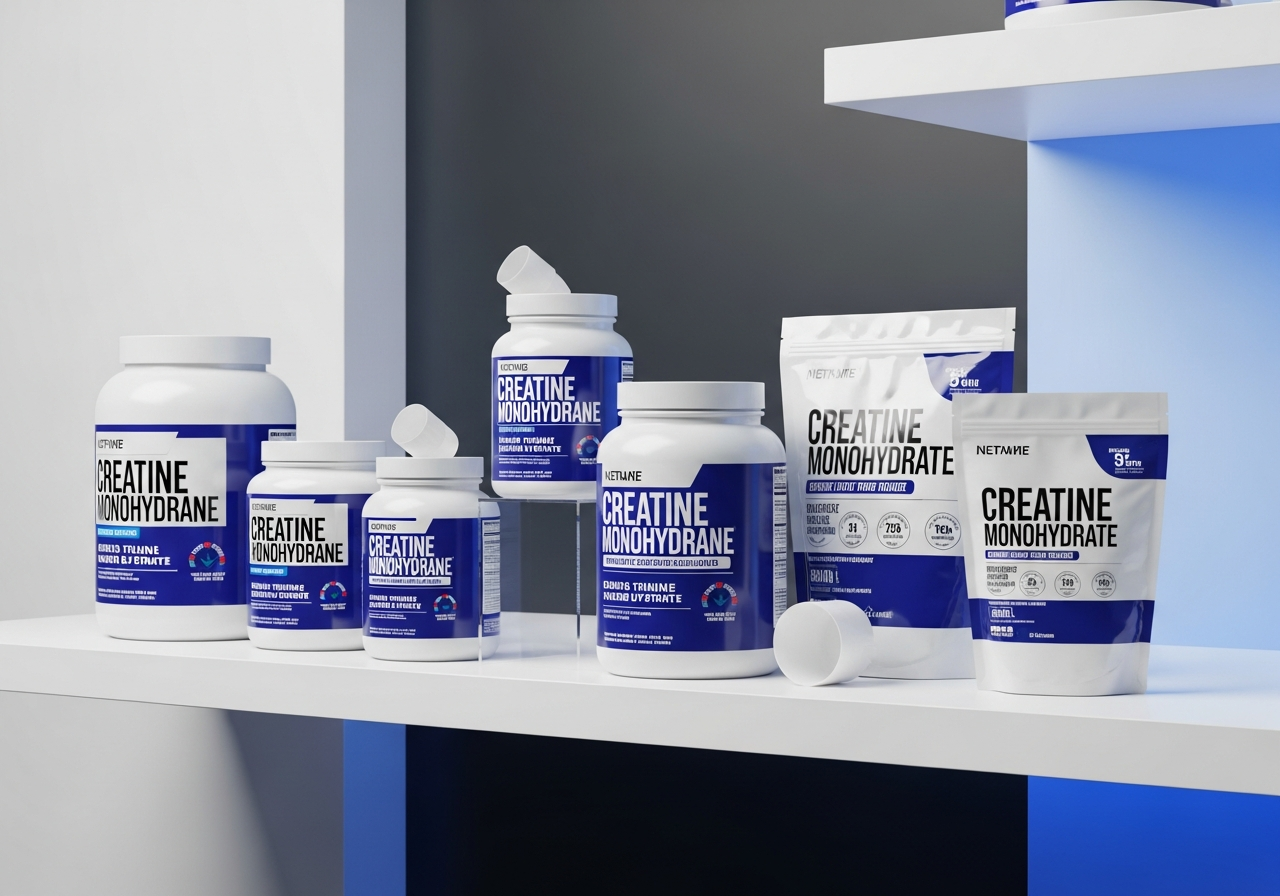
For swimmers in Canada, the best creatine to buy is usually plain creatine monohydrate from a reputable brand with clear dosing, a Natural Product Number where applicable, and ideally third-party testing. You do not need a “swim-specific” creatine formula to get the proven benefits.
Here is what to look for:
- Ingredient list: ideally just creatine monohydrate, especially if you are sensitive to sweeteners or flavour systems.
- Dose transparency: the label should clearly state grams per serving.
- NPN: in Canada, a Natural Product Number indicates Health Canada-authorised licensing for many supplement products sold as natural health products.
- Third-party testing: useful extra reassurance for purity and label accuracy.
- Micronized powder: often mixes better, though it is not required for effectiveness.
| Option | Best for | Pros | Cons |
|---|---|---|---|
| Plain monohydrate powder | Most swimmers | Best evidence, best value, easy to dose | Needs mixing |
| Micronized monohydrate | Swimmers who dislike gritty texture | Mixes more easily, same core ingredient | Sometimes slightly pricier |
| Capsules | Travel or convenience | No mixing, easy for pool bags | Often more expensive per gram, many capsules needed |
| Flavoured blends | People who struggle with plain powder | Tastes better | May include extra ingredients you do not need |
What not to overpay for: proprietary “advanced transport systems”, dramatic absorption claims, or exotic creatine forms marketed as automatically superior to monohydrate. In most cases, those claims outpace the evidence.
If you want help comparing products available to Canadians, see our best creatine rankings, creatine brand reviews, and creatine product catalog. If you want a more focused product guide, the companion read is best creatine monohydrate in Canada.
The practical buying rule is simple: choose purity, clear dosing, and reputation over marketing. For nearly every swimmer, plain monohydrate is still the benchmark to beat.
Three real-world creatine plans for swimmers: sprinter, distance, and masters athlete
The best creatine plan for swimmers depends on whether your priority is pure speed, minimising body-mass change, or supporting strength and recovery as you age. Here are three practical templates you can copy.
1) Sprint swimmer plan: 50–100 m specialist
Use a loading phase if you want the faster effect. Take 5 g, four times daily, for 5–7 days, then 5 g daily. Start this early in a hard training block, not in meet week. Track dive 15 m speed, turn quality late in sets, and repeat 25 or 50 times on short rest.
2) Distance swimmer plan: 400 m and up
Skip loading and take 3 g daily for 4–6 weeks. This slower approach gives you time to judge whether body feel changes in the water help, hurt, or make no difference. Focus on whether your gym power, finishing speed, and repeatability in threshold-plus efforts improve without compromising stroke rhythm.
3) Masters swimmer plan: performance plus healthy ageing
Take 3–5 g daily, ideally tied to your strength training or breakfast routine. Masters athletes often benefit not only from repeated-effort support in the pool but also from improved resistance-training quality over time.
No matter which plan you choose, use the same checklist:
- Start with monohydrate.
- Decide whether rapid loading is worth the chance of early water-weight gain.
- Take it daily for at least 3–4 weeks if not loading.
- Judge it by training metrics, not only by race-day hopes.
- Stop overcomplicating timing and focus on consistency.
A good logbook for swimmers includes:
- Morning body weight 2–3 times weekly
- Best and average times on race-pace sets
- Notes on starts, underwaters, and turn pop
- Gym lifts, jumps, or medicine-ball throws
- How your stomach and hydration feel
Creatine works best when it supports a system, not when it is expected to rescue a weak one. If your programme already includes quality technique work, enough food, and hard but recoverable training, creatine can be a useful layer on top.
Bottom line: should swimmers take creatine?
Yes, many swimmers should consider creatine—especially sprinters, power-oriented swimmers, and athletes doing serious dryland training—but it is not equally valuable for every event. The clearest use case is swimming performance that depends on explosive output and repeated high-intensity efforts.
If you want the shortest practical answer, it is this:
- Best form: creatine monohydrate
- Best everyday dose: 3–5 g daily
- Fast-start option: 20 g daily split into 4 doses for 5–7 days, then 3–5 g daily
- Best for: sprint swimming, repeated race-pace sets, and strength training support
- Main downside: early water-weight gain that may matter more in longer events
Creatine for swimmers is not about hype. It is about matching the supplement to the energy demands of the sport. If your races and training repeatedly ask for short bursts of force, quick ATP regeneration, and the ability to reproduce speed under fatigue, creatine makes physiological sense and has a strong evidence base behind it. If your event is highly sensitive to body mass and less dependent on explosive repeat efforts, the decision is more individual and should be tested in training.
For most swimmers, the smart approach is to start simple, measure your response, and let your event profile guide whether you continue. Take plain monohydrate consistently, track sprint-set quality and body mass, and decide based on actual pool performance rather than internet myths.
Creatine helps swimmers most when the goal is more repeatable power, not when the hope is a shortcut around training, technique, or pacing.
If you are ready to start, use our creatine dosage calculator to set your dose and browse our best creatine rankings for evidence-based product picks.
Creatine for Swimmers: The numbers that matter
- 3–5 g/day Standard maintenance dose — A practical daily range for most swimmers using creatine monohydrate.
- 20 g/day Typical loading dose — Usually split into 4 doses for 5–7 days to saturate muscles faster.
- 5–7 days Loading timeline — Common timeframe to raise muscle creatine stores quickly.
- 3–4 weeks No-loading timeline — Typical time to notice benefits if taking a steady daily dose without loading.
Frequently Asked Questions
Does creatine help swimming performance?
Yes, creatine can help swimming performance, especially in sprinting, repeated hard efforts, and strength work that carries over to the pool. It works best in situations that rely on rapid ATP regeneration, such as starts, turns, underwaters, and race-pace sets with short rest. It is less reliably helpful for pure endurance swimming than for high-intensity swimming.
Is creatine good for sprint swimmers?
Yes, creatine is often a very good fit for sprint swimmers because sprint events depend heavily on explosive power and repeated high-intensity energy. That includes block starts, wall push-offs, breakouts, and the ability to maintain speed late in a 50 or 100. Sprinters also tend to benefit more from creatine-supported dryland strength gains.
Should distance swimmers take creatine?
Maybe—distance swimmers need to weigh the potential benefits against possible early water-weight gain. Creatine may still help with gym performance, finishing speed, and repeated hard sets, but if a small increase in body mass affects your stroke feel or efficiency, the net result may be less favourable. A slow 3 g/day trial in training is the safest way to judge it.
What is the best creatine for swimmers?
The best creatine for swimmers is usually plain creatine monohydrate. It is the most studied form, the most cost-effective, and the form used in most of the evidence supporting creatine’s benefits for strength, power, and repeated high-intensity performance. Micronized monohydrate is fine if you want a powder that mixes more easily.
How much creatine should a swimmer take?
Most swimmers should take 3–5 g of creatine monohydrate daily. If faster saturation is desired, a common loading approach is 20 g daily split into four 5 g doses for 5–7 days, followed by 3–5 g daily. Smaller or weight-sensitive swimmers often start at 3 g daily, while larger athletes often use 5 g daily.
When should swimmers take creatine?
Swimmers can take creatine whenever they are most likely to take it consistently, because timing matters less than daily intake. Many athletes use it after training, with breakfast, or in a post-swim shake simply because those routines are easy to repeat. Taking it right before a swim is not necessary for it to work.
Will creatine make swimmers gain weight?
Yes, creatine can cause a small early weight increase, but this is usually water stored inside muscle rather than fat gain. Many users notice about 0.5–2.0 kg of change, especially if they load. For sprinters this is often an acceptable trade-off, while some distance swimmers may prefer a slower no-loading approach.
Does creatine cause bloating or stomach issues in swimmers?
It can, but those issues are usually preventable. Stomach upset is most often caused by taking too much at once, using a poorly tolerated flavoured product, or dry scooping. Taking smaller doses, using plain monohydrate, mixing it well, and having it with food or fluid usually solves the problem.
Can swimmers take creatine every day?
Yes, swimmers should usually take creatine every day if they want the full benefit. Creatine works by building and maintaining saturation of muscle stores over time, so rest days still matter. Daily use is more effective than only taking it before hard swims or races.
Is creatine allowed in competitive swimming?
Yes, creatine is allowed in competitive swimming and is not a banned substance. It is widely used across many sports because it is a legal dietary supplement with strong evidence for high-intensity performance support. Competitive athletes should still buy from reputable brands to reduce contamination risk from poor manufacturing.