Creatine for Soccer: Sprints, Repeated Efforts, and Recovery
By The Creatine Canada Research Team — Evidence-based supplement analysts
Yes—creatine can help soccer players by improving repeated sprint ability, explosive efforts, strength and training quality, which matters in a sport built on accelerations, decelerations, jumps and hard runs rather than steady-state endurance. For most footballers, 3 to 5 g of creatine monohydrate daily is the simplest, best-supported way to use it.
Evidence-based · Cites 4 sources · Editorial standards
Key Takeaways
- Creatine helps soccer most in repeated high-intensity efforts: sprints, accelerations, jumps, tackles and hard changes of direction.
- The best-supported form for soccer players is creatine monohydrate, typically 3 to 5 g daily.
- A loading phase of 20 g/day split into 4 doses for 5 to 7 days works faster, but is optional.
- Expect faster benefits with loading in about 1 week; without loading, saturation usually takes about 3 to 4 weeks.
- Small body-mass increases from extra muscle water are common, so position, playing style and body-mass sensitivity matter.
- Creatine is not a steroid, is permitted in sport, and has strong safety support in healthy people when used appropriately.
- Buy plain monohydrate with clear dosing, a Health Canada NPN when sold as a natural health product, and preferably third-party testing.
Yes, creatine can help soccer players—especially for repeated sprints and explosive actions
Yes, creatine can help soccer players because soccer performance depends heavily on short, repeated bursts of high power, and creatine directly supports the energy system used in those moments. If you are asking does creatine help soccer, the practical answer is that it is most useful for accelerations, repeated sprint efforts, jumping, physical duels, and the quality of hard training sessions.
Soccer is not a pure endurance sport, even though matches last 90 minutes or more. Footballers repeatedly produce near-maximal actions: a 5- to 30-m sprint to a loose ball, a jump for a header, a quick recovery run, a forceful tackle, or several hard changes of direction in one phase of play. Those actions rely strongly on phosphocreatine, the rapid energy store inside muscle that helps regenerate ATP, the molecule muscles use for immediate energy. Increasing muscle creatine stores gives you a larger reserve for these repeated bursts.
The evidence base is strongest for creatine improving high-intensity exercise capacity, lean mass, strength and training adaptations rather than making someone a better technical player on its own. In soccer terms, creatine will not improve first touch, vision or decision-making by magic. What it can do is improve the physical engine that supports those skills late in training and late in matches.
The 2017 ISSN position stand concluded that creatine monohydrate is the most effective nutritional supplement available for increasing high-intensity exercise capacity and lean body mass during training. The International Olympic Committee’s 2018 consensus on dietary supplements also includes creatine among the few supplements with good evidence for performance applications in specific contexts.
For soccer players, the key nuance is this: creatine tends to help most when your game or training involves repeated explosive work, and less when the main demand is continuous low-intensity running. That is why creatine for soccer players makes sense for wingers, full-backs, midfielders who cover ground with repeated presses, strikers who rely on bursts, and defenders who repeatedly accelerate, jump and wrestle for position.
If you want the short version, use plain monohydrate, take it every day, and judge it by your sprint repeatability, gym strength, jump quality and ability to hold intensity across sessions—not by whether you “feel” a stimulant effect.
How creatine works in football: the phosphocreatine system behind sprints, presses and recovery between efforts
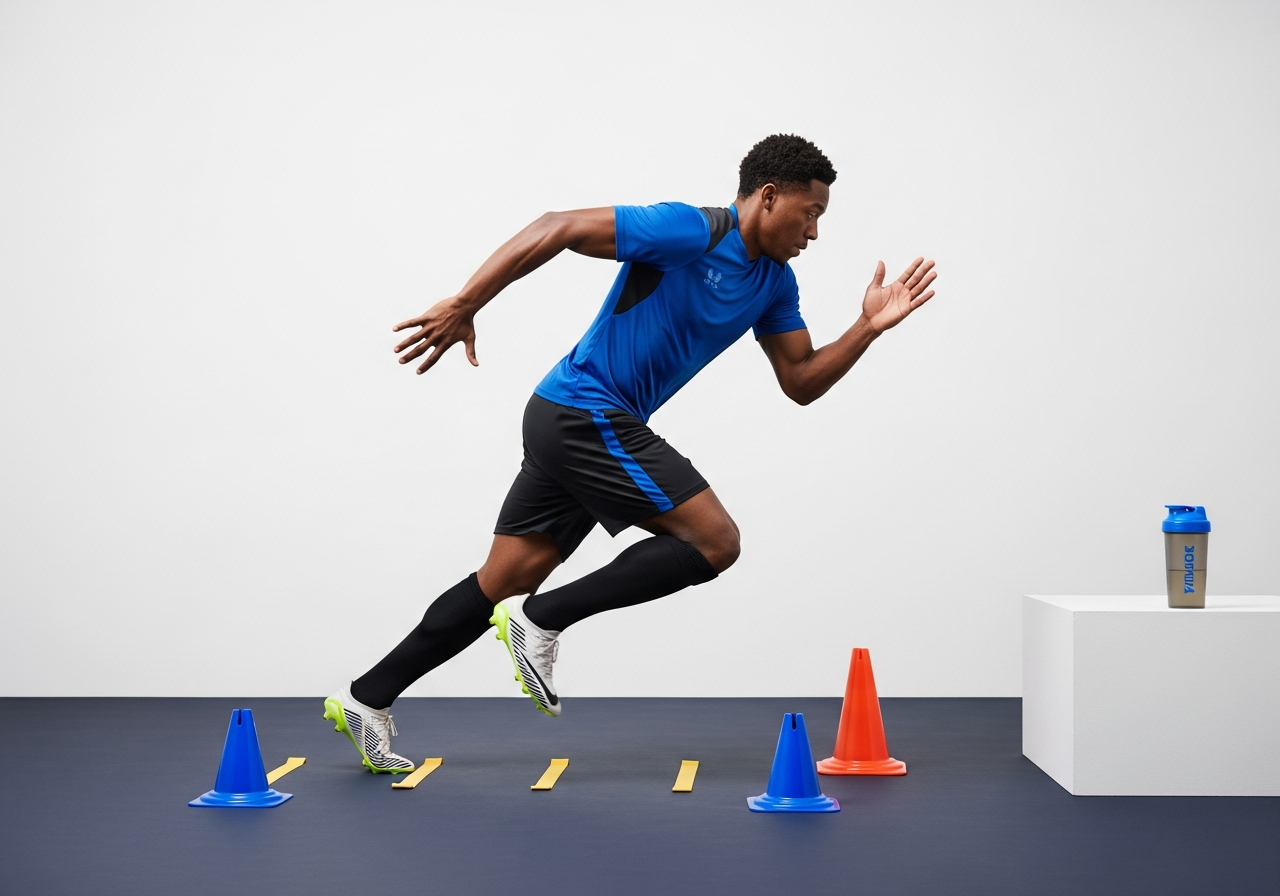
Creatine helps footballers by increasing muscle phosphocreatine stores, which lets the body regenerate ATP faster during short, intense efforts and recover a bit better between those efforts. That mechanism is exactly why creatine is relevant to repeated sprint soccer performance.
Here is the simple physiology. Muscles run on ATP, but the amount of ATP stored in muscle is tiny and can power maximal work only briefly. Phosphocreatine is a high-energy phosphate compound stored alongside ATP in muscle. During a sprint, jump or hard acceleration, phosphocreatine donates a phosphate to rapidly rebuild ATP so your muscles can keep producing force. More stored creatine generally means more phosphocreatine available, which can help maintain power output across repeated efforts.
That matters in soccer because the game is full of clusters of intense actions with incomplete rest:
- press, recover, press again
- overlap sprint, decelerate, cut inside, sprint again
- jump for a header, land, react to the second ball
- multiple accelerations in transition over 20 to 60 seconds
Creatine does not replace aerobic fitness. Your aerobic system still drives recovery over the full match and supports total work rate. What creatine does is improve the short-burst energy side of the equation and often your ability to train that side harder. In practice, that can mean better quality in speed sessions, small-sided games, repeated sprint drills, resisted sprint work, and strength training in the gym.
There may also be indirect benefits. By supporting training volume and power output, creatine can help players accumulate better strength and lean mass adaptations over time. Those long-term adaptations matter for shielding the ball, absorbing contact, accelerating more forcefully and staying physically robust across a season.
The evidence is also stronger for creatine monohydrate than for alternative forms marketed as more advanced. If you want the deeper basics on what creatine is and what saturation means, see What Is Creatine and our evidence-based creatine benefits guide.
One useful expectation check: creatine is a saturation supplement, not an acute pre-workout buzz. You will not take one scoop and suddenly feel electric in the warm-up. Instead, your muscle stores gradually rise, and the payoff usually shows up as better repeated hard efforts, stronger gym sessions, and less drop-off across explosive work.
What benefits soccer players can realistically expect on the pitch and in training
Soccer players should expect creatine to help most with repeated sprint performance, power-oriented training, jumping and strength, while any direct effect on steady running endurance is smaller and less consistent. That is the honest answer for anyone searching creatine for footballers or creatine football players.
The most realistic benefits fall into two buckets: match-relevant explosive actions and the training quality that supports them.
- Repeated sprint ability: Creatine is especially relevant when you must produce hard efforts with short recoveries.
- Acceleration and short-burst power: This can matter more than top-end speed in many soccer situations because the game is won in the first few steps.
- Jumping and physical contests: More power and strength can help in aerial duels and body contact.
- Strength and lean mass gains from training: Over weeks and months, creatine can help you get more from your gym work.
- Training session quality: Better output across sets, reps and repeated drills can compound into better adaptation.
What about recovery? Creatine is not a substitute for sleep, nutrition or smart periodization, but some players notice they hold quality better across congested training weeks. That is probably less about “feeling recovered” in a vague sense and more about better cellular energy availability and the ability to sustain training quality.
What about endurance? Creatine is not primarily an endurance supplement. It may be neutral or mildly helpful in intermittent team-sport endurance, but if your main goal is to improve long continuous running performance, the effect is less compelling. Soccer is different because it is an intermittent sport with repeated intense bursts layered onto a large aerobic base.
There is also a trade-off to consider: some players gain a small amount of scale weight, especially after loading, because creatine increases intracellular water stored inside muscle. For many athletes, that is acceptable or even helpful. For a player extremely sensitive to body mass—such as someone who already feels heavy or is returning to peak speed after injury—it is worth monitoring rather than ignoring.
A good way to tell whether creatine is helping is to track:
- repeat sprint times across 4 to 10 efforts
- countermovement jump or broad jump
- gym lifts such as squat, trap-bar deadlift or split squat
- late-set quality in repeated sprint or power drills
- how much performance drops from your first effort to your last
If those markers trend up over 3 to 6 weeks while your training remains consistent, creatine is doing its job.
How to take creatine for soccer: the simplest step-by-step plan that works
The best way to take creatine for soccer is to use creatine monohydrate daily, either with a short loading phase for faster saturation or a steady 3 to 5 g per day approach for simplicity. If you want results without overthinking it, consistency matters far more than fancy timing.
- Choose the form: Buy plain creatine monohydrate powder. It is the most studied and most cost-effective form. Our best creatine rankings and creatine brand reviews can help you compare options.
- Pick your strategy: Either load at 20 g/day split into 4 doses for 5 to 7 days, then switch to 3 to 5 g/day, or skip loading and take 3 to 5 g/day from the start.
- Take it every day: Use it on training days, match days and rest days. Creatine works by maintaining saturation, not by acting like a stimulant.
- Mix it properly: Stir it into water, juice, or a protein shake. If it settles, swirl and finish it. For tips, see how to mix creatine.
- Pair with a routine: Take it with breakfast, post-training, or any meal you rarely miss so adherence stays high.
- Hydrate normally: You do not need to force absurd amounts of water, but do meet normal hydration needs, especially in summer training and indoor winter facilities.
- Assess after 3 to 4 weeks: If you skipped loading, that is when you should judge effects. If you loaded, assess after about 7 to 14 days.
For players in-season, the easiest plan is usually 3 to 5 g once daily with a meal. It is gentler on the stomach and less likely to create a rapid scale jump than loading. For players in pre-season, a loading phase can make sense if you want faster saturation before a heavy block of sprint and strength work.
If you often forget doses, leave the tub next to something you use daily: coffee maker, protein powder, lunch bag, or toothbrush. Missing one day is not a disaster, but regular misses slow saturation and flatten benefits. If you want a precise daily amount, use our creatine dosage calculator or read how much creatine per day.
The best programme is the one you will actually follow for months, not the one that looks most advanced on paper.
Creatine dosing for soccer players by body weight, position and goal
Most soccer players do well on 3 to 5 g of creatine monohydrate per day, but body weight, position and the urgency of results can guide the fine details. The classic evidence-based loading method is about 0.3 g/kg/day for 5 to 7 days, followed by a maintenance dose of about 3 to 5 g/day.
Here is a practical dosing table for footballers.
| Player profile | Loading option | Maintenance | Best use case |
|---|---|---|---|
| 55-70 kg player | ~15-20 g/day split into 4 doses for 5-7 days | 3 g/day | You want minimal stomach upset and a lighter body-mass approach |
| 70-90 kg player | 20 g/day split into 4 doses for 5-7 days | 3-5 g/day | Most adult soccer players |
| 90 kg+ player | 20-25 g/day split into 4-5 doses for 5-7 days | 5 g/day | Larger, stronger players with high lean mass |
| In-season player avoiding rapid weight gain | Skip loading | 3-5 g/day | Steadier saturation with less abrupt scale increase |
| Pre-season player wanting faster effect | Use loading | 3-5 g/day | Quick saturation before heavy sprint and gym blocks |
Position matters in how you interpret the trade-off, not usually in whether creatine “works.” A centre-back, striker or powerful full-back may welcome a slight increase in body mass if strength and repeated collisions improve. A smaller winger whose game is built on lightness and repeated bursts may still benefit, but should monitor body mass and sprint feel more carefully.
Women soccer players generally use the same creatine dosing principles as men. Older adult players in masters leagues also use similar dosing, although they may place more value on strength retention, muscle mass and recovery support. Beginners do not need a special product; plain monohydrate still applies. For more on those groups, see creatine for women and creatine for older adults.
If you are vegetarian or vegan, creatine may be especially worthwhile because dietary creatine intake is typically lower and baseline muscle stores may also be lower. That can make the response more noticeable. See creatine for vegetarians for the full context.
If in doubt, default to 5 g/day or 3 g/day if you are smaller and want the most conservative, no-fuss option.
When to take creatine for training and match days—and why timing matters less than saturation
The best time to take creatine for soccer is whenever you will consistently remember it, because daily saturation matters much more than whether you take it before training, after training or at night. That is the evidence-based answer, and it prevents athletes from turning a simple supplement into a timing obsession.
Creatine is not like caffeine, where acute timing can noticeably change the next session. Once your muscle stores are saturated, the timing of a single dose is far less important than whether you have been taking it consistently over days and weeks. For that reason, many footballers do best with one of these simple routines:
- After training: Easy to pair with your recovery shake or meal.
- With breakfast: Great for players who train later and often forget supplements at night.
- With dinner on rest days: Keeps the habit intact year-round.
On match day, you can still take your normal daily dose. Do not expect an acute match-day boost from a single serving if you have not already been supplementing. If pre-match nerves make your stomach sensitive, take it earlier in the day with food or move it to another meal. There is no need to “double up” before kickoff.
During loading, splitting your intake into 4 smaller servings across the day usually feels better than taking one large amount at once. For example, 5 g at breakfast, lunch, post-training and dinner is much easier on the gut than 20 g in one shake.
For soccer players with two-a-days, congested fixtures or travel, the practical rule is simple: pack measured servings and keep the habit alive. Capsules can be convenient, but powder is usually cheaper per gram. If timing still interests you, read when to take creatine and creatine on rest days.
The one timing idea worth keeping is adherence design. The “best” timing is the anchor point you almost never miss. For most athletes, a decent routine done daily beats a theoretically perfect protocol done sporadically.
What to expect week by week, including body weight changes and performance signs it is working
Creatine usually starts helping soccer players within about 1 week if they load, or within about 3 to 4 weeks if they take 3 to 5 g daily without loading. The first sign is often better performance repeatability in training, not a dramatic feeling during a single sprint.
Week 1 with loading: Muscle creatine stores rise quickly. Some players notice a small increase in body weight from intracellular water. Gyms sessions may start to feel stronger, and repeated sprint drop-off may feel slightly less severe.
Weeks 1 to 2 without loading: You may not feel much yet. This is normal. Creatine is accumulating gradually.
Weeks 3 to 4 without loading, or weeks 2 to 3 after loading: This is when many players notice the clearest performance effect. You may maintain speed better across sprint reps, recover a bit better between hard efforts, and handle more total quality work in speed or strength sessions.
Weeks 4 to 8: The more meaningful gains often become indirect: stronger lifting numbers, improved jump output, better resilience in repeated hard sessions, and better body composition support if training and nutrition are solid.
How do you know it is working? Use objective markers instead of vibes:
- your last few sprints are less slow relative to your first few
- you can sustain quality across repeated acceleration drills
- your jump testing trends upward
- your gym volume or load improves at the same perceived effort
- you feel less faded late in high-intensity training blocks
Some scale weight increase is common, especially early. That is not fat gain. Creatine draws more water into muscle cells, which is different from getting soft or bloated. If the scale rise worries you, read does creatine make you gain weight and does creatine cause bloating.
It also helps to distinguish between “non-response” and poor setup. If you are under-dosing, skipping rest-day doses, judging it after only a few days, or expecting a stimulant feeling, you may think it is not working when the real problem is protocol. For the realistic timeline, see how long creatine takes to work.
Who creatine is best for in soccer, from beginners and women to older and plant-based players
Creatine is a sensible option for many soccer players, including beginners, women, masters athletes and plant-based players, because the core mechanism is the same across groups: higher muscle creatine stores support repeated high-intensity effort. The differences are mostly in goals, expectations and how carefully body mass is monitored.
Beginners: Yes, beginners can use creatine. In fact, beginners often benefit because it supports gym progress and repeated training quality while they build a strength base. If you are new to supplements, plain monohydrate is the right starting point, not a proprietary performance blend.
Women soccer players: Women use the same evidence-based doses as men. Creatine does not automatically make women “bulky.” What it more often does is support strength, repeated efforts and training adaptation. The bulking fear confuses intracellular muscle water and performance support with unwanted body-fat gain.
Older adult footballers: For players in their 40s, 50s and beyond, creatine may be especially valuable for preserving strength, power and lean mass as recovery and muscle retention become bigger issues. It can support the physical qualities that often decline first with age.
Vegetarian and vegan players: Plant-based athletes may respond especially well because they generally consume less creatine from food. Lower baseline stores can create more room for improvement.
Younger athletes: Creatine use in teenagers requires parent, coach and ideally qualified practitioner involvement, plus a mature approach to training, hydration and product quality. The supplement should never replace basics like food, sleep and coaching. If this applies, read creatine for teenagers and what age can you take creatine.
Players who should pause and ask a clinician first: Anyone with known kidney disease, significant medical conditions, unusual lab concerns, or pregnancy and breastfeeding questions should get individual medical advice before supplementing. That is a caution, not a claim that creatine is broadly unsafe.
Overall, creatine for soccer players is best viewed as a low-complexity, high-evidence supplement for athletes who value explosive repeatability, gym progress and long-term physical development.
Safety, side effects and the biggest creatine myths soccer players still hear
Creatine monohydrate is well supported as safe for healthy people when used at recommended doses, and the biggest real-world issues for soccer players are mild digestive upset, temporary water-related weight gain and bad supplement information. It is not a steroid, and it is not banned simply because it works.
The 2021 JISSN review on common creatine misconceptions addresses many myths directly, including confusion around kidneys, dehydration, cramps and hair loss claims. In healthy individuals, the overall safety profile is strong when the product is used as directed and sourced sensibly. Read the review here: Antonio et al. (2021), JISSN.
Common side effects and what they really mean:
- Small body-weight increase: Common, especially after loading, and usually due to more water stored inside muscle.
- Stomach upset or loose stool: Usually caused by taking too much at once; splitting doses or lowering the dose typically fixes it.
- Bloating: Some athletes report it, but this is often dose-related and more common with aggressive loading than steady daily use.
Common myths worth debunking:
- “Creatine dehydrates you.” The research does not support the claim that creatine inherently dehydrates athletes when normal hydration is maintained.
- “Creatine causes cramps.” This is a long-running sports myth, but it is not well supported by the evidence.
- “Creatine damages kidneys.” In healthy people, recommended-dose creatine is not shown to cause kidney damage, though people with kidney disease should consult a clinician.
- “Creatine is a steroid.” False. Creatine is a naturally occurring compound involved in energy metabolism, not an anabolic steroid hormone.
- “You need to cycle it.” No. Cycling is not required to keep it effective.
For deeper reading, see our guides on creatine safety, kidney concerns, and creatine myths debunked.
For most footballers, the safety playbook is straightforward: use monohydrate, stay within evidence-based doses, avoid megadosing, buy from reputable brands, and do not let internet rumours outweigh the actual evidence.
Best creatine for soccer players in Canada: what to buy, what to ignore, and how labels matter
The best creatine for soccer players in Canada is usually plain creatine monohydrate powder from a reputable brand with transparent ingredient labelling, lot information and preferably third-party testing. You do not need a special “soccer” formula, and you rarely need to pay more for flashy forms like HCL, ethyl ester or buffered creatine.
Here is the practical buying checklist for Canadian shoppers:
- Look for creatine monohydrate as the main ingredient.
- Prefer minimal formulas. Plain unflavoured powder is often the best value.
- Check serving size in grams. Some products under-dose a scoop.
- Look for a Natural Product Number (NPN) when sold in Canada as a natural health product, which indicates Health Canada-authorized labelling for that product category.
- Prefer reputable brands with third-party testing or strong quality control disclosures.
- Avoid proprietary blends that hide the actual creatine amount.
| Option | Pros | Cons | Best for |
|---|---|---|---|
| Creatine monohydrate powder | Most studied, cheapest per gram, easy to dose accurately | Needs mixing; slight graininess is normal | Most soccer players |
| Micronized monohydrate | Mixes a bit easier, same core ingredient | May cost slightly more | Players who care about texture |
| Capsules | Convenient for travel and match weekends | Usually more expensive and requires many capsules for 3-5 g | Frequent travellers |
| Gummies/flavoured blends | Convenient or more enjoyable | Often cost more and may add sugar or under-dose creatine | Adherence-first users with budget flexibility |
If you are comparing products, browse our creatine product catalog and best creatine rankings. If you want the deeper Canadian buying angle, our guide to best creatine monohydrate in Canada is the next logical read.
The bottom line on buying is refreshingly simple: monohydrate still wins because the evidence, price and practicality all point in the same direction.
The mistakes soccer players make with creatine, and how to fix them fast
The most common creatine mistakes in soccer are taking too little, expecting an instant effect, skipping rest-day doses, and blaming creatine for problems caused by poor hydration, poor product choice or bad timing habits. The good news is that nearly all of these are easy to fix.
- Mistake 1: Using a tiny under-dose. Many blends provide less than an effective daily amount. Fix it by checking grams, not marketing claims.
- Mistake 2: Taking it only before training. Creatine is not a pre-workout stimulant. Fix it by taking it daily, including off-days.
- Mistake 3: Judging it after three days without loading. If you skip loading, you usually need about 3 to 4 weeks. Fix it by being patient and tracking objective markers.
- Mistake 4: Taking 20 g in one hit. This often causes stomach issues. Fix it by splitting loading doses into 4 smaller servings.
- Mistake 5: Quitting after minor scale gain. Early weight gain is often intracellular water, not fat. Fix it by assessing sprint performance and body composition context, not scale emotion.
- Mistake 6: Buying trendy forms over monohydrate. Fix it by choosing the form with the best evidence first.
- Mistake 7: Ignoring the rest of the performance equation. Creatine cannot compensate for weak sleep, low calories, poor protein intake or inconsistent training.
Troubleshooting is straightforward. If you get stomach upset, reduce to 3 to 5 g/day, take it with food, and use a more diluted drink. If you feel too heavy after loading, stop loading and continue with maintenance only. If you think you are a non-responder, first verify dose, product quality, adherence and timeline before assuming the supplement failed.
Also remember context: creatine may help a footballer physically, but skill, decision-making, tactical fit and match fitness still dominate actual game performance. Creatine is an enhancer of preparation, not a replacement for preparation.
If you want a broader practical guide, see how to take creatine, the loading phase guide, and why creatine might not seem to work.
Bottom line: should footballers take creatine?
Yes, many footballers should consider creatine because it is one of the best-supported supplements for the exact physical qualities soccer repeatedly demands: short-burst power, repeated sprint work, explosive actions and the training adaptations behind them. For healthy players, plain creatine monohydrate at 3 to 5 g daily is usually the smartest place to start.
If you want the shortest practical recommendation, it is this:
- Buy plain creatine monohydrate from a reputable source.
- Take 3 to 5 g every day.
- Use a 5- to 7-day loading phase only if you want faster saturation.
- Track repeat sprint quality, gym strength, jumps and body weight for 3 to 6 weeks.
- Keep the basics strong: training, sleep, food, protein and hydration.
Creatine is not magic, and it is not equally useful for every possible performance outcome. It will not turn poor fitness into elite match output, and it will not teach you how to play. But if your sport is built on repeated accelerations, transitions, jumps and collisions—as soccer is—creatine fits the job unusually well.
That is why creatine for soccer players remains such a durable recommendation in 2026: not because it is trendy, but because the mechanism is clear, the evidence base is strong, the cost is reasonable, and the day-to-day protocol is simple enough to follow through a real season.
If you are ready to start, compare products in our catalog, estimate your intake with the dosage calculator, and keep your expectations grounded in what creatine actually does best: helping you repeat explosive work at a higher level, more often.
Creatine for Soccer at a Glance
- 3-5 g/day Typical maintenance dose — The standard daily creatine monohydrate intake for most soccer players.
- 20 g/day Classic loading protocol — Usually split into 4 doses for 5 to 7 days to saturate muscle faster.
- 5-7 days Time to faster saturation with loading — Players who load often notice benefits sooner.
- 3-4 weeks Typical timeline without loading — Daily maintenance-only use usually takes a few weeks to fully build muscle stores.
Frequently Asked Questions
Does creatine help soccer players?
Yes, creatine can help soccer players, especially in repeated sprints, accelerations, jumps and explosive efforts with short recovery. It is most useful for the high-intensity parts of football rather than continuous low-intensity running, and many players also benefit indirectly through better gym training quality and strength gains over time.
Is creatine good for footballers or will it make them too heavy?
Creatine is good for many footballers, but some players will notice a small body-weight increase from extra water stored inside muscle. That trade-off is often acceptable because repeated sprint ability, power and strength can improve, but lighter players who are very body-mass sensitive should monitor weight and sprint feel closely.
What is the best creatine for soccer players?
The best creatine for soccer players is plain creatine monohydrate. It has the strongest evidence, is usually the most affordable per gram, and works as well or better than pricier forms that are often marketed as more advanced without better support.
How much creatine should a soccer player take?
Most soccer players should take 3 to 5 g of creatine monohydrate per day. A player who wants faster saturation can use a loading phase of 20 g per day split into 4 doses for 5 to 7 days, then continue with 3 to 5 g daily.
Should soccer players take creatine before or after training?
Soccer players can take creatine before or after training, but the exact timing matters less than taking it consistently every day. Once muscle stores are saturated, creatine works through ongoing availability in muscle rather than from a single pre-session serving.
Does creatine improve repeated sprint soccer performance?
Yes, repeated sprint ability is one of the most relevant reasons soccer players use creatine. Because creatine supports the phosphocreatine system that rapidly regenerates ATP during short intense efforts, it is particularly suited to sequences of hard runs with incomplete rest.
Can women soccer players take creatine?
Yes, women soccer players can take creatine, and the same general dosing principles apply as for men. Creatine does not automatically cause unwanted bulk; it is more accurately viewed as a supplement that supports strength, repeated efforts and training adaptation.
Is creatine allowed in soccer and competitive football?
Yes, creatine is allowed in soccer and competitive football. It is a legal dietary supplement, not an anabolic steroid, though athletes should still buy reputable products to reduce contamination risk and follow team or governing-body supplement policies.
How long does creatine take to work for footballers?
Creatine usually works in about 5 to 7 days if a footballer uses a loading phase, or about 3 to 4 weeks if they use only a standard daily maintenance dose. The first noticeable effect is often better repeated training output rather than a dramatic match-day feeling.
Can creatine hurt endurance for soccer players?
Creatine does not usually help pure steady endurance much, but that does not mean it hurts soccer performance. Soccer is an intermittent sport, so the benefits to repeated explosive efforts often matter more than any small body-mass trade-off, especially for players who rely on bursts, duels and accelerations.