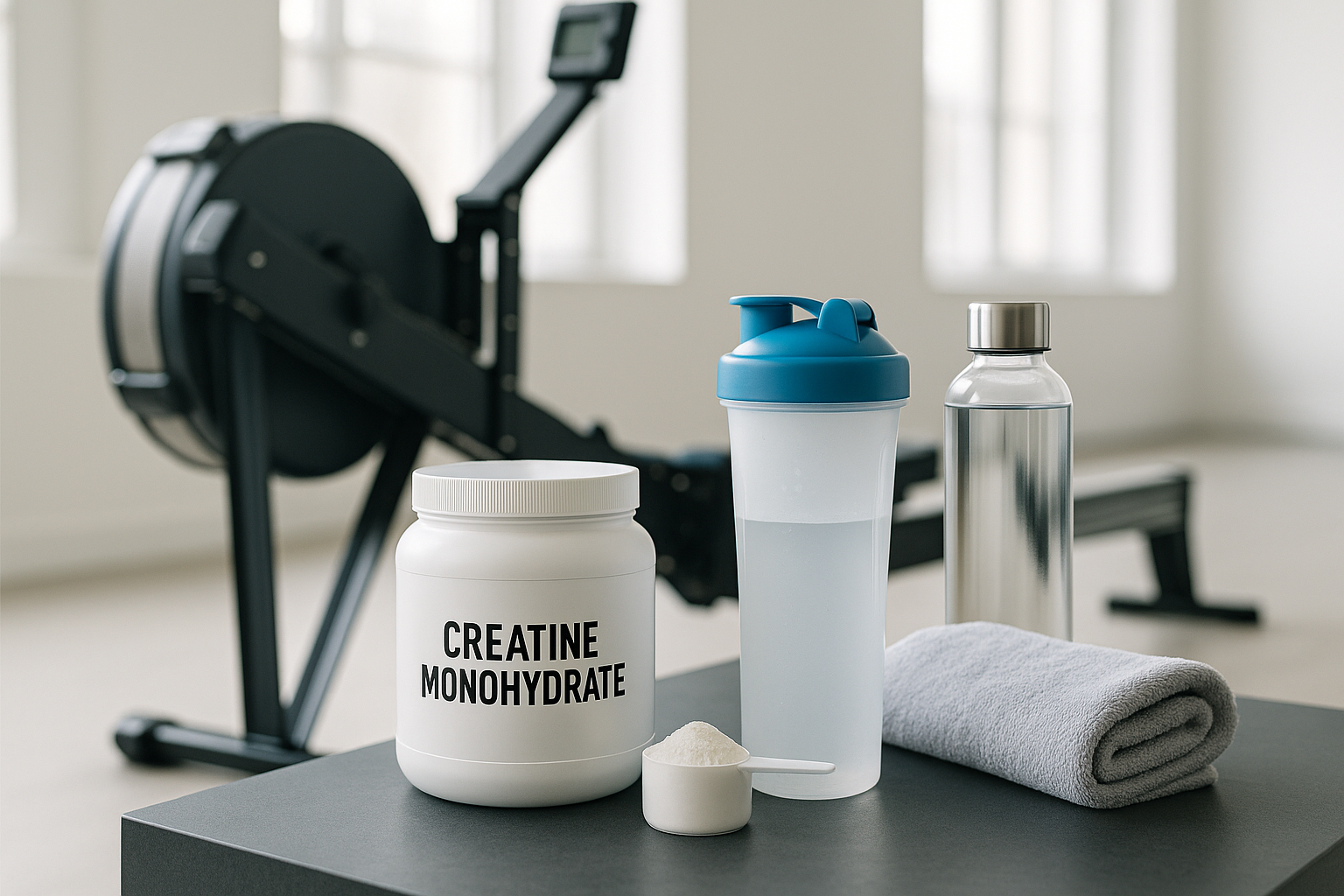
Creatine for Rowing: Power at the Catch, Stroke Rate, and Recovery
By The Creatine Canada Research Team — Evidence-based supplement analysts
Yes—creatine can help rowing performance, especially for starts, power at the catch, high-rate pieces, sprint finishes, lifting, and recovery between hard efforts. For most rowers, 3–5 g of creatine monohydrate daily is the simplest evidence-based protocol, with the main trade-off being a small increase in body mass from extra intracellular water.
Evidence-based · Cites 4 sources · Editorial standards
Key Takeaways
- Creatine helps rowers most in repeated high-power efforts, race starts, sprint finishes, and gym strength work.
- The best-supported form for rowing is creatine monohydrate, not HCL, buffered, or proprietary blends.
- A standard maintenance dose is 3–5 g daily; loading at 20 g/day split into 4 doses for 5–7 days works faster.
- Rowers in lightweight classes should weigh the performance upside against possible short-term water-weight gain.
- Timing matters less than consistency; take creatine every day, including rest days.
- Most healthy adults tolerate creatine well, but digestive upset is more likely when large doses are taken at once.
- In Canada, choose a product with a Natural Product Number and, ideally, third-party testing for sport.
Does creatine help rowing? Yes—mostly where rowing gets explosive, repeated, and brutally fatiguing
Yes, creatine for rowing can improve the parts of performance that depend on rapid energy turnover: the start sequence, power at the catch, high stroke rates, repeated surges, sprint finishes, and strength sessions that support boat speed. Creatine is less about making a long steady-state row feel magically easy and more about helping you produce and repeat hard efforts with better quality.
That distinction matters because rowing is not purely endurance and not purely power. A 2,000 m race blends aerobic capacity with repeated anaerobic demands, especially in the first 20 strokes, mid-race moves, and final sprint. Indoor rowing intervals, head-race surges, seat racing, and crew training also force the body to regenerate energy quickly between hard strokes and hard pieces. Creatine is useful here because it increases intramuscular phosphocreatine, the stored compound that helps rapidly remake ATP, the immediate energy currency used for powerful muscle contraction.
The best evidence for creatine overall is in high-intensity exercise and resistance training, and that maps well onto important parts of rowing performance. The 2017 ISSN position stand concluded that creatine monohydrate is the most effective ergogenic nutritional supplement currently available for increasing high-intensity exercise capacity and lean mass during training. For rowers, that usually means more quality in the gym, stronger repeated efforts on the erg or water, and potentially better ability to hold power when fatigue rises.
Where creatine helps most in rowing:
- Race starts: faster ATP regeneration supports explosive first strokes.
- High-rate work: repeated hard contractions benefit from better phosphocreatine availability.
- Sprint finishes: creatine is most relevant when intensity spikes late.
- Strength training: better training quality can carry over to stroke power.
- Recovery between intervals: phosphocreatine resynthesis supports repeated work.
Where creatine helps less directly:
- Easy steady-state rows done far below threshold.
- Purely technical issues such as timing, blade work, or crew synchronicity.
- Aerobic engine development on its own.
If you want a broader primer on how this supplement works before applying it to crew, see what creatine is. If your main question is whether creatine and rowing performance fit your training phase right now, the short answer is yes for most open-weight rowers and many masters rowers, with more caution for athletes tightly managing body mass.
Why creatine works for rowers: more phosphocreatine means faster energy for hard strokes
Creatine helps rowers because it increases muscle phosphocreatine stores, and phosphocreatine is the rapid-response energy buffer that helps restore ATP during short, intense muscular efforts. In plain English, creatine does not replace endurance fitness; it helps you hit hard efforts harder and recover from them faster.
Every stroke starts with force production from the legs, trunk, and upper body. During the drive, muscle fibres break down ATP almost instantly. Because ATP stores are tiny, the body needs a fast system to rebuild it. That system is the phosphagen system, where phosphocreatine donates a phosphate to ADP to regenerate ATP. When muscle creatine stores are higher, that process can support repeated high-power outputs more effectively.
Why this matters specifically for creatine and rowing performance:
- The catch and first part of the drive are explosive. Better rapid-energy availability can support peak force application.
- High stroke rates compress recovery time between strokes. Faster ATP buffering matters more as rate rises.
- Intervals and seat races rely on repeated efforts. Creatine is especially relevant when recovery periods are incomplete.
- Strength training supports boat speed. Better gym performance can improve the physical qualities behind stroke power.
Creatine may also help indirectly through training adaptations. If a rower gets one or two more good reps on squats, deadlifts, pulls, or rowing-specific power intervals over weeks and months, that extra high-quality work can add up. Some athletes also notice they bounce back a bit better between demanding sessions, though recovery outcomes are more variable than strength and power outcomes.
The mechanism is established; the exact size of the rowing-specific payoff is more individual. A heavyweight male sweeping six times a week with two lifting sessions may notice more obvious benefit than a lightweight sculler in a strict weight window. Vegetarians and vegans often respond well because their baseline muscle creatine stores may be lower. For deeper background on the energy system itself, our guides on creatine and ATP and the creatine phosphate system connect the mechanism to sport performance.
The 2021 JISSN review on common creatine questions and misconceptions reinforced that creatine’s core role is to increase creatine stores and thereby support high-intensity exercise capacity, not to act like a stimulant or hormone booster. That is exactly why creatine for water sports like rowing makes sense: you still need engine, technique, and pacing, but creatine can improve the energy support behind repeated forceful strokes.
Which rowers benefit most from creatine, and who should think harder about the scale
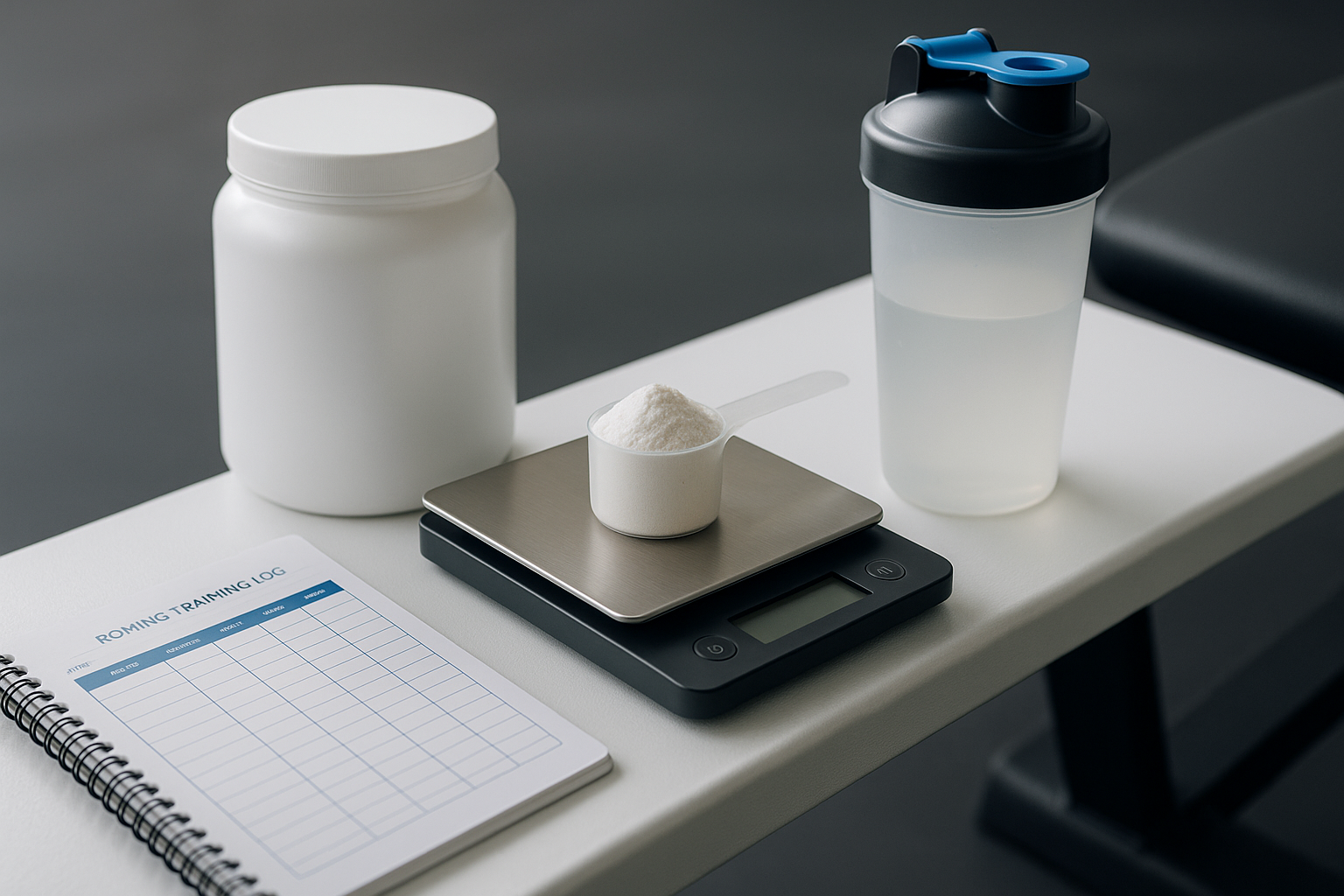
Creatine for rowers makes the most sense for open-weight athletes, indoor rowers, sprint-oriented crews, strength-focused off-season training, masters athletes, and plant-based athletes. The group that should pause and plan more carefully is lightweight rowers or any rower close to a hard body-mass cap.
Here is the practical breakdown.
- Beginners: Yes, beginners can use creatine. If you are new to rowing and also new to lifting, creatine can support gym progress and repeated interval quality while you build basics. It is not necessary to “earn” creatine by reaching an advanced level first.
- Experienced rowers: Competitive rowers often benefit because training includes intense pieces, starts, race prep, and resistance work. Small improvements matter more when performance is already high.
- Women: Women can use the same evidence-based creatine monohydrate protocols as men. There is no good evidence that women need a special female formula. For more, see creatine for women.
- Older adults and masters rowers: Creatine can be particularly useful when preserving strength, lean mass, and training quality becomes more important with age. See creatine for older adults.
- Vegetarian or vegan rowers: These athletes may respond especially well because dietary creatine intake is lower. See creatine for vegetarians and is creatine vegan.
- Lightweight rowers: Creatine can still help, but the short-term increase in water held inside muscle may complicate weigh-ins. This is a sport-specific judgement call, not a reason to call creatine ineffective.
For rowers, the key trade-off is simple: creatine can improve high-intensity output, but some athletes will gain a modest amount of scale weight when muscle creatine stores rise and bring more intracellular water with them. That is usually a performance-positive effect, not bloating in the bodybuilding sense, but in lightweight crew the extra kilograms or fractions of a kilogram can matter. If that is your situation, read does creatine make you gain weight and consider a slower no-loading protocol.
Creatine is also relevant for cross-training rowers who run, bike, ski erg, or lift in the off-season. Among water sports, rowing is actually one of the better fits because race demands include substantial repeated power. So if your question is “does creatine help rowing?” the answer is strongest for rowers who regularly train or race above threshold and who want better repeated high-output capacity.
How to take creatine for rowing: the simplest step-by-step plan that works
The best way to take creatine for rowing is to use creatine monohydrate every day, either 3–5 g daily from day one or a short loading phase followed by maintenance. Consistency matters more than timing, brand hype, or fancy stacks.
- Choose creatine monohydrate. This is the most studied, most reliable, and usually most cost-effective form. If you are comparing options, start with best creatine rankings or browse the creatine product catalog.
- Pick your dosing approach. Use 3–5 g/day if you are fine waiting longer for full effect, or load with 20 g/day split into 4 doses for 5–7 days if you want to saturate muscle faster.
- Take it daily. Training day, rest day, race week, deload week—it stays daily. Saturation, not acute pre-workout stimulation, is the goal.
- Mix it with water, a shake, or a meal. Many rowers find it easiest post-workout in a protein shake or at breakfast on non-training days.
- Use a small split dose if your stomach is sensitive. Two doses of 2–2.5 g or four doses during loading usually reduce digestive issues.
- Stay normally hydrated. You do not need absurd water chugging, but heavy rowing sessions already increase fluid needs. Our water with creatine guide covers practical hydration.
- Stick with it for at least 4 weeks. Judging creatine after three random doses is one of the most common mistakes.
Here is a useful real-world routine for crew athletes:
- Morning steady-state rower: take 3–5 g with breakfast after training.
- Afternoon varsity session: take 3–5 g with lunch or after practice.
- Double-session athlete: take it with the meal or shake you are least likely to skip.
- Lightweight rower: favour 3 g/day without loading to minimise abrupt scale changes.
If you want the fastest route to full muscle saturation, a loading phase works. If you want the easiest route with fewer stomach complaints and less abrupt water-weight change, daily maintenance from the start works too. Both roads end in the same place.
For exact daily amounts, use our creatine dosage calculator or read how to take creatine. The best protocol is the one you will actually follow for weeks, because creatine rowing training benefits come from accumulated muscle stores, not a single scoop before a hard erg test.
Creatine dose for rowers by body weight, training goal, and urgency
Most rowers do well on 3–5 g of creatine monohydrate per day, but body size, weight-class concerns, and the need for rapid saturation can fine-tune the plan. If you want an exact answer, use 0.3 g/kg/day for loading and about 0.03 g/kg/day for maintenance, which aligns with standard sports-nutrition practice.
| Rower profile | Best protocol | Why it fits |
|---|---|---|
| Beginner or recreational rower | 3–5 g daily | Simple, effective, easy to sustain |
| Competitive open-weight rower wanting fast effect | 20 g/day split into 4 doses for 5–7 days, then 3–5 g/day | Reaches saturation quickly before a training block |
| Lightweight rower | 3 g daily, no loading | Reduces chance of abrupt water-weight jump |
| Larger athlete with high lean mass | 5 g daily maintenance | Practical upper end of standard daily dosing |
| Plant-based rower | 3–5 g daily; loading optional | Potentially greater response if baseline stores are lower |
Body-weight examples using common evidence-based practice:
- 60 kg rower: about 18 g/day loading if using a strict 0.3 g/kg formula, then roughly 2–3 g/day maintenance by formula; in practice, 3 g/day is usually simple and sufficient.
- 75 kg rower: about 22.5 g/day loading by formula; practically, 20 g/day split doses works well. Maintenance is around 3–5 g/day.
- 90 kg rower: about 27 g/day loading by formula; many athletes still use 20 g/day practically, though some larger athletes prefer slightly higher loading. Maintenance is typically 5 g/day.
The main reason not to overcomplicate creatine dosing is that muscle saturation has a ceiling. More is not better once stores are full; it just increases the odds of stomach upset and wastes product. If you are unsure whether to use the lower or upper end, start with 3 g/day if you are smaller, lighter, or body-mass sensitive, and 5 g/day if you are larger or simply want the easiest standard maintenance dose.
For a dedicated deep dive, read how much creatine per day, the creatine loading phase, and maintenance dosing. The best dose for crew is not the most aggressive dose; it is the one that saturates muscle while fitting your body size, race calendar, and tolerance.
When to take creatine for rowing, race season strategy, and what to expect week by week

Take creatine whenever you will remember it consistently, because daily adherence matters more than pre-row timing. For rowers, the strategic timing question is usually seasonal rather than hourly: when to start before a training block, test week, or regatta cycle.
Daily timing: morning, post-workout, with lunch, or before bed can all work. Creatine is not a stimulant, so it does not need to be taken right before your session to “kick in.” If taking it with food or a shake helps routine and stomach comfort, that is a good choice. Our guide on when to take creatine goes deeper.
Seasonal timing for rowers:
- Off-season or strength block: excellent time to start, especially if gym progress is a priority.
- Pre-season: start 2–4 weeks before testing or seat racing if using a no-loading approach, or 1 week prior if loading.
- In-season: still useful, especially for repeated high-intensity work and preserving strength.
- Weight-sensitive race periods: lightweight athletes may need to test their individual body-mass response well before key weigh-ins.
What many rowers can realistically expect:
- Days 1–7 with loading: possible quick body-mass increase from intracellular water; gym sessions and short intervals may begin to feel stronger by the end of the week.
- Weeks 2–4 without loading: muscle stores gradually rise; repeated hard efforts may feel more repeatable.
- Weeks 3–8: the clearest benefits often show up in training quality, strength numbers, sprint pieces, and the ability to maintain output late in hard work.
- Months 2–3: indirect benefits can accumulate through better training adaptations, especially if you lift consistently.
How do you tell it is working? Creatine is rarely dramatic in a single session. Better signs are more subtle and repeatable: holding split a little better in the last minute of intervals, adding reps or load in rowing-specific lifts, feeling stronger in starts, or recovering a bit better between repeated pieces. If your main training is very low intensity, the effect may be harder to notice.
If you are impatient, read how long creatine takes to work. If you are racing soon, loading can make sense. If you care about body-mass stability, use the slower approach. For creatine rowing training success, the smartest timing strategy is the one that matches your season and event demands.
Safety, side effects, and the rowing-specific weight question
Creatine monohydrate is well-supported as safe for healthy adults when used at standard doses, and the most common side effects are mild digestive upset and temporary body-mass increase from extra water stored inside muscle. For rowers, that second point is the one that matters most in practice.
The broad safety case is strong. The 2021 JISSN review addressed many common myths directly, and mainstream expert guidance continues to support creatine monohydrate as one of the better-studied sports supplements. The IOC consensus on dietary supplements also recognises creatine as one of the small number of supplements with evidence-based performance utility in sport.
Common side effects and fixes:
- Stomach upset or loose stool: usually caused by taking too much at once. Split the dose, take it with food, or reduce from loading to daily maintenance.
- Water-weight increase: common early on because creatine draws water into muscle cells. This is not fat gain.
- Perceived bloating: some people use the term loosely, but true puffy GI bloating is more often a mixing or dosing issue than a sign creatine is “bad.”
Myths rowers still hear:
- “Creatine dehydrates you.” No, that is not what the evidence supports. Normal hydration habits are enough for most athletes. See creatine and dehydration.
- “Creatine causes cramps.” This is not well supported. See cramps myth.
- “Creatine is bad for your kidneys.” In healthy people using standard doses, this claim is often based on confusion between creatine and creatinine on lab tests. See kidneys explained.
When should a rower be cautious? If you have kidney disease, a significant medical condition, or take medications that warrant review, speak with a qualified clinician before starting. If you are under 18, parental and coaching oversight are sensible, and the rest of your sport nutrition basics should be in order first.
For crew athletes, the key safety-and-performance question is not “is creatine dangerous?” but “is the likely increase in intracellular water acceptable for my event class and race calendar?” For open-weight rowers, usually yes. For lightweight rowers, sometimes yes, but only with planning.
Why creatine seems not to work for some rowers: the biggest mistakes and myths to fix first
Creatine usually “doesn’t work” because the protocol is inconsistent, the athlete expects stimulant-like effects, or the training does not include enough high-intensity work to reveal the benefit clearly. True non-response can happen, but it is not the first explanation to jump to.
The most common mistakes in creatine rowing training are practical, not biochemical.
- Skipping days: creatine works by saturating muscle over time. Taking it only before erg tests misses the point.
- Using underdosed blends: proprietary pre-workouts often include too little creatine to reach a real daily dose.
- Judging it after a few workouts: without loading, it can take several weeks to fully appreciate the effect.
- Expecting aerobic magic: creatine helps the high-intensity side of rowing more than easy steady-state paddling.
- Stopping because of a small scale increase: for many open-weight rowers, that extra intracellular water is part of how creatine supports performance.
- Taking huge single doses: that mostly increases the odds of digestive upset.
Common myths to debunk:
- “You need to cycle creatine.” No. Daily use is standard; see cycling guide.
- “HCL works better than monohydrate.” Marketing often outruns evidence here. Monohydrate remains the reference standard; see monohydrate vs HCL.
- “Creatine is a steroid.” It is not; see steroid myth.
- “You must take it with sugar.” Not necessary for results in the real world.
What if you really feel nothing? Check four things: dose, consistency, event demands, and baseline stores. A rower who weighs 95 kg, takes 2 g twice a week, and mainly does low-intensity mileage will not learn much from that trial. On the other hand, a vegan rower lifting twice weekly and doing race-pace intervals may notice a clearer response.
If you want a full troubleshooting checklist, see creatine not working and non-responders. For most athletes, the fix is boring but effective: monohydrate, enough grams, every day, for long enough, alongside training that actually challenges repeated power output.
Best creatine for rowers in Canada: what to buy, what to ignore, and how to read the label
The best creatine for rowers in Canada is usually a plain creatine monohydrate powder with a clear dose per serving, a Natural Product Number, and ideally third-party testing if you compete in tested sport. Fancy forms are usually more expensive without better evidence.
What to look for first:
- Form: creatine monohydrate.
- Dose transparency: clearly labelled grams per serving.
- Minimal extras: unflavoured powder is often the best value and easiest to dose.
- NPN: in Canada, an NPN is a Natural Product Number showing the product is licensed by Health Canada for sale as a natural health product.
- Third-party testing: especially valuable for rowers in school, varsity, national-team, or anti-doping environments.
| Option | Pros | Cons | Best for |
|---|---|---|---|
| Unflavoured monohydrate powder | Best evidence, best value, flexible dosing | Slightly gritty in some liquids | Most rowers |
| Micronized monohydrate | Often mixes better, same core ingredient | Sometimes costs more | Rowers who dislike texture |
| Capsules | Convenient for travel | Higher cost per gram, many capsules needed | Athletes on the go |
| Gummies/chews | Easy to take | Often costly or underdosed | Convenience-first users |
| HCL/buffered/other premium forms | Marketing appeal | Higher price, not better supported | Usually unnecessary |
For Canadian buyers, start with reputable sellers, review labels carefully, and avoid products that bury dose details behind proprietary language. If you compete, third-party certification can reduce contamination risk. Our creatine brand reviews, best creatine monohydrate in Canada, and third-party tested creatine in Canada can help narrow the shortlist.
If you are comparing raw ingredient quality, many athletes also look for established sourcing and simple formulas rather than trend-driven blends. In rowing, the supplement itself should be boring. Your training should do the exciting work.
For a general evidence summary supporting monohydrate as the default choice, see Examine’s creatine evidence summary. If you want a product decision fast, plain monohydrate powder is still the right answer for nearly every rower.
Bottom line: should rowers take creatine?
Yes, many rowers should consider creatine, because rowing includes repeated high-power demands that align well with how creatine works. The best candidates are open-weight rowers, indoor rowers, sprint-oriented crews, athletes in heavy training blocks, and anyone who wants better support for gym strength and repeated race-pace work.
The simplest high-value plan is this:
- Buy plain creatine monohydrate.
- Take 3–5 g every day.
- If you want faster saturation, use 20 g/day split into 4 doses for 5–7 days first.
- Keep taking it on rest days.
- Assess results over at least 4–8 weeks, not 4–8 hours.
The main rowing-specific trade-off is body mass. For most open-weight athletes, the likely increase in intracellular water is a reasonable price for potential gains in repeated power and training quality. For lightweight crew, the answer is more individual: creatine can still help, but testing it well ahead of key weigh-ins is the smart move.
Creatine will not fix poor technique, low training consistency, under-fuelling, bad sleep, or weak aerobic preparation. It is a support tool, not a substitute for the fundamentals. But among legal sports supplements, it remains one of the few with a strong enough evidence base to deserve serious attention from rowers.
If you are ready to start today, use our dosage calculator, compare options in the product catalog, and read is creatine safe if you want a deeper safety review. If you want the one-sentence answer to remember, here it is: creatine for rowing is most useful when your performance depends on producing and repeating hard efforts, and that describes a lot more of rowing than many athletes first assume.
Creatine for Rowing: the numbers that matter
- 3–5 g/day Standard daily maintenance dose — Appropriate for most rowers using creatine monohydrate
- 20 g/day Common loading dose — Usually split into 4 doses for 5–7 days
- 5–7 days Fastest route to saturation — Using a standard loading phase
- 2–4 weeks Typical no-loading timeline — Daily maintenance-only approach takes longer to fully saturate muscle
Frequently Asked Questions
Does creatine help rowing performance?
Yes, creatine can help rowing performance, especially in starts, sprint finishes, high-rate pieces, repeated intervals, and strength training that supports stroke power. It works best where rapid ATP regeneration matters most, so its effect is usually clearer in intense efforts than in easy steady-state rowing.
Is creatine good for rowers doing 2k racing?
Yes, creatine can be useful for 2k rowers because a 2,000 m race includes repeated anaerobic demands on top of a strong aerobic base. It is most likely to help the start, race moves, and final sprint, and it may also improve training quality in the gym and on race-pace intervals.
Should lightweight rowers take creatine?
Lightweight rowers can take creatine, but they should plan more carefully than open-weight athletes because creatine often increases body mass slightly through extra intracellular water. A slower 3 g/day protocol without loading is usually the most sensible way to test tolerance before important weigh-ins.
What is the best creatine for rowing?
The best creatine for rowing is plain creatine monohydrate. It is the most studied form, the most consistently effective, and usually the best value, while premium forms like HCL or buffered creatine have not shown better real-world results for most athletes.
How much creatine should a rower take?
Most rowers should take 3–5 g of creatine monohydrate per day. If faster saturation is important, a common protocol is 20 g/day split into 4 doses for 5–7 days, then 3–5 g/day as maintenance.
When should rowers take creatine?
Rowers should take creatine whenever they are most likely to remember it daily, because consistency matters more than exact timing. Post-workout, with breakfast, or with another regular meal are all practical choices that work well.
Does creatine make rowers gain weight?
Yes, creatine often causes a small increase in body weight at first, but this is usually water stored inside muscle rather than fat gain. For open-weight rowers that is often acceptable, while for lightweight rowers it can be a meaningful planning issue.
Can women rowers take creatine?
Yes, women rowers can take creatine and generally use the same evidence-based monohydrate dosing protocols as men. There is no good evidence that women need a separate female-specific creatine product to get results.
Do rowers need a creatine loading phase?
No, rowers do not need a loading phase, but loading works if they want faster saturation. Taking 3–5 g daily without loading is still effective; it simply takes longer, usually a few weeks instead of about one week.
Is creatine allowed in rowing and tested sport?
Yes, creatine is allowed in rowing and is not a banned substance in normal sport anti-doping rules. Competitive athletes should still choose reputable, preferably third-party tested products to reduce the risk of contamination from poor-quality manufacturing.