Creatine for Muscle Recovery and Soreness
By The Creatine Canada Research Team — Evidence-based supplement analysts
Yes—creatine can help muscle recovery, but mainly by helping you maintain training output, restore high-intensity energy faster between efforts, and modestly reduce muscle damage or soreness in some contexts rather than acting like a painkiller. The best-supported use is 3–5 g of creatine monohydrate daily, taken consistently for weeks, to support recovery capacity and long-term training progress.
Evidence-based · Cites 4 sources · Editorial standards
Key Takeaways
- Creatine helps recovery best by improving repeated-effort performance and training quality, not by instantly erasing soreness.
- The most evidence-based dose is 3–5 g/day of creatine monohydrate; a loading phase of 20 g/day split into 4 doses for 5–7 days works faster but is optional.
- If you are asking “does creatine help with DOMS?”, the answer is sometimes a little, but the effect is inconsistent and usually modest.
- Creatine does not typically cause sore muscles; new soreness after starting it is more often from harder training, a loading phase, or unrelated muscle strain.
- For injury or surgery recovery, creatine is promising in some rehabilitation settings but it is not a substitute for medical care or rehab programming.
- Women, beginners, older adults, vegetarians, and many athletes can all use creatine safely when doses are appropriate and contraindications are respected.
- In Canada, choose plain creatine monohydrate with clear gram dosing, an NPN where applicable, and ideally third-party testing rather than paying extra for flashy forms.
Does creatine help muscle recovery? Yes—but here is what it actually helps
Yes, creatine for muscle recovery is useful, but its strongest benefit is improving your ability to recover performance between hard efforts and across training sessions rather than directly numbing soreness. If you are asking “does creatine aid recovery?”, the evidence-backed answer is that creatine helps restore the phosphocreatine energy system, supports training volume, and may reduce some markers of muscle damage in certain situations.
Creatine is a naturally occurring compound stored mostly in muscle, where it helps regenerate ATP, the cell’s immediate energy currency, during short, intense work. Phosphocreatine is the stored form of creatine in muscle that donates a phosphate group to rapidly rebuild ATP during sprints, sets, jumps, and heavy lifts. When muscle creatine stores are saturated, you generally recover better between repeated high-intensity efforts, which means the second, third, and fourth set often suffer less drop-off.
That matters because recovery is not just about how sore you feel the next morning. Real recovery includes:
- How quickly you can produce force again
- How much quality volume you can repeat in the next session
- How much performance falls off across intervals or sets
- How well you preserve muscle during hard training, travel, immobilization, or rehab
The 2017 ISSN position stand concluded that creatine monohydrate is the most effective ergogenic nutritional supplement currently available for increasing high-intensity exercise capacity and lean body mass during training. That conclusion matters for recovery because better capacity and lean mass retention are two of the most practical ways a supplement can improve recovery outcomes over time.
Where people get confused is soreness. If you mean “does creatine help muscle soreness?” or “does creatine help DOMS?”, the answer is sometimes, but not reliably enough to promise. Some studies show lower indirect markers of muscle damage or inflammation after damaging exercise, while others show little meaningful difference in how sore people feel. So creatine can support the recovery process, but it is not the same thing as an anti-inflammatory drug or massage gun.
If you are new to the supplement, start with plain monohydrate and a consistent routine. Our creatine dosage calculator and guide on how to take creatine can help you set up the basics correctly from day one.
How creatine supports recovery: energy, cell hydration, and less performance drop-off
Creatine helps recovery by increasing intramuscular phosphocreatine stores, which speeds ATP regeneration during repeated high-intensity work and reduces performance decline between efforts. That is the core mechanism, and it is far more important than supplement marketing claims about “faster healing”.
Here is the practical physiology. During explosive exercise, ATP is used quickly and must be replenished quickly. The phosphocreatine system is your first rapid backup. More stored creatine means more phosphocreatine available to resynthesize ATP, so your muscles can recover faster between short bouts of work. This is why creatine is most useful for lifting, sprinting, team sports, combat sports, HIIT, repeated jumps, and any training format with brief rests.
Creatine may also support recovery through secondary mechanisms:
- Cell hydration: Creatine draws water into muscle cells, which may support cell volume and create a more anabolic environment for training adaptation.
- Glycogen support: In some settings, creatine may help glycogen storage when combined with carbohydrate, which can matter for hard training blocks.
- Reduced indirect damage markers: Some research shows smaller rises in markers like creatine kinase after exhaustive or eccentric exercise, though results are mixed.
- Training preservation: If you maintain power and volume better, you often recover functionally better even when soreness still exists.
The key point is that creatine’s recovery effect is often indirect but still meaningful. If your squat session on Friday is 5–10% better because Tuesday’s session beat you up less, that is a recovery benefit even if your quads were still a little tender. The 2021 JISSN review on common creatine questions and misconceptions reinforces that creatine’s best-established benefits are tied to exercise performance, lean mass, and training adaptation, while many newer claims deserve more nuance.
For endurance-only athletes, the recovery benefit is more situational. Creatine can still help if your sport includes surges, sprints, hills, finishing kicks, or strength work, but it is less central to pure steady-state recovery than it is for repeated-power sports. If you need a broader foundation, start with what creatine is and then compare it to your sport demands.
Creatine for DOMS and soreness: modest help is possible, but do not expect magic
Creatine can help with DOMS in some people and some training contexts, but the effect on soreness is modest and inconsistent across studies. If you are asking “can creatine help with muscle soreness?” or “does creatine help with muscle recovery after a brutal workout?”, the honest answer is that it may help a bit, especially around repeated damaging training, but it is not a guaranteed soreness fix.
DOMS stands for delayed onset muscle soreness, the tenderness and stiffness that usually peaks about 24–72 hours after unfamiliar or high-eccentric exercise. Eccentric exercise means the muscle is lengthening under load, such as lowering a squat, descending stairs after leg day, or the lowering phase of a curl. DOMS is influenced by microtrauma, inflammation, neural sensitivity, and novelty of training stress.
Why creatine might help:
- It may reduce secondary muscle cell disruption after repeated intense work.
- It may improve recovery of force production even when soreness ratings stay similar.
- It may help you tolerate training frequency better over several weeks.
Why it often disappoints people expecting instant relief:
- Creatine does not block pain signals the way analgesics can.
- DOMS is driven heavily by training novelty and eccentric load, not just energy availability.
- Many people notice performance recovery before they notice less soreness.
In real life, the best sign that creatine is helping recovery is usually not “I feel zero soreness.” It is “my warm-up feels better, my second session of the week is stronger, and I am not falling apart after repeated hard efforts.” That distinction matters.
If DOMS is your main problem, combine creatine with the basics that actually move the needle most:
- Keep training progression gradual, especially with new lifts.
- Eat enough total protein and calories.
- Sleep 7–9 hours if possible.
- Use light movement, not complete inactivity, the day after hard sessions.
- Stay consistent with 3–5 g/day of creatine rather than taking random large doses after soreness appears.
If you want the broader myth-busting view, see creatine myths debunked and our guide to how long creatine takes to work, because expectations are usually the real issue here.
Can creatine cause muscle soreness or sore muscles? Usually no
Creatine does not usually cause muscle soreness, and for most people the answer to “can creatine cause sore muscles?” is no. If you feel more sore after starting creatine, the more likely explanation is that you trained harder, added volume, started a loading phase, changed hydration habits, or coincidentally developed normal DOMS from training.
This myth persists because creatine often lets people do more quality work. They get an extra rep, an extra set, or better sprint repeatability, then assume the supplement itself caused the soreness. In reality, the soreness usually comes from the additional training stress. That is not a side effect in the strict sense; it is a training response to increased output.
What creatine can sometimes cause is:
- Temporary water-weight gain: often 0.5–2 kg in the early phase, especially with loading
- Mild gastrointestinal upset: more likely with large single doses
- Perceived “tightness”: sometimes reported when hydration, sodium intake, or training load changes abruptly
Those are not the same as muscle soreness. The Mayo Clinic overview notes that creatine is likely safe for many people when used appropriately, while common minor issues are more often digestive than muscular.
If you started creatine and now feel worse, use this checklist:
- Review training changes: Did you increase sets, intensity, or frequency?
- Check your dose: Are you taking 10–20 g at once instead of splitting doses?
- Check hydration: Are you drinking roughly as you normally would, or did you sharply cut fluids?
- Consider other ingredients: Is it a blend with stimulants, acids, or sugar alcohols rather than pure monohydrate?
- Look for real injury signs: sharp pain, swelling, bruising, weakness, or pain that worsens with time deserves medical attention.
For most lifters, switching to plain monohydrate at 3–5 g/day solves the issue. If digestion is the problem, smaller doses or micronized powder can help. Our guide to creatine digestive side effects and mixing guide cover those fixes in detail.
How to use creatine for better recovery: the simple step-by-step plan
The best way to use creatine for muscle recovery is simple: take creatine monohydrate every day, hit a fully effective dose, and give it enough time to saturate your muscles. You do not need a complicated protocol, but you do need consistency.
- Choose the right form. Buy plain creatine monohydrate, ideally unflavoured, with transparent gram dosing. It is the most-studied and most cost-effective form. If you are comparing products, use our best creatine rankings, creatine brand reviews, or product catalog.
- Decide whether to load. Loading means 20 g/day split into 4 doses of 5 g for 5–7 days. This saturates muscles faster. If you skip loading, take 3–5 g/day and expect full saturation in roughly 3–4 weeks.
- Take it daily. Training day or rest day, the habit should be the same. Recovery benefits depend on muscle saturation, not on a one-off pre-workout buzz.
- Take it with enough fluid. Mix in water, a shake, or a meal. The exact liquid is not critical. Most people tolerate it best in 250–500 mL of fluid.
- Pair it with training and nutrition. Creatine helps most when you are also resistance training, eating enough protein, and sleeping decently.
- Track the right outcomes. Watch for better repeat performance, less drop-off across sets, improved training tolerance, and gradual increases in lean mass or strength.
What to expect week by week:
- Week 1 with loading: possible quick body-mass increase from water in muscle; some people notice better repeat effort fast.
- Weeks 2–4: clearer improvements in training quality and recovery between sessions.
- Weeks 4–8: the biggest practical payoff is usually better progression in strength, volume, and lean mass when training is solid.
If you miss a day, do not double up in panic; just resume your normal dose the next day. If you want a precise routine, read creatine loading, creatine on rest days, and when to take creatine. The main rule remains the same: saturation beats timing tricks.
Creatine dosage for recovery by body weight and goal
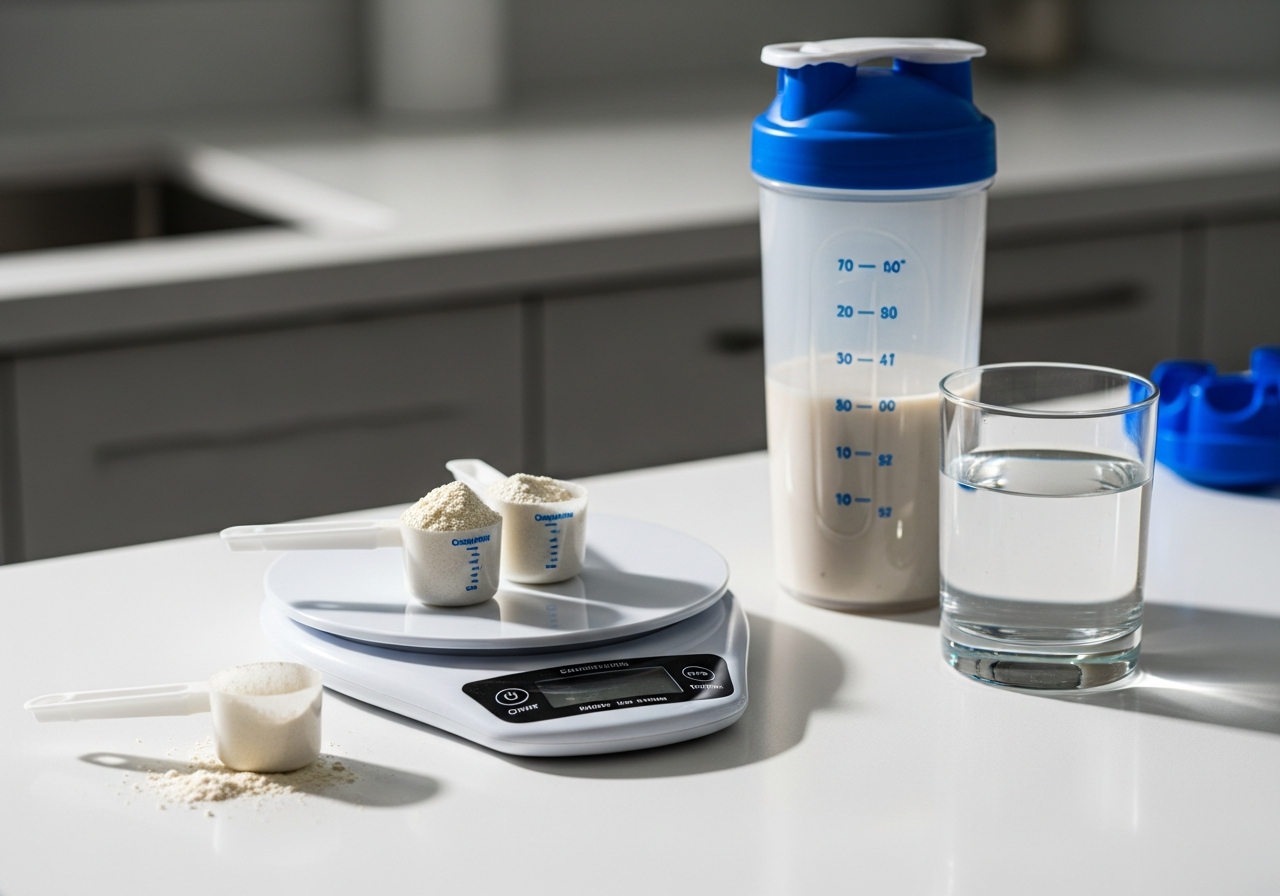
For recovery, most adults do well with 3–5 g/day of creatine monohydrate, while larger athletes or strict body-weight formulas may use about 0.03 g/kg/day for maintenance. If you want faster saturation, use 20 g/day split into 4 doses for 5–7 days, then drop to maintenance.
Body weight matters a little, but not nearly as much as supplement labels suggest. The average person does not need exotic dosing. Here is a practical dosing table you can actually use.
| Body weight / goal | Loading option | Maintenance dose | Best for |
|---|---|---|---|
| Under 60 kg | 15–20 g/day for 5–7 days, split doses | 3 g/day | Beginners, smaller athletes, general fitness |
| 60–90 kg | 20 g/day for 5–7 days, split into 4 x 5 g | 3–5 g/day | Most lifters and field/court athletes |
| Over 90 kg | 20 g/day for 5–7 days, occasionally slightly higher by formula | 5 g/day | Larger strength athletes |
| Rehab / older adult using training | Usually optional | 3–5 g/day | Muscle retention and training support |
| Want the simplest plan | Skip loading | 5 g/day | Anyone prioritizing convenience |
Examples:
- A 55 kg beginner can simply take 3 g/day.
- A 75 kg recreational lifter can take 5 g/day or load first, then 3–5 g/day.
- A 102 kg rugby player will often use 5 g/day after loading.
If your main question is “does creatine help recover faster?”, remember that loading changes how soon you reach full stores, not how powerful creatine becomes once saturated. Long term, 3–5 g/day without loading works fine.
For precise calculations, use our creatine dosage calculator or the full guide on how much creatine per day. If you prefer evidence summaries, Examine’s creatine evidence review is also a useful external reference.
Best timing for recovery, rest days, and what to mix creatine with
The best time to take creatine for recovery is the time you will remember every day, because consistent saturation matters more than precise timing. If you are asking whether post-workout is better for recovery, it is reasonable and convenient, but the difference versus other times is likely small for most people.
Here is the practical hierarchy:
- Daily consistency matters most.
- Total dose matters next.
- Form matters after that: monohydrate wins on evidence.
- Timing is a distant fourth for most people.
Good timing options:
- Post-workout: convenient because you already have a shake or meal and are thinking about recovery.
- With any meal: easy on digestion and habit-forming.
- Morning routine: helpful if you train at inconsistent times.
- Rest days: yes, keep taking it to maintain saturation.
What to mix it with:
- Water
- Protein shake
- Juice or a carb-containing drink
- Yogurt or oatmeal if you do not mind texture
You do not need a sugar spike, a pre-workout blend, or a proprietary “transport matrix” for creatine to work. You also do not need to cycle on and off. The International Olympic Committee consensus on dietary supplements places creatine among the supplements with strong performance evidence for appropriate use in sport, and its utility depends on regular use, not sporadic “special occasion” dosing.
If you want the most beginner-proof setup, take 5 g with your post-workout protein shake on training days and with breakfast on rest days. If mixing is annoying, choose micronized powder or capsules, though powder is usually better value in Canada. Related guides that help here include with or without food, on rest days, and mixing creatine with protein powder.
Who benefits most from creatine for recovery: beginners, women, older adults, and athletes
Creatine can help many groups with recovery, but the biggest practical benefits usually show up in people doing repeated high-intensity training, resistance training, or rehab-oriented strength work. It is not just for male bodybuilders.
Beginners: New lifters often experience lots of DOMS because everything is novel. Creatine will not erase that, but it can help them maintain training quality and recover better across the first months of structured training. A simple 3–5 g/day routine is enough.
Women: Women respond well to creatine and should not avoid it because of “bulking” myths. Recovery, strength, training capacity, and lean tissue support all matter here. Water retention from creatine is usually intramuscular, not the same thing as getting puffy or gaining fat. For more, see creatine for women.
Older adults: Older adults can benefit when creatine is paired with resistance training, especially for preserving muscle, supporting function, and improving training response. Recovery capacity often matters more with age because harder sessions can take longer to bounce back from. Our older adults guide goes deeper.
Vegetarians and vegans: People who eat little or no meat often start with lower baseline creatine stores, so they may notice strong benefits from supplementation. That is relevant for recovery because a bigger jump in stored creatine can mean a bigger practical effect.
Athletes: Team-sport athletes, sprinters, swimmers, CrossFit athletes, and lifters tend to benefit most because their sports repeatedly tax the phosphocreatine system. Endurance athletes may still benefit when training includes intervals, hills, gym work, or sprint finishes, but the body-mass tradeoff deserves consideration in weight-sensitive sports.
Rehab and disuse: There is emerging interest in creatine during injury recovery or immobilization because preserving muscle and training output is valuable. But “can creatine help injury recovery?” should be answered carefully: it may support muscle retention and rehab work, yet it does not directly heal tissue damage on its own.
If you are choosing your first tub, look for plain monohydrate instead of sex-specific or sport-specific formulas. The product usually matters less than the consistency of use.
Creatine for injury recovery or surgery recovery: promising, but not a stand-alone treatment
Creatine may help support injury recovery or surgery recovery in some cases, but it should be viewed as a rehab support tool, not a treatment by itself. If you are asking “does creatine help surgery recovery?” or “does creatine help recovery from injury?”, the evidence is more limited and context-dependent than it is for gym recovery.
Why it could help: during immobilization, reduced training, or rehab, muscle mass and strength can decline quickly. Creatine may help preserve intramuscular energy availability and support resistance training during rehabilitation. In practical terms, that may make it easier to maintain or rebuild muscle and power as activity resumes.
Where the evidence is strongest:
- Supporting resistance training adaptations during rehab-style exercise
- Helping retain or regain lean mass when training is reduced
- Potentially assisting older adults or deconditioned people doing structured exercise
Where the evidence is weaker or too limited to oversell:
- Direct healing of tendons, ligaments, or surgical wounds
- Shortening the medical recovery timeline after surgery by itself
- Replacing physiotherapy, protein intake, or a physician’s recommendations
If you are recovering from surgery, you should first ask your surgeon, physician, or registered dietitian whether creatine fits your case, especially if you have kidney disease, unusual lab values, medication concerns, or temporary fluid restrictions. For most healthy adults, creatine monohydrate is considered safe, but medical recovery is not the place for DIY guesswork.
A sensible rehab-support approach often looks like this:
- Clear supplement use with your care team.
- Use plain monohydrate at 3–5 g/day.
- Prioritize adequate protein and total calories.
- Resume or progress resistance work only as prescribed.
- Judge success by preserved strength, less performance drop-off, and better rehab compliance—not by pain alone.
This is an area where people often want certainty the science does not fully provide yet. The fair bottom line is that creatine is plausible and often reasonable as a supportive supplement in rehab, but it is not proven to speed every kind of tissue healing or surgery outcome.
Safety, side effects, and how to buy a good creatine product in Canada
Creatine monohydrate is one of the most studied sports supplements available, and it is generally considered safe for healthy people when used at standard doses. The biggest real-world risks are not mysterious muscle problems; they are buying low-quality products, misunderstanding lab tests, or using needlessly large doses.
The ISSN position stand and the 2021 misconceptions review both support creatine’s safety profile in healthy populations. Common side effects are usually mild:
- Water-weight gain, especially during loading
- Stomach upset if you take too much at once
- Occasional bloating perception, often dose-related
Creatine can raise blood creatinine, but creatinine is a breakdown product and a lab marker, not proof of kidney damage by itself. That is why people with kidney disease, unexplained renal issues, or clinician-directed restrictions should speak with a healthcare professional first.
In Canada, buying well matters. Look for:
- Creatine monohydrate clearly stated on the label
- Serving size in grams, not vague scoop language only
- NPN where applicable; NPN means Natural Product Number, a Health Canada product licence identifier for regulated natural health products
- Third-party testing or reputable manufacturing standards
- Minimal ingredient list, especially if you want easy troubleshooting
Most shoppers do not need premium “buffered”, “HCl”, or “recovery matrix” formulas. Monohydrate still wins on evidence and cost-effectiveness. If you want help choosing, see best creatine monohydrate in Canada, buying creatine online in Canada, and Canadian supplement regulations.
Who should be cautious or get medical clearance first:
- Anyone with kidney disease or significant kidney-history concerns
- People under medical care for complex chronic conditions
- Those recovering from surgery with fluid or medication restrictions
- Anyone pregnant or breastfeeding should consult a qualified clinician because routine supplementation guidance is more individual here
For most healthy gym-goers, the safety play is simple: buy plain monohydrate, dose it correctly, and stay consistent.
Common mistakes and myths about creatine recovery benefits—and the real bottom line
The biggest mistakes people make with creatine for recovery are expecting instant soreness relief, underdosing, overcomplicating timing, or paying extra for inferior forms. If you understand those four points, you will avoid most frustration.
Myth 1: Creatine should make soreness disappear in a day or two.
Reality: Creatine is not a painkiller. Its main recovery benefit is better repeated performance and better long-term adaptation.
Myth 2: If I do not load, creatine is not working.
Reality: Loading only gets you saturated faster. Daily 3–5 g still works if you are patient.
Myth 3: More is better.
Reality: Once stores are saturated, extra creatine usually just increases cost and the chance of stomach upset.
Myth 4: Fancy forms recover muscle better than monohydrate.
Reality: Monohydrate remains the reference standard because it is the most studied and usually the best value.
Myth 5: Creatine causes sore muscles.
Reality: Creatine usually does not cause soreness. Harder training after creatine starts is the more likely reason.
Here is the simplest way to think about it. If your goal is to recover better so you can train hard again sooner, creatine is one of the few supplements genuinely worth considering. If your goal is to eliminate all discomfort after training, creatine will probably feel underwhelming. That is not because it fails; it is because its real job is energetic support and training adaptation.
The practical bottom line:
- Use creatine monohydrate.
- Take 3–5 g/day, every day.
- Load only if you want faster saturation.
- Judge results over weeks, not one workout.
- Track performance recovery, not just soreness.
If you want a complete next step, read creatine for beginners, is creatine safe, and why monohydrate still wins. For most healthy adults who train hard, the answer to “does creatine help with recovery?” is yes—just not always in the way people first imagine.
Creatine Recovery Basics at a Glance
- 3–5 g/day Standard daily maintenance dose — Works for most adults once muscle stores are saturated
- 20 g/day Typical loading dose — Usually split into 4 doses for 5–7 days
- 5–7 days Time to saturate with loading — Without loading, full saturation often takes roughly 3–4 weeks
- 0.03 g/kg/day Body-weight maintenance formula — Useful for larger athletes or more precise dosing
Frequently Asked Questions
Does creatine aid recovery after workouts?
Yes, creatine can aid recovery after workouts, mainly by helping your muscles restore high-intensity energy faster and by reducing performance drop-off between efforts. Its strongest benefit is improved recovery of training capacity, not guaranteed elimination of soreness.
Does creatine help with muscle recovery or just strength?
Creatine helps with both muscle recovery and strength, but the recovery effect is mostly indirect. By increasing phosphocreatine stores, creatine helps you repeat hard efforts with less decline and supports better long-term muscle and strength gains from training.
Does creatine help DOMS?
Creatine can help DOMS a little in some cases, but it is not a reliable anti-soreness supplement. Some people notice less soreness or better force recovery after damaging workouts, while others mainly notice they perform better before they feel less sore.
Can creatine help with muscle soreness?
Yes, creatine can help with muscle soreness for some people, but the effect is usually modest. It is better thought of as a training-support supplement that may soften some post-exercise damage responses rather than a direct pain reliever.
Can creatine cause muscle soreness?
No, creatine does not usually cause muscle soreness by itself. If you feel sorer after starting creatine, it is more likely because you trained harder, added more volume, or changed your routine at the same time.
Does creatine help you recover faster between sets?
Yes, creatine is especially good at helping you recover faster between short, intense efforts like heavy sets, sprints, and repeated intervals. That benefit comes from better ATP regeneration through the phosphocreatine system.
Does creatine help injury recovery?
Creatine may help injury recovery by supporting muscle retention and rehab performance, especially when strength training is part of rehabilitation. It does not directly heal injured tissues on its own, so it should be treated as a support tool rather than a treatment.
Does creatine help surgery recovery?
Creatine may support surgery recovery in some cases by helping preserve or rebuild muscle during reduced activity, but it is not proven to speed all surgical healing. Anyone recovering from surgery should check with their care team before using it.
How long does creatine take to help recovery?
Creatine can start helping recovery within about 5–7 days if you use a loading phase, or within roughly 3–4 weeks if you take a standard daily dose without loading. Most people notice the clearest benefits over several weeks of consistent training.
What is the best creatine dose for recovery?
The best creatine dose for recovery for most adults is 3–5 g of creatine monohydrate per day. If you want faster saturation, use 20 g/day split into 4 doses for 5–7 days, then continue with 3–5 g/day.