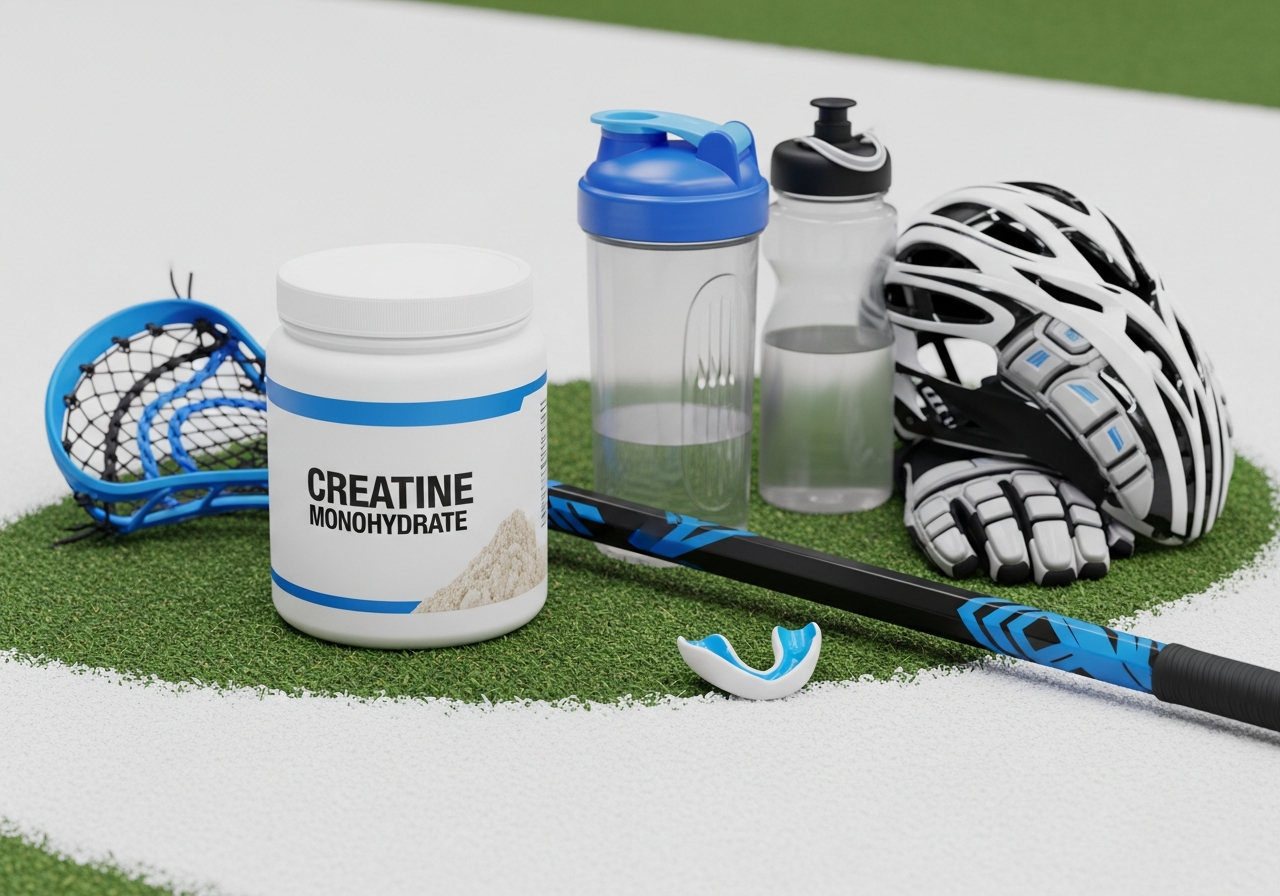
Creatine for Lacrosse: Speed, Strength, and Canadian Sport Performance
By The Creatine Canada Research Team — Evidence-based supplement analysts
Yes—creatine can help lacrosse players by improving repeated sprint power, explosive strength, training quality, and recovery between hard efforts, which makes it especially relevant for field lacrosse and box lacrosse athletes. For most players, 3 to 5 g of creatine monohydrate daily is the simplest, most evidence-based way to support speed, strength, and high-intensity game performance.
Evidence-based · Cites 4 sources · Editorial standards
Key Takeaways
- Creatine for lacrosse works best for repeated sprints, accelerations, checks, shots, jumps, and gym-based strength gains.
- Creatine monohydrate is the best creatine for lacrosse because it is the most studied, most effective, and usually the best value.
- Most lacrosse players should take 3 to 5 g daily; a loading phase of 20 g per day split into 4 doses for 5 to 7 days speeds up results.
- Timing matters less than consistency, so take creatine every day, including rest days, at any time you will reliably remember.
- A small increase in body mass from water inside muscle is common in the first 1 to 2 weeks and is not fat gain.
- Creatine is appropriate for many lacrosse athletes, including beginners and women, but players with kidney disease or relevant medical concerns should speak with a clinician first.
- In Canada, look for creatine products with clear dosing, an NPN when applicable, and preferably third-party testing or strong brand transparency.
Does creatine help lacrosse players? Yes—especially for repeated power
Yes, creatine for lacrosse is a strong fit because lacrosse is a repeated high-intensity sport that relies on short bursts of sprinting, dodging, cutting, jumping, shooting, checking, and wrestling for position. Creatine does not turn lacrosse into an endurance event supplement; it helps most when the job is to produce high power again and again with incomplete rest.
That profile matches both field lacrosse and box lacrosse surprisingly well. Midfielders and transition players repeatedly accelerate and decelerate. Attackers need first-step burst and shot power. Defenders benefit from contact strength, repeated efforts, and better gym progression. Goalies may benefit less from total running demands but can still gain from explosive lateral movement, jumping, and resistance training quality.
The reason this matters is simple: creatine increases the amount of stored phosphocreatine in muscle. Phosphocreatine is the quick energy reserve your body uses to rapidly regenerate ATP, the immediate fuel for maximal effort muscle contractions. When your phosphocreatine stores are fuller, you can often maintain power output slightly better across repeated sprints, heavy sets, and explosive efforts.
The evidence base for creatine is much stronger for power, strength, lean mass, and repeated high-intensity work than for long, steady endurance. The 2017 ISSN position stand concluded that creatine monohydrate is the most effective nutritional supplement currently available for increasing high-intensity exercise capacity and lean body mass during training. That does not mean every lacrosse metric improves equally, but it does mean the supplement makes sense for the energy demands of the sport.
For practical use, think of creatine as a support tool for:
- Repeated sprint ability
- Explosive gym performance
- Strength and power development
- High-quality training volume over weeks and months
- Potentially better recovery between intense efforts
If you want the short answer to “does creatine help lacrosse?”, it is this: creatine helps lacrosse players most by improving the power system that fuels repeated explosive efforts and by helping them train harder over time. For a broader primer, see what creatine is and what it does.
How creatine works in field lacrosse: the ATP-phosphocreatine system explained
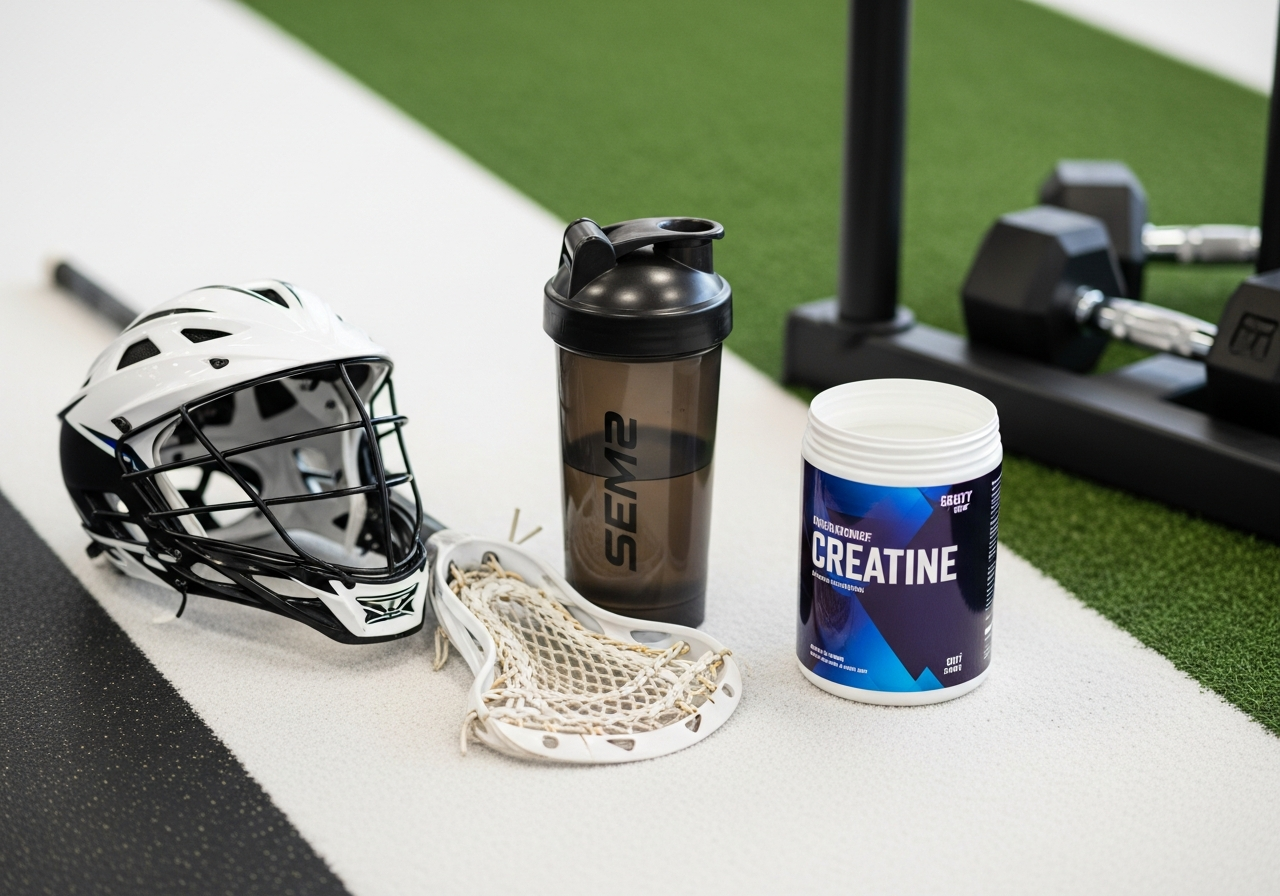
Creatine helps field lacrosse by supporting the body’s fastest energy system, which is the ATP-phosphocreatine system used for explosive efforts lasting only a few seconds. In plain English, creatine helps you recharge your top gear faster.
Your muscles store a limited amount of ATP, or adenosine triphosphate, which is the direct energy currency for muscle contraction. During a max sprint, hard dodge, jump shot, ground-ball scramble, or heavy squat set, ATP gets used almost instantly. Phosphocreatine donates a phosphate group to help remake ATP quickly, allowing you to keep producing force at a high rate. Supplementing with creatine monohydrate increases intramuscular creatine and phosphocreatine stores, which can improve the speed and capacity of rapid ATP resynthesis during repeated high-intensity efforts.
That mechanism matters for lacrosse because the sport is rarely one long continuous output. It is stop-start, reactive, and brutally intermittent. You sprint, recover, cut, absorb contact, then sprint again. Creatine does not directly replace conditioning, stick skill, or tactical awareness, but it can raise the ceiling on the explosive pieces.
There is also a second layer to the benefit. Creatine can improve training quality in the weight room and in repeated sprint sessions. If you perform even one or two more high-quality reps, sustain a little more bar speed, or hold sprint quality better across intervals, that adds up over 8 to 12 weeks of training. Many of creatine’s best sport outcomes are indirect: better daily training quality leads to better strength, power, and body composition later.
Creatine may also increase cell hydration inside muscle. This is often misunderstood as “bloating,” but in most cases it is intracellular water, meaning water held inside the muscle cell, not puffiness under the skin. That fuller cell state may support training and muscle growth signalling, though the performance case remains strongest for the phosphocreatine mechanism.
For lacrosse players comparing supplements, this is why creatine outperforms trendier options. The mechanism is clear, the research base is decades deep, and the effect is highly relevant to field sport demands. If you want the daily practical dose after understanding the mechanism, use a creatine dosage calculator or read our guide on how much creatine per day.
Best creatine for lacrosse: why monohydrate still wins
The best creatine for lacrosse is creatine monohydrate, because it is the most studied form, the form used in most performance research, and usually the most cost-effective option in Canada. If your goal is real sport performance rather than marketing claims, monohydrate is the default choice.
This is one of the clearest calls in sports nutrition. Monohydrate has the best combination of efficacy, safety data, and price. Fancy alternatives such as HCl, buffered creatine, nitrate, ethyl ester, or gummies are not supported by stronger performance evidence. Some may mix differently or feel more convenient, but convenience is not the same as superiority.
The 2021 JISSN review on common questions and misconceptions about creatine reinforced that creatine monohydrate remains the gold standard form. That is the form a lacrosse player should choose unless there is a very specific tolerability issue.
| Form | Best for | Evidence for lacrosse-style performance | Practical verdict |
|---|---|---|---|
| Creatine monohydrate | Almost everyone | Strongest evidence for strength, power, repeated efforts | Best overall choice |
| Micronized monohydrate | Players who want easier mixing | Same active ingredient as monohydrate | Good choice if price is reasonable |
| Creatine HCl | Players who prefer smaller scoop size | Less evidence than monohydrate | Usually not worth the premium |
| Buffered or “advanced” forms | Marketing-sensitive buyers | No clear advantage over monohydrate | Skip unless price is equal |
| Gummies/capsules | Convenience | Can work if dose is adequate | Often more expensive per gram |
For Canadian buyers, check the label for:
- Creatine monohydrate as the only active ingredient, or the primary one
- A clear serving size in grams, not vague “scoops” only
- An NPN, or Natural Product Number, when sold as a licensed natural health product in Canada
- Third-party testing or transparent quality controls
- Minimal unnecessary fillers if you want pure powder
If you are comparison shopping, start with our best creatine rankings, browse the creatine brand reviews, or scan the creatine product catalog. For most creatine Canadian lacrosse buyers, plain monohydrate powder is still the smartest buy.
How to take creatine for lacrosse: the simple step-by-step plan
The best way to take creatine for lacrosse is to choose creatine monohydrate, take it every day, and stay consistent long enough to saturate your muscles. You do not need a complicated stack or a perfect pre-game ritual.
- Choose the right product. Buy plain creatine monohydrate powder or micronized monohydrate from a reputable brand.
- Decide whether to load. If you want faster results, take 20 g per day split into 4 doses of 5 g for 5 to 7 days. If you prefer the gentler route, skip loading and take 3 to 5 g per day from day one.
- Move to maintenance. After loading, take 3 to 5 g daily to keep muscle stores saturated.
- Take it every day. Training days and rest days both count. Consistency matters more than timing.
- Mix it in a way you will repeat. Water, a shake, juice, or a post-workout protein drink all work. If you want mixing help, see how to mix creatine.
- Keep hydration normal. You do not need to force extreme water intake, but you should not under-drink during hard practices, summer tournaments, or travel weekends.
- Track useful outcomes. Watch body weight, sprint repeatability, gym numbers, jump quality, and how fresh you feel late in sessions.
What should you expect?
- With loading: some players notice fuller muscles, a slight scale increase, and improved gym pop within about a week.
- Without loading: expect a slower build, often around 3 to 4 weeks before the effects are obvious.
- By 6 to 8 weeks: the real payoff is often better training quality and better strength or power progress rather than a dramatic “feeling.”
Lacrosse-specific practical uses include starting creatine 3 to 4 weeks before preseason, before a speed-strength block, or before the competitive season if you are not cutting weight aggressively. It also works well during off-season hypertrophy and strength phases.
If you are brand new, keep it boring: 5 g once daily after breakfast or after training. That is enough for most athletes. For a full beginner walkthrough, read how to take creatine and creatine for beginners.
Exact creatine dosing for lacrosse players by body weight and goal
Most lacrosse players do well on 3 to 5 g of creatine monohydrate daily, but larger athletes and players who want body-weight-based precision can use 0.03 g per kg per day for maintenance. Loading is typically 0.3 g per kg per day for 5 to 7 days.
That body-weight framework is useful for serious athletes because a 55 kg attacker and a 105 kg defender are not identical cases, even though both may still do fine on a flat 5 g. Here is the most practical dosing table.
| Body weight | Maintenance dose | Loading dose for 5-7 days | Best use case |
|---|---|---|---|
| 50-65 kg | 3 g/day | 15-20 g/day split into 4 doses | Smaller athletes, many youth and women players |
| 66-85 kg | 4-5 g/day | 20 g/day split into 4 doses | Most adult lacrosse players |
| 86-105 kg | 5 g/day | 20-25 g/day split into 4-5 doses | Larger field or box players |
| 106 kg+ | 5-7 g/day | 25-30 g/day split into 5-6 doses | Very large strength-focused athletes |
Goal also matters:
- Faster saturation before camp or season: load for 5 to 7 days, then maintain.
- Minimal stomach risk: skip loading and take 3 to 5 g daily.
- Strength and lean mass focus in the off-season: 5 g daily is a practical default.
- Weight-sensitive athlete: start in the off-season or earlier preseason so any water-weight change is predictable.
Week-by-week, a loaded athlete may gain roughly 0.5 to 1.5 kg early, mostly from water retained inside muscle. The scale response varies with body size, muscle mass, and baseline diet. Athletes with lower habitual creatine intake, especially vegetarians, may notice a stronger response. If weight class or speed-to-weight ratio matters greatly, test creatine in training well before meaningful competition.
If you want exact math for your size, use our creatine dosage calculator. You can also compare this to our dedicated guide on creatine maintenance dose or the creatine loading phase.
When to take creatine for field lacrosse, game days, and in-season play
The best time to take creatine for field lacrosse is the time you will take it consistently every day, because timing is far less important than muscle saturation. A daily dose works by gradually keeping stores full, not by creating an acute stimulant effect before a game.
This is one of the most common mistakes in team sports. Players treat creatine like pre-workout and only take it before practice or matches. That is not how it works. Creatine is not a same-day performance booster in the way caffeine is; it is a saturation supplement whose benefits come from consistent daily use over days and weeks.
Here is the simple timing strategy:
- Training days: take 3 to 5 g with any meal, post-workout shake, or convenient routine.
- Rest days: take the same 3 to 5 g with breakfast or another regular meal.
- Game days: take your normal dose; there is no need to double it or “save it” for competition.
- Travel tournaments: pack pre-measured baggies or capsules so you do not miss doses.
What about before versus after training? The evidence does not show a major real-world difference for most athletes. If post-workout is easier because you already use a protein shake, that is fine. If breakfast is more reliable, that may be even better simply because compliance improves.
In-season, creatine can still be useful. Many lacrosse players reduce lifting volume during the season, but they still need to preserve strength, power, and body mass while absorbing sprint and contact loads. A steady maintenance dose supports that goal. During two-a-day camps or tournament weekends, focus less on exotic timing and more on basics: hydration, carbohydrates, sleep, and not missing the daily dose.
If you want a deeper look at timing nuance, read when to take creatine, creatine on rest days, and how long creatine takes to work. The practical answer for lacrosse remains straightforward: take it daily, year-round if it suits your goals, and stop overthinking the clock.
Who should use creatine in lacrosse: beginners, women, teens, and older athletes
Creatine can be appropriate for many lacrosse players, including beginners, women, vegetarians, and older athletes, as long as dosing is sensible and there are no medical contraindications. The supplement is not only for bodybuilders or elite men’s players.
Beginners often benefit because creatine supports the same basic qualities they need most: getting stronger, learning to train hard, and improving repeated sprint power. A beginner does not need a complicated loading plan; 3 to 5 g daily is enough.
Women who play lacrosse can use creatine just as effectively as men. The main myths to ignore are that it is “too bulky,” “not for female athletes,” or only useful in maximal strength sports. In reality, women can benefit from the same mechanisms: better training quality, strength support, repeated-effort performance, and improved lean mass retention. For more, see creatine for women.
Vegetarian or vegan lacrosse players may respond especially well because baseline muscle creatine stores can be lower when dietary creatine intake from meat and fish is low. That does not mean omnivores do not benefit; it means plant-based athletes often have more room to gain.
Teen athletes require a bit more care. Creatine is widely used in youth sport, but the key questions are maturity, supervision, product quality, and whether the athlete already has training, nutrition, and hydration basics in place. Families should review the evidence, involve a qualified clinician or sport dietitian when needed, and use reputable products. See creatine for teenagers.
Older adult lacrosse players, masters athletes, and coaches who still compete can also benefit, especially for strength, lean mass, and training recovery support. Creatine is not only a young athlete supplement. It can be relevant wherever preserving muscle and explosive capacity matters.
The players who should slow down and ask questions first are those with known kidney disease, complex medical conditions, pregnancy or breastfeeding considerations, or medication issues best reviewed by a healthcare professional. A general safety overview from the Mayo Clinic and our guide on whether creatine is safe can help frame those decisions.
Safety, side effects, hydration, and weight gain: what lacrosse players should expect

Creatine monohydrate is generally considered safe for healthy people when used at recommended doses, and the most common side effects are mild and manageable rather than dangerous. For lacrosse players, the biggest practical issues are stomach upset from poor dosing, temporary scale increases, and confusion about hydration.
The safety profile is one reason creatine remains a staple in sport nutrition. The International Olympic Committee’s supplement consensus and the ISSN position stand both place creatine among the more evidence-supported performance supplements when used appropriately. That said, “safe” does not mean “zero side effects for every person.”
Here is what is actually common:
- Weight gain in the first 1 to 2 weeks: usually water stored inside muscle, not fat.
- Stomach upset or loose stools: more likely if you take too much at once, especially during loading.
- Mild bloating sensations: often solved by splitting doses or using micronized monohydrate.
- No dramatic sensation: many players think it is “not working” because creatine is not a stimulant.
Here is what the evidence does not strongly support in healthy users at normal doses:
- That creatine dehydrates you
- That creatine causes muscle cramps
- That creatine damages healthy kidneys when used responsibly
A major point of confusion is creatinine, a blood marker. Creatine supplementation can increase creatinine on bloodwork because creatinine is a breakdown product of creatine, but that is not the same thing as proving kidney damage. This is why lab interpretation matters. If you ever need testing, tell your clinician you use creatine. For more, see the kidneys guide.
Lacrosse-specific hydration advice is simple: maintain normal good hydration, especially in summer heat, tournament weekends, and heavy conditioning blocks. Do not assume creatine replaces electrolytes or sports drinks, and do not assume you need absurd amounts of extra water either. Pair creatine with sensible fluid intake and game-day hydration habits. If digestion is the problem, our guides on digestive side effects and how much water to drink with creatine go deeper.
Common creatine mistakes and myths in Canadian lacrosse
The most common creatine mistakes lacrosse players make are choosing flashy formulas over monohydrate, taking it inconsistently, overdosing during loading, and blaming creatine for myths the evidence does not support. Fixing those mistakes usually improves results more than changing brands.
Myth 1: “Creatine is only for getting bulky.” False. Creatine primarily supports high-intensity energy production and training quality. Any lean mass gain usually reflects better training plus increased intracellular water, not instant bulk.
Myth 2: “Creatine is a steroid.” False. Creatine is a naturally occurring compound involved in cellular energy metabolism, not an anabolic steroid. If this myth still comes up on your team, read is creatine a steroid?
Myth 3: “You only need creatine on workout days.” False. Missing many rest-day doses slows or weakens saturation. Daily intake matters.
Myth 4: “If 5 g is good, 15 g daily forever is better.” False. Once muscle stores are saturated, extra creatine is not a performance hack. It more often increases the chance of GI issues.
Myth 5: “Creatine ruins conditioning.” Overstated. A small body-mass increase may feel different during long running, but for a mixed sport like lacrosse the trade-off is often favourable because the sport rewards repeated power, speed, and contact capacity.
Myth 6: “All forms are better than monohydrate now.” False. Monohydrate still has the best evidence-to-cost ratio in 2026.
In Canada, another mistake is buying sketchy imported products with poor labelling. Look for straightforward labels, ideally an NPN where relevant, and companies that explain testing. Our creatine myths debunked page and brand reviews can help you avoid low-trust products.
If creatine seems not to be working, ask these questions:
- Have you taken it daily for at least 3 to 4 weeks, or 5 to 7 days with loading?
- Are you using enough—usually 3 to 5 g daily?
- Is your training actually challenging enough to reveal the benefit?
- Are you expecting a stimulant-like feeling instead of gradual performance support?
- Are you already eating well and sleeping enough?
Creatine is powerful, but it is not magic. In lacrosse, it works best when fundamentals are already in place.
Buying creatine in Canada for lacrosse: what to look for on the label
Canadian lacrosse players should buy plain creatine monohydrate from a reputable company with transparent dosing, clean labelling, and preferably third-party testing or strong manufacturing quality controls. The best product is usually the one that is simple, properly dosed, and consistently available.
In Canada, you may see products sold as natural health products with an NPN, or Natural Product Number. An NPN shows the product has been licensed by Health Canada under the natural health product framework. That is useful, but it is not the only marker of quality. You should still assess the label and the brand.
Use this buying checklist:
- Ingredient list: ideally just creatine monohydrate, unless you specifically want a flavoured formula.
- Dose transparency: serving size should clearly state grams of creatine, not proprietary blends.
- Form: monohydrate or micronized monohydrate first.
- Testing: look for third-party testing claims or clear GMP-style manufacturing standards.
- Value: calculate cost per 100 g or per 5 g serving, not just tub price.
- Practicality: if you travel for tournaments, capsules or single-serve packets may help adherence, even if they cost more.
For field lacrosse players, plain powder usually remains the best value because a standard 3 to 5 g dose is easy to hit accurately. Gummies and flavoured blends can work, but check how many servings are required to reach a full evidence-based dose. A product that tastes good but delivers too little creatine per serving is not a bargain.
If you want help comparing options in the Canadian market, review our best creatine rankings, product catalog, and related guide on best creatine monohydrate in Canada. For buyers who are also comparing new trends, our guide on why monohydrate still wins is worth reading.
The short version for creatine Canadian lacrosse shoppers is this: buy boring, buy accurate, buy trusted, and spend your money on enough total grams rather than fancy claims.
Bottom line: should you use creatine for field lacrosse performance?
Yes—most lacrosse players who want better repeated sprint power, strength progress, and high-intensity training quality should seriously consider creatine monohydrate. It is one of the few supplements with a clear mechanism, a large evidence base, and a performance profile that matches the demands of lacrosse.
The most practical plan is also the simplest. Take 3 to 5 g of creatine monohydrate every day. If you want faster saturation before preseason or a tournament block, use a loading phase of 20 g per day split into 4 doses for 5 to 7 days, then return to 3 to 5 g daily. Do not worry too much about timing; do worry about consistency.
Creatine is especially worthwhile if you:
- Play a sprint-heavy midfield or transition role
- Want more gym strength and power carryover to the field
- Need to maintain output late in repeated hard sessions
- Are a vegetarian or vegan athlete
- Are entering an off-season or preseason strength block
Be realistic about the trade-offs. Some athletes notice a small increase in scale weight, usually from water stored inside muscle. For most lacrosse players, that is an acceptable exchange for better power and training support. If your role or body-composition goals are highly weight-sensitive, test it well before important competition and monitor the response.
Also be realistic about expectations. Creatine will not fix poor conditioning, weak stick skills, under-fuelling, low sleep, or bad programming. It is a force multiplier for good habits, not a substitute for them.
If you want one final quotable answer: creatine for lacrosse is worth it because lacrosse rewards repeated explosive efforts, and creatine reliably supports the muscle energy system behind those efforts while helping athletes train harder over time.
Next steps: use our creatine dosage calculator, compare the best creatine rankings, and read is creatine safe? if you want to double-check the safety side before starting.
Creatine for Lacrosse: The Numbers That Matter
- 3-5 g/day Standard maintenance dose — The simplest evidence-based daily intake for most lacrosse players.
- 20 g/day Typical loading protocol — Usually split into 4 doses of 5 g for 5 to 7 days.
- 5-7 days Fast saturation window — Loading can fill muscle creatine stores much faster than maintenance alone.
- 0.03 g/kg/day Body-weight-based maintenance — Useful for athletes who want a more precise dose.
Frequently Asked Questions
Does creatine help lacrosse players get faster?
Yes, creatine can help lacrosse players get faster in the sense that it supports acceleration, repeated sprint quality, and explosive power output. It does not act like a stimulant, but by increasing phosphocreatine stores in muscle, it can help you reproduce hard efforts better and train speed-strength qualities more effectively over time.
What is the best creatine for lacrosse?
The best creatine for lacrosse is creatine monohydrate. It is the most studied form, the most consistently effective for high-intensity performance and strength, and usually the best value compared with HCl, buffered forms, or heavily marketed blends.
Is creatine good for field lacrosse specifically?
Yes, creatine is a good fit for field lacrosse because the sport relies on repeated short bursts of sprinting, cutting, jumping, and contact. Those actions depend heavily on the ATP-phosphocreatine energy system, which is exactly the system creatine supplementation helps support.
How much creatine should a lacrosse player take?
Most lacrosse players should take 3 to 5 g of creatine monohydrate daily. If faster saturation is important, a common loading phase is 20 g per day split into 4 doses for 5 to 7 days, followed by 3 to 5 g per day for maintenance.
Should lacrosse players take creatine before games?
Lacrosse players can take creatine before games, but it is not necessary to time it that way for performance. Creatine works by keeping muscle stores saturated over days and weeks, so your normal daily dose matters far more than taking it right before faceoff.
Will creatine make a lacrosse player gain too much weight?
Creatine can cause a small early increase in body weight, but it is usually water held inside muscle rather than fat gain. For most lacrosse players, this is modest and often a worthwhile trade-off for improved strength, power, and training quality.
Can women lacrosse players take creatine?
Yes, women lacrosse players can absolutely take creatine. The same evidence-based dosing applies, and the benefits can include stronger training sessions, improved repeated-effort performance, and support for lean mass without creatine somehow causing unwanted 'bulk' on its own.
Is creatine safe for competitive lacrosse athletes?
Creatine is generally considered safe for healthy competitive athletes when used at recommended doses. Players with kidney disease, significant medical conditions, or special circumstances should still check with a healthcare professional, but for healthy users creatine monohydrate has one of the strongest safety records in sports nutrition.
Do lacrosse goalies benefit from creatine too?
Yes, lacrosse goalies can still benefit from creatine, though often for slightly different reasons than midfielders. The main potential upsides are explosive movement, jumping, lateral reactions, and better quality resistance training rather than repeated long sprint demands.
How long does creatine take to work for lacrosse performance?
Creatine can start working within about 5 to 7 days if you use a loading phase, or within roughly 3 to 4 weeks if you take only a standard daily maintenance dose. The fastest visible changes are often fuller muscles and better gym performance, while sport carryover builds over continued training.