Creatine for Dancers: Explosive Jumps, Endurance, and Aesthetic Concerns
By The Creatine Canada Research Team — Evidence-based supplement analysts
Yes—creatine can help dancers, especially for explosive jumps, repeated high-intensity phrases, rehearsal recovery, and maintaining power through long training blocks, and it usually does so without making you "bulky" when taken properly. For most dancers, 3–5 g of creatine monohydrate daily is the evidence-based, low-drama approach that improves phosphocreatine stores, supports repeated effort, and may cause only a small early increase in water weight.
Evidence-based · Cites 4 sources · Editorial standards
Key Takeaways
- Creatine for dancers is most useful for jumps, quick floor-to-standing transitions, repeated bursts, and fatigue resistance in hard rehearsals.
- Creatine monohydrate is the best-studied and most cost-effective form; 3–5 g daily is the standard maintenance dose.
- A loading phase of 20 g/day split into 4 doses for 5–7 days works faster, but many dancers prefer skipping it to minimise temporary water-weight changes.
- Creatine does not directly build bulky muscle on its own; training style, total calories, and genetics matter far more for physique changes.
- Some dancers notice a small scale increase in the first 1–2 weeks from extra water stored inside muscle, not fat gain.
- Take creatine every day, including rest days; timing matters much less than consistency.
- In Canada, choose a simple monohydrate product with an NPN and, ideally, third-party testing if you perform in drug-tested settings.
Creatine for dancers: the short answer on whether it helps
Yes, creatine for dancers is a legitimate, evidence-based option when the goal is more explosive movement, better repeat-effort capacity, and steadier performance across long rehearsals and training weeks. Dance is not just "artistic cardio"; many forms of dance, including ballet, contemporary dance, jazz, commercial choreography, and stage performance, repeatedly demand short, intense muscular efforts such as jumps, lifts, accelerations, directional changes, and powerful landings.
Creatine works best in activities that rely heavily on the phosphocreatine system, which is the fast energy system your muscles use to rapidly regenerate ATP, the cell's immediate fuel. That matters for dancers because a grand allegro combination, repeated petit allegro jumps, explosive contemporary floorwork, or a final run-through late in rehearsal all depend on producing force quickly and doing it again with less drop-off.
The best-supported form is creatine monohydrate, not flashy newer forms. The 2017 ISSN position stand concluded that creatine monohydrate is the most effective ergogenic nutritional supplement currently available for increasing high-intensity exercise capacity and lean mass during training. For dancers, the key performance takeaway is not bodybuilding size; it is improved high-output work capacity.
That said, the answer is nuanced. Creatine is more likely to help a ballet dancer with jump quality, repeated centre work, and supplemental strength sessions than to transform a slow adagio line or magically improve artistry. It may also be less appealing for dancers in periods where even small changes in scale weight or muscle fullness feel psychologically or professionally important. If that is a major concern, a slow-start protocol often solves the problem better than avoiding creatine altogether.
For beginners, the practical starting point is simple: take 3–5 g once daily, every day, for several weeks. If you want the full background first, see our creatine dosage calculator and best creatine rankings. If you want the quick answer, this is it: creatine and dance performance are a good fit whenever your style includes repeated power, and the trade-off is usually a modest, manageable water-weight increase rather than unwanted bulk.
How creatine actually helps dance performance: jumps, repeat power, and fatigue resistance
Creatine helps dance performance by increasing intramuscular phosphocreatine stores, which lets muscle regenerate ATP faster during short, intense efforts and repeated bursts with incomplete rest. In plain English, that means creatine can help dancers hit powerful efforts more often before performance quality fades.
Your muscles store creatine partly as phosphocreatine, a high-energy compound that donates a phosphate to rapidly remake ATP during explosive work. A single jump, quick travelling phrase, sharp direction change, or supported lift is brief enough that this fast system matters a lot. When those efforts are repeated over and over in class, rehearsal, or stage work, local energy supply becomes a limiting factor. Higher creatine stores can improve that buffer.
For dancers, the likely benefits are most relevant in four areas:
- Explosive elevation: more support for jump takeoff and repeated leap quality.
- Repeated high-intensity phrases: less drop-off from the first run to the fourth or fifth.
- Strength training transfer: harder gym sessions can support stronger legs, hips, and trunk for dance.
- Recovery between efforts: faster phosphocreatine resynthesis may help short-rest work.
Creatine is also useful indirectly. Many dancers now do supplementary resistance training for tendon health, landing control, power, and injury resilience. Creatine tends to shine in exactly that environment. If it helps you squat, lunge, hinge, jump, or sprint slightly better over months, that can translate to better dance capacity even if the studio itself is not a classic weight room setting.
What about endurance? Creatine is not primarily an aerobic supplement, so it will not raise endurance in the same way as sport-specific conditioning. But dance performance often mixes aerobic demand with repeated anaerobic surges. That is why creatine for ballet and creatine for contemporary dance makes sense despite dance not looking like sprinting on paper. The intermittent nature of rehearsals and choreography is exactly where creatine can matter.
Evidence summaries such as Examine's creatine review and the ISSN position stand consistently support creatine's role in repeated high-intensity performance. For a deeper primer on the basics, see what creatine is and the main benefits of creatine. The practical message for performing arts athletes is straightforward: creatine will not teach technique, but it can help preserve the power and physical quality that technique depends on.
Who benefits most: ballet, contemporary, commercial, beginners, women, and older dancers
Creatine helps some dancers more than others, and it tends to be most useful for performers whose training includes repeated explosive efforts, high rehearsal volume, or supplementary strength work. The less your work relies on rapid force production, the less noticeable the benefit may feel day to day.
Creatine for ballet is often a strong fit for dancers who do frequent allegro, grand allegro, men’s jumps, coda work, partnering, or demanding rehearsal blocks. Ballet places a premium on looking effortless, but the underlying physical demand is not light. Jumps, balances under fatigue, repeated relevés, and controlled landings all depend on force and repeated output.
Creatine for contemporary dance also makes sense, especially where choreography features floorwork, fast transitions, athletic phrases, acrobatics, and repeated full-out run-throughs. Contemporary styles often combine endurance with sudden bursts, which is a classic creatine use case.
Beginners can absolutely use creatine, particularly if they have started cross-training or strength training alongside dance. You do not need to be elite for creatine to work. In fact, recreational dancers often notice that hard classes feel more repeatable and gym sessions feel stronger.
Women should not assume creatine is a "men's supplement." It is one of the most studied sports supplements in women as well, and concerns about instant bulk are usually overstated. If that concern is front and centre, our guide on creatine for women goes deeper.
Vegetarian or vegan dancers may respond especially well because dietary creatine intake is typically lower when you do not eat meat or fish. That can make supplementation more noticeable for some people.
Older dancers and teachers who still train hard may also benefit. With age, preserving muscle function, power, and training quality becomes more important, not less. Creatine's research base in older adults is substantial, especially when paired with resistance training.
Dancers who may be more cautious include those near performance weigh-ins, costume fittings, auditions with strict aesthetic pressure, or any period where even a small temporary scale change could be stressful. In those cases, creatine is still an option, but the protocol matters. Skip loading, start with 3 g daily, and assess calmly over 3–4 weeks rather than assuming the supplement is unsuitable.
The bottom line is that dancers and creatine are a sensible match when the real demand is athletic, not just artistic—which, in modern dance training, is often the case.
Exact creatine dosing for dancers by goal, body size, and urgency
For most dancers, the right dose is 3–5 g of creatine monohydrate per day, taken every day, with loading optional rather than necessary. That dose is enough for most adults to gradually saturate muscle creatine stores over several weeks.
If you want faster saturation, the standard loading protocol is 20 g per day split into 4 doses of 5 g for 5–7 days, followed by a maintenance dose of 3–5 g daily. The loading phase works, but many dancers skip it because it is more likely to cause temporary stomach upset or a quicker bump in body water. If aesthetic concerns are high, daily low-dose use is usually the better fit.
A useful body-weight rule is:
- Smaller dancers under about 60 kg: 3 g/day is usually enough.
- Most dancers around 60–90 kg: 3–5 g/day is the standard range.
- Larger or very muscular dancers over about 90 kg: 5 g/day is usually appropriate.
Some sport nutrition frameworks also use a maintenance intake of roughly 0.03 g/kg/day after loading, which lands in the same real-world range for most adults.
| Goal | Best protocol | What to expect |
|---|---|---|
| Minimise water-weight changes | 3 g/day for 4+ weeks | Slower saturation, usually gentler on digestion and aesthetics |
| Get ready quickly for a hard training block | 20 g/day in 4 doses for 5–7 days, then 3–5 g/day | Faster saturation, higher chance of early scale change |
| General studio plus gym support | 5 g/day | Simple, effective default for most adult dancers |
| Very small dancer or highly cautious first trial | 3 g/day | Practical starting point with low side-effect risk |
Take it with water or any regular drink. You do not need a proprietary transport blend, sugary juice, or a pre-workout to make it work. If you want help matching dose to your body size, use our creatine dosage calculator or read how much creatine per day.
If you miss a day, do not double up dramatically; just resume your usual dose. Creatine works by saturation, not by a one-time acute boost like caffeine. That is why consistency beats perfect timing.
How dancers should start creatine: a simple 4-step plan that avoids common problems
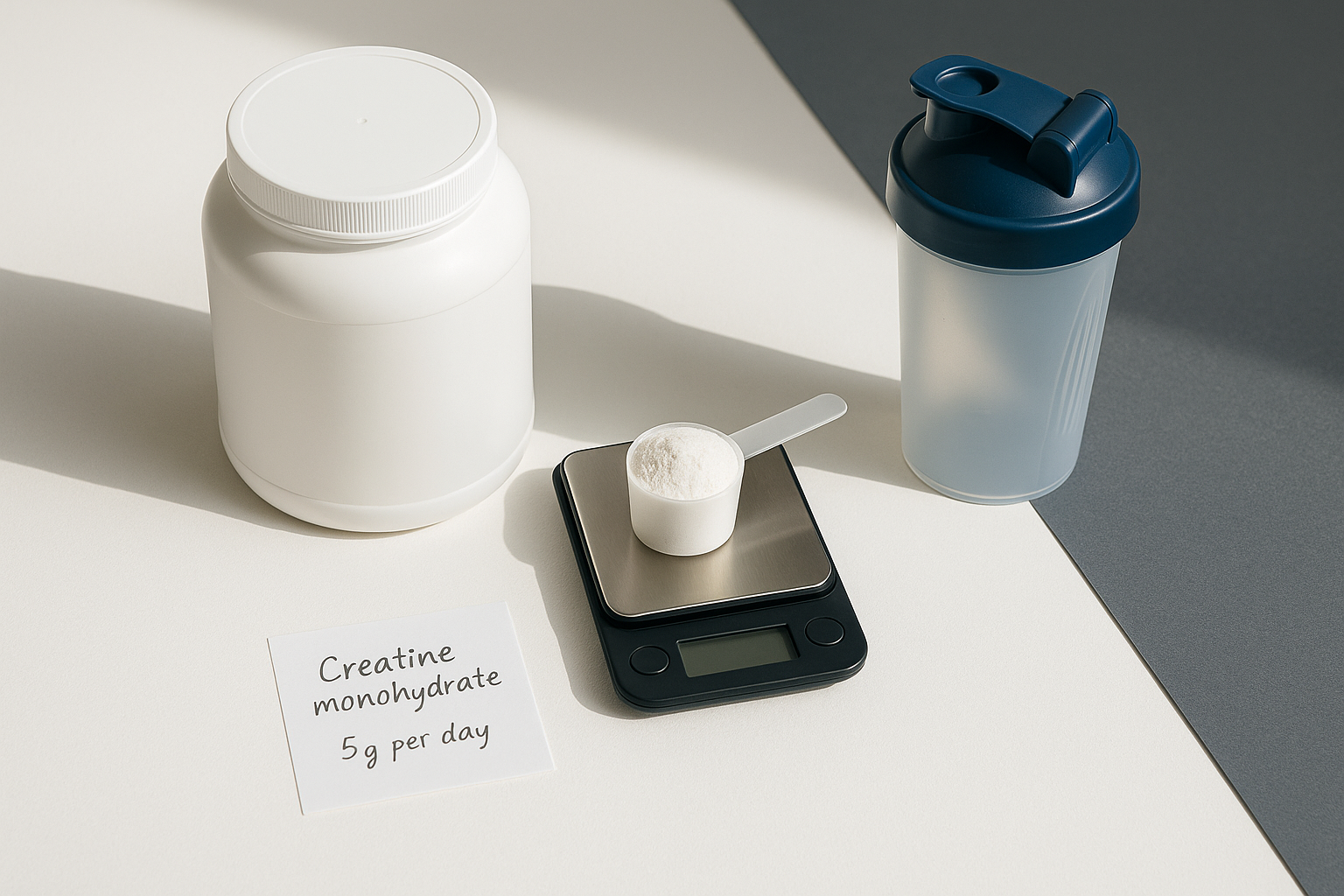
The easiest way for a dancer to start creatine is to choose plain monohydrate, take 3–5 g daily, keep hydration normal, and judge results over at least 3–4 weeks instead of day by day. That simple approach avoids most beginner mistakes.
- Choose the right product. Buy a straightforward creatine monohydrate powder with minimal added ingredients. In Canada, look for an NPN, which is the Natural Product Number used on licensed natural health products, and consider third-party testing if you compete or work in environments sensitive to contamination. Our creatine product catalog and creatine brand reviews can help shortlist options.
- Pick your dose. Start with 3 g/day if you are cautious about scale weight or digestion. Start with 5 g/day if you just want the standard evidence-based dose. No cycling is required.
- Take it consistently. Mix it into water, a smoothie, or a post-class shake. Timing is flexible, but attaching it to a habit is smart: breakfast, post-rehearsal, or evening meal all work. If you want deeper timing guidance, see when to take creatine.
- Track the right outcomes. Over 2–6 weeks, note jump quality late in class, how your legs feel during repeated runs, your gym numbers, and how well you hold movement quality under fatigue. Those are better markers than obsessing over the scale.
Here is a practical beginner example:
- 55 kg ballet student: 3 g daily with breakfast for 4 weeks, no loading.
- 68 kg contemporary dancer cross-training twice weekly: 5 g daily after training or with dinner.
- 82 kg musical theatre performer entering intensive rehearsals: optional loading for 5–7 days, then 5 g daily.
For week-by-week expectations, a no-loading plan usually feels subtle in week 1, more noticeable in weeks 2–4, and fully established by roughly week 4. A loading plan can feel faster, often within the first week, but again may bring a quicker water-weight shift.
What not to do: dry scoop it, constantly switch brands and forms, skip it on rest days, or quit after five days because you do not feel a stimulant-like kick. Creatine is a saturation supplement, not a buzz. If you want a full beginner walkthrough, read how to take creatine and creatine for beginners.
Best timing for dancers, plus loading, rest days, and audition-season strategy
The best time for dancers to take creatine is simply the time they will remember every day, because total daily intake and muscle saturation matter far more than exact timing. Taking it before class, after rehearsal, or with a meal are all fine.
Some athletes prefer post-training use because it is easy to pair with an existing routine. Others take it at breakfast so they never forget. Both approaches work. The evidence does not support obsessing over a tiny anabolic window for creatine the way supplement marketing often suggests.
What does matter is whether you want rapid saturation. If you have a demanding rehearsal block starting next week, a loading phase can make sense. If you are entering audition season or costume fittings and do not want a sudden change in scale weight or muscle fullness, skip loading and take a steady daily dose instead.
Use this decision guide:
- Need benefits sooner: load at 20 g/day split into 4 doses for 5–7 days, then maintain with 3–5 g/day.
- Want the lowest-drama approach: take 3–5 g/day with no loading and wait about 3–4 weeks for full effect.
- On rest days: keep taking the same daily dose. Muscle creatine stores stay elevated through consistency, not workout-only use.
- During deloads, school breaks, or lighter rehearsal weeks: keep taking it unless you have a specific reason to stop.
For dancers trying to time creatine around performance periods, a useful rule is this: do not experiment for the first time a few days before a show. Trial it in a regular training block first so you know whether you personally notice any temporary water retention, digestion issues, or no issues at all. Once you know your response, using it around peak periods becomes far easier.
If you are mixing creatine with other staples, it combines easily with protein powder, milk, coffee, or a simple meal. None is required, but all are workable. More detailed timing and stacking guidance is covered in creatine on rest days and whether to take creatine with or without food.
In short: take it daily, don’t overthink the clock, and choose loading only when speed matters more than avoiding a temporary water-weight shift.
Will creatine make dancers look bulky, puffy, or heavier? The honest answer
Creatine can increase body weight slightly in some dancers at first, but that early change is usually water stored inside muscle, not fat gain, and it does not automatically mean a bulky look. This is the section most dancers care about, and the nuance matters.
Creatine pulls more water into muscle cells as muscle creatine stores rise. That intracellular water can slightly increase scale weight and sometimes make muscles feel a bit fuller. This is not the same as subcutaneous "soft" puffiness, and it is not the same as body fat. For many people the change is modest; for others it is more noticeable, especially with loading.
Whether this is helpful or unwanted depends on context:
- Helpful: stronger gym work, more robust legs, better repeat power, and sometimes a fuller athletic look.
- Less welcome: dancers highly sensitive to costume fit, line aesthetics, or psychological stress from even minor scale changes.
Importantly, creatine alone does not "bulk" you like a bodybuilding phase. Significant muscle gain requires progressive training, adequate calories, and time. A dancer doing high-volume technique classes with modest resistance training is not going to wake up suddenly looking like a bodybuilder because of 5 g of creatine monohydrate.
The 2021 JISSN review on common questions and misconceptions about creatine addresses many of these fears directly: creatine is widely misunderstood, and many popular claims about bloating, cramps, dehydration, or inevitable bulk are exaggerated or unsupported.
If aesthetics are your main concern, here is the practical playbook:
- Start at 3 g/day, not a loading phase.
- Trial it in an off-peak training block, not right before auditions.
- Judge mirror, performance, and costume feel together—not scale weight alone.
- Adjust expectations: a small increase in muscle water can coexist with better power and no meaningful change in appearance.
For a fuller deep dive, read does creatine make you gain weight, does creatine cause bloating, and does creatine make you look bigger. For most dancers, the realistic answer is this: creatine may make the scale go up a little at first, but it does not inherently ruin aesthetics, and careful dosing usually keeps the trade-off manageable.
Safety for dancers: side effects, hydration, kidneys, cramps, and who should ask a clinician first
Creatine monohydrate is generally considered safe for healthy adults when used at standard doses, and the strongest concerns dancers hear about kidneys, dehydration, cramps, or hair loss are often overstated or misunderstood. That does not mean every claim online is false, but it does mean safety should be judged by actual evidence, not gym folklore.
The ISSN position stand and mainstream medical summaries such as the Mayo Clinic creatine overview support creatine's safety profile in healthy people at recommended doses. Common minor side effects are usually practical rather than dangerous:
- Stomach upset: more likely with large single doses or poor mixing.
- Temporary water-weight increase: common early, especially with loading.
- Grittiness or mild GI discomfort: often solved by smaller doses or better dissolution.
Creatine does not appear to dehydrate healthy users when hydration is otherwise adequate, and the idea that it automatically causes cramps has not held up well. Dancers should still hydrate sensibly because dance training itself is dehydrating, especially in hot studios under stage lights, but creatine is not a reason to panic-drink litres of water.
Kidney concerns need precision. Creatine can increase creatinine, a breakdown product often measured on blood tests, and that can confuse interpretation because creatinine is also used as a kidney marker. A higher creatinine blood test after starting creatine does not automatically mean kidney damage. Healthy dancers are usually fine, but anyone with known kidney disease, a history of serious renal issues, or clinician-directed fluid restrictions should ask their physician before supplementing.
Also ask a clinician first if you are:
- Pregnant or breastfeeding
- Managing significant kidney disease
- Taking medications that affect kidney function or fluid balance
- Under 18 and wanting sport-specific guidance from a qualified adult team
For troubleshooting, split the dose, take it with food, or use 3 g/day instead of 5 g/day if digestion is touchy. More detail is in is creatine safe, creatine and kidneys, and creatine digestive side effects.
The practical bottom line: healthy dancers using standard doses of creatine monohydrate generally have a strong safety margin, but smart screening and sensible dosing still matter.
Common creatine myths in dance culture, and what the evidence actually says
The biggest creatine mistake dancers make is rejecting it based on aesthetic myths instead of matching the supplement to their actual performance demands and response. Dance culture often amplifies fear of scale weight and downplays legitimate athletic fuelling tools.
Here are the myths worth clearing up directly:
- "Creatine is only for bodybuilders." False. Creatine supports rapid ATP regeneration, which matters in any activity with repeated high-intensity efforts, including dance.
- "Creatine will make every dancer bulky." False. Creatine may increase intracellular water and support training quality, but major size gain still depends on training volume, calories, and time.
- "You must load or it won't work." False. Loading works faster, but daily 3–5 g use also works.
- "You only take it on training days." False. Rest-day use helps keep muscle stores saturated.
- "Creatine is a steroid." False. It is a naturally occurring compound involved in cellular energy, not an anabolic steroid.
- "Creatine damages healthy kidneys." Unsupported in healthy users at standard doses, though people with kidney disease need medical guidance.
- "It causes dehydration and cramps." Not supported as a general rule in healthy users.
A subtler myth in the dance world is that if a supplement causes any water retention, it is automatically performance-negative. That is too simplistic. Some intracellular water gain may be part of how creatine supports better training capacity. The real question is whether the performance benefit outweighs the aesthetic cost for that dancer, in that season.
Another common mistake is buying expensive alternative forms because they promise less bloating, better absorption, or a smaller dose. In reality, creatine monohydrate remains the most validated form by a large margin. Fancy forms often market around insecurities rather than outperforming the standard.
If you want a myth-by-myth breakdown, visit creatine myths debunked and creatine myths vs. facts. If you think creatine is not working, the usual issues are inconsistent use, stopping too soon, underdosing, or expecting a stimulant-like feeling. Dancers should evaluate creatine by rehearsal quality, repeat power, and gym support—not by whether they feel an instant buzz.
Well-used creatine is boring in the best way: simple, proven, and more useful than its reputation in aesthetic sports would suggest.
What to buy in Canada: the best creatine form, labels to check, and when certification matters
The best creatine for dancers in Canada is usually a plain creatine monohydrate powder from a reputable brand, ideally with an NPN and, where relevant, third-party testing for sport. You do not need a proprietary blend, stimulant stack, or expensive designer form.
Why monohydrate? Because it is the most studied, most consistently effective, and usually the cheapest per effective gram. Newer forms such as HCl, buffered creatine, nitrate, gummies, or liquids may be convenient for some users, but they have not displaced monohydrate as the evidence leader.
| Option | Best for | Pros | Cons |
|---|---|---|---|
| Creatine monohydrate powder | Most dancers | Best evidence, cheapest, flexible dosing | Needs mixing, may feel gritty |
| Micronized monohydrate | Dancers who dislike texture | Same core ingredient, often mixes a bit better | Sometimes slightly pricier |
| Capsules | Travel and convenience | No mixing, easy on the go | More expensive, many capsules needed for full dose |
| Gummies or flavoured specialty products | Taste-first users | Convenient, palatable | Often costly per gram, may underdose per serving |
Canadian buyers should check for:
- NPN: a Natural Product Number indicating the product is licensed for sale as a natural health product in Canada.
- Serving size clarity: does one scoop actually deliver the grams you need?
- Minimal extras: plain monohydrate is usually enough.
- Third-party testing: useful for competitive or drug-tested performers; look for programmes such as NSF Certified for Sport or Informed Sport where relevant.
Dancers in company settings or crossover athletic environments should care more about contamination risk than casual consumers do. Creatine itself is not banned, but poor manufacturing can be a problem in any supplement category.
To compare options, see our best creatine rankings, best creatine monohydrate in Canada, and third-party tested creatine in Canada. If you want individual brand breakdowns, our brand reviews are the fastest shortcut.
The buying rule is simple: for dancers, boring usually wins. Plain monohydrate from a reputable Canadian-legal product is the highest-confidence choice.
What results dancers can realistically expect in the first 8 weeks
Dancers should expect creatine to feel subtle but meaningful, with the most realistic early wins being better repeated power, slightly stronger gym sessions, and less performance drop-off late in class or rehearsal rather than a dramatic overnight transformation. If your expectations are realistic, creatine is easier to judge fairly.
Here is a practical timeline for a dancer using 3–5 g/day without loading:
- Week 1: usually little to feel directly; some people notice mild water-weight change, many notice nothing.
- Weeks 2–3: hard combinations may feel a bit more repeatable, and gym numbers may improve slightly.
- Weeks 4–6: muscle stores are typically better saturated, and benefits are easier to notice in repeated jumps, training density, and fatigue resistance.
- Weeks 6–8: the value often shows up in accumulated training quality, not just single-session sensations.
With a loading phase, that timeline compresses, often bringing earlier saturation within about a week.
How do you know creatine is working for dance?
- Your jump height or takeoff quality fades less across repeated runs.
- You recover a little better between explosive phrases.
- Your supplemental strength work improves gradually.
- You maintain leg power later in rehearsals.
- You feel less "flat" in demanding training blocks.
What creatine probably will not do by itself:
- Instantly improve flexibility or turnout
- Replace conditioning, strength training, or fuelling
- Cause obvious physique changes in a week
- Act like caffeine or a pre-workout
If you notice nothing after 4–6 weeks, ask the obvious questions first: Are you taking it daily? Is the dose adequate? Are you using monohydrate? Are your main demands actually explosive enough to reveal an effect? Are you eating and recovering enough to take advantage of better training quality?
For many dancers, creatine's real payoff is cumulative. Better strength sessions, less power drop-off, and more productive training over a semester or performance season matter more than a dramatic first impression. If that appeals to you, it is doing exactly what a good foundational supplement should do.
Bottom line: when creatine is worth it for dancers and when it may not be
Creatine is worth it for dancers when performance depends on explosive effort, repeated high-intensity phrases, hard rehearsal blocks, or supplemental strength training, and it may be less attractive when even a small temporary increase in water weight is unacceptable right now. That is the honest decision framework.
For most performing arts athletes, creatine monohydrate is one of the few supplements with a deep evidence base, a clear mechanism, and a realistic chance of helping actual performance. It is especially relevant for ballet dancers with demanding allegro and partnering, contemporary dancers with athletic floorwork and repeated phrases, musical theatre performers balancing choreography and stamina, and any dancer who uses resistance training to support longevity and injury resilience.
Use creatine if you want:
- Better support for jumps and repeated explosive efforts
- Improved gym training quality that can transfer to dance
- A low-cost, well-researched supplement with simple daily use
- A gradual performance edge rather than a stimulant effect
Be more cautious or strategic if you are:
- Days away from an audition, shoot, show, or costume fitting
- Extremely scale-sensitive and unwilling to tolerate any early fluctuation
- Managing kidney disease or another medical reason to seek clinician advice first
If you decide to try it, the simplest evidence-based protocol is 3–5 g creatine monohydrate daily, every day, for at least 4 weeks. Skip loading if aesthetic concerns are high. Keep expectations grounded in performance markers, not internet myths.
For the next step, use our creatine dosage calculator, compare options in the product catalog, or learn how long results take in how long creatine takes to work. The final takeaway is simple: creatine and dance performance are compatible, and for many dancers the real question is not "Does it work?" but "Is this the right phase of training for me to use it strategically?"
Creatine for Dancers: the numbers that matter
- 3–5 g/day Standard daily creatine dose for most dancers — Creatine monohydrate, taken every day
- 20 g/day Typical loading dose — Split into 4 doses for 5–7 days if faster saturation is needed
- 5–7 days Time to saturate with loading — Versus several weeks with a no-loading approach
- 0.03 g/kg/day Body-weight maintenance rule — A useful guideline after loading or for estimating long-term intake
Frequently Asked Questions
Is creatine good for dancers?
Yes, creatine can be good for dancers, especially those who need explosive jumps, repeated high-intensity phrases, strong rehearsals, or better gym cross-training. It is most useful when dance demands repeated bursts of power rather than purely steady aerobic work. Most dancers do best with creatine monohydrate at 3–5 g daily.
Does creatine help ballet dancers jump higher?
Creatine may help ballet dancers improve jump-related performance by supporting rapid ATP regeneration during explosive takeoffs and repeated efforts. It is not a magic jump supplement, but it can help maintain power across repeated allegro work and support strength training that improves jump capacity over time.
Will creatine make a dancer gain weight?
Creatine can make a dancer gain a small amount of early weight, but it is usually water stored inside muscle rather than fat. That change is often more noticeable with a loading phase than with a slower 3 g/day start. It does not automatically mean a bulky look or loss of line.
Is creatine for contemporary dance worth it?
Yes, creatine for contemporary dance can be worth it when choreography includes athletic floorwork, rapid transitions, repeated full-out phrases, or supplementary strength training. Contemporary dance often blends endurance with repeated bursts, which is exactly the type of demand creatine supports best.
What is the best creatine for dancers?
The best creatine for dancers is usually plain creatine monohydrate powder from a reputable brand. It has the strongest evidence base, the best value, and the simplest dosing. In Canada, look for an NPN and consider third-party testing if you perform in competitive or drug-tested settings.
Should dancers load creatine or just take 3–5 grams daily?
Most dancers can skip loading and simply take 3–5 g daily, especially if they want to minimise temporary water-weight changes. Loading at 20 g/day for 5–7 days works faster, but it is optional. The best protocol depends on whether speed or aesthetics matters more in your current training phase.
Does creatine make dancers bulky?
No, creatine does not automatically make dancers bulky. It can increase muscle water content and support better training, but noticeable muscle size gains still depend on training style, calorie intake, and time. For many dancers, any appearance change is small or not visually obvious.
Can female dancers take creatine safely?
Yes, healthy female dancers can generally take creatine safely at standard doses such as 3–5 g daily. Creatine is not a men-only supplement, and its main concerns are usually practical, like mild water-weight change or digestion, rather than unique safety issues for women.
When should dancers take creatine?
Dancers should take creatine at any time they can do it consistently every day. Before class, after rehearsal, or with a meal are all fine. Consistency matters much more than exact timing because creatine works by building and maintaining muscle saturation over time.
Can dancers take creatine during audition season?
Yes, dancers can take creatine during audition season, but a slow daily dose is usually smarter than loading if appearance or scale weight is a concern. The safest strategy is to test creatine in a normal training block first, so you know how your body responds before a high-pressure period.